deployments

Russia Building New Infrastructure For Major Troop Deployments Along NATO’s Northern Flank

In another indication of the growing military and economic importance of the Arctic, Russia and NATO are increasing their buildup of forces and facilities in the region. Recent media investigations found that Russia is constructing new bases near Finland to eventually house tens of thousands of troops while NATO on Saturday stood up a long-planned new battalion battlegroup. It is a force that will operate in Finland and Sweden as a deterrent against Russia.

TWZ has frequently reported how Russia, and to a lesser extent China, have moved aggressively to assert their presence in the High North, leaving the U.S. and its NATO allies looking to bolster their defenses.

While Russia remains totally bogged down and suffering high attrition in Ukraine with little chance of moving masses of troops to the Arctic at the moment, concern over the future has spurred NATO to bolster its presence along the Finnish border. Having moved to a wartime economy during the full-on conflict with Ukraine, Russia could leverage that in a post-Ukraine war future to threaten NATO’s borders.

A NATO official told us Friday morning that while the alliance assesses that the chances of a near-term conflict are low given the war in Ukraine, “Moscow could seek to expand westward into the Nordic and Baltic nations after a ceasefire with Ukraine.”

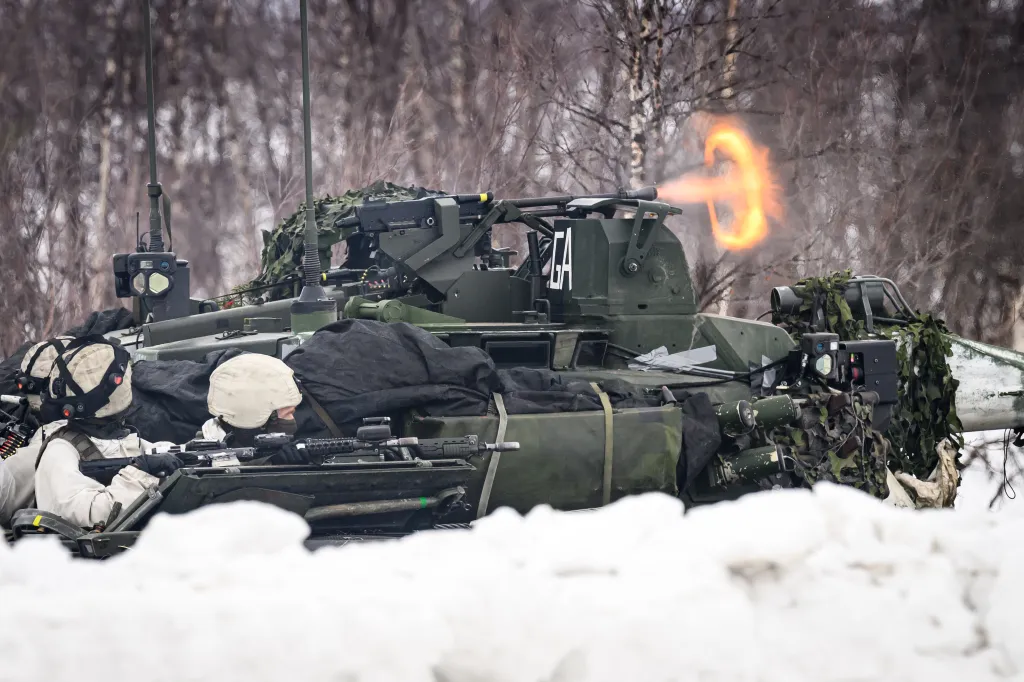
KIVILOMPOLO, FINLAND - MARCH 09: Swedish soldiers take part in an exchange of fire with "enemy troops" using blan rounds during a training exercise, visible to the media, on the Finland/Norway border during the Nordic Response military exercise on March 09, 2024 in Kivilompolo, Finland. The exercise, which primarily takes place across Scandinavia from March 3-14, features 20,000 troops from 13 allied countries. Following the recent NATO expansion, the group now includes Finland and Sweden. (Photo by Leon Neal/Getty Images)
Swedish soldiers take part in training on the Finland/Norway border during the Nordic Response military exercise on March 09, 2024 in Kivilompolo, Finland. (Photo by Leon Neal/Getty Images) LEON NEAL

Russia appears to be investing in infrastructure in preparation of such a contingency. A joint report by several Nordic and Baltic media outlets published earlier this week has found that Russia is expanding military facilities along its borders with Norway and Finland to accommodate tens of thousands of new troops.

“New satellite images show that Russia is increasing its armament in [the] vicinity,” the report stated. “SVT, together with media partners in several countries, has examined how Russia is preparing for 80,000 soldiers… It is a threat that we should take seriously, says Thomas Nilsson, head of Sweden’s military intelligence service (MUST).”

The images “show new barracks for thousands of soldiers, long lines of military vehicles and ammunition storage,” the report further noted. “All winter, Russia has been building new military structures in several places on the other side of the Finnish border.”

“We expect to have 80,000 soldiers on our border and that can be compared to the fact that we previously had 20,000,” Finnish Army Chief Pasi Välimäki told the joint investigation.

A separate report by the Finnish Yle media outlet found that the Russians are expanding a base in the town of Novaya Vilga to hold as many as 6,000 Russian troops. It is located about 100 miles east of the Finnish border.

“NATO has monitored a buildup of military infrastructure in Russia along NATO’s Eastern Flank, particularly along Finland’s border,” the NATO official told us earlier this week. “The real question is what becomes of the infrastructure? Will, for example, Russian troops now in Ukraine be relocated there after the war? It’s something we certainly need to consider, and we do.”

“That’s why NATO and nations are working to deliver real military capabilities to the alliance now, not five to ten years from now, which is so very, very important,” the official added.

KIVILOMPOLO, FINLAND - MARCH 09: A Swedish soldier takes part in an exchange of fire with "enemy troops" using blank rounds during a training exercise, visible to the media, on the Finland/Norway border during the Nordic Response military exercise on March 09, 2024 in Kivilompolo, Finland. The exercise, which primarily takes place across Scandinavia from March 3-14, features 20,000 troops from 13 allied countries. Following the recent NATO expansion, the group now includes Finland and Sweden. (Photo by Leon Neal/Getty Images)
A Swedish soldier takes part in a training exercise during the Nordic Response military exercise on March 09, 2024, in Kivilompolo, Finland. LEON NEAL

One of those efforts, as we noted earlier in this story, was stood up on Saturday, involving NATO’s two newest members.

NATO’s Forward Land Forces (FLF) Finland began operations in Finland and Sweden, according to the alliance. The FLF will include NATO’s newest multinational battlegroup, led by Sweden, “to support the defense of NATO’s northeastern flank.”

The establishment of FLF Finland places a Swedish battlegroup based in Boden, Sweden, and a Multinational Staff Element in Rovaniemi, Finland, under the command of the Supreme Allied Commander Europe (SACEUR) and NATO.

The NATO Forward Land Forces Finland has been established on June 6, 2026, in Boden, Finland. General Markus Laubenthal, SHAPE Chief of Staff, assumed Command of the Swedish Regiment in presence of the Swedish Minister of Defence Pål Jonson. The FLF Finland will be the 9th FLF in SACEURs AoR. NATO Photo by OR-7 Dennis Sattler
The NATO Forward Land Forces Finland (FLF) was established on June 6, 2026. (NATO Photo by OR-7 Dennis Sattler) MSgt OR-7 Dennis Sattler; DEU Army

“Sweden is contributing a battalion battlegroup that, together with a Multinational Staff Element in Rovaniemi, will form the core of FLF Finland,” NATO added. “The Swedish battalion battlegroup is prepositioned in Boden, with capacity to operate in the North Calotte and, where necessary, rapidly reinforce the presence in northern Finland. In 2026, Sweden’s contribution to FLF Finland will total around 600 personnel, with the option to expand to 1,200 personnel if needed.”

“This region is one of the most strategically significant and environmentally challenging areas in the world,” said U.S. Air Force Gen. and SACEUR Alexus G. Grynkewich. “FLF Finland, just like Arctic Sentry, will leverage NATO’s strength to defend our territory and ensure the Arctic and High North remains secure, especially considering Russia’s military activity and China’s growing interest there.”

Activated: NATO Multinational Battlegroup (FLF Finland) thumbnail

Activated: NATO Multinational Battlegroup (FLF Finland)


The U.S. too is working to improve its presence and operations in the region. During last month’s SOF Week symposium in Tampa, Florida, the head of U.S. Northern Command (NORTHCOM) announced the formation of Nordic Bridge to “tie together” the work of U.S. European Command, North American Aerospace Defense Command (NORAD) and SACEUR.

Air Force Gen. Gregory Guillot provided no real details about Nordic Bridge at the time, so we reached out to NORTHCOM for additional details.

“The Nordic Bridge concept seeks to enhance Arctic integration between U.S. Northern Command and U.S. European Command and enhance cooperation between NORAD and NATO in order to expand domain awareness, strengthen deterrence, and improve interoperability,” a NORTHCOM spokesperson told us last month. “It envisions increased participation in each other’s training and exercises, increased data sharing (such as air pictures), deconflicting conferences to maximize personnel availability and participation, etc.”

Last month, Guillot visited Grynkewich “to discuss opportunities under this concept,” the NORTHCOM spokesperson told us.

U.S. Marine Corps Lance Cpl. Thomas Teague, a motor vehicle operator assigned to Combat Logistics Battalion 6, Combat Logistics Regiment 2, 2nd Marine Logistics Group, provides security for a convoy during offensive and defensive operations in Syndalen, Finland during exercise Freezing Winds 23 (FW23), Nov. 30, 2023.  FW23 is a Finnish-led maritime exercise in which United States Marines assigned to Marine Rotational Force- Europe, and U.S. Navy Forces Europe take part; the exercise serves as a venue to increase Finnish Navy readiness, increase U.S., Finland, and NATO partners' interoperability in operational logistics, integrated fires, and amphibious operations within the Baltic Sea littorals. (U.S. Marine Corps photo by Lance Cpl. Christian Salazar)
U.S. Marine Corps Lance Cpl. Thomas Teague, a motor vehicle operator assigned to Combat Logistics Battalion 6, Combat Logistics Regiment 2, 2nd Marine Logistics Group, provides security for a convoy during offensive and defensive operations in Syndalen, Finland during exercise Freezing Winds 23 (FW23), Nov. 30, 2023. (U.S. Marine Corps photo by Lance Cpl. Christian Salazar) Cpl. Christian Salazar

All this is taking place, of course, against the backdrop of President Donald Trump’s frequent insistence that the U.S. subsume Greenland to provide better Arctic protection for the U.S. homeland. The issue reached a fever pitch earlier this year, causing a serious rift with NATO after the president threatened to invade the world’s largest island. You can read more about that in our story about the crisis here.

While there are no indications that the Arctic region is about to break out into open conflict, there are several indications that Russia, NATO and the U.S. are increasing preparations for such an eventuality.

Contact the author: howard@twz.com

Howard is a Senior Staff Writer for TWZ. He writes frequently about conflict, focusing heavily on the Middle East and Ukraine, and interviews with military and intelligence officials and industry leaders from around the globe. He lives near Tampa, Florida, home of U.S. Central Command, U.S. Special Operations Command.


Source link

Pentagon halts deployments to Poland and Germany to cut troop numbers in Europe, AP sources say

The Pentagon is drawing down thousands of troops in Europe by canceling deployments to Poland and Germany as opposed to yanking forces already stationed there, U.S. officials say, as President Trump has tussled with allies over the Iran war and called for changes.

Several U.S. officials confirmed that 4,000 troops from the Army’s 2nd Armored Brigade Combat Team, 1st Cavalry Division were no longer en route to Poland this week. The Trump administration had previously said it was cutting U.S. forces only in Germany, and the decision spurred questions and criticism in both Warsaw and Washington.

Two officials told the Associated Press that the deployments were canceled after Defense Secretary Pete Hegseth signed a memo directing the Joint Chiefs of Staff to move a brigade combat team out of Europe. One of them said the choice of which unit was left to military leaders.

Besides the Army combat team based in Fort Hood, Texas, the memo also led to the cancellation of an upcoming deployment to Germany of a battalion trained in firing long-range rockets and missiles, according to the two officials, who like the others spoke on condition of anonymity to discuss sensitive military operations.

Three U.S. officials said the changes were part of an effort to comply with a presidential order issued at the beginning of May to reduce the number of troops in Europe by about 5,000. The reasoning does not appear to have been well communicated because others based in Europe said they did not know if the halted deployment to Poland was part of the previously announced reduction.

Trump and the Pentagon have said in recent weeks that they were cutting at least 5,000 troops to Germany after Chancellor Friedrich Merz said the U.S. was being “humiliated” by the Iranian leadership and criticized Washington’s lack of strategy in the war.

The drawdown reflects a growing rift between the administration and traditional European allies, with the U.S. leader repeatedly criticizing fellow NATO members for a lack of support for the Iran war.

Polish officials on Friday insisted that the U.S. withdrawal was not targeted directly at Poland but was a consequence of Trump’s decision to reduce the number of troops in Germany.

Polish Prime Minister Donald Tusk said he “received assurances” that the decision was of a logistical nature and said it does not directly affect deterrence capabilities and Poland’s security.

Military officials say the decision to halt unit to Poland made recently

Joel Valdez, a Pentagon spokesman, said, “the decision to withdraw troops follows a comprehensive, multilayered process” and he argued that it was “not an unexpected, last-minute decision.”

Speaking to Congress in a hearing Friday, Army Secretary Dan Driscoll and Gen. Christopher LaNeve, the Army’s chief of staff, told lawmakers that discussions around the halted deployment occurred over the last two weeks but noted the decision itself was made in the last couple days.

Republican Rep. Don Bacon of Nebraska said he spoke with Polish officials on Thursday and they noted they were “blindsided.”

The move also left many U.S. military personnel in Europe in the dark about how the Trump administration was reducing forces. A U.S. official based in Europe said a meeting was called with 20 minutes’ notice on Monday to discuss the cancellation of the deployment to Poland.

At that time, troops had already been sent to Poland and some, still in the U.S., were told shortly before departure not to travel to the airport, that official said. Another official said most of the Army unit’s equipment had already made it to Europe and was sitting in ports.

Change to troop deployment to Poland draws bipartisan criticism

The reductions drew criticism from Democratic and Republican lawmakers about the move sending the wrong signal both to allies and Russian President Vladimir Putin, whose forces this week have launched one of the deadliest attacks on the Ukrainian capital in the 4-year-old war.

At the House Armed Services Committee hearing Friday, LaNeve said he worked with U.S. Gen. Alexus Grynkewich, commander in Europe of both U.S. and NATO forces, after Grynkewich received the instructions for the force reduction.

“I’ve worked with him in close consultation of what that force unit would be, and it made the most sense for that brigade to not do its deployment in theater,” LaNeve said.

Bacon called the decision “reprehensible” and said it was “an embarrassment to our country what we just did to Poland.”

Republican Rep. Mike Rogers of Alabama, who chairs the committee, said the military is required to consult with lawmakers and that did not happen.

“So we don’t know what’s going on here,” Rogers said. “But I can just tell you we’re not happy with what’s being talked about.”

A State Department official said Friday at a security conference in Tallinn, Estonia, that the U.S. reductions in Europe were “right there in black and white” but also noted that “the U.S. isn’t going anywhere.”

“We’ll continue to work with the Pentagon and work with our partners to make sure we get the right fit and right mix of what’s happening here on the ground,” said Thomas G. DiNanno, U.S. undersecretary of state for arms control and international security.

NATO says the change in Poland won’t affect defense

With the halted deployments, the U.S. military presence in Europe will now be at pre-2022 levels, before Russia commenced its full-scale invasion of Ukraine, one U.S. official said.

European countries have been bracing for a U.S. reduction since Trump returned to the White House, with the administration warning that Europe would have to look after its own security, including Ukraine’s, in the future.

A NATO official said the U.S. decision to cancel its rotational deployment to Poland would not impact NATO’s deterrence and defense plans. Canada and Germany have increased their presence on the alliance’s eastern flank, which contributes to NATO’s overall strength, the official said, insisting on anonymity in line with NATO regulations.

Ben Hodges, former commanding general of U.S. Army Europe, said the move “reinforces the perception that the United States just does things without consultation with allies,” which ultimately “damages cohesion inside the alliance.” The decision would in the long run harm the U.S. defense industry as it reduces the trust of partners, he said.

Around 10,000 U.S. troops are typically stationed in Poland, the majority of them present in the country on a rotational basis. Only about 300 troops are permanently stationed in the country, according to the U.S. Congressional Research Service.

Polish officials had hoped they would be spared from any cuts as Poland spends the most in NATO on defense as a proportion of its economy — around 4.7% in 2025. Hegseth has called it a “model ally” in NATO for spending so much on defense.

When Poland’s conservative president, Karol Nawrocki, visited the White House in September, Trump said he didn’t intend to pull U.S. troops out of Poland. “We’ll put more there if they want,” Trump said at the time.

Toropin, Burrows, Finley and Ciobanu write for the Associated Press. Burrows reported from Tallinn, Estonia, and Ciobanu from Warsaw.

Source link