Depend

Did the outcome of World War II depend on the weather? Separating fact from fiction in ‘Pressure’

The success of D-day, a pivotal moment in World War II, partially hinged on the weather forecast. The Allied invasion of Normandy, France, on June 6, 1944, was planned for months as the American and British forces held practice operations in England.

Enormous efforts were made to mislead the Germans about what was coming. The operation was originally scheduled for June 5 but the day before, James Stagg, a meteorologist and group captain in the Royal Air Force, advised the American commander, Dwight D. Eisenhower, to wait for better conditions.

This lesser-known decision is the premise of “Pressure,” a new movie from filmmaker Anthony Maras. It’s an adaptation of David Haig’s play of the same name, in which the playwright himself portrayed Stagg. Haig, who co-wrote the “Pressure” screenplay with Maras, compares it to “The Imitation Game.”

“Some of these heroes who affect history from the sidelines just stay in the sidelines until somebody does research, discovers them lurking and finds they are so quietly heroic that it’s irresistible as a story,” Haig says, speaking via Zoom from London.

Haig began writing a version of the script shortly after the play debuted at the Royal Lyceum Theatre in Edinburgh in May 2014. It moved to the West End in 2018, and opened in North America at Toronto’s Royal Alexandra Theatre in 2023. Maras came onboard after making his 2018 film “Hotel Mumbai,” also based on a true story.

“When I first read the play and the script, I was bowled over by how, with this one decision, so many lives were changed,” Maras says, on a video call from Los Angeles. “Not just the lives of the men on the beach but throughout the Allied world. When you think of a war story, you think of men and now women on the field, but there is so much more to it behind the scenes.”

The film expands Haig’s play and includes additional characters and sequences, including the actual D-day invasion. It stars Andrew Scott as Stagg, Brendan Fraser as Eisenhower, Kerry Condon as Eisenhower’s secretary Kay Summersby, Chris Messina as U.S. Air Force meteorologist Irving P. Krick and Damian Lewis as senior British army officer Bernard Montgomery.

Both Haig and Maras strove to be as historically accurate as possible, even including archival footage from the war. “It is inevitably heightened, as any stage play or film is,” Haig says. “But it is very true.”

“It is absolutely as true as we could get it within the confines of a two-hour runtime,” Maras adds. “We took great lengths to try and be as accurate to the history but also to the deeper story as possible.”

Here’s what is true and what is dramatized in “Pressure.”

The importance of the weather

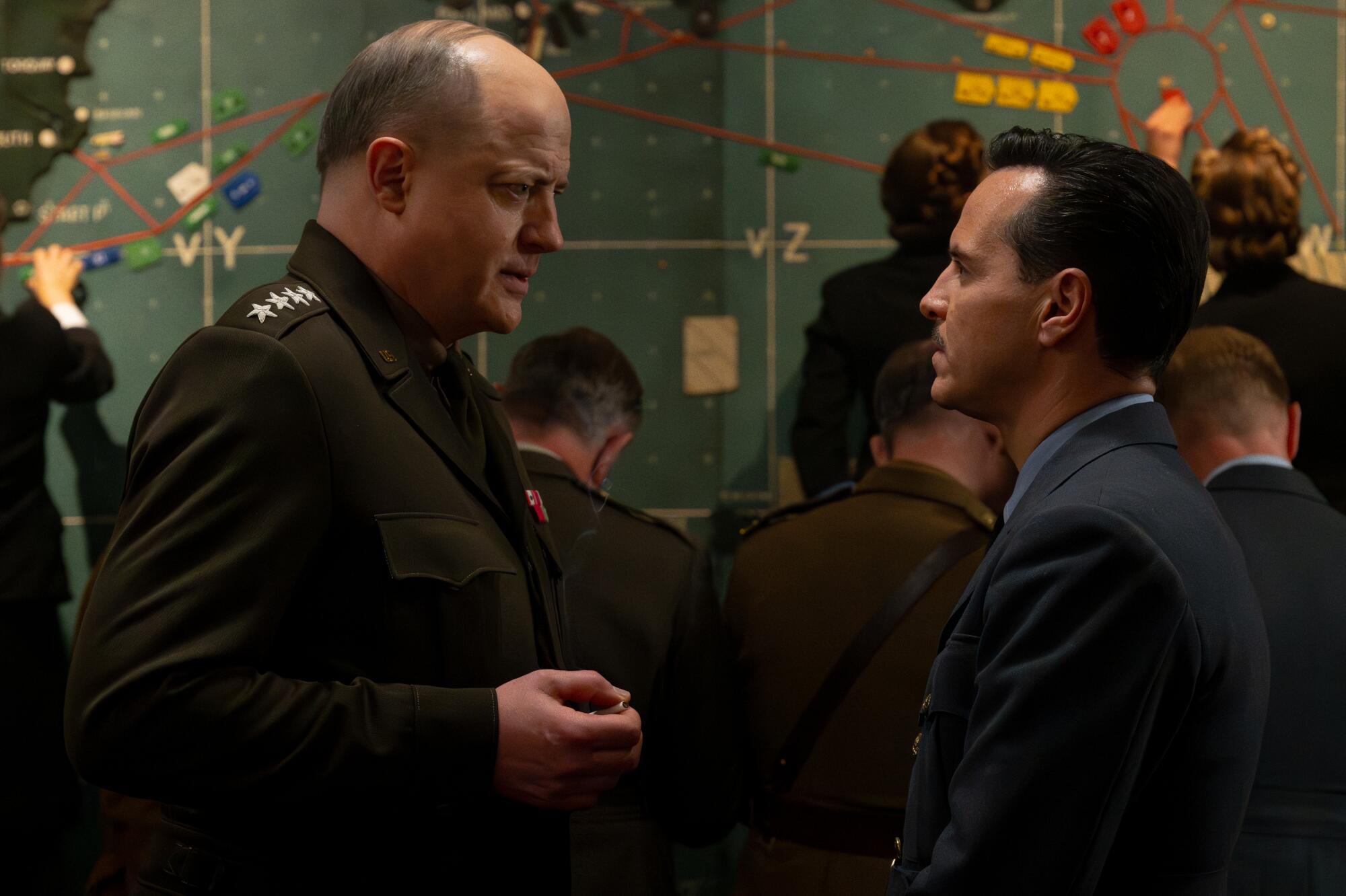
Two military men argue in a war room.

Brendan Fraser, left, and Andrew Scott in the movie “Pressure.”

(Alex Bailey / Focus Features / StudioCanal)

D-day, secretly known as Operation Overlord, was timed based on several factors, including the weather, the tides and the moonlight. Because the assault was multipronged, with Allied forces coming by sea, land and air, they required good visibility at night and a high tide to ensure less distances between the boats and the defending Germans.

“There were hundreds of meters between low tide and high tide,” Maras says. “So depending on where the boats landed, you either had 50 meters until you made it to the dunes and then the bunkers, or you had to make it 300 meters if it was low tide.”

A clear forecast with low winds and no rain was essential.

“The landing craft were antiquated and flat-bottomed,” Haig says, “and if they had gone on May 5 with the storms that Stagg anticipated coming in with the jet stream, those landing craft would have capsized. The war wouldn’t have been lost, although we do posit that it might have been in the film. In reality, failure would have elongated [the war] and caused countless extra deaths.”

To shoot “Pressure,” the filmmakers used real charts and meteorological instruments. The production design team re-created the famous D-day map from the Allied headquarters in Southwark House. The real one was made in two pieces by separate manufacturers to ensure secrecy.

“When you see that map, it’s a little bit mismatched and our team re-created that,” Maras says. “We got the paper they used to draw the maps from the same mill they used for those maps 80 years ago. A lot of effort was put into the minutiae that adds to the accuracy.”

Exercise Tiger

The film opens with a depiction of an Allied training operation called Exercise Tiger, which took place over several months on England’s Slapton Sands. Because many of the soldiers were young and untested, the Allied leaders wanted to prepare them for the sights and sounds of battle.

“They did a whole series of exercises to try and get together a full-scale dress rehearsal of what D-day would be,” Maras says.

These rehearsals, still widely unknown and spanning from late 1943 through April 1944, involved dangerous friendly fire and suffered from serious coordination errors, resulting in the real-life deaths of at least 700 American and British soldiers.

“That was an absolute disaster and yet we remember D-day as one of the great military triumphs in history,” Haig says.

Maras wanted the film to begin with this moment to emphasize the headspace of the Allied leaders.

“How do you establish what the true consequences of failure are for a story like this?” Maras says. “When we’re in the war room with all of those commanders and officers, they know what the implications of their words mean because they’ve seen it. They’ve lived it. The image of the blood in the water and the young men in that water was to tattoo in the audience’s brain that if these commanders mess up, this could happen again.”

Eisenhower, in particular, felt the magnitude of D-day. “He wrote two letters on the eve of D-day: what happens in success and what happens in failure,” Maras says. “He was sleeping two hours a night. He was a nervous wreck.”

Stagg vs. Krick

In the film, Scott’s Stagg arrives at Southwark House from Dunstable four days before D-day is planned. He is confronted by the American meteorologist Krick, who disagrees with him about the potentially disastrous forecast. Krick believes sun and calm seas are on the horizon thanks to historical analogue charts, but Stagg, using more comprehensive prediction methods, thinks a major storm is coming.

“In actuality, Stagg came onboard in about November 1943 and got to Southwark House a few months earlier,” Maras says. “His transfer came a few months earlier, not a few days earlier. The contours of the relationships between Stagg and Krick and the others are accurate, but they took place in a more compressed timeline.”

Both Stagg and Krick have recounted their version of events in various books, both claiming they were right about the weather. Although Haig and Maras imagine their dialogue and how these conflicts may have played out, the conflicts were real.

“They both adhered to their own meteorological vision,” Haig says, explaining the differences in prediction models from continent to continent. “In the United States, Krick’s system of weather forecasting was viable. If you come to the U.K., you can’t rely on the weather for more than five minutes, so that method doesn’t apply.”

Adds Maras, “They thought, ‘The weather is going to be good. We should hold our nerve and go.’ There was a rhetorically violent disagreement between him and the others.”

In the film, Krick claims that he has never inaccurately predicted the weather ahead of a battle, using his successes in North Africa as evidence. This was technically true.

“He was very good at his job within the context of certain geographical landscapes,” Haig says. “He didn’t make a mistake in North Africa. When Eisenhower challenges Stagg, he says, ‘This man never got it wrong.’ And he didn’t. In the whole of the North African campaign, Krick was spot on.”

After Stagg convinces the leaders to postpone D-day, he is vindicated by a deluge of rain that arrives while everyone is attending church at Southwark House on June 5. There was a church on site, although this moment in the film was dramatized.

“Whether it began raining precisely at that moment I have my doubts,” Haig says. “But it has the framework of truth.”

Ike and Kay

An officer stands next to a secretary.

Andrew Scott and Kerry Condon in the movie “Pressure.”

(Alex Bailey / Focus Features / StudioCanal)

Kay Summersby had been an ambulance driver during the Blitz. The film hints at a less-than-professional relationship between Eisenhower and his personal secretary. She was certainly with Eisenhower at Southwark House, although there is less evidence that she had any kind of association with Stagg.

“The biggest fictional thing I did with both the play and the film was to join the third point of the triangle so you’ve got Stagg, Eisenhower and Kay,” Haig says. “The link between Stagg and Kay historically would be tenuous.”

There are differing opinions about Eisenhower and Kay’s relationship. “We know that they were extremely close and they shared a trustful bond,” Maras says. “There are many photos of them together. She was definitely a big force in Ike’s life at that time, and we wanted to pay respect to that.”

“Whatever one’s interpretation of the relationships that she inhabits within the story, her influence was substantial,” Haig adds.

After seeing Peter Jackson’s 2018 World War I documentary “They Shall Not Grow Old,” Maras had the idea to use colorized archival footage in “Pressure.”

“In the D-day sequence at the end, there are various real-life shots of the soldiers landing on the beaches,” Maras says. “We were able to cut between the archival [material] and our footage to increase the scope. And it wasn’t just to get the scale. Yes, we have shots of massive flotillas and ships and trucks, but sometimes it was just for a glance of a soldier where you can see death in his eyes.”

The team ultimately acquired more than 50 hours of archival footage. They hired research editors to go through it and, after a few days, Maras asked if any of the editors could recommend additional crew to help.

Then a man named James Stagg showed up to work. “Stagg’s grandson, 80 years later, walked into our offices and helped edit the archival movie footage that we put in his grandfather’s film,” Maras says.

Stagg’s wife

A man waits on the phone for urgent news.

Andrew Scott in the movie “Pressure.”

(Alex Bailey / Focus Features / StudioCanal)

The play doesn’t include scenes with Stagg’s wife, Elizabeth, but Haig purposefully bookends the film with the couple together. “When he arrives at Southwark House as a terse, brusque, tricky man, you’ve already experienced his level of affection with his wife and that’s really important contextually,” Haig says. “You’re waiting for the end when he goes back to see her and the baby.”

At the time when Stagg went to Southwark House, his wife was pregnant. Stagg was not allowed to make phone calls to her because of the secrecy surrounding D-day. In reality, the hospital where she gave birth was not bombed, as it is in the movie.

“The bombing of the hospital was more reflective of the times that Stagg and his wife had gone through in the lead up to D-day,” Maras says. “That element is to encapsulate that Stagg was fearing for his wife. As he walks down this corridor, he is faced with: Is she alive? Is she dead?”

Truth to power

Ultimately, Stagg tells a room full of military leaders that they have to pause on D-day because of the weather — a truthful inclusion. It was important to Maras to emphasize how he stood up to power.

“Here’s a protagonist who’s not afraid to speak his mind and has the courage to get up in front of a room full of the most powerful military on Earth at that point and tell them something they don’t want to hear,” Maras says.

“When Eisenhower was passing on the baton of leadership at the inauguration for JFK, JFK asked, ‘What gave you the edge on D-day?’ Eisenhower said, ‘We had better meteorologists than the Germans.’ He had the wisdom to trust in the experts. It’s worth heeding that lesson from history.”

Source link

Naomi Osaka’s French Open fashion statements depend on wins to matter

“Dress shabbily and they remember the dress; dress impeccably and they remember the woman.” ― Coco Chanel

Apropos of Paris. Apropos of the French Open.

That’s all the context necessary to appreciate Naomi Osaka removing a ceremonial black skirt and sleeveless beaded bodice ahead of her opening match at the Roland-Garros Complex this week, revealing a sequined gold playing dress.

Osaka was playing all right. With sensibilities. With tradition. With her opponents, who she summarily dispatched with victories in the first and second rounds.

Naomi Osaka in a flowy pleated black skirt atop a shiny tennis dress, holding up a tennis racket

Naomi Osaka arrives on Court Suzanne-Lenglen to play her singles match against Laura Siegemund.

(THOMAS SAMSON/AFP via Getty Images)

And it was clear the four-time Grand Slam champion was playing with all of us when she said of her dress, “It’s very couture. You know the Eiffel Tower at night when it’s sparkly? I kind of think I look like that a little bit.”

Countless LinkedIn pages spout something about residing at the intersection of sport and fashion. Osaka locates that intersection at tennis tournaments worldwide, looks both ways and boldly steps into the street.

Last year at the U.S. Open she adorned her ponytail with red roses and attached a Labubu to her tennis bag that she named Billie Jean Bling.

At the Australian Open in January, she entered the court in a tie-dye turquoise and green palette with flowing tendrils. Her face was concealed by a veil, a wide-brim hat and a white parasol that she said was inspired by an image of a jellyfish that excited her 2-year-old daughter.

Naomi Osaka in a white wide-brimmed hat with a veil, white wide leg flowy pants and holds a white parasol with stairs behind

Naomi Osaka walking onto the court in a jellyfish-inspired ensemble ahead of her first-round match at the 2026 Australian Open in Melbourne.

(Quinn Rooney/Getty Images)

It’s all great fun. Yet continued fashion statements depend on her performance on the court. Osaka wins, she earns another grand entrance. She loses, nobody cares what she wears on the ride home.

At the U.S. Open, Osaka shined, reaching the women’s singles semifinals. Seeded as an also-ran at No. 23, she upset Coco Gauff and Karolina Muchova before falling in a tight three-set match to Amanda Anisimova.

Seeded No. 16 in Australia, she won two matches before withdrawing because of an abdominal injury suffered during her three-set victory against Sorana Cîrstea.

Fast forward to the French Open. Osaka advanced to the third round for the first time in seven years Thursday with a 7-6 (7/1), 6-4 win against Croatia’s Donna Vekic and will take on teenager Iva Jovic on Saturday.

What she will wear walking in is anybody’s guess. An effortless chic aesthetic courses through Paris. Advancing to the French Open round of 16 for the first time would require the opposite, Osaka toiling through another step in her return to form after giving birth to her daughter.

And creating another opportunity to have fun with fashion.

Source link

Marines Realize They Can’t Depend On Army For Ballistic Missile Defense

The U.S. Marine Corps is exploring the possibility of fielding a theater ballistic missile defense capability. A key driver in this discussion is the U.S. Army’s capacity to provide protection against ballistic threats in future conflicts, or lack thereof, something TWZ has highlighted repeatedly in the past. The latest conflict with Iran has underscored the serious threats that ballistic missiles pose even to high-end integrated air and missile defense networks, which would be magnified further in a fight against a near-peer adversary like China.

“We’re exploring theater ballistic missile defense. So we’re doing some studies, we’re running some simulations, to see if that’s a requirement for the service in the future,” Marine Lt. Col. Robert Barclay said during a panel discussion yesterday at the annual Modern Day Marine exposition, at which TWZ has been in attendance.

US Marine Corps Lt. Col. Robert Barclay seen speaking at the annual Modern Day Marine exposition on April 28, 2026. USMC

Barclay is currently the Marine Air Command and Control Systems (MACCS) Integration Branch Head within the Aviation Combat Element Division of the service’s Combat Development and Integration office. His portfolio includes service-wide air and missile defense requirements.

“We know our old sensor used to be able to do it, but it wasn’t really a requirement,” Barclay added. “What we need to determine is, is [defending against] a theater ballistic [missile] like an SRBM [short-range ballistic missile] or MRBM [medium-range ballistic missile], a requirement for the Marine Corps to do? I would argue that it probably is.”

“At the end of the day, I don’t think the Army’s going to have enough capacity with us where we’re operating to actually adjudicate on that threat,” he continued. “So, I think we need to take a hard look at that, and that’s what our intent [is] to do over the next year.”

To take a step back quickly, the Marine Corps’ main general-purpose ground-based anti-air weapon today is the Stinger short-range heat-seeking surface-to-air missile. The service currently fields Stinger in a man-portable air defense system (MANPADS) configuration using shoulder-fired launchers, as well as integrated on the Humvee-based Avenger air defense vehicles. Stinger offers a point defense capability against fixed-wing aircraft, helicopters, drones, and certain types of cruise missiles.

A Marine fires a Stinger missile from a man-portable launcher during training. USMC

The Marines also hope to reach initial operational capability this year with a new Medium-Range Intercept Capability (MRIC), which is a service-specific variation of the Israeli Iron Dome system. MRIC uses a U.S.-made version of Iron Dome’s Tamir interceptor, called SkyHunter, and a trailer-based road-mobile launcher. Each launcher can accommodate up to 20 interceptors, which come preloaded in individual canisters, at a time. The system uses offboard sensors to spot and track targets and cue missiles to intercept them. The Corps’ existing AN/TPS-80 Ground/Air Task-Oriented Radars (G/ATOR) have been presented as the primary sensor for MRIC.

A Marine Corps MRIC launcher on display loaded with a row of five launch canisters for SkyHunter interceptors. USMC/Cpl. Michael Bartman

“The primary target set for MRIC is cruise missiles and your higher-end Group 5-type of [anti-]air application, as well as rotary wing, fixed-wing type of aspects,” Marine Col. Andrew Konicki, the service’s Program Manager for Ground Based Air Defense and another panelist at Modern Day Marine yesterday, explained. MRIC “can go after Group 3, because it’s probably a mismatch in terms of ammunition versus what it’s going after. So it’s primarily focused on that growing threat, or that higher-end threat, so to speak, as part of that integrated air missile defense application and layer defense piece.”

Groups 3 and 5 here refer to different categories of uncrewed aerial systems. The U.S. military defines Group 5 as consisting of drones with maximum weights greater than 1,320 pounds, and that can fly above 18,000 feet. The MQ-9 Reaper is a commonly used example of a Group 5 uncrewed aircraft. Drones that fall under Group 3 have maximum weights anywhere between 56 and 1,320 pounds, can operate at altitudes between 3,500 and 18,000 feet, and reach top speeds of up to 250 knots. Group 3 is very broad, but notably includes Iran’s now-infamous Shahed 136 long-range kamikaze drone, and the growing number of variants and derivatives thereof.

Lt. Col. Robert Barclay’s mention of an unspecified previous Marine ballistic missile defense capability seems most likely to be a reference to the HAWK medium-range surface-to-air missile system. The service retired HAWK in the 1990s, but versions of the system remain in use elsewhere worldwide, including in Ukraine. HAWK has used an evolving mixture of radars for target acquisition and engagement since the system was first introduced in the 1950s, as you can read more about here. Improved HAWK interceptors have also been developed, including variants explicitly intended to offer a rudimentary anti-ballistic missile capability.

The video below shows HAWK systems in service in Ukraine.

Американський ЗРК HAWK (Яструб) захищає небо України! thumbnail

Американський ЗРК HAWK (Яструб) захищає небо України!


Barclay did not elaborate on what level of ballistic missile defense capability the Marine Corps might look to pursue in the future. In the past year or so, there have been reports of Israel using Iron Dome against incoming Iranian ballistic missiles in the terminal phase. However, the system’s effectiveness against ballistic missiles of any kind, which it was never designed to intercept, and whether the Marines might be able to employ MRIC in this role, is unclear.

Today, the main tool for providing ground-based theater ballistic missile defense across all of America’s armed forces is the Army’s Patriot surface-to-air missile systems. The Army also operates the Terminal High Altitude Area Defense (THAAD) system, which offers a higher-end ballistic missile defense capability over Patriot. Both Patriot and THAAD are only capable of intercepting incoming ballistic threats during their final terminal phase.

The PATRIOT Missile in Action thumbnail

The PATRIOT Missile in Action


At the same time, as TWZ has highlighted several times in recent years, the Army’s Patriot force is heavily strained due to constant demands that it is simply not adequately resourced to meet. The THAAD force is even smaller and is in equally heavy demand.

A THAAD interceptor is fired during a test. MDA

The latest conflict with Iran has reignited discussions about the Army’s worryingly limited capacity to meet operational needs for ballistic missile defense, as well as protection against other aerial threats. Between February and April, Iranian forces launched repeated missile and drone attacks on key bases across the Middle East. They were successful in many instances in targeting high-value military assets, including aircraft parked on the ground and air and missile defense radars.

📸 Al Jazeera shows heavily damaged AN/FPS-132 early warning radar at Al Udeid Air Base in Qatar, a key U.S. ballistic-missile detection system.

The AN/FPS-132 early-warning radar at Al Udeid Air Base in Qatar is a $1.1 billion U.S.-built missile-warning system that detects… pic.twitter.com/RcmvQff2Is

— Clash Report (@clashreport) April 10, 2026

The conflict with Iran also put a new spotlight on concerns about the depth of American stockpiles of air and missile defense interceptors, and the ability to replenish them quickly. Pressure on Patriot and THAAD units would be even more pronounced in a high-end fight, such as one across the broad expanses of the Pacific against China.

The Army has been trying to take steps to rectify these issues, including efforts underway now to expand the size and capabilities of the Patriot force. The U.S. military, overall, has been pushing industry to ramp up capacity to produce air and missile defense interceptors, as well as other critical munitions. At the same time, it will take years to fully achieve these aims.

Still, as Lt. Col. Barclay noted yesterday, questions about Army air and missile defense capacity remain, especially in the context of the Marine Corps’ broader vision for future operations. The service’s current core focus is on preparing for expeditionary and distributed operations involving the relatively rapid deployment and redeployment of forces between forward operating locations that could be well within reach of enemy standoff strikes. The Marines, like the other services, also have large established facilities that would need defending in any major conflict scenario.

The ballistic missile threat ecosystem is also not static. This is underscored by Iran’s recent use of ballistic missiles with cluster munition warheads, which are also designed to release their payloads at very high altitudes, as a way to consistently get around Israeli terminal defenses. TWZ previously explored the very serious broader implications of this in a feature you can find here.

One of the ballistic missiles launched by Iran at central Israel a short while ago carried a cluster bomb warhead, footage shows. pic.twitter.com/kaIdFcyKuj

— Emanuel (Mannie) Fabian (@manniefabian) March 24, 2026

China, in particular, continues to expand on its already diverse arsenal of ballistic missiles. Earlier this month, North Korea also notably tested a ballistic missile with a new cluster munition warhead. These developments are just some examples of a broader surge in ballistic missile developments globally in recent years. Those capabilities continue to proliferate to smaller nation-state militaries and even non-state actors.

“The purpose of the test-fire is to verify the characteristics and power of cluster bomb warhead and fragmentation mine warhead applied to the tactical ballistic missile.” pic.twitter.com/cem3NwYpAC

— Joseph Dempsey (@JosephHDempsey) April 19, 2026

Ballistic missiles would be only one part of the threat picture in any future high-end fight. The development of new hypersonic weapons, as well as advanced cruise missiles, continues worldwide. There has also been an explosion in the development and adoption of long-range one-way attack drones like the aforementioned Shahed 136, a trend that now also includes the United States.

“I would argue that the adversary is not just going to throw drones at you. We’re going to have other threats in the future,” Lt. Col. Barclay stressed during yesterday’s panel, which was focused primarily on ongoing efforts to counter uncrewed aerial threats. “You’re going to see probably TBM [theater ballistic missiles], ballistic missiles, coming at you as well in a variety of other types of threats.”

With all this in mind, a new, organic theater ballistic missile capability may now be on the horizon for the U.S. Marine Corps.

Contact the author: joe@twz.com

Joseph has been a member of The War Zone team since early 2017. Prior to that, he was an Associate Editor at War Is Boring, and his byline has appeared in other publications, including Small Arms Review, Small Arms Defense Journal, Reuters, We Are the Mighty, and Task & Purpose.


Source link