departure

Christine Lagarde ECB Departure: Key Takeaways

With Lagarde stepping down early, Europe must weigh experience and policy priorities in choosing a successor.

Christine Lagarde confirmed today at the European Central Bank’s policy press conference that she would step down as the bank’s president in February, nine months before her term ends in October 2027. She plans to remain in office until after the bank’s February 2027 policy meeting.

Her early departure has brought two leading contenders into focus as European leaders prepare to choose her successor.

Lagarde cited her desire to speak and engage freely on non-monetary policy matters, which the European Central Bank’s presidential neutrality does not allow.

“At this time, in relation to many corners of the world, not just Europe, I think that my voice can help,” she said. “My action can help in relation to principles that are dear to my heart. I don’t think I can be comfortable with that neutrality at the present time. And I’m interested in the truth, and I see the truth being very often damaged, contradicted by misrepresentation.”

Likely Successor

Whoever replaces Lagarde will likely come from the same background. Unlike her three predecessors, she is not a national central bank governor or a classic economist. Lagarde was a lawyer, government minister, and managing director of the International Monetary Fund.

Her political experience helped the European Central Bank, or ECB, when it needed to manage bond purchases and emergency lending to banks, and to provide oversight of various rescue programs with the IMF.

However, she did not have a strong track record of communicating inflation expectations to the market. During the ECB press conference on March 12, 2020, she triggered a market panic when she said that narrowing bond spreads was “not the function or business of the ECB.”

“My guess would be that going forward, whoever they pick, they’re going to want somebody who is better at that part of the job,” said Rebecca Christie, a senior fellow at economic think tank Bruegel. 

The two frontrunners are Spain’s Pablo Hernández de Cos and the Netherlands’ Klaas Knot.

Pablo Hernández de Cos is the general manager of the Bank for International Settlements, or BIS. Previously, he served as the governor of the Bank of Spain, was a member of the ECB’s Governing Council, and chaired the Basel Committee on Banking Supervision and the Advisory Technical Committee of the European Systemic Risk Board.

Klaas Knot is currently a visiting fellow at the Peterson Institute for International Economics. Knot served as president of De Nederlandsche Bank, chaired the Financial Stability Board, and served on the ECB’s Governing Council and General Council, the European Systemic Risk Board, the IMF’s Board of Governors, and the BIS Board of Directors.

“There are some other names in the mix that have come up, but I would say there isn’t a clear third frontrunner,” said Christie.

“As a former head of the G20’s Financial Stability Board, Knot is exceptionally well qualified to handle potential financial risk,”  added Holger Schieding, chief economist at multinational private and merchant bank Berenberg Bank, in an email response.

Whether a candidate is perceived as a “hawk” or a “dove” will likely play less of a role than it did in the past, he said. “Many central bankers have changed their views somewhat on the job, such as [ECB Executive Board member Isabel] Schnabel starting as a dove and ending up as a perceived hawk.”

However, with Schnabel scheduled to leave on Jan. 3, 2027, to become the IMF’s financial counselor and director of the Monetary and Capital Markets Department the following day, Christie said there will be no female representation on the ECB’s Executive Board or among the 21 national central bank governors who constitute its Governing Council.

Smooth Transition 

Any plausible succession outcome would not change Schieding’s outlook on corporate investment and financing, he said.

“As Christine Lagarde clearly articulated today, there are a number of very capable potential candidates for the position of the next ECB president, and the process of selecting her successor is already underway,” said Yael Selfin, Vice Chair and Chief Economist at KPMG in the U.K. “We would therefore expect a relatively smooth transition. Any volatility in financial markets is more likely to be driven by other unfolding events in Europe and beyond.”
Source link

Burbank airport’s new $1.3-billion terminal opens — bigger and sleeker than ever

After 33 months of construction and $1.3 billion in spending, the Hollywood Burbank Airport’s new terminal opened on Tuesday morning, with a medley of arrivals and departures in the minutes after 7 a.m.

Instead of the snug, historic facility whose Spanish Colonial Revival style dated to 1930, travelers found themselves in a sleek terminal at Winona Avenue and Hollywood Way, distinguished by high ceilings, contemporary art, twinkling terrazzo floors, abundant charging stations and landscaping full of cactus and succulents, along with a few “wet paint” signs. Passengers gawked at mirrored grid artwork by Glenn Kaino overhead.

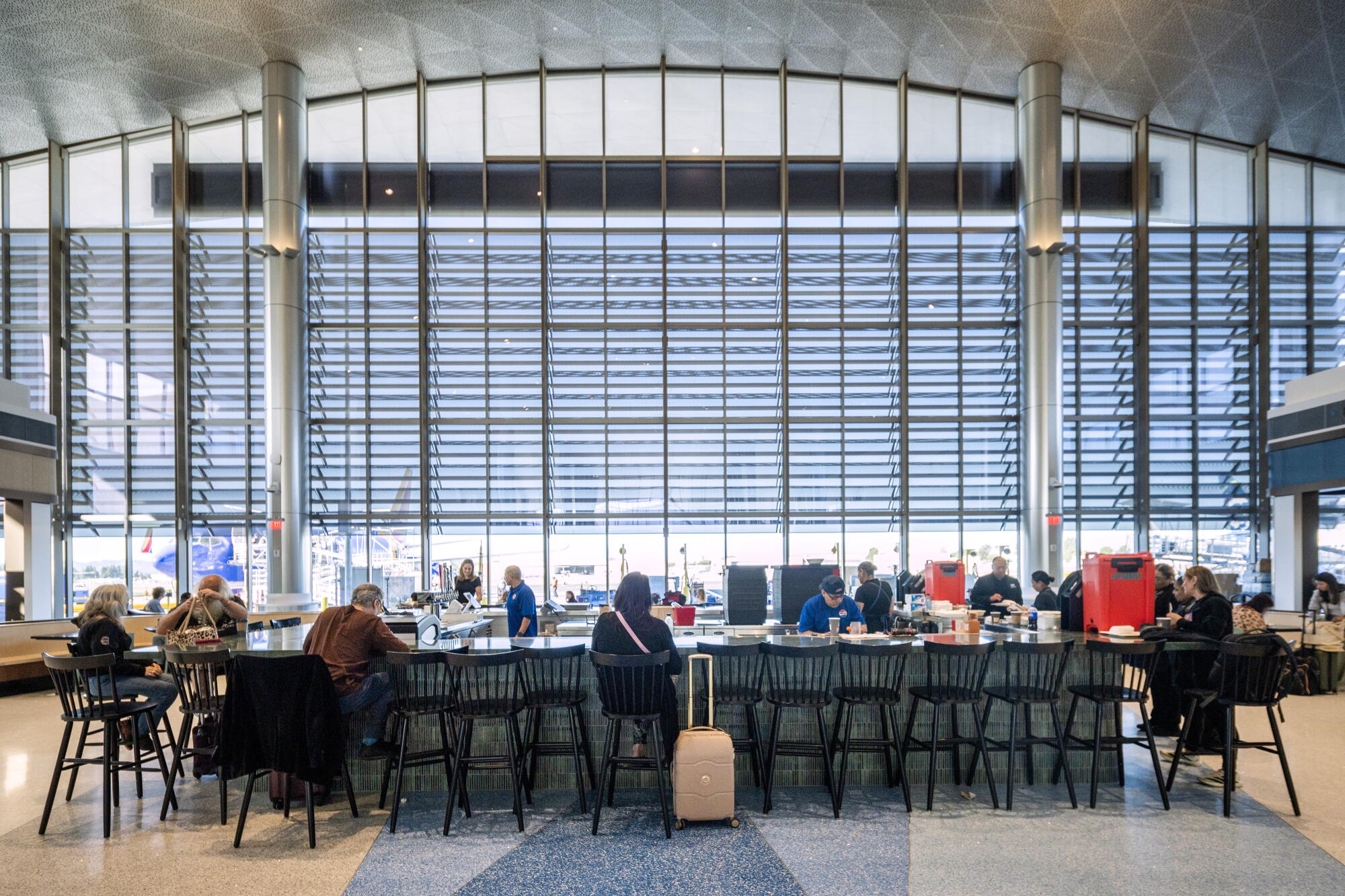
Passengers at Pete's Pub inside the new Hollywood Burbank Airport terminal. None of the 13 food concessions are fully open.

Passengers at Pete’s Pub inside the new Hollywood Burbank Airport terminal. None of the 13 food concessions are fully open.

(Myung J. Chun/Los Angeles Times)

“It was weird,” said Tanya Radke, 25, of Van Nuys, who was headed to Kansas City and caught off-guard by the terminal switch. “It was not what I thought was going to happen today for me.”

But looking around, the passenger called the new space a big upgrade. “It reminds me a lot of the Kansas City airport,” Radke said. “It was well overdue.”

The day’s schedule called for about 90 departures and arrivals by eight airlines, roughly the same schedule as in the previous buildings. The new terminal also has the same two runways and same number of gates — 14 — as the airport’s previous two-terminal alignment. And passengers still often board planes from the front and back, using outdoor steps from the tarmac, rather than enclosed tunnels. That practice is something travelers have long praised for its informality and efficiency.

But the new building does bring many changes. It measures about 50% larger than the two old terminals combined — about 355,000 square feet — with higher ceilings and a pair of illuminated steel sculptures by Cliff Garten flanking the main entrance.

The first departure was Alaska Flight 3401 to Santa Rosa at 7:03 a.m. with 33 passengers aboard. The first arrival: Southwest Flight 189 from Las Vegas, which landed at 7:16 a.m. with 30 passengers aboard.

The new terminal opened after 33 months of construction and $1.3 billion in spending.

The new terminal opened after 33 months of construction and $1.3 billion in spending.

(Myung J. Chun/Los Angeles Times)

“The taxi off was a little different. Instead of turning right, you turn left,” said Southwest Airlines pilot Mike Petros, who arrived at 7:31 a.m. with a planeload of passengers from Sacramento. At the start of the flight, Petros said, “We told them that we would be flying to a new terminal, so if they had anybody picking them up, let them know.”

Still, many were surprised. Airport management deployed several staffers to redirect confused travelers from the old terminals (now idle) to the new one. Anthony Bailey, 29, said he learned of the switch from an Uber driver on his way to the airport.

“So far, I’m liking it,” Bailey said of the new terminal, standing near gate 13 before catching a flight to Las Vegas. “Nice and clean. The TSA line was pretty smooth.”

While most of the six retail stores were open on Tuesday, none of the terminal’s 13 food concessions were fully operating. Two eateries were offering grab-and-go options, and airport spokesperson Mike Christensen said more options would arrive later in the day and week.

A woman's dog sits next to her as she checks in at the airport.

Katelyn Bailey and travel companion Pigeon check in for a flight to the Bay Area.

(Myung J. Chun / Los Angeles Times)

When the new terminal concessions open, dining options will include Guy Fieri’s Flavor Town, Spring Chicken, Diane’s Farm Table and Italian Market, Jones Coffee, Perry’s Joint, Poquito Mas, West Coast Smash Burgers, Massis Kabob, Starbucks, Border Grill, Jet Tila’s Asian Table, Santa Canela bakery and a bar, Pete’s Pub, with picture-window views of the runways and Verdugo Mountains.

Many travelers, including William Langlois and Annie Cerillo of Tampa, noted the shortage of eating options on Tuesday. “It’s horrible, there’s no restaurants and not enough security stations,” said Langlois, who had gone to the old terminal first and was redirected. Before this change, “this was the easiest airport,” said Cerillo.

In the new terminal, airport officials say, the walk from the entrance to the farthest gate is 1,285 feet, down from 1,600 feet now, with wider corridors and sidewalks and access to power plugs for devices from every seat. (Its many charging stations are now mostly USB-C ports, not USB.) The new terminal includes eight TSA lines, versus five in the old set-up. Baggage claim carousels have moved from outdoors to indoors.

The airport’s new parking structure includes about 2,000 spots and 310 charging ports for electric vehicles. (The airport’s total number of parking spaces is 6,637, the same as before.)

Alaska Airlines flight 3401.

Alaska Airlines Flight 3401 to Santa Rosa was the first flight to depart from the new terminal at Hollywood Burbank Airport on Tuesday.

(Myung J. Chun/Los Angeles Times)

As it did before, the airport supplies shuttle bus service between the new terminal and Burbank Airport-South Train Station (which connects with Amtrak’s Pacific Surfliner) and the Burbank Airport-North Station at San Fernando Road and Hollywood Way.

Among many preparations for the day, Burbank airport officials staged a “passenger simulation trial” on Sept. 19, inviting 1,500 volunteers to behave like passengers in the new building, giving dozens of airport workers staffers, including TSA staffers and airline gate agents, a chance to prepare for Tuesday.

The airport, second busiest in L.A. County, was built in 1930 and is run by the Burbank-Glendale-Pasadena Airport Authority. For decades it has been favored by many local travelers as a simpler, faster, quainter alternative to Los Angeles International Airport. The Burbank airport’s site in the San Fernando Valley, however, has often put its leaders at odds with residents of surrounding suburban neighborhoods. Unlike LAX, which has no flight curfew, the Burbank airport has limited operating hours — 7 a.m. to 10 p.m.

Passengers disembark from a plane.

Passengers disembark Southwest Flight 189 from Las Vegas just before 7:30 a.m. This was the first arrival into the new terminal at Hollywood Burbank Airport.

(Myung J. Chun / Los Angeles Times)

Before this week’s move, the aged Burbank facility didn’t meet current state seismic standards or Federal Aviation Administration design standards, which prompted repeated safety warnings. Airport officials said the new design also increases the distance between the terminal and the nearest runway, formerly as little as 257 feet, to about 880 feet — a change that brings the airport into compliance with FAA standards.

Voters approved the Burbank airport terminal replacement project in 2016. Construction began in 2024. The airport reported about 6.2 million arriving and departing passengers in 2025, flying to and from about 30 nonstop destinations.

“It’s a beautiful building, but buildings aren’t anything without people who fill them with dedication and service,” said Tyron Hampton, president of the Burbank-Glendale Airport Authority and City Councilmember in Pasadena. He predicted that the new facility would attract not only new passengers but new businesses to the commercial corridor along Burbank’s Winona Avenue.

As Burbank unveils its new terminal, the opening of LAX’s most high-profile project — the SkyLink automated people mover (a 2.25-mile electric train route linking terminals to rail service and rental cars) has been delayed by technical and legal issues until Jan. 6 at the earliest.

“I don’t like to compare,” said Hampton when asked about LAX. “We have 14 gates. LAX has 161.”

Source link

B-1B Bombers Make Hasty Departure From England

U.S. Air Force B-1B Lancer bombers that had been deployed to RAF Fairford in the U.K. since operation Epic Fury have returned to their home stations, a U.S. defense official confirmed to TWZ. The hasty movement was reportedly sparked by new Iranian threats against the base, although the Pentagon doesn’t confirm that assertion.

The sudden withdrawal came a week after a major incident was declared near Fairford following the arrest of five men on suspicion of driving bomb-laden vans toward it. They were later released on bail after no explosives were found. However, Counter-Terrorism police are continuing the investigation and said they were considering ​whether a foreign ​state had ⁠been involved. On Wednesday, British Prime Minister Andy Burnham said the incident might have had an Iranian ​link.

The Wall Street Journal was the first to report the departure.

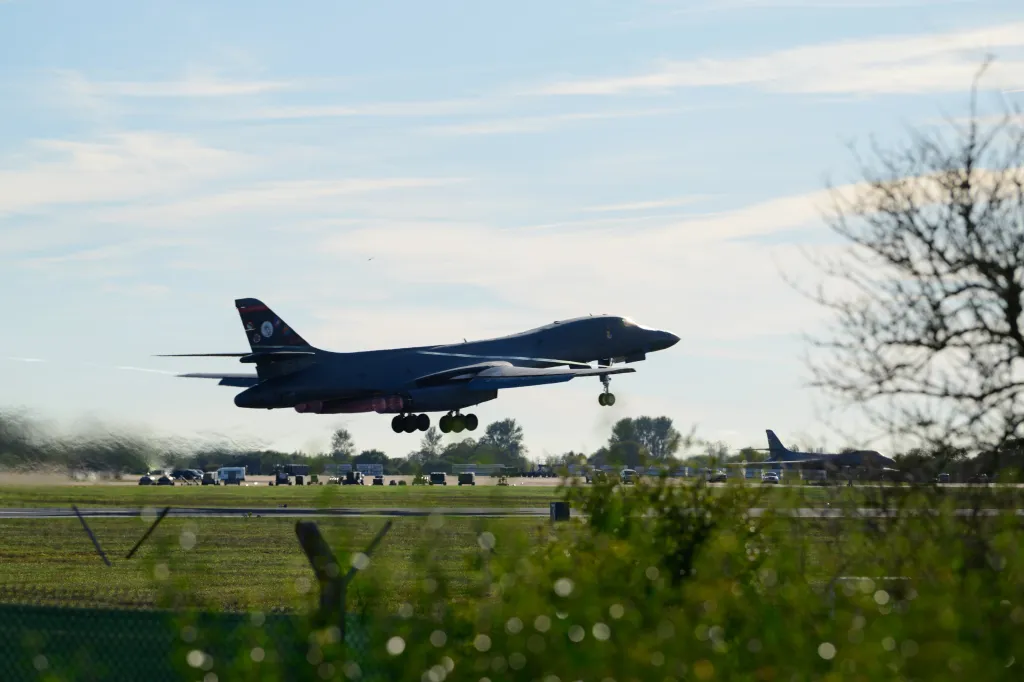
FAIRFORD, ENGLAND - OCTOBER 4: A Rockwell B1 Lancer heavy bomber takes off from runway 27 to depart for home at RAF Fairford on October 04, 2026 in Fairford, United Kingdom. Around a dozen US B-1B Lancer bombers remain stationed at RAF Fairford in Gloucestershire, following a significant military drawdown late last month that saw six B-52 Stratofortress bombers return across the Atlantic. The heavy aircraft are part of an American forward strike force that has used the Gloucestershire airfield to conduct missions against Iranian capabilities, with total aircraft numbers at the Gloucestershire hub previously peaking between 21 and 23 strategic bombers earlier this year. (Photo by David Bown/Getty Images)
A U.S. Air Force B-1B Lancer heavy bomber takes off from runway 27 to depart for home at RAF Fairford on Oct. 4, 2026 in Fairford, United Kingdom. (Photo by David Bown/Getty Images) DAVIDBOWN

Bomber strikes launched from Fairford, which included ones executed by both B-1s and B-52s, were a central aspect of major U.S. combat operations against Iran earlier this year. In addition, the installation is a major hub for U.S. military aircraft in the United Kingdom. It is a regular host of strategic assets, including bombers and U-2 spy planes. It also acts as a pit stop for other aircraft, including fighters, that are being ferried to and from the United States.

The U.S. withdrew all 12 B-1s “after commanders received new threats about an Iran-backed plot against the installation,” The New York Times reported, citing two U.S. officials.

FAIRFORD, ENGLAND - OCTOBER 4: B1 bombers take off as they depart for home at RAF Fairford on October 04, 2026 in Fairford, United Kingdom. Around a dozen US B-1B Lancer bombers remain stationed at RAF Fairford in Gloucestershire, following a significant military drawdown late last month that saw six B-52 Stratofortress bombers return across the Atlantic. The heavy aircraft are part of an American forward strike force that has used the Gloucestershire airfield to conduct missions against Iranian capabilities, with total aircraft numbers at the Gloucestershire hub previously peaking between 21 and 23 strategic bombers earlier this year. (Photo by David Bown/Getty Images)
U.S. Air Force B-1 bombers depart RAF Fairford for home bases on Oct. 4, 2026. (Photo by David Bown/Getty Images) DAVIDBOWN

“The withdrawal was highly unusual: Such moves are rarely made so quickly from an allied air base in a peacetime country thousands of miles from a combat zone,” the publication added. “The need to move the bombers out of the base, R.A.F. Fairford, was deemed so urgent that some of the planes and their flight crews left while aerial refueling aircraft were still being scrambled to support their flights to the United States. At least three of the planes had landed at their home base in South Dakota by Sunday.”

U.S. officials declined to tell the Times the specific nature of the new information that prompted the Lancer withdrawal, some of which had just arrived in the past week as part of a normal rotation of forces to maintain the B-1 forward presence in Europe.

“One U.S. official said the new information was part of the same threat warnings that surfaced three weeks ago, but specific details and a sense of urgency spiked in the past 24 hours, alarming commanders,” the publication noted.

As we previously reported, Tehran directly threatened RAF Fairford in July over its use as a base to launch attacks against Iran.

“The American aggressor army, which used to launch cruise missiles from its vessels in the Indian Ocean in its aggression after the official resumption of the war, with the end of the missile reserves of the aforementioned vessels, yesterday switched to using B1 planes flying from Fairford Air Base, England,” Tasnim News Agency, a quasi-state outlet in Iran with ties to the country’s powerful Islamic Revolutionary Guard Corps (IRGC), claimed on Telegram on July 23. “As the officials of the Ministry of Foreign Affairs also stated, any base that is used to invade Iran’s territory is our legitimate goal.”

Local aircraft spotters and aviation photographers began to notice the aircraft departing in large numbers earlier on Sunday.

The aircraft left in several waves, according to the DefenceGeek X account, run by the senior editor of the U.K. Defence Journal.

The defense official who confirmed the withdrawal said the aircraft movements won’t affect overall readiness.

“The Airmen that operate America’s bomber force, including B-1s, B-2s, and B-52s, remain ready to deliver precision global strike capabilities – including through operations that launch and recover from the continental United States – anywhere, anytime,” the official added.

When we asked the Pentagon about the retrograde movement of bombers from the U.K., they did not confirm the security issue that prompted it, stating:

“U.S. Air Force bombers routinely operate around the world to support global force readiness and operational requirements. While operational security precluded us from confirming the movement of our assets and forces in real-time, we can acknowledge now that all U.S. bombers that were deployed to RAF Fairford have re-deployed to their home stations in the United States. The Airmen that operate America’s bomber force, including B-1s, B-2s, and B-52s, remain ready to deliver precision global strike capabilities – including through operations that launch and recover from the continental United States – anywhere, anytime.”

Regardless, this is the first time in months that RAF Fairford has not hosted U.S. bombers.

Contact the author: howard@twz.com

Howard is a Senior Staff Writer for TWZ. He writes frequently about conflict, focusing heavily on the Middle East and Ukraine, and interviews with military and intelligence officials and industry leaders from around the globe. He lives near Tampa, Florida, home of U.S. Central Command, U.S. Special Operations Command.


Source link