Survey finds strong demand-support calls from Korean small businesses

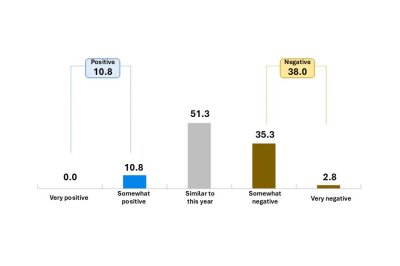
Outlook for next year’s business operations among South Korean small business owners, Dec. 16, 2025. Graphic by Asia Today and translated by UPI.
Dec. 16 (Asia Today) — Nearly half of South Korea’s small business owners say policies to boost domestic demand and consumer spending are the most urgently needed form of support, according to a new survey released Tuesday.
The Korea Federation of SMEs said 49.5% of respondents cited domestic demand and consumption stimulus as their top policy priority, according to its “Survey Results on Small Business Owners’ Management Status and Policy Tasks.”
The survey was conducted from Nov. 4 to 21 among 800 small businesses in daily life-related sectors, including wholesale and retail trade, lodging and food services, and manufacturing.
The results showed a largely pessimistic outlook for next year. About 89.3% of respondents said they expect business conditions to remain similar to this year (51.3%) or worsen (38.0%), while only 10.8% reported a positive outlook.
Asked about the biggest management burdens this year, respondents most frequently cited rising prices, including higher raw material and supply costs (56.3%), followed by declining sales due to weak domestic demand (48.0%), rising labor costs and labor shortages (28.5%), and loan repayment burdens (20.4%). Despite these pressures, 97.4% said they are not considering closing their businesses, which the federation attributed to the high share of livelihood-based startups, accounting for 91.4% of respondents.
The survey also found increased reliance on online platforms. The share of small business owners using online platforms rose 3.5 percentage points from a year earlier to 28.1%. Platform use was highest in the lodging and food service sector (44.3%), compared with wholesale and retail trade (20.3%) and manufacturing (15.5%). Among platform users, platform-based sales accounted for an average of 41.7% of total revenue, up 6.3 percentage points from a year earlier.
About 25.7% of respondents said their loan balances increased compared with the previous year, with the average interest rate on current loans at 4.4%. Among small business owners with loans, 90.4% said interest and principal repayments were burdensome.
Assessing the effectiveness of domestic demand stimulus policies implemented this year, 52.3% of respondents in the lodging and food service sector said they felt policy effects, compared with 18.0% in wholesale and retail trade and 8.5% in manufacturing. Among those who reported effects, 65.4% said the impact was temporary, while 19.7% cited short-term sales increases.
Looking ahead, respondents said future consumption-promotion policies should focus on concentrating spending in local commercial districts (41.8%), expanding the scale and duration of support (31.8%), and strengthening policy promotion (24.5%).
When asked about the most urgent tasks for the National Assembly or government, respondents cited stimulating consumption and reviving local economies (52.1%), addressing rising labor costs and labor shortages (45.0%), easing loan burdens caused by high interest rates (42.8%), and reducing energy costs (26.3%).
Choo Moon-gap, head of the Economic Policy Division at the Korea Federation of SMEs, said persistent inflation, weak domestic demand and a high exchange rate have worsened business conditions for small business owners. While consumption-stimulating measures such as livelihood recovery coupons have had some effect, he said, mid- to long-term growth policies that small business owners can clearly feel are also needed.
– Reported by Asia Today and translated by UPI.
© Asia Today. Unauthorized reproduction or redistribution prohibited.