Activists say Israeli soldiers have prevented them from delivering aid to Palestinians who have been besieged by settlers outside their homes in the occupied West Bank village of Qusra for nearly a week. We spoke to Jonathan Pollak from the Sumud Network.
For six years, Californians have been able to shake up a craft cocktail at home using alcohol delivered to their doorstep. Now, it’s last call for the distillery deliveries, unless lawmakers intervene by the end of this month.
That’s unlikely, thanks to opposition from California’s wine industry, Teamsters union truck drivers and corporate alcohol wholesalers and distributors.
The influential, well-funded groups lobbied the Legislature behind closed doors this year to block legislation that would have made permanent pandemic-era rules that allowed craft distillers to ship spirits directly to their customers.
During the pandemic lockdowns, Gov. Gavin Newsom issued an executive order that allowed craft distillers to ship spirits to their customers’ homes. In the years since, lawmakers passed temporary laws allowing craft distillers — defined as those that produce up to 150,000 gallons a year — to keep shipping their spirits.
The latest extension expires Dec. 31.
“I don’t have a lot of hope that we’re going to be able to salvage this,” said Folsom Republican Assemblymember Josh Hoover. He tried unsuccessfully this year to amend one of his bills to let small distillers continue shipping directly to their customers.
The groups blocking Hoover’s proposal have spent more than $1 million lobbying the Legislature and state government this year. They have donated at least 11 times that much to California politicians and their campaigns over the years.
The craft distillers, who have spent a fraction as much on state politics, say all that spending from the opposition, particularly from corporate liquor distributors, appears to have paid off.
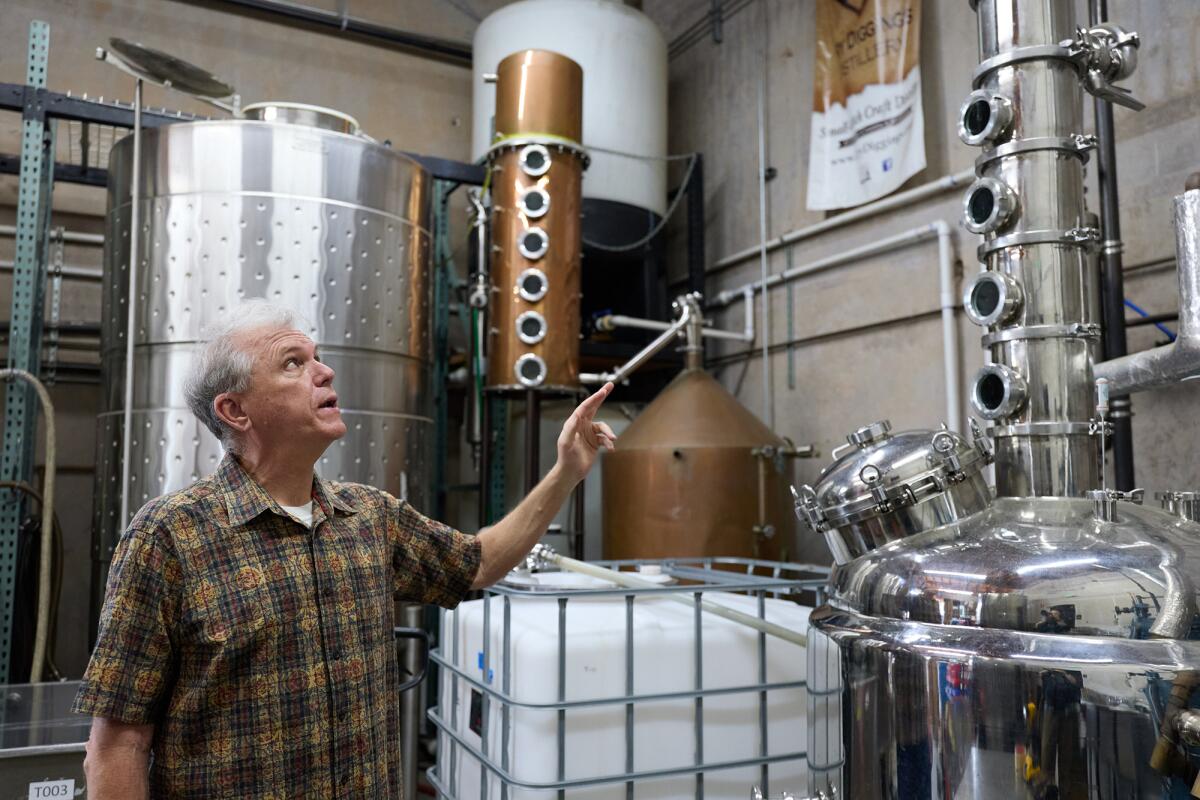
Cris Steller, owner of Dry Diggings Distillery, talks about the various products that are made in his distillery.
(Fred Greaves / For CalMatters)
“They went directly to legislators’ offices and basically torpedoed any effort we came up with,” said Cris Steller, acting executive director of the California Distillers Assn. and the owner of Amador and Dry Diggings Distillery in El Dorado Hills, a family-run business that makes whiskey, brandy, vodka and gin.
The fight is about more than whether Californians can have a bottle of whiskey or gin delivered. It illustrates how decisions are made in Sacramento, where wealthy and powerful interests can shape or kill policy in secret negotiations with lawmakers. Politicians, in turn, benefit when proposals die quietly because they don’t have to explain their decisions to voters.
Opponents insist they aren’t using the political system to crush competitors as national alcohol sales slump.
Instead, representatives of the major alcohol wholesalers and distributors that stock shelves at liquor retailers say they oppose the proposal because it primarily benefits out-of-state companies and weakens safeguards that include preventing alcohol deliveries to minors.
Teamsters lobbyist Matt Broad said the labor group’s truck drivers aren’t opposed to allowing craft distillers to ship their product. They just want them to use established shipping companies that have actual employees, including those that employ Teamsters, such as UPS. Those companies, Broad said, have standards to ensure liquor is delivered legally.
Those companies have standards to ensure legal delivery, Broad said. When they employ drivers rather than use contractors, the companies — not the drivers — bear legal liability.
Federal law preempts California from mandating hiring unionized truck drivers, Broad said.
“We are absolutely not opposed to the little guys being able to ship directly to consumers, and in fact, we have a track record of supporting the proposal but with meaningful guardrails that protect our members and protect the public,” he told CalMatters.
The California wine industry, which has been allowed to ship bottles directly to customers in California for decades, isn’t necessarily opposed either. But its representative says wine sellers are leery of giving little alcohol sellers delivery rights when big liquor companies deserve the same. Wineries of any size can ship to their customers in California.
Big Booze, Big Labor spend big
The U.S. Postal Service prohibits most alcohol shipments to homes, but California allows certain types of alcohol sellers to use private shipping companies. Breweries are prohibited from shipping directly to California customers.
Hoover hoped his Assembly Bill 2211, a proposal to give craft distillers the ability to offer tastings and sell spirits at locations other than their distilleries, could be amended to give craft distillers a permanent direct-to-consumer provision.
It has advanced through the Legislature without formal opposition or any lawmaker voting against it, according to CalMatters’ Digital Democracy database. The measure is pending before the full Senate.
There may be no formal opposition, but reports filed with the California secretary of state show an extensive behind-the-scenes lobbying effort aimed at preventing any changes.
At least six groups, including some of the biggest national alcohol distributors, have reported lobbying on Hoover’s bill.
The reports show those groups spent more than $1 million on lobbying this year. State ethics laws only require entities to report the total amount they spent lobbying the government in a year. They’re not required to report how much they spent on specific legislation, so it’s unclear how much they spent trying to influence lawmakers as they considered AB 2211 and its never-published direct-shipping amendment.
Those groups, along with the International Brotherhood of Teamsters and the Wine Institute, have given at least $11 million to both Democrats and Republicans in California since 2000, according to Digital Democracy, including at least $738,000 since 2025, the start of the current two-year legislative session.
By comparison, California’s craft distillers reported spending $54,000 on lobbying this year.
They reported just three donations to lawmakers in the past decade, according to Digital Democracy. One was a $42 bottle of whiskey in 2022 to former Napa Democratic Sen. Bill Dodd, who now lobbies on behalf of the craft distillery industry. In 2023, Assembly Speaker Robert Rivas received $215 in tequila. Democratic Assemblymember-turned U.S. Rep. Adam Gray received a $1,300 campaign donation in 2016. Hoover said he has been trying since last year to add language to his bill that would allow craft distillers to permanently keep shipping. He succeeded last year in getting the extension that expires Dec. 31, but this year he’s been unable to overcome the opposition to expanding the tasting room measure.
“I’m always open to figuring this out, if there’s a way that we can make this work. … but I don’t have a lot of hope that this bill is going to preserve those provisions this year,” he said.
With less than a month left before the Legislature finishes for the year on Aug. 31, Democratic leaders would probably need to sign off on changes to Hoover’s tasting room measure. They’ve offered little indication they intend to intervene for craft distillers.
Rivas, who’s received at least $108,000 in donations over the years from opponents of Hoover’s unpublished proposal, declined CalMatters’ request for an interview. Senate President Pro Tem Monique Limón, who’s received at least $33,000, responded to an interview request with an emailed statement saying she is aware of the pending deadline.
“This bill will continue to work its way through the legislative process as intended,” it said.
Bottles of spirits produced by Dry Diggings Distillery in El Dorado Hills on Aug. 4.
(Fred Greaves / For CalMatters)
Democratic Sen. Susan Rubio and her sister, Democratic Assemblymember Blanca Rubio, oversee the committees that regulate California’s alcohol industry. When Hoover’s measure passed through their committees, the chairs could have allowed Hoover to add the direct-to-consumer amendment. They did not.
Susan Rubio has received at least $65,000 in donations from the groups blocking the direct-shipping proposal, according to Digital Democracy. Blanca Rubio has received at least $129,000.
Sen. Rubio’s spokesperson, Giovanni Ruiz Reyes, responded to interview requests with emailed statements. The first said “conversations between stakeholders are ongoing” and that she “looks forward” to reviewing potential legislation.
Ruiz Reyes said in a second statement Thursday that she’s supported four previous extensions of the craft distiller shipping policy.
“There is currently no bill or amendment before the committee seeking another extension,” Ruiz Reyes said. “Accordingly, it would be inaccurate to suggest that Senator Rubio or the committee has blocked or refused to hear an extension when no such proposal is currently before the committee.”
In that difficult business climate, corporate liquor wholesalers and distribution companies lobbied “to obliterate competition,” said Dodd, the former state senator from wine country lobbying on behalf of craft distillers.
“We oppose any effort to make DTC (direct to consumer) permanent,” the Wine & Spirits Wholesalers of America, the California Beer & Beverage Distributors and the California Family Beer Distributors wrote in a joint statement to CalMatters.
Craft distilleries’ direct shipping “was always meant to be temporary pandemic relief, and it’s expiring exactly as designed, six years later,” said the groups, which represent local and national companies that move many of America’s best-known beer, wine and liquor brands. They argue that after the law expires, spirits can still be delivered to customers through services such as DoorDash. DoorDash is listed as a member of the Wine & Spirit Wholesalers of America on its website.
The groups’ representative, Kevin Luckey, declined an interview request.
Steve Gross, president and chief executive of the Wine Institute, said the wine industry has worked hard over the decades to have large and small wine sellers treated equally under California and national alcohol distribution laws. He said it would undermine his industry’s efforts if small distillers get delivery rights in California when large ones don’t have them.
“They have the option to go in and try and fight for a bill that we and others could also support,” Gross said. “They’ve chosen not to because those larger distillers are not their members.”
The Wine Institute is a lobbying group that represents more than 700 large and small wine sellers, including one of the world’s largest, Modesto-based Gallo Winery.
Craft distillers say they’ve tried to work with the groups blocking their bill to address their concerns, but they have gotten nowhere.
In the meantime, Steller, the El Dorado Hills distiller, has already started pulling back on shipping bottles to his customers because the Legislature won’t budge.
“I don’t want to keep putting money into a program that’s going to get yanked,” he said.
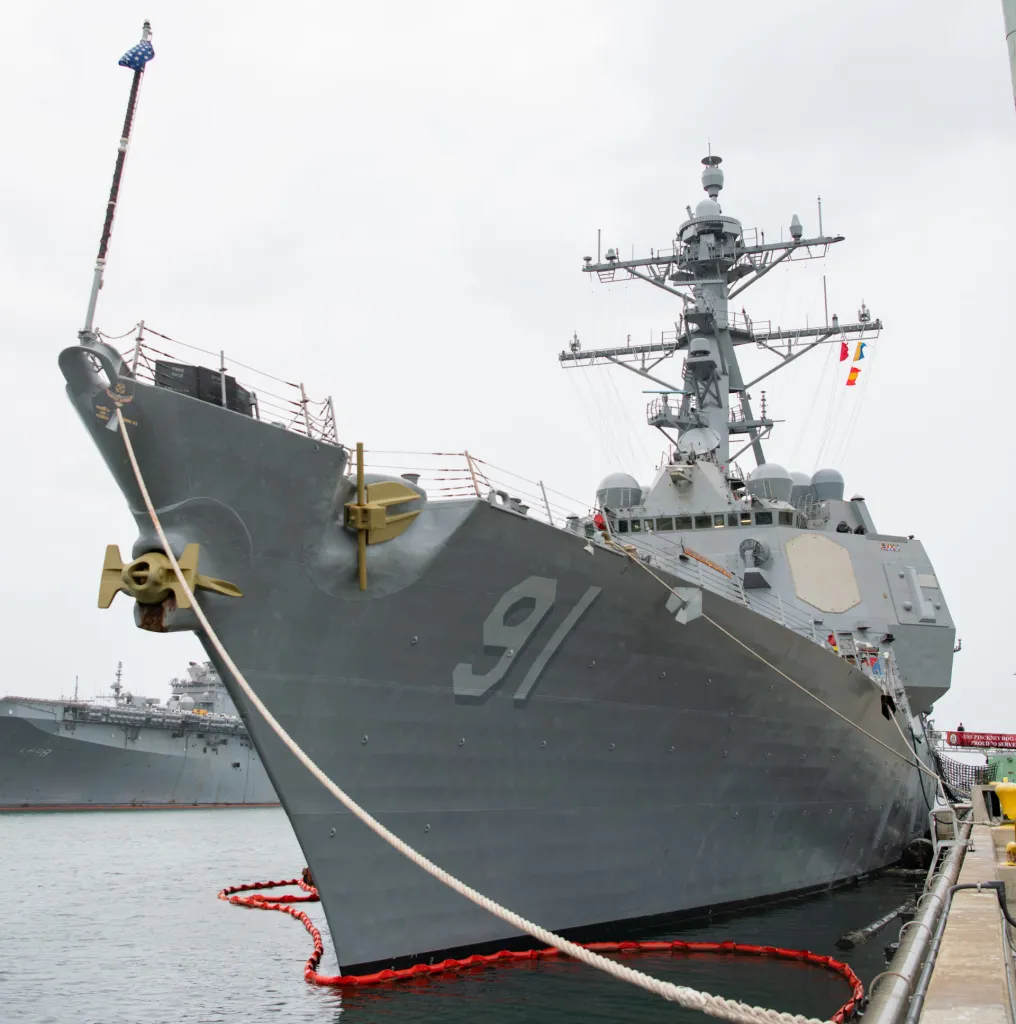
A stock picture of the USS Pinckney taken in September 2025 after the ship had received the SEWIP Block III installation. USN
“The Wallops site, a land‑based test facility situated over an open-water environment, will support extensive testing of the radar and its power and combat system interfaces ahead of installation on USS Pinckney (DDG 91), the first ship to be backfit with SPY‑6(V)4,” according to a press release from prime contractor Raytheon today. “Initial testing will begin later this year and continue through mid‑2028.”
Land-based testing is a routine step in the development of naval radars. Work to integrate the radar onto the USS Pinckney is also set to start this year and wrap up in 2028, according to Raytheon.
“By leveraging the Wallops test site, we’ll be able to integrate SPY‑6(V)4 with its dedicated power system before it reaches the ship, reducing the amount of testing needed on DDG 91,” Barbara Borgonovi, president of Naval Power at Raytheon, said in a statement. “That means less time in the shipyard, more time dedicated to the mission, and a smoother path for future backfit ships.”
The AN/SPY-6(V)4 is also known as the Air and Missile Defense Radar Backfit (AMDR Backfit) radar. It is a scaled-down version of the AN/SPY-6(V)1 AMDR radar that is being integrated onto new Flight III Arleigh Burke class destroyers. The AMDR has four fixed-face arrays, each made up of 37 Radar Modular Assemblies (RMAs). The AMDR Backfit also has a quartet of fixed arrays, but with 24 RMAs apiece.
Raytheon – AN SPY 6V Radar Build Timelapse Video
Each RMA is a two-foot-by-two-foot-by-two-foot cube that contains an independent active electronically scanned antenna. The modules are a key building block of all four radars that currently make up the AN/SPY-6 family. The AN/SPY-6(V)2 and AN/SPY-6(V)3 versions – also known as the Enterprise Air Surveillance Radar (EASR) Rotator and EASR Fixed Face, respectively – have arrays with significantly fewer RMAs than either the AMDR or AMDR Backfit types. AN/SPY-6-series radars are set to become a fixture across the Navy’s surface fleets, with versions also being added to new Ford class aircraft carriers and set to be backfitted onto some Nimitz class types. Various amphibious warfare warships are also getting radars from this family. You can read more about all of this here.
The RMAs that make up any AN/SPY-6-series radar can be utilized individually or linked together with others to focus their energies on a specific task. This offers immense operational flexibility, as well as the ability to produce higher-fidelity tracks over extended ranges. The loss of a single RMA also does not render the entire radar inoperable, and the modules can be replaced individually for repairs and upgrades. This, in turn, translates to increased reliability and upgradability, and less downtime for the radar, in general.
Missile Defense Radars at Sea
With 96 RMAs versus 148, the AMDR Backfit radar is not as capable as its larger AMDR cousin. However, it is still a major capability upgrade for Flight IIA Arleigh Burkes, which are currently equipped with the AN/SPY-1D. The SPY-1D is an aging passive electronically scanned array radar, the development of which traces back to the 1980s. The original AN/SPY-1 entered Navy service in the 1970s.
When paired with the new Baseline 10 configuration of the Aegis Combat System, “the AN/SPY-6(V)4 will provide volume search, tracking, BMD [ballistic missile defense] discrimination, and missile communications in a wide diversity of environments and conditions,” according to a past Navy contracting notice. As noted, this Aegis upgrade is another central aspect of the Destroyer Modernization 2.0 plan.
The Destroyer Modernization 2.0 effort has so far been proceeding in phases, with the SEWIP Block III, Aegis Baseline 10, and chiller upgrades being integrated first, and the AN/SPY-6(V)4 radar coming afterward. In June, the Navy had announced the completion of the SEWIP Block III upgrades on another pair of Flight IIA Arleigh Burkes, the USS Chung-Hoon (DDG-93) and USS James E. Williams (DDG-95).
USS Chung-Hoon seen departing Naval Base San Diego for sea trials on April 20, 2206 after completing its Depot Modernization Period as part of the DDG Modernization 2.0 program. Courtesy photo via USN
As mentioned, the SEWIP III installation requires substantial changes to the ship’s physical structure, inside and out. Arleigh Burke destroyers with the new electronic warfare suite have all-new geometric structures extending off the port and starboard bridge wings that contain key elements of the new electronic warfare suite. When work on Pinckney was completed, some observers dubbed it the ‘muffin top’ destroyer and the ‘USS Thickney.’
A head-on view of the USS Pinckney in San Diego, California, in 2024, offering a good look at the substantial structural changes from the SEWIP Block III installation. @SanDiegoWebCam via @WarshipCam Another head-on view of USS Pinckney before the SEWIP Block III installation. USN
At least as of last year, two more Flight IIAs, USS Halsey (DDG-97) and USS Sterett (DDG-104), were in line to receive the AN/SLQ-32(V)7 and the rest of the Destroyer Modernization 2.0 package. The Navy also previously said that Sterett would be the first ship to get all of the new capabilities in one single in-port availability.
“This destroyer modernization effort is the cornerstone of increasing service life and delivering decisive combat power to the US Navy via our Flight IIA destroyers,” Capt. Tim Moore, the Destroyer Modernization 2.0 (DDG MOD 2.0) program manager, said in a statement in June. “We focused on opportunities to shift milestones supporting acquisition, planning and execution left to provide these game-changing capabilities to the operators sooner. The DDG MOD 2.0 program remains a top priority as the Navy continues to build and sustain a lethal, resilient, and rapidly adaptable force.”
How many Flight IIA Arleigh Burke class destroyers, in total, will eventually receive the full Destroyer Modernization 2.0 upgrade package is unclear. The Navy has said in the past that 20 destroyers could be brought up to this new standard. In 2025, the service said that the USS Kidd (DDG-100) would be among several ships to receive the SEWIP Block III suite, but not the AN/SPY-6(V)4 radar, according to USNI News. The Navy’s Arleigh Burke class destroyer force, as a whole, is in the process of receiving other upgrades, including new defensive capabilities, too.
A stock picture of the USS Kidd, one of several Flight IIA Arleigh Burke class destroyers that might receive just a portion of the Destroyer Modernization 2.0 upgrades. USN
The Navy currently has 75 Arleigh Burke class destroyers in service, altogether, of which 34 are Flight IIA versions. There are another 12 Flight IIA Restart and Flight IIA Technology Insertion subtypes, which feature additional improvements. Production of new ships in this class is now transitioning fully to the Flight III subvariant.
Regardless, the arrival of the first AN/SPY-6(V)4 at Wallops Island is a significant milestone that puts the Navy on track to move ahead with the second phase of its Destroyer Modernization 2.0 plans.
Weekly insights and analysis on the latest developments in military technology, strategy, and foreign policy.
Two decades after the tiltrotor MV-22B Osprey first achieved initial operational capability, the U.S. Marine Corps on Tuesday received its final delivery of these controversial aircraft, closing the books at 359 of them. While the Osprey fleet is expected to keep flying through 2055, the Corps is eyeing a replacement, dubbed the Next Generation Assault Support (NGAS) aircraft.
Developed to bridge the gap between rotary-wing and fixed-wing capabilities, the MV-22B combines the vertical takeoff and landing of a helicopter with the speed and range of a fixed-wing airplane. After first entering service in 2007, the MV-22B became the backbone of the Marine combat air assault capability, primarily replacing the CH-46 Phrog. The self-deployable tiltrotors, able to fly themselves around the globe, vastly outrange and outpace any other rotary-wing aircraft the Corps has to offer. They can also land on ships and in tight austere locations that fixed-wing transport aircraft can’t. This unique mix of capabilities has altered how the USMC does business and opened up new tactical opportunities.
U.S. Marines and Sailors with Marine Rotational Force – Darwin 26 disembark an MV-22B Osprey tiltrotor aircraft assigned to Marine Medium Tiltrotor Squadron (VMM) 268 (Reinforced), MRF-D 26. (U.S. Marine Corps photo by Cpl. Grant Schirmer) Cpl. Grant Schirmer
“The MV-22B didn’t just join our fleet; it fundamentally changed the way the Marine Air-Ground Task Force generates combat power,” said Lt. Gen. William Swan, Deputy Commandant for Aviation. “It provides commanders with decision space that only speed and reach can provide, connecting ships, bases, and distributed forces in ways previous generations could only imagine. Today, Marine commanders build operations around the assumption that the MV-22B will be there.”
The Marine Corps MV-22B fleet “has flown more than 686,500 hours across 114 operational deployments,” the service said in its announcement of the final delivery. “This versatile platform supports combat operations, contested logistics, medical evacuations, and humanitarian assistance from forward-deployed locations across the globe. Today, the Osprey sources 75% of all Marine Corps rotary-wing assault support. This unmatched operational tempo underscores the success of the joint acquisition program as it reaches its final delivery.”
Welcome to the MEU: Osprey Vertical Assault
However, the success of the Osprey has come at a cost. As of July 2025, “65 military personnel and civilians have died in mishaps involving V-22 aircraft,” according to the Congressional Research Service (CRS). “That figure includes 30 fatalities before 2007, when the aircraft was declared ready for initial operations, and 35 after 2007. Since 2022, V-22s have experienced four fatal mishaps that killed 20 servicemembers and injured another 20.”
With the delivery of the final Osprey, the Marine Corps is now shifting from fielding these aircraft to sustaining and evolving the fleet for decades to come.
To keep the MV-22B operational through 2055, the Corps is “focused on improving nacelle wiring to reduce maintenance hours, pursuing improved prop-rotor gear boxes with triple-melted, refined steel components, standardizing aircraft configurations across the fleet, and redesigning key components to enhance safety and make the aircraft more sustainable,” the Marines explained.
“We cannot assume that because the MV-22B transformed Marine aviation once, its evolution is complete,” said Swan. “It is our responsibility to carry this legacy forward and ensure this aircraft remains ready, relevant, and lethal for the fight ahead.”
Marines assigned to the “Dragons” of Marine Medium Tiltrotor Squadron (VMM) 265 (Reinforced), 31st Marine Expeditionary Unit (MEU) perform maintenance on a rotor blade of a MV-22 Osprey on the flight deck of amphibious assault ship USS America (LHA 6). (U.S. Navy photo by Mass Communication Specialist 3rd Class Vincent E. Zline) Petty Officer 1st Class Vincent Zline
Concurrent modification plans will also provide continuous platform improvements, the USMC noted in its 2026 Aviation Plan.
“Informed by the Center for Naval Analysis (CNA) Renewed V-22 Aircraft Modernization Plan (ReVAMP) study, the Marine Corps is pursuing additional modernization efforts to ensure platform relevance and reliability until the end of the V-22 fleet’s service life, while at the same time developing and informing the requirements for the Next Generation Assault Support aircraft,” according to the aviation plan.
The aviation plan offers scant details about the NGAS program, though as we highlighted in the past, increased range, as well as greater speed to help get across the vast distances of the Pacific faster, will be key considerations, especially with an eye toward a future high-end in the Pacific against China. The Corps has touted its ability to conduct long-range and long-endurance MV-22 operations in the Pacific region, but this presents significant challenges and resource requirements, especially when it comes to aerial refueling, as you can read more about here. Those issues would only be magnified in an actual conflict against an opponent with substantial anti-access and area denial capabilities.
U.S. Marine Corps MV-22B Ospreys, attached to Marine Medium Tiltrotor Squadron (VMM) 164 (Reinforced), 15th Marine Expeditionary Unit, take off from Wasp class amphibious assault ship USS Essex (LHD in the Pacific Ocean as part of Exercise Rim of the Pacific 2026, July 15, 2026. (U.S. Navy photo by Mass Communication Specialist Zachary Warr) Seaman Zachary Warr
TWZ has reached out to the Marines and to the U.S. Navy’s Naval Air Systems Command (NAVAIR), the latter of which serves as the central manager for major aviation programs for the Navy and Marines, for more information. NAVAIR also leads the V-22 Joint Program Office (JPO), overseeing the entire U.S. military Osprey family that includes Air Force CV-22s and Navy CMV-22s. The JPO supports foreign Osprey operators, of which Japan is currently the only one, as well. At one time, more countries were interested in procuring V-22s, however interest faded and now the window for new foreign contracts appears to be closing as demand has not materialized and production on the aircraft is ending.
The expected delivery of the Navy’s final CMV-22 is in Fiscal Year 2028, NAVAIR told us.
“Due to operational security concerns a more detailed delivery schedule is not publicly releasable,” the command added. “The Navy will receive 53 CMV-22s in total and 42 have already been delivered.”
A U.S. Navy CMV-22 Osprey. (USN) USN
The Air Force has received all 56 of its CV-22s, with the last one being delivered in July 2025.
CV-22 Ospreys assigned to the 21st Special Operations Squadron approach an MC-130J Commando II for aerial refueling over the Sea of Japan, March 17, 2023. (U.S. Air Force photo by Senior Airman Trevor Gordnier ) U.S. Air Force CV-22B Ospreys. USAF
With fewer than a dozen Ospreys still in production, we reached out to the Bell-Boeing team to find out what will happen to the Amarillo, Texas, plant where these aircraft are manufactured.
Inside the Bell Boeing plant in Amarillo, Texas. (Bell Boeing)
Though it has received the last of its MV-22Bs, the Marines anticipate this airframe to remain the backbone of its combat air assault operations through the next three decades, barring any unforeseen drastic changes to its aviation plans.
Tesla (TSLA) delivered a record 480,126 vehicles in Q2 2026, up 25% year-over-year, while producing about 452,000 vehicles during the quarter. Despite the strong delivery beat, shares slumped 8% following the report, with the stock now down more than 9% year