California Republicans rejoice over Swalwell scandal, but split on best GOP candidate for governor
SAN DIEGO — While their spring convention was held beneath mostly sunny San Diego skies, delegates and leaders of the California Republican party basked in a different sort of glow over the weekend as the campaign for a leading Democratic candidate for governor imploded because of allegations of sexual assault and misconduct.
The party did not endorse a candidate for governor on Sunday because neither of the top Republicans — Riverside County Sheriff Chad Bianco and former Fox News host Steve Hilton — received the support of 60% of delegates. Bianco won 49% while Hilton had 44%; 7% of delegates voted not to endorse in the race.
“We’re very happy,” Bianco said after the vote. “We got the popular vote here, right? Ultimately, our goal is to win California, and you win California with the popular vote … Californians are looking for a leader. Californians are looking for integrity. Californians are looking for honesty. And they want someone that they know is going to be looking out for them, working for them, and that’s why I won this vote.”
Hilton also said he was pleased by his showing.
“Chad came into this convention thinking he had it in the bag,” Hilton said. “I think we made a lot of progress this week and I think the endorsement of President Trump is the one that’s gonna be decisive in the primary.”
The convention took place as a former staff member for Rep. Eric Swalwell (D-Dublin) accused him of forcing himself on her twice when she was too intoxicated to consent, according to reports published by the San Francisco Chronicle and CNN. Three other women also accused Swalwell of misconduct that included sending and soliciting explicit photos and messages.
Swalwell has not withdrawn from the race, but within hours of the allegations top supporters withdrew endorsements of the East Bay Area congressman, including Sen. Adam Schiff, campaign co-chairs Reps. Jimmy Gomez and Adam Gray, and prominent labor unions including the California Teachers Assn.
The collapse of Swalwell’s campaign brought a surge of energy to leaders and hundreds of die-hard members of a state Republican Party that holds a superminority in the state Legislature and no statewide elected offices. The news broke Friday, just as the party convention was getting underway at the bayside Sheraton San Diego Resort and hours before the Artemis II crew splashed down off the nearby coast.
Sean Spicer, a former press secretary during President Trump’s first term who is promoting a new book, joked during a Saturday brunch panel about landing in San Diego just in time to see “the fall.”
“Sorry, I was talking about Swalwell,” he said to laughter. “It was also cool to see Artemis come back down.”
Republicans have not won a statewide election since 2006 and some hoped Swalwell’s controversy would fuel voters already beleaguered by the cost of living to consider supporting GOP candidates this year.
“Quite frankly, Californians are, by and large, looking for viable alternatives. They’re looking towards the California Republican Party,” Chairwoman Corrin Rankin told reporters.
Republicans running to succeed Democratic Gov. Gavin Newsom shared similar visions during five-minute speeches at a Saturday afternoon candidate forum.
“We meet here today, full of energy and hope and optimism, with a spring in our step on this beautiful spring day. Why? Because every party has its season, and for the California Democrats, the leaves are cascading from the trees,” Hilton told delegates.
Hilton, who served as a top political advisor to U.K. Prime Minister David Cameron, argued that 16 years of Democratic rule has led to dysfunction, chaos and scandal that alarmed voters in the overwhelmingly blue state even before the Swalwell scandal.
“And now, it’s been a couple of hours, so I think we’re due for another Eric Swalwell intern eruption,” he said.
Hilton touted Trump’s endorsement, describing it as a “tremendous asset for us, the energy, the resources, the precious gift of having the boost that makes the biggest difference in a midterm year turnout.”
Bianco emphasized his decades serving in law enforcement in the state, one of his main selling points to Californians concerned about liberal criminal justice policies of past Democratic administrations.
“I have spent every day serving California residents, making our lives better and safer. I have fought for you, and I have bled for you,” Bianco said.
Bianco refuted Hilton’s allegations that he coddled undocumented immigrants, sympathized with Black Lives Matter protesters and threatened county residents with punishment if they did not abide by mask mandates during the pandemic. He said he was the first law-enforcement official in the nation to defy a lockdown order after the pandemic. Bianco said that while he prayed with protesters in the aftermath of George Floyd’s death, he also “forcefully” expelled “rioters and domestic terrorists” from his county.
Bianco also obliquely referred to attacks Hilton has lobbed against the sheriff on the campaign trail.
“This was never supposed to be about a dishonest smear campaign and bullseyes,” Bianco said, referring to a mailer Hilton’s campaign sent to voters that pictured Bianco’s head with circles around it that resemble a shooting target.
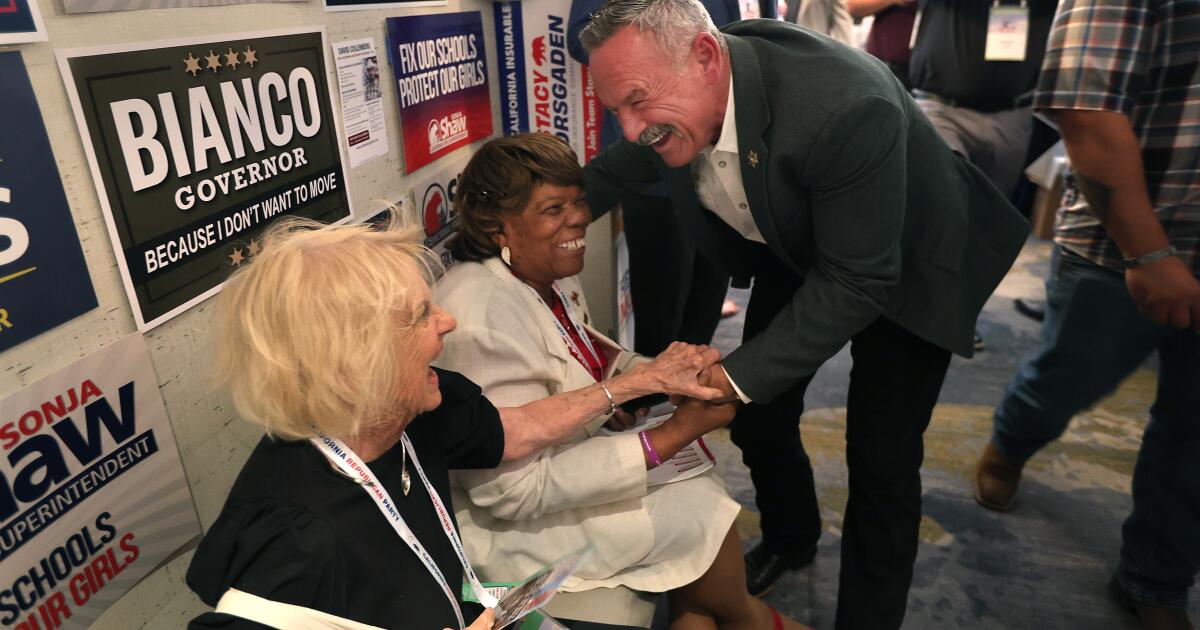
As Bianco walked through the bayfront convention hotel after the forum, he was swarmed by supporters chanting his name.
Saturday night, Bianco hosted a western-saloon themed party for delegates. Attendees wearing cowboy hats line danced, petted fluffy white calves and posed for pictures in front of an inflated cactus.
A Hilton-hosted party took on the feel of a candidate forum as he and Republican allies running for other statewide offices gave another round of speeches, often punctuated by shushing attendees who chattered in the back of the room.
Under California’s top-two primary system, the two leading candidates advance to the general election regardless of party affiliation. For weeks, Hilton and Bianco have led polls while eight prominent Democrats including Swalwell split the support of liberal voters, stoking anxiety among Democrats that the party could end up shut out of the November election.
The chances of that happening diminished with Swalwell’s fall from grace and Trump’s endorsement of Hilton, political experts said, but those in the conservative wing of California politics celebrated the apparent downfall of the once-powerful Democrat.
Swalwell is “in denial right now, but once he realizes he doesn’t have any friends left and his campaign team is leaving him, people are laughing at him in the restaurant, I think, and I hope for his sake, he has enough self-awareness that he’ll quietly drop out and go to the south coast of France and put on a wig,” said Republican National committeeman Shawn Steel.
One of the convention’s celebrated speakers, Sen. Ted Cruz (R-Texas) took shots at other California Democrats during a Saturday evening banquet, describing Los Angeles Mayor Karen Bass as “the Democrats’ national ambassador for disaster management” and Newsom as a contender for “Texas Realtor of the year, because no person in human history has sold more homes in the state of Texas.”
“Look, as a Texan, I gotta say, just isn’t fair. [You have] an economy that has been a monstrous engine driving America forward for decades, and yet you were cursed with idiot politicians,” Cruz said.
While Hilton‘s and Bianco’s campaigns have sparred about their respective records, the candidates largely avoided direct confrontation until a debate earlier this month in Rancho Mirage. The two GOP candidates tore into each other about issues such as immigration, their credentials and their honesty.
Delegates also sparred about Bianco and Hilton’s records in the halls of the convention.
Shiva Bagheri, a Bianco supporter from Beverly Hills, said that Hilton’s political positions are not constitutional.
“Steve said that anybody that makes under $100,000 shouldn’t pay [income] taxes,” said Bagheri, 52. “That’s against the 14th Amendment. I’m a constitutionalist.” She said she preferred Bianco’s plan to cut income taxes for everyone to avoid class warfare.
Celeste Greig, a Hilton supporter from Northridge, initially supported Bianco and donated to his campaign. But she grew troubled after hearing about Bianco’s comments about immigration, seeing images of the sheriff taking a knee alongside BLM protesters and learning of what she believes was an unlawful arrest of a person outside of President Trump’s 2024 rally in the Coachella Valley.
Some Republicans longed for a return to a bygone era when state lawmakers regularly worked across the aisle. State Sen. Tony Strickland (R-Huntington Beach) described teaming up with Democratic Sen. Alex Padilla when they served in the Legislature, adding that he still considers Padilla, now the state’s senior U.S. senator, a friend.
“We’re in a divided era right now,” Strickland said. “If we actually pick up a few more seats, I think it will give more comfort to some of those moderate Democrats to come over and work with us.”