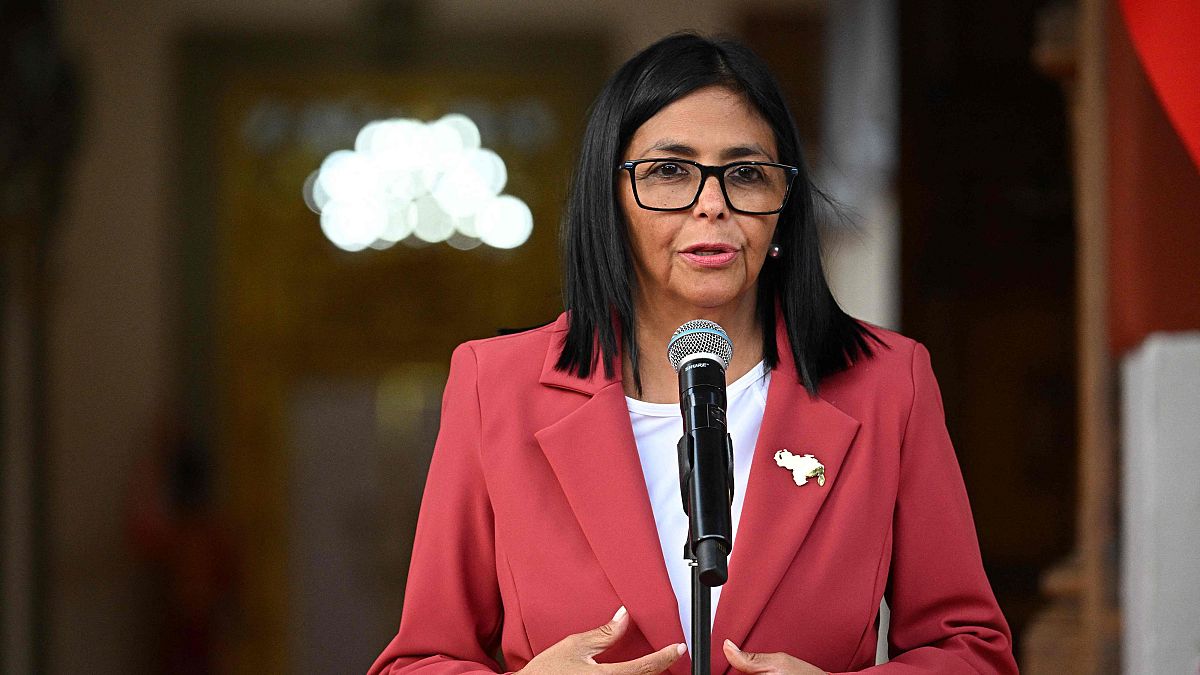
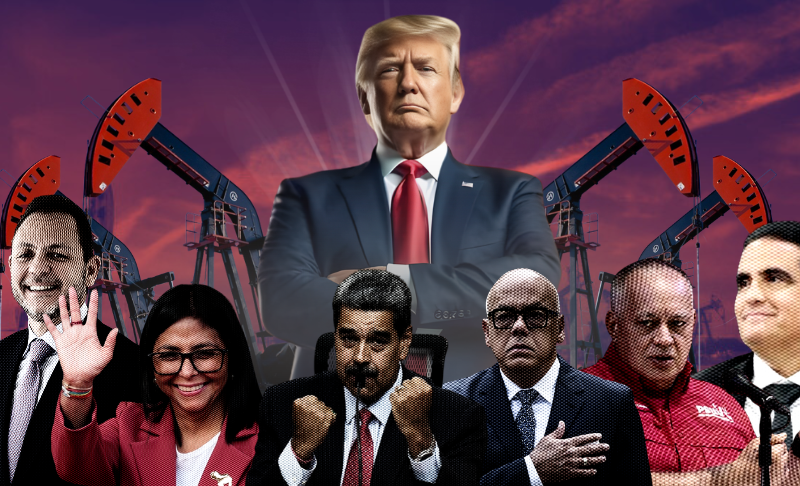
The Venezuelan acting leader called the decision “a step for the normalization” of bilateral relations. (RTVE)
Caracas, April 2, 2026 (venezuelanalysis.com) – The US Treasury Department removed Venezuelan Acting President Delcy Rodríguez from the Office of Foreign Assets Control (OFAC) “Specially Designated Nationals” list on Wednesday, April 1.
Rodríguez had been on the list since 2018. The sanctioned individuals are barred from any sort of economic or financial relationship with US entities and have any US-based assets frozen.
The Venezuelan acting head of state reacted to the decision with a message on her X account, calling it “a step in the direction of normalizing and strengthening relations between our countries.”
Rodríguez added that she is confident this step will lead to the lifting of all sanctions currently in place against Venezuela “in order to guarantee an effective binational cooperation agenda” that benefits both Washington and Caracas. In recent weeks, the Trump administration has issued licenses allowing Western corporations to engage with the Venezuelan energy and mining sectors, but wide-reaching coercive measures remain in place.
The US government targeted Rodríguez in September 2018, Trump’s first presidential term, alleging that the then–vice president was part of a group that contributed “to the destruction of democracy.” The same round of sanctions targeted First Lady and Deputy Cilia Flores, as well as Vladimir Padrino López and Jorge Rodríguez, who respectively served as defense and communications ministers at the time.
Delcy Rodríguez denounced the 2018 measures as “illegal” and “unjust,” arguing that they were part of an “economic blockade” that undermined her country’s right to food, health, and sovereignty.
The Venezuelan leader’s sanctions removal opens the door for direct engagement with US entities and multilateral organizations such as the IMF. Creditors have likewise expressed intentions to launch renegotiation efforts surrounding Venezuela’s sizable foreign debt.
The Trump administration’s move comes on the heels of a fast-tracked rapprochement with Washington that Rodríguez has spearheaded since the January 3 attacks and kidnapping of President Nicolás Maduro. Rodríguez, who took over the acting presidency, has hosted a number of high‑ranking US officials, among them Trump Energy Secretary Chris Wright.
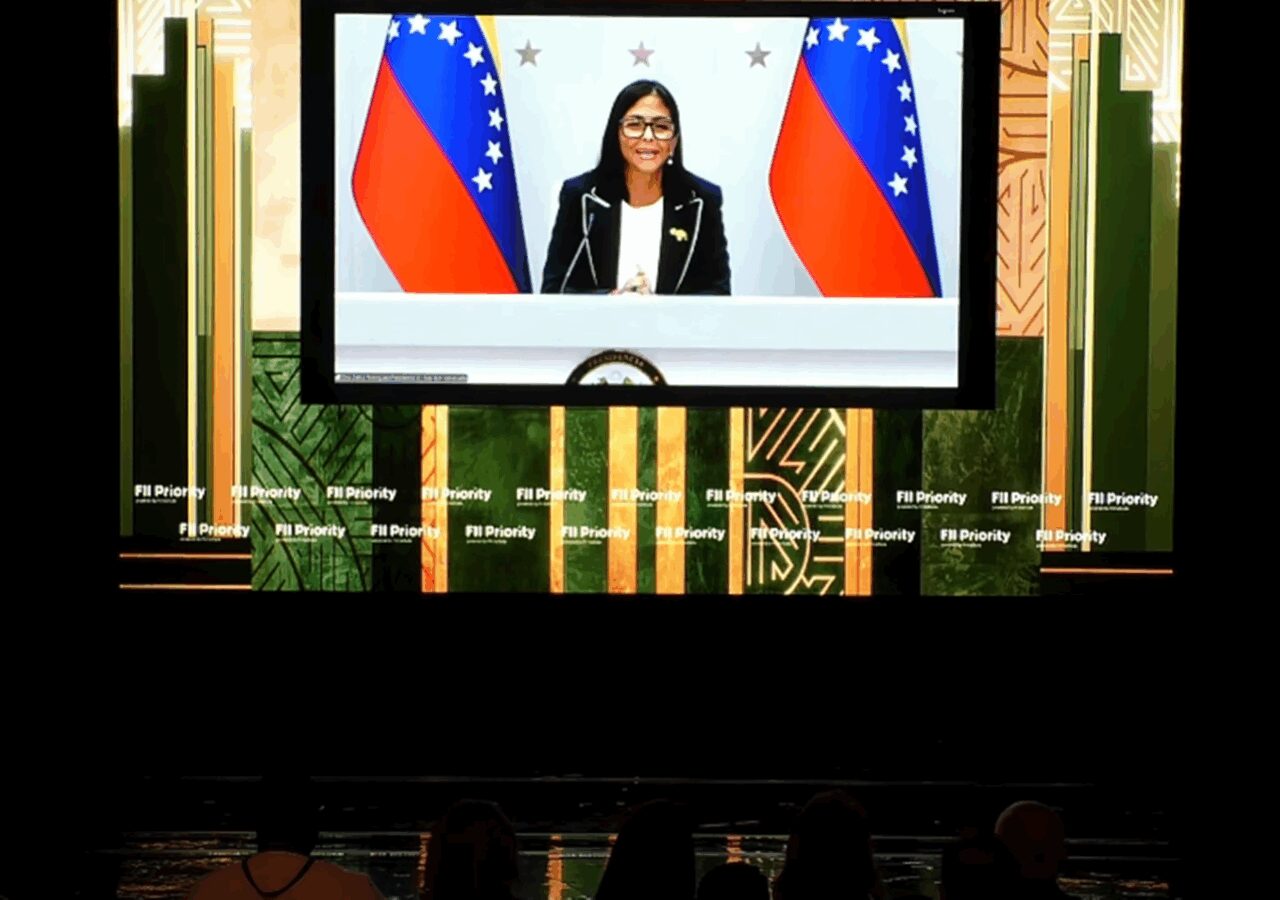
Similarly, last week Rodríguez took part via videoconference in a business gathering in Miami organized by Saudi Arabia’s Future Investment Initiative Institute. During her address, she touted the country’s recent pro-business reforms and urged investors to come to Venezuela.
Caracas and Washington formally reestablished diplomatic ties on March 5, with the Trump administration recognizing the acting president as Venezuela’s “sole” leader days later.
Regaining control of CITGO
The lifting of coercive measures against the Venezuelan acting president raised the possibility of the Rodríguez acting government retaking control of US-based assets that had been frozen and placed under the control of the hardline opposition. According to Reuters, Venezuelan authorities are preparing to take control of the boards of directors of the US subsidiaries of state oil company PDVSA, including refiner CITGO. However, the US State Department must also sign off on the appointments.
This past March, PDVSA’s board ratified Asdrúbal Chávez, cousin of the late Venezuelan President Hugo Chávez, as director of all its US subsidiaries. Nonetheless, Chávez, who was previously denied a US visa to run Houston-based CITGO, has been unable to manage the companies for more than seven years.
CITGO has been administered since 2019 by boards of directors appointed by a defunct Venezuelan opposition‑led National Assembly whose term expired in January 2021. The company, which is Venezuela’s most valuable foreign asset, underwent a long and protracted court-mandated auction to satisfy creditor demands which concluded with a winning bid from vulture fund Elliott Management.
The CITGO sale requires a US Treasury license in order to conclude. The Trump administration has not publicly disclosed whether it will greenlight or halt the ownership transfer.
In 2012, I participated in a United Nations mission in Ethiopia for a technical cooperation event on international trade, which at the time was my area of expertise. Since then, every major development in Venezuela brings me back to that trip, which proved far more revealing than I could have imagined. More than once, I have found myself thinking: this is just like in Ethiopia.
I witnessed firsthand, before it unfolded in Venezuela, that totalitarian systems do not just collapse. They transform in order to survive and advance, as Hannah Arendt argued. Over time, I also came to understand that while authoritarian regimes may promise reform and a democratic transition, without sustained external and domestic commitments those promises tend to dissolve sooner rather than later. This insight is particularly relevant in the current Venezuelan process.
On my way from Addis Ababa airport to the hotel, I noticed large portraits of a politician displayed throughout the city. Thinking of the strongman politics I knew from home, I asked the official accompanying me whether he was the president. “No,” he replied, “the prime minister. He died.” Surprised, I asked why his images were still everywhere. “Don’t these images bother the new one?” “No, because he chose his successor,” came the answer. When I pressed further and asked whether people had voted for him, the response was matter-of-fact: they belonged to the same party, and parliament had selected him.
In those few days, I caught a glimpse of what Venezuela would later experience between 2013 and 2019, after Chávez died and his handpicked successor Maduro came to power. I saw a country marked by hunger, where people wandered with a vacant, distant gaze. A look that would later become painfully familiar during Venezuela’s humanitarian crisis. That image contrasted sharply with the ruling elite, visibly prosperous, gathering in luxury hotels and indulging in imported comforts. I saw women collecting firewood to cook because two decades of socialist mismanagement and corruption had destroyed the electrical system. I saw the haze produced by environmental degradation, similar to what would later hang over Caracas. I also observed a strong Chinese presence, already a dominant economic partner and creditor.
During that mission, I came to understand how the ruling system had entrenched poverty, controlled resources, and normalized corruption, not merely as governance failures but as mechanisms of social control. Years later, working from a human rights perspective, I would recognize these patterns as instruments of ideology, repression, and economic, and ethnic exclusion.
His profile seemed ideal: a system-man, with military and security credentials, Western education, and a discourse centered on reform and reconciliation.
I also witnessed the regime’s hostility toward international actors, imposing strict conditions on United Nations operations and limiting the work of officials on the ground. Hearing the likes of Jorge Rodríguez and other Venezuelan representatives threaten Volker Turk this year, the High Commissioner for Human Rights, did not surprise me. I had seen that before, years earlier, in the Horn of Africa.
Now, I return to the phrase like in Ethiopia because, following the US operation to capture Maduro, the proposed plan for stabilization, recovery, and democratization echoes a trajectory that Ethiopia followed over the past decade.
The Ethiopian Delcy
Let’s go back to 2018. A figure from within the ruling coalition, Abiy Ahmed, rose to power after three years of widespread protests and political unrest that led to the resignation of Hailemariam Desaleng. Although it is not clear how much the US and the EU were involved in his rise, he was not directly imposed from outside as has been the case with Delcy Rodríguez, but he was “unequivocally embraced” by the United States and the European Union. Abiy became the media’s darling, who placed their bets on him and promoted the new leader as a reformist capable of modernizing the country.
His profile seemed ideal: a system-man, with military and security credentials, Western education, and a discourse centered on reform and reconciliation. Between 2018 and 2020, Ethiopia experienced a period of remarkable transformation on three fronts: recovering the economy, stabilizing the region and strengthening the rule of law.
The economy grew at an annual rate of around 7 percent, key sectors were opened to foreign investment, and political reforms were introduced, including the release of political prisoners, the return of those in exile, the legalization of opposition parties, and greater press freedom. Women were incorporated into government at unprecedented levels. On the international stage, Ethiopia expanded its diplomatic engagement, signed trade agreements, and most notably reached a peace agreement with Eritrea, which earned Abiy the Nobel Peace Prize.
Political attention from foreign actors is limited, international agendas evolve rapidly, and what might begin as a priority can quickly be overtaken by other crises.
Yet this period of optimism proved fragile. Tensions in 2020 with the Tigray People’s Liberation Front, once part of the ruling coalition, escalated into a full-scale internal conflict. Abiy’s government shifted course and relapsed. The reform process gave way to a reassertion of authoritarian power, along with widespread human rights violations, restrictions on the press, and accusations of war crimes.
The response from the United States and the European Union included targeted sanctions, visa restrictions, suspension of trade benefits, and partial freezes on aid. Abiy’s international image deteriorated significantly, and Ethiopia began to diversify its alliances, strengthening ties with China, engaging with Russia, and expanding cooperation with actors such as Turkey, the United Arab Emirates, and Iran, eventually becoming members of the anti-West BRICS alliance.
Careful with the honeymoonphase
The Ethiopian case offers at least one revealing lesson. External support can facilitate an initial opening and even generate strong economic momentum, but it does not guarantee a democratic transition.
When international commitment weakens before new institutional rules are consolidated, the outcome is often not transformation but reconfiguration. The system adapts to the new reality, but is not replaced or merely revamped. This dynamic reflects a broader pattern in contemporary international politics. Particularly since the costly experiences of Iraq and Afghanistan, external actors have tended to favour reform processes led by internal figures rather than imposing leadership from outside. However, the central challenge lies not in how these processes begin, but in what happens when external support diminishes, which often occurs during the crucial consolidation phase.
Both the United States and Europe tend to operate within relatively short time horizons when supporting political transitions, often between two and four years, three if I revert to an American security and communications expert whom I worked with yet in another career chapter. These timelines are shaped by electoral cycles, budgetary constraints, shifting strategic priorities, and, in the European case, the difficulty of sustaining consensus among multiple states with divergent interests. Political attention is limited, international agendas evolve rapidly, and what might begin as a priority can quickly be overtaken by other crises. The result is a form of strategic fatigue that has been evident in multiple contexts over the past decades.
By contrast, the transitions most often cited as successful (such as those in Chile, South Africa, and Eastern Europe) were characterized by sustained external engagement over much longer periods, often a decade or more, combined with favourable internal conditions. These cases demonstrate that democratic consolidation is not the product of a short window of opportunity, but of a prolonged commitment.
For Venezuela, the implications are clear. The current process may well generate an initial opening, attract investment, and produce early signs of stabilization. But without sustained international engagement beyond the initial phase, there is a risk that the system will stabilize without fundamentally democratizing. The lesson from Ethiopia is not that transition is impossible, but that it is incomplete if the conditions for its consolidation are not maintained.
The real challenge, therefore, is not how the transition begins, but whether it is sustained long enough to transform the underlying structures of power. Otherwise, we may once again find ourselves looking at a familiar outcome and thinking, once again, like in Ethiopia.
Rodríguez connected remotely to the FII Priority conference. (Archive)
Caracas, March 25, 2026 (venezuelanalysis.com) – Venezuelan Acting President Delcy Rodríguez has reiterated calls for foreign investment in the Caribbean nation.
Addressing the FII PRIORITY Miami Summit, Rodríguez showcased Venezuela’s economic growth and lauded the investment opportunities in the country’s vast oil, natural gas, gold, and other mineral resources. The Venezuelan leader highlighted the recent pro-business overhaul of the country’s Hydrocarbon Law and other upcoming reforms as key in generating “flexibility,” “guarantees,” and “security” for investors.
“The new Hydrocarbon Law creates important mechanisms for private sector control over production and commercialization,” Rodríguez said in her video message from Caracas. “It also creates flexible fiscal arrangements and establishes alternative conflict-resolution processes such as international arbitration.”
The acting president added that 64 percent of the price of a barrel is up for “negotiations with investors” in terms of reduced royalties and taxes, as well as dividends.
Approved in late January by the Venezuelan National Assembly, the new Hydrocarbon Law allows the executive to reduce taxes and royalties at its discretion. The reform also grants expanded control to private corporations, curtailing the state’s sovereignty over the industry established under Hugo Chávez under the 2001 Hydrocarbon Law and subsequent reforms.
In her remarks, Rodríguez urged “de-ideologization,” vowing, “regardless of different [political] views, a favorable climate can be created so that investors have the mechanisms so that their investments foster returns.” She added that she has met with representatives from 120 multinational corporations since January.
“Our reforms are a call for investors to participate,” Rodríguez stated. She went on to press for greater Latin American economic integration and for an end to unilateral sanctions against Venezuela, though she refrained from mentioning the US by name.
The Future Investment Initiative (FII) Institute is a non-profit run by Saudi Arabia’s Public Investment Fund and holds regular conferences bringing together business executives, analysts, and political leaders.
Rodríguez’s participation in the Saudi initiative came amid unprecedented energy market volatility as a result of the US and Israeli war against Iran. In spite of strong Venezuelan ties with Iran over the past 25 years, the Rodríguez administration has not taken a firm stance on the conflict, having published and later withdrawn a controversial statement. Caracas expressed solidarity with Qatar and the UAE after Iran retaliated against US military assets in the region.
The Venezuelan leader’s Wednesday message to investors in Miami followed a meeting with business executives at Miraflores Presidential Palace on Tuesday. The companies represented were not disclosed, though Houston-based oil giant Exxon Mobil has confirmed it has a team in Caracas “looking to assess the state of the resource that’s there.”
Rodríguez delivered a similar pitch hailing Venezuela’s natural resource potential and the prospects for foreign conglomerates opened by ongoing reforms. She appealed for the full lifting of sanctions, arguing that US Treasury licenses hurt investor confidence.
Since January, the Trump administration has issued a number of sanctions waivers allowing Western entities to engage with the Venezuelan energy and mining sectors. The licenses block transactions with companies from China, Cuba, Iran, North Korea, and Russia.
Additionally, the Treasury exemptions mandate that all royalty, tax, and dividend payments destined for Venezuelan state entities be deposited in US-run accounts. Washington currently controls Venezuelan oil proceeds, having returned a reported US $500 million, out of an initial $2 billion agreement, to Caracas.
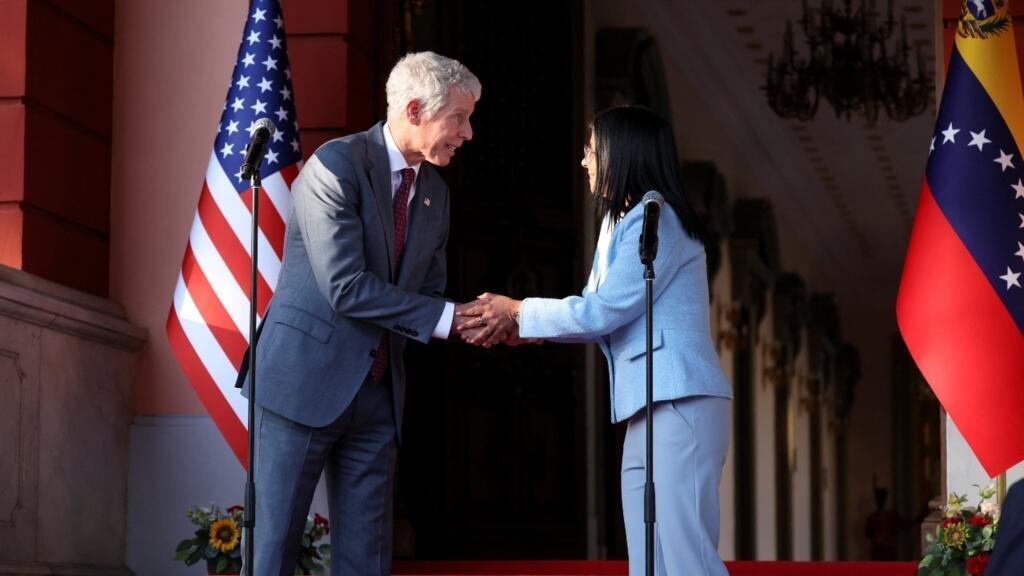
On Tuesday, Rodríguez likewise announced the imminent departure of a Venezuelan diplomatic mission to Washington. Félix Plasencia, slated to become the country’s ambassador to the US, will lead the delegation.
“Our delegation will manage this new stage of diplomatic relations and dialogue between our two countries,” she affirmed.
Caracas and Washington fast-tracked a diplomatic rapprochement in the wake of the January 3 US attacks against Venezuela and kidnapping of President Nicolás Maduro and First Lady Cilia Flores. The two governments reestablished diplomatic relations in early March after a seven-year hiatus. The Trump administration went on to recognize Rodríguez as Venezuela’s “sole leader” days later.
Rodríguez, who had served as vice president since 2018, assumed the presidency in an acting capacity on January 5 with the endorsement of the Venezuelan National Assembly and Supreme Court, which declared Maduro’s absence as temporary.
Maduro and Flores pleaded not guilty to charges including drug trafficking conspiracy and will have a court hearing on Thursday. US officials have not presented evidence to sustain reiterated “narcoterrorism” accusations against Venezuelan leaders, while data from specialized agencies has found Venezuela to play a marginal role in global narcotics trafficking.
Behind a network of fake YouTube newscasts spreading propaganda in favor of Venezuela’s acting president, Delcy Rodríguez, lies a hidden digital structure made up of dozens of websites and social media accounts. It is a much larger and still-active operation than initially believed, designed to distribute content as if it came from independent regional outlets.
In two previous reports, Cazadores de Fake News named this influence operation “Hispan Online.” The first revealed part of the network of YouTube channels whose videos appeared as ads on Venezuelan screens, pushing narratives favorable to the Rodríguez administration. The second report confirmed that the “anchors” were not journalists, but more than 20 actors living in Argentina who were hired through an intermediary agency. The videos racked up millions of views.
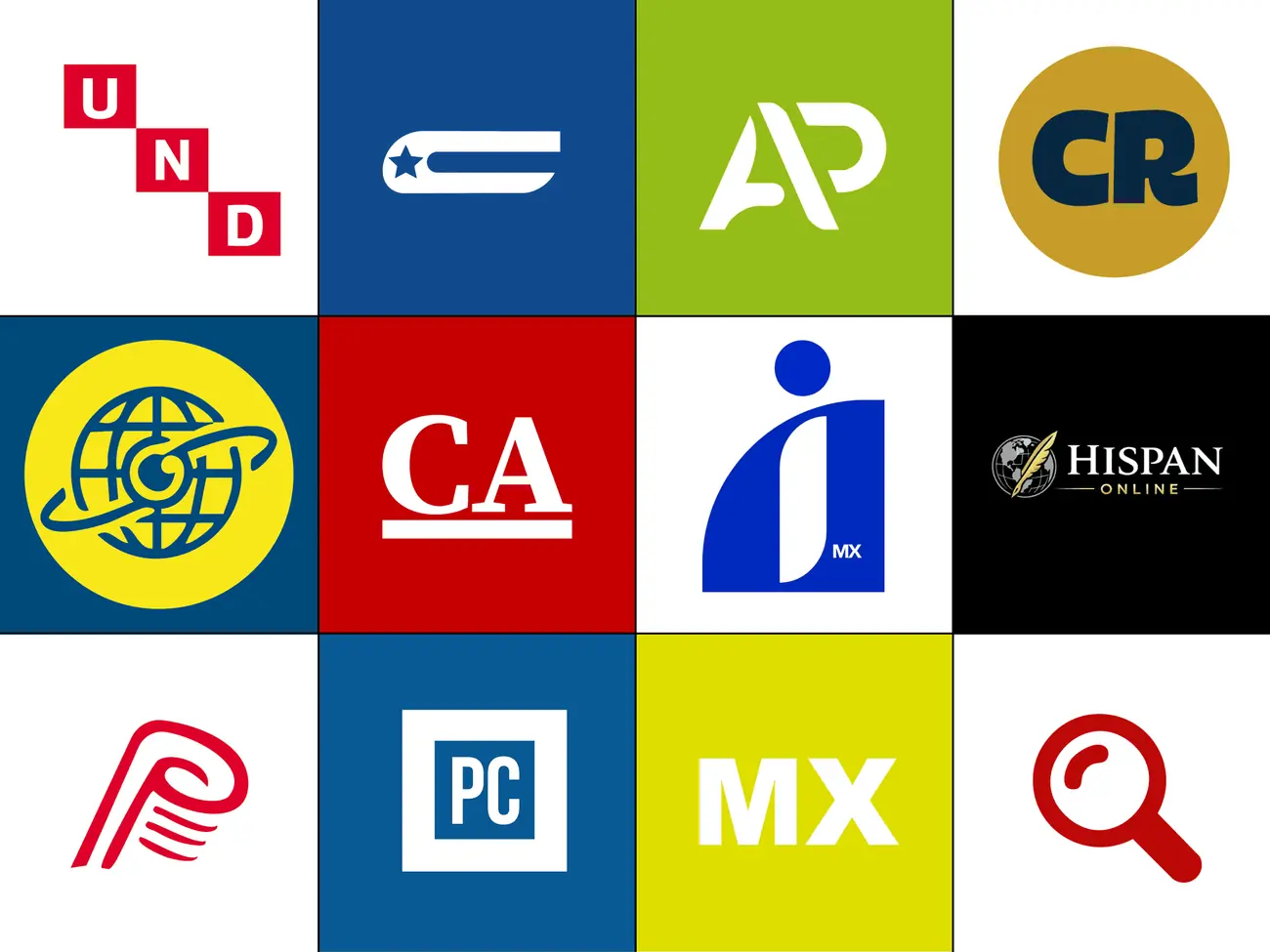
The channels mimic Spanish-language news outlets, presenting their content as if it were multiple spontaneous local coverages. So far, Cazadores has identified: Hispan Online (the most prolific producer and the network’s central amplification node), Nación Argentina, Colombia Actual, Panorama Colombiano, La Perspectiva Global, México en Datos, Informe Mexicano, United Data News, Continental Report, Nación Digital MX, Chile en Datos, Argentina en Perspectiva, EC En Análisis, and El Informe Europeo. All of them are part of the network identified so far as the YouTube arm of the operation.
Logos of 12 of the “Hispan Online” network’s YouTube channels.
But Venezuelans exposed to those videos are largely unaware that the operation extends far beyond YouTube. At least 30 websites were created as part of it, publishing more than 11,000 articles in just one month. Each site links to Instagram, Facebook, and YouTube accounts bearing the same names as the fake newscasts.
Domain records for some of these websites identify QSocial, an Argentine political communications firm, as the registrant of several of them. A separate investigation by La Nación points in the same direction.
YouTube channels as the tip of the iceberg
The propaganda videos promoted through YouTube ads amassed millions of views, but the 14 channels that initially hosted them hardly resembled real news outlets. Most displayed little more than a logo, and their videos were often not publicly listed.
Some channels, however, included short descriptions and, in some cases, a website address—such as colombiaactual.co for “Colombia Actual” and nacionargentina.info for “Nación Argentina.”
Ongoing monitoring of F. G. Medios S.A. (the company that paid for the YouTube ads) through Google’s Ads Transparency Center led to the identification of 30 distinct YouTube channels. Together, they published at least 90 videos and amassed more than 47.5 million views. Following the pattern of the web addresses, additional associated sites were expected: Manual searches confirmed 30 corresponding websites.
At least five of these sites embedded YouTube playlists or windows featuring the same fake “journalists” seen in the ads.
Screenshots of four websites from the “Hispan Online” network.
All 30 domains with known registration dates were created within just nine days, between February 17 and 25, 2026. Fourteen were registered on February 20 alone. This pattern mirrors the creation of the YouTube channels, which appeared between February 18 and early March. The clustering of dates is one of several technical indicators of coordination in this influence operation.
The sites also share a common technical architecture. All run on WordPress, use Cloudflare servers, were registered via Dattatec or DonWeb, use themes developed by Ansar, and have the same Jetpack plugin installed. Articles across all sites are published by the same three WordPress users: “administrador,” “periodista 1,” and “periodista 2.”
This is not a network of independently built websites. It is a single model replicated 30 times and operated by the same group. In total, the network includes more than 90 social media accounts: 30 YouTube channels, 32 Instagram accounts, and 29 Facebook pages. As of publication, most have minimal activity and almost no followers—but the infrastructure is in place and regularly updated.
Venezuela content stands out
With 30 active websites identified, the next step was to analyze their content. Reviewing each article manually was not feasible at that scale.
To do so, Cazadores de Fake News developed a tool—with assistance from generative AI—capable of automatically downloading all articles published across the 30 sites, including full text and images. The result was a database of 11,391 articles produced in just one month.
While most articles are not about Venezuela, it is the most frequently referenced country. With 1,912 pieces, Venezuela accounts for 16.79% of all content, ahead of Brazil (14.30%), Colombia (8.83%), Mexico (8.79%), and Argentina (8.12%). The rest covers other countries, helping each site appear as a regional outlet with its own editorial agenda.
Much of the Venezuela-related content mirrors the narratives promoted in the YouTube ads: favorable coverage of Delcy Rodríguez and her brother Jorge Rodríguez (who presides the Venezuelan parliament), reporting on the new amnesty and hydrocarbons laws, and stories highlighting positive economic projections and the oil sector.
Screenshots of related articles published across “Hispan Online” websites.
The analysis also revealed another pattern: the same article often appeared across multiple sites with different headlines and slight rewrites tailored to each country, but with nearly identical core narratives. It is a form of serial production, where one base story is rewritten and redistributed to simulate independent local coverage.
One example is coverage of joint ventures between PDVSA and US oil companies. Articles published on March 16–17 across republicahoy.do, pulsonacional.mx, and panoramabrasil.info repeat identical figures (250,000 barrels per day, 22% of national output) while adapting their framing. The Dominican version adds references to Caribbean fuel prices. The Mexican version mentions the Dos Bocas refinery and the Energy Ministry. The Brazilian version refers to the Palácio do Planalto and investment opportunities for Brazil.
The texts share repeated transitional phrases—“in this context,” “on the other hand,” “diante deste cenário”—and identical section structures. The Brazilian version also contains errors suggesting automated translation, such as “empresas americana” instead of “americanas” and leaving “barriles” untranslated.
Although headlines and wording vary, these articles share one constant: they use exactly the same featured images. By comparing images across all 11,391 articles, the tool identified hundreds of such clusters. Contents largely consist of one base story, adapted and republished across multiple sites with the same photo.
Articles published across multiple websites show minor variations tailored to different national audiences.
This is the first time Cazadores de Fake News has documented evidence suggesting the use of automation or generative AI to sustain an influence operation of this scale targeting Venezuelan audiences. Producing more than 11,000 articles in one month, localized by country and language, would have been unfeasible for a small team of human writers.
The websites have so far attracted little traffic. But the infrastructure is active, content continues to be published, and the material already looks credible enough to be mistaken for real journalism.
The trail leads to QSocial
Despite the scale of the operation (30 websites, three social media platforms, and thousands of articles) those who registered the domains left traces. At least five domains lacked privacy protection, exposing registrant names and emails.
Two Dominican domains—diariocaribedigital.do and republicahoy.do—were registered on February 20 at the exact same second. Their records list “QSocial” as the registrant. These are different names pointing to the same corporate ecosystem.
Multiple websites in the network list QSocial or QSN Big Data—names tied to the same Argentine political communications firm—as their registrant.
QSN Big Data and QSocial are names used by the same Argentine political communications firm, which has also operated as QSocialNow. According to a March 23 investigation by La Nación, the company—led by former Chubut governor Martín Buzzi—produced the fake newscast videos. The outlet reported that the videos were recorded at the company’s offices in Buenos Aires, where actors were recruited through a casting process.
The firm also has a documented history within Venezuela’s propaganda ecosystem. After the July 2024 presidential election, it produced a poll under the name QSocialNow backing a decision from Venezuela’s Supreme Tribunal to declare Nicolás Maduro the winner, despite widespread independent evidence of electoral fraud.
All domains in the network were registered through the same Argentine provider, within the same time frame, and using the same servers. However, this investigation could not determine whether QSocial itself entered the domain registration data or whether it was done by a third party.
Cazadores de Fake News and Argentine fact-checking outlet Chequeado contacted QSocial for comment. The company had not responded at the time of publication (March 24).
An unprecedented operation in Venezuela
Although QSocial director Martín Buzzi denied involvement to La Nación, the technical records documented in this investigation and the newspaper’s sources point to the same company. Who commissioned the operation and how it was financed remain unanswered questions.
It is also unclear whether the thousands of articles about Argentina, Mexico, Brazil, and other countries are merely camouflage for the pro-Rodríguez campaign or part of parallel influence operations using the same infrastructure.
There is no recent precedent in Venezuela for an influence operation of this scale deployed in such a short period.
Before Google, Meta, or the operators themselves took down most of the YouTube channels and 15 Instagram accounts, the propaganda videos had already surpassed 47.5 million views. At the time of publication, all Facebook accounts and the 30 websites remain active.
Commander of the Presidential Guard, head of Military Counterintelligence (DGCIM), and now Minister of Defense. The meteoric rise of General-in-Chief Gustavo Enrique González López in the 75 days since January 3 is only comparable to Delcy Rodríguez’s own improbable ascent to Venezuela’s presidency.
In less than three months, González López went from leading the Bolivarian Intelligence Service to commanding the Armed Forces and becoming one of the most powerful figures in the Venezuelan government. His appointment points in several directions: counterbalancing Diosdado Cabello’s power (no longer an ally) in the monopoly of force; shielding the acting president from enemies within chavismo itself; and building a loyal enforcement structure for the new ruling clan.
Amid celebrations of Venezuela’s victory in the World Baseball Classic on March 18, Rodríguez seized the moment to overhaul her cabinet. One of the most radical moves was the dismissal of Vladimir Padrino López, the longest-serving minister in the chavista cabinet. After 12 years at the helm of the Defense Ministry, he will hardly be remembered for defending the nation.
Although rumors had long suggested that Padrino López would soon step down, the selection of his successor caught observers off guard.
There were strong reasons to replace Vladimir Padrino López.
Replacing Padrino with González López raises several questions:
What role will he play in a power structure divided among four family-based factions, consisting of Diosdado Cabello, the Rodríguez siblings, the Chávez family, and the Maduro-Flores clan?
If this marks a new political moment, why recycle officials from the Chávez and Maduro governments?
What is the point of US sanctions if the acting president rewards sanctioned officials with key posts?
Does his appointment guarantee impunity for human rights abuses committed under his command?
And, since it came after official visits from the CIA director and the head of US Southern Command, does it have Donald Trump’s backing?
Neither hero nor martyr
Before examining why González López was chosen, it is clear there were several reasons to replace Padrino López.
On January 3, 2026, when US forces bombed key military infrastructure and captured Nicolás Maduro, the Venezuelan Armed Forces offered no resistance. The attack left 83 dead among those guarding Maduro, including 32 Cubans, while US forces only reported minor injuries. There was no troop mobilization afterward to restore order or deter further attacks.
Padrino appeared only hours later in a solitary video, declaring: “The Bolivarian National Armed Forces inform the world that the Venezuelan people have been the victims of a criminal military aggression by the United States.”
Days later, he justified his inaction bluntly: “It would have been a massacre if we had confronted the Americans.”
When Delcy became the acting minister of petroleum, she appointed González López to a tailor-made role at PDVSA overseeing strategic affairs and production control.
This was not his only failure. In 2021, the FANB lost the so-called Apure war, an operation aimed at expelling FARC dissidents from Venezuelan territory.
The Colombian guerrillas killed 17 Venezuelan soldiers and kidnapped eight more to force negotiations that allowed them to remain in the country. By January 2022, the ELN had finished the job the FANB could not, pushing FARC factions out of the border region.
Nor did the Defense Ministry respond to US attacks on more than 20 Venezuelan vessels in the Caribbean. US tactical teams seized at least eight oil tankers without any naval reaction from Venezuela. Padrino also failed to deploy troops to prevent Maduro’s blatant presidential election fraud on July 28, 2024.
Beyond his rank and decorations, Padrino leaves behind another legacy: signing Resolution 008610, which authorizes the use of “firearms or potentially lethal weapons” for public order control.
Why González López?
González López was the first official appointed after Delcy Rodríguez herself. On January 6, 2026, he was named Commander of the Presidential Guard and head of Military Counterintelligence. These roles are clearly designed to protect the new head of state.
Since then, he has been inseparable from Rodríguez: her shadow, her watchdog, the strongman of the Rodríguez clan. His appointment is key to consolidating this new ruling faction. Previous chavista groups had their own enforcers. These are figures with intelligence expertise, coercive power, and influence over security forces and armed groups. González López fills that role for the Rodríguez siblings.
Their Achilles’ heel had been precisely a lack of support from armed elements within the Venezuelan State. For this reason, the Rodríguez siblings could not operate independently from other chavista factions. They had secured economic power and built extensive business ties, including in the oil sector. Rodríguez’s tenure as foreign minister also gave her a broad international network.
The rise of González López could even foreshadow a purge to both consolidate Delcy’s power and polish the image of a criminalized State.
González López has been close to her since at least 2018, when as vice president she oversaw SEBIN, then led by him.
In 2024, when Rodríguez became the acting minister of petroleum, she appointed him to a tailor-made role at PDVSA overseeing strategic affairs and production control. Such position combined security and operational authority.
González López has therefore become Delcy’s trusted operator, the man that can enforce her orders.
At the same time, chavismo has spent 26 years building a system of power rooted in complicity, which explains the constant recycling of officials. Even if the Rodríguez faction wanted to break away, it cannot fully detach from that structure without risking collapse. It still lacks independent foundations.
Blessed and lucky
After overseeing more than 2,000 arbitrary detentions in 2024 as head of SEBIN, being identified as one of Maduro’s torture chiefs, and linked to the deaths of political prisoners, González López has not been punished. He has been promoted.
His appointment disregards warnings from human rights groups and signals that the regime’s institutional chain remains intact—one of chavismo’s enduring strengths. If prosecutions ever come, they will likely follow the familiar script: a few scapegoats.
His rise could even foreshadow a purge to both consolidate Rodríguez’s power and polish the image of a criminalized State.
As the architect of the Operation for the Liberation and Protection of the People (OLP), González López has already demonstrated a zero-tolerance approach to crime. In practice, that policy led to the killing of young men in poor neighborhoods under the banner of law enforcement.
Could Rodríguez appoint a defense minister of this magnitude without a green light from Washington?
His profile aligns with hardline anti-crime and anti-migrant approaches promoted by US policy in recent years, which could appeal to sectors in Washington.
This may help explain why he appears to have received approval from Donald Trump’s team. Could Rodríguez appoint a defense minister of this magnitude without a green light from Washington? Perhaps not. While not every minister requires it, Defense almost certainly does.
Other signs point in that direction: González López appeared as host during John Ratcliffe’s visit (Trump’s CIA director) and was part of the delegation that met US Southern Command chief General Francis L. Donovan. There have also long been rumors of his role as a US intelligence informant. Which is unsurprising, given that intelligence and repression are his specialties.
For now, sanctions imposed under Barack Obama and accusations of crimes against humanity are not part of Venezuela’s new political moment, as Delcy Rodríguez has labelled it.
After two months, the new era seems to prioritize “stabilization, economic recovery, and political transition.” Not human rights, not justice.
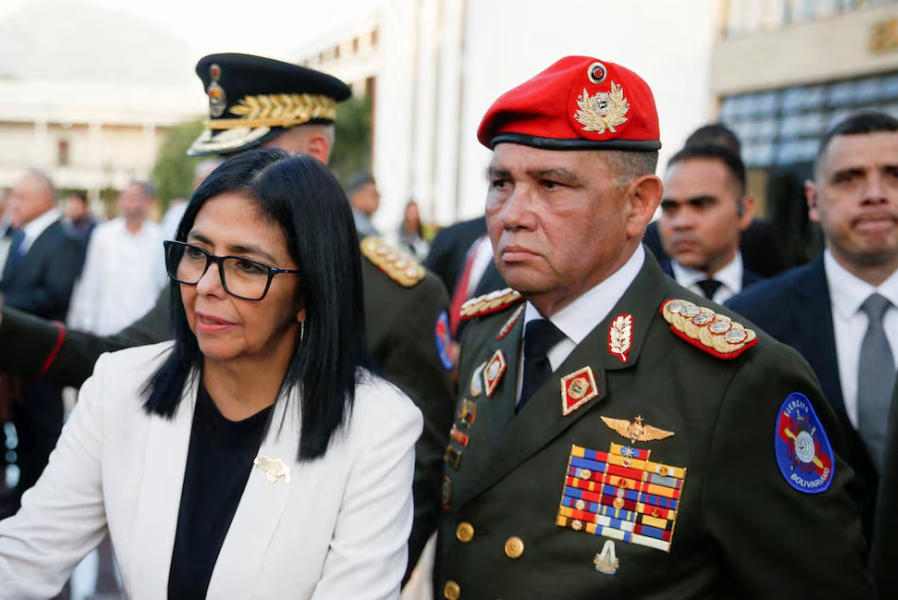
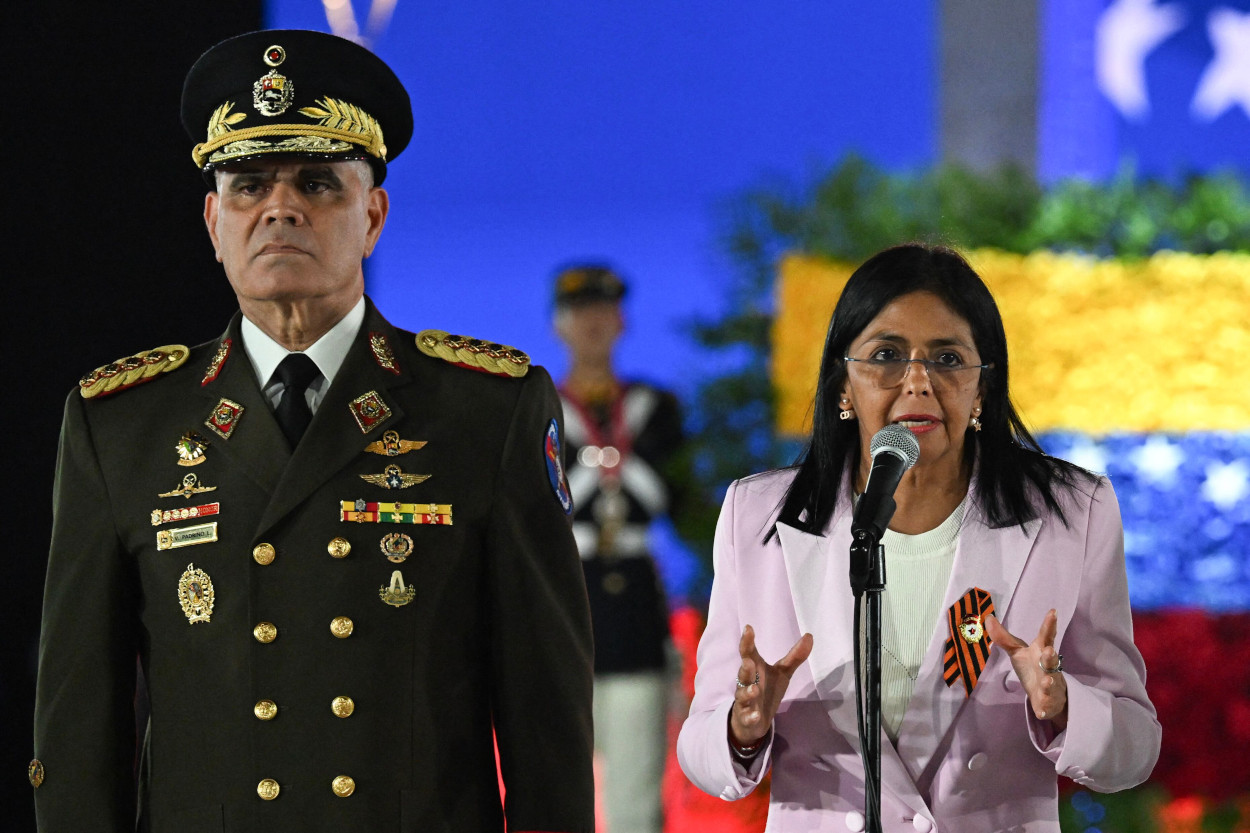
Acting President Delcy Rodríguez (right) thanked Padrino López (left) for his service as defense minister. (AFP)
Caracas, March 19, 2026 (venezuelanalysis.com) – Venezuelan Acting President Delcy Rodríguez tapped Gustavo González López as the country’s new defense minister on Wednesday, replacing Vladimir Padrino López after more than a decade in the post.
“We thank General Vladimir Padrino López for his loyalty and for having been the first soldier in the defense of our country for so many years,” Rodríguez wrote on social media. In response, Padrino thanked the acting president and stated that “serving the Homeland” had been his “highest honor.”
Padrino had served as defense minister since October 2014. The four-star general staved off a number of US-backed coup attempts, including the May 2020 “Operation Gideon” failed mercenary invasion.
In 2025, the Biden administration announced a $15 million bounty for information leading to Padrino’s capture as part of a “narcoterrorism” indictment against several Venezuelan leaders, including President Nicolás Maduro. However, US officials have not presented evidence tying Venezuelan high-ranking officials to narcotics activities.
Padrino’s removal follows the January 3 US military strikes against Venezuela that saw special forces kidnap Maduro and First Lady Cilia Flores. Despite months of defense exercises in the face of escalating US threats, Venezuelan forces, particularly air defenses, were quickly neutralized by US bombing and electromagnetic warfare on January 3.
The Venezuelan armed forces have yet to offer a complete account of the operation, including a definitive list of casualties that are said to surpass 100. Padrino condemned the US attacks and pointed to Washington’s military superiority, arguing that it would have been “suicidal” for Venezuelan air force jets to take off and engage with the enemy.
The 60-year-old Gustavo González López previously held posts as interior minister and director of intelligence services and has been under US sanctions since 2015. A career military officer, he briefly studied at the School of the Americas in the early 1990s.
Following the January 3 attacks, González was chosen by Rodríguez to lead the presidential guard. He was pictured alongside the acting president during a visit to Caracas from CIA Director John Ratcliffe on January 16. General Henry Navas will replace González as Commander of the Presidential Guard of Honor.
Rodríguez announced several other cabinet changes on Wednesday. She had previously replaced the industry, oil, tourism, healthcare, communications, and eco-socialism ministers as well.
Jorge Márquez and Rolando Alcalá will take over the housing and electricity portfolios, respectively. Furthermore, Supreme Court magistrate Carlos Alexis Castillo will serve as labor minister amid rising demands for minimum wage increases and labor rights, replacing veteran official Eduardo Piñate.
Former Caracas mayor Jacqueline Faría was likewise appointed as the new transport minister, replacing Aníbal Coronado after two months in the post. Faría’s appointment followed a public transportation strike in Caracas as private bus operators push to increase single-ride fares to 120 bolívars, roughly US $0.25 at the present exchange rate.
Wednesday’s cabinet changes also included Raúl Cazal becoming culture minister, replacing Ernesto Villegas, who had held the post since 2017. Villegas is one of the candidates shortlisted by the Venezuelan National Assembly for the vacant ombudsman post.
Finally, Rodríguez picked academic Ana María Sanjuan as minister of higher education, replacing Ricardo Sánchez. A trained psychologist and professor at the Central University of Venezuela (UCV), Sanjuan had participated in political dialogue initiatives as a representative of moderate opposition sectors.
For years, the legal fight over Venezuelan assets abroad turned on one basic question: who does a foreign government recognize as the person entitled to act for Venezuela? In the United States, that question once pointed toward the opposition-led structure tied to the 2015 National Assembly and, before that, Juan Guaidó. After Guaidó fell, Dinorah Figuera became the head of what remains of that 2015 Assembly, the Comisión Delegada. Through that entity, the opposition continued trying to preserve control over foreign assets such as Citgo and funds held abroad.
Reuters reported in 2023 that the new opposition leadership under Figuera moved to oversee foreign assets, including Citgo and gold held at the Bank of England. During the Biden administration, the State Department likewise said in January 2023 that it would continue to recognize the democratically elected 2015 National Assembly as the last remaining democratic institution in Venezuela.
That is no longer the key US posture. In March 2026, the US government formally told a federal court in New York that the United States is recognizing Delcy Rodríguez as the “sole Head of State, able to take action on behalf of Venezuela.” The filing relied on the State Department’s March 5 statement normalizing relations with Venezuela under Delcy Rodríguez and on President Trump’s public remark that the United States had “formally recognized” the Venezuelan government. That is the legal pivot. Once Washington says who it recognizes as Venezuela’s head of state, US courts and agencies do not get to run their own foreign policy.
This is why the debate about Delcy’s legitimacy under Venezuelan domestic law, while politically important, is not the decisive question in New York, Delaware, Texas, or Washington. The majority of Venezuelan lawyers believe that Delcy Rodríguez is illegitimate. I am not arguing otherwise. However, under US constitutional law, recognition of a foreign sovereign belongs exclusively to the President of the United States.
The recognition question has shifted sharply in Delcy’s favor, even if some operational steps are still controlled by licenses, sanctions, and pending litigation.
In the case Zivotofsky v. Kerry, decided in 2015, the US Supreme Court said exactly that: the President has the exclusive power to grant formal recognition, and the nation must speak with “one voice” on that subject. Older US Supreme Court cases say the same thing in slightly different words. The practical result is simple: if the President recognizes one person as the one entitled to act for a foreign state, US courts (federal and state courts) generally follow that determination.
So, does that mean Delcy now controls Citgo? As a matter of US recognition law, the answer is yes, in the sense that authority now runs through the person Washington recognizes, not through whichever Venezuelan faction lawyers or commentators prefer. But there is one important practical wrinkle: Reuters reported that Delcy’s team still needs US Treasury clearance to take over Citgo’s US subsidiaries, and Citgo also remains entangled in ongoing court proceedings. In other words, the recognition question has shifted sharply in Delcy’s favor, even if some operational steps are still controlled by licenses, sanctions machinery, and pending litigation.
England works in much the same way. In the Bank of England gold litigation, the Supreme Court of the United Kingdom held that recognition of foreign heads of state is a matter for the executive, not the courts. The Court called this the “one voice principle”: English courts must accept the executive’s recognition position as conclusive. That is why the courts treated Juan Guaidó as the recognized head of state when the UK government recognized him. The logic is straightforward. English judges do not decide who truly won the constitutional struggle in Caracas. They follow the position taken by His Majesty’s Government.
If London does the same, the same logic will likely carry over to Venezuelan assets in England, including the gold dispute.
That is also why there is no serious legal basis for pretending that personal politics can change the answer. A lawyer may dislike Delcy Rodríguez. Another may dislike Dinorah Figuera. Someone else may prefer Edmundo González. None of that changes the recognition rule. On this issue, legal analysis is supposed to be colder than politics. If Washington recognizes Delcy, US institutions will generally treat Delcy as the person entitled to act for Venezuela. If London does the same, the same logic will likely carry over to Venezuelan assets in England, including the gold dispute. The law here is not about who we admire or dislike. It is about who the executive power of the US recognizes. Nothing else.
One last point matters. I have not found any official UK statement, as of now, publicly recognizing Delcy Rodríguez in the same clear way the United States has. A January 2026 statement by the UK Foreign Secretary referred to her as “acting President” and urged democratic steps, but it did not announce the kind of formal recognition statement the UK issued for Guaidó in 2019.
So the US conclusion is already here. The English conclusion depends on whether London takes that additional recognition step.
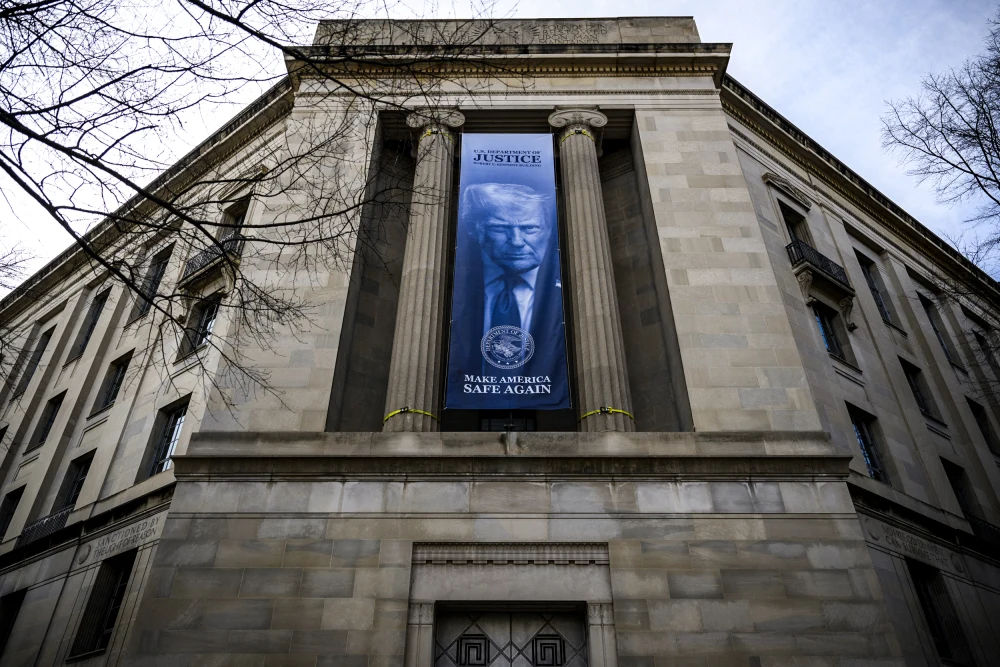
The US Justice Department reiterated its non-recognition of Maduro since 2019 ahead of a March 26 hearing. (AFP)
Caracas, March 13, 2026 (venezuelanalysis.com) – Venezuelan Acting President Delcy Rodríguez welcomed on Wednesday the formal recognition granted by the United States government to her administration as the South American country’s “sole” and legitimate authority.
Rodríguez argued that Washington’s decision goes beyond any individual figure or government.
“It is not recognition of a person or a government; it is recognition of a country so that it is able to recover its life,” she said during a televised broadcast, referring to the impact of wide-reaching US unilateral coercive measures imposed since 2015.
The Venezuelan leader affirmed that the diplomatic move could help advance “national unity” and contribute to the “normalization” of the country’s political, economic, and social life. “What matters to me is that this can bring a process of reordering and normalization,” she added.
The recognition was communicated by Manhattan US Attorney Jay Clayton in a “statement of interest” addressed to federal Judge Sarah Netburn. Clayton is likewise heading the prosecution in the US Justice Department’s case against Venezuelan President Nicolás Maduro.
Maduro was kidnapped by US special forces alongside First Lady Cilia Flores on January 3 during a military operation. The pair has pleaded not guilty to charges including drug trafficking conspiracy and will face a hearing on March 26. US officials have not provided evidence tying Venezuelan high-ranking officials to narcotics activities, while specialized reports have consistently found Venezuela to play a marginal role in global drug trafficking.
Clayton’s missive referenced a letter from State Department official Michael Kozak which identified Rodríguez as Venezuela’s “sole Head of State.” Kozak’s letter expressed the Trump administration’s argument that the recognition will help advance US interests in the Caribbean nation.
Trump publicly acknowledged Washington’s recognition of the Venezuelan government for the first time during the Shield of the Americas Summit on March 7. The White House argued that its stance would contribute to Venezuelan stability and economic recovery, as well as create the conditions for “a peaceful transition toward a democratically elected government.”
Caracas and Washington reestablished diplomatic ties on March 5 and have taken steps to reopen their respective embassies and consulates. The Maduro government severed ties with the first Trump administration in 2019 when the latter recognized then–National Assembly president Juan Guaidó as Venezuela’s “interim president.”
Kozak reiterated in his letter that since January 23, 2019, the US has not recognized Maduro as Venezuela’s head of state and that this position had not changed.
“Maduro is an accused narco-terrorist awaiting trial in a US federal court for his crimes,” the document read. The Venezuelan president’s defense team is expected to argue that Maduro should be entitled to immunity from prosecution as a sitting head of state.
Washington’s formal recognition of the acting government in Caracas could also have implications for Venezuelan assets abroad. Since 2019, several bank accounts and US-based Venezuelan refiner CITGO have been frozen or under the control of the US-backed opposition.
The White House’s move will also pave the way for renegotiations surrounding Venezuela’s sizable sovereign debt, with creditors eager for a potential windfall after buying defaulted bonds at very depressed prices.
While Clayton’s address identified Rodríguez as the only person “able to take action on behalf of Venezuela,” US authorities have not clarified whether the Venezuelan government will retake control of its US-based assets.
In addition, the Justice Department attorney declined to take a position regarding “which counsel is authorized to represent certain Venezuelan state-owned entities.” On Thursday, Judge Netburn requested further clarification from the administration regarding the representation of Venezuelan interests before US courts before March 26.
In her Wednesday address, Rodríguez went on to acknowledge “daily exchanges” with US counterparts and expressed “gratefulness” for the reestablishment of trade relations. The acting president stated that Venezuela has imported medical equipment and medicines from US companies in recent weeks.
Since early 2026, the Trump administration taken direct control of revenues generated by Venezuelan oil exports, depositing funds into accounts held by the US Treasury. Around a quarter of an initial US $2 billion crude sale agreement has reportedly been returned to Caracas.
Recently issued US licenses allowing transactions in the Venezuelan oil and mining sectors likewise mandate that proceeds be deposited in Treasury-run accounts.
US officials have claimed that Venezuelan authorities need to submit a “budget request” to access the country’s funds and will only be allowed to import goods and services from US manufacturers.
Edited and with additional reporting by Ricardo Vaz in Caracas.
Six days after the commencement of Operation Epic Fury, President Trump took to Truth Social to announce, in the context of the ongoing joint American-Israeli military campaign against the Islamic Republic of Iran: “There will be no deal with Iran except UNCONDITIONAL SURRENDER!” In the same post, the president seemed to equate such “unconditional surrender” with “the selection of a GREAT & ACCEPTABLE Leader” to lead Iran, which would enable the country to come back from the “brink of destruction” and emerge “stronger than ever.”
Just three days after announcing “unconditional surrender” as his goal, Trump, speaking on March 9 in Doral, Fla., proclaimed that the end of the war will happen “very soon.” One might be forgiven for experiencing some whiplash — especially because earlier that same day, Trump told Fox News he was “not happy” with Iran’s naming of a new supreme leader, Mojtaba Khamenei. In fact, around the same time he was demanding “unconditional surrender” the prior week, Trump had already called Khamenei the younger “unacceptable.”
What exactly is going on here?
Trump is a conservative nationalist, which means his general approach to foreign policy and his specific foreign policy “excursions” are guided by his view of how best to secure the American national interest. Accordingly, since Operation Epic Fury started, Pentagon press briefings featuring Secretary of War Pete Hegseth and Chairman of the Joint Chiefs of Staff Dan Caine have repeatedly emphasized empirical metrics for measuring success, such as Iranian naval vessels sunk, Iranian air force planes shot down, Iranian ballistic missile silos and launch sites destroyed and so forth.
Trump hasn’t said it explicitly, but the Trump administration’s goal — and thereby, definition of victory — in Operation Epic Fury seems clear enough: the neutralization of Iran as an active, ongoing threat to the United States and our interests. If nothing else, at least, that is how victory in the current campaign should be defined.
That does still raise at least one pressing question, though, especially in the context of exiled Crown Prince Reza Pahlavi’s call to the Iranian people to prepare for “the decisive stage of our final struggle”: Where does that most controversial of foreign policy goals, “regime change,” fit into the puzzle?
At this point, it is undeniable that wholesale regime change is the most desirable outcome for the conflict in Iran. The pursuit of regime change as a goal unto itself is often now disparaged, coming in the aftermath of the failed neoconservative boondoggles earlier this century. But it ought to be axiomatic that there are some foreign regimes that behave in a manner that redounds to the American national interest, and there are some foreign regimes that behave in a manner that is contrary to the American national interest. It is natural and logical that we would wish for the latter types of regime to be heavily reformed or outright replaced — especially with the local populace leading the way.
Perhaps even more to the point: One does not take out a 37-year-ruling despot like Ali Khamenei, as the American and Israeli militaries did in the opening hours of the present operation, and not hope for full-scale regime change. All people of goodwill should be hoping for that outcome — for the Iranian people to rise up like lions and throw the yoke of tyranny off their necks once and for all, delivering a long-sought victory for the American national interest in the process.
But it’s entirely possible full-scale regime change won’t happen. The people of Iran just witnessed tens of thousands of their countrymen brutally gunned down during the anti-regime uprisings of late December and early January. They are an unarmed populace facing Nazi-esque regime jackboots, in the form of the Islamic Revolutionary Guard Corps and the Basij paramilitary.
All of that, then, raises one final question: Is it possible for there to be victory in Operation Epic Fury, and for the Iranian regime to be neutralized as a threat to the United States and our interests, if there isn’t full-scale regime change in Tehran?
In theory, the answer is yes. Venezuela provides a model.
Delcy Rodríguez, the current leader, is a hardened Marxist-Leninist in the mold of her predecessors Hugo Chávez and Nicolás Maduro. But Rodriguez has been fully cooperative with the United States since the astonishing January operation to extract Maduro for the simple reason that she has no real choice in the matter: She remains in power, yes, but only on the condition of an “offer” presented by Trump and Secretary of State Marco Rubio that, to borrow from Vito Corleone in “The Godfather,” Rodríguez “can’t refuse.” Rodríguez has thus been fully cooperative in areas such as American oil extraction and the reestablishment of diplomatic relations with the United States.
In theory, a similar arrangement is possible with a decimated, chastened regime in Tehran. And some experts predict that such an arrangement will characterize the regime in Iran a year or two from now. In practice, however, there is the ever-thorny problem that has frustrated and perplexed Westerners for decades when they attempt to reason with zealous Islamists: They do not fear death. A socialist like Delcy Rodríguez can, ultimately, be reasoned with; an Islamist like Mojtaba Khamenei (or his successor), perhaps not.
The cleanest solution to the Iran quagmire at this particular juncture — and the one that most clearly fulfills Trump’s “unconditional surrender” victory criterion — is indeed full-scale regime change. That is certainly the outcome that would be best for the neutralization of the Iranian threat and the corresponding advancement of the American national interest. I’m far from certain it will happen. But like many, I pray that it will posthaste.
Josh Hammer’s latest book is “Israel and Civilization: The Fate of the Jewish Nation and the Destiny of the West.” This article was produced in collaboration with Creators Syndicate. X: @josh_hammer
A longer version of this piece in Spanish was published on Marisela’s Substack.
After the systemic rupture that the US incursion of January 3 represents, chavismo has embarked on its third great metamorphosis, carrying out a profound reengineering in a context of tutelage and transactional pragmatism. In my view, the Venezuelan State is undergoing a deep transformation rather than facing an imminent transition to democracy. Nevertheless, the government of Delcy Rodríguez is pursuing this transformation with remarkable speed and bluntness.
The survival of the chavista system has required the sacrifice of its original forms, forcing a mutation that uses economic opening as social anesthesia and the sophistication of repression as a guarantee of stability.
From the oil embargo on Cuba to microeconomic measures that we will discuss in the following lines, these milestones are the material proof of a power that has chosen to fill itself with realism, and to sacrifice its traditional epic narrative.
The case of Alex Saab and friends
A most scandalous event over which public officials have remained silent is the alleged arrest of Alex Saab. Saab was removed as Minister of Industries and National Production on January 17. Although Delcy initially presented the move as a departure to assume new responsibilities, it ultimately marked the beginning of his demise in Venezuela. According to reports from The New York Times, La Nación, and Infobae, SEBIN agents detained Saab and businessman Raúl Gorrín, the owner of TV network Globovisión, who has long navigated sanctions and power and lost his media and political shield almost simultaneously with the capture of Maduro. The novel element in this second arrest of Saab is that reports describe an operation carried out with the knowledge and cooperation of the FBI. It would appear that the new leadership in Caracas is willing to hand over key figures to US authorities in exchange for validation and stability.
Both men immediately disappeared from the public radar. Two weeks later, the Spanish broadsheet ABC claimed that the Trump administration has demanded judicial cooperation from Delcy regarding nine figures close or formerly close to the government, including Maduro’s son (known as Nicolasito), Tareck El Aissami (arrested by Maduro in 2024) and, of course, Alex Saab and Raúl Gorrín. The report describes Saab as “the man who knows where the money is.” The dismissal on February 23 of Saab’s wife, Camilla Fabri (appointed vice minister for international communication a year earlier) reinforces the hypothesis of Saab’s detention.
In the mining sector, foreign capital has abandoned concessions due to the absence of minimal infrastructure and the suffocating control of armed groups.
In theory, the US would be seeking access to Saab’s testimony and archives in order to finish dismantling the money laundering and drug trafficking networks surrounding Maduro’s inner circle. Following his arrest in Cape Verde in 2020 and a prolonged legal battle in Florida over his alleged diplomatic immunity, Saab was released and sent back to Venezuela in December 2023 through a complex prisoner exchange. Upon arrival, he was granted a high political profile and appointed president of the International Center for Productive Investment, positioning him as the key operator for attracting foreign capital under sanctions.
The Saab-Gorrín case demonstrates that chavismo’s ongoing metamorphosis involves sacrificing the financiers who helped evade sanctions in previous years. Even after leading an intense campaign for Saab’s release in 2023, National Assembly president Jorge Rodríguez has shown no hesitation in serving in a government that makes him disappear on the orders of a foreign power. Ruling chavismo now seeks to present itself before Trump as a renewed, pragmatic actor and, above all, one unified under a centralized command without visible fractures. The official silence surrounding this issue stems from the fact that the capture of strategic allies buys the Rodríguez siblings time to manage the internal divisions this would inevitably generate.
Supervised economic liberalization
Since early January, the government has accelerated decrees and measures of economic opening that were previously unthinkable, such as the Hydrocarbons Law’s reform. The objective is to accelerate economic timelines in order to demobilize political demands. However, while the government is betting on a rapid economic rebound to pre-empt any possibility of opposition reorganization, a deep gap is beginning to emerge between the rhetoric of hope and the reality of purchasing power, which continues to deteriorate.
To assess the supposed implementation of these measures, I spoke with economist Manuel Sutherland to unpack the speculation that currently dominates public debate. According to his analysis, the exchange rate system has not undergone structural change: the allocation of foreign currency remains discretionary. Financial flows reveal a complex triangulation in which oil revenues are deposited in a fund in Qatar and then routed to an account at the US Treasury Department. From there, major banks acquire foreign currency through auctions restricted to the purchase of American goods. This process, executed in an opaque environment by private banks, occurs alongside discussions of tax exemptions for certain goods, such as vehicles.
Contrary to public perception, there has been no acceleration of privatization, while in the mining sector, foreign capital has abandoned concessions due to the absence of minimal infrastructure and the suffocating control of armed groups. What initially appeared to be a fast-tracked path toward economic recovery under American supervision now seems to be advancing at the same pace as, or even behind, political changes. The dissonance that once represented a danger for democratization (rapid economic liberalization coexisting with political stagnation) is not occurring. On the contrary, the slow economic rebound is unable to keep pace with the acceleration of political dynamics, which has gained renewed vigor through the mobilization of relatives of political prisoners. While the economy remains trapped in inertia and opacity, the political chessboard is being shaken by social pressure that the government appears not to have anticipated in its calculations for stability.
Amnesty and softer repression
By managing to adapt to this new scenario, chavismo shows it retains room of maneuver to ensure its permanence. This continuity is guaranteed by opening strategic pressure valves in response to the two main sources of coercion: internal social pressure and external pressure. The tactical softening of repression manifests itself as an unfolding of chavismo toward more sophisticated forms of exercising power. During the opening of the judicial year, the acting president delivered a striking speech announcing an amnesty law. The timeframe established for the law (1999-2025) functions as a symbolic rupture with the era that precedes her. All of this seeks to project renewed leadership based on the pillars of efficient technocracy and a pacifist façade.
The Amnesty Law thus operates as both a pacification mechanism and a transactional trophy for the Trump administration. A trophy meant to reduce the political cost of external pressure without implying any real dismantling of the repressive apparatus. It is a functional mutation that attempts to stabilize the system through a new version of authoritarian peace that can only be challenged if social pressure and mobilization manage to move beyond the mirage of this merely symbolic rupture.
Venezuela has ended up suffocating Cuba more effectively than the Helms-Burton Act.
However, attempts to “unify” the country through this law have had the opposite effect. Instead of extinguishing the spirit of struggle, it has revived it. On February 6, while the amnesty bill was still being debated, National Assembly president Jorge Rodríguez appeared at an infamous detention center before the mothers of political prisoners who were on vigil. Rodríguez established a novel form of blackmail: if the law were approved within a record seven days, their children could be released. None of this happened. The discussion was delayed, and once the law was enacted, the release process proved extremely slow. In addition, new cases of abductions and disappearances have emerged, while those who have been released leave prison without fear and determined to remain in the streets. None of this had been anticipated by Jorge Rodríguez.
This whole process, which is still ongoing, has brought the tacit recognition of political prisoners, the implementation of mass release measures, and the positioning of political prisoners within the public discourse—an issue the Maduro government always preferred to deny.
Oil embargo on Cuba and sales to Israel
The abrupt halt in crude shipments to Cuba—confirmed through maritime tracking by specialized firms—has also not been officially acknowledged by Venezuela. Reuters has been the leading outlet reporting the drop in shipments. According to its investigations, based on internal documents from the state oil company PDVSA and export data, Venezuela has prioritized cargoes destined for companies such as Chevron in order to secure foreign currency flows, leaving supply to Cuba in operational limbo. What is new? The beginning of a phase of energy suffocation for Havana led by Venezuela.
Despite the evidence of reduced shipments, neither Caracas nor Havana has issued statements acknowledging a suspension. What has been officially reported, however, is the dismantling of Cuban missions in Venezuela. Official Gazette No. 6,885 published decrees ordering the intervention, restructuring, and liquidation of emblematic social programs such as Mission Barrio Adentro and the Housing Mission.
In addition, international correspondents in Caracas, such as Sarah Kinosian, have reported the departure of Cuban medical personnel and military advisers. These reports cite internal sources in ministries and testimony from health workers who have been notified that their contracts are ending and that they must return immediately to the island.
Within a span of only a few minutes, the Venezuelan Foreign Ministry published and then deleted from all its platforms a statement expressing solidarity with the Islamic Republic of Iran following recent bombings.
How long can the rupture between Caracas and Havana remain hidden in discourse? And what implications does it hold for the Latin American left, which has remained silent about Venezuela’s authoritarian drift in order to preserve a utopian narrative? The only official source regarding the oil embargo on Cuba came from Miguel Díaz-Canel, who admitted that “we are going to live through difficult times” and announced a plan to deal with “acute fuel shortages,” acknowledging that no crude has arrived since December. As one of history’s paradoxes, Venezuela has ended up suffocating Cuba more effectively than the Helms-Burton Act.
Another shift that also lacks official confirmation is the presumed resumption of oil sales to Israel, reported only by Bloomberg and maritime tracker Kpler. Although the government has dismissed these reports as fabricated news through its communications minister, the flow of roughly 200,000 barrels toward the Haifa refinery suggests a reality consistent with the scenario of tutelage and its geopolitical ramifications (Venezuela severed relations with Israel in 2009).
The erosion of the anti-imperialist narrative
An episode that occurred on March 1 offers a window into the speed with which the government has decided to push through a compliant policy shift and how it appears to be redefining its strategic ties. Within a span of only a few minutes, the Venezuelan Foreign Ministry published and then deleted from all its platforms a statement expressing solidarity with the Islamic Republic of Iran following recent bombings.
The episode suggests a latent tension between the discursive inertia of certain officials and the logic of tutelage guiding the government’s current decisions. More than a mere coordination error, the incident could be interpreted as a symptom of constant monitoring of Venezuelan foreign policy by the US embassy in Caracas, or of unclear internal guidelines regarding this shift, where preserving negotiation channels with Washington must prevail over historical ideological loyalties.
The novelty of this shift lies not only in the rhetorical distancing, but in the fact that the internal fissure has become visible. For the first time in decades, the opportunity cost of maintaining a symbolic alliance with Tehran appears to be perceived by the political leadership as greater than the benefit of ideological consistency. This exercise in digital cleansing reinforces the hypothesis of a system that will prioritize the stability of financial flows guaranteed by American tutelage over the rhetoric of confrontation, marking a drastic departure from the alliances that once sustained chavismo.
The reality is that there has been a change in governmental behavior. Not only has the government implemented measures that clash with the historic conduct of a regime attached to the ideological agenda of the revolution, but it has also shown clear difficulty in the communication management of these measures. This suggests they may respond to a strategy of obedience to the occupying power while exploiting certain windows of opportunity for remaining in power.
Delcy Rodríguez’s government knows that exposing the measures recently adopted could generate even deeper cracks within the internal structures of chavismo. So now, in many instances, we just have silence.