defense

Why Clayton Kershaw can still be a key part of Dodgers rotation

Before anything, Clayton Kershaw has to believe. Before he can snap off curveballs the way he used to, before he can be a dependable member of the rotation instead of last resort, he has to believe.

Clayton Kershaw believes.

Never mind the mounting evidence to the contrary — the 5.17 earned-run average through his four starts this season, the two starts that weren’t interrupted by rain in which he failed to complete five innings, the unremarkable high-80s-to-low-90s fastball, the career-low strikeout rate.

Kershaw believes he can once again be a contributor on a championship team.

“I just need to put it together for a whole game,” Kershaw said, “which I think I can do and will do.”

Who’s to say otherwise?

He’s looked finished before, and he wasn’t. Even with diminished stuff, he’s found ways to get hitters out, so why should this time be any different?

“I’m gonna bet on him,” manager Dave Roberts said.

For now, at least, Roberts doesn’t have a choice. Tyler Glasnow and Blake Snell remain sidelined. So is Roki Sasaki.

The next man up would be Bobby Miller, who lasted only three innings in his only major league start this season.

In reality, Kershaw also doesn’t have a choice other than to believe. What’s the alternative?

In the wake of a 10-inning, 6-5 victory over the New York Mets on Tuesday night in which he pitched just 4 ⅔ innings, Kershaw’s rhetoric and demeanor were remarkably upbeat. He pointed to his recovery from the knee and foot surgeries he underwent over the winter, as well as his shoulder operation from the previous offseason.

A chart examining the strikeout leaders in MLB history and where Clayton Kershaw stands.

“I mean, physically, I feel great,” he said. “I don’t feel old. My arm feels good. There’s not really any excuses. It’s just pitch better, pitch like you’re capable of. I think the stuff’s there. The stuff’s there to get people out.”

Kershaw was charged with five runs, three of them earned. He gave up six hits and three walks.

“It’s kind of in and out for me,” he said. “I think I’ll go on a stretch of making, like, 10 or 11 good pitches in a row and then just make enough bad ones to get some damage done against me.”

In Roberts’ view, his trademark slider lacked “teethiness.” More problematic was his curveball, which was particularly erratic.

“Can’t just be a two-pitch guy out there, so definitely need to throw my curveball better, for sure,” Kershaw said.

The absence of the curveball prevented Kershaw from putting away batters. He had 14 batters into two-strike counts but managed only two strikeouts while giving up four hits and a walk.

“I know he’s frustrated because he’s getting count leverage with guys and can’t put them away by way of strikeout,” Roberts said. “He’s competing his tail off, but it just hasn’t been as easy as it has been for him prior to this little stretch.”

In Kershaw’s defense, he was let down by, well, his defense.

In the Mets’ two-run five inning, Max Muncy allowed a potential inning-ending double play grounder to skip through his legs. Later, Brandon Nimmo reached base on a train wreck of a defensive play by the Dodgers, allowing the Mets to score and take a 5-4 lead.

Kershaw is 37 now, with more than 3,000 innings pitched in professional baseball. He won’t win another Cy Young Award, and he knows that. The Dodgers know that too, and that’s not what they’re asking of him. What they’re counting on him to do is to take the mound every six or seven days and keep them in games, perhaps take down six or seven innings on occasion to relieve their overworked bullpen.

“I think he’s going to approach each start to give us a chance to win,” Roberts said. “And I don’t know what that looks like each start, but I think that that’s a starting point, and then from that point, as a game goes on, then I’m gonna have to make decisions on what we have behind him.”

Kershaw made an All-Star team just two years ago and started one the year before that. His stuff was almost as diminished then as it is now. He should be able to pitch like that again, and he’s taken a small but critical first step toward doing that. He believes he can.

Source link

Ukraine claims successful strike on Crimean Bridge

A photo made available by the Ukrainian Security Service Tuesday shows people looking at damages caused by an explosion at the Crimea bridge. EPA-EFE/UKRAINIAN SECURITY SERVICE / HANDOUT HANDOUT EDITORIAL USE ONLY/NO SALES

June 3 (UPI) — Ukraine said Tuesday it successfully carried out a military strike on the Crimean Bridge, the culmination of an operation that took several months to execute.

The Security Service of Ukraine, or SBU, posted to Telegram that it struck the bridge, which connects Russia and Crimea, in an underwater attack.

The aquatic assault, the third strike on the bridge by Ukraine, involved SBU agents who mined the bridge’s pillars over a period of several months. The first explosive device was detonated early Tuesday morning, and SBU officials claim no civilians were harmed in the attack.

The SBU said the structure’s submerged support system was “severely damaged at the bottom level,” with the equivalent of over 2400 pounds of TNT used, which ostensibly left the bridge is in disrepair.

SBU Lieutenant General Vasyl Maliuk, who was in charge of the operation, said via the Telegram report that “the Crimean Bridge is an absolutely legitimate target, especially given that the enemy used it as a logistical artery to provide its troops.”

Ukraine also suffered a major attack Tuesday as its president Volodymyr Zelensky posted to social media around an hour after the assault on the Kerch Bridge happened. He posted videos that purportedly showed bodies on the ground of the northeastern city of Sumy and confirmed that three people were killed and many were injured. “The Russians launched a savage strike on Sumy, directly targeting the city and its ordinary streets with rocket artillery. It was a fully deliberate attack on civilians.” said Zelensky.

He did not mention the Kerch Bridge attack in his post.

Source link

Britain announces $20B boost to make armed forces ‘battle ready’

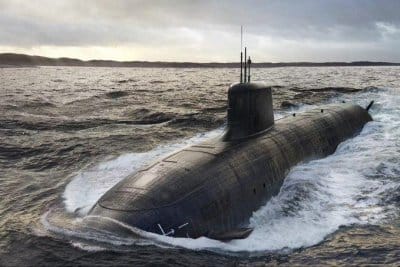
A concept image of one of 12 newly announced Submersible Nuclear Ships (SSN), in development under the AUKUS security pact, as part of a major overhaul of Britain’s strategic defense published on Monday. Photo courtesy U.K. Government

June 2 (UPI) — British Prime Minister Keir Starmer announced plans Monday to inject an additional $20.3 billion into the country’s nuclear weapons program to combat the “threat from Russia” and China and build 12 new nuclear-powered attack submarines.

The new spending is part of a major Strategic Defense Review unveiled by Starmer at a military contractor on Clydeside in Scotland, home to the country’s Trident submarine nuclear deterrent, aimed at restoring Britain’s fighting capability and making it “war-ready” within two years for a conflict in Europe and/or the Atlantic.

“We are moving to war-fighting readiness as the central purpose of our armed forces. When we are being directly threatened by states with advanced military forces, the most effective way to deter them is to be ready, and frankly, to show them that we’re ready to deliver peace through strength,” Starmer said.

“I believe the best way to deter conflict is to prepare for it.”

The plan, was Starmer said, “a blueprint to make Britain safer and stronger, a battle-ready, bomber-clad nation with the strongest alliances and the most advanced capabilities, equipped for the decades to come.”

However, he stressed that it would be a “NATO first” policy, putting the military alliance at the center of everything the United Kingdom did.

In addition to the nuclear warheads program and submarines, which will be built under the AUKUS security pact signed in 2021, other review pledges include six new munitions plants and adding 7,000 new long-range weapons to Britain’s arsenal, a “hybrid” Royal Navy that uses drones alongside warships, submarines and aircraft and invest in improved housing and equipment for members of the armed forces.

While Starmer said he was unable to give assurances that defense spending would reach the government’s goal 3% of GDP by 2034, everything in the defense blueprint was deliverable within the 2.5% figure the government committed to in February, due by Fiscal Year 2027.

Britain’s fiscal year runs April 1 through March 31.

The government has promised $12 billion of the $20 billion will come from economic growth, rather than spending cuts or tax hikes.

The 3% is an “ambition,” and the government’s refusal to set a firm timeline, and again tying it in with economic growth, raised eyebrows.

Starmer rejected suggestions that the failure to commit to a 3.5% minimum by 2032 called for by Secretary-General Mark Rutte and others, demonstrated a lack of commitment to the 32-member-country alliance.

The SDR was slammed by both the opposition Conservatives and the Liberal Democrats.

“With the prime minister unable to even confirm a date for hitting 3% on defense spending, the SDR really is unravelling. How can they deliver what they’ve promised?” Shadow Defense Secretary James Cartledge wrote on X.

Conservative leader Kemi Badenoch accused Starmer’s ruling Labour Party of not being able to “even hold a defense policy together for 48 hours.”

“How can they be trusted to defend Britain? In the most dangerous era in a generation, they found BILLIONS for the Chagos surrender — but can’t commit to properly funding our armed forces,” she wrote in a social media post.

Writing on X, Helen Maguire, defense spokesperson for the Liberal Democrats, called for all-party negotiations to agree on a path forward to 3% of GDP.

“Whilst the prime minister is totally right to recognize the importance of increasing our defense capabilities — without a clear spending plan — the SDR risks becoming a damp squib,” she said.

Source link

China criticizes Hegseth’s ‘Cold War mentality’ on Indo-Pacific

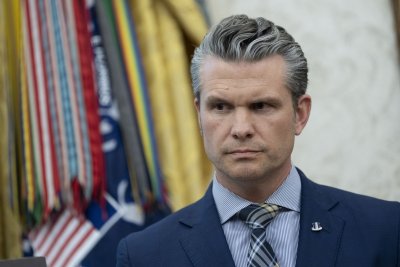
June 1 (UPI) — China criticized the United States on Sunday for having a “Cold War mentality” after Defense Secretary Pete Hegseth described Beijing as a threat the Indo-Pacific region in a speech Saturday.

“Hegseth deliberately ignored the call for peace and development by countries in the region, and instead touted the Cold War mentality for bloc confrontation, vilified China with defamatory allegations, and falsely called China a ‘threat,'” a spokesperson for China’s Foreign Ministry said in a statement.

“The remarks were filled with provocations and intended to sow discord. China deplores and firmly opposes them and has protested strongly to the U.S.”

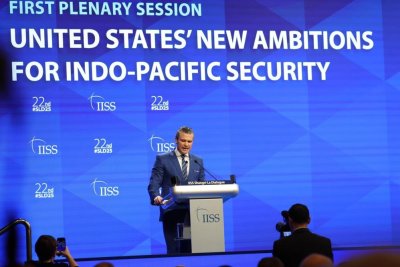
Hegseth had delivered his remarks during the International Institute for Strategic Studies Shangri-La Dialogue event in Singapore. He said the Indo-Pacific region is the United States’ “priority theater” and won’t allow China to push it and its allies out of the region.

China retorted Sunday that “no country in the world deserves to be called a hegemonic power other than the U.S. itself.”

“To perpetuate its hegemony and advance the so-called ‘Indo-Pacific strategy,’ the U.S. has deployed offensive weaponry in the South China Sea and kept stoking flames and creating tensions in the Asia-Pacific, which are turning the region into a powder keg and making countries in the region deeply concerned,” the Foreign Ministry spokesperson said.

Hegseth had also said that China was “preparing to use military force” to alter the balance of power in the region and said that the United States and its allies must be prepared for armed conflict, citing “great progress” in the region toward “achieving peace through strength.”

“If deterrence fails — and if called upon by [the] commander in chief — we are prepared to do what the Department of Defense does best: to fight and win, decisively,” Hegseth said.

Mainland China and the island of Taiwan, among other islands, were ruled by the Republic of China before the ROC lost the Chinese Civil War in the early 20th century to the Chinese Communist Party, which established the new government of the People’s Republic of China in October 1949.

The ROC in turn established a temporary capital in Taipei on the island of Taiwan, a former Japanese territory, in December 1949 that served as the seat for China at the United Nations until it was replaced by the People’s Republic of China in 1971 when foreign countries switched their diplomatic relations.

China views self-governed Taiwan and its 23 million residents as a wayward province and has vowed to retake it by force, if necessary. Many supporters of Taiwan have since argued that it is already an independent sovereign state separate from mainland China, which has never controlled Taiwan.

Tensions between the United States and China started to grow during the administration of President Joe Biden in 2022 when then-U.S. House Speaker Nancy Pelosi visited Taiwan, sparking a military response from the Chinese government and increased drills in the Taiwan Strait. In 2022, a four-star general predicted that the U.S. and China could be at war by the end of this year.

After returning for his second term, President Donald Trump‘s administration has escalated tensions with China, particularly related to trade tariffs that appear now to be expanding into broader military and diplomatic arenas.

For example, the Pentagon has increased naval patrols in contested areas of the South China Sea and bolstered military partnerships with allies including Japan, Australia, and the Philippines.

“The Taiwan question is entirely China’s internal affair. No country is in a position to interfere. The U.S. should never imagine it could use the Taiwan question as leverage against China,” the Foreign Ministry spokesperson said. “The U.S. must never play with fire on this question.”

Source link

Air Force Chief Fired by Cheney : Military: Gen. Dugan used ‘poor judgment’ in discussing possible Iraq targets, the defense secretary says. The general talked of attacking Hussein and his family.

Defense Secretary Dick Cheney on Monday fired Air Force Chief of Staff Michael J. Dugan, saying that the four-star general displayed “poor judgment at a very sensitive time” by revealing possible targets of air strikes in Iraq in the event of war.

President Bush and Gen. Colin L. Powell, chairman of the Joint Chiefs of Staff, concurred in the dismissal, which came in a 10-minute meeting with Dugan in Cheney’s Pentagon office early Monday.

Dugan was fired for comments published in The Times and Washington Post on Sunday, in which he said that–if war comes–the U.S. military intends to conduct a massive air campaign against Iraq, specifically targeting Iraqi President Saddam Hussein, his family and his palace guard.

“Given the extreme delicacy and sensitivity of the current situation, it’s incumbent upon senior officials to be discreet and tactful in their public statements, and I found those qualities lacking” in Dugan’s remarks, Cheney said in a news conference Monday.

The defense secretary said Dugan’s comments put at risk the lives of the more than 150,000 U.S. troops in the region and jeopardized the five-week-old Persian Gulf operation by revealing classified details of U.S. war planning.

Cheney said he will nominate Gen. Merrill A. McPeak, currently commander of Pacific Air Forces, to be the next chief of staff.

As for Dugan, who had been in the post only since July, Cheney said: “He will be retired.”

The only other member of the Joint Chiefs to have been fired was Adm. Louis E. Denfeld, sacked in October, 1949, by President Harry S. Truman. Denfeld, ironically, had irritated the President and his fellow chiefs for raising questions about the value of air power in modern warfare.

Cheney cited a number of critical sins that Dugan committed in the interviews with three journalists conducted over several hours aboard his aircraft on a trip to Saudi Arabia last week.

“We never talk about future operations, such as the selection of specific targets for potential air strikes. We never talk about the targeting of specific individuals who are officials of other governments. Taking such action might be a violation of the standing presidential executive order” banning assassinations, Cheney said.

He also chastised Dugan for underestimating Iraqi military capabilities, for revealing classified information about the size and disposition of U.S. forces in Saudi Arabia and for demeaning the role of the other U.S. military services by citing air power as the “only option” available for defeating the 1-million-member Iraqi army.

Cheney also was disturbed with Dugan for “treating (U.S.) casualties cavalierly,” an aide said. He apparently was referring to a comment from a senior Dugan aide on the trip who called the expected loss of American lives in such a military operation a “manageable risk.”

Powell reportedly was furious when he saw the Post story on Sunday morning and called Cheney at home at 7 a.m. to point it out. Cheney then sought The Times’ version to see if Dugan’s remarks were accurately reported. The two articles were similar, and the quotations in common were exactly the same. Cheney was “very upset,” but did not make up his mind to fire Dugan until Sunday night, a knowledgeable defense official said.

An aide to Cheney said the defense secretary believes Dugan’s comments “showed egregious judgment” and could not be tolerated. “He became the self-appointed spokesman for (Gen. H. Norman Schwarzkopf, who is directing the U.S. operation in Saudi Arabia) and the chiefs. He revealed classified information. He talked about operational plans that are fundamentally not his choice. He raised sensitive matters of diplomacy relating to other nations. He set a poor standard of military leadership, that a military commander would not take seriously the people we’re up against,” this official said.

“Based on all these things, the secretary just lost confidence in him,” the aide said.

Powell contacted Dugan in Florida and asked if he had been accurately quoted. Dugan assured him that he had been. Powell told him to report to Cheney’s office at 8 a.m. Monday but did not tell the Air Force chief that the decision had been made to dismiss him.

Dugan did not know when he entered Cheney’s Pentagon office that he was about to be fired, an Air Force official said.

In his news conference, Cheney did not dispute the truth of any of Dugan’s assertions, which included a statement that the Joint Chiefs have concluded that the United States would never have sufficient ground forces in Saudi Arabia to drive Iraqi troops out of Kuwait and would therefore be dependent on air power to sway any potential battle.

Dugan also revealed for the first time that the United States has deployed 420 combat aircraft to the Arabian Peninsula–nearly as much striking power as the fleet dedicated to defending Europe against the Soviet Union. Previous estimates of air power in the Persian Gulf region were about half that.

The Air Force chief also disclosed for the first time that the United States had recently purchased advanced Israeli cruise missiles and deployed them aboard B-52 bombers stationed within striking distance of Baghdad. In addition, he said that the Pentagon has consulted with Israeli intelligence agencies to determine the best targets in Iraq.

The most troubling matter, senior Pentagon officials said, was Dugan’s discussion of the possible targeting of Hussein, his family, his inner circle and even his mistress. Cheney suggested that such action “might” violate Executive Order 12333, issued in December, 1981, which specifically prohibits assassinations.

“I think it’s inappropriate . . . for U.S. officials to talk about targeting specific foreign individuals,” Cheney said in the news conference. “I think it is potentially a violation of the standing presidential Executive Order.”

However, the ban on assassinations was modified last year to allow for the killing of senior enemy military commanders as part of a “decapitation” strategy. Hussein is commander in chief of Iraqi military forces–as Bush is commander of all U.S. forces–and thus would be a legal target for military action, Pentagon officials said Monday.

But it clearly would violate U.S. law and policy to target Hussein’s wife, his children or his girlfriend, officials noted.

Cheney, pressed on a variety of Dugan’s assertions, said he could not confirm or deny them without violating the security considerations for which he dismissed Dugan.

The defense secretary also noted that Dugan is “not even in the chain of command,” which runs from Bush to Cheney to Powell to Schwarzkopf, commander of the U.S. Central Command, which covers the Middle East.

Under the current military structure, the members of the Joint Chiefs are advisers to the chairman and provide forces, equipment and support to theater commanders, known inside the Pentagon as the “war-fighting CINCs” or regional commanders in chief.

Cheney praised Dugan’s record of 32 years of Air Force service and said that he regretted firing him. “But under the circumstances, I felt it was necessary,” the secretary said. Dugan’s comments, Cheney noted, “did not in my mind reveal an adequate understanding of the situation and what is expected of him as chief of staff of the Air Force and as a member of the Joint Chiefs.”

The abrupt dismissal undoubtedly will reverberate throughout the Pentagon and the entire U.S. military, which has not enjoyed good relations with the press for two generations.

“You won’t be talking to any generals any time soon,” one senior Army officer told a reporter Monday.

Cheney denied that he was sending a message to military officers to avoid reporters. But he said that he expected his subordinates “to exercise discretion in what they say. . . . That sort of wide-ranging speculation about those matters that were discussed in the interviews that were granted by the general is what I felt was inappropriate.”

Air Force Secretary Donald B. Rice, who had recommended Dugan for the job and who concurred in Cheney’s decision to relieve him, said in a prepared statement: “I regret the circumstances that made it necessary for Secretary of Defense Dick Cheney to take this action. Gen. Dugan is a superb officer. His leadership and innovation will be missed by every man and woman in the Air Force.”

Dugan, 53, jumped over a number of senior Air Force officers when he was chosen for the chief of staff job earlier this year. He is a fighter and attack plane pilot with more than 4,500 flying hours and 300 combat missions in Vietnam.

A graduate of the U.S. Military Academy at West Point, N.Y., Dugan rose rapidly through the Air Force, serving chiefly in fighter squadron commands. His last post before becoming chief of staff in July was as commander of U.S. Air Forces in Europe.

His last Washington assignment was in 1988 and early 1989, when he served as deputy Air Force chief of staff for plans and operations.

Among his decorations are the Distinguished Service Medal, Silver Star, Legion of Merit with two oak leaf clusters, Purple Heart, Distinguished Flying Cross, Air Medal and the Republic of Vietnam Gallantry Cross with Palm.

Dugan has six children, three of them Air Force officers. When the articles appeared Sunday, he was in Florida attending a ceremony for his son Michael’s graduation from F-16 pilot training school.

Sen. John S. McCain (R-Ariz.), a former Navy bomber pilot who was shot down and taken prisoner in Vietnam, said the American system of civilian control of the military dictated Cheney’s firing of Dugan. “I think that clearly Cheney has the authority, and indeed the responsibility, to discipline anyone who violated policy,” he said.

McCain said he was especially troubled by Dugan’s comment that in any bombing campaign “the cutting edge would be in downtown Baghdad. This wouldn’t be a Vietnam-style operation, nibbling around the edges. . . . The way to hurt you is at home, not out in the woods somewhere.”

McCain said he did not think the American public would accept that tactic, even if it were justifiable on purely military grounds.

“His comments are at best not cognizant of the sensitivity of those remarks and the reaction that would be fueled by them,” McCain said. “It’s too bad, because I’m sure the guy was highly qualified for the job. But it comes down to the fact that the civilian leaders have a right to choose whom they want.”

Sens. Sam Nunn (D-Ga.) and John W. Warner (R-Va.), chairman and ranking minority member of the Senate Armed Services Committee, said in a joint statement that they believe Dugan’s firing to be justified.

“The recent public statements attributed to Gen. Dugan were inappropriate,” they said.

THOSE WHO WENT TOO FAR The following is a list of some U.S. military leaders who have been cashiered or disciplined for their comments. GEN. MICHAEL J. DUGAN, Air Force chief of staff

Fired on Sept. 17, 1990

By: Defense Secretary Dick Cheney

For: Publicly discussing possible targets of U.S. air strikes in Iraq if President Bush ordered use of military force against Saddam Hussein.

MAJ. GEN. JOHN K. SINGLAUB, U.S. chief of staff in South Korea

Fired May 21, 1977

By: President Jimmy Carter

For: Publicly opposing Carter’s plan to withdraw U.S. ground forces from Korea. He contended that the move would lead to war.

GEN. DOUGLAS MacARTHUR, Commander, U.S. , U.N. forces in Korean War

Fired on April 11, 1951

By: President Harry S. Truman

For: Making public his disagreement with Truman over methods to win the war, including his desire to bomb supply centers in Manchuria.

ADM. LOUIS E. DENFELD, Chief of naval operations

Fired in October, 1949

By: President Harry S. Truman

For: Speaking out on Capitol Hill against Navy budget cuts and questioning the value of air power.

GEN. WINFIELD SCOTT, General in chief, U.S. Army

Suspended for a year in 1810

By: Court-martial

For: Calling his superior officer, Gen. James Wilkinson, as great a traitor as Aaron Burr.

(Southland Edition) THOSE WHO WENT TOO FAR . . . OR NOT FAR ENOUGH

The following is a list of some U.S. military leaders who have been cashiered or disciplined for their actions or comments. ADM. HUSBAND E. KIMMEL Commander in chief, Pacific Fleet

Retired in 1942 after being accused of dereliction of duty

By: Naval board of inquiry

For: Poor state of readiness of naval forces; poor response to Japan attack on Pearl Harbor.

GEN. JOSEPH HOOKER Commander, Union Army

Relieved of command in April, 1863

By: President Abraham Lincoln

For: Indecisiveness at the battle of Chancellorsville which allowed Confederates to mount surprise attack.

GEN. AMBROSE E. BURNSIDE Commander, Army of the Potomac

Relieved of command in December, 1862.

By: President Lincoln

For: Ordering his forces on Dec. 13, 1862, to make suicidal assault on entrenched

Confederate positions in Fredericksburg, Va., and sustaining 12,600 casualties.

GEN. GEORGE B. McCLELLAN Commander, Union Army

Fired on Nov. 7, 1862

By: President Lincoln

For: Procrastination and failure to capitalize on military opportunities, including allowing Confederates to hold the line at the Battle of Antietam on Sept. 17.

BRIG. GEN. JOHN POPE Union Army

Fired on Sept. 5, 1862

By: President Abraham Lincoln

For: Leading Union forces to defeat at the Second Bull Run battle in August.

DUGAN WAS WARNED: Cheney aides told the general to steer clear of the press. A10

WHITE HOUSE CONCERN: Officials are said to feel the military was too candid. A12

Source link

Ship with aid bound for Gaza sets sail to break blockade

The Madleen, a yacht, is seen in Malta readying to set sail for Gaza and laden with aid for besieged Palestinians and celebrities onboard. Photo courtesy of the Freedom Flotilla Coalition

June 1 (UPI) — A ship filled with aid bound for Gaza set sail Sunday, hoping to break Israel’s blockade on the Palestinian enclave a month after another of its ships was damaged in an alleged Israeli drone strike in Maltese waters.

The Freedom Flotilla Coalition launched a ship called the Madleen from Catania in southern Italy with activists onboard.

Ahead of the launch, those expected to join included Greta Thunberg; celebrity artists Brian Eno and Nan Goldin; actors Susan Sarandon, Guy Pearce, Aiysha Hart, Liam Cunningham, and Indya Moore; and Alana Hadid, the daughter of Palestinian-Jordanian real estate developer Mohamed Hadid, among others.

The ship is carrying “as much life-saving aid as she can carry,” including baby formula and medical supplies. Its organizers have stressed that the ship is not carrying any weapons.

Organizers have installed a tracking device on the ship so that the public can view its progress, noting that “the risk is real.” They hope that the tracker can help increase its safety, accountability and solidarity with their mission.

A similar flotilla was raided by the IDF in May 2010, leading to the close-range shooting deaths of at least nine passengers in international waters.

“Unarmed and nonviolent, ‘Madleen’ poses no threat. She sails in full accordance with international law,” the Freedom Flotilla Coalition said in a statement on Telegram. “Any attack or interference will be a deliberate, unlawful assault on civilians.”

Last month, another ship called the Conscience put out an SOS distress signal when it was 16 miles off the coast of Malta.

“The front of the vessel was targeted twice, resulting in a fire and a breach in the hull,” the group said at the time. “We have sent an SOS distress signal out, but no one has responded. Water is coming into the ship.”

Source link

China responds after Hegseth warns to prepare for war

June 1 (UPI) — China criticized the United States on Sunday for having a “Cold War mentality” after Defense Secretary Pete Hegseth appeared to warn that the U.S. is prepared to go to war to prevent China from dominating the Indo-Pacific region in a speech Saturday.

“Hegseth deliberately ignored the call for peace and development by countries in the region, and instead touted the Cold War mentality for bloc confrontation, vilified China with defamatory allegations, and falsely called China a ‘threat,'” a spokesperson for China’s Foreign Ministry said in a statement.

“The remarks were filled with provocations and intended to sow discord. China deplores and firmly opposes them and has protested strongly to the U.S.”

Hegseth had delivered his remarks during the International Institute for Strategic Studies Shangri-La Dialogue event in Singapore. He said the Indo-Pacific region is the United States’ “priority theater” and won’t allow China to push it and its allies out of the region.

China retorted Sunday that “no country in the world deserves to be called a hegemonic power other than the U.S. itself.”

“To perpetuate its hegemony and advance the so-called ‘Indo-Pacific strategy,’ the U.S. has deployed offensive weaponry in the South China Sea and kept stoking flames and creating tensions in the Asia-Pacific, which are turning the region into a powder keg and making countries in the region deeply concerned,” the Foreign Ministry spokesperson said.

Hegseth had also said that China was “preparing to use military force” to alter the balance of power in the region and appeared to indicate that the United States would step in to defend Taiwan if China were to attack it.

Mainland China and the island of Taiwan, among other islands, were ruled by the Republic of China before the ROC lost the Chinese Civil War in the early 20th century to the Chinese Communist Party, which established the new government of the People’s Republic of China in October 1949.

The ROC in turn established a temporary capital in Taipei on the island of Taiwan, a former Japanese territory, in December 1949 that served as the seat for China at the United Nations until it was replaced by the People’s Republic of China in 1971 when foreign countries switched their diplomatic relations.

China views self-governed Taiwan and its 23 million residents as a wayward province and has vowed to retake it by force, if necessary. Many supporters of Taiwan have since argued that it is already an independent sovereign state separate from mainland China, which has never controlled Taiwan.

Tensions between the United States and China started to grow during the administration of President Joe Biden in 2022 when then-U.S. House Speaker Nancy Pelosi visited Taiwan, sparking a military response from the Chinese government and increased drills in the Taiwan Strait. In 2022, a four-star general predicted that the U.S. and China could be at war by the end of this year.

After returning for his second term, President Donald Trump‘s administration has escalated tensions with China, particularly related to trade tariffs that appear now to be expanding into broader military and diplomatic arenas.

For example, the Pentagon has increased naval patrols in contested areas of the South China Sea and bolstered military partnerships with allies including Japan, Australia, and the Philippines.

“The Taiwan question is entirely China’s internal affair. No country is in a position to interfere. The U.S. should never imagine it could use the Taiwan question as leverage against China,” the Foreign Ministry spokesperson said. “The U.S. must never play with fire on this question.”

Source link

Hegseth: Prepare for war to ensure Indo-Pacific peace

Defense Secretary Pete Hegseth says nations must prepare for war to ensure peace amid Chinese aggression in the Indo-Pacific region during the International Institute for Strategic Studies Shangri-la Dialogue Defence Summit in Singapore on Saturday. Photo by How Hwee Young/EPA-EFE

May 31 (UPI) — The United States and its allies won’t allow China to dominate the Indo-Pacific region, but do not seek war, Defense Secretary Pete Hegseth said Saturday morning in Singapore.

He addressed regional concerns while speaking during the International Institute for Strategic Studies Shangri-La Dialogue event in Singapore.

Hegseth said the Indo-Pacific region is the United States’ “priority theater” and won’t allow China to push the United States and its allies out of the region, the Department of Defense announced Friday in a news release.

Instead, deterrence will be the primary tool by which the United States and its allies will counter any aggressive moves made by China, particularly in the South China Sea and against Taiwan.

“As our allies share the burden, we can increase our focus on the Indo-Pacific,” Hegseth said, adding that the region is the nation’s “priority theater.”

He said the futures of the United States and its allies in the Indo-Pacific depend on each other.

“We share a vision of peace and stability, of prosperity and security,” Hegseth said, “and we are here to stay.”

Common sense and national interests with guide policy making in the region, while respecting mutual self-interests.

President Donald Trump is working to get European nations to do more to increase their respective national security interests instead of largely relying on the United States.

As European nations do more to protect themselves, Hegseth said the United States will be better able to focus on matters in the Indo-Pacific region and do more to thwart Chinese aggression.

“This enables all of us to benefit from the peace and stability that comes with a lasting and strong American presence here in the Indo-Pacific,” Hegseth said.

That presence won’t come at a cost for the nation’s allies, though.

“We are not here to pressure other countries to embrace and adopt our politics or ideology,” Hegseth told the audience. “We are all sovereign nations.”

He said the United States does not “seek conflict with communist China.”

But the United States “will not be pushed out of this critical region,” Hegseth added. “And we will not let our allies and partners be subordinated and intimidated.”

He said China’s leaders are “preparing to use military force to alter the balance of power in the Indo-Pacific,” including occupying Taiwan.

Any move by China to take over Taiwan, which China has claimed as part of its sovereign state, would trigger “devastating consequences” for the region and the world, Hegseth told the audience.

“The threat China poses is real, and it could be imminent,” he said, adding that the United States and its allies must be prepared with “urgency and vigilance.”

If deterrence doesn’t work and a fighting war is inevitable, “we are prepared to do what the Department of Defense does best: to fight and win decisively,” Hegseth said.

The best way to ensure peace is to prepare for war, “but we have to do this quickly,” he said. “We have no time to waste.”

Source link

ISIS claims responsibility for 2 bomb explosions in Syria

ISIS forces in a remote region in southern Syria claimed responsibility for two bombings targeting vehicles carrying soldiers and others on Wednesday and Thursday. Photo by Fayyaz Ahmad/EPA-EFE

May 31 (UPI) — The Islamic State claimed responsibility for two bomb attacks in a remote region in southern Syria on Wednesday and Thursday.

The twin bombings mark the first time ISIS has attacked the new Syrian government that took power in December and occurred in the remote Sweida Province.

ISIS posted two online statements on Thursday claiming responsibility for the bombings that killed and wounded Syrian soldiers and militia members who are allied with the Syrian government, The New York Times reported.

An attack occurred on Wednesday and struck a Syrian Army reconnaissance group that was tracking ISIS activities in the remote desert area, CNN reported.

Those wounded in that attack are members of the Syrian Army’s 70th Division, and the man who died was assisting the soldiers, according to The New York Times.

ISIS used a remote-controlled land mine to target the vehicle in which they were traveling, the British-based Syrian Observatory for Human Rights announced.

That attack occurred in the eastern portion of the Sweida Province and was the first attack carried out by ISIS and targeting forces allied with the new Syrian government.

A second bombing occurred on Thursday in the same region, according to news reports and ISIS.

ISIS said it killed and injured seven soldiers for the “apostate Syrian regime” by using an explosive device on a road in the Talul al Safa area in the Suwayda province in southern Syria, Al Jazeera reported.

Both attacks occurred near Sweida in southern Syria, which is a mountainous desert area in which ISIS has operated for many years.

Neither the Syrian government nor the Free Syrian Army has commented on either bombing.

The United States backs the Free Syrian Army, which operates in the Sweida region’s al Tanf Deconfliction Zone that is located near Syria’s borders with Jordan.

The United States maintains a small outpost in the area.

ISIS also has operated in the area for a long time due to its “extremely rugged and dangerous” terrain, CNN reported.

Earlier this month, U.S. President Donald Trump said he he was lifting “crippling” U.S. sanctions on Syria originally imposed to block flows of money into Syria, including aid, to put pressure on the brutal regime of ousted President Bashar al-Assad.

He met with the country’s transitional leader, President Ahmed al-Sharaa, in Riyadh, Saudi Arabia on May14.

Al-Sharaa, who was appointed president in January, has promised to hold elections once a new constitution is in place in around four years.

Source link

Can NATO’s Middle Powers Lead the Alliance Without the US?

With the recent pivot in US foreign policy regarding Europe and NATO, it has become clear that NATO’s European members need to ramp up spending on defense, and the time of relying on the US for defense in Europe is over. Many would argue that it’s well overdue, with Trump saying that NATO members should boost their defense spending to 5% of their GDP versus the traditional 2% target set by NATO. This target for NATO members was first set at the 2006 Riga summit; however, that target was reaffirmed and made more concrete in the 2014 Defence Investment Pledge at their summit in Wales, with only four members hitting the target that year. In 2024, those numbers were up, with NATO estimating 22 out of 32 would hit the target that year, so it’s clear defense spending in Europe is on the up. The Secretary-General of NATO, Mark Rutte, said, “We will need more time to consult amongst Allies what exactly the new level should be. But it is considerably more than 2%,” when asked about higher spending targets.

Inevitably, it will come down to the middle powers of NATO—France, Germany, Poland, and the UK—to step up to the plate and take over the leadership roles. Ultimately, this shift in responsibility will largely shape the alliance and Europe for years to come. But is this realistic, and what hurdles will the middle powers overcome to get there?

The US is the glue that holds NATO together.

Since NATO’s inception, the US has acted as the glue that keeps the alliance together, and it is evident from recent events just how crucial that role is. And it’s significantly more than just manpower/firepower, as you may expect.

The middle powers of NATO face a series of challenges ahead in their effort to step up and take over that role from the US. One of these challenges is the fact that the US plays a monumental role in the hierarchy of NATO’s various operational commands, with the US holding a lot of key roles within that structure that NATO, without the US, would not be able to operate certainly anywhere near as efficiently as it is currently run.

 The US also has an integral part to play in NATO’s capability for intelligence surveillance and reconnaissance (ISR), with most of the capability that NATO has being US-supplied and run. An example of this occurred during Operation Unified Protector (Libya, 2011): the US provided an estimated 75% of ISR assets, enabling NATO to carry out precision strikes and monitor Gaddafi regime movements.

All of this is said without even touching the subject of the US’s missile defense and general man/firepower capabilities, with the European nations currently not having an equivalent.

Defense spending and capabilities

The only way the middle powers will be able to step into the US’s shoes and fill the role Washington has traditionally played is through an increase in defense spending, resulting in a significant boost to their military capabilities. However, this necessity presents several challenges of its own, so what does the current situation look like, and how will it develop?

France has consistently maintained a capable military and spent a good amount of their GDP on defense. Fluctuations in their defense budget have meant they’ve fallen short of the 2% goal set by NATO in previous years.

President Macron announced plans in early 2023 to vastly increase military spending, pledging to spend 413 billion euros on defense in 2024-2030, an increase of 118 billion euros compared to the previous period.

Since the Russian invasion of Ukraine in 2022, we have seen a vast increase in defense budgets across NATO, none perhaps more noticeable than in Germany, with Chancellor Olaf Scholz wanting to inject 100 billion euros into the German military (Bundeswehr) to increase military capability and readiness. With the German Federal Minister of Defence, Boris Pistorius, pledging to make the German military “the backbone of deterrence and collective defense in Europe.”

It would seem this shift in defense policy is here to stay, with both German parliaments recently voting in favor of another boost to military spending.

Nevertheless, it’s not all plain sailing for Germany. With recent recruitment numbers falling short of their targets, the Bundeswehr still faces personnel shortages. It’s clear that the intention is there, but there are still many practical challenges for them to overcome.

Poland has quickly become a key player within NATO, from having a humble military at the time of the 2014 annexation of Crimea by Russian forces to boasting the third-largest military within NATO, only behind that of the US and Turkey. Their armed forces have undergone a significant modernization program at this time, too.

This rapid modernization has meant Poland has fast become one of the leading defense powers within NATO, playing a crucial role in securing their eastern flank; they have also become one of NATO’s highest spenders on defense, spending an impressive 4.12% of their GDP.

The UK has consistently hit the 2% target set by NATO and, for the past four years, has even slightly exceeded this, with projects such as the Challenger 3 and the Boxer armored vehicle receiving around £5 billion in funding.

As with Germany, this isn’t without its challenges. The UK has faced significant setbacks in recruitment, with it being reported in November 2024 that the British armed forces had “consistently fallen short of recruitment targets over the past five years,” with some saying that the armed forces were losing 300 people a month more than they were recruiting.

It is also worth mentioning that France and the UK both possess nuclear capabilities, although the UK’s Trident missile system is US-supplied and maintained. Meanwhile, the French “Force de dissuasion” is fully independent.

Whilst it is undoubtable that the middle powers and Europe as a whole are taking defense spending a lot more seriously, and, for the first time since the Cold War, it is being seen as a priority, there is still a long way to go before NATO without the US taking a primary role could even be considered comparable to the NATO we have known up until now.

No natural leader

Other issues the middle powers face when trying to take over these roles are cooperation, coordination of efforts, and political and military leadership. To put it simply, NATO risks lacking unified leadership without the US. There is no obvious alternative to U.S. leadership within NATO. This means the alliance’s future leadership will depend entirely on the ability of European members to cooperate. Historically, however, that cooperation has been difficult. Europe is often divided by differing political ideologies, national interests, and unresolved disputes between member states. Countries frequently prioritize their own agendas, making it hard to reach collective decisions. A key example of this is the long-standing tension between Turkey and Greece—both NATO members, yet frequently at odds due to their history of conflict and territorial disputes. There is also the issue of the European Union and NATO often failing to cooperate, causing frequent internal strife on key issues such as the situation with Turkey and Cyprus.

Nevertheless, there are recent examples of political cohesion, such as the UK stating it would back the potential incoming German chancellor Friedrich Merz in sending Taurus missiles to Ukraine come across more as a patchwork than cohesive leadership. Most of the middle powers appear to focus on strengthening their own national capabilities rather than fostering cohesion and building multinational capacity. The result is a fragmented and disorganized approach—unsurprising, given that NATO is fundamentally an alliance of countries with a long history of rivalry and conflict. However, one should never underestimate the power of an external threat in uniting nations and giving them a common enemy, and Russia certainly seems to be doing just that.

NATO going forward

What does all this mean going forward? Across the board, especially amongst the middle powers of NATO, the intention to take a more active role in defense is there. Generally, NATO isn’t in a terrible position, and the desire for collective defense amongst member states has become paramount.

That said, the alliance still faces significant challenges ahead, especially when it comes to leadership; the US has long been the force that bridged the gap where the European members fell short. The US shifting its focus away from Europe has undoubtedly had a profound effect. It was perhaps not until this happened that it became clear just how much NATO relied on Washington for political direction, and whilst it is entirely possible for the middle powers to collectively take over that role, presently, that reality seems distant. Reaching that reality will be far from an overnight process. With Europe’s attention firmly focused on the war in Ukraine, many argue that the clock is already ticking, bringing the prospect of a conflict with Russia closer to reality.

Source link

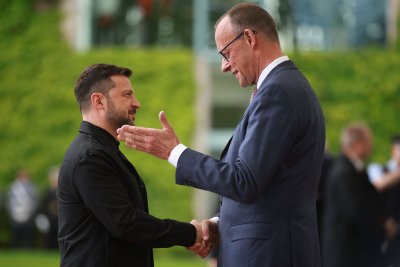
Ukrainian President Zelensky visits Germany to talk defense against Russia

Ukrainian President Volodymyr Zelensky arrived in Berlin Wednesday to talk defense against Russia with German Chancellor Friedrich Merz. Photo by Clemens Bilan/EPA-EFE

May 28 (UPI) — Ukrainian President Volodymyr Zelensky traveled to Germany Wednesday to discuss the state of German military support, which could include a delivery of powerful missiles to Ukraine for use against Russian targets.

Zelensky and the Ukrainian delegation were welcomed by German Chancellor Friedrich Merz shortly after their arrival in Berlin, and Zelensky is also expected to meet with German President Frank-Walter Steinmeier.

The visit takes place as speculation continues in regard to whether Germany will supply Ukraine with its Taurus cruise missiles, which can strike targets as far away as 300 miles. Merz had signaled before his ascension to chancellor that he would overturn a previous ban by his predecessor Olaf Scholz on the provision of such weaponry to Ukraine.

Zelensky spoke with reporters Tuesday, and said he would discuss the issue of long-range missiles.

The decision to provide the Taurus missiles remains officially unresolved as it has been a matter of contention between the conservative alliance of the Christian Democratic Union and Christian Social Union parties, and the Social Democratic Party, their coalition partners.

However, Merz announced Monday that Germany would “do everything in our power to continue supporting Ukraine,” and that “also means no longer having any range restrictions on the weapons we supply. Ukraine can now also defend itself by attacking military positions in Russia.”

Merz later explained the comment was in reference to actions taken months ago, and German Vice Chancellor Lars Klingbeil has since confirmed that no new decision in regard to the Taurus missile issue.

Germany has previously provided Ukraine with two weapons systems capable of strikes within Russian borders, the Mars II rocket launchers and Panzerhaubitze 2000 self-propelled artillery, and range restrictions on their usage were lifted in May 2024.

Kremlin Spokesman Dmitry Peskov announced Monday that European countries who lift restrictions on the range of provided armaments for use against Russia on Russian territory would be making a “rather dangerous decision.”

Zelensky posted to social media Tuesday that in an “extended meeting” with Ukrainian military leadership, they had discussed “preparing new agreements with our European partners in the near future, to attract investment into Ukrainian production,” which “First and foremost,” means “the production of unmanned systems and long-range capabilities,” so that the military can “operate at significant distances.”

Source link

Czech Republic blames China for cyberattack on foreign ministry

A Chinese national flag flies in front of a new, modern business complex in Beijing on August 15, 2013. China’s construction boom could be stalling out, according to Societe Generale, which sounded a warning last week that recent softening in demand for cement and earth-moving equipment could be an early warning sign. UPI/Stephen Shaver | License Photo

May 28 (UPI) — The Czech Republic accused China on Wednesday of being responsible for a “malicious cyber campaign” that targeted an unclassified network of the foreign ministry.

Little information about the cyberattack was made public, the Czech government said it began in 2022, affected an institution designated as Czech critical infrastructure and that it was perpetrated by well-known China-backed hackers APT31.

“The Government of the Czech Republic strongly condemns this malicious cyber campaign against its critical infrastructure,” the Czech foreign affairs ministry said in a statement.

“Such behavior undermines the credibility of the People’s Republic of China and contradicts its public declarations.”

APT31, which stands for Advanced Persistent Threat Group 31, is a collection of China state-sponsored intelligence officers, contract hackers and support staff that conduct cyberattacks on behalf of the Chinese government.

Seven Chinese nationals were charged in the United States in late March for their involvement in APT31, which federal prosecutors said has targeted U.S. and foreign critics of the Chinese government, business, and political officials over the last 14 years.

The Czech government said Wednesday it tied APT31 to the cyberattack through an “extensive investigation,” which “led to a high degree of certainty about the responsible actor.”

“The Government of the Czech Republic has identified the People’s Republic of China as being responsible,” it said.

NATO and the European Union — both of which Czech is a member of — were quick to condemn China following Prague’s revelation.

“We stand in solidarity with the Czech Republic following the malicious cyber campaign against its Ministry of Foreign Affairs,” the security alliance said in a statement.

NATO did not blame China but acknowledged the Czechs’ accusation of Beijing for the attack and said that it has observed “with increasing concern the growing pattern of malicious cyber activities stemming from the People’s Republic of China.”

Similarly, the EU did not directly point the finger at China for the attack on the Czech Republic, but said there have been cyberattacks linked to Beijing targeting EU and its member stats.

“In 2021, we urged Chinese authorities to take action against malicious cyber activities undertaken from their territories. Since then, several Member States have attributed similar activities at their national level,” the EU’s high representative, Kaja Kallas, said in a statement.

“We have repeatedly raised our concerns during bilateral engagements and we will continue to do so in the future.”

Source link

Israeli warplanes again strike Houthi-controlled Sanaa int’l airport

May 28 (UPI) — Israeli warplanes struck the Houthi-controlled Sanaa International Airport in Yemen on Wednesday morning, the Israel Defense Forces said, seemingly in response to missiles recently launched by the militant group toward Israel.

The IDF said in a statement on X that its airstrikes targeted unidentified aircraft belonging to the Houthis.

“The aircraft that were attacked were used by the Houthi terrorist regime to transport terrorists who promoted terrorist acts against the State of Israel,” it said.

Israeli Defense Minister Israel Katz said the strike destroyed the last remaining planes used by the Houthis at the site that remained following the IDF’s previous attack on the airport on May 6.

“This is a clear message and a direct continuation of the policy we established: Whoever fires at the State of Israel will pay a heavy price,” Katz said in the statement, The Times of Israel reported.

“The ports in Yemen will continue to be struck heavily, and the airport in Sanaa will be destroyed again and again, as will other strategic infrastructures in the area used by the Houthi terror organization and its supporters.”

Houthis, an Iran-backed group, have repeatedly attacked Israel since early in Israel’s war against Hamas in Gaza, which began on Oct. 7, 2023, in response to Hamas’ brutal attack on Israel that killed 1,200 people and saw another 251 kidnapped.

The involvement of the Houthis, also an Iran-proxy militia, increased starting in mid-November when it started to enforce a military blockade of the Red Sea and the Gulf of Aden, vowing to attack Israeli ships attempting to pass. It said the blockade was in solidarity with the Palestinian people. The rebels followed by broadening targets to include U.S. military ships.

Israel, with its allies, including the United States, have responded with conducting mass airstrikes in Yemen.

On May 6, Israel attacked the airport in Sanaa, and last week conducted similar airstrikes on ports in Hodeidah and al-Salif.

On Tuesday, the IDF said it had intercepted a missile launched from Yemen.

“This is another example of the Houthi terrorist organization’s brutal use of civilian infrastructure for terrorist activities,” the IDF said Wednesday morning on X, seemingly in reference to the Sanaa airport.

“The IDF is determined to continue to act and strike with force anyone who poses a threat to the residents of the State of Israel, at whatever distance is required.”

Source link

Lincoln Riley shouldn’t take all blame if USC-Notre Dame rivalry ends

Surprise! The Times of Troy is back by popular demand in your inbox, here to help ease you back into your week after what we hope was a relaxing holiday weekend.

I was honored and humbled to hear your thoughts — most of them very kind — about the newsletter’s debut season. So much so that we’ve decided to bring it back before our scheduled return in July.

Newsletter

Fight on! Are you a true Trojans fan?

Get our Times of Troy newsletter for USC insights, news and much more.

You may occasionally receive promotional content from the Los Angeles Times.

We’ve got some new ideas in the works for Season 2. But between now and July, when we turn our full attention to previewing the upcoming Trojans football season, we’ll land in your inbox periodically as the moment calls for it.

Now feels like one of those moments.

One of college football’s most storied rivalries is at a crossroads. A century after it was played for the first time, the historic series between USC and Notre Dame is at serious risk of ending. A lot of fans, former players and college football purists are upset about it. Most of them are pointing fingers at USC — and at Lincoln Riley especially.

I think there’s a little more to the situation than that. But the reason USC’s coach finds himself at the center of that frustration stems from comments he first made last summer during Big Ten media day, comments that explain quite transparently where USC stands right now, almost a year later.

USC and Mississippi had just canceled a home-and-home series, and rumors were swirling that Riley had pushed administrators to pull out of last September’s matchup with Louisiana State too. When he was asked what led to those changes, Riley didn’t hide his feelings about how scheduling should be handled. Why would any power conference school schedule marquee nonconference games in the future, he wondered aloud, unless there were “more guaranteed [College Football Playoff] spots in some of these conferences.” Otherwise, he predicted, those games would happen “less and less.”

“Our schedules are already going to be so good,” Riley said. “At some point, you’re like, alright, is the juice worth the squeeze in terms of playing these games?”

Before we address how that logic applies to Notre Dame — and before you start screaming “COWARD!” at your phone/computer screen — let’s acknowledge the fact that Riley has a point. (Ducks.) He is paid — more than all but a few coaches in the sport — to get USC to the College Football Playoff. Period. And as the playoff is currently constructed, there is no real incentive, on paper, for a coach such as Riley to want an extra marquee nonconference game on the schedule. Remove 95 years of context with the Irish and, to his point, the juice probably isn’t worth the squeeze.

This issue runs far deeper than just Notre Dame and USC, but let’s address the golden-domed elephant in the room, since Notre Dame’s athletic director has the college football world worked into a lather.

This is what Riley said about the rivalry last summer:

“If you get in a position where you’ve got to make a decision on what’s best for SC to help us win a national championship versus keeping that, shoot, then you gotta look at it. I mean, listen, we’re not the first example of that. Look all across the country — there’s been a lot of other teams [that] sacrifice rivalry games. I’m not saying that’s what’s going to happen, but you know, as we get into this playoff structure, and if it changes or not, we’re in this new conference, we’re going to learn something about this as we go.”

And boy did USC learn something on the road in its Big Ten debut. The Trojans unraveled on all four of their conference road trips. They realized how hard it would be to mix in an October trip to South Bend during that annual gantlet. No other Big Ten teams have that challenge on the Trojans’ particular timeline. Not to mention there’s a possible Southeastern Conference-Big Ten crossover matchup to consider in the future.

Automatic qualifiers to the College Football Playoff are the quickest way to solve this problem, as far as USC is concerned. It would give teams such as USC comfort that a loss to a nonconference opponent in September wouldn’t keep them out of the playoff. However, it would also mean rendering games such as USC-Notre Dame mostly meaningless as far as playoff resumes go.

USC is choosing to take the cold, calculated route when it comes to this quandary. And I understand why. Why should the Trojans be expected to carry the water for the soul of college football at the cost of their own playoff odds, while the rest of the sport’s leaders, USC’s own included, have made clear just how much tradition actually means to them?

Don’t get me wrong. USC isn’t being brave with its stance. It’s openly acknowledging that it is choosing the route of least resistance, no matter how its fans may feel about it. That’s not exactly valiant. And by calling them out for holding up negotiations, Notre Dame’s athletic director has already won the PR battle. If the rivalry ends after this season, the narrative will forever be that USC killed it with cowardice.

I do think that narrative would ignore some key points. Notably that USC hasn’t said it wants to end the game. Only that it doesn’t want a long-term contract before it understands the parameters of the playoff. Nor was Notre Dame interested at all in having a conversation about any concessions to USC’s situation, such as an early season date for the game, to help get a deal over the finish line. If these negotiations were simply about maintaining the rivalry, Notre Dame would have agreed to play next season already. This isn’t a one-sided stalemate.

I know that USC athletic director Jennifer Cohen would prefer to continue the rivalry with Notre Dame. I know she understands how much equity she could lose if it doesn’t continue.

I also have no doubt that she will take the heat, if necessary, for its demise, if it means putting USC on a better path to the College Football Playoff.

Is that hope of a playoff worth losing a storied rivalry? I’d understand if you said no. But USC leaders have made abundantly clear how they feel about that question. Let’s hope they never have to answer it.

USC-Notre Dame poll

Let’s hear from you. Could a smoother path to the College Football Playoff be worth losing the Notre Dame-USC rivalry? Vote here and let us know. Results announced in the next Times of Troy.

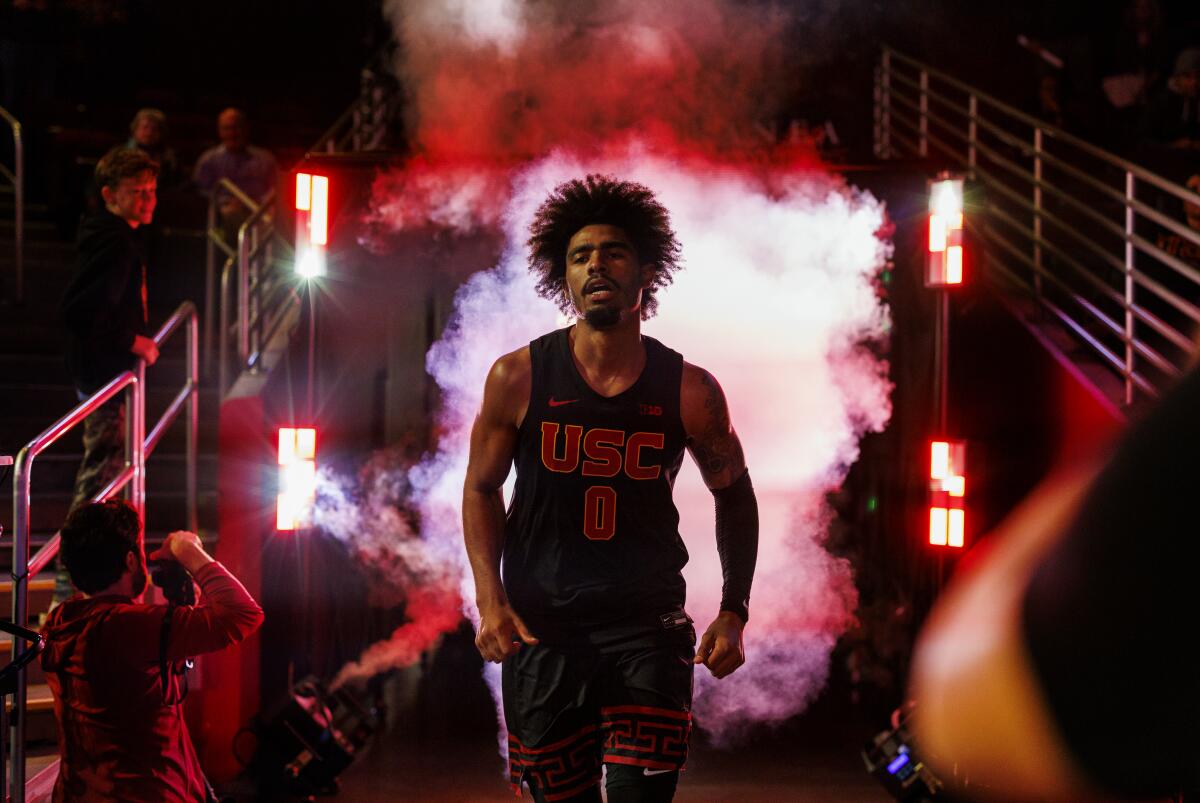
Saint Thomas exits a tunnel of smoke and steps on the Galen Center before a game against Oregon

Will Saint Thomas walk onto the court with the Trojans next season?

(Gina Ferazzi / Los Angeles Times)

—USC basketball still has two roster spots available for the 2025-26 season. One is currently being held for Saint Thomas. But it’s not clear how much longer Eric Musselman and his staff are willing to wait on Thomas’ appeal to the NCAA. The sentiment within the program was that Thomas had a compelling case for a mental health waiver, but the gears of justice grind slowly with the NCAA, and Thomas is running out of time. Summer practice kicks off on June 9. If he isn’t granted an extra year, expect USC to fill that spot with a low-major, all-conference-type point guard who could initiate the offense when called upon.

—Six-foot-10 sophomore forward Jacob Cofie is one to watch this summer. USC’s staff is very bullish on the young big man. One person with close knowledge of the program told The Times that they expect Cofie to be on draft boards by the start of Big Ten season. Along with Utah transfer Ezra Ausar — who stands 6-8, 242 pounds — Cofie should give USC much more of a physical presence in the paint, something it sorely lacked last season.

—Leaders from the Power Four conferences are floating a binding document that would force schools to fall in line with the new NIL enforcement entity … or else. It won’t work. I, for one, would love to see the Big Ten try to kick USC or Michigan or Ohio State out of the conference for not bending the knee to the new College Sports Commission. But more critically here, there’s no way that such an agreement would pass legal muster. College sports can’t supersede state law, no matter what some galaxy-brained commissioners might think.

—The College Football Playoff field will no longer give the four highest-rated conference champions an automatic first-round bye. That change to “straight seeding” was unanimously approved last week by CFP leaders, after the initial format last season was received poorly pretty much everywhere outside of Tempe, Ariz. In the new format, the committee’s top-four rated teams will be ranked one through four and get that coveted bye, no matter if they won their conference or not. That might sound like a tedious change. But this is better for everybody.

—Former USC point guard Kayleigh Heckel finally has a transfer destination. Heckel is joining Connecticut months after losing to the Huskies in the Elite Eight in her last game at USC. No one would’ve anticipated that turn in the immediate aftermath of that loss in Spokane. But hey, if you can’t beat ‘em, join ‘em, I guess.

In case you missed it

Rancho Cucamonga cornerback RJ Sermons to join USC a year early

College Football Playoff shifts to straight seeding for upcoming season

USC baseball program looks to continue breakthrough season

USC pushes for one-year renewal of Notre Dame series until CFP bids are clarified

Lincoln Riley made more than twice what USC’s president did in 2023

What I’m watching this week

"Around the Horn" host Tony Reali sits and mutes panelists displayed on screens across from him.

Tony Reali on the set of “Around the Horn.”

(Phil Ellsworth / ESPN Images)

When I was a kid, still just dreaming up the possibility of writing about sports, I would flip on ESPN every afternoon after school to try and catch Bill Plaschke or Woody Paige or Jackie MacMullan on “Around the Horn.” It was the show that taught me, in my ways, how to talk about sports.

That feels more and more like a lost art these days. And maybe that’s why ESPN unfortunately saw it fit to end “Around the Horn’s” run after nearly 5,000 shows. But I will always hold the show near and dear and forever respect its host, Tony Reali, for reminding the world all these years that sports talk can still have a soul.

Until next time….

That concludes today’s newsletter. If you have any feedback, ideas for improvement or things you’d like to see, email me at [email protected], and follow me on Twitter at @Ryan_Kartje. To get this newsletter in your inbox, click here.

Until next time…

That concludes today’s newsletter. If you have any feedback, ideas for improvement or things you’d like to see, email me at [email protected], and follow me on Twitter at @Ryan_Kartje. To get this newsletter in your inbox, click here.

Source link

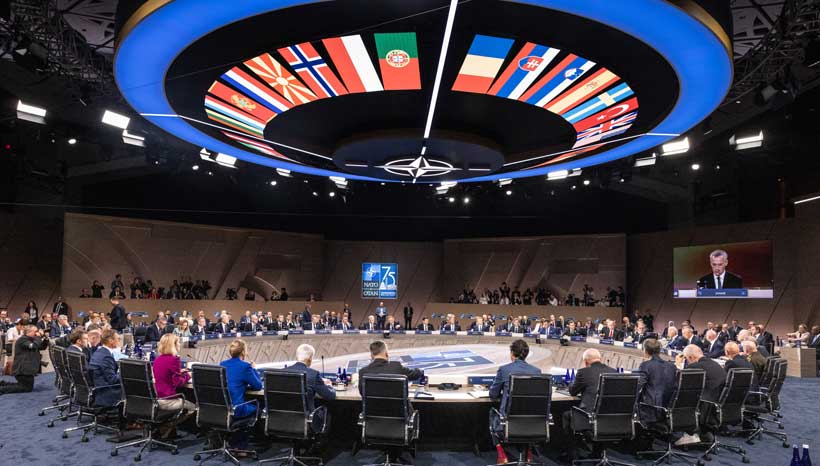
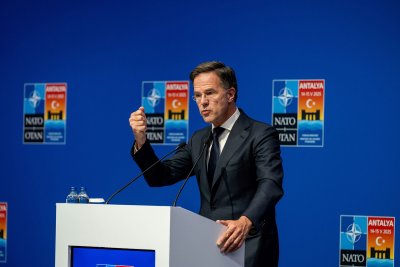
NATO head expects members to agree to spend 5% GDP on defense

NATO Secretary-General Mark Rutte addresses a press conference following an informal meeting foreign ministers of member nations on May 15, 2025. On Monday, he said he expects member nations to agree to spend 5% GDP on defense spending next month in The Hague. Photo by NATO/UPI | License Photo

May 27 (UPI) — NATO Secretary-General Mark Rutte said that he expects alliance members to agree during next month’s summit to a defense spending target of 5% of gross domestic product.

Rutte made the revelation during the sixth and final day of the NATO Parliamentary Assembly in Dayton, Ohio.

“I assume that in The Hague we will agree on a hard defense spend target of 5%,” he said.

“Let’s say that this 5%, but I will not say what is the individual breakup, but it will be considerably north of 3% when it comes to the hard spend and it will be also a target on defense-related spending.”

“We need this, because otherwise we can never, ever, ever reach the capability targets,” he added.

All NATO members have agreed to spend at least 2% of their GDP on defense by 2025, with no country yet reaching the 5% threshold.

NATO spending by member nations has long been an issue of contention for U.S. President Donald Trump, who has called for European nations to pay more, accusing them of relying on Washington for their defense.

Since returning to the White House in January, Trump has been calling for NATO members to increase defense spending to 5%.

Of the 32 NATO nations, Poland spent an alliance-high 4.12% of GDP on defense last year, according to statistics from the security alliance, with Estonia second at 3.43% and the United States third at 3.38%.

Eight countries spent below the 2% GDP on defense last year, with Spain coming in last at 1.28% GDP.

The NATO Summit is to be held in The Hague from June 24-25, where world leaders and defense chiefs of alliance members will congregate to discuss pressing security issues and decide on the alliance’s strategic direction.

Source link

Dozens killed overnight in Gaza by IDF strikes amid deal breakdown

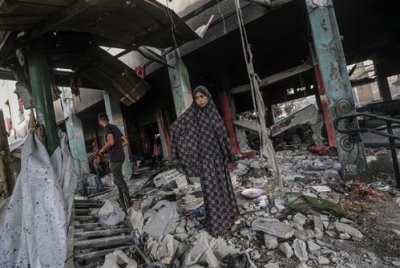
1 of 3 | An displaced Palestinian woman stands among the rubble of her destroyed family shelter after an Israeli airstrike in Al Jerjawi school in the Al Daraj neighborhood in Gaza City onMonday. Photo by Mohammed Saber/EPA-EFE

May 26 (UPI) — Dozens of Palestinians were killed overnight by further Israeli air strikes on the war-torn enclave amid a breakdown in a new cease-fire agreement.

An estimated 54 Palestinians sheltering at Fahmi Al-Jargawi School in Gaza City have been killed by airstrikes carried out by the Israeli Defense Forces, the BBC reported Monday.

The scores of dead refugees included children from Beit Lahia after fires were seen engulfing two classrooms fixed as living quarters in the school, which was housing hundreds of people, according to the Hamas-run civil defense authority.

At least 35 were reported to be killed when the school was hit.

Video footage depicted fire engulfing parts of the school and graphic images of severely burned victims, including kids.

On Monday morning, the IDF said it hit 200 “terrorist organizations” across the Gaza Strip in 28 hours as military ops carried on.

The IDF claimed it targeted a “Hamas and Islamic Jihad command and control center” in an area used by “terrorists” to presumably “plan” attacks against Israeli civilians and IDF troops, accusing Hamas of using the Gaza population “as human shields.”

Meanwhile, a senior Hamas official told the BBC that the terror syndicate agreed to the latest cease-fire deal.

The proposal permitted the release in two phases of 10 Israel hostages in exchange for a 70-day truce, a gradual withdrawal of IDF troops out of the territory and release of an undetermined number of Palestinian prisoners.

Hamas further demanded the entrance of 1,000 humanitarian aid trucks a day to aid the ailing population in Gaza.

However, a senior Israeli official said Monday that it had rejected the cease-fire proposal after reports that Israel had agreed to it in principle.

“The proposal received by Israel cannot be accepted by any responsible government,” the official told The Times of Israel without providing further detail, claiming that Hamas was setting “impossible conditions that mean a complete failure to meet the war goals, and an inability to release the hostages.”

On Sunday, IDF officials claimed that since its war began, Israel has “facilitated” the entry of over 1.7 million tons of humanitarian aid into Gaza.

On Monday, Israel’s Coordination of Government Activities in the Territories office — a unit of its Ministry of Defense — claimed that 107 humanitarian aid trucks transporting flour and food were transferred into Gaza “following inspection” via the Kerem Shalom Crossing.

But according to international human rights organizations, Gaza is at a “breaking point” while the United Nations-backed Integrated Food Security Phase Classification has warned of imminent famine on top of reputable accusations of genocide by Israel against Palestinians.

Nearly 54,000 people, including at least 16,000 children, have been killed in Gaza since Israel began its invasion, according to the territory’s health ministry.

Source link

Watch: Trump to honor fallen soldiers at Arlington wreath laying

May 26 (UPI) — President Donald Trump will mark his first Memorial Day as commander-in-chief in his second term with ceremonies in Arlington National Cemetery.

“I will be making a Memorial Day Speech today at Arlington National Cemetery,” the president announced Monday morning on his social media platform, adding to “enjoy!!!”

Trump, who will take part in a wreath-laying ceremony per tradition at the Tomb of the Unknown Soldier, says the speech at the nation’s cemetery across the Potomac River from Washington in Virginia will be at 11 a.m. EDT.

“Happy Memorial Day to all, including the scum that spent the last four years trying to destroy our country through warped radical left minds,” Trump wrote in all caps in part in an earlier post Monday morning.

In a separate statement, the White House said on “this solemn day” as the country honors the sacrifice of its fallen soldiers, Trump and first lady Melania Trump “ask all citizens to join us in prayer that Almighty God may comfort those who mourn, grant protection to all who serve, and bring blessed peace to the world.”

America’s first observance of Memorial Day on May 30, 1890, previously known as Decoration Day, was proclaimed by Union Commander John A. Logan to honor fallen soldiers who died fighting to preserve the Union during the Civil War.

According to the U.S. Department of Veterans Affairs, the government estimates more than 650,000 Americans have died in battle since the Revolutionary War began in 1775.

On Monday, the VA will partner with nonprofits to honor veterans interred in national cemeteries where more than 5.4 million people are buried.

VA officials announced Thursday that through partnerships with Carry The Load, the Travis Manion Foundation and Victory for Veterans, at least 70,000 volunteers visit 54 national veterans cemeteries on Memorial Day.

It arrives on top of Trump’s revelation earlier this month that he plans to name November 11 — which is Veterans Day — a “national holiday” to celebrate past world war victories.

Source link

Lackluster offense, poor defense cost Dodgers in loss to Mets

Shohei Ohtani provided the Dodgers some temporary reprieve on Sunday.

Before the game, he faced hitters for the first time since undergoing Tommy John revision surgery in 2023, drawing a large crowd in the visitor’s dugout at Citi Field as he touched 97 mph with his fastball and struck out two batters in five at-bats.

Four and a half hours later, the two-way star dazzled with his bat, as well, belting a second-deck leadoff blast in the first inning against Mets ace and fellow Japanese star Kodai Senga to tie the major league lead with 18 home runs on the season.

“I thought that infused some life into us,” manager Dave Roberts said.

Alas, it wouldn’t last, the Dodgers instead going quiet the rest of the night in a 3-1 rubber-match loss to the New York Mets.

They were doomed by bad defense early, the Mets scoring three early runs with the help of two Dodgers errors. They were frustrated by wasted opportunities at the plate later, hitting into three double plays for a second consecutive game.

It sent the team to a series defeat in the weekend’s rematch of last year’s National League Championship Series. It also dropped them to 3-6 in their last nine games and 9-11 in their last 20.

Really, outside of their 8-0 start to the season, they’ve been little better than a .500 team, going just 24-21 since then (even with another seven-game winning streak mixed in to that stretch).

And while they’re still in first place in the NL West, and trailing only the Philadelphia Phillies, Detroit Tigers and New York Yankees for the best record in baseball, they aren’t playing like a team anywhere near that distinction.

“Tonight was one of those nights that we just gave them extra outs, and they took advantage,” Roberts said.

“It’s been pretty frustrating,” echoed third baseman Max Muncy. “Just keep shooting ourselves in the foot.”

There was no bigger self-inflicted wound than the one Muncy suffered in the bottom of the first.

After two strikeouts from Landon Knack to start the inning, Juan Soto hit a sharp grounder to third that Muncy bobbled on a high hop, recovering too late to throw Soto out at first.

It was Muncy’s eighth error of the season, second-most among MLB third basemen, and first not to come on a throw.

“It’s one of those things where I’m just really not good defensively right now,” Muncy said. “Not going to shy away from it, but all I can do is keep showing up every day, working on it, trying to figure things out, trying to get better. That’s what I’ve been doing.”

On Sunday, however, there was nothing Muncy could do.

One pitch later, Pete Alonso whacked a hanging curveball from Knack for a two-run homer. The Mets (32-21) wouldn’t squander the lead the rest of the way.

“We were trying to get it down a little bit, and obviously left it up,” Knack said. “I would say he’s a little more aggressive with runners on, so was able to take advantage of it.”

As Alonso rounded the bases, Muncy stared stoicly into the distance.

“It makes you feel like the game is on your shoulders. That’s how I feel, at least,” Muncy said. “It’s a play that needs to be made, and I should have made it. It’s just a frustrating one.”

There were plenty of other moments, however, that left the Dodgers (32-21) shaking their head.

After Ohtani’s leadoff homer, their offense had the chance to add on more. Mookie Betts reached on an error. Freddie Freeman moved him to third with a double. When Will Smith followed with a fly ball to center field, it was deep enough for Betts to break for home. At least, that’s how it seemed.

Instead, Mets center fielder Tyrone Taylor delivered a strike to the plate. And after Betts was initially ruled safe on a feet-first slide, a Mets challenge got the call overturned. A chance to build some early breathing room for Knack had disappeared. And despite repeated opportunities to claw back later, the Dodgers failed to scratch anything else across the plate.

In the fourth inning, Freeman hit a leadoff single … only for Smith to promptly ground into a double-play.

Later in the inning, Teoscar Hernández doubled and Muncy walked to put two aboard … only for Andy Pages to hit a deep fly ball that died at the warning track in left.

In the fifth, the Dodgers generated their best chance against Senga … only for the right-hander to induce a two-out grounder from Smith that ended the threat.

In the sixth, Muncy drew a one-out walk … only for Pages to roll into another double play, the 42nd for the Dodgers this season (fifth-most in the majors).

“I think that the tale is we’ve just got to play clean baseball, have a good offensive approach, because we’re going to see some good pitching,” Roberts said, with the Dodgers in the midst of a 29-game stretch against nothing but playoff-contending teams.

“Case in point is Shohei didn’t get a fifth at-bat [tonight], because they made plays and they got a couple double plays and things like that. All that stuff matters. So that stuff that’s really highlighted when you’re playing against good ballclubs.”

The Mets scored their only other run against Knack — who delivered just the 14th six-inning start of the season for the club — in the third. With one on and one out, Mark Vientos hit a hard grounder up the middle that Betts impressively got to from shortstop. But then Betts misfired on a flip to second base, sailing the ball over teammate Tommy Edman’s head to put runners on the corner. A fielder’s choice from Soto in the next at-bat led to a run.

The 3-1 deficit proved too much for the Dodgers to surmount — ending a day that had begun with so much optimism around Ohtani’s two-way talents with a dud of a performance and frustrating series loss in Queens.

Source link

Ukraine, Russia exchange massive air strikes amid POW swap

A photo shared to social media by President Volodymyr Zelensky shows the damage after a widespread missile and drone strike by Russia. Photo courtesy of Volodymyr Zelensky/Facebook

May 25 (UPI) — The Ukrainian and Russian militaries exchanged massive air strikes overnight Saturday, even amid a planned swap of some 303 prisoners of war from each side.

The Ukrainian Air Force said in a statement that Russia’s bombardment began around 8:40 p.m. Saturday, during which Russia launched some 367 air attack weapons. It was the second night of such a large-scale attack by Russia.

Kyiv said it had shot down some 311 of them, including 45 cruise missiles and 266 drones. Still, some landed on Ukrainian territory.

“The air attack was repelled by aviation, anti-aircraft missile troops, electronic warfare and unmanned systems units, and mobile fire groups of the Ukrainian Defense Forces,” the Ukrainian Air Force said in its statement.

The Ukrainian Air Force said “most regions of Ukraine” were affected by Russia’s attack, with strikes recorded in at least 22 locations.

The scope of the attack prompted the Armed Forces Operational Command of neighboring Poland, a NATO alliance member, to scramble jets in case it needed to defend its airspace, Polish officials said in a statement.

When the strike ended, the Polish military said it had observed no violations of its airspace and that defense systems had returned to normal.

“Unfortunately, last night, due to the barbaric attack of the Russians, there are dead and wounded, including children,” the Ukrainian Air Force said. “We express our condolences to the families of the victims and the wounded.”

Russia’s Defense Ministry confirmed Sunday that it carried out a “massive strike” against “enterprises of the Ukrainian military-industrial complex” that it said make missile components, drones, explosives, rocket fuel and radios for the Ukrainian military.

“The strike objectives have been achieved,” the Russian Defense Ministry said. “All designated targets have been hit.”

Ukrainian President Volodymyr Zelensky insisted Sunday that the Russian strike was against “ordinary cities” and hit “ordinary residential buildings” in Ukraine.

“In Kyiv, dormitories of the university’s history department were hit. There were also strikes on enterprises. Tragically, people were killed, including children,” Zelensky said.

Zelensky called on world powers to levy new sanctions against Russia, which he said “is dragging out this war and continues to kill every day” as he criticized the “silence of America.”

“Without truly strong pressure on the Russian leadership, this brutality cannot be stopped. Sanctions will certainly help,” he said. “The war can be stopped, but only through the necessary force of pressure on Russia.”

Meanwhile, Russia’s Defense Ministry said in a statement that it too had defended against a large-scale air attack by Ukraine on Russian territory Saturday night.

In total, Russia said it had intercepted and destroyed some 110 Ukrainian drones over the several Russian regions along the Ukraine-Russia border, including Moscow and the contested region of Crimea.

The Russian Defense Ministry later said that its troops are continuing to advance every day to push Ukrainian troops further from the Russia border to create a protection zone for Russia’s civilian population.

In another statement, the Russian Defense Ministry confirmed that 303 prisoners of war were returned from “territory controlled by the Kyiv regime” and that Russia handed over 303 Ukrainian soldiers in return.

The Russian soldiers are currently undergoing psychological and medical assistance in Belarus, an ally of Russia. They will then be taken back to Russia for further treatment and rehabilitation at Russian military hospitals.

In total, since Russia and Ukraine reached an agreement on May 16 in Istanbul, the two nations have swapped some 1,000 prisoners of war each.

“303 Ukrainian defenders are home. The third part of the 1,000-for-1,000 exchange deal, agreed upon in Turkey, has been completed,” Zelensky said in a statement.

“I thank the team that worked around the clock to successfully carry out this exchange. We will definitely bring every single one of our people back from Russian captivity.”

Source link

Treasury, State Department ending Syrian sanctions to speed recovery

May 24 (UPI) — President Donald Trump‘s administration is lifting sanctions on war-torn Syria, with the goal of speeding recovery and reconstruction efforts in the Middle Eastern country.

The move will pave the way for “new investment and private sector activity consistent with the President’s America First strategy,” Secretary of State Marco Rubio said in a statement this week.

Trump earlier this month met with Interim Syrian President Ahmed al-Sharaa where he promised he would lift “crippling” U.S. sanctions.

“I have issued a 180-day waiver of mandatory Caesar Act sanctions to ensure sanctions do not impede the ability of our partners to make stability-driving investments, and advance Syria’s recovery and reconstruction efforts,” Rubio said in the statement.

“These waivers will facilitate the provision of electricity, energy, water, and sanitation, and enable a more effective humanitarian response across Syria.”

During his first term in the Oval Office in 2020, Trump imposed sweeping sanctions on Syria and its then-President Bashar al-Assad. The Caesar Syria Civilian Protection Act of 2019 had a major impact on Syria’s economy, particularly its financial and construction sectors.

Trump at the time said sanctions were targeting entities and individuals that were “actively supporting the murderous and barbaric Assad regime.”

Assad was ousted from power last December, fleeing to Russia. It ended a five-decade run of Assad family rule in Syria.

In addition to lifting sanctions, the U.S. Department of the Treasury issued Syria General License 25, allowing people previously blocked from conducting business with Syrian entities to do so under the new al-Sharaa government.

“The GL will allow for new investment and private sector activity consistent with the President’s America First strategy. The Financial Crimes Enforcement Network is providing exceptive relief to permit U.S. financial institutions to maintain correspondent accounts for the Commercial Bank of Syria,” Rubio said in the statement.

“Today’s actions represent the first step in delivering on the President’s vision of a new relationship between Syria and the United States,” Rubio said. “President Trump is providing the Syrian government with the chance to promote peace and stability, both within Syria and in Syria’s relations with its neighbors. The President has made clear his expectation that relief will be followed by prompt action by the Syrian government on important policy priorities.”

The American directive comes just days after the European Union made a similar move. EU officials on Tuesday lifted its sanctions on Syria with the same goal of helping economic recovery.

“We want to help the Syrian people rebuild a new, inclusive and peaceful Syria,” EU High Representative for Foreign Affairs and Security Policy Kaja Kallas said at the time.

Source link