defence

UK’s Starmer announces 300-billion-pound defence investment plan | Government News

Plan includes more than 5 billion pounds for drones and autonomous systems over four years, Ministry of Defence says.

Outgoing Prime Minister Keir Starmer has announced that Britain will spend almost 300 billion pounds ($397bn) over the next four years to modernise its armed forces amid rising threats.

Starmer, expected to leave office next month after losing the support of Labour MPs, announced on Tuesday that the overall defence budget would increase by 15 billion pounds ($20bn) over the next four years to almost 300 billion pounds as he launched his long-awaited defence investment plan.

Recommended Stories

list of 3 itemsend of list

“Last year I made the decision in the national interest to reprioritise aid spending towards defence and achieved the biggest uplift in defence spending since the end of the Cold War,” Starmer said.

“That was the right choice because the world has changed. National security is economic security.

“Today we uplift defence spending further – an additional 15 billion pounds worth of funding – by … reprioritising spending across government.”

The plan includes more than 5 billion pounds ($6.6bn) for drones and autonomous systems over the next four years, the Ministry of Defence said in a news release.

The announcement followed months of wrangling within Starmer’s Labour government over the resources required to modernise the United Kingdom’s armed forces in the face of rising threats, including from Russia.

Two defence ministers quit this month in a row over the spending proposals, including Defence Secretary John Healey, who said the plans risked making Britain “less safe”.

Starmer’s pledge came as United States President Donald Trump has repeatedly urged NATO allies to spend more on defence and become less reliant on Washington for security.

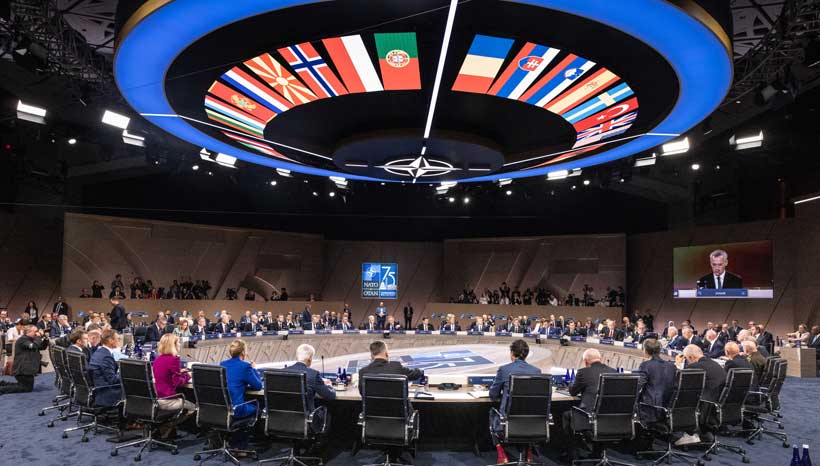
Starmer will take the plan, which foresees spending nearly 80 billion pounds ($105.7bn) a year by 2029, to Ankara for a NATO summit on July 7-8. He wants to signal Britain is on track to spend 3.5 percent of its gross domestic product on defence by 2035.

With likely successor Andy Burnham due to take power as early as July 20, Starmer acknowledged new governments could “build” on his blueprint.

Critics said the plan, delayed for more than nine months, was too little, too late.

Source link

European defence IPO: KNDS lays out listing plans that could value it at up to €15bn

Published on Updated

One of Europe’s largest military equipment producers, KNDS, rolled out long-awaited details of its initial public offering (IPO), aiming for a dual listing in Paris and Frankfurt in the coming weeks.


ADVERTISEMENT


ADVERTISEMENT

The IPO could value KNDS, the maker of Leopard and Leclerc tanks, at between €12bn and €15bn, according to the Financial Times, potentially making it one of Europe’s largest defence listings in recent years.

The listing comes at a time when European military budgets are surging, driven by the war in Ukraine and doubts over the reliability of the US as a security guarantor.

The company declined to comment on the precise date, but CEO Jean-Paul Alary told reporters the offering was expected within weeks.

According to Alary, the move comes as the continent enters what he called a new era of defence and security, with armed forces modernising rapidly and rebuilding the land-warfare capabilities run down during decades of lower spending.

According to Reuters, the firm has now formally launched the IPO process, which is expected to take place in mid-July.

The announcement comes days after Germany unveiled plans to acquire a 40% stake in KNDS, saying the move would secure long-term influence over a company it considers strategically important to European security and defence.

France, which currently owns 50% of KNDS, is expected to reduce its stake to 40%.

The remaining 20% of the company is set to be floated on the stock market, with France and Germany each retaining 40% stakes following the transaction.

According to the Financial Times, the shares are expected to be marketed primarily to institutional investors amid strong demand for European defence stocks.

Once the listing is completed, KNDS shares will begin trading on Euronext Paris and the Frankfurt Stock Exchange, giving investors direct exposure to one of Europe’s largest land-defence manufacturers.

KNDS was created in 2015 through the merger of Germany’s Krauss-Maffei Wegmann and France’s Nexter.

A growing headache for Rheinmetall

The rapid emergence of the rival adds to the pressure on Rheinmetall, Europe’s largest ammunition maker and KNDS’s main competitor in subsectors such as land systems.

The Düsseldorf-based group, whose shares have shed roughly a quarter of their value this year, had itself reportedly hoped to buy into KNDS, only to be shut out by the governments’ intervention.

To make matters worse, Berlin announced it would scrap Rheinmetall’s multi-billion-euro F126 frigate programme, which would have been Germany’s largest warship order since the Second World War, in favour of smaller vessels from rival builder TKMS.

Rheinmetall, which had been poised to take over the project, fell 13% in early trading on Wednesday due to the news.

The squeeze also coincides with regulatory scrutiny at home.

Germany’s Monopolies Commission has warned that defence procurement is concentrated among a small number of suppliers, potentially weakening competition and driving up costs.

Calling for reforms to procurement rules, commission chairman Tomaso Duso said competition was “the fundamental pillar of Europe’s economic order” and should play a greater role in the defence sector.

A listed KNDS will give investors a direct yardstick against which to measure Rheinmetall’s order momentum and margins.

Additional sources • AFP

Source link

Germany to take 40% stake in Leopard tank maker KNDS alongside France

Published on

The German government announced on Monday that it intends to acquire 40% of the defence contractor KNDS, a move designed to bolster European arms production in partnership with its NATO and EU ally France.


ADVERTISEMENT


ADVERTISEMENT

The decision deepens state involvement in a company whose hardware has become central to Europe’s rearmament efforts.

KNDS was created in 2015 through the merger of Germany’s Krauss-Maffei Wegmann and France’s Nexter. The French state holds a 50% stake, while the other half belongs to the German family behind Krauss-Maffei Wegmann, whose planned exit has opened the door for Berlin to step in.

Based in Amsterdam, the group reported revenue of €4.4 billion last year and employs more than 11,000 people.

The timing reflects a broader scramble across Europe to expand military spending and manufacturing capacity, as governments weigh the continued threat from Russia’s war in Ukraine against growing doubts about the reliability of the US as a security guarantor.

Berlin framed the investment in explicitly strategic terms, saying it would secure lasting influence over a business it considers vital to European security and defence.

The German government added that the stake would reinforce domestic industrial output, technological independence and the safeguarding of key national security interests and technologies.

In a joint statement, Germany and France said they had agreed on the future strategy and governance of KNDS, which they intend to co-own through arrangements aimed at giving both countries equal shareholdings.

Clearing the path to a stock market listing

Neither government specified a timeline or the final level at which their holdings would settle, but they stated the agreement opens the way for a possible flotation of KNDS in the near future.

According to people familiar with the matter cited by the Associated Press, the two states plan to trim their stakes to around 30% within two to three years of any listing, while retaining equal voting rights regardless of the size of each holding.

The two governments cast the deal as a joint commitment to building up Europe’s defence industry and armed forces, and to securing the continent’s strategic independence well into the future.

State participation in the firm was first floated by German Defence Minister Boris Pistorius in 2025 as a way to protect strategic expertise and jobs.

Beyond its tanks, KNDS also manufactures the Puma infantry fighting vehicle and the Boxer and Dingo armoured personnel carriers, equipment which is in growing demand as European armies replenish stocks depleted by years of underinvestment and donations to Ukraine’s defence.

Additional sources • AP

Source link

Arsenal to begin Premier League title defence against promoted Coventry | Football News

The first match of the 2026-27 Premier League season sees the reigning top-flight champions face the second-tier Championship winners.

Arsenal will kick off their Premier League title defence against promoted Coventry City on August 21.

The Premier League fixtures for the 2026-27 campaign were released on Friday, with the Gunners’ home game against Frank Lampard’s Coventry among the highlights in the opening round of matches.

Recommended Stories

list of 3 itemsend of list

Coventry are back in the top flight for the first time in 25 years after winning the Championship last season.

Andoni Iraola’s first Premier League game as Liverpool manager will be at Newcastle United on August 23. Former Bournemouth boss Iraola’s Anfield debut is set for the weekend of August 29 against Nottingham Forest.

Manchester City start life after Pep Guardiola at home to Bournemouth on August 23.

City are expected to appoint former Chelsea boss Enzo Maresca to replace Guardiola, who stepped down at the end of the season after a decade in charge.

New Chelsea manager Xabi Alonso begins his reign with a west London derby at Fulham on August 24.

Hull City, who won promotion via the Championship playoffs, begin their first Premier League season since 2017 with a home fixture against Manchester United on August 22.

Elsewhere on the first weekend, Europa League winners Aston Villa travel to Brighton & Hove Albion.

Soccer Football - Premier League - Crystal Palace v Arsenal - Selhurst Park, London, Britain - May 24, 2026 Arsenal manager Mikel Arteta celebrates with the trophy after winning the Premier League Action Images via Reuters/Matthew Childs EDITORIAL USE ONLY. NO USE WITH UNAUTHORIZED AUDIO, VIDEO, DATA, FIXTURE LISTS, CLUB/LEAGUE LOGOS OR 'LIVE' SERVICES. ONLINE IN-MATCH USE LIMITED TO 120 IMAGES, NO VIDEO EMULATION. NO USE IN BETTING, GAMES OR SINGLE CLUB/LEAGUE/PLAYER PUBLICATIONS. PLEASE CONTACT YOUR ACCOUNT REPRESENTATIVE FOR FURTHER DETAILS..
Mikel Arteta guided Arsenal to the Premier League title last season, ending a 22-year drought [Matthew Childs/Action Images via Reuters]

Arsenal, champions for the first time since 2004, face a testing period after they host Coventry.

Mikel Arteta’s side head to Villa for their first away league game of the season, then meet Chelsea at Emirates Stadium on September 5.

The weekend of September 12 brings the first Manchester derby of the post-Guardiola era, while Liverpool host Manchester United on November 21.

City and Arsenal do not face each other until November 28 at the Emirates Stadium.

The first Merseyside derby of the season between Everton and Liverpool is scheduled for November 28 at the Hill Dickinson Stadium.

Roberto De Zerbi will get his first taste of the north London derby on December 5 when Tottenham host Arsenal.

The pick of the Boxing Day schedule sees Coventry boss Lampard facing his old club Chelsea on December 26.

The final day of the Premier League will take place on May 30, with Arsenal at home to Brighton, while City travel to Sunderland and Liverpool host Bournemouth. Chelsea and United finish at home to Brentford and Fulham, respectively.

The start and end of the upcoming season are later than usual due to the FIFA World Cup 2026, which finishes just 34 days before the Premier League begins.

Arsenal will face FA Cup winners City in the Community Shield, which serves as the curtain raiser to the top-flight season, on August 16.

Source link

Luigi Mangione to use psychiatric defence in healthcare CEO murder case | Courts News

Mangione would face lighter sentencing if jury accepts he was in a state of ‘extreme emotional disturbance’ during act.

Luigi Mangione, the man suspected of fatally shooting United Healthcare CEO Brian Thompson in New York City, will argue a psychiatric defence during his trial.

Judge Gregory Carro said on Wednesday that Mangione’s lawyers informed him that they will assert that their client was in a state of “extreme emotional disturbance” when he allegedly carried out the shooting in December 2024.

Recommended Stories

list of 3 itemsend of list

New York state allows murder defendants to make the case that they cannot be held fully responsible for their actions because they were in a state of extreme emotional disturbance at the time of the killing.

Thompson’s slaying, which took place outside a hotel in midtown Manhattan, shocked the United States public. Grainy footage of the act quickly spread across social media.

It also drew attention to the widespread anger over sky-high healthcare prices. Police have said that the terms “delay”, “deny”, and “depose” were written on the suspect’s ammunition, a reference to how health insurance companies avoid paying claims.

If the jury concludes that Mangione was emotionally disturbed at the time of the alleged act, it could move to convict him of manslaughter rather than murder. Such a conviction generally results in a lighter sentence.

Relying on a claim of emotional disturbance means that Mangione would effectively admit that he carried out the act, but that he did so under circumstances of impaired judgement. It differs from an insanity plea, which would allow Mangione to serve his sentence in a psychiatric facility rather than a prison.

Mangione, who sat between two of his lawyers dressed in a blue suit, is set to go to state trial on September 8. The 28-year-old has previously pleaded not guilty to state and federal charges in connection to the killing.

His federal trial, which includes stalking charges, is set to begin on October 13. He faces a potential life in prison if convicted in either case.

US District Judge Margaret Garnett, who is overseeing the federal case, threw out murder and weapons charges against Mangione on technical grounds in January. That ruling eliminated the possibility of Mangione facing the death penalty.

Source link

Britain’s defence ⁠minister Healey quits over defence spending | News

BREAKING,

PM Starmer is ‘unable to ⁠commit resources ⁠the nation needs’, John Healey ⁠says in letter.

⁠Britain’s defence ⁠minister ⁠says he has resigned over ‌a disagreement with the prime minister about defence spending.

In a letter addressed to Keir Starmer and posted on X on Thursday, Defence Secretary John Healey accused the prime minister of failing to commit the government resources that ⁠are needed to defend the country.

Britain’s’s defence and finance ministries have been locked in talks for months over ‌how to meet rising demands to expand military spending, delaying Britain’s Defence Investment Plan since last year.

“You have been unable, and the Treasury has been unwilling, to ⁠commit the resources that ⁠the nation needs to defend the country at this time of rising threats,” Healey ⁠said in his letter to Starmer.

The delay has ⁠infuriated Britain’s defence ⁠industry which says it cannot invest in long-term programmes for the country’s security at a time ‌of huge geopolitical volatility and as the United States pivots away ‌from ‌protecting Europe.

This is a breaking story. More to come…

Source link

‘Partners and friends’: Trade and defence top of agenda at EU-South Korea summit

European Commission President Ursula von der Leyen, European Council President Antonio Costa and with South Korean President Lee Jae-myung celebrated the signing of new a digital trade agreement at a ceremony in Brussels on Wednesday.


ADVERTISEMENT


ADVERTISEMENT

The event marked the EU and South Korea’s 11th summit, with everything from security and defence to trade on the agenda.

“Korea is one of Europe’s closest partners in the Indo-Pacific region and on the global stage,” von der Leyen said. “In today’s uncertain world, stable and trusted partnerships like ours are more precious than ever.”

The trio released a joint statement extolling the value of the talks and committing the two sides to a firm and friendly relationship.

“We reaffirm our shared commitment to effective multilateralism, and to a stable and predictable rules-based free and fair economic order,” the statement reads.

The semiconductor factor

Both sides have an interest in diversifying their trade relationships at a time of growing tensions with both China and the US, and the EU-South Korea digital trade agreement comes more than a decade after a landmark free trade deal.

Since 2015, trade between the EU and South Korea has doubled, with goods trade reaching approximately €124.25 billion in 2025, according to figures from the European Commission.

“The European Union-Korea Free Trade Agreement remains one of the European Union’s most successful trade agreements since its entry into enforcement in 2011,” European Council António Costa said on Wednesday.

South Korea is becoming an increasingly important investor in Europe, particularly in strategic sectors such as batteries, electric vehicles and semiconductors.

For the EU, a key objective is to secure semiconductor supply chains while attracting further investment from Korean companies into Europe.

“Korea has a global leadership position in semiconductors,” an EU official said. “This is clearly an area with significant potential for cooperation that would benefit both sides.”

The digital trade agreement concluded on Wednesday is expected to complement the broader trade partnership by reducing “unnecessary barriers to digital trade” and providing greater “legal certainty” for businesses operating across the two markets, according to another EU official. It will facilitate cross-border data flows while prohibiting the mandatory transfer of source code.

The deal is also designed to establish robust online consumer protection rules, though both partners intend to maintain their respective levels of protection for personal data and privacy.

Economic security was also high on the summit agenda, with the two sides agreeing to establish a high-level dialogue on supply chain resilience.

Supply chains came under pressure last year following China’s restrictions on exports of strategic materials, including rare earths – essential for green technologies and the defence sector – as well as products linked to the chip industry, which are critical to automotive manufacturing.

Security and defence

One thing that did not get over the line was a security of information agreement, which had been touted by EU officials prior to the summit as a means of strengthening the flow of classified information between Brussels and Seoul.

“I hope that the security of information agreement will be adopted soon, so that Korea and the EU can share confidential information safely, which will allow the two sides to engage in industrial and research cooperation actively through information exchange exchange,” President Lee said on Wednesday.

The agreement would build on the Security and Defence Partnership agreement that South Korea and the EU signed in 2024. That deal was designed to facilitate cooperation in areas spanning maritime security, countering hybrid threats, fighting foreign information manipulation and interference, and more besides.

In the run-up to this week’s talks, a senior EU official said a key topic of the discussions will be nuclear non-proliferation, as North Korea continues to hold a small but concerning stockpile of nuclear-armed warheads.

North Korea (the DPRK) and Russia were considered “big questions” at the summit, the source said, with Brussels ready to share information on its support for Ukraine with Seoul.

The joint statement from the summit reiterates this, with words of condemnation directed at North Korea and other nations who enable Russia to sustain its war of aggression against Ukraine.

“We urge Russia and the DPRK to immediately cease all such activities and abide by the UN Charter and all relevant United Nations Security Council resolutions,” the statement reads.

Source link

US suspends joint defence effort with Canada dating back to World War II | Donald Trump News

The Trump administration has frequently accused US allies of failing to live up to mutual defence obligations.

The United States has said it will not take part in a joint board for continental defence with Canada, depicting the country as failing to live up to its defence obligations.

On Monday, US Undersecretary of Defense Elbridge Colby wrote on social media that his department would halt its involvement in the Permanent Joint Board on Defense to “reassess” the forum’s benefits.

Recommended Stories

list of 3 itemsend of list

The board dates back to World War II and has served as a forum for regional security. But relations with Canada have grown strained since US President Donald Trump returned to office for a second term in 2025.

“A strong Canada that prioritizes hard power over rhetoric benefits us all. Unfortunately, Canada has failed to make credible progress on its defense commitments,” Colby wrote on X.

“We can no longer avoid the gaps between rhetoric and reality. Real powers must sustain our rhetoric with shared defense and security responsibilities.”

The announcement is the latest instance of the Trump administration chiding Western allies for what the president believes is an overreliance on US military power.

Allied countries have largely refuted his claims, arguing that they are ramping up military spending and taking steps to take greater control over regional security.

Just last year, at a NATO summit in The Hague, nearly every member state agreed to increase defence spending to 5 percent of their gross domestic product (GDP). Spain petitioned to be excluded from the agreement, though.

Canada, under Prime Minister Mark Carney, was among the countries committing to the increased spending.

Of the 5 percent earmarked for defence, 3.5 percent would go to bolstering Canada’s “core military capabilities”, Carney’s government said. The rest would go to security-related expenses, including port improvements, emergency preparedness and other resources.

Since taking office as prime minister in March 2025, Carney has been an outspoken supporter of lessening Canada’s dependence on the US’s military and economy.

In a speech this year, he outlined a vision in which “middle powers” like Canada banded together to sidestep the current “era of great power rivalry”, a veiled reference to countries like the US, Russia and China.

While the US and Canada are neighbours, Trump’s second presidency has resulted in fraying bonds between the two countries, even beyond matters of security.

Trump has accused Canada of pursuing unfair trade policies and failing to crack down on the illicit traffic of people and drugs across the border, though critics have questioned the legitimacy of these claims.

To force Canada to comply with his policies, the US president has pursued an aggressive tariff regimen to tax cross-border imports.

Trump has suggested in the past that Canada could avoid such penalties by ceding its sovereignty and becoming the US’s 51st state.

“Cooler and wiser brains are needed to preserve a close alliance w/ our neighbor,” US Republican Representative Don Bacon said in a social media post on Monday, criticising the decision to pull out of the defence forum with Canada.

“This all started w/ taunts of ‘Canada will be the 51st state’ and ‘their Prime Minister will be the 51st governor’. The insults gained us nothing but animosity that cost us economically and now militarily.”

The US, Canada and Mexico are set to negotiate an updated version of a regional free trade agreement, known as the USMCA, later this year.

Source link

Champions League analysis: How aggressive attack & defence fuelled Arsenal’s run to final

Champions League analysts Stephen Warnock, Nedum Onuoha and Guillem Balague explain how Arsenal were able to “make life difficult” with the use of a man-to-man press high up the pitch to force Atletico Madrid to play the ball long in their semi-final second leg at the Emirates Stadium.

MATCH REPORT: Champions League – Arsenal 1-0 Atletico Madrid (2-1 agg)

Available to UK users only.

Source link

Mali leader Goita takes defence post after minister killed | News

The leader of Mali’s military government, Assimi Goita, has taken on the role of defence minister following the killing of the previous minister in last week’s uprising by rebel groups.

State television channel ORTM reported on Monday that Goita was taking on the post following the death of Sadio Camara in large-scale attacks by an al-Qaeda-linked group working with Tuareg separatists.

Recommended Stories

list of 3 itemsend of list

The report noted the presidential decree that Assimi Goita will remain president while also taking on the new role

General Oumar Diarra, who was military chief of staff, has been appointed as delegate minister to the defence ministry.

Car bomb blast

During the assault on strongholds of the military government, more than a week ago, Camara was killed by a car bomb blast at his residence. The rebel armed groups were able to capture the key northern town of Kidal in the largest attack in the West African country in nearly 15 years.

The fighting killed at least 23 people, with the United Nations children’s agency UNICEF reporting that civilians and children were among the dead and injured.

Mali has been beset by security crises since at least 2012. Al-Qaeda-linked Jama’at Nusrat al-Islam wal-Muslimin (JNIM) controls large areas of rural territory, especially in the north and central regions, and has active cells around the capital. Similarly, the ISIL (ISIS) affiliate in Sahel Province (ISSP) controls areas in northeastern Menaka city.

At the same time also in the north, armed Tuareg separatists of the Liberation Front for Azawad (FLA) group are fighting for an independent nation called Azawad. They are battling Mali’s military and allied Russian mercenaries who have been deployed since 2021.

Together with the JNIM, they control Kidal, but also want Gao, the largest city in the north, as well as Menaka and Timbuktu, to complete the self-declared state of Azawad.

Those groups sometimes work together: they operate in the same areas and draw from the same pool of fighters from aggrieved communities. In the latest widespread attacks, the JNIM worked with the FLA against the army.

Goita’s military government took power after coups in 2020 and 2021, pledging to restore security, but has struggled to achieve that.t It has cut ties with its former colonial ruler, France, and expelled French forces and United Nations peacekeeping missions.

Last July, military authorities granted coup leader Goita a five-year presidential mandate, which can be renewed “as many times as necessary” without an election.

The previous month, Russia’s Wagner Group, which had been aiding Malian forces against armed groups since 2021, said it would complete its mission. It has now become the Africa Corps, an organisation under the direct control of the Russian defence ministry.

In the wake of last month’s attacks, the rebels announced a blockade of the capital Bamako in retaliation for “the population’s support of the army”. However, that blockade has only partially been effective, according to an AFP correspondent in the city.


Source link

NATO chief says Europeans have ‘gotten the message’ from Trump on defence | European Union News

The US president has accused some NATO countries of not doing enough to support the US-Israel war on Iran.

NATO Secretary-General Mark Rutte says European leaders have “gotten the message” after United States President Donald Trump announced plans to withdraw 5,000 soldiers from Germany.

Trump has grown increasingly frustrated with NATO allies, accusing them of not doing enough to support the US-Israel war on Iran. Speaking on Monday, Rutte acknowledged “disappointment from the US side”.

Recommended Stories

list of 3 itemsend of list

“European leaders have gotten the message. They heard the message loud and clear,” Rutte said before a European Political Community meeting in Armenia.

“Europeans are stepping up, a bigger role for Europe and a stronger NATO,” he added.

The Pentagon announced the troop withdrawal from Germany on Friday, days after German Chancellor Friedrich Merz said Iran was humiliating the US during the negotiations aimed at ending the war.

The European Union’s top diplomat, Kaja Kallas, called the announcement’s timing a “surprise”.

“I think it shows that we have to really strengthen the European pillar in NATO, and we have to really do more,” Kallas said while stressing that “American troops are not in Europe only for protecting European interests but also American interests.”

Over the weekend, NATO spokesperson Allison Hart said officials in the 32-nation military alliance “are working with the US to understand the details of their decision on force posture in Germany”.

‘Dangerous military intervention’

European criticism of the war on Iran has mounted in recent weeks as the conflict sends shockwaves through the global economy due to the continued disruption to shipping in the Strait of Hormuz.

Last week, Merz compared the war to previous military quagmires, such as the US invasions of Iraq and Afghanistan.

“It is, at the moment, a pretty tangled situation,” he said. “And it is costing us a great deal of money. This conflict, this war against Iran, has a direct impact on our economic output.”

Spain has refused to let the US launch attacks on Iran from its airspace or military bases. Prime Minister Pedro Sanchez has condemned the war as “unjustified” and a “dangerous military intervention” outside the realm of international law.

In response, Trump called Spain “terrible” and threatened to end all trade ties.

Despite this, Rutte said “more and more” European nations were now pre-positioning assets such as minehunters and minesweepers close to the Gulf to be ready for the “next phase” in the war.

He provided no details, and European nations have previously insisted they would not help to police the Strait of Hormuz until the war is over.

Increased defence spending

Many European countries have committed to ramping up defence spending in the face of fears over Trump’s commitment to NATO and Russia’s assault on Ukraine – a push underscored by several leaders in the Armenian capital.

“Europeans are taking their destiny into their own hands, increasing their defence and security spending, and building their own common solutions,” French President Emmanuel Macron said.

“We have to step up our military capabilities to be able to defend and protect ourselves,” European Commission President Ursula von der Leyen told reporters.

Source link

Can the EU’s Article 42.7 offer Europe NATO-like collective defence? | NATO News

European leaders are seeking to clarify a little-used mutual defence clause in the European Union treaty as questions grow over Washington’s long-term commitment to NATO during a deepening rift with the United States.

NATO, founded in 1949, is a military alliance of North American and European countries built on the principle that an attack on one member is an attack on all. But years of tension between Washington under President Donald Trump and its European allies have pushed European governments to place greater emphasis on their own defence capabilities.

Recommended Stories

list of 4 itemsend of list

The shift has come as Trump has repeatedly criticised NATO members over their defence spending. He has also questioned the value of the alliance and clashed with European leaders over Ukraine and Iran while threatening to seize Greenland from NATO ally Denmark. The latest tensions escalated after the US and Israel began their war on Iran when Trump accused allies of failing to support Washington and dismissed NATO as a “paper tiger”.

Media reports have said that the Pentagon has also prepared a memo examining options to punish allies viewed as insufficiently supportive during the Iran war. Those options reportedly include exploring the suspension of Spain, which has been particularly critical of the war, from NATO and reviewing the US position on Britain’s claim to the Falkland Islands. NATO has no formal mechanism to expel a member, but the episode has cast doubt over the alliance’s unity and revived questions about Europe defending itself without Washington.

At the heart of Europe’s bid to look for alternative security arrangements beyond NATO is Article 42.7 of the European Union’s founding treaty.

What is Article 42.7?

Article 42.7 of the Treaty on European Union is the bloc’s mutual defence clause. It says that if an EU member state is the victim of armed aggression on its territory, the other member states are obliged to provide aid and assistance by all means in their power in line with the United Nations Charter.

By comparison, Article 5 in NATO’s North Atlantic Treaty states that an attack on one member is considered an attack on all. It is supported by common planning and joint exercises and is underpinned by the military weight of the US.

Unlike NATO’s Article 5, however, the EU clause is not backed by an integrated military command structure, standing defence plans or a permanent force able to respond automatically and the US has no obligation to intervene.

That means it is often seen as less credible as a military guarantee in practice although it remains an important political commitment.

Who is calling for Europe to turn to Article 42.7?

Cyprus, which is an EU member but not a NATO member, has been especially eager to strengthen the clause after a drone struck a British airbase on the island during the Iran war last month. While such an incident may not have been enough to invoke NATO’s Article 5, it could raise questions about Article 42.7, particularly at a time of growing strain between the US and Europe.

Cypriot President Nikos Christodoulides said leaders had agreed it was time to define how the provision would work in practice if it were triggered.

“We agreed last night that the [European] Commission will prepare a blueprint on how we respond in case a member state triggers Article 42.7,” he said on Friday at an EU summit.

French President Emmanuel Macron has also stressed that the clause should be treated as a binding commitment rather than a symbolic gesture. “On Article 42, paragraph 7, it’s not just words,” he said during a weekend visit to Greece. “For us, it is clear, and there is no room for interpretation or ambiguity.”

Antonio Costa, president of the European Council, said the bloc was drawing up a “handbook” for the use of the clause.

And EU foreign policy chief Kaja Kallas said Europe must step up its defence efforts after Trump has “shaken the transatlantic relationship to its foundation”.

“Let me be clear: We want strong transatlantic ties. The US will remain Europe’s partner and ally. But Europe needs to adapt to the new realities. Europe is no longer Washington’s primary centre of gravity,” she said at a defence conference in Brussels.

“This shift has been ongoing for a while. It is structural, not temporary. It means that Europe must step up. No great power in history has outsourced its survival and survived.”

Has the article ever been invoked?

The clause has been used only once before when France invoked it after the 2015 Paris attacks claimed by ISIL (ISIS), in which 130 people were killed and hundreds wounded.

The attacks were the deadliest in France since World War II. After Article 47.2 was invoked, other EU states shared intelligence aimed at helping French authorities unravel the conspiracy that led to the attacks.

NATO’s Article 5 has also been invoked just once – after the September 11, 2001, attacks in the US.

But NATO’s help to the US wasn’t limited to intelligence sharing. Allies contributed tens of thousands of soldiers to the US-led war in Afghanistan. The operations lasted two decades, and more than 46,000 Afghan civilians were killed alongside 2,461 US personnel and about 1,160 non-US coalition soldiers, according to Brown University’s Cost of War project.

Can countries be kicked out or leave NATO?

Europe’s debate over its defence comes amid a string of disputes inside NATO. The reports that US officials have considered punitive measures against allies have revived questions over the alliance’s future cohesion.

Pablo Calderon Martinez, head of politics and international relations at Northeastern University London and a specialist in European affairs, told Al Jazeera that Spain cannot legally be removed from NATO.

“There is no legal mechanism to remove a member. There is, however, a mechanism through which a member can withdraw itself from the organisation,” he said.

He added that some countries have long fallen short of NATO commitments but that does not provide grounds for expulsion. A more likely scenario, he said, would be the US choosing to leave.

Carne Ross, a former British diplomat and founder of Independent Diplomat, a nonprofit diplomatic advisory group, said the deeper issue is whether Europe and Washington still share common values.

“It is abundantly clear that we do not. Trump is anti-democratic. He tried to subvert democracy, challenged the 2020 election result and whipped up a violent crowd to storm the Capitol,” Ross said.

“What more evidence do we need that the values of Europe are not shared in Washington?”

Is Europe preparing for a future without the US?

European countries have pledged to sharply increase their defence budgets with many aiming to spend 5 percent of their gross domestic products each year on their militaries.

Trump cannot withdraw the US from NATO without congressional approval, but doubts over Washington’s commitment have already unsettled many European capitals.

That has created new urgency around strengthening Europe’s own defence capabilities and building a more credible European pillar inside, or alongside, NATO.

Ross said Europe’s major powers should begin planning seriously for greater self-reliance.

“The Europeans themselves, particularly the most powerful countries – Britain, France, Germany and Italy – need to be talking about how to defend themselves without the US,” he said.

Source link

Mali’s Defence Minister Sadio Camara killed amid coordinated attacks | Conflict News

DEVELOPING STORY,

Camara’s house in the garrison town of Kati came under attack amid simultaneous attacks across the West African country.

Mali’s Defence Minister General Sadio Camara has been killed amid coordinated attacks on military sites across the country, sources told Al Jazeera.

The news on Sunday came a day after his residence in the garrison town of Kati came under attack during the simultaneous attacks launched by al-Qaeda affiliate and Tuareg rebels on Saturday.

Recommended Stories

list of 4 itemsend of list

Camara was a central figure in the military government that seized power after back-to-back coups in 2020 and 2021.

“He was one of the most influential figures within the ruling military leadership and had been seen by some as a possible future leader of Mali,” said Al Jazeera’s Nicolas Haque, who has reported extensively from Mali.

“His death is a major blow to the country’s armed forces.”

Haque said attackers carried out a suicide car bomb assault on Camara’s residence in Kati, a heavily fortified military town about 15km (9 miles) northwest of the capital, Bamako.

“Kati is considered one of the most secure locations in the country, yet fighters from the al-Qaeda-linked Jama’at Nusrat al-Islam wal-Muslimin, along with Tuareg fighters from the Liberation Front of Azawad, were able to launch the attack,” he said.

Gunmen also attacked several locations across Mali, including Bamako, as well as Gao and Kidal in the north, and the central city of Sevare.

“As we speak, people in the garrison town of Kidal can still hear heavy gunfire and loud explosions,” Haque added. “This remains an ongoing operation more than 24 hours after it began.”

Interim President Assimi Goita has come under pressure since the offensive, with analysts saying the authorities appeared to have been caught off guard by the latest wave of violence.

Haque said Goita was “alive and well in a secure location”.

“When the attack took place, he was moved to safety, so he remains in command of the military,” he said.

The African Union, the secretary-general of the Organisation of Islamic Cooperation and the US Bureau of African Affairs condemned the attacks across Mali.

Source link

Why has Italy’s Giorgia Meloni suspended a defence pact with Israel? | US-Israel war on Iran News

Italy’s decision to suspend a defence agreement with Israel has more symbolic value than concrete consequences, but it is an unprecedented move by the Italian government and reflects deep unease over its longtime ally’s actions in the Middle East, analysts say.

On Monday, Prime Minister Giorgia Meloni said Italy would not renew a memorandum of understanding – signed in 2003 and ratified in 2005 – between the two countries’ ministries of defence. The accord provided a framework for cooperation in “defence industry and procurement policy” and “import, export and transit of defence and military equipment”, among other things.

Recommended Stories

list of 3 itemsend of list

The memorandum was set to automatically renew every five years “unless a written notice of intention to denounce is given” by one of the two countries to the other.

That notice arrived on Monday in a letter written by Italian Defence Minister Guido Crosetto to his Israeli counterpart, Israel Katz.

The Israeli government has downplayed the move. Foreign Minister Gideon Saar said it was a deal that “never materialised” and did not have “substantial content”. “Israel’s security will not be harmed,” he wrote on X.

It is true that the Italy-Israel agreement constituted more of a political framework than a series of operational commitments between the two countries. Furthermore, the Italian government’s decision does not cancel it outright, as opposition parties and human rights advocates have long demanded, but merely suspends it.

Still, the move is a sharp reversal for a right-wing government that has been one of Europe’s staunchest allies of Israel.

Along with Germany, Italy has been one of the strongest opponents of calls to suspend a trade agreement between Israel and the European Union. Italy has largely supported Israel’s war on Gaza, which a United Nations inquiry says amounts to genocide, and it has refused to recognise Palestinian statehood. 

But relations between Israel and Italy have soured recently.

On Monday, the Italian ambassador to Tel Aviv, Luca Ferrari, was summoned after Italy’s Foreign Minister Antonio Tajani condemned Israel for its “unacceptable attacks against the civilian population” in Lebanon during a visit there. And last week, the Italian government accused Israeli forces of firing warning shots at a convoy of Italian peacekeepers in southern Lebanon, prompting Tajani to summon the Israeli ambassador.

Israel also launched a massive attack across Lebanon last week, bombing 100 targets in 10 minutes on Wednesday, shortly after a two-week truce between Iran and the US was called. That series of strikes killed hundreds of people in one of the country’s worst mass slaughters since the end of the country’s civil war in 1990. Observers say the attack on Lebanon was an unwelcome disruptor to efforts to de-escalate tensions in the region.

De-escalating Middle East tensions

The Italian government’s decision to suspend its defence agreement with Israel “must be seen within a broader effort to progressively stabilise the region, including by reducing tensions in Lebanon”, said Michele Valensise, president of the Institute for International Affairs and former secretary-general of Italy’s Ministry of Foreign Affairs.

“Israel’s military operation there objectively constitutes an irritant, complicating negotiations with the Iranians,” said Valensise. “If the Lebanese front can be part of a deal with Iran, then everyone has an interest in de-escalation there.”

European governments, including Italy, have been watching nervously as the United States-Israeli war on Iran has unfolded. Following initial joint Israel-US strikes on Tehran on February 28, Iranian forces brought shipping traffic in the Strait of Hormuz to a near-total halt, causing the paralysis of the one-fifth of global oil and liquefied natural gas (LNG) exports that pass through the narrow waterway in peacetime.

Following a first failed round of high-stakes Iran-US talks in Islamabad last weekend – amid a fragile two-week truce – Washington imposed a naval blockade on Iranian ports, further aggravating fears of a protracted energy crisis. Italy heavily relies on gas imports.

‘Stop the genocide’

Possibly more importantly, Italy’s government and prime minister are preparing for elections next year.

“There is a general discontent over the war in Iran and the crisis in the Strait of Hormuz – a crisis that’s impacting Italian growth and, if it continues, could have a significant impact on citizens, something Meloni worries about in a pre-election year,” said Arturo Varvelli, a political scientist and senior policy fellow at the European Council on Foreign Relations.

Italian public opinion also has a strong pro-Palestinian component. Last October, more than two million Italians took to the streets as part of a general strike in solidarity with the Global Sumud Flotilla, which was intercepted by Israel while trying to bring aid to Palestinians in Gaza. The flotilla had been carrying 40 Italians among its passengers, calling on Israel to “stop the genocide”.

“There’s a concern that this will be a long agony, between an increasingly unmanageable Trump and the economic problems he and Netanyahu have caused with the war in the Middle East,” Varvelli said.

After years of efforts to emerge as US President Donald Trump’s “whisperer” in Europe, Meloni has been pushed by the war in Iran to put some distance between herself and Trump. Rome refused the US president’s request to join a naval coalition to force the opening of the Strait of Hormuz and to allow US bombers to refuel at a military base in southern Italy.

Trump had not commented on those decisions until yesterday, when, in an interview with Italian newspaper Corriere della Sera, he took aim at Meloni. The Italian PM had leapt to defend Pope Leo XIV after he became embroiled in a feud with Trump. Pope Leo had condemned the US president’s threat that Iran’s “civilisation will die” if it didn’t re-open the Strait of Hormuz. In response to that, Trump unleashed a storm of criticism at Leo, calling him “weak on crime” and “terrible for foreign policy”. He said he does not “want a Pope who criticises the President of the United States”.

Trump also posted a bizarre image of himself as a Christ-like figure healing the sick on social media. He has since claimed it was meant to depict him as a doctor, following widespread criticism.

Of Meloni, who he once affectionately called “a real live wire”, Trump said, “I’m shocked at her” during an interview with Corriere della Sera on Tuesday.

“Do people like her? I can’t believe it,” he said in the interview, adding, “I thought she had courage. I was wrong.”

Source link

Italy suspends long-standing defence agreement with Israel | Israel attacks Lebanon

NewsFeed

Italy has suspended the renewal of a 20-year-long defence agreement with Israel, following recent tensions between the two countries after the Italian government accused Israeli forces of firing warning shots at a convoy of Italian peacekeepers in Lebanon.

Source link