defeat

Munster 21-7 Zebre: Irish province defeat Italian visitors in United Rugby Championship

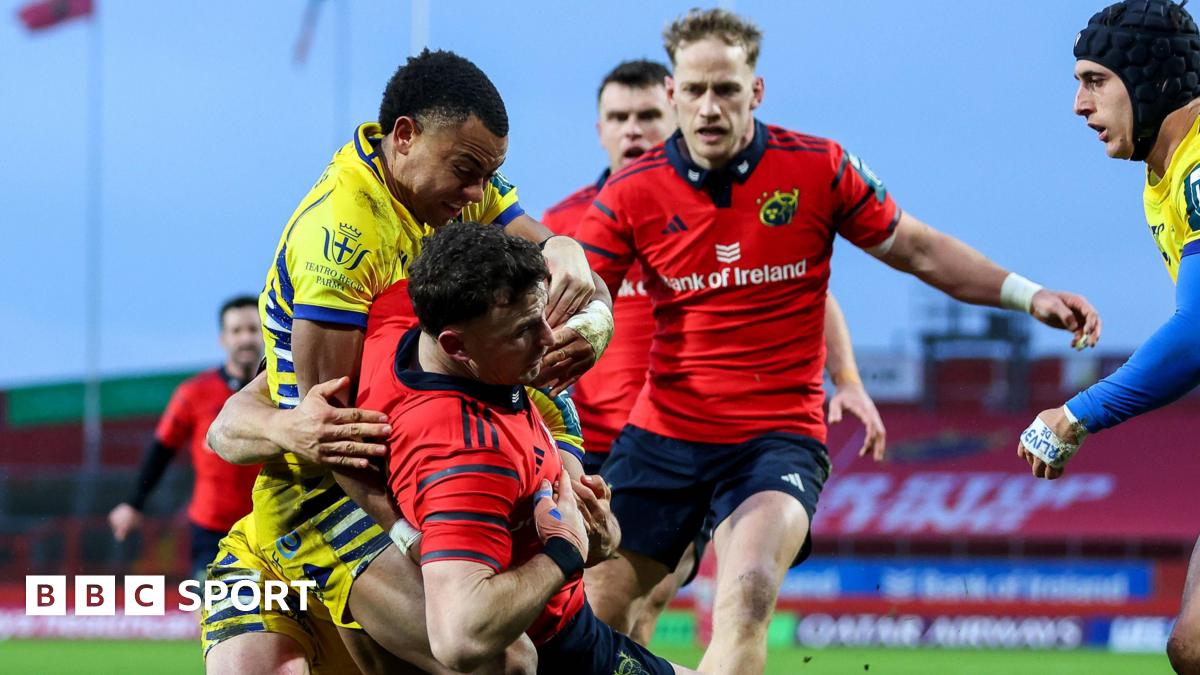
Munster secured a much-needed 21-7 win over Zebre in the United Rugby Championship, being made to work hard before pulling clear in the second half at a drenched Thomond Park on Saturday.

With three defeats in their last four URC outings – against Leinster, Ulster and Glasgow Warriors – and having made 10 changes from the side that lost to Glasgow Warriors last month, this result will steady the ship somewhat for the Irish province.

After going in level at half-time at seven points apiece, Munster edged ahead in the second period with a late brace of tries from Alex Kendellen and Lee Barron, those scores securing Clayton McMillan’s side their first win in Limerick since October.

Munster had the majority of early territory and pressure, with a beautifully judged kick from Tom Farrell handing the hosts a line-out just seven metres from the Zebre line.

That pressure intensified when Giulio Bertaccini was shown a yellow card two minutes in for a deliberate knock-on, as Munster threatened to score under the posts.

Despite being reduced to 14 men, Zebre initially stood firm, but winger Shane Daly demonstrated his explosive pace and stormed over in the left corner after six minutes, getting Munster off the mark, JJ Hanrahan adding the conversion.

A sudden downpour swept across Thomond Park, making handling increasingly treacherous, yet Munster continued to probe.

The hosts generated quick ruck ball and a clever grubber from Mike Haley almost put captain Jack O’Donoghue in under the posts, but the ball slipped forward at the crucial moment.

Munster controlled territory for much of the opening quarter, working patiently through phases as Zebre were forced into heavy defensive shifts.

Gradually the Italian visitors found a foothold and just after the half-hour mark, Samuele Locatelli broke Munster’s defensive line, with flanker Bautista Stavile scoring under the posts. Giacomo Da Re added the extras.

Munster had one final opportunity before the interval, but another spilt ball in the wet conditions allowed Zebre to clear.

Source link

Golden Knights score five goals in third period to defeat Kings

Pavel Dorofeyev had two goals and the Vegas Golden Knights spoiled Artemi Panarin’s Kings debut by scoring five third-period goals to rally for a 6-4 win Wednesday night.

Colton Sissons, Brandon Saad and Reilly Smith scored three goals in a span of 4:14 midway through the third and the shorthanded Golden Knights overcame the absence of five players who participated in the gold medal game at the Milan Cortina Olympics on Sunday. Ivan Barbashev added a late empty-netter, and Adin Hill made 15 saves.

Vegas played without United States center Jack Eichel and defenseman Noah Hanifin and Canada forwards Mark Stone and Mitch Marner and defenseman Shea Theodore, all of whom are expected to be available when their five-game trip continues against the Capitals in Washington on Friday night.

Quinton Byfield had two goals, Adrian Kempe and Brandt Clarke scored, while Panarin had two assists in his team debut, but the Kings dropped their fourth straight game.

Panarin, who was acquired in a trade from the New York Rangers on Feb. 4, set up the Kings’ opening goal by putting his pass in off Byfield’s skate on the power play late in the first period and had the secondary assist on Kempe’s goal in the second period.

Anton Forsberg made 19 saves for the Kings, who came out of the Olympic break three points out of a wild-card berth.

The Golden Knights found themselves trailing after two periods as Panarin reached the 40-assist mark for the 11th straight season. But they responded with a strong final 20 minutes, including Dorofeyev’s power-play goal with 4:01 remaining that made it 5-3.

Source link

Coach Joel Quenneville gets 1,000th victory as Ducks defeat Oilers

Joel Quenneville became the second coach in NHL history to win 1,000 games with the Ducks’ 6-5 comeback victory over the Edmonton Oilers on Wednesday night.

Quenneville joined Scotty Bowman in an exclusive hockey club with a milestone win in the Ducks’ first game back from the Olympic break.

Cutter Gauthier scored the tiebreaking goal with 1:14 to play for the Ducks, who erased a pair of two-goal deficits. Leo Carlsson had a goal and two assists in his first appearance since Jan. 10 for the Ducks, who have won six straight home games and 10 of 12 overall to leapfrog the Oilers into second place in the Pacific Division.

Zach Hyman and Evan Bouchard scored late in the second period to put the Oilers ahead, but Carlsson and Olen Zellweger scored early in the third to even it again.

Rookie Matt Savoie then converted a rebound late in a power play for his 10th career goal, but Beckett Sennecke answered 46 seconds later with a slick wrist shot for his 19th goal — tops among NHL rookies.

Gauthier then converted a rebound of Carlsson’s shot, setting off a wild celebration inside a sold-out Honda Center.

Jack Roslovic and Ryan Nugent-Hopkins scored for Edmonton. Connor McDavid had two assists, giving the Olympic silver medalist an NHL-best 98 points in 59 games.

Ian Moore and Alex Killorn scored for the Ducks, and Lukas Dostal made 22 saves.

Tristan Jarry made 20 saves before getting pulled for Connor Ingram after Sennecke’s tying goal with 13:21 to play.

Carlsson was outstanding in his return to the Ducks’ lineup after missing the final 11 games before the break with a thigh injury that kept him out of the Olympics.

Mikael Granlund didn’t play for the Ducks after captaining Finland to bronze in Milan. None of the Oilers’ Olympians sat out as they opened a three-game California trip.

Source link

Penn State rallies to defeat USC women, despite Kara Dunn’s 24 points

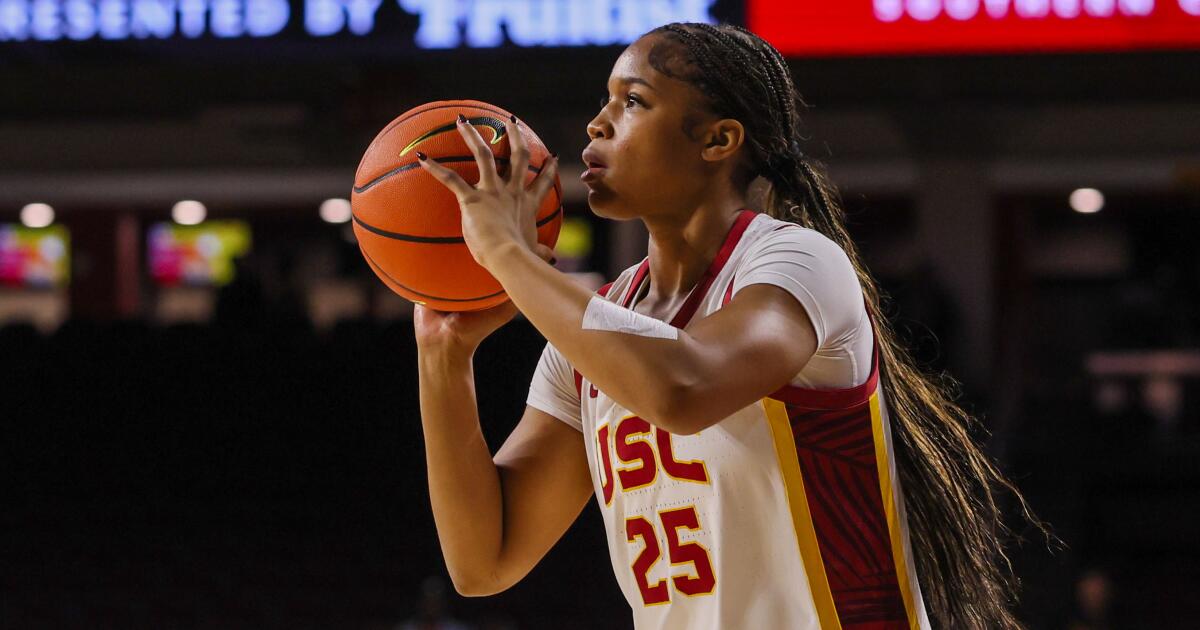
Kara Dunn had 24 points and Jazzy Davidson had 22, but Penn State rallied to defeat the USC women, 85-82 on Wednesday night.

The Trojans led 62-58, early in the fourth quarter and 70-68 with 5:35 to play before Kiyomi McMiller and Moriah Murray made key shots to give Penn State the lead.

Penn State extended its lead to 79-74 after a 15-foot jumper by McMiller. The teams exchanged buckets until Dunn hit a three-pointer with 14 seconds left, pulling the Trojans back within two at 82-80. McMiller was fouled immediately after the inbounds pass, and made both her free throws. Davidson scored on a layup to make it 84-82 with four seconds remaining. Vitoria Santana was fouled and made one of two free throws with three seconds remaining, but USC was unable to get a shot off after that.

Dunn made a season-high six three-pointers and had six rebounds and three assists. Davidson had her 25th consecutive double-figure scoring performance and sixth straight 20-point game. Kennedy Smith had 19 points along with six rebounds, four assists, two steals and a block.

With the loss, USC drops to 17-11 overall and 9-8 in Big Ten play. Wednesday was Penn State’s second win all-time and first win against USC since Jan. 6, 1980.

Source link

Iran cannot defeat US military might, but it can still win | Opinions

Last week, American diplomats and their Iranian counterparts sat down in Geneva for yet another round of talks mediated by Oman. The outcome seemed unclear. While the Iranians said “good progress” had been made, the Americans claimed there was “a little progress”. Meanwhile, United States President Donald Trump threatened once again to strike Iran.

In recent weeks, there has been a heavy US military build-up in the Middle East in preparation for what many observers see as an imminent attack. In this context, it may be apt to question whether the current negotiations are not simply a tactic to buy time to better prepare for the inevitable.

In the face of US military might, some have suggested that Iran’s only option is negotiating an agreement with the US, however unfair it may be. While Iranian military capabilities stand no chance against an army with the world’s biggest budget, accepting capitulation through a debilitating deal that may be broken again by Washington may not necessarily be Tehran’s only choice.

There is another way in which Iran can stand up to US bullying and win.

The fate of past negotiations

The ongoing US-Iran talks cannot be viewed in isolation. For Iran, any diplomatic engagement with the US is overshadowed by the legacy of the Joint Comprehensive Plan of Action (JCPOA).

Signed by the US, China, Russia, France, the United Kingdom, Germany, the European Union and Iran in 2015, the agreement provided sanctions relief in exchange for full transparency of the Iranian nuclear programme. Tehran accepted the deal even though it had some unfair provisions, including some US sanctions remaining in place.

Nevertheless, it fulfilled its obligations – a fact that was repeatedly verified by the International Atomic Energy Agency.

In return, however, the US as a signatory did not uphold its end of the deal. In 2018, Trump unilaterally withdrew from the JCPOA and reimposed maximum pressure sanctions aimed at crippling Iran’s economy.

It was a stark reminder that American promises are nonbinding. As a leader who has shown no regard for the interests of American allies in pursuit of an “America first” policy, Trump could hardly be expected to respect the interests of American adversaries.

However, even if a Democratic president had been in the White House, there would not have been any guarantee that the JCPOA would have remained in place. In the US’s polarised political climate, an American president’s signature is only valid until the next election.

For the US, negotiations can also be little more than a facade intended to lull adversaries into a false sense of security. Last year, just as US and Iranian representatives were scheduled to meet in Oman for another round of talks, Israel, a key American ally, launched a massive military campaign against Iran.

While the US denied direct involvement, it acknowledged having received prior notice. Given the close ties between the two countries, this prior knowledge strongly implied that the US had given Israel tacit approval for the air attacks.

Today, Iran is engaging in negotiations with the US again, and it is being pressured to accept an even more unfair deal. Should it back down and submit to US demands, then Trump – who preys on perceived weakness – would simply move the goalpost. Demands would shift from Iran’s nuclear programme today to its ballistic missiles tomorrow and regime change the day after.

The special US relationship with Israel means that Washington is fundamentally hostile to an Iranian government that sees the Israeli state as an enemy. Consequently, Trump’s goal is not to reach a durable agreement but to ensure that Iran can never fully comply with his demands, thereby justifying a permanent campaign of maximum pressure and hostility.

In this context and given its recent experience, it would be foolish for Iran to rely on US promises and negotiated agreements.

Leverage through strong regional ties

The current US-Iran standoff is a high-stakes game in which an all-out war is a likely outcome. While the US could achieve an initial victory through overwhelming military superiority, it could also get bogged down fighting a protracted counterinsurgency in Iran’s mountainous terrain.

Conversely, while Iran could eventually repel an American invasion – just as its Afghan neighbours did – the country would be reduced to rubble in the process.

That does not mean Iran should back down. The Greenland crisis and the China-US trade war have demonstrated that Trump’s propensity for sabre-rattling is tempered by his aversion to losses. Even though the EU and China are far more powerful than Iran, a clear show of resolve could compel Trump to retreat.

And Tehran does not have to be alone in its defiance. In its neighbourhood, there are other big players who recognise that another disastrous war led by the US is not in their interests. Iran can and should leverage the regional desire for stability.

For years, Iran pursued a policy of confrontation in the region until it realised that carving out a sphere of influence was actually exacerbating its security dilemma. This recognition ultimately led to the historic normalisation of relations with Saudi Arabia in 2023 – a breakthrough facilitated by China, Oman and Iraq – which in turn set in motion a broader detente with other Arab countries.

Three years later, that decision is yielding dividends. Notably, Saudi Arabia, Oman, Turkiye and Qatar are lobbying Trump to exercise restraint. Building on this neighbourly diplomacy and investing in developing regional stability and a security architecture could help stave off another major US war in the region.

The most important path to peace – and the only means of countering American gunboat diplomacy – does not lie in matching American military might, a contest Iran is destined to lose, but in establishing good relations with its neighbours and accepting regional stability as part of its national security.

The views expressed in this article are the author’s own and do not necessarily reflect Al Jazeera’s editorial stance.

Source link

Six Nations 2026: What went wrong for England in defeat by Ireland?

After seven dynamic caps off the bench, 21-year-old back rower Henry Pollock finally gained a first Test start.

The idea was his energy would help avoid a repeat of last week when Scotland blitzed England in the opening 20 minutes.

“What do you do? Two weeks in a row conceding so many points in the first 15 minutes,” prop forward Ellis Genge told BBC Sport.

“Everyone has to take a look at themselves. No-one knows what the answer is right now or we would have sorted it out.

“It opened up scar tissue from last week – we have to be better at managing that period and stop turning the ball over.

“It’s brutal, professional sport because if you get 5% wrong it’s gone. We probably believed the hype from the first week too much. We can’t let the noise in now.

“We have let everyone down. Apologies for that but I promise we will make it better. We are going to go away and work as hard as we can to go away and rectify things.”

England found themselves deep in Ireland’s 22 on multiple occasions but lacked any clinical edge, making 14 handling errors in the game.

George Ford also missed touch with a penalty that could have put the hosts in a scoring position.

“As players, senior players and the leadership team we have to take responsibility for not starting the game right,” said Itoje.

“It was just our inaccuracy. We turned the ball over too much, and when we did get into positions to hurt Ireland we were not accurate and then gave ourselves a mountain to climb.”

Source link

After Supreme Court defeat, Trump says he’ll increase new tariff to 15% from 10%

President Trump said Saturday that he was raising the global tariff he wants to impose to 15%, up from 10% he had announced a day earlier after the Supreme Court declared most of his tariffs to be illegal.

Trump said in a social media post that he was making the decision “Based on a thorough, detailed, and complete review of the ridiculous, poorly written, and extraordinarily anti-American decision on Tariffs issued yesterday.”

After the court ruled he didn’t have the emergency power to impose many sweeping tariffs, Trump signed an executive order Friday night that would allow him to bypass Congress and impose a 10% tax on imports from around the world. The catch is that those tariffs would be limited to 150 days unless Congress agrees to extend them.

Trump’s post, significantly ratcheting up a global tax on imports to the U.S. yet again, was the latest sign that despite the court’s check, the Republican president was intent on continuing to wield in an unpredictable manner his favorite tool for the economy and to apply global pressure. Trump’s shifting announcements over the last year that he was raising and sometimes lowering import taxes with little notice jolted markets and rattled nations.

Saturday’s announcement seemed to be a sign that Trump intends to use the temporary global tariffs to continue that pattern.

“During the next short number of months, the Trump Administration will determine and issue the new and legally permissible Tariffs, which will continue our extraordinarily successful process of Making America Great Again,” Trump wrote in his post.

Under the order Trump signed Friday night, the 10% tariff was scheduled to take effect starting Feb. 24. The White House did not immediately respond to a message inquiring when the president would sign an updated order.

In addition to the temporary tariffs that Trump wants to set at 15%, the president said Friday that he was also pursuing tariffs through other sections of federal law that require investigation by the Commerce Department.

Trump leveled pointed personal attacks on the Supreme Court justices who ruled against him in a 6-3 vote, two of whom he appointed during his first term, Justices Neil M. Gorsuch and Amy Coney Barrett. Trump, at a news conference Friday, said of the court majority: “I think it’s an embarrassment to their families.”

He was still seething Friday night, complaining on social media about Gorsuch, Barrett and Chief Justice John G. Roberts Jr., who wrote the majority opinion.

On Saturday morning, Trump issued another post declaring that his “new hero” was Justice Brett M. Kavanaugh, whom he also appointed and who wrote a 63-page dissent. He also praised Justices Clarence Thomas and Samuel A. Alito Jr., who joined Kavanaugh in the minority.

The president said of the three dissenting justices: “There is no doubt in anyone’s mind that they want to, MAKE AMERICA GREAT AGAIN!”

Price writes for the Associated Press.

Source link

U.S. men defeat Sweden in overtime, advance to Olympic hockey semifinals

The U.S. men haven’t stood on the podium at the end of an Olympic hockey tournament in 16 years and haven’t played for a medal in 12.

In fact, it’s been so long since an American hockey team took home a prize from the Winter Games none of the players on this year’s team, the second youngest in the Milan-Cortina competition, had finished high school the last time it happened.

No one on the team was even alive the last time the U.S. won gold in 1980.

This team has a chance to end that drought after beating Sweden 2-1 in overtime Wednesday to advance to Friday’s semifinals, where they will play Slovakia. The win was the Americans’ first over Sweden in an Olympic tournament in nine games dating to 1960.

The winning goal came from Quinn Hughes 3:27 into the extra period. Canada also advanced to the semifinals, overcoming one-goal deficits twice to beat Czechia 4-3 in overtime. Canada will play Finland, another overtime winner, in its semifinals.

The first U.S. goal came from Dylan Larkin of the Detroit Red Wings but Sweden forced the overtime when it pulled its goalie, allowing Mika Zibanejad to score on a slap shot from the left circle with 91 seconds left in regulation.

Hughes, a Minnesota Wild defenseman, then ended things, circling around the ice to create space, then skating into the high slot and blasting a shot between two defenders and past Swedish goalie Jacob Markstrom.

“Quinn, he’s a special player,” said defenseman Noah Hanifin of the Vegas Golden Knights. “So much swagger and confidence on the ice. And he’s always looking to take over. He did that for us in overtime.”

The game began like a heavyweight title fight, with both teams cautiously probing the other for weaknesses. The U.S. finally found one midway through the second period with Larkin deflecting in a one-timer from Jack Hughes at the blue line. Hughes’ shot was headed directly into the pads of Markstrom, who was perfectly positioned for an easy save, before Larkin, perched on the doorstep, reached out to deflect the puck by Markstrom on his gloved side.

The Americans haven’t trailed since the middle of the second period of their second game. But losing a lead with just 1 ½ minutes to play tested the team’s “character, just the will to win,” forward Brady Tkachuk said.

“That’s something that can deflate you and end your tournament, if you don’t just put your mind back in a good spot,” he added. “It shows the character being able to bounce back get that one.”

“That’s a big momentum shift. But there wasn’t any panic,” Charlie McAvoy added. “I got back to the bench [and] it’s just you’ve got to flush it. That was kind of what I was saying to myself. It’s a tie game now.”

Dylan Larkin (21) is congratulated by U.S. teammates on the bench as he skates off ice after scoring a goal against Sweden.

Dylan Larkin (21) is congratulated by U.S. teammates on the bench as he skates off the ice after scoring a goal against Sweden during the second period Wednesday.

(Hassan Ammar / Associated Press)

It didn’t stay that way for long before Hughes broke Sweden’s heart, beating Markstrom cleanly. Markstrom was otherwise spectacular, making 38 saves — two with his helmeted head and probably deserved a better fate.

In the last two Olympic tournaments the Americans, playing without NHL players, were bounced in the quarterfinals while Canada got no further than the bronze-medal game. The top pros didn’t participate in the 2018 Games because of a dispute between the NHL and the International Olympic Committee regarding insurance, travel costs and marketing rights. They were held out four years ago over scheduling complications caused by the coronavirus pandemic.

Not surprisingly, getting some of the best players in the world back has made a difference, with the unbeaten Canadians rolling to a tournament-best plus-18 goal differential while the averaged 4 1/2 goals a game in their four wins.

“It’s been unreal,” Hanifin said of the tournament. “It’s so fun to be a part of. Anytime you get into these one-game eliminations, anything can happen so you’ve got to be to be prepared.

“But that’s part of what makes the Olympics so special and hard to win.”

Canada’s comeback spoiled good performances by a pair of Anaheim Ducks. Defenseman Radko Gudas got an assist on the Czechs’ first score while NHL teammate Lukas Dostal turned away 37 shots in goal. But Montreal Canadiens’ captain Nick Suzuki got a fortunate bounce on a deflection to tie the score with 3:27 left in regulation before Vegas’ Mitch Marner scored the game-winner 82 seconds in overtime for Canada, which led for less than six minutes.

On his way to the dressing room, Gudas picked some snow off the ice and kissed it. At 35, this was his second and likely last Olympic tournament.

“It’s a mix of emotions, because you feel sad but proud in the same time,” said Dostal, who was playing in his first Olympics. “It hurts. It’s probably gonna hurt for a long time.”

The victory might have come at a high cost for Canada, which saw captain Sidney Crosby limp to the dressing room in the second period following a collision with Gudas along the boards. Crosby, who has two goals and four assists in the tournament, will undergo an MRI exam on Thursday; his status for Friday’s semifinal is unknown.

For the U.S. and Canada, two more wins brings a gold medal while a loss Friday means that dream is over.

“It’s a one-game tournament,” Canada’s Tom Wilson said. “It’s not seven games. It’s a one-game tournament. And everybody thinks they can win.”

Source link

Winter Olympics 2026: GB curlers on brink of early exit after Canada defeat

Mouat’s rink have an excellent record against Brad Jacobs’ team, and beat them in the last four of the worlds last spring.

But the Canadians knew they could improve their own chances – and inflict a little revenge – and they started strongly, opening a 3-1 lead after three ends.

The British team are considered the world’s best, though, and righted themselves. Capitalising on a slight drop off by their opponents, they took two themselves in the fourth and another two in the six to lead with four to play.

However, the clank of granite went against them in the seventh, an unfortunate bounce leaving Canada the chance of three, which they gladly took.

Mouat and his team needed to respond. They couldn’t. Instead, they gave up a steal to leave themselves with a three-point deficit with two ends to play.

It was a deficit that they could not overcome. And now, their aspirations of upgrading their silver medal from Beijing are no longer in their own hands.

GB’s women are also in a perilous position, and also must beat the United States on Wednesday (08:05), as well as Japan later in the day (18:05) and Italy on Thursday (13:05) if they are to scrape into the last four.

Source link

Winter Olympics 2026: GB curlers semi-final hopes on line after shock defeat

The Winter Olympics medal hopes of Team GB’s men’s curlers have been cast into doubt after a shock 8-6 defeat by Norway left them scrambling to make the semi-finals in Cortina.

Bruce Mouat’s world champions had lost two of their opening six matches, and were expected to beat the Norwegians for their fifth victory of the competition.

Leading 4-2 after six ends, they appeared to be in good shape. But a few untimely errors, combined with a disciplined display by their unheralded opponents, left them 6-4 down with two ends left.

Mouat’s attempted triple takeout in the penultimate end was a fraction out, but still yielded two to level the scores going into the last. However, Norway held their nerve with the hammer to close out an unexpected victory.

Given results elsewhere,, external five wins might still prove to be enough to reach Thursday’s semis.

But the British rink will need to beat both Canada on Tuesday and the United States the following day (both 18:05 GMT).

“We need to win our next two to make sure we’re definitely in the semis,” lead Hammy McMillan told BBC Sport. “We’re doing a lot of the right things, we just need to find that extra inch.”

The women’s rink are not well-placed, either, but they did deliver their best in the biggest moment to beat Denmark 7-2 and keep their hopes alive.

Having lost three of their opening four, Rebecca Morrison’s rink need victories in at least four of their final five matches to have any chance of salvaging a place in Friday’s last four – and they began that quest well.

An aggressive start was rewarded with an early 2-0 advantage and the British rink led 3-2 at the break.

Another fine two-point haul in the sixth, followed by a steal in the seventh, opened up a four-point gap with three ends to play and the Scottish quartet closed out the win.

They are back on the ice against Switzerland at 18:05 GMT in another must-win contest, live on the BBC.

Source link

T20 World Cup: England batters too ‘careful’ in defeat by West Indies, says Harry Brook

Brook’s assessment is a familiar one.

After England were bowled out for 131 in a one-day international against South Africa last year, he said his could have “gone a little bit harder with the bat”.

When they lost an ODI in New Zealand before Christmas, Brook asked, “Can we go harder?”.

Against the impressive Windies, Tom Banton also chipped a catch to extra cover pushing a drive off Motie, while Jacob Bethell and Will Jacks were bowled and pinned lbw respectively playing from the crease.

“Chasing nearly 200 is always a big ask and we thought the pitch would get a little bit better and it would slide on to the bat a little bit more, but that didn’t happen,” Brook said.

“We were probably a little bit careful, myself included.”

In the absence of dew, which makes it harder for bowlers to grip the ball, the pitch at Wankhede Stadium offered more turn than any other at this World Cup so far.

England played spin well on their recent tour of Sri Lanka, where they won a T20 series 3-0, but here familiar issues resurfaced.

“I thought we played spin outstanding in Sri Lanka and we’ve just had a bad day today,” Brook said.

“We didn’t manage to get over the line and they bowled well.”

Brook also backed leading pace bowler Jofra Archer, who conceded 48 runs from his four overs after being hit for 42 in the win over Nepal on Sunday.

“Everybody knows how good Jof is,” Brook said.

“He’ll bounce back for sure. He’s bowling rapid and I’m sure he’ll execute better in the coming games.”

England face Scotland on Saturday before their final Group C match against Italy on Monday, with both games taking place in Kolkata.

Source link