Venezuela: Feminist Collectives Rally to Demand Abortion Decriminalization
Protesters urged Venezuelan authorities to understand the right to abortion as a public healthcare issue. (Maureen Riveros)
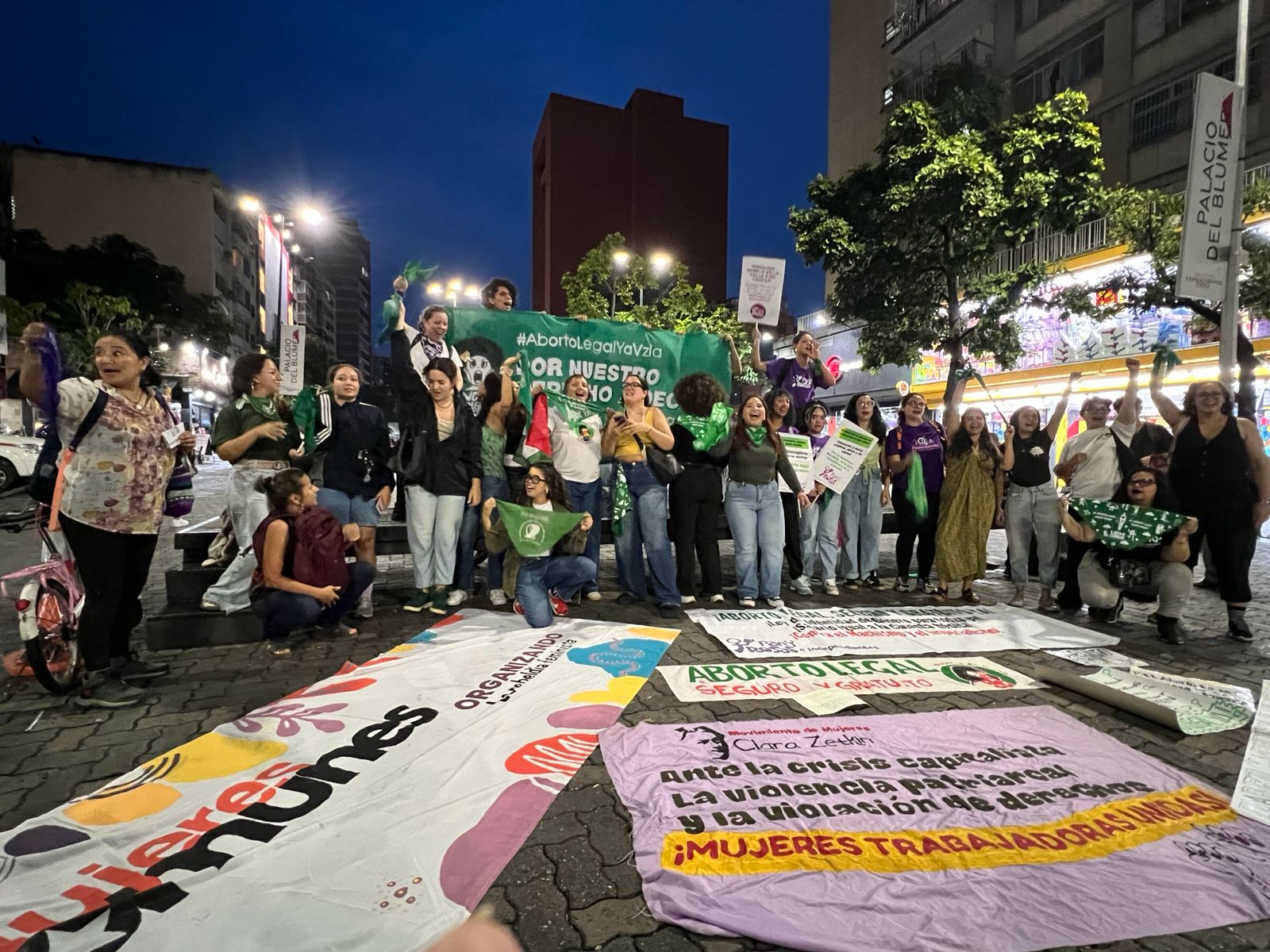
Caracas, September 30, 2026 (venezuelanalysis.com) – Venezuelan feminist organizations protested on Monday to mark International Safe Abortion Day and demand reforms to advance sexual and reproductive rights in the Caribbean nation.
Around 100 activists gathered in Plaza Venezuela, Caracas, to debate the conditions facing working-class women and urge responses from Venezuelan authorities.
“We are here to protest against the absence of inclusive public policies,” Jackeline López, spokesperson for the Clara Zetkin Women’s Movement, told press. “Abortion remains a taboo subject for Venezuelan authorities, whose response is to criminalize it.”
López went on to stress that unsafe abortions mostly plague Venezuelan working-class women.
“The current wages do not allow women access to family planning or contraceptive methods,” she continued. “The right to decide over our bodies is a key public healthcare issue, and leaving it unattended means criminalizing poor women.”
Comunes, Pan y Rosas, and Mujeres en Lucha were some of the other grassroots movements present at the protest. “We have to abort this patriarchal system” was one of the main chants in Monday’s rally. Feminist collectives also organized smaller rallies or public discussion forums in other parts of the country.
Venezuela has one of the most draconian abortion laws in Latin America, with termination of pregnancy only allowed if a doctor determines that the woman’s life is in danger. Women who perform abortions risk six-month to two-year sentences, while doctors who facilitate the procedure face up to three years in prison.
Though the country’s Penal Code was last updated in 2005, articles governing abortion were left unchanged from their original 1915 version.
In recent years, women’s rights organizations have engaged with Venezuelan institutions, including the National Assembly and the Supreme Court, proposing the opening of public debates on sexual and reproductive rights and initiatives to reform the criminal code. However, the projects have not gained traction.
María Alejandra Reyes, an activist from Faldas-R, told Venezuelanalysis that support networks and sources of information for women in need of abortions have “grown organically” in Venezuela despite a lack of institutional progress.
The activist highlighted findings from Faldas-R’s safe abortion hotline, including that more than 50 percent of women who seek information had used some kind of contraceptive method. “This underscores that we are dealing with a public healthcare issue, not just a matter of women being ‘careless’,” she said.
“Also, nearly 40 percent of the women who reach out to us already have kids,” she added. “So they are conscious of what motherhood implies and their decision is driven mostly by the present conditions in Venezuela.”
Reyes warned that the growing influence of conservative religious groups, especially evangelical churches, stands as an obstacle to women’s rights, as well as the country’s “political instability.”
“Women’s rights are never seen as a priority because there is always something urgent going on, whether it’s a [US] economic blockade, or military strikes, or something else,” she explained. “However, we are talking about basic rights for half of the population.”
In recent years, the Venezuelan government, under President Nicolás Maduro and Acting President Delcy Rodríguez, forged close ties with Venezuelan evangelical groups, granting them a public holiday and funding programs. In March, Rodríguez administration officials additionally hosted high-profile international pentecostal pastors, including Trump ally Ramiro Peña.
Edited by Lucas Koerner in Philadelphia, USA.