UN rights chief condemns worsening repression in Nicaragua, urging the restoration of freedoms and the rule of law.
Published On 22 Jul 202622 Jul 2026
The United Nations human rights chief has condemned Nicaragua’s escalating crackdown on civil and political rights, days after President Daniel Ortega announced a plan to block elections and shut out the opposition.
UN High Commissioner for Human Rights Volker Turk said on Wednesday that the “latest developments further deepen the severe restrictions on fundamental freedoms, the dismantling of civic space, and the steady erosion of the rule of law” in the Central American country.
Recommended Stories
list of 3 itemsend of list
Ortega, a former leftist fighter who has ruled Nicaragua for almost two decades alongside his wife, Vice President Rosario Murillo, said on Sunday that “there won’t be elections” in the country, a move that would remove any prospect of a challenge to the couple’s rule.
General elections were due in November, but constitutional reforms passed 18 months ago extended the presidential term from 5 to 6 years, pushing the vote back to 2027.
Turk said power in Nicaragua was increasingly being concentrated “under the co-presidency”, with the ruling Sandinista party already holding full control over parliament, all municipalities and the regional councils on the North and South Caribbean Coast.
He called on the authorities to “reopen civic space, and restore the rule of law”, warning that “independent expression of thought or opinion is systematically suppressed”, urging that “people of all political viewpoints must be allowed to vote and run for office, in line with the State’s international human rights obligations”.
The statement also cited the government’s abrupt revocation of several lawyers’ credentials earlier this month, which it said had no legal justification, and noted that at least 46 people remain arbitrarily detained on political grounds.
Turk further raised concern over the treatment of religious groups, pointing to the unclear whereabouts of Bishop Abelardo Mata Guevara, 80, who was detained on June 29, and urged Managua to release all those held arbitrarily “with humanity and dignity”.
Since a deadly crackdown on protests in 2018 – in which more than 300 people were killed, according to UN figures – Ortega and Murillo have tightened their grip on Nicaraguan society.
German Health Minister Jens Spahn (R) and his husband Daniel Funke (L) arrive for a state banquet in honor of the queen and crown prince of Denmark at Bellevue Palace in Berlin on November 10, 2021. On Saturday, Spahn, now a member of the Bundestag, resigned his post after the couple used a surrogate in the United States to have a baby. File Photo by Clemens Bilan/EPA
July 19 (UPI) — Jens Spahn, a member of Germany’s Bundestag, has resigned his post amid uproar over his use of a surrogate to have a baby.
The leader of the center-right Christian Democrats in parliament quit abruptly Saturday, The New York Times reported. The move came three days after he announced the birth of his child, Georg, with husband Daniel Funke.
“Georg is our greatest joy,” Spahn, 46, told the German newspaper Bild. “This feeling is almost impossible to put into words.”
The couple faced criticism for the decision to use surrogacy to have a baby because the practice is outlawed in Germany — a law Spahn and fellow Christian Democrats voted to keep in place in February. Spahn and Funke used a surrogate in the United States to welcome their son.
In 2015, Spahn wrote that “as a gay man and a Christian, I find it personally very hard to warm to the idea of a rented womb,” The Guardian reported.
In an appearance on a podcast, Spahn said he struggled with the decision to use surrogacy but ultimately put his family first, the Times reported.
German Chancellor Friedrich Merz, also a member of the Christian Democratic Union, called on Spahn to step down Saturday. Other regional members of the party also sought his ouster.
NEW YORK — The Dodgers’ game against the New York Yankees on Saturday in the Bronx was rained out and rescheduled as the first game in a split doubleheader Sunday.
It was the Dodgers’ first postponement of the season.
They are set to play Game 1 at 9:35 a.m. PDT Sunday, followed by Game 2 at 4:20 p.m.
Saturday’s game was originally scheduled to air on Fox at 5:08 p.m. PDT. But with persistent showers in the forecast, the decision to postpone was made official more than three hours before game time.
Dodgers right-hander Emmett Sheehan (4-6, 4.81 ERA) was scheduled to take the mound opposite Yankees lefty Ryan Weathers on Saturday. The Dodgers didn’t immediately announce how the doubleheader might affect their starting pitching plans.
The state has rescinded a $73.4-million grant for a new mental health and drug treatment facility in San Pedro, putting the future of the controversial project in jeopardy.
Neighbors had picketed outside the property at 2100 S. Western Avenue and packed a town hall in April to oppose the project, with some expressing fears about drug users coming to the area.
The nonprofit Fred Brown Recovery Services was seeking to acquire the five-acre property and turn it into a 106-bed inpatient recovery center for “veterans, the justice-involved, the unhoused, and those with co-occurring conditions.” The facility also would serve about 200 outpatients a day.
About 70 elderly residents who live in a nursing home on the property would have had to move, some opponents of the project said. Others said they supported mental health treatment in general but argued that the proposed center would be too close to nearby schools, day cares and churches.
The grant, which would have covered most of the project’s cost, was funded partially by Proposition 1, a $6.4-billion bond measure approved by California voters in 2024 to improve mental health and addiction treatment.
In a letter dated July 15, the California Department of Health Care Services said it rescinded the grant because Fred Brown Recovery Services failed to meet a cash match requirement and did not address discrepancies in an appraisal document.
The matching funds cannot come from the seller of the property, and the match documentation was signed by Brian Dror, a manager for the current property owner, 9 Gem Capital Group, said the letter, which was addressed to Fred Brown Recovery Services. The letter also noted that there is no process to appeal the decision.
Dror, a partial owner of the property, said that state bond guidelines do not prohibit an owner from providing matching funds.
In a statement Thursday, Fred Brown Recovery Services said it is “reviewing the Department’s decision and evaluating next steps. Regardless of the future of this particular project, our commitment to serving individuals and families struggling with substance use disorders remains unchanged, and we will continue looking for opportunities to expand access to treatment for those who need it most.”
Los Angeles City Councilmember McOsker, who represents the coastal neighborhood, opposed the project and rallied community members to send letters to elected officials and state decision makers, urging them to review the grant application.
In a Facebook post, McOsker said he had raised concerns to the Department of Health Care Services for months over the project’s financial structure and lack of transparency.
Previously, McOsker had applauded Fred Brown for its work on recovery group homes elsewhere in San Pedro. But he said he was doubtful that the nonprofit could scale up from 20-person homes to the larger one proposed for the South Western site.
“I am grateful to the many residents, neighborhood organizations, and community leaders who remained engaged throughout this process,” McOsker wrote in the Facebook post. “Today’s action demonstrates why thorough review, public scrutiny, and accountability matter.”
L.A. County Supervisor Janice Hahn, who lives in the neighborhood and was booed at the April town hall for saying that rehab facilities like the proposed one are sorely needed, said Thursday that halting the project “might be for the best.”
“There was so much opposition in San Pedro, I don’t think this proposal was ever going to work,” she said.
Richard Scandaliato, president of San Pedro’s South Shores Community Assn., said the reversal was “unbelievable” after months of near-weekly picketing and hundreds of letters that neighbors wrote to state officials.
The most important thing, he said, is that the senior citizens living on the property can stay there. He said he’s gotten at least a hundred phone calls from neighbors since the grant was rescinded.
“It really shows what a community can do,” he said.
Folarin Balogun insists that the red card controversy surrounding him during the World Cup was not the reason the U.S. lost 4-1 to Belgium in the round of 16.
But, the breakout American star said Tuesday on NBC’s “Today” show, “it didn’t help.”
“As an athlete, you go into a game that’s already difficult enough with everything that goes on, the pressure,” Balogun said. “So to have more pressure, not just internally [but also] from almost the whole footballing world, was difficult. But it’s not an excuse. We were disappointed with the way it ended, but there’s still a lot to be proud of.”
Balogun, a birthright U.S. citizen whose Nigerian parents live in England, scored his third goal in four World Cup games during a 2-0 win over Bosnia and Herzegovina on July 1 in Santa Clara. But he also received a straight red card for stomping on the ankle of Bosnian center back Tarik Muharemović, meaning the top-scoring American player would have to miss the next game.
It was a controversial call, with some feeling the red card was unwarranted since Balogun’s action didn’t seem intentional.
The only other time a red-card suspension was overruled during a World Cup was in 1962, when Brazilian attacker Garrincha was allowed to play in the final after Brazil’s prime minister lobbied on his behalf.
“My initial reaction was, I was happy to be back in the team,” Balogun said Tuesday on “CBS Mornings.” “But when I kind of started to reflect, I knew it was going to cause a lot of controversy.”
He was correct about that. Although Infantino insisted that the FIFA Disciplinary Committee makes its decisions independently, the reversal caused outrage among many in the soccer world. Belgium submitted an appeal, but it was rejected hours before the game.
Amid all that, the U.S. had to prepare for Belgium — first without and then with Balogun in the mix. He told CBS the situation was “confusing” for all involved.
“I could almost see within my teammates a bit of nerves, because it’s something that is so unique,” Balogun said. “But the closer we got to the game, I tried to just focus as best as I could, but it was difficult. A lot of outside noise, and that’s hard to avoid.”
He added, though, that he and his teammates were “able to separate the emotion from the job at hand,” and the distractions didn’t contribute to the disappointing loss.
“We’re all professionals, so it’s not something I think was too difficult to be separate once we kind of got over the initial announcement that I’d be back in the team,” Balogun said. “I think you saw definitely it was a difficult game against Belgium, and that can kind of overshadow whether we were focused or not. … I know we had full concentration going into the game.”
Croatia’s World Cup was seconds away from being over and Portugal was seconds away from the round of 16 when Ivan Perisic sent a long, desperate cross into the penalty area. The ball bounced off bodies like a pinball before magically, unbelievably, caroming into the net.
Gooooooallllllll!!!!
Fate had given Croatia a reprieve.
But as pandemonium broke out in the stands and on the pitch, Norwegian referee Espen Eskas stood in the middle of the celebration in Toronto, hand to his ear, listening to a voice half a continent away in Dallas.
So Eskas trotted over to a TV monitor, watched a video replay over and over again, and more than 2½ minutes after the goal was recorded, he took it off the board. Perisic’s cross had brushed the hair of teammate Igor Matanovic, leaving Mario Pasalic in an offside position when the ball reached him near the far post. The contact was imperceptible to the naked eye, but a space-age sensor in the ball had confirmed it.
A VAR review led a referee to overturn a Croatia goal during its 2-1 World Cup loss to Portugal in Toronto, eliminating Croatia from the tournament.
(Dan Mullan / Getty Images)
Croatia’s World Cup was over, another victim of VAR, which has had an outsized influence on this summer’s tournament.
It wasn’t supposed to be this way. When VAR was introduced to soccer nine years ago, its mission was clear: to alert the head referee to potential clear and obvious errors or serious missed incidents. At least that’s what Major League Soccer, one of the first leagues to use the system, wrote in the news release introducing it.
“It was really to stop the headlines,” said Mark Geiger, who helped implement VAR as an MLS referee. “These super-egregious errors in a game that impact the outcome. The mantra for VAR was always minimum interference but maximum benefit.”
Under the VAR system, officials sitting before a bank of monitors in a centralized control room review match footage in real time and advise the on-field referee of potential errors. If the video assistant referees believe a mistake has been made, they communicate that through an earpiece the match referee is wearing. If the match official agrees, they will stop play, signal a review by motioning their hands in the shape of a rectangular TV screen, then watch the play themselves on a pitch-side monitor before either confirming or reversing the original decision.
It is comparable to the Automated Ball-Strike review added this year in Major League Baseball, tennis’ Hawk-Eye line-calling system and long-standing centralized instant replay review in the National Football League and National Basketball Assn., systems that have both corrected errors and stoked debate.
But VAR has morphed into something far greater. In this World Cup, there have been more than 100 VAR interventions, encompassing both confirmed on-field calls and overturned decisions, through the end of the round of 16, according to Antonio Vuksanovic, a publication relations and communications professional at Sofascore, a Croatian technology company and sports statistics website.
“When it comes to actual overturned decisions, we’re looking at roughly 0.5 per match, which is higher than the last World Cup and higher than what we saw across the most recently completed club season,” Vuksanovic said.
Even though the officials have gotten most of those calls right, many of the infractions reviewed have been so imperceptible yet so consequential, it has raised a question: if human error on the part of players and coaches is part of the sport, is allowing a game to be decided by electronic evidence of a touch detectable only through NASA-level technology violating the spirit of the game?
Iran’s Shoja Khalilzadeh shoots past Egypt’s Mostafa Shobeir, but the goal was overturned after VAR review during a World Cup match in Seattle on June 26.
(Maddy Grassy / Associated Press)
Christina Unkel, a former FIFA referee, state referee administrator in Florida and a rules of the game analyst for multiple TV networks, believes it does.
“Football is an art. And that’s why we love it,” she said. “It truly isn’t the referee’s fault. We’re not the ones seeking more advanced technology. We don’t want to look like robots out there. But the stakeholders are like ‘more, more, more.’
“When you do pursue black and white — objectivity is what they’re trying to get to, and I get it; they want to eliminate as much subjectivity as possible — what everyone is hating is this perfection thing.”
FIFA, the major stakeholder in the World Cup, declined multiple requests to answer questions about the officiating, but it has clearly doubled down on the technology for this tournament, introducing the semi-automated offside system which uses player-tracking cameras, computer-generated offside lines and, in some cases, data from a measuring instrument inside the match ball, to identify everyone’s position on the pitch when the ball is played.
“The whole genesis of VAR was not to fix every mistake or to make the referees perfect,” said Geiger, the first American to officiate a World Cup knockout game and now general manager of the Professional Referees Organization (PRO), which oversees referees for MLS and the NWSL. “Is the referee correct? That’s not the right question. They should be asking themselves, ‘is the referee clearly and obviously wrong?’”
Geiger, however, remains a huge proponent of the system and was careful not to criticize how it’s been used in this World Cup.
Belgium’s Youri Tielemans on a penalty kick that sails by Senegal goalkeeper Mory Diaw during a World Cup round of 32 match in Seattle on July 1. The game-deciding penalty kick was awarded after VAR review.
(Manu Fernandez / Associated Press)
Still, the frequent use of VAR and other technologies has clearly robbed the World Cup of much as its drama, with spontaneous celebrations of game-winning goals turning to grief moments later when the referee steps away from the monitor and takes away a score.
Reviews not only ended Croatia’s tournament, but they showed Shoja Khalilzadeh was a toe offside when he scored the goal that would have sent Iran to the knockout stages, one of three goals Iran had disallowed by VAR in the tournament; it gave Belgium a late penalty, based on light contact, that Youri Tielemans converted to end Senegal’s World Cup; and it cost Egypt a goal for a perceived foul that took place nearly 100 yards away from the ball in its 3-2 loss to Argentina.
“What happened to us wasn’t fair,” Egypt coach Hossam Hassan said.
Unkel agreed with that sentiment too.
“Everyone hates it,” she said. “According to VAR, that’s correct to take that goal away. That’s not the spirit of the game. But it’s the correct decision by law.”
What Unkel would prefer — and she believes a majority of officials are on her side — is for referees to have discretion to ignore or even overrule VAR if common sense and their understanding of the game suggest they should, just as judges have discretion to use common sense in applying the law.
“A lot of our game, the majority of it, is very subjective,” she said. “When we’re all sitting there saying, ‘No, that doesn’t gain an unfair advantage,’ then that’s when we have to start reconsidering things back to the spirit of the law. That’s the catchall loophole for saying, ‘Do we want this to be part of our game?’
“And I think everyone’s universally saying there a lot of different kinds of decisions we do not want part of our game. Toenail offsides, hair follicle arguments.”
Without the use of video replays, its unlikely any of those calls would have been made and the World Cup quarterfinals would probably look quite different.
England players react as referee Alireza Faghani shows a red card to England’s Jarell Quansah during a World Cup match against Mexico on July 5.
(Natacha Pisarenko / Ap Photo/natacha Pisarenko)
England coach Thomas Tuchel, upset about a penalty call on captain Harry Kane and a red card given to defender Jarell Quansah, both following video reviews in his team’s round-of-16 win over Mexico, said rulings were being overturned in the tournament “in a very questionable way.”
“The referees can send any team out in any moment,” he added. “It’s just not good enough. It’s just erratic. It’s just unreliable.”
An apparent misuse of the technology also led to the most controversial incident in the tournament. In the second half of an elimination game between the U.S. and Bosnia-Herzegovina, American Folarin Balogun stomped on the ankle of Bosnia’s Tarik Muharemovic, something Brazilian referee Raphael Claus initially decided did not merit even a caution. But after VAR official Juan Soto of Venezuela urged him to watch a replay, Claus flashed a red card at Balogun, expelling him from the game and banning him from the next match in the round of 16.
Claus had watched the replay in slow motion, allowing him to see what wasn’t apparent at game speed. FIFA later intervened by lifting Balogun’s one-game suspension, igniting ever greater controversy because it was just the second time that has happened in a World Cup.
U.S. forward Folarin Balogun steps on Bosnia-Herzegovina defender Tarik Muharemovic’s foot and received a red card after VAR review during the World Cup.
(Robert Gauthier/Los Angeles Times)
The heavy use of VAR has also interrupted the flow of games by halting matches that weren’t meant to be halted, leaving everyone standing on the field while the referee goes off to watch TV, sometimes for minutes at a time.
“When calls are reviewed and when goals are reviewed, sometimes it could take away from the momentum,” U.S. defender Chris Richards said. “Look under anything with a microscope, you could probably find something. But ultimately it was meant to be helpful for the game.”
And it has been. Because if officials have become over-reliant on VAR to review decisions that were not, or could not, be seen in real time, at least they’re getting those decisions right.
“I wish we had it in the 2002 World Cup,” said Bruce Arena, who coached the U.S. in that tournament. “We might have made it to the semifinals.”
In the quarterfinals of that tournament, with Germany leading 1-0 in the 40th minute, an obvious handball by Germany’s Torsten Frings kept out a shot from American Gregg Berhalter. If VAR had been available, Scottish referee Hugh Dallas could have corrected the missed call, awarding a penalty and giving Frings a red card, expelling him for the final 40 minutes.
“Look at every sport now in the world,” said Arena, coach of the San José Earthquakes. “They have some version of VAR. Why not make decisions correct?”
“There are still plenty of opportunities for the referees to control the game and make mistakes and not make mistakes,” he continued in reference to the human element. “It’s not like every moment is evaluated. But key moments are.”
As for interrupting the flow of play, Arena says the three-minute hydration breaks FIFA has introduced each half — ostensibly for player welfare, but in practice to give the TV networks additional commercial breaks — have been more disruptive.
“You don’t want VAR to officiate the game completely,” Arena said. “You have to pick your spots. For the most part, I think VAR is good.”
The Trump administration finalized a rollback of the Endangered Species Act on Friday, paving the way for drilling, mining and other human development across protected wildlife habitats.
The move redefines “harm” under the Endangered Species Act, the landmark conservation law that protects threatened and endangered plants and animals. For years, “harm” meant actions that injure or kill wildlife, as well as actions that destroy protected habitats.
Under the new rule, destroying those habitats is no longer illegal.
The decision aligns with the Trump administration’s ongoing effort to slash regulations in the name of economic growth. Interior Secretary Doug Burgum, whose department finalized the move, said the prior definition of harm “interfered with private property rights” and “turned routine activity into a regulatory trap.”
Environmental groups called the decision a disaster, saying it puts protected species on a path to extinction.
The move seems especially poised to hit California, the most biodiverse state in the country, where more than 6,700 species are spread across mountains, forests, deserts and oceans. Of the roughly 2,300 species protected by the Endangered Species Act, nearly 300 are found in California.
These species include amphibians such as tiger salamanders and Yosemite toads; birds such as California condors and northern spotted owls; fish such as Little Kern golden trout and Santa Ana suckers; insects such as Franklin’s bumble bees and Mission blue butterflies; mammals such as gray wolves and Santa Catalina Island foxes; and reptiles such as desert tortoises and green sea turtles.
The Endangered Species Act is widely credited with saving the California condor, which almost went extinct in the 1980s due to several factors, including habitat destruction. Thanks to a recovery program under the act, the condor population has since soared to several hundred. But under the new law, the logging and human development that led to their near demise is now allowed.
A handful of California species recoveries have been championed as success stories under the Endangered Species Act, including southern sea otters, peregrine falcons, humpback whales, bald eagles and green sea turtles.
According to a report from the Center for Biological Diversity, the El Segundo blue butterfly lost 90% of its oceanside habitat due to the construction of LAX and beachfront housing developments. The population dwindled to about 1,000 butterflies in the 1970s, when it was named an endangered species. Now, the population has climbed above 120,000.
In California, the rollback could pave the way for more farming, mining, logging and drilling in areas that were once forbidden due to the potential for wildlife habitat destruction. A report from Earthjustice estimates that expanded oil drilling in California could threaten five marine species including humpback whales, sea otters, leatherback sea turtles, marbled murrelets and wild salmon.
Several environmental groups are planning legal challenges to the ruling.
“For the first time ever, a presidential administration now claims that species protected by the Endangered Species Act shouldn’t be safe from habitat modification that destroys where they live, raise their young, or search for food,” Kristen Boyles, attorney for the environmental nonprofit Earthjustice, said in a statement. “Let’s be clear: there is no support for the Trump administration’s rule — no scientific support, no legal support, no public support. We will see the Trump administration in court.”
Ben Greuel, wildlife campaign manager at the Sierra Club, called the decision “an unlawful attempt to open the door for corporate polluters to degrade vitally important habitats.”
“For more than four decades, the definition of ‘harm’ recognized a simple truth: if you destroy the places wildlife need to survive, you are putting species on a path to extinction,” Greuel said in a statement.
It’s not the first time Trump has taken aim at California environmental regulation.
Earlier this year, Gov. Gavin Newsom, along with the governors of Washington and Oregon, submitted a formal opposition to the Trump administration’s plans to expand drilling off the Pacific Coast, with Newsom saying it leads to “dead wildlife.” In June, the Trump administration ordered a review of the California Coastal Commission, claiming the state’s “environmental extremism” obstructs spaceport development and offshore oil production.
A day before the Endangered Species Act decision, the Trump administration signed off on a controversial plan to use an old oil pipeline to pump water from the Mojave Desert into cities. Environmental groups said the plan threatens springs and local wildlife, since six pumps would need to be built in desert tortoise habitats.
WASHINGTON — President Trump did not like what he saw. So, once again, he picked up the phone.
Trump said Monday that he called FIFA President Gianni Infantino after he disagreed with the World Cup referee who gave a red card to U.S. men’s soccer team star Folarin Balogun. The discipline, which Trump called “very unfair” and a “stain” on the World Cup, would have barred Balogun from playing in Monday’s elimination game against Belgium.
“I asked for a review because I didn’t think it was a foul,” Trump told reporters during an event in the Oval Office. “I am good at this stuff. I didn’t think it was a foul. I thought it was two great athletes that crashed into each other and got entangled.”
Trump said he initially didn’t know “what the hell a red card was” or what it meant. “When I found out, I said, ‘You gotta be kidding!’” he said.
Trump’s involvement in soccer’s disciplinary process created an international uproar.
UEFA, European soccer’s governing body, said FIFA “crossed a red line” with the reversal. Belgium’s football association appealed the ruling, which FIFA denied during a hearing Monday. Belgian coach Rudi Garcia mocked the decision as an April Fools’ joke.
“This decision clearly raises many questions,” Belgian Foreign Minister Maxime Prévot said in a statement Monday, according to the New York Times.
“If a phone call really is what explains this incomprehensible decision, it would amount to undermining the most basic rules of soccer and sports,” added Prévot, a former soccer referee.
Trump’s close relationship with Infantino also has drawn new scrutiny.
In December, Infantino presented Trump with the inaugural FIFA Peace Prize, an award the governing body created after Trump was passed over for the Nobel Peace Prize. That decision is now the subject of an ethics complaint, backed by members of the European Parliament, who argue it compromised FIFA’s political neutrality.
Trump said he did not ask Infantino to reverse the call. But that was the outcome reached by FIFA’s disciplinary committee, which, in 64 years, has reversed a red-card penalty only once during a World Cup tournament.
The episode serves as a reminder of a pattern of behavior the president has exhibited when he doesn’t get his way, regardless of the rules of the game. For Trump, a deal-maker who has described the world as “a casino,” often pushes the boundaries of long-standing norms.
After FIFA reversed course, Trump called the decision “brilliant” and said Belgium can now “be really proud” if they were to beat the U.S. team on Monday night.
“The other way, if they beat us, we’ll say, or I’ll say it was rigged, just like the election was rigged in 2020, but I won’t get into that,” Trump said.
Steven Levitsky, a Harvard political scientist and co-author of “How Democracies Die,” said Trump’s action are “perfectly consistent with how Trump has behaved on the world stage.”
“He has no interest in or no respect for any kind of international rules or norms,” he said.
Levitsky said the events illustrate the Trump administration’s worldview, one that, he argues, revolves around the ethos that “if we’re strong enough, we can leverage our way to whatever the hell we want.”
As examples, he pointed to the administration’s military strikes on boats in the Caribbean and efforts to acquire Greenland, both of which have led to diplomatic tensions.
Trump also has a history of using phone calls to pressure officials to reach an outcome he wants.
In a 2019 call, he asked Ukrainian President Volodymyr Zelensky to investigate his political rival, a moment that became the catalyst of his first impeachment. And after losing the 2020 election, he pressed Georgia Secretary of State Brad Raffensperger to “find 11,780 votes,” the margin he needed to flip the state, a move that ultimately led to a criminal indictment.
FIFA President Gianni Infantino presents President Trump with the FIFA Peace Prize in December.
(Evan Vucci / Associated Press)
Trump defended his call with Infantino to reporters and appeared to downplay how much it may have contributed to the red card penalty being reversed.
“I can’t tell [Infantino] what to do, and I don’t believe he made the decision,” Trump said. “I think it was a committee that made the decision, and they made the right decision, because No. 1, it wasn’t a foul, and you want to see a game with your best players.”
Sen. Ted Cruz (R-Texas), who was in the Oval Office when Trump acknowledged the call with Infantino, made reference to the Peace Prize as he thanked Trump for “getting rid of the ridiculous red card” ahead of the knockout game.
“There was a reason the FIFA trophy sat here for as long as it did,” Cruz told Trump.
Infantino, for his part, issued a statement Monday insisting that the decision came from FIFA’s independent disciplinary committee and that he told Trump the case would be decided by the body. Bill White, the U.S. ambassador to Belgium, also defended Trump, saying he “would never interfere with the inner workings of FIFA.”
Norman Eisen, co-founder of Democracy Defenders Action, said Trump’s decision to get involved in soccer’s disciplinary process is a “classic example of achieving a right outcome through wrong means.” He added that he believes the Trump administration and FIFA showed to be “two of the most corrupt entities around.”
“Like many Americans who are following the World Cup and rooting our team on, I thought it was a bad call,” Eisen said. “But I would never have chosen to bring that about in this fashion.”
Levitsky argued that given the popularity of the World Cup, which hundreds of millions of people around the world are tuning into to watch, Trump is opening himself up for more scrutiny on the global scale.
“People across the world who don’t give a damn about politics are following the World Cup, and they’re seeing the United States behave this way, taking what it can take at the expense of others unfairly,” he said. “Of course it is going to hurt the U.S. image abroad.”
The California Supreme Court is poised to rule in a lawsuit that has pitted the state’s court reporters — the workers who create transcripts of court proceedings — against victims of domestic violence and other vulnerable litigants.
The case will determine whether to end a long-standing prohibition on the electronic recording of most civil court proceedings, enabling the use of modern technology to create a “verbatim record,” which is crucial to appeals and other legal challenges.
Advocates say a decision in favor of electronic recording could end a years-long judicial crisis virtually overnight, producing legal records and preserving the right to appeal in tens of thousands of cases in civil, family and probate hearings where court reporters are rarely provided. Participants in the civil proceedings can hire private stenographers to maintain a record of what’s said, but their services can run thousands of dollars a day.
“In many, many courtrooms throughout the state today, there is nobody there, and there’s not going to be anybody there,” attorney Sonya Winner told the high court during oral arguments in Los Angeles last month. “The court reporters the court has on staff are off doing felony trials,” making electronic recording the only alternative for most civil litigants.
Everyone agrees the lack of court reporters is a crisis. Lawyers on both sides have urged the high court to establish a clear right to a verbatim record in civil hearings.
The divergence is over whether the worker shortage is improving slowly or still getting worse, and what the Supreme Court should do about it.
California’s largest public sector union and the court reporters it represents warn the decision could allow the state’s court systems to stop hiring stenographers.
Court reporters say their duty to maintain an accurate record is a profound public trust that can only be performed by a human being, who can intervene to ensure everyone is heard and who bears responsibility if a transcript is missing or incomplete.
Despite California’s sluggish job market, hiring for court reporters remains brisk, bolstered by tens of millions in funding from Sacramento, a recent change in state law and aggressive recruitment by some of the country’s largest court systems, including Los Angeles, Orange and San Diego counties.
Lila Scott, a TV writer, is among those seeking to join the profession. Like a lot of Hollywood talent, she had been struggling to find steady work in recent years.
The “Unicorn Academy” writer was trolling government job sites when she stumbled across a listing for court reporters in Los Angeles — and then another, and another.
“I thought, ‘What the heck is this?’” Scott recalled as she set up for a class at Downey Adult School.
Scott is now in training to become a “voice writer,” a form of note-taking that relies on a device called a stenomask — something like a cross between a podcast mic and a nebulizer — to produce a transcript. Voice writers repeat every word spoken in court along with a sequence of formatting commands to voice recognition software.
“You use your mom voice when you’re dictating,” said another Downey student, 40-year-old Wanda Port. “That stern mom voice, that’s the one you use.”
Traditionally, court reporters have used 22-key steno machines to rapidly take down every word said by lawyers, judges and anyone else who speaks on the record during an official proceeding. The licensing process for these stenographers is significantly longer and more difficult than what voice writers undergo.
A change in state law in 2024 allowed voice writers to become licensed as “certified shorthand reporters,” opening a new pipeline for court staff.
About half of the court reporters hired in California since 2024 have been voice writers, data show.
“Of the 300-plus students we have, it’s about 50/50,” said Jennifer Shenbaum, who directs the Downey program.
The current hiring blitz follows more than a decade of decline, after California’s court systems shed about a third of their reporters amid a protracted budget crisis in 2012. Labor leaders say new licenses have jumped ninefold in recent years, and court reporting classrooms across the state are full.
Diana Van Dyke, a Los Angeles County Superior Court reporter and a shop steward in Service Employees International Union Local 721, credits much of that growth to the expansion of paid internships, signing bonuses and other aggressive recruitment tactics funded by the Legislature and promoted by the union.
Students training to become court reporters practice on stenotypes and stenomasks during a speed-building class at Downey Adult School.
(Kayla Bartkowski / Los Angeles Times)
At Orange County’s Cypress College, which offers court reporter training, job fliers boasting six-figure salaries paper the walls. A pamphlet from the Central District of California that touted “front-page Federal cases” hung in the window of a court reporting classroom, where students practiced typing 200 words per minute.
“By the end of the third test I can’t feel my fingers — but it’s worth it!” said Asia Mendez, a trainee-stenographer.
While advocates for court reporters say humans can still do the job better than machines, the fact that many hearings occur without any official transcript at all has drawn concern from top state officials.
Atty. Gen. Rob Bonta has called the situation “untenable.”
“This is the rare case in which the current application of a statute violates procedural due process,” Bonta’s office said in a brief urging the state’s high court to allow recordings.
Such a ruling would be especially important for survivors of domestic violence, who often find the family court system weaponized against them, said Jennafer Dorfman Wagner, director of programs at the Family Violence Appellate Project, which brought the suit that is now before the California Supreme Court.
“People who want to exert power and control over an ex-partner will find whatever foothold they can and use it,” Wagner said.
Without a record of their proceedings, litigants can’t prove what happened in the courtroom, or appeal if a judge denies a restraining order or approves a custody arrangement that leaves them vulnerable to further violence.
California’s court systems have also thrown their weight behind the plaintiffs in the case.
“California has long led in areas of access to justice and technology, but in this area, it lags far behind the rest of the country, and behind the federal courts that are in this state,” said Mark Yohalem, an attorney representing the state’s superior courts.
The justices, too, seemed eager to embrace electronic recording in cases where no court reporter is available and litigants cannot afford to pay for one on their own, repeatedly pressing lawyers on exactly how such a ruling might be written.
Although the decision would not affect criminal proceedings, the high court judges have expressed concern that court systems may use their ruling to roll back the broader recruitment push as a cost-cutting measure — a worry labor leaders share.
“Electronic recording is cheaper,” said Justice Joshua P. Groban. “It allows any court to just say, for example, that no more court reporters are needed.”
When advocates for the Family Violence Appellate Project told Groban and the other justices hearing the case that such a move by the courts would amount to “bad faith” and should not weigh on their decision, the judge appeared skeptical.
“Either bad faith or fiscal responsibility, depending on the budget that year,” Groban said.
Under Fifa’s disciplinary code, Ronaldo should have received a three-match ban for elbowing Dara O’Shea during Portugal’s 2-0 qualifying defeat by the Republic of Ireland in November.
He served one match in the final qualifier against Armenia – but the remaining two games of the ban were suspended.
Ronaldo’s red card, though, was received in qualifying. It was not a red card at a World Cup.
There have been many cases of players being shown some leniency before a tournament, not just Ronaldo.
See France’s Laurent Koscielny in 2014, or Ecuador’s Moises Caicedo and Argentina’s Nicolas Otamendi before this World Cup.
At least with Ronaldo, we were given some justification, with Fifa saying it had taking into account that “he had no red cards in his other 225 international appearances”.
With Balogun, we did not even get that.
It has left a vacuum of information which can only lead to speculation.
Why was this a special case? What factors were taken into account? Who made the decision?
BBC Sport has been told there are no suggestions that the referee asked for the suspension to be removed, or that video assistant referee protocol was not respected.
In England, the Football Association would publish the full written reasons.
The United States have the right to ask Fifa to publish them, Belgium do not.
BBC Sport pundit Micah Richards, a former England defender, said it was a farce.
“To have it suspended for a year makes a mockery of the whole tournament,” he said.
“It is to keep the big stars in the competition. How can that happen? Fifa needs to do better.
“It has left a bad taste in a lot of people’s mouths.”
Belgium are, of course, furious. They issued a statement on Sunday saying they were “astonished” that Balogun had been cleared to play.
The Belgian FA referenced several regulations, workshop presentations and pre-tournament co-ordination meetings.
They are adamant that the decision contradicts the tournament regulations which state that a player “will automatically be suspended from their team’s subsequent match”.
In effect, they say Fifa used its disciplinary code to override the competition regulations.
Belgium head coach Rudi Garcia, speaking at a news conference, went further. He said: “I didn’t know that [at] the Fifa World Cup 5 July is now 1 April, and that is April Fool’s.
“We are not defending the national team or the federation, we’re defending football.”
What must the other players sent off at this tournament be thinking?
Take Qatar’s Assim Madibo, involved in an unfortunate incident which led to a broken leg for Canada’s midfielder Ismael Kone.
There is a clear case here that Madibo did not even make a challenge, that the injury happened by chance and not because of the nature of the tackle.
Yet Fifa handed Madibo a five-game ban – an extra three on top of the standard punishment for serious foul play.
A Jangbogo-III Batch-II submarine built by Hanwha Ocean. Photo courtesy of Hanwha Ocean
July 5 (Asia Today) — Canada is nearing a decision on a major submarine program that could open the North American defense market to South Korea’s Hanwha Ocean or strengthen Germany’s naval defense ties with Ottawa.
The Canadian Patrol Submarine Project is intended to replace Canada’s aging fleet of four Victoria-class submarines with as many as 12 new conventionally powered submarines. Industry estimates put the program at as much as 60 trillion won, or about $39.3 billion, when shipbuilding and long-term maintenance are included.
Canada is expected to select a preferred bidder soon, with the timing drawing attention because Prime Minister Mark Carney is scheduled to attend the NATO summit in Ankara, Turkey, from Monday to Wednesday.
A decision near the summit could carry a political message about Canada’s defense cooperation with allies. Germany has been pressing its case through government-level support for TKMS, while Hanwha Ocean is emphasizing delivery speed, pricing and proven South Korean submarine technology.
German Vice Chancellor and Finance Minister Lars Klingbeil recently visited a TKMS site and said Berlin was making a broad push to support defense cooperation with Canada. He said Germany’s high production standards and submarine-building capacity put TKMS in a strong position.
TKMS CEO Oliver Burkhard has also expressed confidence that the company can win the contract. The German company is stressing its more than 100 years of submarine experience and interoperability with NATO navies.
Hanwha Ocean is offering a model based on the KSS-III Batch-II submarine, a 3,000-ton-class hybrid diesel-electric submarine developed for the South Korean Navy. The submarine uses fuel-cell air-independent propulsion and lithium-ion batteries, allowing it to remain submerged for more than three weeks, according to the company.
The submarine has a range of more than 7,000 nautical miles, or about 8,055 miles.
Hanwha Ocean has proposed delivering the first submarine in 2032 if a contract is signed in 2026. The company has said it could deliver four submarines by 2035 and then supply one additional submarine each year.
Delivery timing is considered a key factor because Canada’s Victoria-class submarines are expected to retire in the mid-2030s.
Hanwha Ocean is also seeking to strengthen its bid through long-term maintenance, repair and overhaul plans, as well as industrial partnerships in Canada. The company has promoted cooperation in shipbuilding, steel, artificial intelligence, space and defense technology.
If Hanwha Ocean is selected as the preferred bidder, it would mark a major breakthrough for South Korea’s shipbuilding and defense industries in North America. It would also expand South Korea’s submarine exports beyond Asia and Europe.
But TKMS remains a strong competitor because Canada may value closer defense industrial cooperation with Germany and other NATO partners at a time of heightened security concerns in the Arctic and North Atlantic.
New Jersey is launching a new fee on companies whose workers have Medicaid health coverage instead of being covered by their employers. Other states are considering it, too.
Democratic lawmakers and governors see it as a way to help pay for the joint federal and state insurance program that covers low-income residents as federal policy changes are expected to make the program more expensive for states and may lead to a reduction in the number of people with coverage.
Proponents also say it’s about fairness because employers benefit from having some lower-income workers with taxpayer-funded health coverage.
Business groups object. So do some liberal policy organizations.
New Jersey is putting the fee in place
New Jersey Gov. Mikie Sherrill signed a measure Tuesday night to charge employers that have at least 50 workers covered by Medicaid, and the state budget she approved earlier in the week counts on raising $145 million this year from the program.
Under the plan, companies will be billed for each employee and employees’ dependent receiving Medicaid, the joint state-federal insurance program.
The fees per person would start at $325 a year for companies with 50 to 249 Medicaid beneficiaries and top out at $725 annually for employers with at least 500 recipients.
A bill passed this week in California doesn’t impose a charge now, but it does direct the state administration to present lawmakers options for doing so next year.
Finishing the job would fall to the successor of Gov. Gavin Newsom, a Democrat who is leaving office in January. Democratic gubernatorial candidate Xavier Becerra has made an employer charge part of his election platform.
State Sen. John Laird, a Democrat who sponsored the California proposal, said the big tax and policy law President Trump signed a year ago was a major factor in the need for action because it could prompt the state to spend more on Medicaid to plug holes left by federal changes.
The nonpartisan Congressional Budget Office expects more than 10 million people will be uninsured because of the law by 2034. It requires some beneficiaries to work, be in school or volunteer — and requires even more to document whether they meet the requirements.
Most employees at the bigger companies would not be at risk of losing Medicaid coverage as long as they’re working at least 20 hours a week.
Laird also said there’s an equity issue involved.
“If you’re a small business person in California, you are quite likely paying for health insurance for your employees. And through your taxes, you’re paying for health insurance for some of the biggest employers in California,” he said. “And that’s not fair.”
Legislation with similar intents passed one legislative chamber in both Colorado and Oregon this year, but neither made it to law. A measure was also introduced in Washington.
Connecticut Gov. Ned Lamont, a Democrat who is seeking a third term in November’s election, has called for the same move there with the idea of making it a part of the state budget that would kick in two years from now.
Opposition comes from business and some liberal groups
It’s no surprise that business organizations have criticized the approach, which would add to their expenses.
“The fact remains that many job-creators are still going to be penalized for something they have no control over,” Christopher Emigholz, the chief government affairs officer at the New Jersey Business and Industry Assn., said in a statement. “If an employee declines an employer-provided health plan because they’d rather be on Medicaid, it is unfair to penalize the employer for that employee’s decision.”
Some left-leaning policy organizations also oppose the charges.
Gideon Lukens, who analyzes health policy at the left-leaning Center on Budget and Policy Priorities, said that while the idea may be well-intentioned, it could lead companies to employ fewer people from low-income household or single parents. He said companies could also consider the policy in decisions about whom to hire or lay off — and also on where to locate or how many workers to employ.
And, he said, it could make employees — or potential employees — less likely to enroll in Medicaid knowing it would make them less attractive to employers.
“Usually, when I see a tax on something it’s going to discourage whatever being taxed,” he said in an interview.
New Jersey’s legislation tries to address some of the concerns. It would exempt temporary, seasonal and part-time employees. It would also bar employment decisions based on a workers’ Medicaid status.
Charging companies whose workers are covered by Medicaid isn’t a new idea. At least two states have previously enacted it, and it’s been proposed in Congress.
Massachusetts lawmakers in 2017 adopted a charge on employers up to $750 per nondisabled worker who was covered through Medicaid or a state-subsidized health exchange plan. The program began in 2018 was not renewed when it expired the next year.
An even earlier policy in Maryland, in 2006, immediately affected only Walmart. An industry group challenged it in court and won, stopping the fees.
The latest generation of proposals may avoid that legal pitfall by not referencing those health plans in the legislation.
Police have criticised the timing of the government’s decision to let pubs stay open until 05:00 BST on Monday for England’s World Cup match against Mexico.
The National Police Chiefs’ Council said the “late announcement” meant officers would have to be taken away from other duties and work longer hours, even though the team’s likely route through the tournament “has been known for a considerable time”.
It asked fans to be “considerate” and “drink within sensible limits” while watching the crucial last-16 match in which the losing team will be eliminated.
The government has said a previous relaxing of licensing laws for the tournament had not covered the eventuality of England playing so late.
A Downing Street spokeswoman said that after England’s progression was confirmed on Wednesday evening, the government “announced plans as quickly as possible following this”.
The spokeswoman added: “And more broadly, we have engaged with policing partners throughout preparations for the World Cup and we are grateful for their flexibility and professionalism throughout.”
Kick-off for the knock-out game is not until 01:00 in the UK and the match is not expected to end until at least 03:00. It could finish even later if it goes to penalties.
Knock-out games in previous tournaments have led to an increase in violent incidents and domestic abuse, the policing body said.
“This is directly linked to alcohol consumption,” the NPCC’s football and alcohol policing leads said in a joint statement.
“We will continue to work with partners and venues to support a safe and enjoyable evening for everyone.”
Licensing hours had already been extended for the international football tournament and the government had initially said it would not relax the laws further.
But late on Thursday, Prime Minister Sir Keir Starmer said pubs could remain open until the end of the game.
Local Government Secretary Steve Reed told broadcasters the previous measures “hadn’t covered the eventuality of England playing so late in the night”, adding it was “one of the fastest changes in the law that we’ve seen”.
England was not guaranteed to play in Monday’s match, only earning a place in the round of 16 after beating DR Congo 2-1 on Wednesday.
The hospitality sector welcomed the government’s decision. Emma McClarkin, chief executive of the British Beer and Pub Association, said: “We all know the best place to watch the match is down the local.”
Michael Kill, chief executive of the Night Time Industries Association, said it was “fantastic news” that would be “hugely welcomed by operators”.
Pub chain Greene King has said more than 600 pubs across England will be staying open late to show the match, while Marston’s has said more than 400 of its pubs will also be open.
Priyesh Bathia, who runs the Elephant and Barrel pub in Stockwell, south London, and said he is “so thankful” for the late licensing on Monday.
“I’m really excited,” he added, and said so far they have had between 100-150 people book tables for the game.
WASHINGTON — Chief Justice John G. Roberts Jr. led a fractured Supreme Court this year that both expanded a president’s power to run the government and dealt major defeats to President Trump.
In Trump’s second year back in the White House, Roberts and the court punctured his claim to have power with no limits.
They also threw out his executive order that would end the principle of birthright citizenship. The Constitution wrote this promise into law, Roberts said, and the president may not change it.
The court also ruled in December that the president did not have the power to put National Guard troops on the streets of Chicago.
The three decisions came over fierce dissents from conservative Justices Clarence Thomas and Samuel A. Alito Jr. and with Neil M. Gorsuch in two of them.
The three liberal justices dissented angrily when the court ruled the administration may end Temporary Protected Status for Haitians and Syrians.
They did the same when the court ruled the president may replace the top appointees of semi-independent agencies.
Trump has won on most immigration fronts because Roberts and the conservatives believe Congress put the enforcement power in the hands of the administration. They point to the law authorizing temporary protection which says there shall be “no judicial review” of the decision to end the protection.
Roberts is a solid conservative who also tries to keep the court on a middle course. It’s an approach that rarely wins plaudits from the right and almost never from the left.
This year the chief justice prevailed with different coalitions.
This week, the court ruled by a 5-4 vote against the Republican National Committee and upheld state laws that allow for counting late-arriving mail ballots. Justice Amy Coney Barrett joined with Roberts and Justices Sonia Sotomayor, Elena Kagan and Ketanji Brown Jackson.
Barrett also joined the chief justice in the rulings on tariffs and birthright citizenship.
Chief Justice John G. Roberts Jr. speaks to the Georgetown Law School graduating class in 2025.
(Manuel Balce Ceneta / Associated Press)
This week, the court also limited the power of police to use cellphone data to look for crime suspects. This too came on a 5-4 vote when Justice Brett M. Kavanaugh joined Roberts and the three liberals.
Harvard law professor Richard Lazarus, who has been a friend of Roberts’ since their time in law school, said the chief justice “is clearly working very hard” to put together majorities.
“It is not easy to formally preside over a court in which five of its members (Justices Thomas, Alito and Gorsuch on the right and Justices Sotomayor and Jackson on the left) deride the kind of efforts at moderation that is the chief’s preferred signature and harshly condemn him when he strays from their own views.”
Washington attorney Roman Martinez, a former clerk for Roberts, said the court is “clearly right of center” but the decision on tariffs was the most important of the year.
“It is a huge deal for the court to say ‘no’ to the president on his major policy initiative,” he said.
Stanford law professor Michael McConnell agreed. “It’s hard to claim the court is in Trump’s pocket when he lost the major cases,” he said.
Trump responded to the tariff defeat by calling the justices in the majority a “disgrace to our nation” and “disloyal to the Constitution.”
They “sicken me,” he said of Justices Barrett and Gorsuch, his two appointees who joined Roberts in the 6-3 majority.
Trump went to the court in April to hear his top attorney defend his executive order on birthright citizenship. He left after an hour of mostly skeptical questions.
On the term’s last day, Roberts issued a clear and eloquent 26-page opinion setting out America’s history of according citizenship to children who were born in this country, without regard to their parents.
This view came from England “and crossed the Atlantic with the colonists — and was adopted with little fanfare after the Revolution,” he wrote. “Nothing is better settled,” Justice Joseph Story wrote in 1830.
But it was unsettled by the fight over slavery.
“In the odious decision of Dred Scott v. Sandford, this Court imposed the Southern States’ beliefs onto the Nation” and decreed Blacks could not become citizens, Roberts wrote.
Abraham Lincoln and Frederick Douglass were among the many who condemned the court’s decision, he said.
“It took more than a decade — and the addition of names such as Antietam, Gettysburg, and Chancellorsville to our national canon — but Douglass’s vision of ‘our common humanity’ would be fulfilled,” he wrote.
The Reconstruction Congress wrote this rule into the 14th Amendment and said “All persons born” here are citizens by birth.
The principle of birthright citizenship had been upheld by the Supreme Court in 1898, the chief justice wrote, and it had gone unchallenged until Trump returned to the White House last year.
But Thomas filed a 91-page dissent arguing that immigrants must be “domiciled” here before their children may become citizens.
Alito filed a separate 39-page opinion branding the Roberts opinion a “serious mistake.”
On that note, the court adjourned for its summer recess.
As CNN prepares for change under a new owner, the network’s chief legal affairs correspondent, Paula Reid, is heading for the exit and expected to jump to MS NOW.
The Washington-based Reid’s contract with CNN is up in several months and she has told the network she does not plan to renew. She is expected to sign on with CNN competitor MS NOW, according to people familiar with her plans who were not authorized to comment publicly.
A representative for MS NOW said the network does not comment on personnel matters but added, “as everyone in Washington knows, Paula Reid is an exceptional reporter, and any news organization would be fortunate to showcase her journalism.”
Reid‘s planned departure comes ahead of the impending merger of CNN parent Warner Bros. Discovery and Paramount. The combination has led to speculation over who will run CNN, and the uncertainty is said to have played a factor in Reid’s decision.
Reid joined CNN from CBS News in 2021.
CNN and Paramount’s CBS News will be combined after the merger, but the management structure is still under discussion. Paramount put Bari Weiss, founder of the heterodox digital news site the Free Press, in charge of CBS News in October, with a mandate to move the network’s coverage more to the political center. Based on the chaos that has ensued at CBS News under her watch, many CNN insiders are concerned over her possible stewardship of an even larger and more complex organization.
CBS News executives and on-air talent have pushed back at Weiss’ efforts to make changes at the division, which many insiders have viewed as an attempt to placate the Trump White House while Paramount seeks regulatory approvals needed ahead of closing the $111-billion Warner Bros. Discovery deal.
Internal resistance to Weiss has been strongest at the venerable news magazine “60 Minutes.” The program’s star correspondent Scott Pelley was fired last month after he confronted management over the dismissals of executive producer Tanya Simon and his on-air colleagues Sharyn Alfonsi and Cecilia Vega.
CNN anchor Anderson Cooper has reportedly told colleagues he does not want to work for Weiss if the cable network is put under her purview. He already rejected an offer from Weiss to anchor the “CBS Evening News” and declined to renew his deal as a “60 Minutes” contributor after nearly two decades with the program.
The chaos at CBS has given pause to people at CNN. Larry Ellison, the tech billionaire and father of Paramount Chief Executive David Ellison, has reportedly promised Trump there will be sweeping changes to CNN after the merger.
Reid, 43, is among the many TV news correspondents and anchors that Trump has disparaged over the years, claiming they are unfair in their coverage. As White House correspondent for CBS News, Reid was known for asking tough questions of Trump during his White House briefings on the coronavirus.
Reid was a lawyer before becoming a journalist at CBS News in 2010. In addition to serving as White House correspondent for the network, she covered the Justice Department and the Supreme Court.
Reid would be another significant hire for MS NOW, the progressive-leaning channel that is rebuilding its roster after separating from NBC News and its parent, Comcast. The network formerly known as MSNBC is now part of Versant, a company with a stable of cable networks spun off by Comcast.
WASHINGTON — The Supreme Court announced Tuesday that it will hear a 2nd Amendment challenge to the gun laws in Connecticut and Cook County, Ill., that ban most semiautomatic assault weapons.
Before leaving for the summer recess, the justices issued orders on new cases that will be heard in the fall. The new 2nd Amendment case figures to be a major test of what kinds of firearms and ammunition are off-limits to state or federal regulation.
The outcome will affect California and all the states led by Democrats that strictly regulate or prohibit semiautomatic rifles, such as the AR-15.
Gun-rights advocates say these are among the most common and popular weapons in the country, and they should not banned in some states.
In response, Connecticut state attorneys said only about 2% of Americans own assault weapons, and they rarely use them for self-defense.
State lawmakers said these rapid-fire guns are not needed for self-defense but can be a weapon of mass murder. All of the blue-state bans could be struck down next year if the court’s conservatives rule in favor of the 2nd Amendment claim.
Gun-rights advocates say firearms in “common use” by law-abiding owners cannot be prohibited by the government.
Four of the court’s conservatives have said in past dissents they believe the state bans on assault weapons run afoul of the 2nd Amendment. They are Justices Clarence Thomas, Samuel A. Alito, Neil M. Gorsuch and Brett M. Kavanaugh.
That suggests the fate of those state laws depends on Chief Justice John G. Roberts and Justice Amy Coney Barrett.
Joining in support of the gun-rights challenge were the state attorneys for Montana, Idaho and 25 other Republican-led states.
They urged the court to prevent liberal judges and states led by Democrats from “rewriting the 2nd Amendment … to allow hostile jurisdictions to continue infringing on their citizens’ core constitutional right to keep and bear arms.”
In 2016, California’s voters approved a ballot measure that makes possession of large-capacity magazines illegal. At least 10 states have similar laws, but they apply only to the manufacture and sale of large-capacity magazines.
Gun-rights advocates sued in San Diego, leading to nearly a decade of back-and-forth litigation. A federal judge struck down these restrictions under the 2nd Amendment, but the state appealed. They were eventually upheld by the 9th Circuit Court in an en banc ruling.
Meanwhile, the 7th Circuit Court in Chicago has upheld an Illinois law and the Cook County ordinance prohibiting semiautomatic rifles and pistols. Its opinion said rapid-fire guns do not differ significantly “from machine guns and military-grade weaponry,” which can be banned under the 2nd Amendment.
Before Tuesday, the justices had repeatedly refused to weigh in on whether the 2nd Amendment’s right to “keep and bear arms” includes the right to semiautomatic “assault weapons” and large-capacity magazines.
Since 2015, the court has turned down gun-rights appeals from blue states like Illinois and Maryland over their bans on “assault weapons,” despite dissents from Justices Thomas, Alito and Gorsuch.
As an appeals court judge in Washington, D.C., Kavanaugh voted to strike down the city’s ban on assault weapons.
Three years after John Roberts became chief justice, the court ruled for the first time in 2008 that the 2nd Amendment protected individual gun rights, not just state militias. But the 5-4 decision simply struck down a city’s ban on having a hand gun at home for self-defense.
Ever since, advocates for gun rights and gun control have been arguing over whether semiautomatic guns with large-capacity magazines can be regulated because they are uniquely dangerous or are protected because they are very common.
In the past two years, the Supreme Court has a mixed record on gun regulation.
Last year, the justices in a 6-3 decision struck down a federal regulation that banned “bump stocks,” which allow rapid-fire shooting with a semiautomatic rifle.
That regulation was adopted in the first Trump administration in response to the mass shooting at an outdoor concert in Las Vegas where a lone gunman fired as many as 1,000 shots from a hotel window.
The conservative majority ruled the bump stock devices did not fit the definition of a prohibited machine gun.
Earlier this year, however, the court in a 7-2 decision upheld a regulation prohibiting unregistered “ghost guns” that were made by parts kits.
Skaters from Russia and Belarus banned “exclusively in the interests of the safety of participants and the integrity of the competitions” can return to world championships and Grand Prix events next season.
The International Skating Union said Tuesday that the ban triggered by Russia’s 2022 military invasion of Ukraine is over. But skaters and officials from Russia and Belarus may compete only as neutral athletes, meaning without their national symbols of flag and anthem.
The figure skaters, speed skaters and short track speed skaters will be allowed to participate as long as they have not supported the war in Ukraine. A neutral skater is not eligible if they are in active service with the armed forces or a national security agency of Russia or Belarus; have taken active part in military operations in the war against Ukraine; and-or have actively and publicly supported that war.
In announcing the decision, the ISU council described the ban as a “protective measure” and emphasized that “those measures were expressly stated not to be a sanction, disciplinary measure or ineligibility decision.”
The war in Ukraine is in its fifth year since the full-scale Russian invasion began in February 2022. According to Global Conflict Tracker, Russia occupies roughly 20% of Ukrainian territory and fighting persists with ongoing Russian missile and drone attacks on Ukrainian cities. Meanwhile, Ukraine has launched retaliatory drone strikes deep into Russian territory targeting energy and military infrastructure.
Nearly 56,000 civilians have died or been injured, while 3.7 million people are internally displaced. Through 2025, Ukraine had received about $188 billion in aid from the United States and $197 billion from the European Union.
“The ISU continues to condemn all armed conflict around the world,” the ISU said in a statement. “The ISU continues to provide financial support to Ukrainian skaters through various initiatives, including the ISU Development Program, contributions to the Ukrainian Skating Federation, and a support program for displaced skaters.”
The ISU council’s decision to lift the ban on Russian skaters took into account “developments across the Olympic Movement and the differing approaches of other International Federations.”
While acknowledging that the lifting of restrictions had given rise to occasional protests at competitions, the participation of neutral Russian and Belarusian athletes in 2025-2026 Olympic qualification events and at the 2026 Milan Cortina Olympic Winter Games were completed “without related incident.”
Russian figure skaters Adeliia Petrosian and Petr Gumennik were cleared to compete with neutral status in Milan and both finished sixth in their events. Viktoriia Safonova of Belarus also competed as a neutral athlete.
“Skaters should not be held responsible for the actions of their governments,” the ISU posted. “Safety remains the guiding consideration for any further easing. The ISU will continue to monitor conditions at ISU events and will relax restrictions further only when satisfied that no safety or integrity issues arise, and reserves the right to reintroduce or increase restrictive measures should such issues emerge.”
Neutral athletes could face difficulty obtaining entry visas from countries hosting ISU events. The 2027 figure skating, short track and speed skating world championships will be hosted by Finland, South Korea and China, respectively.
The International Olympic Committee was instrumental in the ISU decision, advising sports bodies to readmit athletes from Belarus on May 7 without vetting for neutral status.
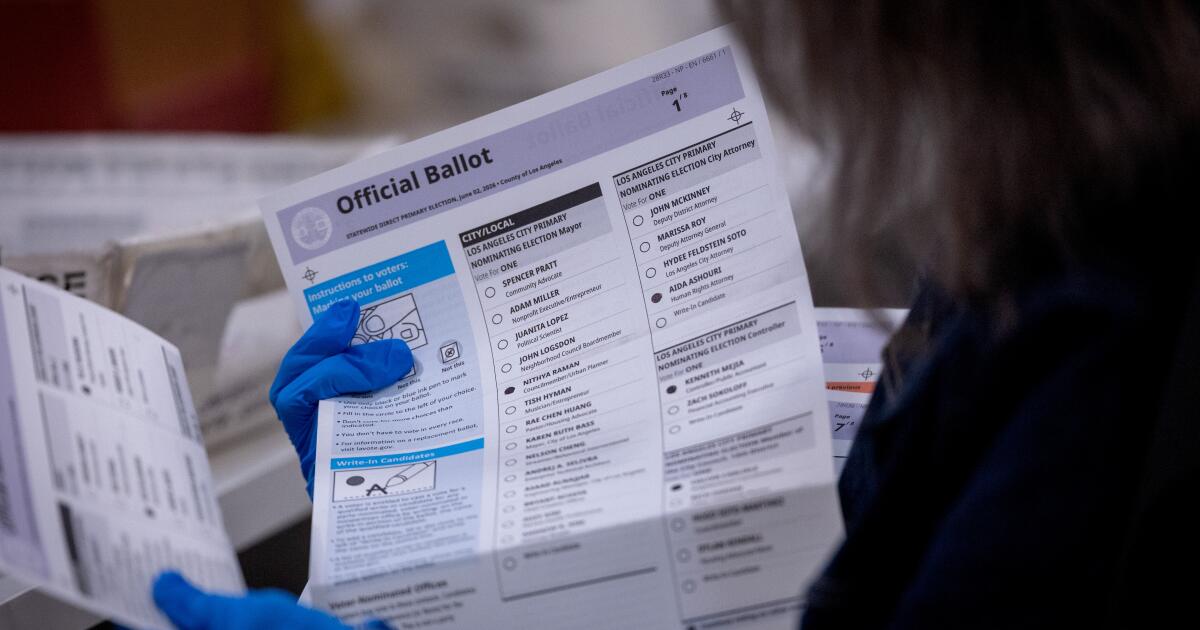
California officials cheered a U.S. Supreme Court ruling Monday that allows states to continue counting mail ballots postmarked by election day but received in the days after — calling it a win for voter participation and access, including in the upcoming November midterm.
They also acknowledged delays in recent vote counting have spurred frustration, and promised to speed the process through other solutions — including by investing millions into new election infrastructure and vote processing capabilities.
Gov. Gavin Newsom — who called the court ruling a “win for voters, plain and simple” — has previously said the state should be able to count ballots faster, and his latest budget includes $29 million for “increased staffing, technology and equipment upgrades and purchases for counties,” $10 million for voter education and outreach at the state and county levels and $750,000 for combating election misinformation.
The court decision, a loss for President Trump and other critics who contend such policies contribute to unacceptable delays in vote counting, specifically upheld a Mississippi policy to accept mail ballots received within five business days of an election.
But it also lets stand similar policies in other states — including California, which counts ballots postmarked by and received within seven days of an election.
California Secretary of State Shirley Weber, who has long prioritized voter participation over a speedy count, called the high court’s ruling a “win for voters, for the rule of law, and for the future of our democracy.”
She said that she will “keep working to ensure every eligible Californian has the opportunity to be heard, because our democracy is strongest when every voice and vote count.”
Dean Logan, head of the Los Angeles County registrar-recorder/county clerk’s office, said in a statement to The Times that the ruling “affirms what Los Angeles County voters deserve: the assurance that a ballot cast by Election Day will be counted if received within the legal timeframe established in State Law.”
“Our office will continue to provide voter education, multilingual outreach, and leverage available resources to ensure voting access for our 5.8 million registered voters,” Logan said.
Many voting rights experts agree California’s vote counting should and could be faster, but disagree with the Trump administration’s efforts to step in with policies such as election day deadlines.
In 2024, California counted more than 406,000 late-arriving mail ballots, but they represented only about 2.5% of the statewide total. Experts say California’s delayed results have far more to do with the massive influx of mail ballots that are placed in ballot drop boxes or arrive at processing facilities on or just before election day.
Rick Hasen, an election law expert and director of the Safeguarding Democracy Project at UCLA Law, said the court’s decision was a “symbolic loss” for Trump, in that the court rejected his preferred policy on mail ballots, but “doesn’t appreciably change how long it takes to count ballots” because late-arriving ballots were never the problem.
In a report published Thursday, the California Voter Foundation recommended statewide adoption of “sign, scan, and go” programs that allow elections officials to immediately process mail ballots that voters submit in person at polling centers or drop boxes.
The foundation recommended ballot curing programs that speed up the process by utilizing a secure text platform when double checking whether a ballot is legitimate when a voter’s signature doesn’t match state records.
It also urged the state to invest $35 million in a voter education campaign to encourage early ballot returns, and more than $55 million in improving counting capacity and efficiency in county elections facilities.
Trump and other conservatives had called for an end to state policies allowing late-arriving mail ballots to be counted as an overdue fix to a voting system that often can’t produce election results in close races for days after polls close, as was the case in California’s recent primary races for governor and L.A. mayor.
Trump has pointed to California’s time-consuming count as proof of widespread fraud to undermine Republican candidates, though he has never produced evidence to support that claim and Democrats have fiercely denied it.
On Monday, Trump called the high court’s decision to uphold such state policies a “tremendous loss,” and more reason to pass the Save America Act — a bill he has backed that would enforce new voter ID and proof of citizenship requirements and ban mail ballots except for military personnel, individuals suffering from illness, disability, and in other rare circumstances.
He said politicians have “no excuse” other than “CHEATING!” to oppose such measures, especially at “a time when there is a powerful Communist Movement taking place in our Country, one more dangerous than World War I, World War II, Pearl Harbor, or September 11th.”
But California leaders rejected that — saying the criticisms of mail ballots are baseless and an attempt by Trump and his allies to undermine elections in which they are poised to lose, particularly in big blue states such as California, by attempting to wrest control over voting processes that have always been the purview of states, not the federal government.
California Atty. Gen. Rob Bonta said Monday that states have been “primarily responsible for regulating elections” since the nation’s founding, and his office was “pleased that the U.S. Supreme Court has respected that authority.”
“Today’s decision recognizes a basic reality: Mail delays happen. When people vote by election day, their ballots should not be discarded because of those delays,” he said.
Sen. Alex Padilla (D-Calif.), the ranking Democrat on the Senate Rules and Administration Committee, which has oversight over federal elections, praised the high court Monday for acknowledging that nothing in federal law precludes states from counting mail ballots in the days after an election.
“Today’s decision is a victory for voting rights and a rejection of Trump’s attacks on mail and absentee voters,” Padilla said.
Liberal groups and many voting rights experts also hailed the ruling as a win for voters.
Moving up deadlines for mail ballots is just one effort in a much broader political war over voting and the rules that govern it. The U.S. Constitution generally gives states the authority to run their own elections, but the Trump administration has been trying to assert greater federal control — especially around mail ballots.
Earlier this year, Trump signed an executive order directing the U.S. Postal Service to assert control over mail balloting by designing new envelopes with special bar codes that would allow the federal government to ensure ballots only go to and get returned by eligible voters. The order prompted the Postal Service to propose new rules requiring states to hand over their voter mailing lists so it could implement Trump’s directive.
In a letter to U.S. Postmaster General David Steiner on Wednesday, Democratic senators denounced the proposed rule as an “unconstitutional and illegal attempt to transform [USPS] into an election administration agency controlled by the White House and President Trump.”
In a Senate hearing the same day, Steiner said that under the new rule, the USPS would not mail the ballots of a state that refused to turn over its voter lists, but also that his agency would adhere to any court orders curtailing its implementation.
On Thursday, just such an order came down in a federal case in which California and other Democrat-led states challenged Trump’s executive order. U.S. District Judge Indira Talwani ruled that the Constitution does not grant the president “any specific powers over elections,” and blocked his order as unlawful.
Nevada Secretary of State Cisco Aguilar, who is chair of the Democratic Assn. of Secretaries of State, said states such as California were right to focus on increasing investment in their own election infrastructure rather than accepting the Trump administration’s “bad policy ideas” for speeding things up.
Newsom’s office on Monday said that is exactly what California has been doing. It pointed to laws passed by the state Legislature last year that allow election officials to begin processing mail ballots earlier and require them to finish counting ballots sooner.
WASHINGTON — The Supreme Court on Monday upheld state laws that allow for counting mail ballots that are postmarked by election day but arrive later.
The 5-4 decision rejects a Republican challenge to laws in California and 13 other mostly Democratic states which permit the counting of these late-arriving ballots.
Justice Amy Coney Barrett and Chief Justice John G. Roberts Jr. joined with the three liberals to form the majority.
The decision is a mild surprise and should bolster Democrats in the fall election.
While California’s seven-day grace period for mail ballots has contributed to slow tabulations, it has not been shown to trigger fraud or unreliable vote counts.
Election law experts blame slow tallies on the surge in voting by mail combined with the need to carefully match signatures on these ballots.
The court said federal law since 1845 has set election day nationwide as the Tuesday after the first Monday in November and voters were required to cast their ballots that day.
Citing that fact, the Republican National Committee and the Trump administration joined a challenge to a Mississippi law adopted during the COVID-19 pandemic that allowed counting ballots that were up to five days late.
Trump’s lawyers said federal law preempted or overrode the state law.
“From the dawn of America, election day has meant the day the ballot box closes — and when election officials must be in receipt of all ballots,” wrote Solicitor Gen. D. John Sauer.
Democrats said the Constitution says the “time, place and manner of holding elections” for Congress “shall be prescribed in each state” by its legislature. However, Congress was given the power to override those state rules and set its own regulations for federal elections.
Barrett said the federal election day requires only that the voter must decide by then.
“The election-day statutes require the electorate’s choice to be made on election day. That occurs so long as election day is the deadline for individuals to vote — as it is in Mississippi,” she wrote. “But the election-day statutes do not set a deadline for ballot receipt, so they do not prevent Mississippi from counting ballots postmarked before election day yet received afterward.”
While Congress could have prohibited the counting of late-arriving ballots, it had not done so. That may be because states wanted to count ballots from members of the military stationed overseas even if they arrived late.
Last year, however, the 5th Circuit Court of Appeals in New Orleans struck down Mississippi’s law that allowed for counting ballots that were cast by election day but arrived up to five days later.
The opinion by three judges, all Trump appointees, concluded that the election day set by Congress “is the day by which ballots must be both cast by voters and received by state officials.”
In its appeal, Mississippi stuck with a states’ rights view and argued that the federal election-day statutes mean that ballots must be cast — not received — by election day.
“This is a victory for voters and for an election system that meets the needs of the people it serves,” said Common Cause President Virginia Kase Solomón. “Eligible Americans shouldn’t lose their voice because of mail delays outside their control.”
John Mozeliak is in Anaheim for one clear-cut reason: to set the foundation for the Angels to get back on track.
At his introductory news conference at Angel Stadium on Saturday, the team’s new baseball operations consultant and interim general manager laid out his vision for success — while acknowledging recent woes — alongside Molly Jolly, one day after the first-year Angels president relieved general manager Perry Minasian of his duties amid his sixth straight losing season.
“Obviously, [the Angels] lacked consistency in terms of when you think about winning, right? Because that’s the proxy,” Mozeliak said. “There’s a lot of things we can use to determine if the organization is healthy or not. … Where Molly and I are connecting on this is like, we understand wins and losses matter, but how do you get to a place where that becomes consistent?
“Look at the best clubs in baseball [and] what you admire; whether they’re large-market or small-market, they have a philosophy, they have direction, and they stick to it, right? … That’s ultimately what we need to do here, and that’s hopefully something I can help bring to them.”
Mozeliak spent 18 seasons (2008-25) as general manager of the St. Louis Cardinals, a tenure consisting of 10 playoff appearances and a World Series victory in 2011.
The 57-year-old intends to “audit” the Angels in this new role alongside Jolly, with plans to hire a general manager by the time Mozeliak’s contract is up “sometime in December.”
“I brought on board John Mozeliak to assist me in preparing a baseball operation strategy as well as guide me in the search for a new general manager,” Jolly said, mentioning that her decision to fire Minasian and bring in Mozeliak had brewed for weeks.
“I did this because John has a proven track record of building and maintaining winning baseball cultures, and my goal is to bring that here to the Angels.”
Mozeliak didn’t rule himself out as the long-term answer at general manager and was emphatic about not speaking in absolutes. However, the longtime executive said he’d rather help Jolly “bridge the gap” during the Angels’ transformative period before anything else.
The Angels have plenty of gaps entering Saturday’s matchup with the Athletics. The Angels are tied for last in the American League with a 34-49 record while on the road to a 12th consecutive finish out of the playoffs.
And all of that is before mentioning the “sell the team” chants that flood the right-field upper deck at Angel Stadium at each home game oas ex-Angel Shohei Ohtani thrives with the Dodgers.
Mozeliak understands that the Angels have lacked direction in recent seasons. He asked for patience in rebuilding the team alongside Jolly.
“I knew coming in, this isn’t going to be something where Molly and I had a light switch and everything just starts working perfectly,” Mozeliak said. “It’s not going to work that way. … I would ask for some patience. We need a little time to sort of work through this … when we come out on the other end of this tunnel, we hope to be in a very successful place.”
Jolly said of Angels fans’ discontent, “I know what’s happening. I see it, I hear it. Fans have a right to have their voices be heard. Didn’t influence the decision that I wanted to make, but we all want to win. Our owner wants to win. I do. The fans deserve that, and that’s what we’re going to work toward.”
Mozeliak acknowledged he’d already forgotten some names of Angels personnel he was introduced to Saturday. But he also said that first-year manager Kurt Suzuki and the rest of the coaching staff’s jobs are secure through the season.
“I met with most of them this morning, and I told them they’re all fine for this year,” Mozeliak said. “There’s nothing they have to worry about. We’re not making any coaching changes right now. I really just need to get to know them, right?”
Mozeliak spoke to Suzuki on Saturday and said that he and his staff are “very impressive.”
Across the board, Mozeliak — who hasn’t yet met owner Arte Moreno since moving into this role — is focused on knowing who the Angels are at this point, with an “aggressive timeline” looming in the background.
With that said, Mozeliak shared that he isn’t “overly concerned” with the Aug. 3 trade deadline, nor is he worried about the MLB Draft, which starts July 11.
“My philosophy on the draft is to let the scouting director and his team do their jobs,” Mozeliak said. “The only real input I’m going to have is … understanding their process … and then if there are some financial decisions that are being banked into who we pick and why.”
Jolly brought in Mozeliak to help the Angels hire their fourth full-time general manager since 2012.
And while many might believe not much will change as long as Moreno remains the owner, Jolly said she has “autonomy” to assess the Angels’ baseball operations and is “confident in my authority and scope within the organization.”
Those invested in the Angels will believe it when they see it.
“When I think about the Angels right now, I just look at it as a very opportunistic time here,” Mozeliak said. “New leadership on the business side; we’re going to put a great team on the baseball side.
“But it’s going to be a place that I hope, in a couple years, we’re all proud of.”
WASHINGTON — Asylum seekers may be turned away without a hearing at the southern border, the Supreme Court ruled Thursday in a historic retreat from the promise of relief for those who say they are fleeing persecution.
The justices split over whether this was a simple dispute over legal wording or a moral question involving desperate families.
Siding with the Trump administration, the court’s conservatives said the Refugee Act of 1980 offers a right to seek asylum to migrants who “arrive in the United States” but not those who are turned back when they approach a border crossing or a port of entry.
“This case presents a straightforward question” that turns on the word “in,” said Justice Samuel A. Alito Jr. “In ordinary speech, no one would say that a person ‘arrives in’ a place — for example, a house, a city, or a country — before the person enters that place.”
The liberal dissenters agreed with immigration rights lawyers who saw this as a nonsensical reading of the law.
Justice Sonia Sotomayor said the asylum law arose from the “international moral reckoning that followed the Holocaust and World War II.”
She cited the infamous voyage of the MS St. Louis in 1939. More than 900 Jewish refugees attempted to flee persecution in Nazi Germany by setting sail aboard the ship, which was turned away from Cuba and the United States.
Most of the passengers were returned to Europe, and several hundred died in the Holocaust, she said.
“Congress passed the Refugee Act in 1980 because it did not want this country to repeat the mistakes of its past. Yet if the refugees on the M.S. St. Louis were to walk up to a port of entry on our southern border today, the majority’s interpretation would allow immigration officers to refuse even to consider their asylum applications by physically blocking them from stepping foot onto U. S. soil,” Sotomayor wrote.
Justices Elena Kagan and Ketanji Brown Jackson agreed.
The Department of Homeland Security said these asylum seekers must wait on the Mexican side of the border until they could return for a scheduled interview. The policy was extended to other border crossings, but it was challenged as illegal in federal court in San Diego.
Last year, a divided 9th Circuit Court of Appeals ruled that those restrictions were illegal if they prevented migrants from applying for asylum.
“To ‘arrive’ means ‘to reach a destination,’” wrote Judge Michelle Friedland. “A person who presents herself to an official at the border has ‘arrived.’”
She said the “government’s reading would reflect a radical reconstruction of the right to apply for asylum because it would give the executive branch vast discretion to prevent people from applying by blocking them at the border.”
The 2-1 decision upheld a federal judge in San Diego who ruled for migrants who had filed a class-action suit and said they were wrongly denied an asylum hearing.
But Solicitor Gen. D. John Sauer urged the Supreme Court to review and reverse the appellate ruling, noting 15 judges of the 9th Circuit joined dissents that called the decision “radical” and “clearly wrong.”
The administration argued federal immigration law “does not grant aliens throughout the world a right to enter the United States so that they can seek asylum.”
From abroad, they may “seek admission as refugees,” Sauer said, but the government may enforce its laws by “blocking illegal immigrants from stepping on U.S. soil.”
Defenders of the asylum system denounced the decision.
“We believe that today’s ruling violates international law, as well as the express intent of Congress,” said Erika Pinheiro, executive director of the migrant support organization Al Otro Lado, which led the legal fight. “For decades, the United States has allowed individuals and families who are fleeing persecution, torture and death to ask for protection at U.S. borders.”
“Cruelty is not a substitute for real solutions. Blocking people from seeking asylum at official ports of entry will do nothing to fix our broken immigration system, said Rebecca Cassler, senior litigation attorney at the American Immigration Council. “It only makes things more chaotic and dangerous for vulnerable families.”
The Federation for American Immigration Reform applauded the decision.
“Our immigration laws are written to be pro-enforcement, not-anti-enforcement,” said Christopher J. Hajec, deputy general counsel of FAIR. “Because of this, courts that hamstring enforcement are often forced to violate basic logic, as the 9th Circuit did here. We are pleased the Supreme Court saw that the lower court’s reading would make immigration law incoherent, and reversed.”
WASHINGTON — The Supreme Court sided with the maker of the Roundup weedkiller Thursday in a ruling expected to block thousands of lawsuits alleging it failed to warn people the product could cause cancer.
The case came before the justices after a tidal wave of litigation that included some multibillion-dollar verdicts against the global agrochemical manufacturer Bayer, which acquired Roundup when it bought its original manufacturer Monsanto in 2018.
The decision is a victory for the Trump administration, but one that could be tricky politically since allies in the Make America Healthy Again movement want to rein in pesticide use.
The high court, in a 7-2 ruling, found that the company can’t be sued in state courts because federal regulations have found a cancer link unlikely and do not require a warning label.
The decision “is good for science, farmers, and industries that depend on regulatory clarity for innovation,” Bayer said in a statement. “It should help significantly contain the Roundup litigation after nearly a decade of legal battles.”
Though Bayer said the ruling should result in the dismissal of pending lawsuits containing failure-to-warn allegations, the company said it plans to proceed with a proposed $7.25 billion class-action settlement intended to resolve many of the remaining claims.
Lawyers for some residents pursuing Roundup litigation criticized the court’s decision.
“This Supreme Court ruling wrongly slams the courthouse door on Americans sickened by pesticides,” said attorney Christopher Seeger, who is proposed as a claimants’ representative in the settlement. But he said a settlement still would allow some people to receive compensation.
The case before the Supreme Court was filed by Missouri resident John Durnell. He developed a cancer called non-Hodgkin’s lymphoma after more than 20 years of serving as the neighborhood association’s “spray guy,” using Roundup on parks in his historic St. Louis community.
A jury agreed that the company failed to warn him about possible cancer dangers and awarded him $1.25 million. It’s one of thousands of similar cases, including some multibillion-dollar damage awards.
There’s still fierce debate about cancer and Roundup’s key ingredient, glyphosate. The World Health Organization’s International Agency for Research on Cancer classified the chemical as “probably carcinogenic” in 2015. The Environmental Protection Agency has determined that it’s not likely to cause cancer in humans when used as directed.
The agency approved a label without a cancer warning, and Bayer argues that it’s required to follow those federal standards — not the state laws that Durnell and others have sued under. The ruling still could allow other suits alleging problems with the way the product was designed, his attorney Ashley Keller has said.
Bayer disputes the cancer claims but previously set aside $16 billion to settle cases, and earlier this year proposed a $7.25 billion class-action settlement. A federal judge recently ruled that the proposed settlement will be heard in a Missouri state court, where many of the lawsuits have been filed. At the same time, the company has tried to persuade states to pass laws shielding it from liability in failure-to-warn lawsuits, and three states have agreed.
About 200,000 Roundup-related claims have been made against Bayer, mostly from home users. It has stopped using glyphosate in Roundup sold in the U.S. residential lawn and garden market.
The company has said it might have to consider pulling glyphosate from U.S. agricultural markets if it keeps getting sued. Agricultural industry group say could have a devastating effect on the food supply.
But pesticides have also created a rift between the Trump administration and members of Health Secretary Robert F. Kennedy’s MAHA movement, adding to their frustration with an executive order aimed at boosting glyphosate’s production.
Kennedy himself has said repeatedly that glyphosate causes cancer, even as he says he recognizes the executive order was necessary for food supply and national security reasons.
Whitehurst writes for the Associated Press. AP writer David A. Lieb in Jefferson City, Mo., contributed to this report.