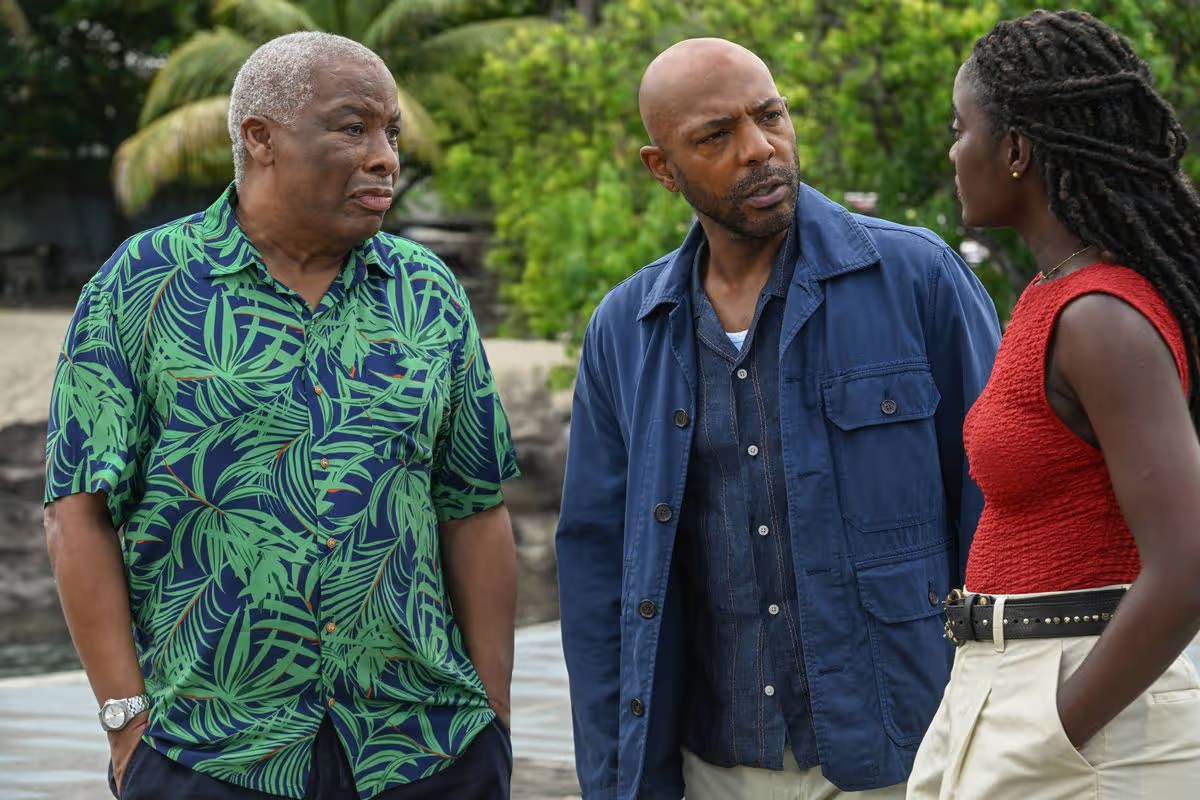
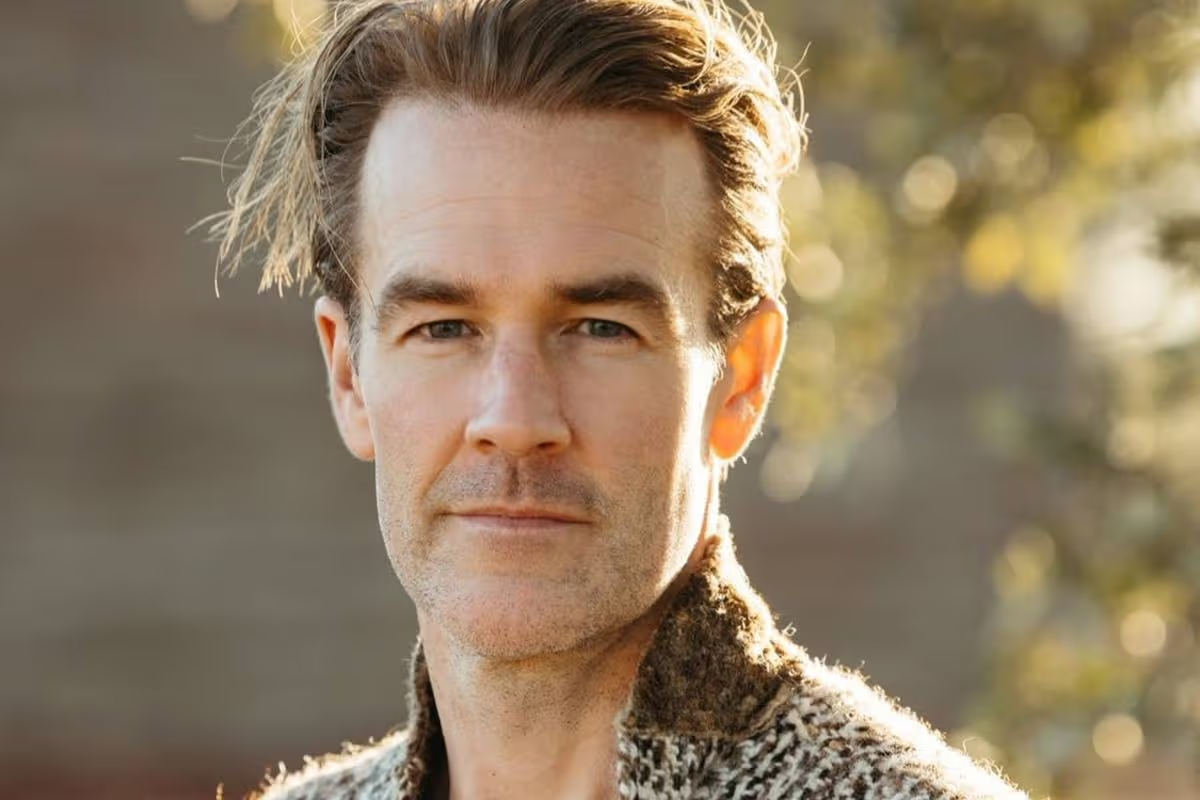
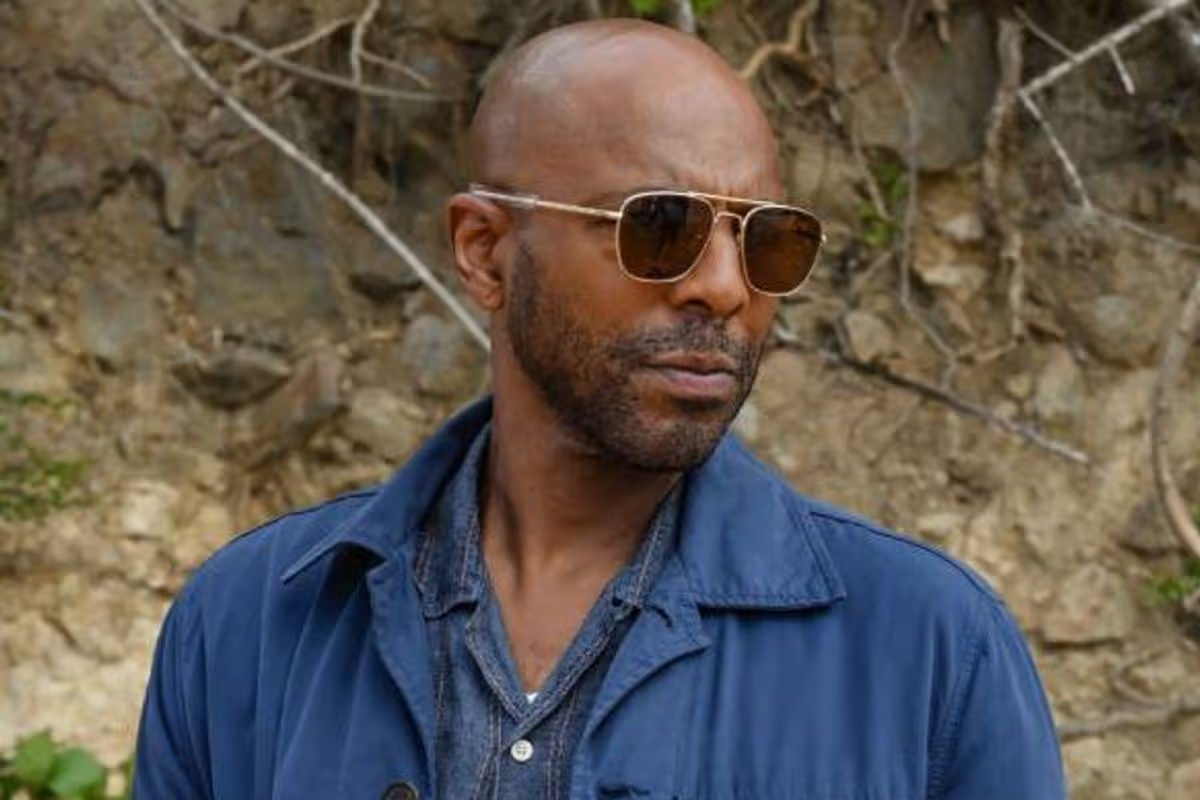
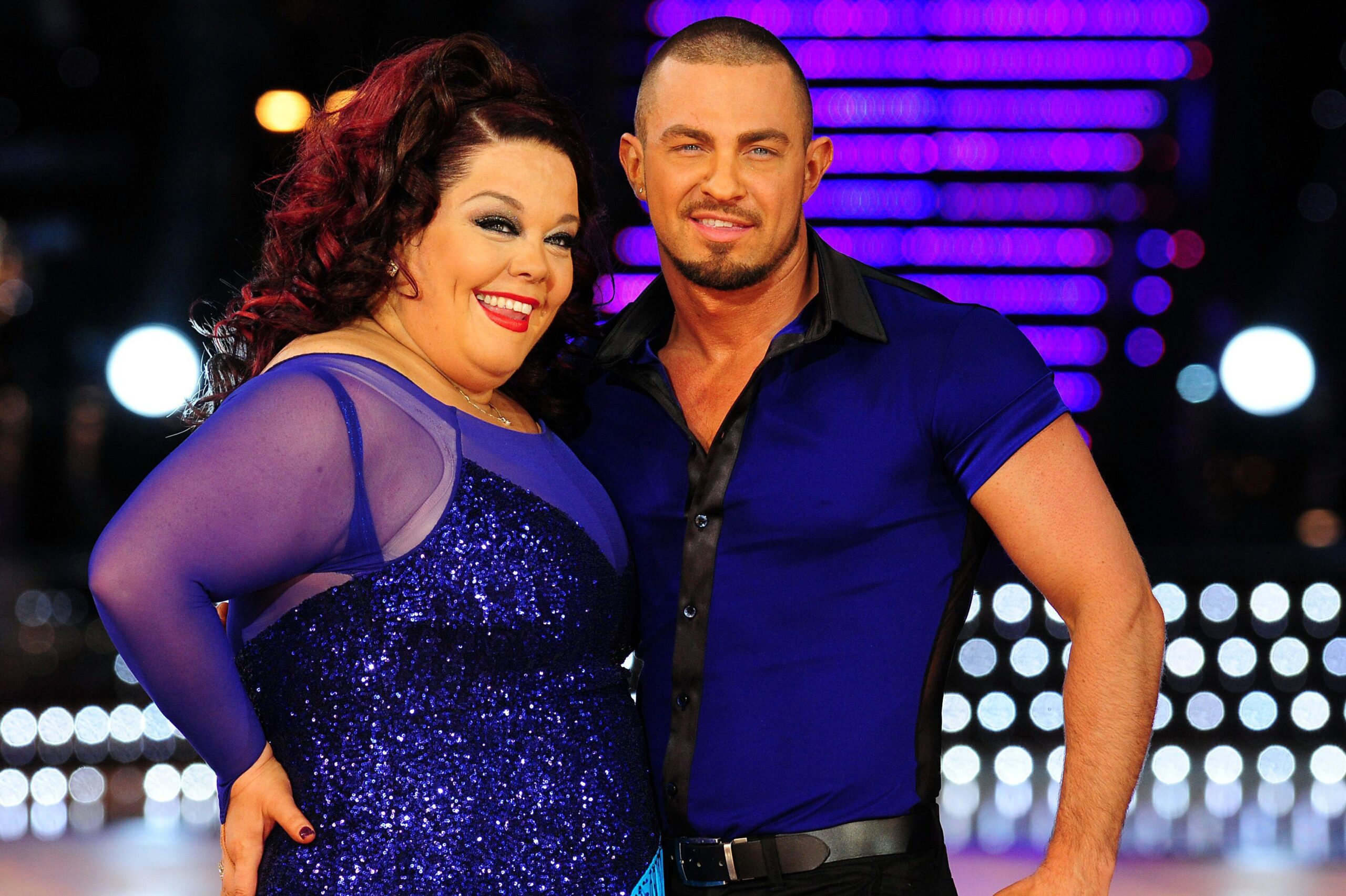
EXCLUSIVE: Death in Paradise star Don Gilet has spoken out about new cast member Catherine Garton who plays Sergeant Mattie Fletcher
Teaser clip ahead of new Death in Paradise series
Death in Paradise’s detective Don Gilet, who portrays Mervin Wilson in the BBC series, has praised new police officer Catherine Garton, who takes on the role of Sergeant Mattie Fletcher.
Mattie is the latest addition to the Saint Marie force and steps into the shoes of Darlene Curtis, previously played by Ginny Holder. Ginny made a quiet exit from the show after only appearing via video link in the Christmas special.
In an exclusive chat with Reach PLC and other media outlets, Don discussed the upcoming series and his experience of welcoming a fresh face to the squad.
He began by stating that Darlene was not replaced, as “you cannot replace that character”. He elaborated, “It was just the new character coming in, just a completely different energy that we weren’t expecting.
“The arrival of Mattie surprises us all as characters, and she’s a very colourful and larger-than-life character as well. So it’s always great,” reports the Express.
“It’s just the same as when new characters come in per episode, it sort of keeps things fresh, keeps the characters on their toes, brings some new and different energy in with a new storyline to go with it.”
He continued, “And again, not giving too much away, but you find out things about Mattie bit by bit as she tries to connect with her colleagues, the same way I tried to connect with my colleagues, and it didn’t happen very easily.
“She’s a great character to work with, and there’s a rebelliousness to the character that Catherine brings, which in some ways is similar to the way that Mervin works.
“So I wonder if there’s just a little tinge of admiration for the way she works that is a bit unorthodox.”
The synopsis for tonight’s episode, available to stream on BBC iPlayer, states: “A reclusive pensioner is shot dead in his home, and a figure matching the description of an unassuming accountant was witnessed fleeing the crime scene.”
It continues: “However, the suspect has a rock-solid alibi. Meanwhile, the commissioner is determined to get the islanders back on side with a community-focused initiative, but tensions rise when Mervin goes rogue during the launch event.”
I’m Glenn Whipp, columnist for the Los Angeles Times, host of The Envelope newsletter and the guy wondering about the profit margin on a $6 churro.
In the meantime, welcome back to the newsletter as we push through to the Oscars on March 15. Have you been catching up on the nominated movies? “Sentimental Value” is a delight … though just how delightful has been the subject of some debate.
Sign up for The Envelope
Get exclusive awards season news, in-depth interviews and columnist Glenn Whipp’s must-read analysis straight to your inbox.
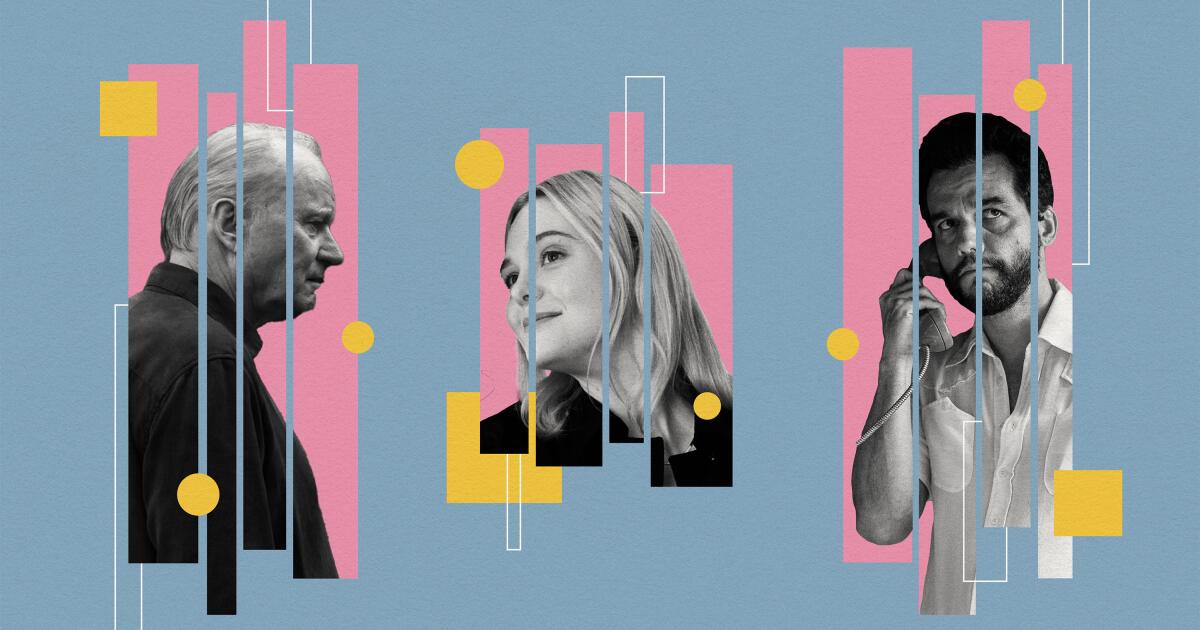
Its primary quartet of actors — Stellan Skarsgård as a legendary director angling for a comeback, Renate Reinsve and Inga Ibsdotter Lilleaas as his daughters and Elle Fanning as an A-list actor who becomes entangled in the family drama — all received nods. Fanning’s name was the first called when nominations were announced, signaling that Scandinavian melancholy would be notably absent that morning. Never mind the hour: Champagne glasses were raised.
The celebratory scene stood in stark contrast to the vibe just two weeks earlier when “Sentimental Value” was blanked at the Actor Awards (formerly known as the Screen Actors Guild Awards). And it wasn’t the only international film ignored. The 2,500 SAG-AFTRA nomination committee voters also shunned Wagner Moura, the lead of celebrated Brazilian drama “The Secret Agent.” Moura went on to nab an Oscar nomination, one of four noms, including best picture, that Kleber Mendonça Filho’s drama earned.
The disparity between the choices of the motion picture academy and SAG-AFTRA could be an anomaly. Or it might be the latest evidence of an Oscar trend this decade. As the academy’s membership has become more global — 24% of Oscar voters live outside the United States — the Academy Awards have become increasingly an international affair, leading to a widening divide with the Hollywood guilds.
Is this a bad thing? It depends who you ask. If you queried the actors that SAG-AFTRA nominated who ended up being Oscar also-rans, the answer would be no. Those who believe that cinema is global, particularly now that American studios have largely abandoned making movies geared toward grown-ups, would have a different response.
“The fact that not one international film got in says a lot,” says a veteran awards consultant, who, like others interviewed, requested anonymity in order to speak freely about the industry. Indeed, one journalist tabbed SAG’s Actor Awards nominations the “‘America First’ List,” which, while technically accurate, might have taken the perceived xenophobia a bit far.
“The SAG Awards or Actor Awards — whatever they’re called now — are in danger of looking like a middlebrow affair,” another awards campaigner notes. “I know this is going to sound elitist, but it’s true. There’s a big difference between an organization where you have to be invited or apply to join versus one where, if you’re a disc jockey in Kansas City, you have voting rights.”
To be fair, DJs, Kansas City-based or otherwise, probably don’t vote for the Actor Awards’ nominations — just for the final awards. In the nominations round, 2,500 randomly selected active SAG-AFTRA members make the choices. To serve on the committee, members must be categorized as an actor/performer, dancer, singer or stuntperson in the SAG-AFTRA database. Could a DJ be classified as a performer? Probably not. In the guild’s view, actor and performer are synonymous, encompassing both principal and background players.
And sure, since only 7% of SAG-AFTRA actors and performers earn $80,000 or more a year, that means there are going to be a few full-time waiters on those nomination committees. But as the speeches at the Actor Awards remind us annually, it’s a profession where you’re just one job away from making it. Think of Connor Storrie, who worked at restaurants for eight years before getting his break on “Heated Rivalry.”
There’s still the question of why, say, SAG-AFTRA dancers and singers are voting on the merits of an acting performance, however. In contrast to the Actor Awards, nominations for the Oscars are decided by the academy’s various branches. Actors vote for actors, writers for screenplays and so on, with the general membership voting for best picture.
“Peer groups are deciding what’s worthy, and that’s the way it should be,” says an academy member from the public relations branch. “I’m not voting for visual effects.”
Not initially, at least. Academy members vote for all 24 categories in the final round, provided, per a rule change that went into effect this year, they attest to watching all the nominated work in the category.
SAG-AFTRA voters have rewarded non-English-language work over the years, but usually when a particular film or TV show — Bong Joon Ho’s 2019 masterpiece “Parasite” or Netflix’s “Squid Game” — is undeniable. Voters ignored recent lead turns from Fernanda Torres (“I’m Still Here”), Yalitza Aparicio (“Roma”) and Sandra Hüller (“Anatomy of a Fall”). All three went on to earn lead actress Oscar nominations.
This year’s snubbing of “Sentimental Value” is particularly puzzling as the movie featured well-known actors like Fanning and Skarsgård, an institution from roles in blockbuster franchises like “Pirates of the Caribbean” and most recently the TV series “Andor.” It’s also a film about, among other things, the blurring of art and reality and the challenges of acting. And, in the scenes featuring Fanning, it’s in English.
What gives? Like every other contender, “Sentimental Value” screened four times for voters and was available for streaming.
“I just think people are less inclined to watch a movie with subtitles at home,” says one awards consultant, alluding to the ways that passive, multiscreen viewing has encroached upon our multitasking lives. Maybe that’s why Skarsgård, when he accepted the Golden Globe award for his work in the movie, preached that “cinema should be seen in cinemas” in his speech.
Does that sound elitist? It shouldn’t. But it does seem to be a belief from a time that’s slipping away. One certainty: With the academy nominating two international features for best picture for the third straight year, global cinema is now entrenched at the Oscars. Whether SAG-AFTRA voters decide to join the party is now a question for next year.
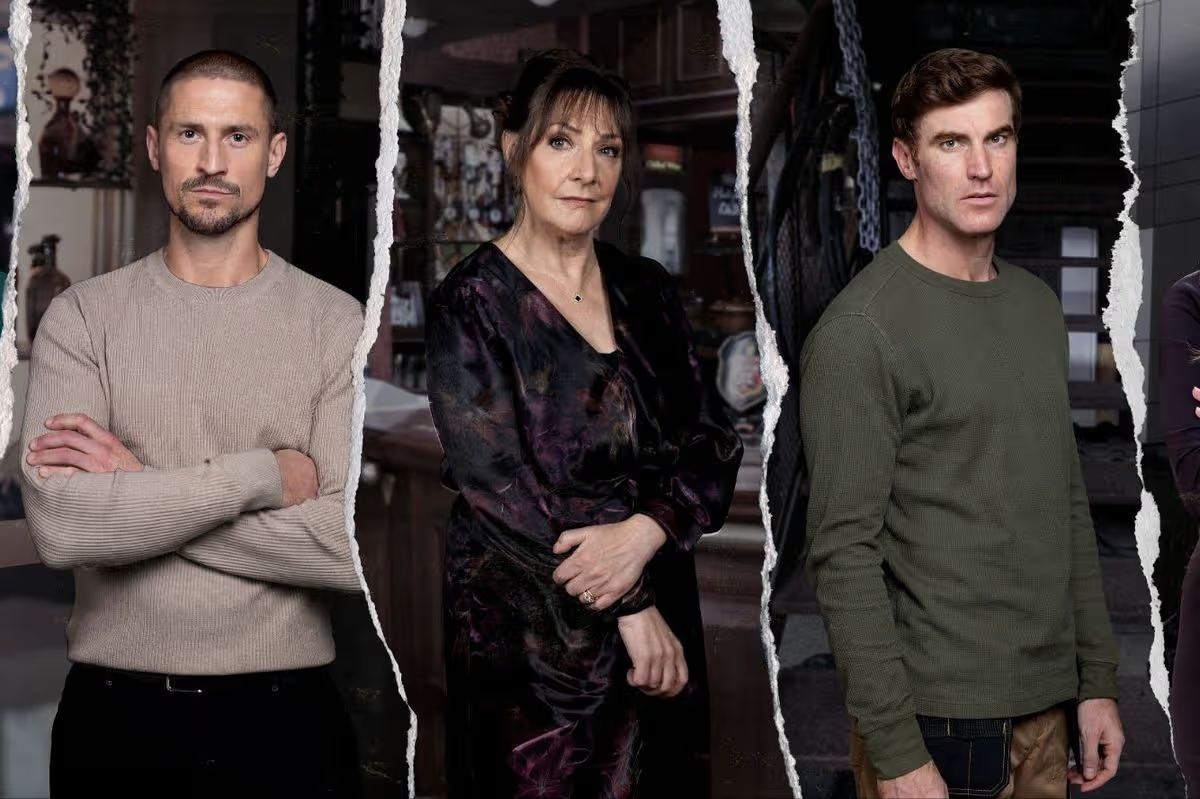
Carl Webster, Megan Walsh, Theo Silverton, Maggie Driscoll and Jodie Ramsey are in a killer’s firing line and tonight’s flashforward episode will keep fans guessing
The five Coronation Street characters at risk of a grisly death have been revealed. One of the ITV soap’s stars will meet their end the identities of the possible murder victims have been confirmed as viewers prepare to be taken back to the future in the show’s much anticipated flashforward episode. But will it be a villian on a much-loved character getting the boot?
Groomer Megan Walsh, manipulative Theo Silverton and twisted Carl Webster could be getting their comeuppance in April. But quirky landlady Maggie Driscoll is also in the firing like, as is strange newcomer Jodie Ramsey, who appears to have a whole load of family bagage to unload.
The groundbreaking episode begins with a police interview taking place on April 23rd 2026. As the drama unfolds a shocked and Betsy Swain is seen telling the detectives about finding the dead body of someone she knows.
Dressed in wedding clothes, the cop’s daughter explains that she had been at the marriage of her mum Lisa Swain to Carla Connor, but was heading into town when she made the shocking discovery. As the episode returns to the present day we begin to see how the behaviour of the five characters could lead to their possible death two months later.
Evil teacher Megan is caught up in a web of lies as she continues to groom impressionable teen Will Driscoll. Doing anything to protect her family, Maggie gives a fake alibi for Will to stop him being charged with the Christmas Day attack on Daniel Osbourne.
Carl has burnt all his bridges when he let Debbie take the blame for the Corriedale accident which saw Billy Mayhew perish. Since finding out Debbie is actually his mum and not his sister, Carl has pressed the self-destruct button and as he continues to goad both family and neighbours – he would have no shortage of people looking to settle a score.
Theo’s coercive control over Todd has reached new lows and with their wedding looming, will Todd finally confide in his friends about what has been going on before it is too late?
Despite initial reservations, the Platts have welcomed Shona’s estranged sister Jodie Ramsey into their home. But Jodie has been keeping secrets from them, and it seems she has got mixed up with some pretty shady characters in her past. Will trouble follow Jodie to Weatherfield, or could she upset people closer to home with her behaviour?
As the episode comes to a close we flash forward again to April 23 and the five characters are on the cobbles as Lisa and Carla’s wedding fireworks light up the night sky.
As the lights flicker a battered and bruised Carl, frantic Jodie, a menacing Maggie, a bloody-nosed Megan and a furtive Theo stare into the darkness. In the final moments the terrified scream of Betsy Swain fills the air – but which Weatherfield resident will be the murder victim?
Support for James Van Der Beek’s family continues to pour in. The GoFundMe created to support them following the “Dawson’s Creek” star’s death approached $2.3 million in donations Friday morning.
Steven Spielberg and his wife Kate Capshaw are among the celebrity donors who have contributed to the fundraiser organized by the late actor’s friends. The couple’s donation is listed as $25,000. Those familiar with Van Der Beek’s breakout role on the millennial teen drama know that Spielberg is Dawson Leery’s favorite director.
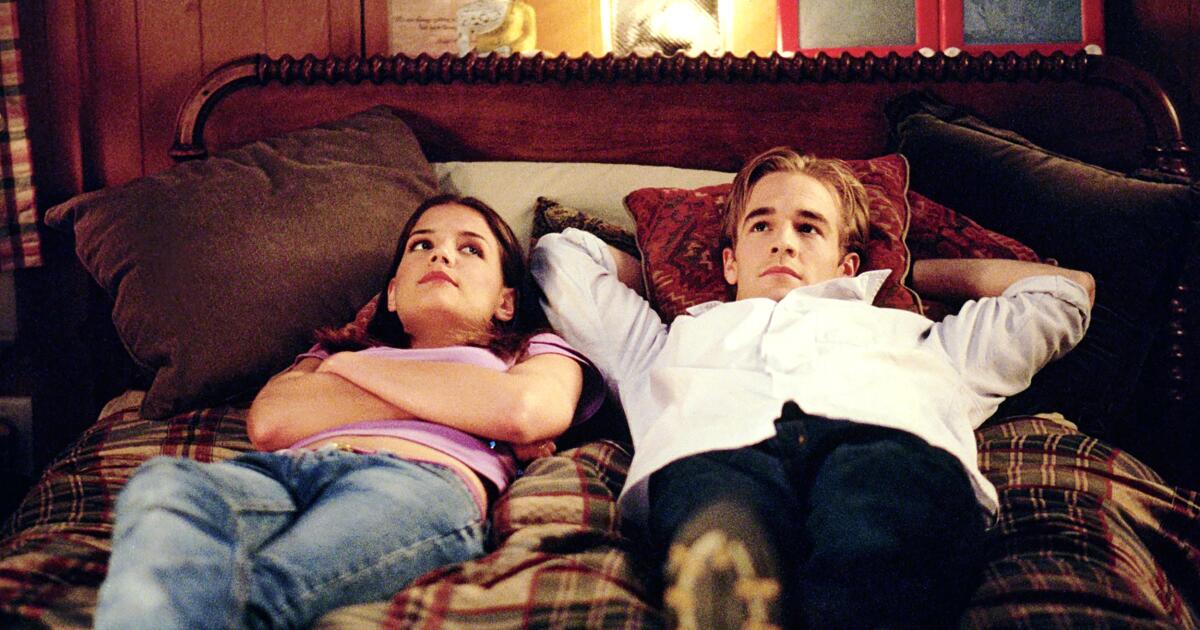
Originally airing from 1998 to 2003, “Dawson’s Creek” was a seminal teen drama that followed four friends growing up in a small coastal town as they navigated their dreams, relationships and various coming-of-age milestones. Van Der Beek’s Dawson was an aspiring filmmaker whose dreams were bigger than his small hometown. Along with friends Joey (Katie Holmes), Pacey (Joshua Jackson) and Jen (Michelle Williams), Dawson grappled with very relatable teen dilemmas including heartbreak, betrayal and bad decisions.
The fundraiser, which had more than 44,000 donors as of Friday morning, was organized to help support Van Der Beek’s wife and children, who “are facing an uncertain future” due to the financial strain of the late actor’s medical costs. The late actor died following a battle with colorectal cancer. Funds will be used to “help cover essential living expenses, pay bills, and support the children’s education,” the organizers wrote.
Van Der Beek revealed in 2012 that he had been paid “almost nothing” for his work on “Dawson’s Creek” and had not received any residuals from the hit show.
“There was no residual money,” he told “Today.” “I was 20. It was a bad contract. I saw almost nothing from that.”
Before his death, Van Der Beek auctioned off personal memorabilia and sold collectibles to help pay for his cancer treatments. In September, his “Dawson’s Creek” co-stars helped organize and stage a reunion fundraiser to support Van Der Beek and his family — a reunion the actor had to miss because of a virus. “Black Bird” actor Paul Walter Hauser had also been raising funds through Cameo videos and auctions to help the late actor prior to his death.
Besides Spielberg, celebrity donors to Van Der Beek’s GoFundMe also reportedly include Zoe Saldaña, Jon M. Chu, Derek Hough, Busy Philipps, Jenna Dewan and others.
Van Der Beek’s “Dawson’s Creek” colleagues have also been among the many who have shared tributes to the late actor.
“Several times today, from my heart, I’ve tried to form the words to express the beautiful brilliance of James and what his presence has meant to my life,” “Dawson’s” creator Kevin Williamson wrote Thursday in a post shared on Instagram. “But I am truly at a loss for words. I will have to trust that one day those words will come… But today, all I can think about is Kimberly and the entire Van Der Beek family.”
Holmes, meanwhile, shared a handwritten note addressed to Van Der Beek on Instagram Wednesday. She was the first of “Dawson’s Creek’s” surviving core quartet to publicly acknowledge Van Der Beek’s death.
“Thank you,” Holmes wrote in her note, which was addressed to Van Der Beek. “To share a space with your imagination is sacred — breathing the same air in the land of make believe and trusting that each others’ hearts are safe in their expression.”
In her remembrance, Holmes highlighted their shared “laughter, conversations about life, James Taylor songs” and their “adventures of a unique youth.” She also highlighted Van Der Beek’s “Bravery. Compassion. Selflessness [and] Strength.”
“I mourn this loss with a heart holding the reality of his absence and deep gratitude for his imprint on it,” wrote Holmes, who also sent love to Van Der Beek’s wife and children in her message.
Other members of the extended “Dawson’s Creek” family, including actors Chad Michael Murray, Kerr Smith and Sasha Alexander, have also been among those offering condolences and paying tribute to Van Der Beek and his family online.
“James Van Der Beek was one in a billion and he will be forever missed and i don’t know what else to say,” wrote Busy Philipps in her Instagram tribute. “He was my friend and i loved him and i’m so grateful for our friendship all these years.”
Ryan Sickler is used to asking the question that people are afraid to ask: “Is there anyone here who has ever actually died and come back and would be comfortable talking about it in front of all of us?”
It’s not your typical comedy show crowd work but it has profound results. During his special “Ryan Sickler: Live & Alive” released on YouTube in October, a woman in the audience talked about a near-death experience as a child where she rode her bicycle in front of a neighbor’s station wagon. But Sickler pointed out that this remarkable level of candor in the audience is something he continues to marvel about. In fact, he said they did two shows the night they taped his special and during the second show two people in the crowd said they had near-death experiences.
“When I ask the question, I know there’s someone in the crowd that’s like, ‘There’s nobody in here that’s died and come back,’” Sickler said. “So now they’re all very excited to listen too. Like, what happened to this lady, or what happened to this guy? You know, there’s been some wild ones, some real funny ones out there too.”
Given how many comedy specials are being released on various streaming platforms, he says that “we have lost the specialness of the special.” But Sickler said since coming so close to death and being able to talk about it with candor and relatability, he is still calling his latest self-produced YouTube special, special. It now has more than 1 million views on YouTube. Sickler has been on the comedy scene for more than 30 years and released his comedy special “Lefty’s Son” in 2023. He also hosts the “HoneyDew Podcast.” His comedy career has often incorporated his lived experience with a rare blood-clotting disease called Factor V Leiden that almost killed him.
But these days, he’s grateful to be alive, to have been able to wake up when it looked like he might not, to watch his daughter continue to grow up and the laughs along the way. Sickler has long been candid about his chronic health issues with his comedy but he has found particular meaning in doing crowd work when he performs, that talks about death and what it means to live.
The Times recently spoke with Sickler about his special and how he thinks about his sense of health, humor and mortality.
Ryan Sickler in the studio where he films the “HoneyDew Podcast.”
(Al Seib / For The Times)
What did you want to say this time around in your new special?
My first special was something that was a bit of a hybrid of stuff that had been out there and around, but I didn’t own it. It was out there on people’s platforms. They’re making the money off of it. And so I did a bit of, “Let me get this stuff on my channel where I can control it.” And then the other part of that special was becoming a new single dad, all those things this time, specifically, I really just wanted to talk about what had happened and the results after that. I follow these comedy accounts and in October, there were 31 stand-up specials that hit between Netflix, Hulu, YouTube. November was 30. This month was a little slow because the holidays, but it was still at 18 the last time I checked. So I don’t think there’s anything special about stand-up specials anymore. You’re in an environment now where there’s a stand-up special a day, people are doing that with podcasts. There’s so much content going on out there, and I feel like a lot of it is the same. So I this time wanted to just take something that happened very personal to me, this incident, and then tell the story, not only behind it, but what happened after and I was really proud of being able to just focus on that and make that into this special instead of just my observations on this or my thoughts on that. I’m a storyteller and I really think that’s what art is.
When did you realize you had the courage to write about this near–death experience?
I know I had the courage to write about it a long time ago. When I’m making people laugh at my father’s funeral and things like that, I knew I was comfortable being able to take on the material. But what I didn’t know was, could I make it funny? Could I make it relatable? Could I make this one thing that happened to this one person on this rock in outer space matter to anybody and make them care? Because it’s not like we all had this happen to us. This is just one thing that happened to this one dude. So that was really what I was more worried about, is like, can I get this message across and make it relatable, funny and entertaining at the same time? Which is why I threw in those really expensive light cues.
It can be very challenging to hear about these traumatic [near–death] experiences that people have had. How do you absorb that and not absorb it too much?
I’ve been doing this show for so long that it does start to wear on you a little bit hearing a lot of the trauma. So I created a new podcast a couple years ago called the Wayback, which is just fun, funny, nostalgia. So that also for me, was like, let’s not dig into the tears and let’s just laugh about growing up. So that was one way where I could still keep it in my lane and do my job, where I alleviate that a little bit. But the other thing, and I make fun of myself a little, is I’m like the paramedic at the party now. I’m the guy that’s like “You think that’s bad, wait until you hear this.” “This one guy …” “This one lady …” You know what I mean? So I’ve almost become sort of their voice, and I have absorbed it in a way that isn’t so negative, where I carry it home with me. I always forget the quote how it’s worded, but it’s something to the tune of, if we all stood in a circle and threw our problems in the middle, we’d all take our shit right back. It’s like you know what, that’s what you’re dealing with? I’m gonna go ahead and take mine.
How is hearing all these stories and connecting with the crowd and fans in this way [about near–death experiences] changed how you think about your own sense of mortality?
Even with my close call, like, that one angered me, because you start to think about things. You never know how you’re really going to go. You might have an idea if you’re getting older and cancer runs in your family, whatever, but the fact that you could go to a hospital for a simple surgery, they don’t listen to you, everything’s there in your paperwork. You’re your own advocate. You’re doing all the right stuff by yourself, and you’re among professionals, medical professionals, not Yahoos, and you can still have someone else make a mistake and your life is gone. That started me thinking a lot like, “Oh man, for no fault of my own, I could also be gone.” So I go day by day, and I try to be happy day by day. And I’m not going to lie, I also like to know I got a little something tomorrow too.
Do you think that incorporating death and near–death in your comedy helps people work through their own feelings about death and grief?
I only say yes to that because the amount of emails I get, the amount of feedback we get, the amount of guests that still continue to show up [to support] the Patreon. I’ve definitely found, I would say, a purpose in my people. If you’re someone saying you’re a jerk for laughing at this lady talking about cancer, we’re not laughing at her cancer. We’re laughing at something, some light that she found in the darkness of this and trying to have a moment here together, all about, “Hey, there’s some positive ways to look at things at your lowest.” So I know it’s helped people. I mean, we have, over the years, probably thousands of emails now. We have people telling us how much it’s helped. And I mean just through podcasting, I found out I have this blood disease. I was 42 at the time, and already been podcasting. There’s a lady I went to high school with. She’s like “Ryan, my son is 17. He started clotting.” I said, “Go ahead and check for this.” He listens to the podcast. This kid has it. I said, “Well, bad news. It’s genetic.” Now the whole family’s got to get tested. And if you have it from one parent, it’s not great, but having it from two is bad. The whole family gets tested. The parents have it. She’s got it from both her parents. So I can’t get over the fact that a woman I knew when we were children, 35 years later is like, “Hey, that thing you’re talking about on your podcast, my kids, my family, we all have it.” And then I’ve talked about another disease I also have, called Charcot-Marie-Tooth disease, which is CMT. And from bringing that up, people hit me up on that like “I have it, no one ever talks about that.”
What have you found to be one of the positives — besides surviving — of your near–death experience?
Gosh, so many. I have a child, so getting to see her grow and really taking care of my health and things. Not that I wasn’t before, but just I dove in even deeper. I went and got what’s called a gallery test for prescreening for cancer. I started doing all these blood works and like, “Let’s go find out everything you know, because I didn’t find out that I had this blood disease until I was 42 when I clotted.” I’m living my whole life, not even knowing I have this thing and and if I don’t clot, there are plenty of people out there that live to 100 years old and have it. It’s really made me appreciate life and trying to take things day by day. I also was living in a little single-dad pad at the time. We had no central air. We had tandem parking. We were above dumpsters. Our laundry was outside in a room with quarters. And when I got home — I’m still on a walker — and I was like, “What are we doing? We’re going to die without central air? Are we going to die with a bucket of quarters on the fridge? No more.” And so I moved my home, I moved my studio, I did all these things that are, like, the biggest thing you can do in life. We’re going to roll the dice, scared money don’t win, and we’re just going to go for it. Also, as a comedian and anybody in entertainment will tell you, a lot of times you work scared, you hold that money and you wait until the next thing comes. And also, as a single parent, you know we got to budget. And I was like, no more. We’re not going to go out and buy 10 Porsches. We’re going to be responsible. But I was on point with let’s go get a living will and trust. Let’s make sure we have that life insurance policy. Let’s make sure we have all the proper paperwork and stuff done before we do anything like go on a vacation, you know, let’s get this done now and get it done proper.
What do those conversations look like, if you have them at all, about encouraging your male friends to go to the doctor or encouraging them to take care of themselves, physically and emotionally?
I would say the conversations go something like this. My younger brother is like, “Hey, man, I just went in for a test, and they’re telling me I got to have an old school triple bypass,” and then that’s what we all get tested. “Hey guys, I found I got a blood disease.” “Oh man, we all better look into it now.” That’s usually how it goes. I don’t know many men who are proactive. There are a few of us these days. But it’s usually something horrible happens and then we’ll be proactive about everything else.
Do you have male fans who also say “I [saw] your special … I went to your show, and it made me go [to the doctor]”?
Yeah, but I’m saying, though, it still took them to come see a professional clown to get them to go to the damn doctor. I actually have been very good about going, because everyone in my family died. So I’ve been proactive in the sense that I go get two physicals a year. I’ve been doing that since my 20s. I always tell my doctor, if I can go buy expensive sushi, if I go buy weed, if I go buy all these things, I can put money into myself here and come see you a second time and pay for all that. So I do two physicals a year, and I’ve been doing that forever. But I’ve never done any sort of like gallery test. And now we’re in our 50s, so we got to go get the prostate and all that. That’s when you start hearing about that stuff. There’s a lot of ignorance that goes into it as well. I just had a guest here on the “HoneyDew” and said he didn’t go to a doctor or anything for over 20 years because he was just scared of what they were going to tell him. He was scared to get the bad news. You can kind of get the bad news and you could turn that into good news. It doesn’t need to be deadly news.
How do you know when you’ve been too open?
It usually tends to be a personal thing where someone’s like, “I don’t really appreciate you bringing that up.” So I don’t anymore. I’m always cognizant of [saying] like, “Hey, would it be cool if I talked about this or whatever?” I feel like the question you’re asking me would have been great for me just before I started, like, the “HoneyDew” and stuff because this is what I really want to talk about. Everyone wants to talk about the best and bring their best and I just really do want to hear about, you know, the trauma bond. I want to hear about the worst times in your life. I want to know because, honestly, that tells me so much more about you than you verbally talking about you. You know who you were in those moments, how you reacted, how you behaved, how you’ve adjusted. Those things really end up defining who you are, and that’s more what I want to know about. I don’t want to know your best polished version of yourself.
I’m Glenn Whipp, columnist for the Los Angeles Times, host of The Envelope newsletter and the guy answering all of the above to this newsletter’s initial question.
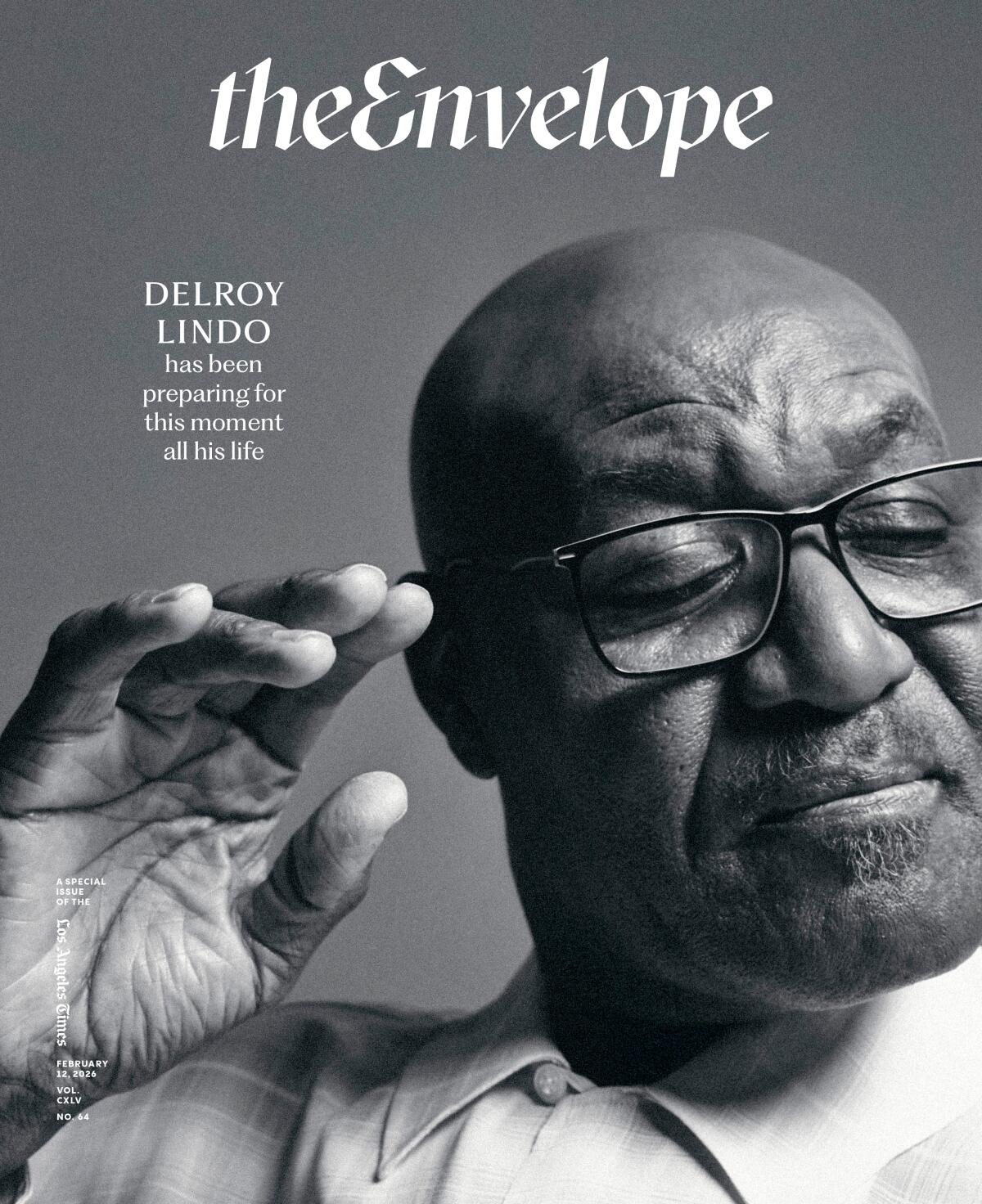
Everyone loves a surprise or two on Oscar nominations morning, and this year gave us the gift of Delroy Lindo, 73, finally earning his first Oscar nomination for his standout performance as bluesman Delta Slim in “Sinners.”
Some people are still smiling about the news. Lindo certainly is.
Lindo and I talked about the lessons he has learned as an actor over the course of a career that has spanned a half-century. He recalled the self-doubts that plagued him when he first played the lead in “A Raisin in the Sun,” the story of a struggling Black family dealing with discrimination in 1950s South Chicago, and how he overcame those fears when he revisited the role three years later.
“This was an absolute period of growth for me as an actor all because I learned the most important thing: preparation, preparation, preparation,” he told me.
But even when you exercise that level of care, you still deal with doubt. Actors will be the first to tell you that they’re needy, neurotic.
To play Delta Slim, Lindo read books on the blues, listened to Son House, Muddy Waters and Howlin’ Wolf and immersed himself in the culture of the Mississippi Delta. Musicians helped him hone his harmonica and piano playing. He was ready.
But that doesn’t mean he couldn’t use a little affirmation for a final boost.
Lindo says there were two such “seminal moments” for him while making “Sinners.” The first came when they filmed the scene where Lindo stands as his car passes a chain gang. Delta Slim exhorts the prisoners to “hold your heads.”
“[Director] Ryan [Coogler] was very nervous,” Lindo says. “He didn’t want any accidents.”
Shortly after shooting the scene, the movie’s unit publicist, Anna Fuson, emailed Lindo’s agents, telling them how his work had moved her and the crew.
“That doesn’t happen,” Lindo says, his voice cracking with emotion.
Later they shot Delta Slim’s monologue, in which he recalls the lynching of a fellow musician, ending with Lindo breaking into a guttural humming and drumming, expressing pain that transcends words. That night Zinzi Coogler, Ryan’s wife and a producer on “Sinners,” wrote Lindo telling him how much that scene had meant to her.
“Those two moments gave me a grounding,” Lindo says quietly. “It let me know this work is impacting people. And you can’t put a value on that kind of thing.”
Seven California Highway Patrol officers who piled atop a man screaming “I can’t breathe” as he died following a drunk driving stop.
All three cases had similar outcomes: charges dropped or reduced to no time behind bars after a plea deal.
After a year in office, a pattern has emerged for L.A. County Dist. Atty. Nathan Hochman, who found himself saddled with a number of misconduct and abuse cases against police officers filed by his predecessor, George Gascón.
During his 2024 campaign, Hochman often chastised Gascón for filing cases he claimed wouldn’t hold up before a jury — while also promising to continue bringing prosecutions against police when warranted.
In recent months, Hochman has downgraded or outright dismissed charges in many high-profile cases that Gascón filed. In the two misconduct cases Hochman’s prosecutors have brought to trial, the district attorney’s office failed to win a conviction.
Those outcomes have infuriated the loved ones of victims of police violence, local activists and even former prosecutors, who say Hochman’s backslide on the issue was predictable after he received millions in campaign contributions from police unions.
Greg Apt, a former public defender who served under Gascón as second-in-command of the unit that prosecutes police cases, said he quit last year out of frustration with the new leadership.
“I had concerns that the cases were not going to be treated the same way under Hochman that they were under Gascón, that alleged police wrongdoing would not be given the same level of oversight,” he said.
Hochman has scoffed at the idea that he’s too cozy with cops to hold their feet to the fire, saying his campaign’s war chest reflected bipartisan support that included Democrats who have been critical of police.
The district attorney said he’s made decisions based on what he can actually prove in court, and argued case reviews within the Justice Systems Integrity Division have become even more rigorous under his leadership.
“I’m going to look at the facts and the law of any case. I don’t believe in the spaghetti against the wall approach where you throw the spaghetti against the wall, and see if anything sticks, and let the jury figure it out,” he said. “That would be me abdicating my responsibility.”
Hochman’s supporters argue he has restored balance to an office that was often filing cases against police that were either legally dubious or flat out unwinnable.
Tom Yu, a defense attorney who often represents cops accused of wrongdoing, said Hochman is handling things in a more fair and objective manner.
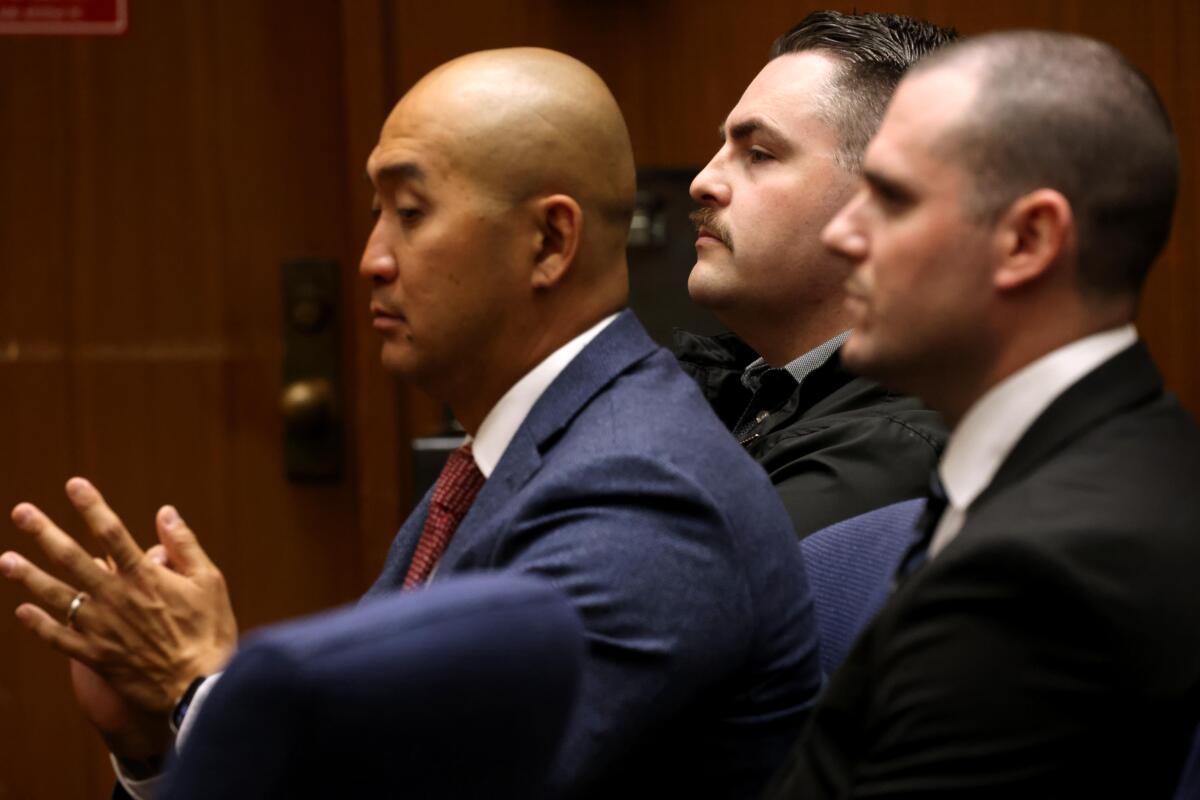
Former Torrance Police Officers Cody Weldin, center, and Christopher Tomsic, right, pleaded guilty last year in a conspiracy and vandalism case in which they allegedly spray painted a swastika on a car. Attorney Tom Yu, defense for Weldin, is seen listening to the proceedings.
(Genaro Molina / Los Angeles Times)
“By and large, he’s not going after the cops. But he didn’t dismiss all the cases either. I’m OK with that,” Yu said. “On a personal level, I think he’s doing a very difficult job in the police cases, because someone is always going to be unhappy with the decisions he made.”
It is difficult to win a guilty verdict for an on-duty shooting, with no such convictions in Los Angeles County since 2000. Laws governing use-of-force give officers great latitude, often protecting them even when they shoot someone who is later found to be unarmed or in situations where video evidence shows no apparent threat.
Hochman questioned why he is being criticized when the California attorney general’s office has reviewed dozens of fatal shootings of unarmed persons throughout the state since 2020 and filed no criminal cases.
“If you bring weak cases and you lose, it undercuts your credibility of being any good at your job,” Hochman said. “It undercuts your credibility in saying that we believe in the facts and the law and bringing righteous cases.”
Hochman brought 15 cases against police officers in 2025, according to documents provided to The Times in response to a public records request, compared with 17 filed by Gascón in his final year in office.
But while Gascón had a strong focus on the kinds of excessive force cases the public was clamoring to see charged when he was elected in 2020, Hochman has more often filed charges for offenses such as fraud and evidence tampering.
Hochman’s recent dismissal of charges against most of the officers involved in the death of Edward Bronstein has drawn outcry from his family and at least one former prosecutor.
Bronstein died after screaming in agony as six California Highway Patrol officers piled on top of him in Altadena in 2020. The officers were trying to get a court-ordered blood draw after Bronstein was pulled over on suspicion of drunk driving.
Video from the scene shows Bronstein arguing with the officers while handcuffed and on his knees.
The officers warn Bronstein they’re going to force him down to get a sample. Right before they do, Bronstein mumbles that he’ll “do it willingly,” but they shove him face down while a seventh officer, Sgt. Michael Little, films the encounter. A minute passes. Then Bronstein’s body goes limp.
Officers can be seen trying to revive Bronstein, calling his name and slapping the side of his head, according to the video. But several minutes elapse before officers attempt to deliver oxygen or CPR. He was pronounced dead at the scene.
Los Angeles County Dist. Atty. George Gascón announces he will ask a judge to resentence Erik and Lyle Menendez for the killing of their parents in 1989, a decision that could free the brothers.
(Allen J. Schaben / Los Angeles Times)
In 2023, Gascón filed manslaughter charges against the seven officers, as well as the nurse who carried out the blood draw. But late last year, Hochman dismissed charges against all except Little, whose case was reduced to a misdemeanor, for which he received 12 months of probation. Little is no longer a CHP officer, according to an agency spokesman.
Prosecutors are still pursuing manslaughter charges against the nurse at the scene, Arbi Baghalian. His defense attorney, Joe Weimortz, said Baghalian had no control over the officers’ actions or the decision to pursue the blood draw. Weimortz also said he believed the officers were innocent.
Bronstein’s daughter, Brianna Ortega, 26, said in a recent interview that Hochman’s decision to drop the charges felt like a betrayal.
“It just seems like because they’re cops … they must get away with it,” Ortega said. “How are you going to put the blame on one person when all of you are grown men who know better? You have common sense. You have human decency. He is literally telling you he can’t breathe.”
The Los Angeles County coroner’s office could not conclusively determine Bronstein’s cause of death but attributed it to “acute methamphetamine intoxication during restraint by law enforcement.” Bronstein’s family was paid $24 million to settle a wrongful death suit in the case.
Hochman said his office reviewed depositions from the civil case — which he said Gascón did not do before filing a case — and did not believe he could win a manslaughter case because it was impossible to say any officer specifically caused Bronstein’s death. Hochman said the officers had no intent to harm the man and were following orders of a superior officer.
“We looked at each officer, what they knew, what their state of mind was at the time. Understanding that there was both a sergeant there and a nurse, who was in charge of not only taking the blood draw but obviously doing it in a safe manner, and then deciding whether or not we could meet the legal standard of involuntary manslaughter for each officer,” he said.
Edward Tapia, the father of Edward Bronstein, speaks at a news conference about his son, a 38-year-old Burbank man who died while being restrained by California Highway Patrol officers in 2020 after refusing to have his blood drawn after a traffic stop. The family received a $24-million civil rights settlement in 2023 after filing a lawsuit against the state.
(Jason Armond / Los Angeles Times)
Bronstein’s killing was one of three cases in which Hochman assigned new prosecutors in the months before a trial started or a plea deal was reached. Aside from the Bronstein case, the others ended in an acquittal or a hung jury. All three prosecutors who were removed from the unit that handles police misconduct cases had either been appointed by Gascón or had a political connection to the former district attorney.
“When somebody’s lived that case for years, and then you take them off, it suggests that you’re less than serious about winning that case,” said Apt, the former prosecutor on the Bronstein case.
Hochman said he was simply bringing in staff with more trial experience on each case, insisting politics had nothing to do with the transfers. One of the cases, which involved allegations of perjury against L.A. County sheriff’s deputies Jonathan Miramontes and Woodrow Kim, ended with a lightning fast acquittal. Records show jurors deliberated less than an hour before coming back with a not guilty verdict.
In the other case, Hochman’s staff came closer to convicting a cop for an on-duty shooting than anyone else has in L.A. County in a quarter-century.
Former Whittier police officers Salvador Murillo, left, and Cynthia Lopez during their arraignment at the Clara Shortridge Foltz Criminal Justice Center in Los Angeles. Murillo was charged in a 2020 shooting that left an unarmed man paralyzed. Murillo’s trial ended with a deadlocked jury in November 2025.
(Mel Melcon / Los Angeles Times)
Former Whittier Det. Salvador Murillo stood trial in November for shooting an unarmed man in the back as he fled down an alley in 2023. Nicholas Carrillo ran away on foot from a vehicle stop and was leaping over a fence — unarmed — when Murillo squeezed off four rounds. Two severed Carillo’s spine, paralyzing him.
The jury came back deadlocked, although a majority of the panel was leaning toward a conviction. Hochman said it is likely he will ask prosecutors to take Murillo to trial a second time, though a final decision has not been made.
This year, Hochman will have to weigh in on a pair of politically charged police killings.
The Department of Homeland Security said the off-duty ICE agent was responding to an “active shooter.” Porter’s family has said he was firing a rifle into the air as a celebration to ring in the new year.
Melina Abdullah, the co-founder of Black Lives Matter L.A., was part of a group that met with Hochman about Porter’s killing and other cases last month in South L.A.
She described the encounter as confrontational — and a disaster.
“I don’t know how we can expect any safety and accountability with this man in office,” Abdullah said.
Hochman must also decide how to proceed with the case of Clifford Proctor, a former LAPD officer charged for shooting an unarmed homeless man in the back in 2015.
Proctor left the LAPD in 2017 and was not indicted on murder charges until 2024. Gascón reopened the case in 2021, after prosecutors previously declined to file charges.
Hochman has not said if he intends to take Proctor to trial.
Hochman said that while he knows cases of police violence drive emotional reactions, he has to constrain himself to a cold analysis of the facts in front of him.
Reflecting on his confrontational meeting with Black Lives Matter activists, which centered on his recent move to dismiss charges in the 2018 killing of Christopher Deandre Mitchell by Torrance police officers, Hochman said he can’t pursue cases just because people are upset.
“They couldn’t point out anything in that analysis that they disagreed with,” he said. “Other than the result.”
Gezani is forecast to return to cyclone status when it strikes southern Mozambique on Friday evening.
Nearly 40 people have been killed and more than 12,000 others displaced after Cyclone Gezani slammed into Madagascar’s second-largest city earlier this week, as Mozambique braced for the storm’s arrival.
Updating its tolls as assessments progressed, Madagascar’s National Office for Risk and Disaster Management (BNGRC) said on Thursday it had recorded 38 deaths, while six people remained missing and at least 374 were injured.
Recommended Stories
list of 3 itemsend of list
Gezani made landfall on Tuesday at the Indian Ocean island nation Madagascar’s eastern coastal city, Toamasina, bringing winds that reached 250km/h (155mph).
Madagascar’s new leader, Colonel Michael Randrianirina, has declared a national disaster and called for “international solidarity”, saying the cyclone had “ravaged up to 75 percent of Toamasina and surrounds”.
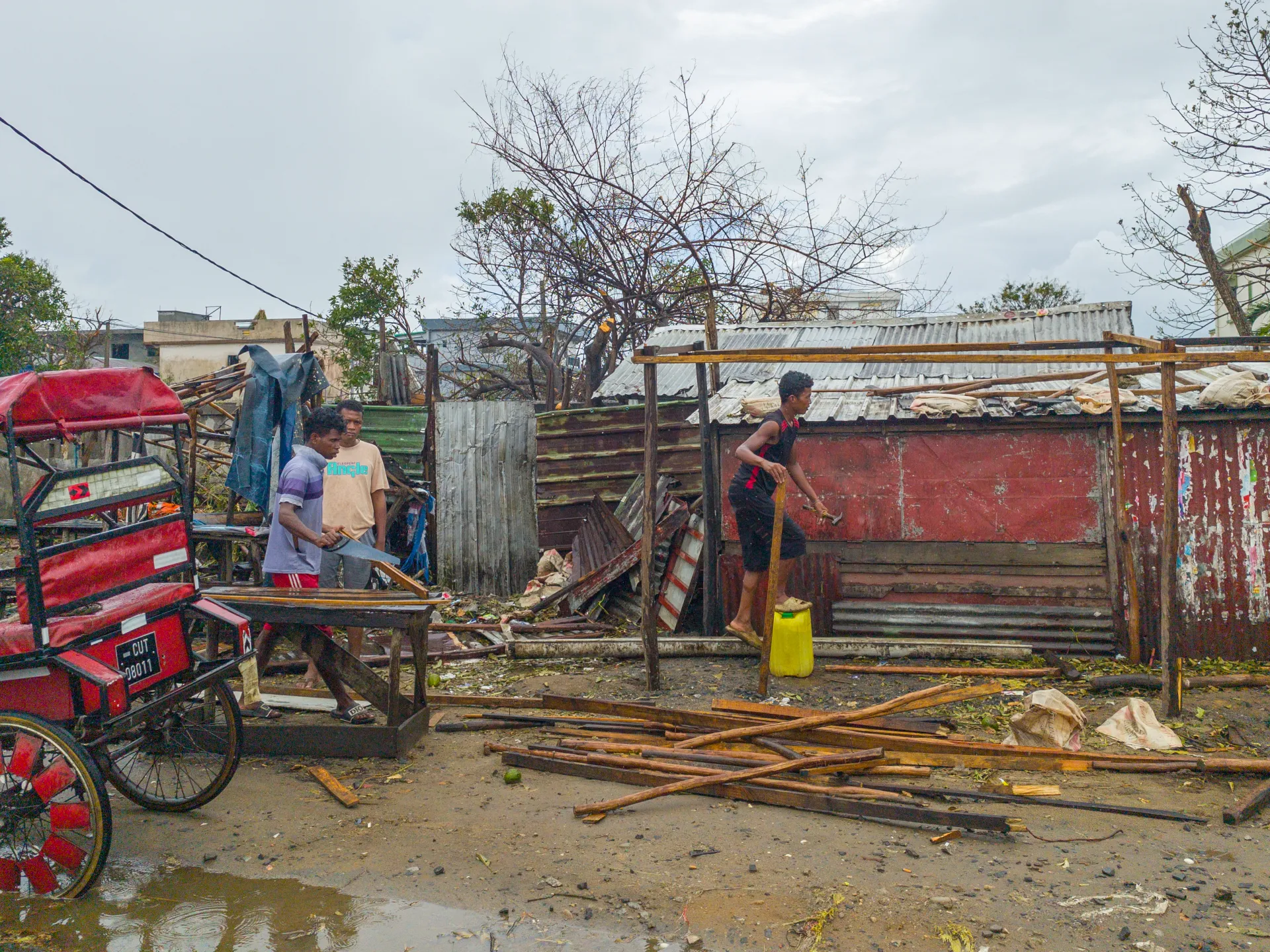
Images from the AFP news agency showed the battered city of 500,000 people littered with trees felled by strong winds and roofs blown off buildings.
Residents dug through piles of debris, planks and corrugated metal to repair their makeshift homes.
More than 18,000 homes were destroyed in the cyclone, according to the BNGRC, with at least 50,000 damaged or flooded. Authorities say many of the deaths were caused by building collapses, as many give inadequate shelter from strong storms.
The main road linking the city to the capital, Antananarivo, was cut off in several places, “blocking humanitarian convoys”, it said, while telecommunications were unstable.
The storm also caused major destruction in the Atsinanana region surrounding Toamasina, the disaster authority said, adding that assessments were still under way.
France announced the dispatch of food aid and rescue teams from its Reunion Island, about 1,000km (600 miles) away.
Thousands of people had been forced to leave their homes, said the United Nations’s International Organization for Migration (IOM), describing “widespread destruction and disruption”.
The cyclone’s landfall was likely one of the strongest recorded in the region during the satellite era, rivalling Geralda in February 1994, it said. That storm killed at least 200 people and affected half a million more.
Gezani weakened after landfall but continued to sweep across the island as a tropical storm until late on Wednesday.
It was forecast to return to cyclone status as it reaches the Mozambique Channel, according to the Regional Specialized Meteorological Centre La Reunion (CMRS), and could from Friday evening strike southern Mozambique.
Mozambican authorities issued warnings on Thursday about the approaching storm, saying it could cause violent winds and rough seas of 10-metre waves and urging people to leave the area of expected impact.
Both Madagascar and Mozambique are vulnerable to destructive storms that blow in off the Indian Ocean. Just last month, the northwestern part of Madagascar was hit by Cyclone Fytia, killing at least 14 people.
Mozambique has already faced devastating flooding from seasonal rainfall, with nearly 140 lives lost since October 1, according to the country’s National Disasters Management Institute.
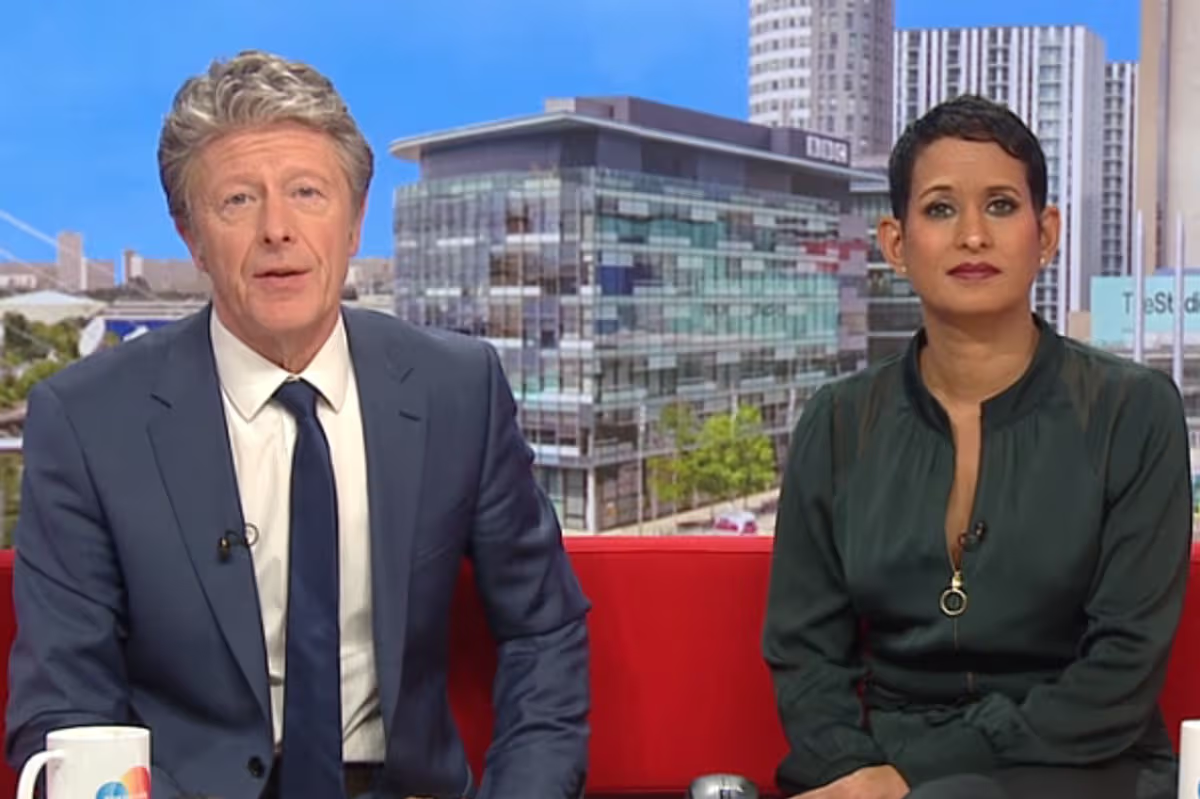
They were joined in the studio by Matt Taylor, who delivered regular weather updates. Meanwhile, Mike Bushell and Peter Ruddick shared the sporting news and Valentine’s Day features, respectively.
Later in the show, the hosts revealed that the Chair of the Commons Health Committee has called on the UK drug regulator to review warnings on medications which can cause impulsive behaviour as a side effect.
Naga explained: “A BBC investigation has found that for some patients, the drugs cause impulsive gambling or sexual behaviour.”
In a pre-recorded segment, BBC correspondent Noel Titheradge spoke to a man called Freddie, whose dad Bill passed away three years ago. He was prescribed medication for Parkinson’s, which had devastating side effects. Reflecting on the struggles his dad faced, Freddie soon broke down in tears in heartbreaking clips.
This is a breaking showbiz story and is being constantly updated. Please refresh the page regularly to get the latest news, pictures and videos.
You can also get email updates on the day’s biggest stories straight to your inbox by signing up for our newsletters
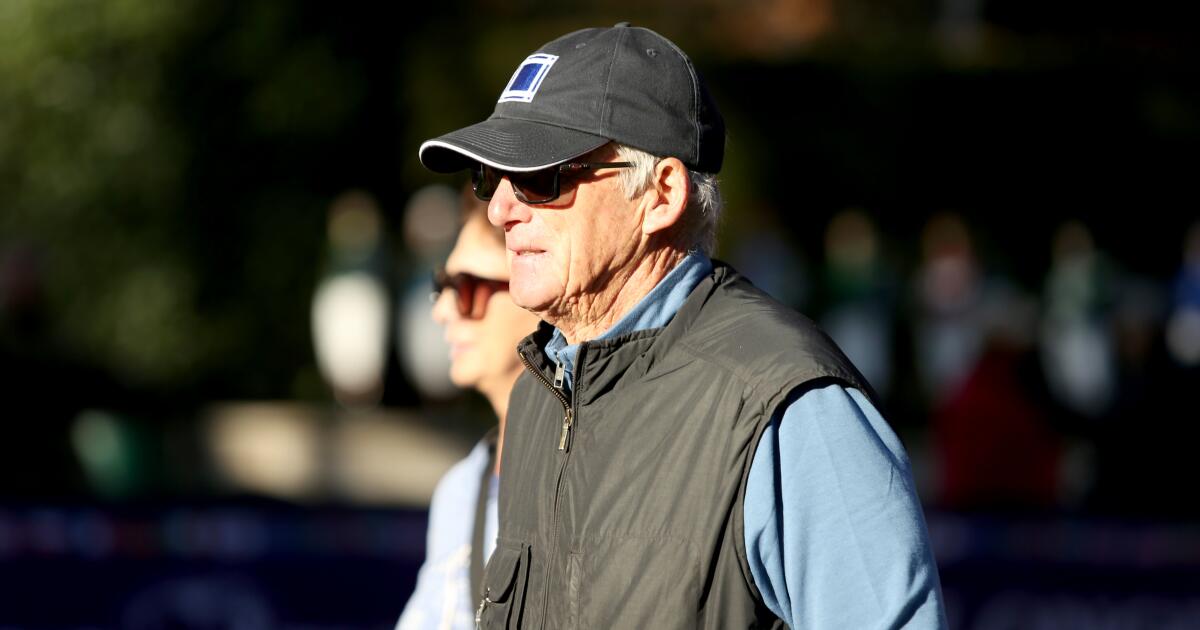
John Shirreffs, the soft-spoken giant who trained Zenyatta, perhaps the best mare of all-time, died in Southern California on Thursday. He was 80. No cause of death was announced.
Shirreffs was one of the top trainers in Southern California with 3,589 starts, 596 of them wins resulting in $58.5 million in purses.
He was a familiar face around local tracks, usually ponying his horses to the track during morning training and then avoiding the spotlight when his horse won by staying on the racing surface and not going to the Winner’s Circle, leaving the punditry to his wife, Dottie Ingordo.
Shirreffs first grabbed national attention when he won the Kentucky Derby with Giacomo at odds of 50-1 in 2005. The horse was partially owned by legendary record producer Jerry Moss, the M along with Herb Alpert in A&M records. Shirreffs remained Moss’ primary trainer until his death in 2023.
Then after Giacomo came Zenyatta, whose personality and skill won the hearts of Southern California race-goers in her 19-race winning streak that included an “un-believe-able” (according to race caller Trevor Denman) last-to-first win against the boys in the Breeders’ Cup Classic at Santa Anita in 2009.
Shirreffs, a Marine veteran, fell into horse racing by accident.
“When I got back from Vietnam, I had no place to go, but I had a friend who knew somebody, so they they said, ‘Come on out West,’” Shirreffs told The Times before last year’s Kentucky Derby.
“So here I’m in New York, I don’t know anything about [horses] except I’ve seen a lot of cowboy movies. So here comes Jim Matthews, pulls up in his trailer, he has his horse set and he it backs his horse out of a trailer.”
Shirreffs admits to not really knowing what he was doing.
“A week or so later, Jim’s just calls me and says, ‘Do you want to come to work for me?’ I said ‘Yeah, that’d be great,” Shirreffs said. “So, I went to work for him and didn’t get paid anything, just room and board. He soon said, ‘I’ll give you this horse and if you sell it, you can make some money.’
“So I’m riding this horse across this field and I get stuck in this mud box. I get the horse out of the mud and Henry Freitas [at Loma Rica Ranch in Central California] asked if I would like to work for him. I said, ‘Well, sure, I get paid here, right? This is great.
“I worked there about 11 years, and one day in he says, ‘John, you wanna take my horse to the fairs?’ I said, ‘Sure, I’d love to do that.’ And that’s how it all started. You know, I never planned it and the opportunity just presented itself each time and when I was fortunate enough, and had some experience with horses, and that’s how it started.”
Shirreffs was asked if Vietnam or training horses was more difficult.
“Well, we don’t want to talk about that,” Shirreffs said.
Santa Anita issued a statement regarding Shirreffs’ death.
“Every horse who races at Santa Anita must first pass by the statue of John’s greatest trainee, the wonderful mare Zenyatta. While John’s victories were plentiful and prestigious, what he accomplished with Zenyatta in the 2009 Breeders’ Cup Classic was a masterpiece and deservedly was voted as the top moment in Santa Anita Park’s 90 years. Our deepest condolences are extended to John’s wife, Dottie, and his family, including those horsemen and women who worked closely with John for so many years. May his memory be a blessing.”
When “Dawson’s Creek” premiered on Jan. 20, 1998, I was 11 years old. I had never been in a love triangle or gotten drunk at a house party. Yet, like so many other millennials, I religiously set the VHS player to record “Dawson’s Creek” every week on the WB.
My parents didn’t approve of their impressionable child devouring the semi-debaucherous teen melodrama, so I labeled the VHS tapes “The Brady Bunch,” then routinely snuck out of bed late at night to quietly watch Dawson, Joey, Pacey and Jen navigate their hormonal angst via unbelievably erudite dialogue.
On Wednesday, “Dawson’s Creek” star James Van Der Beek died at 48 after being diagnosed with colorectal cancer. He left behind six kids, a wife and decades of work across film and television.
But for many millennials, he will always be Dawson Leery.
Van Der Beek’s health was already in decline when I profiled “Dawson’s Creek” creator Kevin Williamson for The Times last year. Still, the actor kindly agreed to answer questions for the piece via email. His commentary went beyond what was expected, graciously detailing his time on the show and praising his co-stars and collaborators.
In the “Dawson’s” audition room, for example, Van Der Beek said his soon-to-be co-star Joshua Jackson “stood out because while other actors nervously went over their sides (myself included), he had the energy of a guy who was ready for a prize fight. I remember thinking, ‘THAT GUY is really interesting. If they cast him as Pacey, this is going to be really good.’”
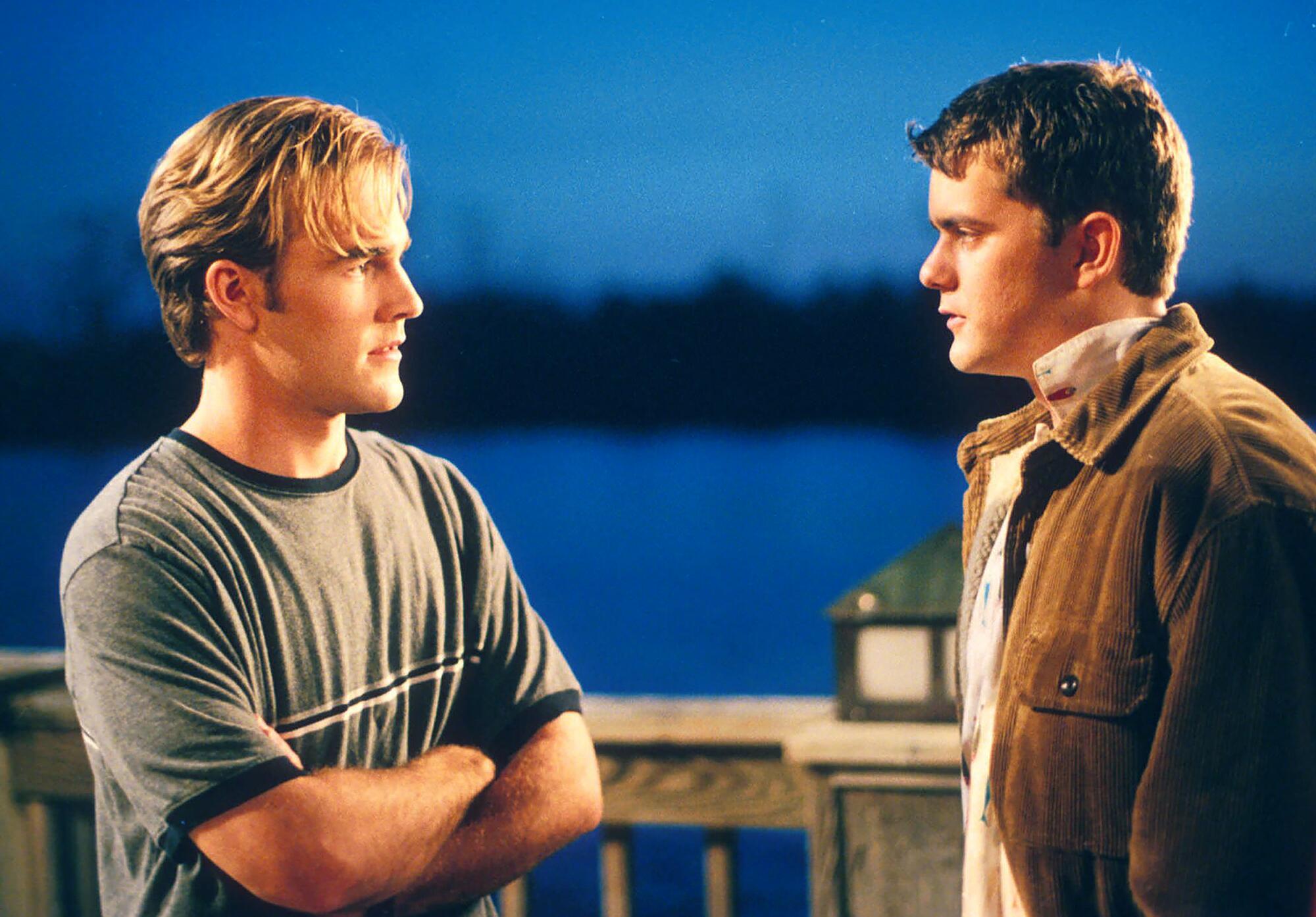
James Van Der Beek, left, and Joshua Jackson in “Dawson’s Creek,” which would launch them to stardom.
(Fred Norris/The WB)
Van Der Beek likewise effused that, as a showrunner, Williamson “felt like a friend who was excited to go make a movie in his backyard. Even the way he ‘pitched’ storylines — it was never a pitch. It was a campfire story about people he cared about that he’d unfold in such a simple, compelling way that you couldn’t help but care about them too.”
Millennial viewers did care. Alot.
“Dawson’s Creek,” a simple drama about four friends growing up in a small, coastal town, quickly became a defining touchstone of Y2K culture, a major hit for the WB network — the series finale drew more than 7 million viewers — and a star-making machine for its four leads: Van Der Beek, Jackson, Katie Holmes and Michelle Williams.
The floppy-haired, often flannel-clad Van Der Beek wasn’t the show’s breakout heartthrob. (That honorific belonged to Jackson, who played Pacey, Dawson’s charming best friend and Joey’s end-game paramour.)
But as the title character and a partial avatar for Williamson — who had similarly spent his own teen years dreamily pining and aspiring to be a filmmaker — Dawson was the boy-next-door pillar around which the show orbited.
Yes, Dawson was whiny and moody and extremely self-centered, but so are a lot of teenagers. Through Van Der Beek’s wistful performance, viewers were given a window through which to grapple with betrayal, death, heartbreak and a litany of bad decisions.
For better or worse, Dawson served as an emotional, often cautionary, proxy for millennials’ own coming-of-age messiness.
In the years since the series ended in 2003, Dawson has largely been reduced to the “Dawson crying” meme: a Season 3 screenshot of Van Der Beek, face contorted in pain and on the verge of crying messy, heaving tears as Dawson tells Joey she should choose Pacey over him.
The emotional relationship between Joey and Dawson was core to the series.
(Fred Norris/The WB)
Van Der Beek later revealed that the tears weren’t scripted. So attuned had he become to his character’s sensitivity by that point that the emotions flowed naturally.
“I think at the heart of [Williamson’s] projects are characters that he himself cares about deeply — flaws and all,” Van Der Beek said in his email last year. “They’re authentic to their background, sincere according to their world view… and vulnerable.”
Van Der Beek was vulnerable, too. As his cancer progressed, he was open with fans about his health struggles and the early warning signs. He appeared via video at a “Dawson’s Creek” reunion event in New York City last September, the proceeds of which raised money for cancer awareness.
In Van Der Beek’s death, there is no real-world instrumental score or innate montage of his best moments to soften the blow, as would have happened with a character on “Dawson’s Creek” (though the internet will surely be awash in such fan-made edits).
But through his work on “Dawson’s,” a generation can take comfort in a starry-eyed boy on a dock in Capeside who once invited us into his messy, emotional world.
Pete Finney, a steel guitarist who toured with Patty Loveless for more than 20 years and recorded with Reba McEntire, the Chicks, Vince Gill, the Judds and more, has died. He was 70.
Confirmation came via a statement earlier this week from Nashville’s Country Music Hall of Fame and Museum, which said Finney died Saturday. No cause of death was provided.
Calling him “a widely admired Nashville musician,” the museum said Finney “exemplified how top instrumentalists can adapt to a remarkable range of styles and settings, whether in a recording studio, a concert stage, or the corner of a small nightclub.”
Finney was born in Maryland in September 1955 and played his first gigs in Washington, D.C., with singer-songwriter Liz Meyer before Meyer moved to the Netherlands in the mid-1980s. He relocated to Austin, Texas, in the late 1970s and then moved to Nashville in the mid-1980s.
Upon his arrival in Tennessee, Finney toured with Foster & Lloyd and later contributed to the solo careers of Radney Foster and Bill Lloyd. His career would take him in diverse directions: He recorded with Beck, Jon Byrd, Shemekia Copeland, Justin Townes Earle, Jon Langford, Jim Lauderdale, Allison Moorer, Ron Sexsmith, Candi Staton and scores of other artists.
“RIP old friend!” wrote Asleep at the Wheel frontman Ray Benson in a comment on a Facebook post announcing Finney’s death. His was one of hundreds of comments, many left by those who had known Finney. “Pete came to a concert in 1970 and saw Asleep at the Wheel he told me that was when he decided to play pedal steel… and play he did with style grace and total command of that instrument! Hard to lose a great friend who was there at the beginning of it all for me and so many in those early Wash DC days.”
Finney was something of a music historian as well, co-curating the Hall of Fame museum’s 2015-2018 exhibition “Dylan, Cash, and the Nashville Cats: A New Music City” and co-writing the exhibit’s accompanying book, which won the 2016 Chet Flippo Award for excellence in country music journalism from the International Country Music Conference.
“The idea for the exhibit came from Finney’s research on the many non-country artists from North America and England who came to Nashville in the 1960s and 1970s to record with the city’s talented and fast-working studio musicians,” the museum said.
Finney hosted programs at the Hall of Fame museum and participated in panel discussions frequently over the years.
The musician married singer Carol Tully on Oct. 15, 2017.
He was touring with Reba McEntire in 1991 when one of the tour’s planes crashed into a mountain near San Diego, claiming the lives of eight band members on their way to a show in Fort Wayne, Ind. Finney was traveling in the second plane to take off from a municipal airport that night; the first was the one that went down. McEntire was not on either plane.
“The planes took off three minutes apart,” a spokeswoman for McEntire told The Times after the March 1991 crash. “The plane that crashed took off first. The pilot of the second plane didn’t see anything. They just knew that they had lost radio contact with the other. They continued flying and were diverted to Nashville.”
Years later, when he was recruited by Mike Nesmith in 2017 to join the revival of the Monkees singer-songwriter’s country-rock group the First National Band, Finney stepped up to replace founding member Red Rhodes, who died in 1995.
“Finney often used Rhodes’ innovative parts from the recordings as his starting point, but frequently added dimensions of his own to prevent the set from simply replicating the original versions,” detailed former Times music writer Randy Lewis in a feature on a 2018 show by the reconstituted group. “Rhodes — and Finney — employ the steel guitar inventively, not just to evoke notes of melancholy often found in country music, but to bring an orchestra’s worth of color, texture and shading to the arrangements.”
The Hall of Fame said Finney “frequently performed in pickup bands in small Nashville clubs, where he might be seen with top-flight players such as Mac Gayden, Jen Gunderman, Jimmy Lester, Chris Scruggs, Kenny Vaughan, and others.”
Singer-songwriter and podcaster Otis Gibbs, who had Finney on his show several times, remembered frequently seeing the steel guitarist out on the Nashville music scene.
“I’d sometimes run into him 4, or 5 nights a week at shows,” Gibbs wrote Tuesday on his website. “If there were 9 people in attendance, Pete would usually be one of them. He’d joke that he liked seeing me at shows because he’d know it must be the place to be.”
Gibbs said he saw Finney just three weeks ago at a Jon Byrd show in East Nashville.
“I snuck up next to him and whispered, ‘I must be at the right show because Pete Finney’s here,’” he wrote. “That was the last time I saw him.”
Finney is survived by his wife. Friends and family are invited to a remembrance gathering Sunday at the Country Music Hall of Fame and Museum’s Ford Theater in Nashville.
Produced by Reese Witherspoon, James Van Der Beek’s final TV role will debut on Amazon Prime later this year, months after the actor’s death following a harrowing cancer battle
James Van Der Beek’s final TV show set to air this summer(Image: Instagram)
Produced by Reese Witherspoon, the show follows a young Elle Woods (Lexi Minetree) in her pre-Harvard high school years, and James played Dean, a mayoral candidate and the school district’s superintendent. His scenes, the last of his that will ever air, were shot in May 2025.
Elle will air on Prime Video on 1 July 2026. This will come months after James’ death. He died aged 48 after a two-year battle with colorectal cancer.
The news was confirmed in a statement from his wife, Kimberley: “Our beloved James David Van Der Beek passed peacefully this morning. He met his final days with courage, faith, and grace. There is much to share regarding his wishes, love for humanity and the sacredness of time. Those days will come. For now, we ask for peaceful privacy as we grieve our loving husband, father, son, brother, and friend.”
In an additional statement, Kimberly said: “James Van Der Beek was a beloved husband, father, and friend who touched the lives of everyone around him. After a long and courageous battle with cancer, James passed away on February 11, 2026, leaving behind his devoted wife, Kimberly, and their six wonderful children. Throughout his illness, the family faced not only emotional challenges but also significant financial strain as they did everything possible to support James and provide for his care.
“In the wake of this loss, Kimberly and the children are facing an uncertain future. The costs of James’s medical care and the extended fight against cancer have left the family out of funds. They are working hard to stay in their home and to ensure the children can continue their education and maintain some stability during this incredibly difficult time. The support of friends, family, and the wider community will make a world of difference as they navigate the road ahead.” The family have since launched a GoFundMe to help them cover costs.
James was diagnosed with cancer in August 2023, after getting checked following changes in his bowel movements. He announced the diagnosis over a year later in November 2024.
Speaking about his diagnosis when he chose to go public, he explained: “The trickiest thing is there are so many unknowns with cancer. You think, ‘How do I fix this? Is this healing me? Is this hurting me? Is this working? Is it coming back?’ As someone who likes answers, not knowing is one of the hardest things. I have a lot to live for.”
In November last year, he announced that he would be auctioning off personal items from Dawson’s Creek, where he played Dawson Leery, in order to help with the costs associated with his ongoing treatment.
He starred in the show alongside Katie Holmes, who played Dawson’s childhood love Joey Potter, and Joshua Jackson, who played their friend and Joey’s second love Pacey Witter.
For more information or support about bowel cancer, you can contact Macmillan Cancer Support or you can call 020 7940 1760 for advice.
Death In Paradise will not air in its usual Friday slot this week owing to a change in scheduling on the BBC as its replacement has now been revealed
Death In Paradise will be off air this week(Image: BBC)
Death In Paradise is off air this week after it was pulled from its usual slot. The BBC show is back for a new series, with DI Mervin Wilson – played by Don Gilet – at the helm.
It usually airs in the Friday 9pm slot each week on BBC One but it has been changed for this week. Death In Paradise follows the story of a British police officer in the Caribbean, working out of island paradise Saint Marie.
The BBC show will not air this Friday as planned as the BBC will instead be broadcasting the football. The FA Cup tie between Hull City and Chelsea will air that evening instead from 7.30pm, with kick off 15 minutes later.
Instead, Death In Paradise will air its latest episode on the following Monday, which follows the story of a pensioner who has been shot dead in his home. The commissioner is also busy trying to get everyone on side after his recent departure.
Meanwhile, Don Gilet previously opened up about his character’s development on the BBC detective drama series.
Speaking about his character, Don – who plays Mervin Wilson – said: “Just by his nature and the way he is when it comes to his work and the way that his mind works, there’s always going to be a bit of kickback with the people he deals with.
“Last year, there was this antagonism between Mervin and the team because they just worked in very different ways, and both had to earn the respect of each other in the way they work.”
He added: “And let’s not forget, he didn’t want to be on the island, so he was going to be particularly reluctant to work with these people because of the personal issues he was dealing with.
“But as time has moved on, he’s realised that he needs these people. They are now gelling, they’re working as a team – now it’s cracking the cases that frustrate him, and they become frustrated as a group. You’ll still see him sometimes working at odds with the team, but they know each other now and can allow for that a little more.”
Of course, in this series, there is also the twist about Mervin’s half-brother Solomon, whom he finally gets to meet this series. However, things don’t get off to a great start.
“It was a great emotional cliffhanger because at any moment in that series Mervin could have just said ‘that’s it, I’ve done my time’, and now he literally can’t go.
“The one thing he was in pursuit of at the start of this series was family, and then to throw that in at the end, that he’s not alone… He’s powerless to resist that and he has to stay now for the next chapter in his family quest, because he thought he had no family. So how can he turn his back on that?
“Well, I think phrases like ‘two peas in a pod’, do not apply… They couldn’t be more opposite. There’s Mervin and then there’s this guy who is on the opposite side of the tracks, potentially the opposite side of the law too…”
EMMERDALE actress Lisa Riley said Robin Windsor’s “glow had gone” after he was dropped from Strictly, an inquest heard.
The professional dancer, 44, was found dead in a hotel room in Shepherd’s Bush, West London, in February 2024.
Sign up for the Showbiz newsletter
Thank you!
Robin Windsor was found dead in a hotel roomCredit: GettyHis dance partner Lisa Riley told how he ‘lost his glow’Credit: PA
An inquest heard Windsor left a suicide note saying the way he was treated by the BBC “destroyed me”.
The pro added: “It started me on the road I’m still on.
“All I wanted from life was to be happy.
“I loved my job more than anyone else.”
Riley was Windsor’s dance partner in the penultimate series he appeared on in 2012.
After being paired with Windsor, Riley said they were “joined at the hip”.
“To say we hit it off was an understatement,” the actress said in a written witness statement read to West London Coroner’s Court on Wednesday.
“I had only just lost my mum in the July. I, myself, was in a very difficult place.
“Robin was my rock.”
The Latin and ballroom dancer joined Strictly in 2010 and danced with actresses Patsy Kensit, Anita Dobson and Riley, and Dragon’s Den’s Deborah Meaden in four series until 2013.
Robin said the decision to axe him from Strictly ‘destroyed me’Credit: PA
He could not perform in the 2014 series because of a back injury and was dropped in 2015, but still appeared in the Christmas special that year, dancing alongside TV presenter Alison Hammond.
“It was from this moment, on to the time of his death, he kept slipping deeper and deeper into depression,” Riley said.
“His glow had gone.”
The actress recalled how she and Windsor had built up an “incredible trust” and remained friends.
“He literally told me everything,” she said.
“I trusted him and he trusted me.
“There were many, many happy times to begin with and together we did have so much fun.”
Riley said Windsor told her of times of “never feeling good enough” and “imposter syndrome”.
“Robin was and always has been very influenced by other men,” she added.
“It became a standing joke that he fell in love after three days.”
Riley said Windsor was insecure about his body and took steroids which, combined with alcohol, would put him in a bad place, jurors heard.
The court was also told how he was “drowning in debts” and “frantically” spent on designer items he could not afford.
Riley added: “Money problems also played a part of his darker days.”
She said her last contact with Windsor was around Christmas 2023, when they texted after Riley saw him share a “really dark” post on Facebook.
Riley continued: “I of course text him straight away and he replied saying he was ‘fine, just usual ups and downs of life’.”
The inquest also heard Robin was “obsessed” with watching Strictly prior to his death.
His panto co-star Terry Gleed said Robin spent his free time during rehearsals watching the show.
How to get help
EVERY 90 minutes in the UK a life is lost to suicide
It doesn’t discriminate, touching the lives of people in every corner of society – from the homeless and unemployed to builders and doctors, reality stars and footballers.
It’s the biggest killer of people under the age of 35, more deadly than cancer and car crashes.
And men are three times more likely to take their own life than women.
Yet it’s rarely spoken of, a taboo that threatens to continue its deadly rampage unless we all stop and take notice, now.
If you, or anyone you know, needs help dealing with mental health problems, the following organisations provide support:
The star added: “I could feel that he really wanted to be there more than where we were. He missed it dearly.”
The court heard Robin had suffered a back injury in late 2013 which resulted in him needing surgery to remove a disc.
He missed the 2014 series while he recovered.
Next year telly bosses chose not to renew his contract.
Pal Kristina Rihanoff, 48, told the hearing yesterday she was “extremely upset” after learning Robin had not been asked back for the 13th series.
She added “the psychological impact was very severe” because he “couldn’t do what he loved” due to his back pain.
Kristina described it as “heartbreaking” to see him “deeply sad, subdued and burdened”.
The inquest continues.
If you are affected by any of the issues raised in this article, please call the Samaritans for free on 116123.
Kristina Rihanoff revealed how Robin ‘changed significantly’ following his injuryCredit: Alamy