cut

Legislature passes bill to give $90 million to Planned Parenthood

California lawmakers on Monday approved a one-time infusion of $90 million for Planned Parenthood and other women’s health clinics, a direct respond to the Trump administration’s cuts to reproductive healthcare and access to abortion providers.

“Trump is tearing down healthcare and increasing costs,” Assembly Speaker Robert Rivas (D-Hollister) said in a statement. “Democrats are building it up — investing millions in women’s health and maternal care, because families come first in California.”

The legislation providing the funding, SB 106, carried by Sen. John Laird (D-Santa Cruz), is intended to help offset the losses from federal cuts that targeted abortion providers. The Republican-backed One Big Beautiful Bill Act, signed last year by President Trump, prohibited federal Medicaid funding from going to Planned Parenthood.

The bill now heads to Gov. Gavin Newsom.

California and a coalition of other Democrat-led states filed a lawsuit against the Trump administration last year over the provision. More than 80% of the nearly 1.3 million annual patient visits to Planned Parenthood in California previously were reimbursed by Medi-Cal, the state’s version of Medicaid, which provides healthcare coverage to low-income Americans.

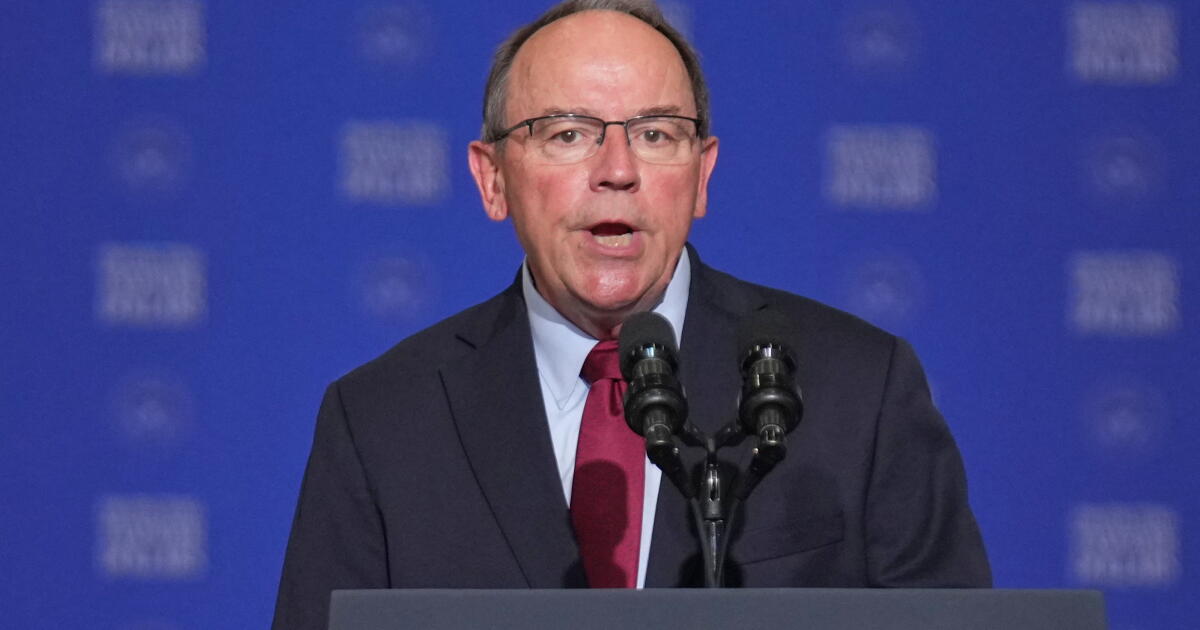
Assemblyman David Tangipa (R-Clovis) voiced opposition to the legislation Monday.

“Why does Planned Parenthood get a $90-million grant when right now over 60 hospitals in the state of California are on the verge of shutting down?” Tangipa asked, speaking on the Assembly floor. “Hospitals across our state that deliver high quality care to women are on the brink of closure.”

Planned Parenthood offers a range of services, including abortions, birth control and cancer screenings.

Source link

Tax billionaires, cut rents and other takeaways from California’s first gubernatorial debate

Gov. Gavin Newsom, barred from running for reelection, still took heat Tuesday during the first debate in California’s 2026 race for governor.

Six Democrats and one Republican on the stage in Newsom’s hometown of San Francisco took direct aim at the governor’s record on homelessness, efforts to ban the sale of new gas-powered cars and opposition to an anti-crime ballot measure that Californians overwhelmingly passed two years ago.

Former Los Angeles Mayor Antonio Villaraigosa, who unsuccessfully ran against Newsom for governor in 2018, pointed to state spending on homelessness as an example of ineptitude.

“We spent $24 billion at the state, along with billions more from the counties and the cities throughout the state, and homelessness went on,” he said. “We cannot be afraid to look in the mirror.”

The televised debate revealed the schism between the moderate and progressive Democrats hoping to replace Newsom, as well as efforts by Steve Hilton, the sole Republican who took part, to coalesce the conservative vote.

Hilton, a former Fox New commentator and British political strategist, called on his top GOP rival, Riverside County Sheriff Chad Bianco, to drop out of the race.

“My Republican colleague Chad Bianco is not here tonight to face these Democrats or his record in 2020, during the Black Lives Matter riots,” Hilton said at the event, which was co-sponsored by the nonprofit Black Action Alliance, which was founded to give Black voters a greater voice in the Bay Area.

Bianco “took a knee when told to by BLM, now he says he was praying,” Hilton said. “Chad Bianco has got more baggage than LAX.”

Bianco was invited to the debate but said he was unable to attend because of a scheduling conflict. His campaign did not respond to requests for comment about Hilton’s attacks.

The, at times, feisty debate came amid a gubernatorial race that thus far has lacked sizzle or a candidate on either side of the aisle who has excited Californians. Public opinion polls show that most voters remain undecided.

Seven of the dozen prominent candidates running to replace Newsom participated in the gathering at the Ruth Williams Opera House in front of a live audience of about 200 people. Rep. Eric Swalwell (D-Dublin) was scheduled to participate but canceled, citing the need to go back to Washington, D.C., for congressional votes. Former Rep. Katie Porter (D-Irvine) also did not attend the debate.

The two-hour clash, at times plagued by audio issues, was hosted by two local Fox News affiliates and moderated by KTVU political reporter Greg Lee and anchor André Senior, as well as KTTV’s Marla Tellez.

Five takeaways from the debate:

Making California affordable again

When grilled about how they planned to tackle the high cost of living in the state — gas prices, rent, utility bills and other day-to-day financial challenges — most of the candidates prefaced their answers by talking about growing up in struggling households, often with immigrant parents who worked blue-collar jobs.

Former U.S. Health and Human Services Secretary Xavier Becerra said he would stabilize rents and freeze utility and home insurance costs “until we find out why they’re increasing.” California Supt. of Public Instruction Tony Thurmond said he would raise taxes on billionaires and create tax credits to help families afford the high cost of living.

Villaraigosa and Hilton said they would lower gas prices by cutting regulations on California’s oil refineries.

Hilton blamed the state’s high cost of living squarely on Democratic policies. “They’ve been in power for 16 years,” he said. “Who else is there to blame?”

Billionaire hedge fund founder turned climate activist Tom Steyer said he favors rent control. Steyer and former state Controller Betty Yee said they would prioritize zoning and permitting reform to build more housing, particularly near public transit. Both Steyer, a progressive, and San Jose Mayor Matt Mahan, a moderate, spoke about using new technology such as pre-fabricated homes to build more affordable housing.

Protecting immigrants

In the wake of the Trump administration’s chaotic immigration raids that started in Los Angeles in June and have spread across the nation — recently resulting in the shooting deaths of two people by federal agents in Minneapolis — the Democrats on stage unanimously voiced support for immigrants who live in California. Some pledged that, if elected, they would use the governor’s office to aggressively push back on President Trump’s immigration policies.

“We’ve got to say no to ICE, and we’ve got to take on Trump wherever he raises his ugly head,” Villaraigosa said.

Steyer, whose hedge fund invested in a company that runs migrant detention centers on the U.S.-Mexico border, and Thurmond both said they support abolishing Immigration and Customs Enforcement, and Thurmond and Mahan said they support a pathway to citizenship for undocumented immigrants.

Politicians politicking

Antonio Villaraigosa, left, talks to Betty Yee

Antonio Villaraigosa, left, talks to Betty Yee during the California gubernatorial candidate debate Tuesday in San Francisco.

(Laure Andrillon / Associated Press)

Amid the debate’s dodging, weaving, yammering and spicy back-and-forth, there were a few moments when the candidates rose above the din.

Villaraigosa, the former two-term mayor of Los Angeles and a former speaker of the California Assembly, insisted that the moderators call him “Antonio” instead of Mayor Villaraigosa.

“It’s my name, everybody. I’m just a regular guy,” he said, prompting a laugh.

Mahan, on the other hand, tried mightily to portray himself as being above the dirty business of politics.

“The truth is that our politics has been oversimplified,” he said. “It’s become this blood sport between populists on both sides, and you deserve real answers, not the easy answers.”

Yee, who has been running on her background as controller and a member of the California Board of Equalization, cast herself as the financial savior the state needs in trying economic times of budget deficits and federal cuts.

“We have not been accountable or transparent with our dollars for a long time,” she said. “Why are we right now and [in successive] years spending more than we’re bringing in? This is where we are. So accountability has to be a tone set from the top.”

The rich guy and the new guy

Steyer, who paints himself as a repentant billionaire devoted to giving away his riches to make California a better place for all, did not directly answer a question about his position on a controversial proposed ballot measure for a new tax on billionaires to fund healthcare. But he said he supported increasing taxes on the wealthy and boasted of having the political backing of bus drivers, nurses and cafeteria workers because he was the rich guy willing to “take on the billionaires for working families.”

Mahan, the latest major candidate to enter the race, wasn’t impressed.

“Tom, I’ve got about 3 billion reasons not to trust your answer on that,” he said, an apparent reference to Steyer’s net worth.

Although he supports closing tax loopholes for the wealthy, Mahan said he opposes the billionaire tax because “it will send good, high-paying jobs out of our state, and hard-working families, in the long run, will all pay more taxes for it.”

Money also spoke Tuesday

Although the battle over campaign fundraising didn’t overtly arise during Tuesday’s debate aside from Mahan’s comment about Steyer, it still was getting a lot of attention. Campaign fundraising disclosures became public Monday and Tuesday.

Unsurprisingly, Steyer led the pack with $28.9 million in contributions in 2025, nearly all of it donations that the billionaire spent on his campaign. Other top fundraisers were Porter, who raised $6.1 million; Hilton, who collected $5.7 million; Becerra, who banked $5.2 million; Bianco, who received $3.7 million in contributions; Swalwell’s $3.1 million since entering the race late last year; and Villaraigosa’s $3.2 million, according to documents filed with the California secretary of state’s office.

Mahan, who recently entered the race, wasn’t required to file a campaign fundraising disclosure, though he is expected to have notable support from wealthy Silicon Valley tech honchos. Former state Controller Betty Yee and state schools chief Tony Thurmond were among the candidates who raised the least, which spurs questions about their viability in a state of more than 23 million registered voters with some of the most expensive media markets in the nation.

Yee defended her candidacy by pointing to her experience.

“All the polls show that this race is wide open. You know, I think voters have had enough. I’ve been around the state. I’ve spoken to thousands of them,” she said. “Enough of the lies, the broken campaign promises, billionaires trying to run the world. You know, look, I’m the adult in the room. No gimmicks, no nonsense, straight shooter, the woman who gets things done. And we certainly can’t afford a leader who thinks grandstanding is actually governing.”

Mehta reported from Los Angeles and Nixon reported from San Francisco. Data and graphics journalists Gabrielle LaMarr LeMee and Hailey Wang contributed to this report.

Source link

Trump moved fast to cut a funding deal. It’s a striking change from the last shutdown fight

President Trump moved quickly this week to negotiate with Democrats to avert a lengthy government shutdown over Department of Homeland Security funding, a sharp departure from last year’s record standoff, when he refused to budge for weeks.

Some Republicans are frustrated with the deal, raising the possibility of a prolonged shutdown fight when the House returns Monday to vote on the funding package. But Trump’s sway over the GOP remains considerable, and he has made his position clear at a moment of mounting political strain.

“The only thing that can slow our country down is another long and damaging government shutdown,” Trump wrote on social media late Thursday.

The urgency marked a clear shift from Trump’s posture during the 43-day shutdown late last year, when he publicly antagonized Democratic leaders and his team mocked them on social media. This time, with anger rising over shootings in Minneapolis and the GOP’s midterm messaging on tax cuts drowned out by controversy, Trump acted quickly to make a deal with Senate Democratic leader Chuck Schumer of New York.

“Trump and the Republicans know that this is an issue where they’re on the wrong side of the American people and it really matters,” Schumer told reporters Friday after Senate passage of the government funding deal.

Crisis after Minneapolis killings

Senators returned to work this week dealing with the fallout from the fatal shooting of ICU nurse Alex Pretti in Minneapolis by federal immigration officers, as well as the killing of Renee Good in the city weeks earlier.

Republicans were far from unified in their response. A few called for the firing of top administration officials such as Homeland Security Secretary Kristi Noem and Stephen Miller, the White House chief of staff for policy. Most GOP senators tried to strike a balance, calling for a thorough investigation into Pretti’s killing while backing the hard-line immigration approach that is central to Trump’s presidency.

But many agreed that the shootings threatened public support for Trump’s immigration agenda.

“I’ve never seen a political party take its best issue and turn it into its worst issue in the period of time that it has happened in the last few weeks,” Sen. John Kennedy (R-La.) said. “Some things have to change.”

Democrats quickly coalesced around their key demands.

Sen. Chris Coons (D-Del.) said there “was unanimity” around core principles of enforcing a code of conduct for immigration officers and agents, ending “roving patrols” for immigration enforcement actions and coordinating with local law enforcement on immigration arrests.

It helped that Trump himself was looking for ways to de-escalate in Minneapolis.

“The world has seen the videos of those horrible abuses by DHS and rogue operations catching up innocent people, and there’s a revulsion about it,” Sen. Tim Kaine (D-Va.) said.

“The White House is asking for a ladder off the ledge,” he added.

The painful politics of shutdown

Republicans are also trying to promote their accomplishments in office as they ready for the November midterms and the difficult task of retaining control of both chambers of Congress.

But the prospect of a prolonged shutdown shifted attention away from their $4.5-trillion tax and spending cuts law, the centerpiece of their agenda. Republicans had hoped the beginning of this year’s tax season on Monday would provide a political boost as voters begin to see larger tax refunds.

Republicans are also mindful of the political damage from last year’s shutdown, when they took a slightly larger portion of the blame from Americans than Democrats, according to polling from the Associated Press-NORC Center for Public Affairs Research.

“The shutdown was a big factor, negative for the Republicans,” Trump told Republican senators at the White House in November.

On a practical level, this funding standoff threatened to destroy months of bipartisan work, including long hours over the holiday break, to craft the 12 spending bills that fund the government and many priorities back home.

“We saw what happened in the last government shutdown in regards to how it hurt real, hardworking Americans,” said Sen. Katie Britt (R-Ala.), a member of the Senate Appropriations Committee. “I don’t want that to happen again.”

A two-week funding battle begins

The agreement reached this week, if passed by the House, would avoid a prolonged shutdown and fund nearly every federal department through the end of the budget year in September. But it would not resolve one of the most difficult issues for Congress and the White House: Homeland Security funding.

Instead of a full-year deal, funding for the department was extended for just two weeks, giving lawmakers little time to bridge the deep divides over immigration enforcement.

Democrats are pressing for changes they say are necessary to prevent future abuses, including requiring immigration agents to wear body cameras, carry clear identification, end roving patrols in cities and coordinate more closely with local law enforcement when making arrests. Many Democrats also want tighter rules around warrants and accountability mechanisms for officers in the field.

Those demands have met stiff resistance from Republicans. Some are opposed to negotiating with Democrats at all.

“Republicans control the White House, Senate and House. Why are we giving an inch to Democrats?” Sen. Tommy Tuberville (R-Ala.) wrote on social media.

Republican senators said they would take the fight to Democrats by introducing their own bills, including restrictions on “sanctuary cities,” to show their support for Trump’s policies. That term is generally applied to state and local governments that limit cooperation with federal immigration authorities.

“We’ve let the issue get away. We’re not leading. We’re trying to avoid losing rather than winning,” said Sen. Lindsey Graham (R-S.C.), who held up the spending bills until Senate Majority Leader John Thune (R-S.D.) agreed to give him a vote on his sanctuary cities bill at a later date.

Thune acknowledged the difficulty of the next two weeks, saying that there are “some pretty significant views and feelings.”

“We’ll stay hopeful,” Thune told reporters about the upcoming fight. “But there are some pretty significant differences of opinion.”

Cappelletti and Groves write for the Associated Press. AP writers Lisa Mascaro and Kevin Freking contributed to this report.

Source link

Justin Rose maintains leads as Brooks Koepka makes cut in PGA Tour return at Farmers Insurance Open

England’s Justin Rose shot a seven-under-par 65 to extend his lead to four shots at the Farmers Insurance Open while returning Brooks Koepka made the cut in San Diego.

The 45-year-old, who leads Ireland’s Seamus Power, sits on 17 under after breaking his own 36-hole record at the tournament.

Rose shot the round of the day on Friday at the more challenging South Course with an eagle, six birdies and just one bogey.

“I feel like in my career I’ve won on tough golf courses generally, so that’s my M.O., I would say,” said 2025 Masters runner-up Rose, who led by a shot after an opening-round 62.

“It’s the kind of a place I enjoy. It’s one of my favourite tournaments on Tour, just the whole area, the whole atmosphere, the whole vibe.”

Meanwhile, Koepka continued his return to the PGA Tour with a second-round 68 to make the cut on three under.

Five-time major winner Koepka, who agreed a release from his LIV Golf contract at the end of 2025, struggled on the South Course on Thursday, shooting a round of 73.

But on the North Course he found his form in his first PGA Tour event in four years, sinking an eagle putt on the 17th.

“I think [Thursday] I was excited to play, nervous, and kind of didn’t know what to expect, but today felt more normal, I guess,” Koepka said.

“But yeah, I mean, don’t get me wrong, I definitely still got antsy, but I guess maybe a little bit of nerves, just trying to figure it out and test – see where my game’s at too, right? I feel like I’m playing really well. It’s just been a long layoff.”

Xander Schauffele’s streak of making consecutive cuts – the longest active on tour at 72 – came to an end, while Patrick Cantlay, Gary Woodland, Will Zalatoris, JJ Spaun, Max Homa and Ludvig Aberg also all missed the cut.

Source link