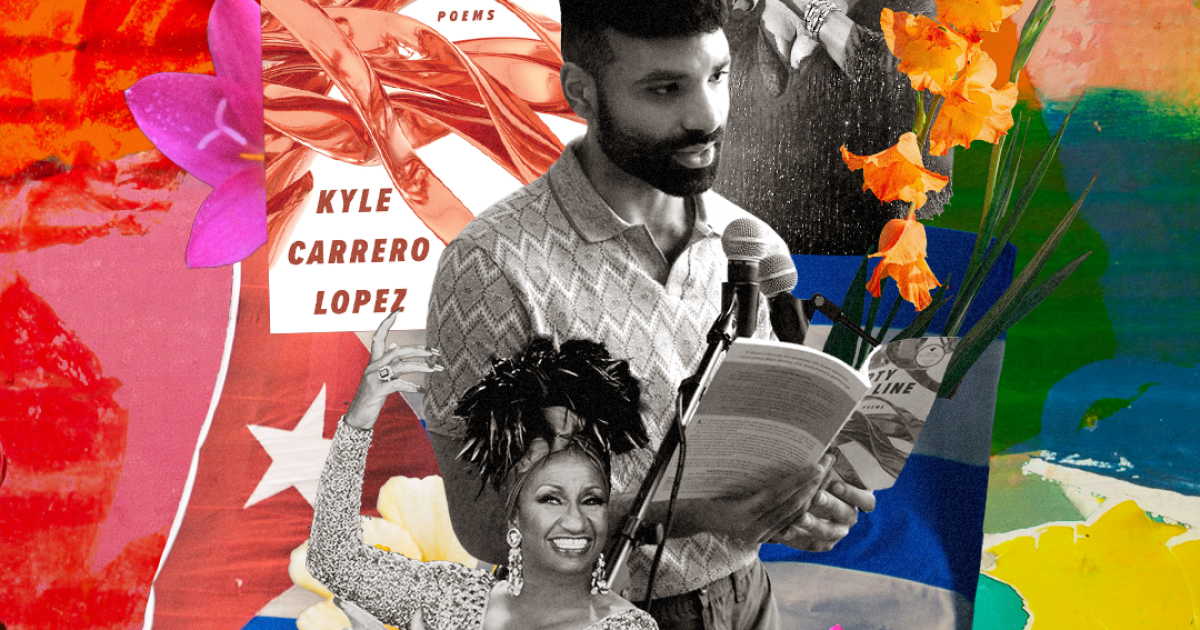
In ‘Party Line,’ Cuban American poet Kyle Carrero Lopez takes a stand
Cuban American poet Kyle Carrero Lopez first learned what sanctions were as a child — not as a political measure, but as a gendered one. In his poem “Sanctions,” he describes how his father, a surly Cuban refugee who worked as a DJ, laid out the terms of acceptable masculinity.
“No dance class/no “girl toys”/don’t walk like that,” writes Carrero. “His anthem, his law, hammered, hammered, into me.”
The poem features in his debut book of poetry, “Party Line,” released in July by indie publisher Graywolf Press. As a gay, Black Cuban American, Carrero uses social etiquette as a springboard to critically examine how marginalized people learn to negotiate space — whether at a nightclub; in the stratified gay mecca of Fire Island; at a socialist magazine party; or in line for customs at the U.S. border. He cites Black cultural figures like the queen of salsa Celia Cruz, American fashion journalist André Leon Talley, the late French singer and dancer Josephine Baker and political activist Assata Shakur as guiding lights.
“There are two sides of me,” he told De Los. “Between the party girl and the politico is Kyle Carrero Lopez.”
Born in 1995 to Cuban parents in New Jersey, Carrero is now based in New York City, where he earned a master of fine arts in poetry at NYU and published his award-winning 2022 chapbook, “Muscle Memory.” He answered my phone call in South Carolina, while overlooking the Atlantic Ocean; his mother was on the precipice of getting married a second time. Carrero, already a poet, scholar, political organizer and nightlife host, would flaunt yet another title that weekend as wedding officiant. “My work is naturally in conversation,” he explained.
Many of the poems in “Party Line” came to Carrero after visiting Cuba for the first time in 2017, through the CubaOne Foundation. Inspired by the Birthright Israel program for Jewish youth, the nonprofit sponsored trips for Cuban Americans to connect with Cubans on the island. Yet for Carrero, this strengthened his political dissonance with many Cubans in the U.S., who’ve supported economic sanctions on the communist nation. In order to force regime change, in January the Trump administration levied an oil blockade on Cuba, triggering a humanitarian crisis.
Written with an unmistakably Caribbean verve and snappy, conversational meter, Carrero defines his stance on Cuba in no uncertain terms.
“This book really is for Cuban Americans,” he said. “Those of us who are not trying to destroy Cuba, that is.”
Carrero spoke to De Los about party politics, Black Cubanidad and how visiting the island changed his writing for the better. The following interview has been lightly edited for clarity and length.
A lot of people fall back on these ideas about immigrant communities being all hard work and drudgery — but we come from a festive, dance-fueled culture. How did you get the idea to combine poems about parties with poems about politics?
I’ve always been involved in politics. I’ve done a lot of canvassing. In high school, I was in a learning community called the Civics and Government Institute. We did a “social reformers” panel, where you had to play somebody from a social movement. They had me up there dressed up as Elijah Muhammad in the 10th grade, asking me what I’d think of Obama. I had to drag Obama! These Nation of Islam people were not feeling the moderate Democrats.
But that informed my political engagement to this day. I was concerned with the language surrounding the embargo and U.S. aggression against Cuba. In my poem “Torricelli,” I talk about how [former New Jersey congressman and senator] Bob Torricelli wrote the Cuban Democracy Act, which he designed to, quote, “wreak havoc on that island.”
And I write a lot about nightlife. It is a family industry for me on both sides. My maternal grandfather ran a social club in New Jersey, a games parlor. My mom was a club kid. She was out all the time. Parenthood changed some things, but my father still had DJ gigs. Our basement was his studio. He’d leave the house at 9, 10 o’clock to go to the gigs. You know that new Jordan Firstman movie, “Club Kid”? I’m the original club kid.
How do you write for those who may not be ready to receive the club kid and the politico at once?
I like challenging assumptions that political people are drab and unglamorous — and that party people are brain-dead, escapist and have nothing to say. One of the problems I have with the ’90s club kid scene, as it existed, is they were extremely apolitical. And not only were they apolitical, but I would go so far as to say the club kids in the ’90s were a white supremacist entity. We don’t talk enough about how their whole thing was like whiteness and white privilege. All we’re here to do is have fun — and we see what that mentality leads to, right?
[The movie] “Party Monster”!
Yes, “Party Monster”! Michael Alig literally killed a man of color. That is not the party world that I live in. We don’t take off who we are just because there’s low lighting and fog and loud music. I’m going to respond the same way to harassment and perceived injustice as I would any other space.
To this day, there are white club kids in New York who are in the club talking in black-ccents and wearing imitations of black people’s hairstyles. And then if you call them out, they’re like, “Why? It’s a party!” And I’m like, “OK, but it’s a party where all of the music comes from Black people … you are a guest in this space.” Before I’m going to serve you a history lesson, let’s at least start with decency.
And though you may not think you’re doing politics … politics will still do you. Your club kid parents experienced politics by coming to the U.S. from Cuba. Can you tell me about their journey?
My father emigrated from Havana as a child. My mother was born to parents who emigrated in the 1950s during Batista’s regime. Cubans have a privileged relationship to immigration — the pipeline available to us [political asylum] was not the same for most people of Latin American descent.
My family came here not only as Cuban immigrants, but as Black immigrants. Politics happened to them. My father came to the U.S. in the late ’60s, getting called the N-word walking home from school with his two sisters…. They got hit so hard with belts that they would go home having soiled themselves. They were not only Black, but they didn’t even know what language or culture they were trying to assimilate to. There were layers of hatred…. When people talk about Cuban Americans, they think of white, rich Miami Cubans. It’s irresponsible to think in such a flat and one-dimensional way.
In the poem “Usefulness,” which was originally published in the Yale Review, you speak of how Black Cubans exist at the nexus of two different political agendas: the pro- and anti-Revolution contingents. Can you talk about that?
My opinion is very useful to many agendas. I joke that I would make a great Republican talking head. If I decided tomorrow that I wanted to get the GOP bag and be like, “Democrats are liars! I hate immigrants! I hate welfare! There’s two genders! We don’t need gay marriage!” — I would be a millionaire in under six months.
There’s a tokenism that happens when you exist at this nexus of identities. It’s true of the left as well sometimes. You could ask five different people in Cuba what they think about the government and they will give you five different answers. And that is OK! We need to allow that to be the case.
I don’t want what Trump and the Marco Rubios of the world want for Cuba — which is to seize it, to subjugate it and turn it into the next Puerto Rico. If people who are progressive and committed to Cuba’s autonomy don’t want that, I think part of [the work] is talking to Cuban people and hearing them out. I don’t think it’s acceptable to seek out only the opinions that match your own.
You bring up a historical moment that not a lot of Cuban Americans know about, which was the 1976 bombing of Cubana Flight 455, by an anti-Castro Cuban exile group. You said they planned on bombing a flight to Havana the week before, which your mom and her sister were on. How did they manage to avoid that?
[My grandfather] was an influential man. He knew the right people. So he heard something was going down and said, “I’m not putting my kids on that flight.” The flight went on as planned, but these men knew my grandfather and heard that his daughters were getting on the plane. To me that’s like getting on the list … sometimes you get into the party, or the plane [isn’t] bombed. It’s the same negotiation. Or just a moment of alignment.
What was it like visiting Cuba for the first time after the Obama administration eased travel and trade restrictions?
I don’t give Obama much, but he did try to normalize relations there. Unfortunately, Biden didn’t follow through with that, but for a second, we did care about Cuba.
The first time I went was in 2017, when I was 22. It was an incredible experience. My mother traveled to Cuba as a teenager; my father never went back. But they never discouraged me from going. I know that’s the case for a lot of Cuban Americans; there’s so much baggage. But once there was an easy path to go, it changed my life.
I write about Amiri Baraka’s time in Cuba, when he was earlier in his poetry journey — and his writing changed from being there. He wrote a poem called “Betancourt,” named after a young radical there. It made me more politically serious. I feel closer to my heritage, having done that.
What made you close the book with “I Saw Assata In Havana”? Did you really see Assata Shakur?
That was an imagined encounter. But it was the vision of what I imagine was her new life in Cuba — her second chance. I thought that it was a good ending note to land on, pushing against prevailing narratives.
I think the ways that we talk about our radicals — the Huey Newtons of the world, people like Kwame Ture or Angela Davis — we think of them as mythical beings, or, depending on who you ask, terrorists. But that disconnects them from their humanity. I wanted to create a portrait of [Shakur] as a normal lady who needed to pick up groceries sometimes. These were regular people who saw what was going on in the world and decided that they needed to do something about it. Each of us has that ability to enact change.
There are so many ways to make societal shifts, whether that’s writing to your officials or protesting or creating art that is challenging. What Shakur did was to say, “I don’t like this for my people. I don’t like this for the world I’m living in.” The same boot that’s on the necks of Black American people is on the necks of people in the Congo, people in Palestine, people of the global majority. We all have to share the planet. If we work together, we can have a world that can actually sustain itself.
My last question for you is: What would you like to see happen for Cuba?
I’m not a politician; I’m an artist. My duty is not toward any specific government; it is toward truth. My Cuba position, as a Cuban American, is focused first and foremost on my home country’s contribution to the conflict. If Cuba is truly no more than a failed state, why not lift all of the restrictions? Let’s see what happens when Cuba is unimpeded by hostile U.S. policy. That’s how you can best prove your point, right? Unless, of course, you’re afraid of what Cuba could be.
