Former ministers criticize Seoul’s North Korea policy

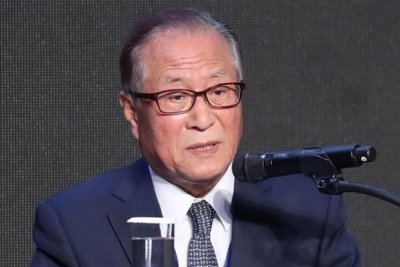
Former South Korean Minister of Unification Jeong Se-hyun speaks during International Convention for Peace and Prosperity in the Asia-Pacific, in Goyang, South Korea. Photo by YONHAP / EPA
June 22 (Asia Today) — Former South Korean unification ministers criticized President Lee Jae Myung’s North Korea policy Monday, arguing that his national security team is continuing some of the previous administration’s hard-line positions.
Chung Se-hyun, who served as unification minister under President Kim Dae-jung, delivered the criticism at the 2026 International Korean Peninsula Forum organized by the Unification Ministry in Seoul.
The forum was held under the theme “Peaceful Coexistence on the Korean Peninsula Built Together With Civil Society.”
Chung criticized a joint statement issued by South Korea and the European Union that condemned North Korea’s nuclear weapons program and its military cooperation with Russia.
“The Lee Jae Myung administration’s view of North Korea has returned to where the Yoon Suk Yeol administration stood in its final years,” Chung said.
He described the joint statement as “pouring concrete over a wall where we were trying to make even a pinhole” for progress in inter-Korean relations.
Chung accused Lee’s national security aides of steering the administration away from engagement.
“President Lee followed what his advisers wrote for him and ended up returning to a relationship of permanent hostility with North Korea,” Chung said. “Civil society must hold the president’s foreign and security policy advisers accountable.”
The former minister identified joint South Korea-U.S. military exercises, Seoul’s participation as a co-sponsor of a United Nations resolution on North Korean human rights and the South Korea-EU statement as policy mistakes.
“I believe the Lee government’s National Security Office is following the Yoon administration’s position on North Korea,” Chung said.
Chung is generally associated with a policy faction that favors resolving inter-Korean issues primarily through dialogue led by the two Koreas.
He has frequently criticized officials who place greater emphasis on the South Korea-U.S. alliance, multilateral diplomacy and international pressure in addressing North Korea’s nuclear program.
His recent criticism has included Wi Sung-lac, Lee’s national security adviser, who is viewed as a leading advocate of alliance-centered diplomacy.
The South Korea-EU statement issued during Lee’s June 10 summit in Brussels condemned North Korea’s nuclear and ballistic missile programs and called for the complete denuclearization of North Korea in accordance with U.N. Security Council resolutions.
It also condemned North Korea’s military cooperation with Russia.
Lee Jae-joung, who served as unification minister under President Roh Moo-hyun, also participated in Monday’s discussion.
Lee said the government should avoid placing North Korea’s complete denuclearization at the forefront of its peace policy.
“It would be more realistic to recognize the current situation and establish nuclear freezing and reduction as the basic direction of our policy,” Lee said.
He also called for a structural and institutional system that would give the Unification Ministry a central coordinating role in policies involving peace on the Korean Peninsula.
Unification Minister Chung Dong-young, meanwhile, said a recent social media post by U.S. President Donald Trump could indicate the possible revival of personal diplomacy between Trump and North Korean leader Kim Jong Un.
Trump posted a photograph showing himself walking with Kim during their 2018 summit in Singapore without providing a caption.
The unification minister cited an interpretation offered by Lee Jung-chul, a professor at Seoul National University, who suggested that Kim may have sent Trump a letter for the U.S. president’s birthday and that the photograph could have been Trump’s response.
“I found that interpretation impressive and plausible,” Chung Dong-young said.
No public evidence has confirmed that Kim recently sent Trump a letter.
Trump and Kim met three times during Trump’s first term, but nuclear negotiations stalled after their February 2019 summit in Hanoi ended without an agreement.
South Korea’s government has said its policy seeks peaceful coexistence and renewed dialogue with North Korea while maintaining international cooperation over Pyongyang’s nuclear weapons program.
— Reported by Asia Today; translated by UPI
© Asia Today. Unauthorized reproduction or redistribution prohibited.
Original Korean report: https://www.asiatoday.co.kr/kn/view.php?key=20260622010007522