Journalists prepare to strike as politicians push through changes that critics say threaten independence.
Published On 24 Oct 202624 Oct 2026
The Czech Republic’s governing coalition has advanced changes to the funding of public media, despite criticism that it could weaken broadcaster independence.
In a rare overnight vote in the early hours of Saturday, the coalition voted to send the bill to committees for further discussion.
Recommended Stories
list of 2 itemsend of list
The changes include scrapping the 205 crown ($9.45) household broadcasting fee, and replacing it with funding from the state budget.
The populist government of billionaire Prime Minister Andrej Babis, backed by the far-right SPD party, has frequently criticised public and private media coverage of its policies and accused some outlets of bias.
Babis promised to scrap the broadcasting fee before taking office last December, and says his three-party government is now fulfilling that pledge to voters.
Public media employees staged a strike against the move in June, saying it would make broadcasters vulnerable to government pressure.
Opposition parties have compared the changes with reforms under neighbouring Hungary’s former Prime Minister, Viktor Orban.
Babis has said the new funding model would be fairer to poorer households and encourage outlets to become more efficient.
“There is no war for independent media,” Babis said on Facebook late on Friday. “There is no fight for democracy and no nationalisation of media is being prepared.”
The proposal would cut funding for Czech Television and Czech Radio by about 15 percent and keep nominal funding unchanged for several years.
Public media are among the most trusted news sources in the Czech Republic, with Czech Television the most-watched broadcaster across several age groups.
A civic group has called a public protest for Sunday, while journalists and other employees at the broadcasters announced a strike for November 3.
WASHINGTON — Xavier Becerra was dubbed a “rising star” before he even entered the halls of Congress.
His June 1992 Democratic primary victory over Los Angeles school board member Leticia Quezada in California’s 30th Congressional District earned the 34-year-old candidate that description in The Times.
When the boyish, affable congressman became the first Latino lawmaker appointed to the powerful House Ways and Means Committee in his second term, national outlets took notice.
Thirty years later, in the final weeks of his gubernatorial race with Republican Steve Hilton, Becerra now finds himself poised to lead the most populous state in the country.
An examination of Becerra’s more than 25 years in Washington shows a politician who was skilled at building important alliances and amassing power on Capitol Hill, but had some stumbles along the way and faced criticism for his performance in his highest profile role.
Becerra built his reputation as a diligent consensus-builder — a workhorse rather than a show horse, to use an analogy favored by political scientists — but also revealed himself to be an ambitious political operator in key moments.
“He’s an affable person who’s not afraid to pull out a knife in politics while smiling,” said Christian Grose, a political science professor at USC.
Becerra’s campaign declined to comment on his time in Washington.
Becerra’s origin story traces back to his youth in Sacramento, and a moment when a high school friend was about to throw out a blank, unused application to Stanford University. The elite university was only 125 miles away, but it might as well have been across the ocean from the working-class world Becerra was raised in. Still, he applied.
He earned a law degree there four years later, and it was at Stanford that he met his wife, Carolyn Reyes, who became a physician.
After living in Boston while Reyes attended Harvard Medical School, Becerra moved to Los Angeles to work for state Sen. Art Torres. Within a few years he was tapped by Henry Lozano, then chief of staff to trailblazing Latino Rep. Edward Roybal, to run for state Assembly in 1990; and then, two years later, to succeed Roybal, who was retiring after 30 years in Congress.
Roybal endorsed Becerra, whose victory in the heavily Latino district that included Central and Eastside Los Angeles communities, was seen as a passing of the torch to the next generation.
Frank Villalobos, the founder and president of Barrio Architects, was among the leaders in East L.A. who encouraged Becerra to run for political office, and he said he was impressed early on by Becerra’s genuine commitment to the community and his ability to unite the area’s sometimes divided political factions.
“I thought if we kept this going, someday he’ll become the governor,” Villalobos said.
Becerra was part of a wave of young Latino lawmakers entering Congress, and his growing power within Democratic ranks helped him escape Roybal’s long shadow. Soon after Becerra’s barrier-breaking appointment to the Ways and Means Committee — which writes tax legislation — Becerra became chair of the Congressional Hispanic Caucus, a position he held from 1997 to 1999.
An early test
He put his growing stature to the test a few years later when he decided to enter the L.A. mayor’s race in 2001.
It didn’t go well.
Former state Assembly Speaker Antonio Villaraigosa was also running, and Becerra — who had slept on Villaraigosa’s couch when he first ran for Congress — faced criticism for potentially splitting the Latino vote.
Becerra performed poorly, winning only 6% of the vote in the Democratic primary. His nice-guy reputation took a hit when his campaign was found to have been behind automated phone calls attacking Villaraigosa by a woman who falsely gave the impression that she was county Supervisor Gloria Molina, whose endorsement had been crucial in Becerra’s first run for Congress.
Becerra also faced criticism for his role in contacting White House staffers as part of an effort to push for the release of convicted L.A. cocaine dealer Carlos Vignali, whose father was a political contributor to Becerra. Vignali’s sentence was commuted by President Clinton on his last day in office; Becerra acknowledged calling the White House several times to discuss the possibility of Vignali’s release. Villaraigosa also wrote a letter on Vignali’s behalf.
Becerra told The Times in 2001 that he wasn’t lobbying for Vignali’s release, but merely asking White House officials to review the details of the conviction on behalf of the family.
“If I was going to try to put pressure on, I would have tried to call the president,” Becerra said at the time.
Villaraigosa fared better than Becerra but ultimately lost the 2001 election to City Atty. James Hahn, then rebounded to win the first of two terms as mayor in 2005.
Becerra got the better of Villaraigosa in their rematch this year in the Democratic gubernatorial primary, and won Villaraigosa’s support after.
“We’ve been friends a long time and, yes, we’ve been adversaries as well, but most of the time we’ve been friends,” Villaraigosa told The Times. “He’s got the experience and the wherewithal to lead this state.”
As for Becerra as a house guest during his first run for Congress?
“He makes his bed. He was neat,” said Villaraigosa. “He was pretty inconspicuous.”
Capitol Hill climbing
After his mayoral defeat, Becerra’s focus returned to Washington, where an alliance with another powerful Californian was a boon to his career on Capitol Hill.
Becerra was a close ally of former House Speaker Nancy Pelosi (D-San Francisco), serving as assistant to the speaker from 2007 to 2009.
John Lawrence, Pelosi’s former chief of staff, said that Becerra’s standing within the California delegation and particularly among Latino lawmakers was a big part of his appeal.
“Speaker Pelosi had set a goal of elevating minorities and women who had historically been excluded from leadership,” he said.
Their relationship took a hit after Becerra told progressive lawmakers in 2009 that he believed party leadership gave up too easily on including a public option in the Affordable Care Act, which was signed into law the following year.
“I understand I have tire tracks on my back because Xavier threw me under the bus,” Pelosi said during a Democratic Party leadership meeting in 2009, Politico reported.
And Pelosi would later question Becerra’s appointment in 2021 to be secretary of Health and Human Services. She has not endorsed Becerra in the gubernatorial race.
But any bad blood between the two didn’t stop Becerra from continuing to advance within the party ranks.
He became chair of the House Democratic Caucus in 2012, leading weekly meetings of all Democrats in the House and uniting the party’s members.
Former Wisconsin Democratic Rep. Ron Kind said Becerra was an excellent listener and skilled at building consensus.
“He could get in the room with anyone and find common ground,” Kind said.
Becerra joined several high-stakes negotiations, notably a 2013 bipartisan effort to pass comprehensive immigration reform, in the wake of the “Gang of Eight” deal struck in the Senate.
John Yarmuth, a Democratic congressman from Kentucky who was also part of the House negotiation, said Becerra was “an amazing positive force” in the process.
“I think he, more than anyone else, was focused on fixing the problem,” Yarmuth said.
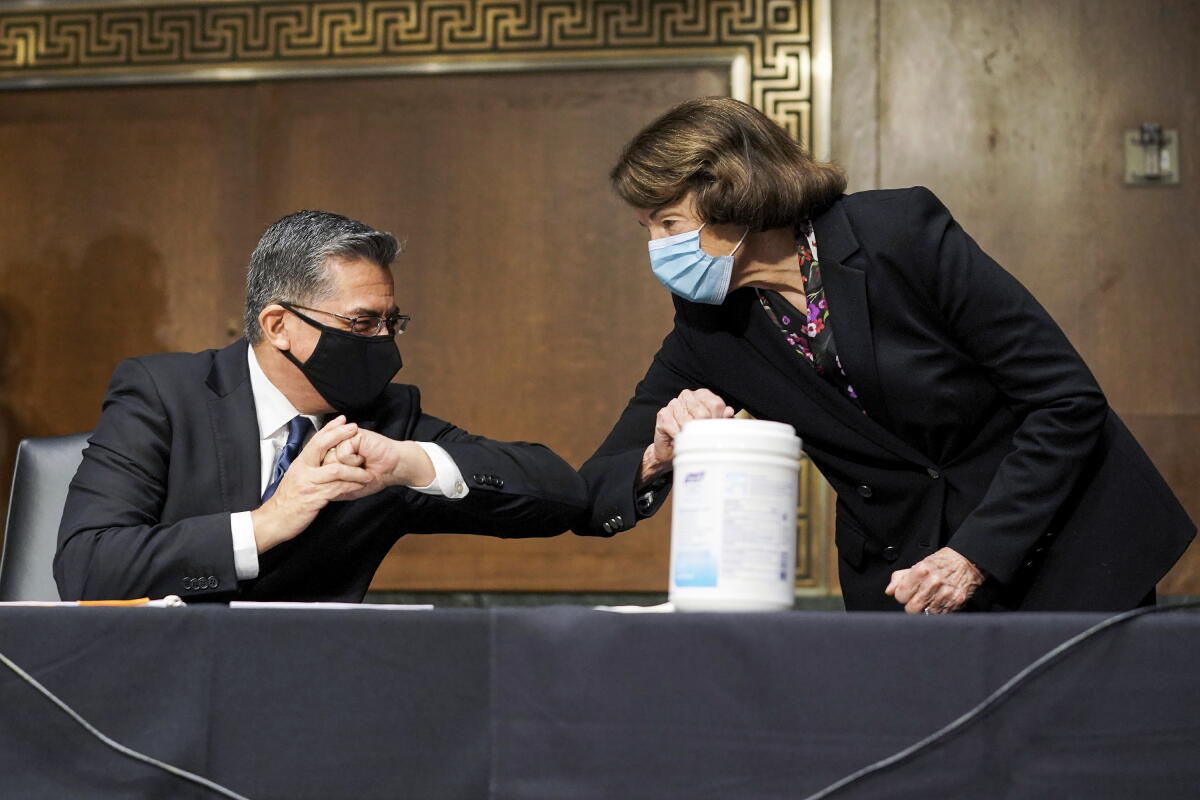
Xavier Becerra bumps elbows with U.S. Sen. Dianne Feinstein (D-Calif.) before his Senate committee confirmation hearing for Health and Human Services secretary in 2021.
(Greg Nash / Associated Press)
The group was able to achieve a compromise, but it never saw the light of day.
Then-House Speaker John Boehner, an Ohio Republican, later blamed then-President Obama, whom he accused of “poisoning the well” on an immigration compromise. Yarmuth said Republicans were spooked about potential blowback.
Several potential off-ramps appeared during Becerra’s time in Washington. He was considered by Obama for U.S. trade representative in 2008, but Becerra declined the offer. After flirting with the idea of running for outgoing U.S. Sen. Barbara Boxer’s seat, Becerra declined to enter the race, ultimately won by then-California Atty. Gen. Kamala Harris. He was briefly floated as a potential running mate for Hillary Clinton in the 2016 presidential election, but that didn’t materialize either.
In late 2016, Becerra found himself at a crossroads.
After more than a decade on the Ways and Means Committee, he faced the possibility of becoming the top Democrat on the committee and had the endorsement of the outgoing top Democrat, Rep. Sander Levin of Michigan.
But Harris’ victory in the 2016 Senate race created a vacancy for state attorney general.
Becerra decided to return home to Sacramento to take the role and spent the next four years as the state’s top law enforcement official, serving as “defender-in-chief” of the state, as USC’s Grose put it, against the Trump administration.
Fraught second act in D.C.
Becerra returned to Washington in 2021 for a second act that would prove to be far more controversial than his first.
Despite having no background in healthcare, Becerra was nominated to be the secretary of Health and Human Services and confirmed, over significant opposition by Republicans.
He took the reins of the healthcare agency as the country was still grappling with the COVID-19 pandemic and struggled to establish a clear role for himself in a response effort that was centered in the White House.
In his first year in office, he was called out by reporters for failing to hold regular press briefings.
And he faced criticism when health officials under his purview offered contradictory information in late 2021 about reduced quarantine requirements for people testing positive for COVID-19.
And Becerra’s chief of staff at Health and Human Services and longtime advisor, Sean McCluskie, pleaded guilty last year to participating in a scheme to use campaign funds from a dormant Becerra state political committee to pay for McCluskie’s frequent travel between Washington and California.
Dana Williamson, a longtime political consultant for Becerra and former chief of staff to Gov. Gavin Newsom, pleaded guilty earlier this year for her role in the scheme. McCluskie and Williamson are scheduled to be sentenced in December. Neither Becerra nor Newsom were accused of wrongdoing.
Democratic operative Xochitl Hinojosa, who served as the spokesperson for the Department of Justice in the Biden administration, earlier this year offered a blunt assessment of Becerra’s performance.
“He was not effective in government, and I think that a lot of people in the Biden administration are talking about this because they realize that he was not an effective HHS secretary,” Hinojosa said on CNN in May.
While other members of the Biden administration have defended Becerra’s performance, his time at the helm highlighted an issue that even allies concede has bedeviled Becerra in the past, his tendency to sometimes recede into the background.
Loretta Sanchez, a former Democratic congresswoman from Orange County who credits Becerra with encouraging her to run for Congress, put it simply.
“Will Xavier be bold?” she said. “I hope he takes those bold moves, because California needs it.”
NICOLE Kidman’s daughter Sunday Rose has addressed being labelled a “nepo-baby” after she posed for Vogue.
The 18-year-old model has followed in her famous parents’ footsteps after launching her career on the runway at age 16.
Nicole Kidman’s daughter Sunday Rose addressed nepo-baby criticism as she posed for VogueCredit: Sebastián Faena/VogueThe 18-year-old has followed in her famous parents’ footstepsCredit: Getty
Sunday – who is the daughter of Hollywood actress Nicole, 59, and country singer father Keith Urban, 58 – made her cover debut for Vogue Germany this month and opened up about getting opportunities due to her parents.
“I’m very aware that I’m given opportunities that not everyone can have, and I’m truly grateful to be able to take advantage of them,” she said.
Sign up for the Showbiz newsletter
Thank you!
“When I’m at work, I make sure to always give my best, never come to work with a negative attitude, no matter how tired or jet-lagged I may be, and treat everyone with respect.”
Sunday often steps out with her famous parents as she continues to make a name for herself in the industry.
It was already going to be a short week, but Sean McVay navigated unexpected business that affected the start of preparation for Sunday’s game against the Arizona Cardinals.
“He says, ‘How’s that tube?’” McVay recalled. “I said, ‘What do you mean?’
“He said, ‘That tube of [s—] that never stops coming down over your head when you’re a head coach.’
“But honestly, it’s part of it.”
The Rams hope that Grupe can clean up the kicking game and relieve criticism of the Rams’ struggling special teams. McVay said this week that he has “a lot of confidence” in special teams coordinator Bubba Ventrone, and that “no changes” are going to be made to that staff position.
“You’re continuing to figure out some of our identity,” McVay said Thursday, adding, “I have seen the intentionality from the group that I’m looking for.”
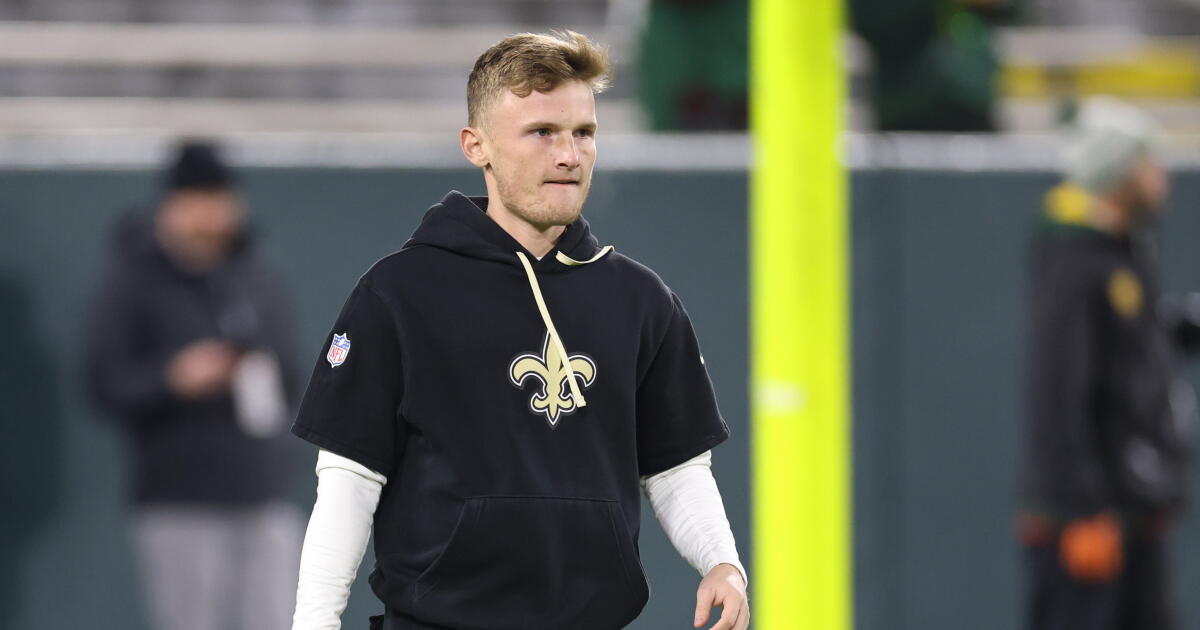
Grupe was signed off the New York Jets practice squad. Last season, he was released by the New Orleans Saints in late November after he made only 18 of 26 field-goal attempts. The Indianapolis Colts signed Grupe and he made all 11 of his attempts.
“For these last five weeks, I’ve been staying ready, been doing what I need to do to take advantage of an opportunity,” Grupe said.
Quessenberry, 36, is a ninth-year pro. But he has not started a game since 2023, when he played for the Minnesota Vikings.
Quessenberry played only 18 snaps on offense last season, none this season.
But McVay said Quessenberry was a “consummate pro” who has played “a lot of meaningful snaps” in his career and worked with the Rams’ first-team offense when Jackson has been held out while managing blood-clot issues.
“This is kind of why I’m here, when things like this happen,” Quessenberry said. “So I’m ready to go. This is what I’ve worked for. I’ve played this position my whole life. Go out there on Sunday and play ball. I’m fired up.”
This will be the first game without Jackson since last season’s late December game against the Atlanta Falcons. With D.J. Humphries starting at left tackle, the Falcons swarmed Matthew Stafford. Humphries was called for two crucial penalties, the Falcons sacked Stafford three times and intercepted three passes.
“He’s proven himself in this league,” Stafford said, adding, “ton of trust in what he’s capable of.”
Rookie lineman Keagen Trost practiced Thursday for the first time since he was placed on injured reserve before the season because of a hamstring injury suffered in the preseason opener against the Kansas City Chiefs.
Trost, a third-round draft pick out of Missouri, could be activated to the roster.
“It’s been a little bit of time since he’s played football,” McVay said. “But if he’s feeling good, expect him to be up for the game.
“But not at the expense of putting him in a situation that, if he did have to play, wasn’t good for him.”
Offensive lineman Justin Dedich, who has been on injured reserve because of a hand injury, also is eligible to return. But interior linemen such as guards Kevin Dotson and Steve Avila have remained physically sound.
“We’ll pray that we stay healthy,” McVay said, “but at some point we’ll start his clock and get him in there.”
Striker takes fire for where and how he has chosen to recover from a knee injury as his return to play could come as early as Saturday.
Published On 9 Oct 20269 Oct 2026
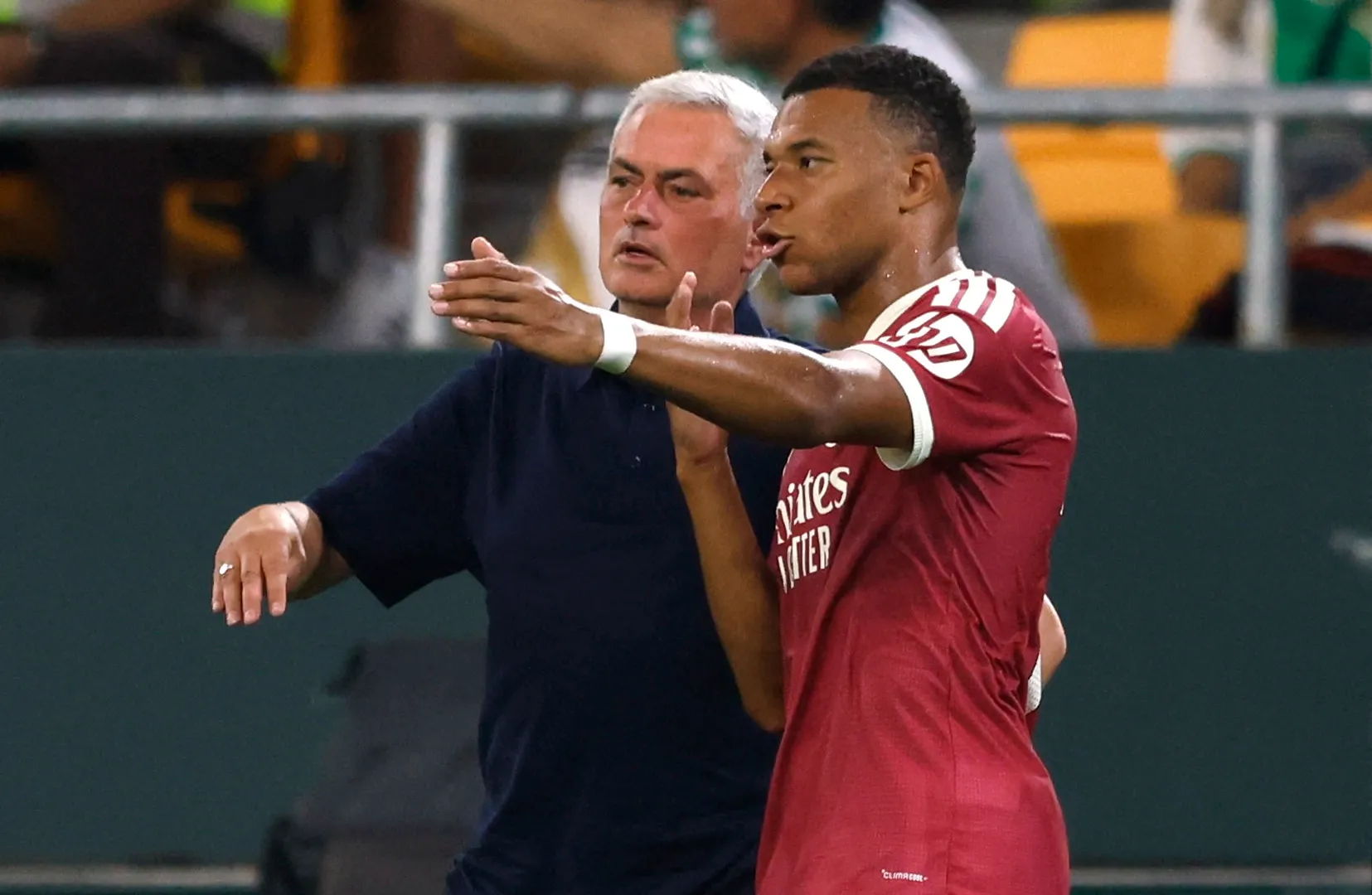
Real Madrid coach Jose Mourinho has slammed criticism of star striker Kylian Mbappe, calling the attacks “ridiculous”.
The French captain has come under fire for spending his time recovering from a left knee injury in France and Switzerland rather than Madrid. He suffered a hyperextension of the joint while playing in a Nations League match against Turkiye on September 25.
Recommended Stories
list of 4 itemsend of list
The 27-year-old was also pictured at the entrance of a Parisian nightclub and photographed on a bicycle when he was in Switzerland.
Some fans claimed it was a deliberate snubbing of Mourinho, who only days before had said players should avoid skiing or riding bicycles to avoid injury.
“Are these criticisms over the top? They are ridiculous,” Mourinho said at a news conference on Friday on the eve of Real’s La Liga home match with Villarreal.
“All the players who were obliged to be present every day for their recovery were here.
“Mbappe came, like the others, to undergo scans in order to be diagnosed.
“He then went to see a specialist in France because he has history with his knee, which we cannot ignore.”
Mourinho, whose side lost to Atletico Madrid in their last match and already lag six points behind bitter rivals Barcelona, is never one to shy away from a confrontation and tackled each of the criticisms against Mbappe.
“Problems involving football are not sufficient for you,” the 63-year-old Portuguese coach told reporters.
“Therefore, you have raised the issue of the discotheque, which in fact was not one because it was used for a private event for Fashion Week.
“As for the bicycle in Switzerland, it was in a hotel made up of small houses which makes them available so guests can ride to the communal areas, and you would have us believe he was competing in the Tour of Switzerland.”
Mbappe, who returned to training on Wednesday, could feature on the pitch as early as Saturday. Mourinho shrugged off the potential of a hostile reception for Mbappe against Villarreal, reiterating that he was “certain” the all-time World Cup record goal scorer has fulfilled “his obligations to Real Madrid”.
It is not the first time this season that Mbappe has been subjected to attacks by fans.
The Ultras Sur, a Real Madrid supporters group linked to the far right and banned from the Santiago Bernabeu, took issue with him last month.
They were furious that before a Real Madrid match, Mbappe, alongside Vinicius Jr and fellow Frenchman Ibrahima Konate, partially rolled up T-shirts bearing the words “We are all Ceutans“, which was intended to be a message of support for people in the Spanish territory bordering Morocco.
Mbappe was also criticised earlier this season over his choice of a location for recovery from a previous injury, which led to an online “Mbappe Out” campaign by some Real fans.
The White House has spent days fiercely defending three taxpayer-funded advertisements that glorify President Trump — approaching at least $1.5 million in public spending — calling them public service announcements.
“Don’t let the Fake News get away with their lies about our epic Public Service Announcements that have been running on tv,” White House communications director Steven Cheung posted on X on Sunday.
But the Republican administration’s ads attracted mounting criticism on Monday, including from members of Trump’s own party.
“It shouldn’t be paid for with taxpayer dollars,” Senate Majority Leader John Thune, R-S.D., told reporters.
“It would not have been something that I would have done. And I know that the White House is not covered by the same guidance that we are, but it’s not something that I would have done,” said Sen. Mike Rounds, another South Dakota Republican.
Multiple legal experts consulted by the Associated Press said the ads appear to run afoul of federal statutes, including a law against congressionally appropriated funds being used for “publicity or propaganda” and a law that limits the partisan political activities of government employees.
They said the new ads, which are airing on network and cable TV and streaming, differ from other administrations’ PSAs because they aren’t designed to help Americans access any specific program.
“You watch all three ads, they’re sheer propaganda,” said Richard Painter, a former White House ethics czar under Republican President George W. Bush. “This is increasingly looking like what authoritarian governments do to promote their leaders.”
The heightened scrutiny comes as the Trump administration has increased spending on the ads and bought time on popular TV shows, including college football and National Football League programming. It remains unclear which part of the government is supplying the funds.
With both chambers of Congress led by Republicans, any oversight would likely have to come from Trump’s allies, decreasing the likelihood of hearings or other accountability efforts before November’s midterm elections.
Three ads have aired in less than a week, totaling well over $1M
The first ad in the campaign, which began airing last Wednesday, features clips of Trump talking about defeating communism interspersed with onscreen text promoting the “largest tax cuts in history,” “reigniting American manufacturing” and a call to “defend law and order and police.”
Later in the week, a second ad began running, showing scenic videos of Mount Rushmore at night with quotes and clips from Trump’s Fourth of July weekend speech there honoring the country’s 250th anniversary.
The latest of the ads, a spot first aired over the weekend, is virtually identical to an ad for Trump’s Republican reelection campaign in 2024. It shows him walking down a hallway as his voice can be heard warning of a “final battle” against “globalists” and “warmongers.”
All three ads end with a message that says: “Paid for by the U.S. Government.” The White House hasn’t responded to inquiries about which part of the government is paying.
According to AdImpact, which tracks media spending, the spots have so far cost more than $1.4 million and run across a wide range of TV networks around the country. The actual amount spent could be significantly more, depending on whether networks classified the ad as a political ad.
The ads are different from past PSAs, experts say
In defending the campaign, the White House published a list of PSAs from recent Democratic and Republican administrations.
Among the examples it cited were Bush’s Republican administration touting a Medicare law, Barack Obama’s Democratic administration promoting Affordable Care Act subsidies and Joe Biden’s Democratic administration running ads promoting COVID-19 vaccinations.
“The announcements are very clearly not campaign ads; President Trump is not on the ballot and there is no call to action,” the White House wrote. “Instead, the announcements are a reminder for Americans to love their country and know why it’s worth defending — at home, at the border, and abroad.”
Kathleen Clark, a legal ethics professor at Washington University in St. Louis, said in her view the new ads differ from the examples the White House provided because they aren’t aimed at helping members of the public benefit from specific government programs.
“These ads are nothing more than government propaganda, aimed at helping Trump,” she said.
Painter, who joined the Bush administration after the Medicare PSAs went out, said that ad campaign toed the line on appropriateness because it included misleading information about Medicare Part D. But he said Trump’s campaign is a far more egregious violation of the statute that blocks congressionally appropriated money from being spent on publicity or propaganda.
“There’s nothing in here about a particular policy that’s at all focused,” Painter said of Trump’s ads. “One of them is just about the evils of the deep state. Another one of them is about communists and Marxists.”
In its support for the ads, the White House also referenced the administrations of President Woodrow Wilson and President Franklin D. Roosevelt, both of whom used posters, radio and film to rally the country during World Wars I and II.
James Kimble, a communication professor at Seton Hall University who studies domestic propaganda, said it’s true that Wilson’s Democratic administration used propaganda to rally Americans. But he said most Americans no longer view its actions in a positive light.
“By almost any objective measure, looking back, we find what they did pretty repulsive,” he said.
Skepticism of the campaign grows on the Hill
Top Democrats on the Senate and House appropriations committees last week wrote to the White House demanding the ads be taken down and requesting more information on how much money was spent to create and air them.
In the days since, more than a dozen Democrats and a handful of Republicans have spoken up to further criticize the ads. Senate Minority Leader Chuck Schumer called the latest ad “an absolute violation of what a democracy is supposed to look like.”
“Americans sat down to watch football, not to be force-fed Trump’s propaganda on their own dime,” he said in a Senate floor speech Monday.
Sen. John Kennedy, a Republican from Louisiana, said on CBS’s “Face the Nation” on Sunday that no public official should spend public money on private ads for themselves.
And Rep. Thomas Massie, a Kentucky Republican who lost his primary to a Trump-backed challenger, had his own harsh words for the administration on Monday.
“Don’t worry, using taxpayer dollars to run ominous campaign ads of the President has been done before and is completely legal… in banana republics,” he wrote in an X post.
The Republican chairs of the Senate and House appropriation committees didn’t respond to requests for comment.
Swenson writes for the Associated Press. AP writers Mary Clare Jalonick and Steven Sloan contributed to this report.