crippling

From blackouts to food shortages: How US blockade is crippling life in Cuba | Explainer News

A US oil blockade is causing a severe energy crisis in Cuba, as the government has been forced to ration fuel and cut electricity for many hours a day, paralysing life in the communist-ruled island nation of 11 million.

Bus stops are empty, and families are turning to wood and coal for cooking, living through near-constant power outages amid an economic crisis worsened by the Trump administration’s steps in recent weeks.

President Miguel Diaz-Canel has imposed harsh emergency restrictions – from reduced office hours to fuel sales – in the backdrop of looming threats of regime change from the White House.

The Caribbean region has been on edge since the US forces abducted Venezuela’s President Nicolas Maduro last month and upped the pressure to isolate Havana and strangle its economy. Venezuela, Cuba’s closest ally in the region, provided the country with the much-needed fuel.

So, how dire is the situation in Cuba? What does United States President Donald Trump want from Havana? And how long can Cuba sustain?

cuba
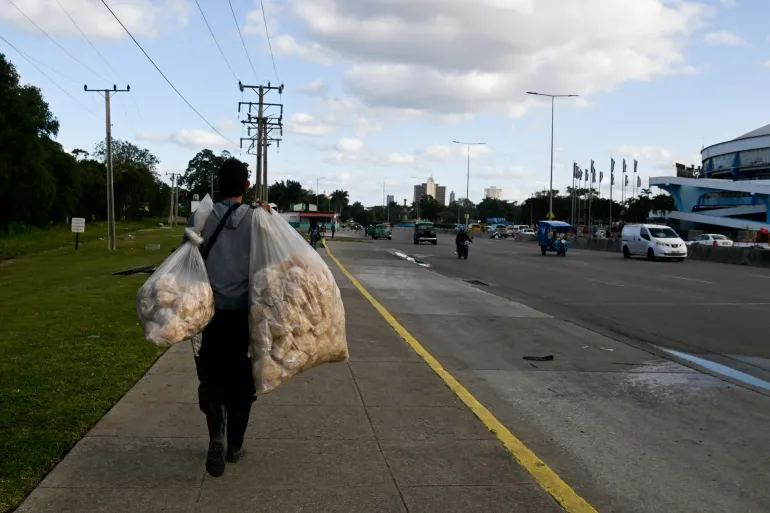
A man carries pork rinds to sell as Cubans brace for fuel scarcity measures after the US tightened oil supply blockade, in Havana, Cuba, February 6, 2026 [Norlys Perez/Reuters]

What are Cuba’s emergency measures?

Blaming the US for the crisis, Cuba’s Deputy Prime Minister Oscar Perez‑Oliva Fraga appeared on state television on Friday to inform the millions of the emergency steps “to preserve the country’s essential functions and basic services while managing limited fuel resources”.

Now, the Cuban state companies will shift to a four‑day workweek, with transport between provinces dialled down, main tourism facilities closed, shorter schooldays and reduced in‑person attendance requirements at universities.

“Fuel will be used to protect essential services for the population and indispensable economic activities,” said Perez-Oliva. “This is an opportunity and a challenge that we have no doubt we will overcome. We are not going to collapse.”

The government says it will prioritise available fuel for essential services – public health, food production and defence – and push the installation of solar-based renewable energy sector and incentives therein. It will prioritise shifting energy to selected food production regions and accelerate the use of renewable energy sources, while cutting down on culture and sport activities and diverting resources towards the country’s early warning systems.

cuba oil
US Secretary of State Marco Rubio looks on as President Trump speaks during a cabinet meeting at the White House in Washington, DC, January 29, 2026 [Evelyn Hockstein/Reuters]

Why has the US blocked oil to Cuba?

Decades of strict US economic sanctions against Cuba, the largest island nation in the Caribbean, have destroyed its economy and isolated it from international trade. Cuba relied on foreign allies for oil shipments, such as Mexico, Russia, and Venezuela.

However, after the US forces abducted Venezuelan President Maduro, Washington blocked any Venezuelan oil from going to Cuba. Trump now says the Cuban government is ready to fall.

Under Trump, Washington has pivoted to the Western Hemisphere, which it wants to dominate. The military actions in Venezuela, the pledge to take over Greenland and changing the government in Cuba are part of the new policy.

Last month, Trump signed an executive order – labelling Cuba a threat to national security – imposing tariffs on any country that sells or provides oil to the island nation. Further pressure on the Mexican government reportedly led to oil stocks reaching a record low in Cuba.

“It looks like it’s something that’s just not going to be able to survive,” Trump told reporters last month, when questioned about the Cuban economy. “It is a failed nation.”

Havana has rejected accusations that it poses a threat to US security. Last week, the Cuban Ministry of Foreign Affairs issued a statement calling for dialogue.

“The Cuban people and the American people benefit from constructive engagement, lawful cooperation, and peaceful coexistence. Cuba reaffirms its willingness to maintain a respectful and reciprocal dialogue, oriented toward tangible results, with the United States government, based on mutual interest and international law,” a statement from the ministry said on February 2.

Trump’s goals in Cuba remain unclear; however, US officials have noted on multiple occasions that they would like to see the government change.

Responding to a question during a US Senate hearing on Venezuela, Secretary of State Marco Rubio said, “We would like to see the regime there change. That doesn’t mean that we’re going to make a change, but we would love to see a change.”

Rubio, who is of Cuban descent, is one of the most powerful figures in Trump’s administration.

“The Cuban-American lobby, which Rubio represents, is one of the most powerful foreign policy lobbies in the United States today,” Ed Augustin, an independent journalist in Havana, told Al Jazeera’s The Take.

“In the new Trump administration, [with] an unprecedented number of Cuban Americans, the lobbyists have become the policymakers,” he said, adding that Rubio has built firm control over the lobby.

On January 31, Trump told reporters, “It doesn’t have to be a humanitarian crisis. I think they probably would come to us and want to make a deal. So Cuba would be free again.”

He said Washington would make a deal with Cuba, but offered no clarity on what that means.

castro
A woman walks past a building with an image of former President Fidel Castro as people prepare for the arrival of Hurricane Melissa in Santiago de Cuba, Cuba, October 27, 2025 [Norlys Perez/Reuters]

History of US-Cuba relations

Since Fidel Castro overthrew the pro-US regime in the Cuban revolution in 1959, the country has been under US embargo. Decades of sanctions have denied Cuba access to global markets, making even supply medicines difficult.

Castro nationalised US-owned properties, mainly the oil sector, and Washington responded with trade restrictions that soon became a full economic embargo that continues to this day, undermining Cuba’s economy.

The US also cut diplomatic ties with Havana, and three years later, a missile crisis almost brought Washington and the erstwhile USSR, an ally of Cuba, to the brink of nuclear war.

In 2014, Washington and Havana restored ties after 50 years. Two years later, US President Barack Obama travelled to Havana to meet Raul Castro.

However, during his first term as president, Trump reversed the historic move in 2017. Since then, the US has reimposed a raft of sanctions against Cuba, especially economic restrictions, leading to one of the worst economic crises in the island nation’s history. Within hours of his inauguration in January 2025, Trump reversed the previous administration’s policy of engagement with Havana.

cuba
People wait for transport at a bus stop as Cubans brace for fuel scarcity measures, Havana, Cuba, February 6, 2026 [Norlys Perez/Reuters]

How long can Cuba sustain?

Until last month, Mexico reportedly remained Cuba’s major oil supplier, sending nearly 44 percent of total oil imports, followed by Venezuela at 33 percent, while nearly 10 percent was sourced from Russia and a smaller amount from Algeria.

According to Kpler, a data company, by January 30, Cuba was left with oil enough to last only 15 to 20 days at current levels of demand.

Cuba currently needs an estimated 100,000 barrels of crude oil per day.

cuba
A man rides a bicycle in Havana, Cuba, on February 6, 2026 [Yamil Lage/AFP]

What has the UN said about the Cuban crisis?

United Nations spokesperson Stephane Dujarric told reporters on Wednesday that “the secretary-general is extremely concerned about the humanitarian situation in Cuba, which will worsen, and if not collapse, if its oil needs go unmet”.

Dujarric said, for more than three decades, the UN General Assembly has consistently called for an end to the embargo imposed by the US on Cuba, adding that the UN urges “all parties to pursue dialogue and respect for international law”.

Francisco Pichon, the senior-most UN official in Cuba, described “a combination of emotions” in the country – “a mix of resilience, but also grief, sorrow and indignation, and some concern about the regional developments”.

The UN team in Havana says the vast majority of Cubans are hit by rolling blackouts, with the number of people in vulnerable situations increasing significantly.

“The last two years have been quite tough,” Pichon said, adding that urgent changes are needed to sustain Cuba “in the midst of the severe economic, financial and trade sanctions”.

Source link

Housing costs are crippling many Americans. Here’s how the two parties propose to fix that

Donald Trump’s promises on affordability in 2024 helped propel him to a second term in the White House.

Since then, Trump says, the problem has been solved: He now calls affordability a hoax perpetrated by Democrats. Yet the high cost of living, especially housing, continues to weigh heavily on voters, and has dragged down the president’s approval ratings.

In a poll conducted this month by the New York Times and Siena University, 58% of respondents said they disapprove of the way the president is handling the economy.

How the economy fares in the coming months will play an outsize role in determining whether the Democrats can build on their electoral success in 2025 and seize control of one or both chambers of Congress.

With housing costs so central to voters’ perceptions about the economy, both parties have put forward proposals in recent weeks targeting affordability. Here is a closer look at their competing plans for expanding housing and reining in costs:

How bad is the affordability crisis?

Nationwide, wages have barely crept up over the last decade — rising by 21.24% between 2014 and 2024, according to the Federal Reserve. Over the same period, rent and home sale prices more than doubled, and healthcare and grocery costs rose 71.5% and 37.35%, respectively, according to the Fed.

National home price-to-income ratios are at an all-time high, and coastal states like California and Hawaii are the most extreme examples.

Housing costs in California are about twice the national average, according to the state Legislative Analyst‘s Office, which said prices have increased at “historically rapid rates” in recent years. The median California home sold for $877,285 in 2024, according to the California Assn. of Realtors, compared with about $420,000 nationwide, per Federal Reserve economic data.

California needs to add 180,000 housing units annually to keep up with demand, according to the state Department of Housing. So far, California has fallen short of those goals and has just begun to see success in reducing its homeless population, which sat at 116,000 unsheltered people in 2025.

What do the polls say?

More than two-thirds of Americans surveyed in a Gallup poll last month said they felt the economy was getting worse, and 36% expressed approval for the president — the lowest total since his second term began.

The poll found that 47% of U.S. adults now describe current economic conditions as “poor,” up from 40% just a month prior and the highest since Trump took office. Just 21% said economic conditions were either “excellent” or “good,” while 31% described them as “only fair.”

An Associated Press poll found that only 16% of Republicans think Trump has helped “a lot” in fixing cost of living problems.

What have the Democrats proposed?

The party is pushing measures to expand the supply of housing, and cut down on what they call “restrictive” single-family zoning in favor of denser development.

Senate Minority Leader Chuck Schumer (D-N.Y.) said Democrats plan to “supercharge” construction through bills like California Sen. Adam Schiff’s Housing BOOM Act, which he introduced in December.

Schiff said the bill would lower prices by stimulating the development of “millions of affordable homes.” The proposal would expand low-income housing tax credits, set aside funds for rental assistance and homelessness, and provide $10 billion in housing subsidies for “middle-income” workers such as teachers, police officers and firefighters.

The measure has not been heard in committee, and faces long odds in the Republican-controlled body, though Schiff said inaction on the proposal could be used against opponents.

And the Republicans?

A group of 190 House Republicans this month unveiled a successor proposal to the “Big Beautiful Bill,” the sprawling tax and spending plan approved and signed into law by Trump in July.

The Republican Study Committee described the proposal as an affordability package aimed at lowering down payments, enacting mortgage reforms and creating more tax breaks.

Leaders of the group said it would reduce the budget deficit by $1 trillion and could pass with a simple majority.

“This blueprint … locks in President Trump’s deregulatory agenda through the only process Democrats can’t block: reconciliation,” said Rep. August Pfluger (R-Tex.), who chairs the group. “We have 11 months of guaranteed majorities. We’re not wasting a single day.”

Though the proposal has not yet been introduced as legislation, Republicans said it would include a mechanism to revoke funding from blue states over rent control and immigration policy, which they calculated would save $48 billion.

President Trump has endorsed a $200-billion mortgage bond stimulus, which he said would drive down mortgage rates and monthly payments. And the White House, which oversees Fannie Mae and Freddie Mac — the two enterprises that back most U.S. mortgages — continues to push the idea of portable and assumable mortgages.

Trump said the move would allow buyers to keep their existing mortgage rate or enable new homeowners to assume a previous owner’s mortgage.

The Department of Justice, meanwhile, has launched a criminal investigation into Federal Reserve Chair Jerome Powell over the Fed’s renovation costs, as Trump bashed him over “his never ending quest to keep interest rates high.”

The president also vowed to revoke federal funding to states over a wealth of issues such as childcare and immigration policy.

“This is not about any particular policy that they think is harmful,” Rep. Laura Friedman (D-Burbank) said. “This is about Trump’s always trying to find a way to punish blue states.”

Is there any alignment?

The two parties are cooperating on companion measures in the House and Senate.

The bipartisan ROAD to Housing Act seeks to expand housing supply by easing regulatory barriers. It passed the Senate unanimously and has support from the White House, but House Republicans have balked, and it has yet to receive a floor vote.

A bipartisan proposal — the Housing in the 21st Century Act — was approved by the House Financial Services Committee by a 50-1 vote in December. It also has yet to receive a floor vote.

The bill is similar to its twin in the Senate, with Rep. French Hill (R-Ark.) working across the aisle with Rep. Maxine Waters (D-Los Angeles). If approved, it would cut permitting times, support manufactured-housing development and expand financing tools for low-income housing developers.

There was also a recent moment of unusual alignment between the president and California Gov. Gavin Newsom, who both promised to crack down on corporate home buying.

What do the experts say?

Housing experts recoiled at GOP proposals to bar housing dollars from sanctuary jurisdictions and cities that impose rent control.

“Any conditioning on HUD funding that sets up rules that explicitly carve out blue cities is going to be really catastrophic for California’s larger urban areas,” said David Garcia, deputy director of policy at UC Berkeley’s Terner Center for Housing Innovation.

More than 35 cities in California have rent control policies, according to the California Apartment Assn. The state passed its own rent stabilization law in 2019, and lawmakers approved a California sanctuary law in 2017 that prohibits state resources from aiding federal immigration enforcement.

The agenda comes on the heels of a series of HUD spending cuts, including a 30% cap on permanent housing investments and the end of a federal emergency housing voucher program that local homelessness officials estimate would put 14,500 people on the streets.

In Los Angeles County, HUD dollars make up about 28% of homelessness funding.

“It would undermine a lot of the bipartisan efforts that are happening in the House and the Senate to move evidence-backed policy to increase housing supply and stabilize rents and home prices,” Garcia said.

The president’s mortgage directives also prompted skepticism from some experts.

“Fannie Mae and Freddie Mac were pressed to get into the riskier parts of the mortgage market back in the housing bubble and that was a part of the problem,” said Eric McGhee, a researcher at the Public Policy Institute of California.

Source link