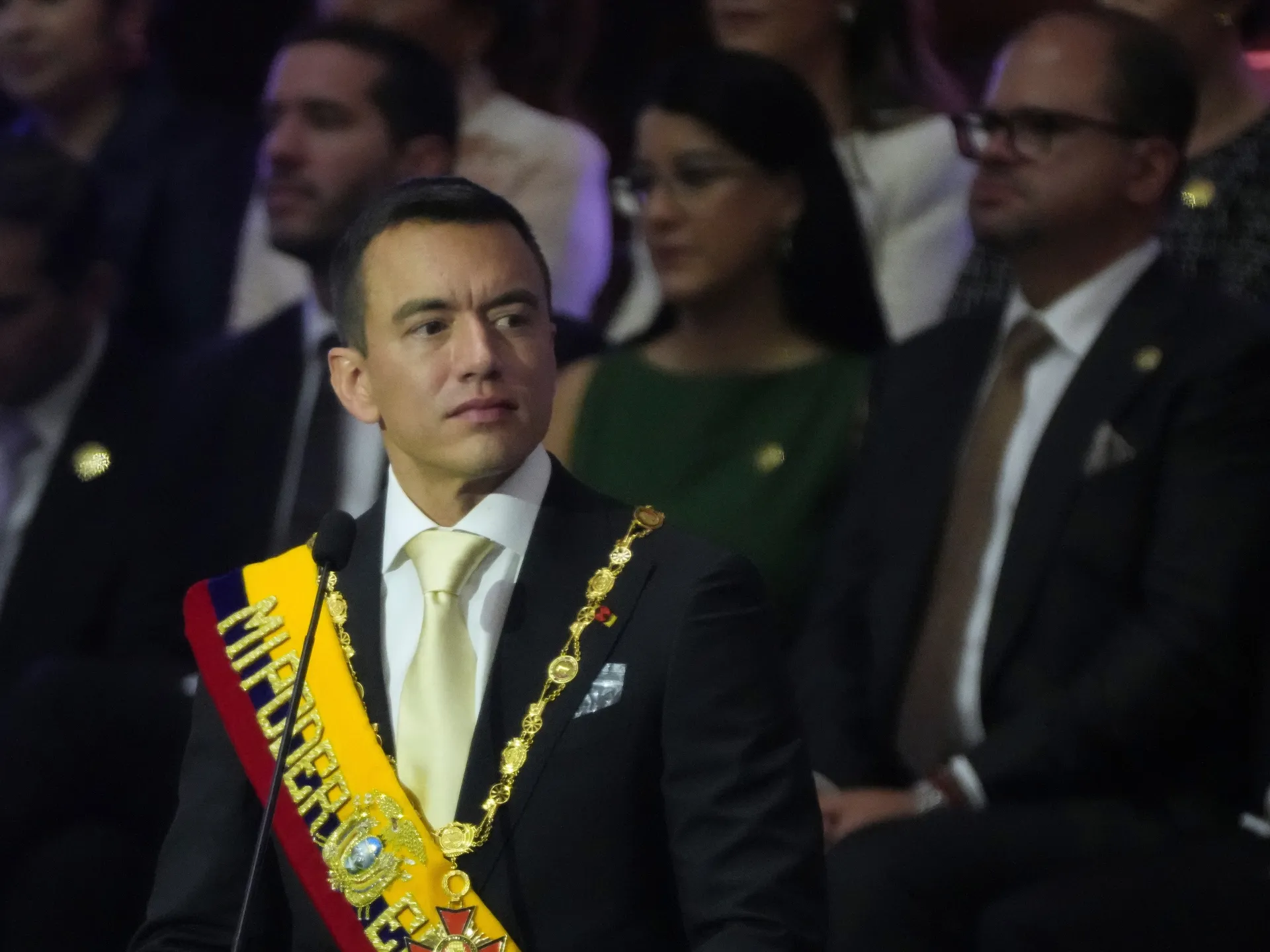
The right-wing president highlighted anti-crime operations and economic progress, while critics warned of abuses.
Published On 24 May 202624 May 2026
Ecuadorian President Daniel Noboa has used his State of the Union speech to tout his United States-backed crime-fighting strategies as well as improvements to the economy.
Addressing the National Assembly in the capital Quito on Sunday, Noboa cited the extradition of a dozen crime bosses to the US and the seizure of almost 300 tonnes of drugs as examples of what he described as his decisive and effective approach.
Recommended Stories
list of 3 itemsend of list
“We will seek them out, find them and extradite them,” Noboa said of wanted criminals. He also asserted that the South American country cannot develop “if families live in fear”.
Organised crime is the leading concern among Ecuadorians this decade, after a spike in homicides during the COVID-19 pandemic.
Since 2021, Ecuador has struggled to contain drug violence as rival cartels partner with local gangs to battle for control of routes and coastal ports used to smuggle cocaine. The country is wedged between Colombia and Peru, the world’s top cocaine producing countries.
Last year, Ecuador recorded its highest homicide rate in decades, with approximately 50 murders for every 100,000 residents, according to the Ministry of the Interior.
In response, Noboa, who was reelected last year to a four-year term, has used a state of exception to allow the military to implement a variety of crime-fighting strategies, including joint patrols with police officers and property searches without warrants.
Earlier this year, Ecuador’s military also carried out an operation with US forces against a training camp allegedly used by Colombian drug traffickers, attacking the site with drones, helicopters and boats.
Noboa’s approach, however, has come under criticism from civil society groups, who say his iron-fisted methods have failed to reduce crime while putting civilians in danger.
Glaedys Gonzalez, an analyst for the Andean region at the International Crisis Group, said on Sunday that Noboa may have been optimistic in his speech regarding the country’s security.
“Progress on violence is far from being achieved,” Gonzalez said. “It is evident that the situation in Ecuador has reached unprecedented levels.”
Sunday’s speech also promoted Ecuador’s economic progress, with Noboa telling lawmakers that poverty dropped from 26 percent to 21.4 percent in 2025. Extreme poverty, he added, went down from 10.4 percent to 8.4 percent.
Noboa was first elected in 2023 during a snap election triggered when then-President Guillermo Lasso dissolved the National Assembly and shortened his own term.
WASHINGTON — A man carrying a gun and a cellphone entered a federal credit union in a small town in central Virginia in May 2019 and demanded cash.
He left with $195,000 in a bag and no clue to his identity. But his smartphone was keeping track of him.
What happened next could yield a landmark ruling from the Supreme Court on the 4th Amendment and its restrictions against “unreasonable searches.”
Typically, police use tips or leads to find suspects, then seek a search warrant from a judge to enter a house or other private area to seize the evidence that can prove a crime.
Civil libertarians say the new “digital dragnets” work in reverse.
“It’s grab the data and search first. Suspicion later. That’s opposite of how our system has worked, and it’s really dangerous,” said Jake Laperruque, an attorney for the Center for Democracy & Technology.
But these new data scans can be effective in finding criminals.
Lacking leads in the Virginia bank robbery, a police detective turned to what one judge in the case called a “groundbreaking investigative tool … enabling the relentless collection of eerily precise location data.”
Cellphones can be tracked through towers, and Google stored this location history data for hundreds of millions of users. The detective sent Google a demand for information known as a “geofence warrant,” referring to a virtual fence around a particular geographic area at a specific time.
The officer sought phones that were within 150 yards of the bank during the hour of the robbery. He used that data to locate Okello Chatrie, then obtained a search warrant of his home where the cash and the holdup notes were found.
Chatrie entered a conditional guilty plea, but the Supreme Court will hear his appeal on April 27.
The justices agreed to decide whether geofence warrants violate the 4th Amendment.
The outcome may go beyond location tracking. At issue more broadly is the legal status of the vast amount of privately stored data that can be easily scanned.
This may include words or phrases found in Google searches or in emails. For example, investigators may want to know who searched for a particular address in the weeks before an arson or a murder took place there or who searched for information on making a particular type of bomb.
Judges are deeply divided on how this fits with the 4th Amendment.
Two years ago, the conservative U.S. Court of Appeals for the 5th Circuit in New Orleans ruled “geofence warrants are general warrants categorically prohibited by the 4th Amendment.”
Chief Justice John Roberts sided with the court’s liberals in a 4th Amendment privacy case in 2018.
(Alex Wong / Getty Images)
Historians of the 4th Amendment say the constitutional ban on “unreasonable searches and seizures” arose from the anger in the American colonies over British officers using general warrants to search homes and stores even when they had no reason to suspect any particular person of wrongdoing.
The National Assn. of Criminal Defense Lawyers relies on that contention in opposing geofence warrants.
Its lawyers argued the government obtained Chatrie’s “private location information … with an unconstitutional general warrant that compelled Google to conduct a fishing expedition through millions of Google accounts, without any basis for believing that any one of them would contain incriminating evidence.”
Meanwhile, the more liberal 4th Circuit in Virginia divided 7-7 to reject Chatrie’s appeal. Several judges explained the law was not clear, and the police officer had done nothing wrong.
“There was no search here,” Judge J. Harvie Wilkinson wrote in a concurring opinion that defended the use of this tracking data.
He pointed to Supreme Court rulings in the 1970s declaring that check records held by a bank or dialing records held by a phone company were not private and could be searched by investigators without a warrant.
Chatrie had agreed to having his location records held by Google. If financial records for several months are not private, the judge wrote, “surely this request for a two-hour snapshot of one’s public movements” is not private either.
Google changed its policy in 2023 and no longer stores location history data for all of its users. But cellphone carriers continue to receive warrants that seek tracking data.
Wilkinson, a prominent conservative from the Reagan era, also argued it would be a mistake for the courts to “frustrate law enforcement’s ability to keep pace with tech-savvy criminals” or cause “more cold cases to go unsolved. Think of a murder where the culprit leaves behind his encrypted phone and nothing else. No fingerprints, no witnesses, no murder weapon. But because the killer allowed Google to track his location, a geofence warrant can crack the case,” he wrote.
Judges in Los Angeles upheld the use of a geofence warrant to find and convict two men for a robbery and murder in a bank parking lot in Paramount.
The victim, Adbadalla Thabet, collected cash from gas stations in Downey, Bellflower, Compton and Lynwood early in the morning before driving to the bank.
After he was robbed and shot, a Los Angeles County sheriff’s detective found video surveillance that showed he had been followed by two cars whose license plates could not be seen.
The detective then sought a geofence warrant from a Superior Court judge that asked Google for location data for six designated spots on the morning of the murder.
That led to the identification of Daniel Meza and Walter Meneses, who pleaded guilty to the crimes. A California Court of Appeal rejected their 4th Amendment claim in 2023, even though the judges said they had legal doubts about the “novelty of the particular surveillance technique at issue.”
The Supreme Court has also been split on how to apply the 4th Amendment to new types of surveillance.
By a 5-4 vote, the court in 2018 ruled the FBI should have obtained a search warrant before it required a cellphone company to turn over 127 days of records for Timothy Carpenter, a suspect in a series of store robberies in Michigan.
The data confirmed Carpenter was nearby when four of the stores were robbed.
Chief Justice John G. Roberts, joined by four liberal justices, said this lengthy surveillance violated privacy rights protected by the 4th Amendment.
But he described the Carpenter decision as “narrow” because it turned on the many weeks of surveillance data.
In dissent, four conservatives questioned how tracking someone’s driving violates their privacy. Surveillance cameras and license plate readers are commonly used by investigators and have rarely been challenged.
Solicitor Gen. D. John Sauer relies on that argument in his defense of Chatrie’s conviction. “An individual has no reasonable expectation of privacy in movements that anyone could see,” he wrote.
The justices will issue a decision by the end of June.