Entering a football match in England and Wales without a ticket will become a criminal offence under new laws that come into force before Sunday’s Carabao Cup final between Arsenal and Manchester City at Wembley.
Offenders will face a football banning order of up to five years, as well as a fine of up to £1,000.
The legislation has been introduced as a result of the serious disorder that marred the European Championship final between England and Italy at Wembley in July 2021, when thousands of fans forced their way into the stadium.
The new act is designed to clamp down on ‘tailgating’ – where supporters without tickets make their way through turnstiles by staying close behind legitimate ticket-holders.
It will also be illegal to knowingly attempt to gain entry using forged tickets, passes and accreditation documents, or by posing as a member of staff.
Until now, there have been no specific legal penalties for entering a football match without a ticket, with supporters that are caught doing so tending to be ejected without any further punishment.
“Football fans should be able to enjoy the game without feeling unsafe or threatened,” said policing minister Sarah Jones.
“We’re giving the police the tools they need to ensure the chaos we saw at Wembley five years ago never happens again.
“Anyone who endangers others by forcing their way into stadiums faces serious consequences.”
A Football Association (FA) commissioned report led by Baroness Louise Casey said the disorder at the Euro 2020 final could have led to deaths.
It found that about 2,000 people got into the match illegally, with 17 mass breaches of disabled access gates and emergency fire doors.
The Unauthorised Entry to Football Matches Act follows Baroness Casey’s findings that sanctions on breaking into stadiums were weak, and that tailgating should become a criminal offence.
WASHINGTON — The Department of Homeland Security will soon be under new management, an opportunity to reset President Trump’s immigration agenda or to double down on his signature campaign promise to conduct the largest deportation operation in American history.
The White House’s political director recently encouraged party lawmakers during a retreat at the Republican president’s golf club in Florida to focus on immigration enforcement against criminals, a pivot from the mass deportation agenda he ran on. House Speaker Mike Johnson said the aggressive operations have created a “hiccup” for the party, which is now embarking on a “course correction.”
Yet all indications are that Trump’s mass deportation operation is not stalling but intensifying, with billions of dollars being spent to hire Immigration and Customs Enforcement officers, build warehouse detention sites and meet the administration’s goal of rounding up and removing some 1 million immigrants from the U.S. this year.
“We are at an interesting moment where it has been an inflection point — the public has finally seen what mass detention and mass deportation mean,” said Sarah Mehta, who tracks the issue at the American Civil Liberties Union.
“This is not an agency that’s slowing down,” she said. “They’re really going forward with some of the cruelest policies.”
White House spokeswoman Abigail Jackson said the president’s policies have sent immigrants out of the U.S., either through forced deportations or on their own, and sealed up the U.S.-Mexico border.
“Nobody is changing the administration’s immigration enforcement agenda,” she said.
Senators ready to grill Trump’s DHS nominee over deportations
The questions put Homeland Security at a crossroads. Secretary Kristi Noem is on her way out, and Trump’s nominee to replace her, Sen. Markwayne Mullin of Oklahoma, appears this week for Senate confirmation hearings.
After the intense deportation sweeps in Minneapolis and other cities — and the deaths of at least three U.S. citizens at the hands of officers — Democratic lawmakers are refusing to provide routine funding unless the department changes its policies.
At the same time, those who believe Trump won the White House with his mass deportation agenda are disappointed the administration did not achieve its goals last year and insist he must do better.
“There has been a lot of talk in Congress and now in the White House about kind of backing away from President Trump’s, candidate Trump’s, mass deportation promise,” said Rosemary Jenks, co-founder of the Immigration Accountability Project, which argues for deportations.
“We believe that now is an opportunity,” she said. “We’ve got to get the deportation numbers up.”
A nation of immigrants no longer?
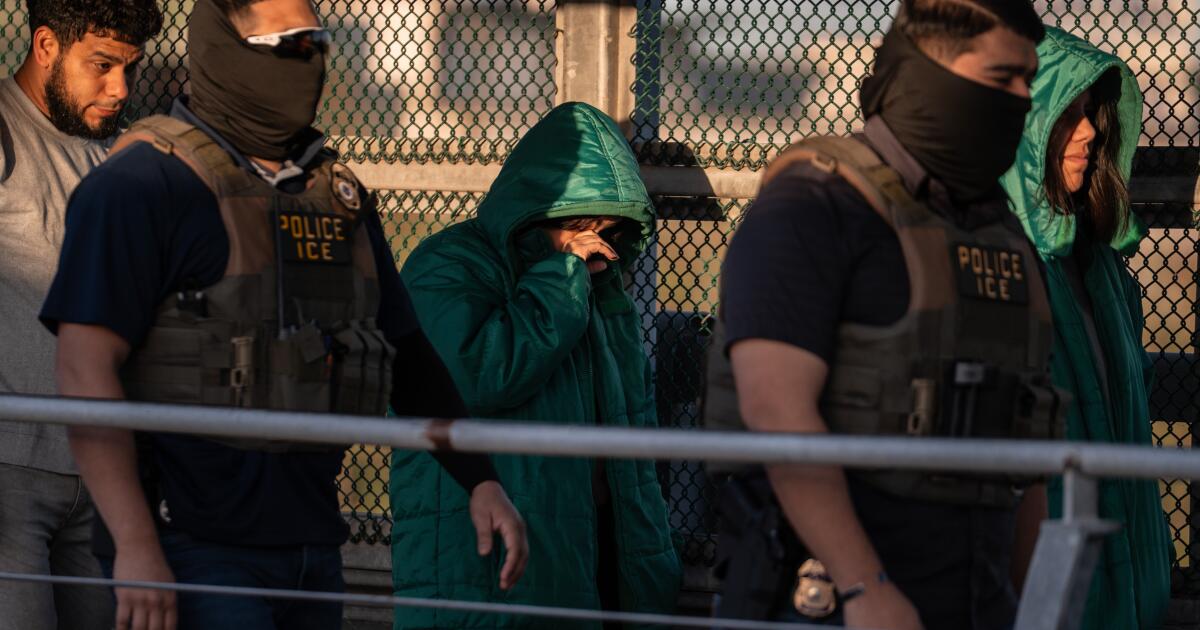
The debate is playing out as the United States, celebrating its 250th year, squares its founding as a nation of immigrants with images of masked federal agents breaking car windows and detaining people suspected of being in the U.S. without proper legal standing.
The Congress, controlled by Republicans, provided some $170 billion in last year’s tax cuts bill to fuel the effort, more than tripling the budget of ICE.
GOP Sen. Eric Schmitt of Missouri, in a fiery speech, fought back against the Democrats’ proposed restraints. “This question about deporting illegal immigrants was on the ballot. President Trump was not bashful,” he said. “And the American people supported the idea that we are going to deport people.”
Yet there are signs of cracks in the Trump coalition. Some Republicans prefer what one called a more humane approach and are sharing their views with Mullin.
Sen. Ron Johnson (R-Wis.), considered a stalwart against illegal immigration, said in his state it’s immigrants who milk most of the dairy cows, and he’s heard from restaurant groups that rely on immigrants to fill jobs.
“Can we just turn back the clock and have … all these people who came in here illegally, just be back home?” he asked.
“In terms of actually implementing that, it’s a lot tougher — particularly, in fact, when you realize a lot of these people, most of them, came here to seek opportunity, wanting freedom,” he said. “They’re working, supporting their family, contributing to organizations and community.”
Mass deportation group wants more
The Mass Deportation Coalition, a group of conservative organizations including the Heritage Foundation and Erik Prince, founder of the security firm Blackwater, was formed recently to keep the administration on track.
It calls last year’s focus on removing violent criminal immigrants “phase one” and says “phase two” should focus this year on deporting immigrants beyond those with violent criminal histories.
Mark Morgan, who served as acting head of ICE and Customs and Border Protection during Trump’s first term and is part of the coalition, said that doesn’t mean roving patrols through Home Depot parking lots. It’s about strategic enforcement focused on immigrants at worksites and those who have overstayed visas and whom a judge has already ordered removed, he said.
But they’re facing opposition from within the Republican Party, Morgan said, particularly from those who want to narrow deportation to mainly criminals and from business groups that want to ease up on worksite enforcement.
“The Republicans that are saying that their definition of targeted enforcement is only criminal, they’re wrong. They’re on the wrong side of this,” he said.
“That’s why you see some of the base that’s really becoming apoplectic because they’re like, ‘Wait a minute. You’re talking about only removing criminals now? That’s not what you promised,’” Morgan said.
What’s coming next
The deportation advocates as well as those working to protect the rights of immigrants see that the Trump administration’s best chance at reaching its goals is creating an environment so unwelcoming for immigrants that they just leave — what’s often called self-deportation.
Mehta, at the ACLU, expects the administration will step up efforts to end temporary permissions that allow immigrants to remain in the U.S. — particularly refugees and asylum seekers — while their cases are making their way through the system. She called it a “deliberate attempt to make people undocumented — to take away lawful status — and then to be able to enforce against them.”
Sen. Alex Padilla (D-Calif.) said he fears that more nonviolent immigrants will be rounded up to fill the new warehouses being equipped as the Trump administration tries to reach its deportation goals.
That’s unacceptable, he said, and among “the key questions that Senator Mullin will have to answer at his confirmation hearing.”
Mascaro, Santana and Cappelletti write for the Associated Press.
Audu Danbaba is in his fifties but trudges like someone in his eighties. He walks carefully, sometimes raising his hands as if they were scales calibrating his body’s equilibrium.
As he emerged from his house on Feb. 25, he moved with visible effort – his feet swollen – counting each step as if needles were being pressed into the soles of his feet. With a laboured exhale, he eased himself down onto a mat that faced his home. The house, made of mud bricks, is located in Nassarawa village, Gwarzo Local Government Area (LGA), in Kano State, northwestern Nigeria.
Audu cannot remember the exact date when the armed kidnappers pulled him from his house, but he does know that it happened roughly two months ago, maybe a little longer. “I spent about 40 days with them, and now I’m in my fourth week since I was released,” he told HumAngle.
Audu’s ordeal is a window into a calculated and expanding kidnapping economy that has quietly taken root in the Gwarzo LGA. Kidnapping in Kano is fuelled by informant networks, strengthened by a porous border with Katsina State, and maintained by a ransom cycle that is systematically draining the little resources left in the poorest communities of the northwestern region.
Late at night, he was lying down when he heard screaming. The attackers had already entered his home and were beating both of his wives and children. He rushed outside and asked what was happening. They told him directly that they had come for him. To protect his family, he surrendered.
Nasarawa village in Gwarzo LGA. Photo: Aliyu Dahiru/HumAngle.
“Here is where they tied my hands and started beating me with the butt of a gun on my legs,” Audu recalled, gesturing toward the spots he said still ache. “Then they pushed me forward, beating me and shoving me until we had walked a long distance through farmland and crossed a road.”
Audu could not recall how long they had trekked with him because he was barely conscious as they dragged him. His sense of measurement also appears faulty, as he confuses miles and kilometres several times while narrating his story.
And so they kept pushing him.
“It was on the road that I noticed security operatives on patrol, as though they had received a tip and were following us. I tried to lift my head, and they struck me with the rifle butt and pinned me down. I couldn’t speak. We stayed like that until the patrol passed, then they pulled me up and kept beating me as we walked,” he added.
What Audu described, the systematic beating of victims after abduction, has emerged as one of the most disturbing features of the kidnapping crisis in northern Nigeria. After reaching the forest, he said he was tied alongside another man who had also been abducted. The torture continued with such ferocity that the other man died a week after he was abducted.
“After his death, his corpse lay there with me for two days before they took him away,” he said.
Different clips showing how abducted victims are tortured by their abductors have recently been circulated online. One footage featured a member of the National Youth Service Corps (NYSC) being tortured repeatedly by his abductors while pleading for help. In another widely shared video, three women were shown being struck as the abductors pressured them to urge their families to pay a ransom.
Another harrowing case is the testimony of a man published by a local media outlet in Zamfara, Maibiredi TV. The man narrated that his abductors burned one of his hands using molten rubber during ransom negotiations to force his family to speed up payment. Only two of his fingers remain.
What is happening in Gwarzo?
At least five Local Government Areas (LGAs) in Kano share borders with neighbouring Katsina State, namely Rogo, Tsanyawa, Shanono, Gwarzo, and Ghari (formerly Kunchi). While Tsanyawa and Shanono have suffered the most attacks, Gwarzo is particularly vulnerable. The town’s western and northern borders are adjacent to Katsina’s Malumfashi and Musawa LGAs, which have been heavily impacted by terrorist activities for a long time.
The dense and ungoverned forests in these regions provide terrorists with continuous cover for their operations. From there, locals say, they flow into Gwarzo.
Gwarzo is particularly vulnerable. Map illustration: Mansir Muhammad/HumAngle.
Locals say that the first recorded case of kidnapping occurred on Dec. 14, 2025, when terrorists on motorcycles attacked the Kururawa community in the Lakwaya district of Gwarzo. They invaded the home of an elderly man known locally as Yakubu Na Tsohuwa and abducted him. His eldest son, Badamasi, was injured while attempting to stop the assailants from taking his father. Within the same week, a second kidnapping incident was reported.
Gwarzo’s security crisis did not start in December 2025. In January 2024, police operatives arrested Isah Lawal, a 33-year-old man from Giwa LGA in Kaduna, during a clearance operation in Karaye LGA along the Kaduna-Kano border. He confessed to fleeing a terrorist camp in Birnin Gwari due to internal gang violence and expressed his intention to establish a new camp in the Gwarzo-Karaye forest. This arrest, which was largely unreported at the time, served as a warning that the authorities did not adequately heed.
The Gwarzo-Karaye forest corridor, straddling Kano’s border LGAs and stretching toward Katsina’s ungoverned zones, had already been identified by displaced armed factions as a viable new territory.
The December 2025 attacks followed a pattern that exposed how openly these groups now operate. Around 20 armed men were spotted in Danjanku village in Malumfashi LGA, heading toward the Kano axis, according to sources. The attack on Zurum Mahauta in the Gidan Malam Sallau community came at midnight on the same day.
To address the growing threat, the Kano State Government deployed forest guards to monitor the woodland areas around Gwarzo. These guards serve a dual purpose: overseeing the reforestation efforts critical to the state’s climate change response, and functioning as an early-warning layer for security threats emerging from the forest.
Get our in-depth, creative coverage of conflict and development delivered to you every weekend.
Subscribe now to our newsletter!
Dahir Hashim, the Commissioner for Environment and Climate Change, told HumAngle that the guards were recruited to tackle both challenges simultaneously: “Managing the forests because of their critical role in halting desertification, and providing rapid alerts whenever security threats are detected.”
HumAngle spoke to Abdullahi Hamza, who leads the team managing one of the forests in Mainika, Gwarzo. He is cautiously optimistic about the project, saying: “This initiative by the government has delivered results; at least for now, we have gone many days without a security incident inside Gwarzo, though there may be areas we are not yet aware of.”
Abdullahi Hamza says the activities of forest guards have reduced the fear of insecurity in Mainika. Photo: Aliyu Dahiru/HumAngle.
There are two forests in Gwarzo. One is known as Dajin Katata, where the forest guard Musa Muhammad previously worked.
“There were constant criminal incidents in that forest; the fear eventually led the previous government to fell the trees to deny criminals cover,” he told HumAngle.
Musa was later reassigned closer to home in Mainika. He does not hide his discomfort with that decision. The felling of Dajin Katata, he said, was ecologically damaging — those trees were a bulwark against the advance of the desert. But he has made his peace with the logic behind it.
“Security comes first,” he said. “You must be alive to breathe the shade of a tree.”
Kidnapping the poor for ransom
Why was Audu a target for abduction in the first place? By every visible measure, even within his own village, Audu is not a wealthy man. His mud-brick house sits among the more neglected on the street, unrepaired and unremarkable.
He told HumAngle himself that shortly before his abduction, he had tried to sell his farmland out of financial desperation, but the offer he received felt so insulting that he walked away from the deal.
“The land was worth between three and a half and four million naira, but they offered me two and a half million naira. I felt disrespected, so I refused,” he said.
Then came a coincidence that, in hindsight, feels like anything but.
Around the same period, the Kano State government began disbursing outstanding allowances owed to former ward councillors across the state. Audu’s son, Anas, had served as a councillor between 2020 and 2023, which placed him among the beneficiaries. The payment, amounting to roughly ₦6 million, was not made quietly; the state government publicised it widely. Photographs were taken at the government house. Screenshots of bank alerts began circulating on social media, shared by recipients whose names and faces were now attached to a specific, traceable sum.
The publicity became something else entirely.
“Many people had their eyes on that money,” said Mallam Saidu, Audu’s neighbour. “There is a strong suspicion that it was this payment that drew the kidnappers to Danbaba’s house that night.”
Audu suspects the same. He says his captors told him, as they held him, that someone had directed them to him. They did not tell him who.
“They showed me about five people from a distance,” he said. “I could barely lift my head to look, and when I did, I didn’t recognise any of them.”
Later, during ransom negotiations, Audu says he kept hearing one side of a phone conversation — someone telling the kidnappers that they should push his family harder to bring more, insisting they had the money and should produce it.
Across northern Nigeria, kidnapping has evolved from opportunistic crime into a sophisticated industry, and at its operational core lies a network of human intelligence that security agencies have struggled, and often failed, to penetrate or counter.
Transborder lands between Katsina and Kano. Illustration: Mansir Muhammed/HumAngle
Kano has witnessed a surge in kidnapping and criminal operations aided by local informants and snitches within the state’s localities. This development seems to have inflated security threats in local communities. Musbahu Shanono, for instance, is originally from Faruruwa in Kano but works in Lagos, in Nigeria’s South West.
When HumAngle spoke with Musbahu in 2025, he described the creeping anxiety that now accompanies what should be an ordinary homecoming – the fear of informants making him a stranger in his own community.
“Now I only come at night,” he said. “No one should know I’m around. Not even my friends. Not until I’m sure it’s safe.”
According to security authorities across northern Nigeria, kidnappers conduct detailed advance planning before armed teams execute raids at vulnerable hours, overwhelming lightly protected targets and transporting captives deep into remote forest hideouts.
In 2021, the Zamfara State government announced the arrest of more than 2,000 suspected informants. The following year, the state went further to enact legislation prescribing life imprisonment for anyone found to have aided kidnapping operations or other criminal activity in the state.
Yet the problem has not abated. Security authorities across Nigeria acknowledge that informant networks remain one of the most intractable elements of the crisis, embedded in communities, operating in plain sight, and extraordinarily difficult to root out.
Even Nigeria’s Minister of Defence, then-Chief of Defence Staff, Christopher Musa, admitted publicly in 2024 that informants were being used not only to identify and track targets, but to actively misdirect security forces pursuing terrorists.
“They make the troops go elsewhere, and when they get there, they meet nothing,” Musa said.
The price of coming home
Now Audu is back. But his return has cost his family everything.
“They only released me after we paid ₦8 million and three motorcycles,” he recalled.
The family sold whatever they could find. The farm that he had refused to part with for two and a half million naira, the offer he had walked away from as an insult to his dignity, went for only ₦1.8 million in the end due to desperation.
Danbaba’s legs are recovering a month after he returned home. Photo: Aliyu Dahiru/HumAngle.
“Then we went around asking for help – some people gave us gifts, others gave us loans,” said Anas, his eldest son. Today, after his father’s release, the family is saddled with a debt of approximately ₦4.5 million and has no clear idea where to begin repaying it.
Audu carries the weight in his body as much as in his finances. “Even after I returned, everyone who saw me broke into tears at the state I was in,” he said. “Doctors have examined me and given me medication, but the pain in my body has not stopped.”
His deeper anguish is the problem he cannot solve: how does a man who had nothing rebuild from less than nothing? “We sought help from every direction and found very little,” Anas added. “We are still appealing to the government, even if it is just to help settle the debt, because everything we had was consumed by this ordeal.”
For the remaining residents of Nassarawa and the villages clustered along Gwarzo’s edges, the haunting question is not about debt. It is about prevention and how to protect themselves from the fate that swallowed Audu before the kidnappers come again.
MIAMI — Voting technology firm Smartmatic is seeking to dismiss a criminal indictment for money laundering, blaming President Trump and his allies for seeking its prosecution as part of a “campaign of retribution” against those they blame for his 2020 election loss.
Smartmatic’s parent company, UK-based SGO Corporation, was added to a criminal indictment last fall previously charging several executives with paying $1 million in bribes to election officials in the Philippines.
In a motion to dismiss the indictment filed Tuesday, attorneys for Smartmatic said the company had been cooperating with the Justice Department since it first learned of its investigation in 2021, including by producing millions of pages of documents and making presentations to federal agents. A trial date for the executives, including co-founder Roger Pinate, had been set and the company believed that it was in the clear.
But when Trump returned to the White House, the Justice Department reversed course and decided to press charges against Smartmatic. Attorneys for the company said the decision was prompted by Trump’s demands to prosecute his perceived enemies and his “mantra” that Smartmatic helped rig the 2020 U.S. presidential election won by Joe Biden — allegations that are at the heart of a $2.7-billion lawsuit filed by Smartmatic against the president’s allies in the media.
“The prosecution of SGO furthers their collective false narrative that President Trump did not actually lose the 2020 election,” Smartmatic said in the filing in Miami federal court.
The White House did not immediately respond to a request for comment.
Attorneys likened the prosecution to the Justice Department’s targeting of Kilmar Armando Ábrego García, a Salvadoran migrant who was criminally charged for conduct years earlier after he successfully sued the Trump administration over its decision to deport him.
In the years since the election, the filing states, “Smartmatic USA has exercised its right to hold those individuals and entities legally accountable for their deluge of defamatory statements and the attendant damage inflicts on its business, putting it squarely in the crosshairs for retribution.”
The criminal case against Smartmatic and its employees stems from payments, between 2015 and 2018, that were allegedly made to obtain a contract with the Philippine government to help run that country’s 2016 presidential election. Pinate, who no longer works for Smartmatic but remains a shareholder, has pleaded not guilty.
As part of the criminal case, prosecutors in August sought the court’s permission to introduce evidence they argue shows that revenue from a $300-million contract with Los Angeles County to help modernize its voting systems was diverted to a “ slush fund” controlled by Pinate through the use of overseas shell companies, fake invoices and other means.
They also accused Pinate of secretly bribing Venezuela’s longtime election chief by giving her a luxury home with a pool in Caracas. Prosecutors say the home was transferred to the election chief in an attempt to repair relations following Smartmatic’s abrupt exit from Venezuela in 2017 when it accused then-President Nicolas Maduro ’s government of manipulating tallied results in elections for a rubber-stamping constituent assembly.
Smartmatic was founded more than two decades ago by a group of Venezuelans who found early success running elections while the late Hugo Chavez, a devotee of electronic voting, was in power. The company later expanded globally, providing voting machines and other technology to help carry out elections in 25 countries, from Argentina to Zambia.
But Smartmatic has said its business tanked after Fox News gave Trump’s lawyers a platform to paint the company as part of a conspiracy to steal the 2020 election.
Fox said it was legitimately reporting on newsworthy events but eventually aired a piece refuting the allegations after Smartmatic’s lawyers complained. Nonetheless, it has aggressively defended itself against the defamation lawsuit in New York — arguing that the company was facing imminent collapse over its own internal misconduct, not due to any negative coverage.