April 1 (UPI) — NASA launched its most powerful rocket yet, the Space Launch System, on Wednesday to send the crewed Artemis II mission to the moon, the first in more than five decades.
The mission had liftoff around 6:35 p.m. EDT from the Kennedy Space Center in Florida.
Within minutes of liftoff, Artemis II commander Reid Wiseman told operators on the ground, “we have a beautiful moonrise, we’re headed right at it.”
The four-person crew — which also includes NASA’s Victor Glover and Christina Koch, and Canadian Space Agency’s Jeremy Hansen — is expected to enter the moon’s orbit in about six days. The spacecraft won’t land on the moon, but will orbit around it before returning to Earth.
The 2-hour launch window for Artemis II began around 6:24 p.m., and most of the pre-flight checks were successfully.
Shortly after the crew members boarded the craft, though, NASA officials had to address a pair of issues.
Derrol Nail, of NASA, said officials fixed a problem with the Space Launch System rocket’s flight termination system.
Later, there was a problem with the battery on the launch abort system on Orion. This system ejects the capsule away from the rocket in case there’s a problem with the rocket during flight. NASA detected issues with temperature readings on the battery but had resolved the issue before schedule launch.
The 10-day trip will be the first crewed flight to the moon in more than 50 years and the farthest distance from Earth traveled by humans.
About 9 minutes after the launch, the Artemis crew entered orbit, traveling about 15,000 mph. During Earth orbit, the crew has a series of tasks to complete before they’re able to make their way to the moon.
The Artemis I mission in 2022 flew around the moon but didn’t have a crew aboard.
Children race to push colored eggs across the grass during the annual Easter Egg Roll event on the South Lawn of the White House in Washington on April 21, 2025. Easter this year takes place on April 5. Photo by Samuel Corum/UPI | License Photo
Weekly insights and analysis on the latest developments in military technology, strategy, and foreign policy.
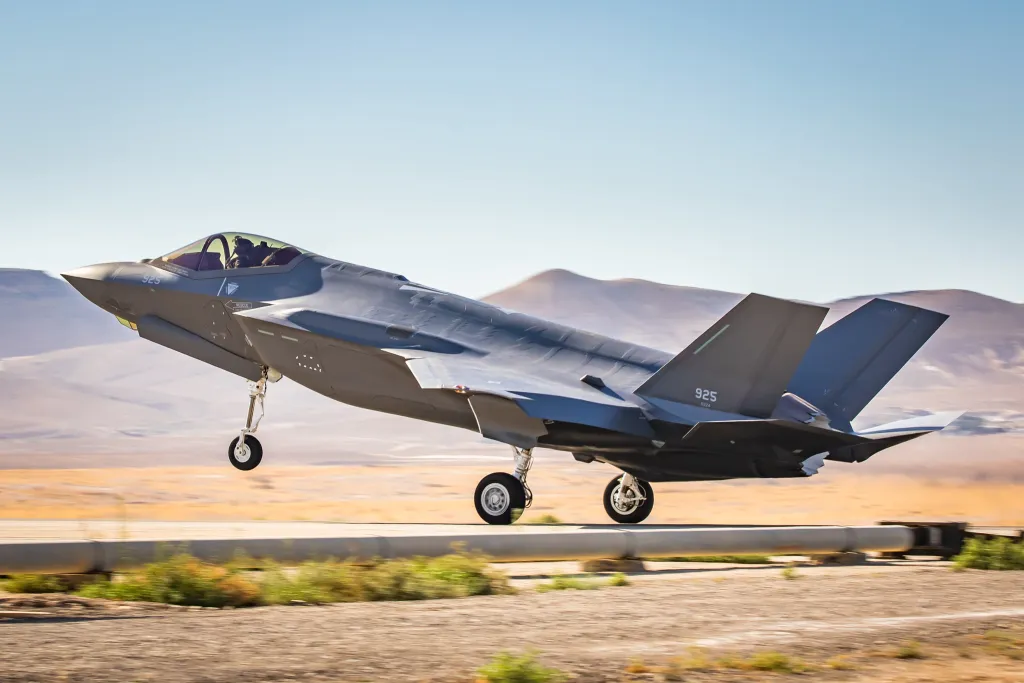
For the first time, an F-35 has shot down a crewed aircraft in combat. According to the Israeli military, an Israeli Air Force (IAF) F-35I Adir brought down an Iranian Yak-130 Mitten combat trainer over Tehran. This would also be the first IAF air-to-air kill against a crewed combat aircraft since November 1985, when an F-15 claimed a pair of Syrian MiG-23 Floggers over Lebanon.
An Israeli Air Force F-35I. Amit Agronov/IAF
The announcement was made earlier today by the Israel Defense Forces (IDF) via their social media channels. There are no further details at this point, but the IDF says the engagement occurred “a short time ago.”
מטוס אדיר (F35I) של חיל האוויר הישראלי הפיל לפני זמן קצר מטוס קרב איראני (YAK-130) מעל שמי טהרן.
זו הפלה הראשונה בעולם של מטוס קרב מאויש על ידי F-35
Air Force Commander Tomer Bar congratulates F-35I “Adir” pilot who carried out the first-ever shoot-down of an Iranian fighter jet over Tehran pic.twitter.com/hBTisPSo0s
There is at least one unverified video that purports to show the stricken Yak-130 coming down, accompanied by two possible ejections, in a mountainous area north of Tehran.
Footage shows the moment two pilots ejected from a fighter jet, shot down north of Tehran.
Previously, unverified videos had been posted to social media purporting to show at least one Yak-130 operated by the Islamic Republic of Iran Air Force (IRIAF) flying over Tehran, while armed with air-to-air missiles.
The shoot-down of Iranian manned tactical jets follows two others that occurred at the hands of the Qatari Air Force, which swatted a pair of Su-24 Fencers out of the sky.
🇶🇦🇮🇷 Qatar claims its forces shot down two Sukhoi Su-24 tactical bombers operated by the Islamic Republic of Iran Air Force. pic.twitter.com/vfqmWPZlB1
— Status-6 (War & Military News) (@Archer83Able) March 2, 2026
While the Russian-made Yak-130 was developed primarily as an advanced trainer, the jet has a significant combat capability, with the option to carry gun pods, bombs, and rockets as well as R-73 series (AA-11 Archer) infrared-guided air-to-air missiles.
An Islamic Republic of Iran Air Force Yak-130 armed with an R-73 air-to-air missile. via X
The Yak-130 is among the newest combat aircraft in the Iranian inventory.
As you can read about here, evidence of Yak-130 deliveries to Iran emerged in late 2023, when imagery published by the Tasnim News Agency showed one of the jets in a hangar displaying a high-visibility IRIAF paint scheme. Another video showed a Yak-130 with the same paint job reportedly taxiing at Iran’s Isfahan Air Base.
Undated image and video leak of Yak-130 in Isfahan, Iran. Yesterday there were rumours that 2 Yak-130s had been transferred to Iran, and today these images have been shared through unofficial sources.
The delivery of Yak-130s to Iran was one of the signs of Tehran securing new Russian equipment in exchange for supplying Moscow’s war effort in Ukraine. This burgeoning military relationship has also seen Russia acquire Iranian drones starting in 2022, after which Iranian-made Shahed-136 kamikaze drones (and their Russian-made derivatives) have been a staple of Russia’s raids against Ukraine.
In exchange for drones and other supplies, it was expected that Russia would provide more advanced weapons systems to Iran, among them a batch of Su-35 Flanker multirole fighters. The claimed Su-35 deal has yet to materialize.
Although not in any way comparable to the Su-35, the Yak-130 is arguably the most advanced fast jet in service with Iran overall. However, its combat capabilities are mainly limited to the light attack role, or drone-hunting. According to unconfirmed reports, the Yak-130 that fell victim to an F-35 today was flying a counter-drone mission over the Iranian capital at the time.
At the very least, the fact that one or more Yak-130s have been operating over Tehran in any capacity indicates the IRIAF’s continued ability to put some aircraft in the sky despite the significant blows delivered on the ground by U.S. and Israeli strikes, which have also targeted Iranian airbases. The video below shows Iranian Su-22 Fitter swing-wing attack jets being destroyed on the tarmac by U.S. strikes.
However, the Yak-130 is clearly no match for the F-35.
The IAF has been at the forefront of introducing the Joint Strike Fighter to combat.
In May 2018, Israel announced that it had become the first operator to use the F-35 on offensive operations, and, since then, it has also recorded success in aerial combat against Iranian drones.
Making History:
Last year, Israeli “Adir” (F-35I) fighter jets successfully intercepted two Iranian UAVs launched towards Israeli territory. pic.twitter.com/FQsEjKzxct
This time last year, Israel confirmed that its F-35s had flown airstrikes using external ordnance. The F-35’s so-called ‘beast mode,’ featuring heavier loads on underwing pylons, is familiar, but as far as is known, it had not previously been called upon operationally by any other countries.
The IAF F-35 fleet has seen extensive combat action since October 2023. It has been involved in raids on targets in Gaza and Lebanon and has also taken part in long-range strikes against Iranian-backed Houthi militants in Yemen and against Iran.
These long-endurance missions have been aided by Israel’s reported development of a means of extending the range of its F-35s, allegedly providing them with enough reach to hit targets in Iran without needing aerial refueling.
The Adir has also been used in an air defense capacity against other uncrewed targets, including against Houthi cruise missiles, as you can read about here.
As it stands, the latest milestone in the Israel Air Force’s Adir story is the first instance of an air-to-air kill of a crewed aircraft — as far as we know — by any F-35 operator.
Update, 11:10 a.m. EST
On its website, the IAF has provided more details of the engagement. These suggest that the kill may have been achieved at beyond visual range.
From the article: “Various types of Israeli aircraft were deployed against the hostile aircraft, and the one chosen to deal with the threat was the F-35I, which was endowed with several features that gave it an advantage in the scenario.”
The article quotes Brigadier General D., commander of Nevatim Base, from where the F-35 was launched:
“It has particularly advanced sensors, which were able to lock onto the target quickly and accurately, and is armed with long-range missiles, which the pilots are particularly trained in, and are suitable for this type of mission.”
Brigadier General D. continues:
“We detected it, got on it — and launched at it. There was no overly complicated air battle here, no dogfight or aerial scuffle. There was a rapid response here — which ended in making history in the skies of Iran.”
Update, March 5:
The IAF has now released footage showing the engagement of the Yak-130 shootdown: