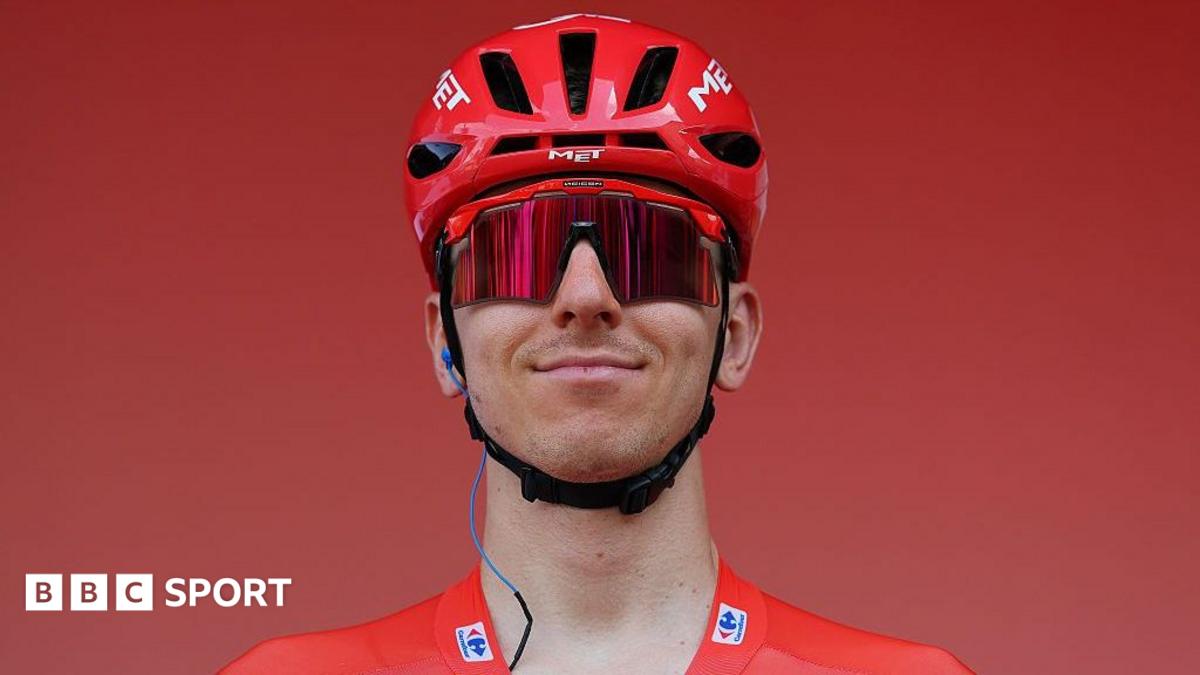
crashing

Vuelta a Espana: Tadej Pogacar abandons after crashing during stage eight

Race leader Tadej Pogacar has abandoned the Vuelta a Espana after crashing during stage eight.

The world champion, who was looking to complete a full set of Grand Tour victories, crashed with about 33km to go.

Pogacar, 27, was riding in the midst of the peloton when he came off his bike, hurting his left shoulder and cutting the left side of his face.

The Slovenian appeared to try to get back on his bike before sitting back down again.

He then walked unaided into an ambulance. It is the first time he has abandoned a Grand Tour.

The overwhelming favourite to win the three-week long race had started the stage three minutes and 50 seconds clear of Spaniard Enric Mas in second place.

In what was a chaotic race, another crash occurred in the finishing straight as France’s Bryan Coquard claimed his first stage win in a Grand Tour.

The 34-year-old edged Lidl-Trek rider Mads Pedersen in a photo finish.

“I think it has been 13 years, it has been a lot of work and I have finished second a lot of times,” Coquard told TNT Sports.

“I have not been in good positions in the first two sprints, I know I have good legs. Maybe I climb better now, I am fast again.”

Movistar rider Mas now leads the general classification by one minute and 11 seconds from Decathlon CMA CGM rider Felix Gall.

He is the first Spaniard to lead the Vuelta since Jesus Herrada in 2018 but a sombre Mas opted not to wear the red jersey when presented with it on the podium, instead holding it in front of him.

“It’s a real shame,” Mas said about Pogacar. “I hope he gets better quickly. We’ve still got a few races left and I hope he’ll be in good shape for them.”

Six-time Grand Tour winner Pogacar was on course to win all three of the sport’s biggest stage races, having already won five Tours de France and a Giro d’Italia.

Having become the joint most successful Tour de France champion of all time last month, the UAE Team Emirates-XRG rider is aiming to become the ninth rider to win all three Grand Tours.

Pogacar has also won almost all of the sport’s biggest races. In addition to his multiple stage race victories, the two-time road world champion has won 13 one-day monument races, including the Tour of Flanders (three times), Milan-San Remo (once), Il Lombardia (five times) and Liege-Bastogne-Liege (four times).

In 2025, he recorded his best finish of second in the other monument – Paris-Roubaix.
Source link

Seven reasons why U.S. soccer keeps crashing out of World Cup

p]:text-cms-story-body-color-text”>

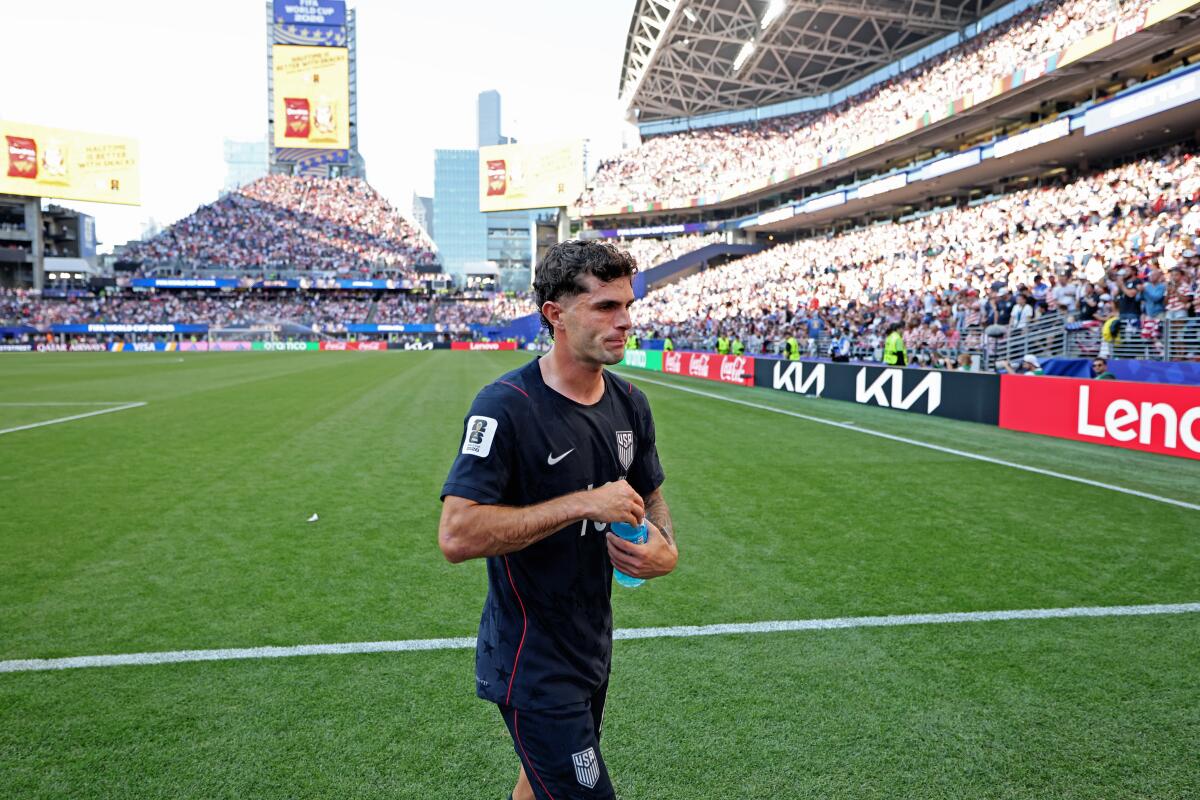
U.S. forward Christian Pulisic heads to the locker room at halftime during the loss to Belgium.

U.S. forward Christian Pulisic heads to the locker room at halftime during the loss to Belgium.

(Allen J. Schaben / Los Angeles Times)

More Americans are playing for bigger clubs and having more success in Europe than ever before, but that pipeline has yet to produce a true superstar. Many of the teams that have had success in this tournament have at least one player — Mbappé, Haaland, Lionel Messi, Harry Kane — who can change the game on their own.

The U.S. doesn’t have anyone who would be sure to start on any of the World Cup semifinalists and until it does, closing the gap will be difficult.

“We are USA and [we’re] competing against Belgium, Portugal,” Pochettino said last March. “I think for sure Belgium and Portugal have [players] in the top 100. We don’t.”

He is right. When the Guardian published its annual list of the world’s top players last winter, Christian Pulisic, the top American, didn’t make the top 100. And he didn’t play a full game in this tournament, missing one to injury, leaving three early and entering another as a late second-half substitute. He played just 223 minutes — 19 more than Ricardo Pepi — and finished with one assist.

Landon Donovan was arguably the closest thing to a game-changing player the U.S. had, so it’s no surprise he scored key goals in the team’s most important World Cup games in the last 32 years: one against Algeria in stoppage time in 2010 that allowed the Americans to finish atop their group for the first time since 1930, and another against Mexico in the round of 16 in 2002, sending the team to the quarterfinals for the only time.

If those are structural things that have long held U.S. Soccer back, there also were issues specific to this team, a supposed Golden Generation whose core was formed in the wake of the failure to qualify for the 2018 World Cup.

The talent was undeniable, which led to great expectations. But what has this generation accomplished? Two round-of-16 exits in the World Cup, one Gold Cup title in the last four tournaments — the team’s worst stretch this century — a fourth-place finish in the last Nations League and a group-stage departure in the last Copa América.

Impressive wins over Paraguay and Australia to start the World Cup gave the Golden Generation a bit of a shine and suggested progress. But when the Americans met a top-10 team in Belgium, the matchup proved a mismatch.

“We want to have higher hopes,” Pulisic said. “We want to be able to go and compete with some of the best in the world. We just still have that next step to climb.”

Against Belgium, that step looked as steep as Mt. Everest.

Source link