In recent weeks, Marin County Registrar Natalie Adona has been largely focused on the many mundane tasks of local elections administrators in the months before a midterm: finalizing voting locations, ordering supplies, facilitating candidate filings.
But in the wake of unprecedented efforts by the Trump administration to intervene in state-run elections, Adona said she has also been preparing her staff for far less ordinary scenarios — such as federal officials showing up and demanding ballots, as they recently did in Georgia, or immigration agents staging around polling stations on election day, as some in President Trump’s orbit have suggested.
“Part of my job is making sure that the plans are developed and then tested and then socialized with the staff so if those situations were to ever come up, we would not be figuring it out right then and there. We would know what to do,” Adona said. “Doing those sort of exercises and that level of planning in a way is kind of grounding, and makes things feel less chaotic.”
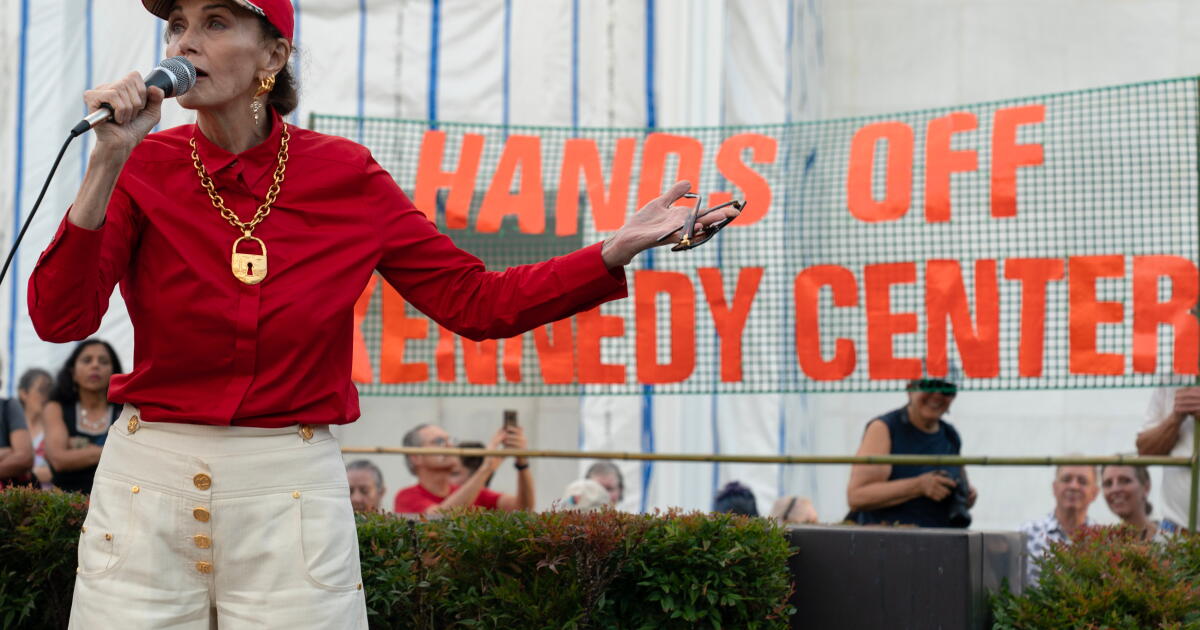
Natalie Adona faced harassment from election deniers and COVID anti-maskers when she served as the registrar of voters in Nevada County. She now serves Marin County and is preparing her staff for potential scenarios this upcoming election, including what to do if immigration agents are present.
(Jess Lynn Goss / For The Times)
Across California, local elections administrators say they have been running similar exercises to prepare for once unthinkable threats — not from local rabble-rousers, remote cyberattackers or foreign adversaries, but their own federal government.
State officials, too, are writing new contingency plans for unprecedented intrusions by Trump and other administration officials, who in recent days have repeated baseless 2020 election conspiracies, raided and taken ballots from a local election center in Fulton County, Ga., pushed both litigation and legislation that would radically alter local voting rules, and called for Republicans to seize control of elections nationwide.
California’s local and state officials — many of whom are Democrats — are walking a fine line, telling their constituents that elections remain fair and safe, but also that Trump’s talk of federal intervention must be taken seriously.
Their concerns are vastly different than the concerns voiced by Trump and other Republicans, who for years have alleged without evidence that U.S. elections are compromised by widespread fraud involving noncitizen voters, including in California.
But they have nonetheless added to a long-simmering sense of fear and doubt among voters — who this year have the potential to radically alter the nation’s political trajectory by flipping control of Congress to Democrats.
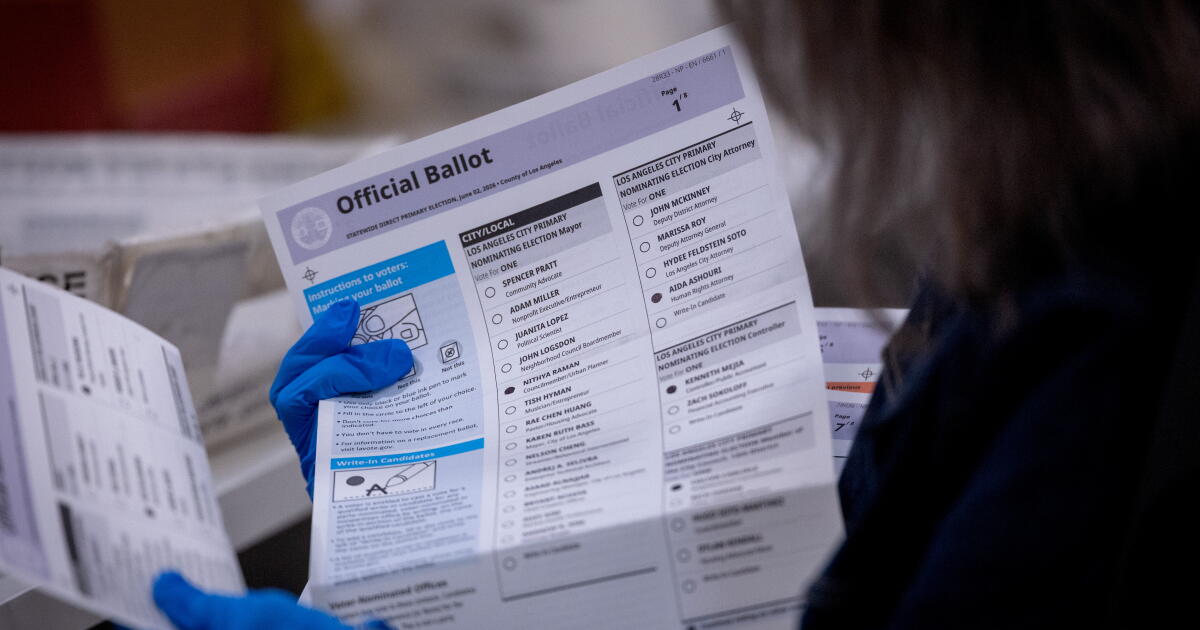
An election worker moves ballots to be sorted at the Orange County Registrar of Voters in Santa Ana on Nov. 5, 2024.
(Allen J. Schaben / Los Angeles Times)
Trump has said he will accept Republican losses only if the elections are “honest.” A White House spokesperson said Trump is pushing for stricter rules for voting and voter registration because he “cares deeply about the safety and security of our elections.”
Rick Hasen, an election law expert and director of the Safeguarding Democracy Project at UCLA Law, said some of what Trump says about elections “is nonsensical and some is bluster,” but recent actions — especially the election center raid in Georgia — have brought home the reality of his threats.
“Some worry that this is a test run for trying to seize ballot boxes in 2026 and prevent a fair count of the votes, and given Trump’s track record, I don’t think that is something we can dismiss out of hand,” Hasen said. “States need to be making contingency plans to make sure that those kinds of things don’t happen.”
The White House dismissed such concerns, pointing to isolated incidents of noncitizens being charged with illegally voting, and to examples of duplicate registrations, voters remaining on rolls after death and people stealing ballots to vote multiple times.
“These so-called experts are ignoring the plentiful examples of noncitizens charged with voter fraud and of ineligible voters on voter rolls,” said Abigail Jackson, the White House spokesperson.
Experts said fraudulent votes are rare, most registration and roll issues do not translate into fraudulent votes being cast, and there is no evidence such issues swing elections.
A swirl of activity
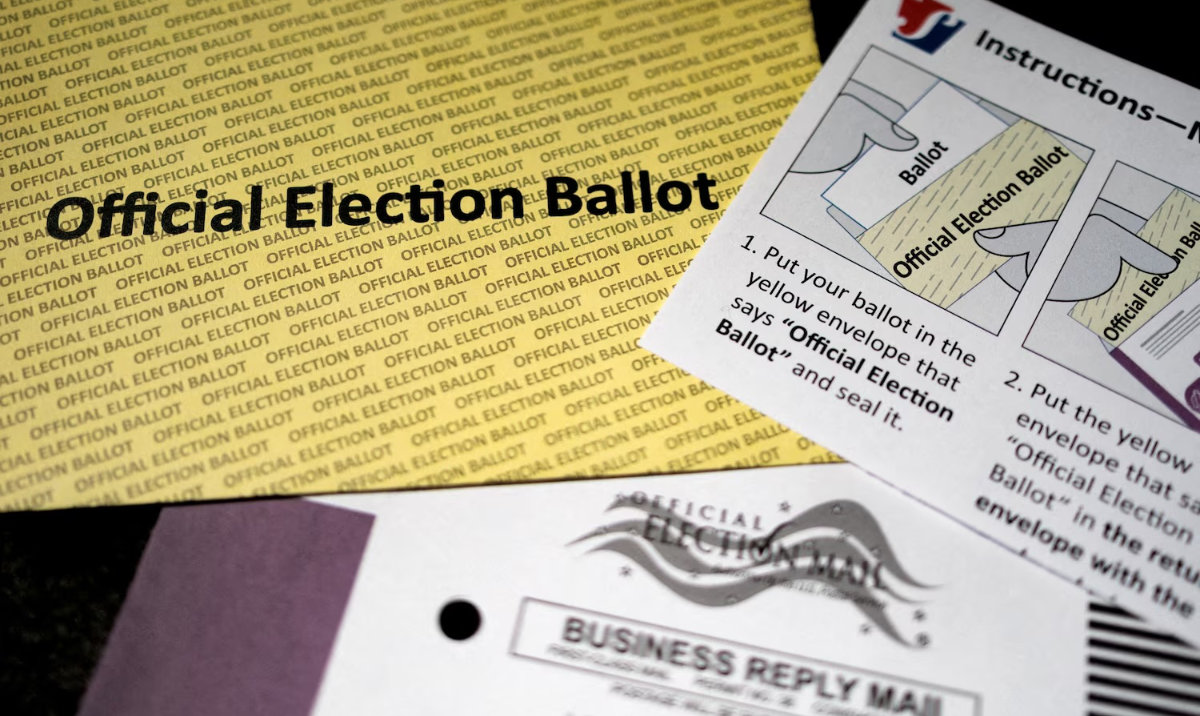
Early in his term, Trump issued an executive order calling for voters nationwide to be required to show proof of U.S. citizenship, and for states to be required to disregard mail ballots received after election day. California and other states sued, and courts have so far blocked the order.
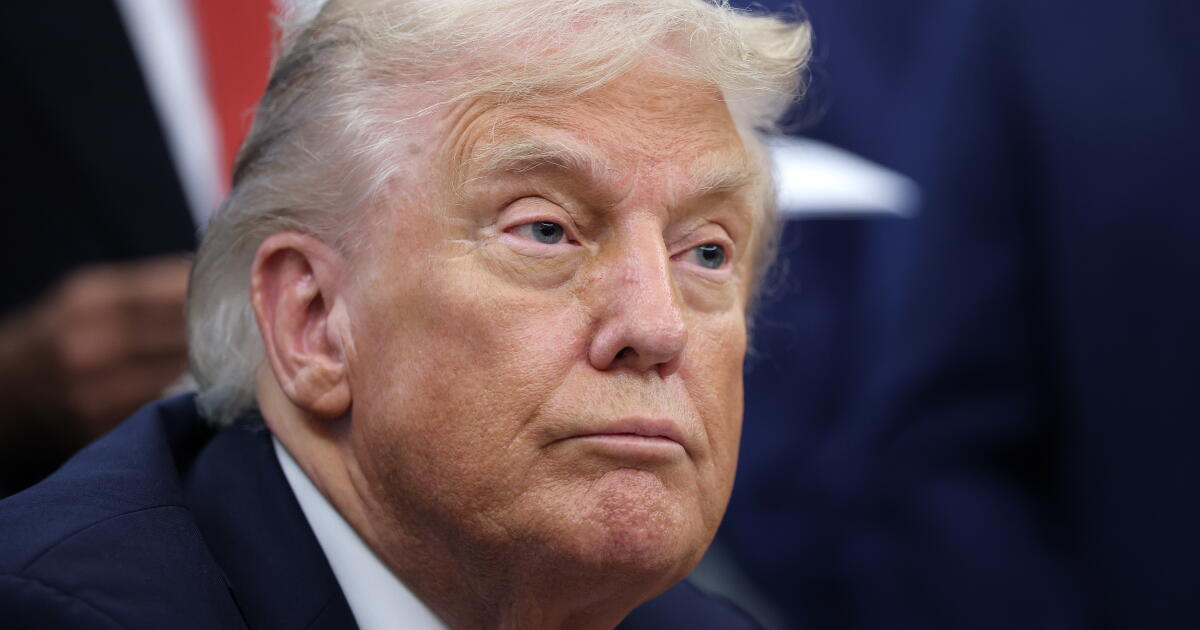
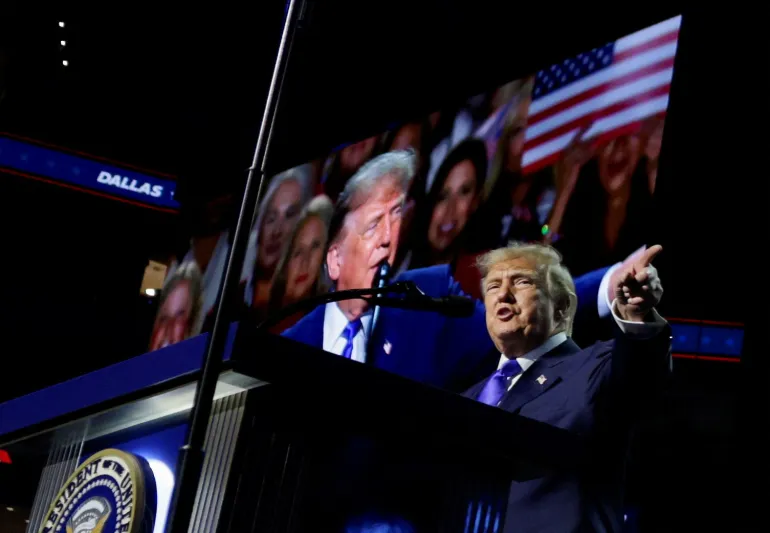
President Trump walks behind former chairperson of the Republican National Committee Michael Whatley as he prepares to speak during a political rally in Rocky Mount, N.C., on Dec. 19.
(Andrew Caballero-Reynolds / AFP via Getty Images)
Longtime Trump advisor and ally Stephen K. Bannon suggested U.S. Immigration and Customs Enforcement agents will be dispatched to polling locations in November, reprising old fears about voter intimidation. White House Press Secretary Karoline Leavitt said she couldn’t rule that out, despite it being illegal.
Democrats have raised concerns about the U.S. Postal Service mishandling mail ballots in the upcoming elections, following rule changes for how such mail is processed. Republicans have continued pushing the SAVE America Act, which would create new proof of citizenship requirements for voters. The U.S. Supreme Court is considering multiple voting rights cases, including one out of Louisiana that challenges Voting Rights Act protections for Black representation.
Charles H. Stewart, director of the MIT Election Data + Science Lab, said the series of events has created an “environment where chaos is being threatened,” and where “people who are concerned about the state of democracy are alarmed and very concerned,” and rightfully so.
But he said there are also “a number of guardrails” in place — what he called “the kind of mundane mechanics that are involved in running elections” — that will help prevent harm.
California prepares
California leaders have been vociferous in their defense of state elections, and said they’re prepared to fight any attempted takeover.
“The President regularly spews outright lies when it comes to elections in this country, particularly ones he and his party lose,” Gov. Gavin Newsom said in a statement. “We will continue to correct those lies, rebuild much-needed trust in our democratic institutions and civic duties, and defend the U.S. Constitution’s grant to the states authority over elections.”
California Atty. Gen. Rob Bonta and Secretary of State Shirley Weber take questions after announcing a lawsuit to protect voter rights in 2024.
(Damian Dovarganes / Associated Press)
California Atty. Gen. Rob Bonta said in an interview that his office “would go into court and we would get a restraining order within hours” if the Trump administration tries to intervene in California elections, “because the U.S. Constitution says that states predominantly determine the time, place and manner of elections, not the president.”
Weber told The Times that the state has “a cadre of attorneys” standing by to defend its election system, but also “absolutely amazing” county elections officials who “take their job very seriously” and serve as the first line of defense against any disruptions, from the Trump administration or otherwise.
Dean Logan, Los Angeles County’s chief elections official, said his office has been doing “contingency planning and tabletop exercises” for traditional disruptions, such as wildfires and earthquakes, and novel ones, such as federal immigration agents massing near voting locations and last-minute policy changes by the U.S. Postal Service or the courts.
“Those are the things that keep us up at night,” he said.
Los Angeles County Registrar-Recorder Dean Logan said the county no longer has ballots from the 2020 election.
(Irfan Khan / Los Angeles Times)
Logan said he is not currently concerned about the FBI raiding L.A. County elections offices because, while Fulton County still had its 2020 ballots on hand due to ongoing litigation, that is not the case for L.A. County, which is “beyond the retention period” for holding, and no longer has, its 2020 ballots.
However, Logan said he does consider what happened in Georgia a warning that the Trump administration “will utilize the federal government to go in and be disruptive in an elections operation.”
“What we don’t know is, would they do that during the conduct of an election, before an election is certified?” Logan said.
Kristin Connelly, chief elections officer for Contra Costa County, said she’s been working hard to make sure voters have confidence in the election process, including by giving speeches to concerned voters, expanding the county’s certified election observer program, and, in the lead-up to the 2024 election, running a grant-funded awareness campaign around election security.
Connelly — who joined local elections officials nationwide in challenging Trump’s executive order on elections in court — said she also has been running tabletop exercises and coordinating with local law enforcement, all with the goal of ensuring her constituents can vote.
“How the federal government is behaving is different from how it used to behave, but at the end of the day, what we have to do is run a mistake-free, perfect election, and to open our offices and operation to everybody — especially the people who ask hard questions,” she said.
Lessons from the past
Several officials in California said that as they prepare, they have been buoyed by lessons from the past.
Before being hired by the deep-blue county of Marin in May, Adona was the elected voting chief in rural Nevada County in the Sierra foothills.
In 2022, Adona affirmed that Trump’s 2020 election loss to Democrat Joe Biden was legitimate and enforced a pandemic mask mandate in her office. That enraged a coalition of anti-mask, anti-vaccine, pro-Trump protesters, who pushed their way into the locked election office.
Protesters confronted Adona and her staffers, with one worker getting pushed down. They stationed themselves in the hallway, leaving Adona’s staff too terrified to leave their office to use the hallway bathroom, as local, state and federal authorities declined to step in.
“At this point, and for months afterwards, I felt isolated and depressed. I had panic attacks every few days. I felt that no one had our back. I focused all my attention on my staff’s safety, because they were clearly nervous about the unknown,” Adona said during subsequent testimony before the Senate Judiciary Committee.
In part because she knows what can go wrong, Adona said her focus now is on preparing her new staff for whatever may come, while following the news out of Georgia and trying to maintain a cool head.
“I would rather have a plan and not use it than need a plan and not have one,” she said.
Clint Curtis, the clerk and registrar of voters in Shasta County — which ditched its voting machines in 2023 amid unfounded fraud allegations by Trump — said his biggest task ahead of the midterms is to increase both ballot security and transparency.
Since being appointed to lead the county office last spring, the conservative Republican from Florida has added more cameras and more space for election observers — which, during the recent special election on Proposition 50, California’s redistricting measure, included observers from Bonta’s and Weber’s offices.
He has also reduced the number of ballot drop boxes in the vast county from more than a dozen to four. Curtis told The Times he did not trust the security of ballots in the hands of “these little old ladies running all over the county” to pick them up, and noted there are dozens of other county locations where they can be dropped off. He said he invited Justice Department officials to observe voting on Proposition 50, though they didn’t show, and welcomes them again for the midterms.
“If they can make voting safer for everybody, I’m perfectly fine with that,” he said. “It always makes me nervous when people don’t want to cooperate. Whatcha hiding? It should be: ‘Come on in.’”
Election workers inspect ballots after extracting them from envelopes on election night at the Los Angeles County Ballot Processing Center on Nov. 5, 2024, in the City of Industry.
(Gina Ferazzi / Los Angeles Times)
Weber, 77 and the daughter of an Arkansas sharecropper whose family fled Southern racism and threats of violence to reach California, said that while many people in the U.S. are confronting intense fear and doubt about the election for the first time, and understandably so, that is simply not the case for her or many other Black people.
“African Americans have always been under attack for voting, and not allowed to vote, and had new rules created for them about literacy and poll taxes and all those other kinds of things, and many folks lost their lives just trying to register to vote,” Weber said.
Weber said she still recalls her mother, who had never voted in Arkansas, setting up a polling location in their home in South L.A. each election when Weber was young, and today draws courage from those memories.
“I tell folks there’s no alternative to it. You have to fight for this right to vote. And you have to be aware of the fact that all these strategies that people are trying to use [to suppress voting] are not new strategies. They’re old strategies,” Weber said. “And we just have to be smarter and fight harder.”
The United States Supreme Court has ruled in favour of a California redistricting measure meant to net the Democratic Party more congressional seats, rejecting a challenge from the state Republican Party.
There was no dissent in Wednesday’s decision, and the conservative-majority court did not offer any explanation for its decision.
Recommended Stories
list of 3 itemsend of list
Instead, its order was comprised of a single sentence, stating that the Republican application “is denied”.
Previously, in December, the Supreme Court had allowed a similar redistricting measure, designed to benefit Republicans in Texas, to move forward.
Democratic officials in California have applauded Wednesday’s decision as fair, given that Republican President Donald Trump has led a nationwide push to redraw congressional districts in his party’s favour.
“Donald Trump said he was ‘entitled’ to five more Congressional seats in Texas,” California Governor Gavin Newsom said in a written statement.
“He started this redistricting war. He lost, and he’ll lose again in November.”
California’s Attorney General Rob Bonta echoed Newsom’s remarks, blaming Trump for launching a kind of redistricting arms race that threatened to disenfranchise Democratic voters.
“The US Supreme Court’s decision is good news not only for Californians, but for our democracy,” Bonta said in the statement.
The Supreme Court’s decision marks a win for Democratic efforts to counter the Trump-led redistricting efforts, which began last year in Texas.
In June last year, reports emerged that Trump had personally called Texas state politicians to redraw their congressional districts to give Republicans a greater advantage in Democrat-held areas.
Each congressional district elects one person to the US House of Representatives, which has a narrow Republican majority. Out of 435 seats, 218 are held by Republicans, and 214 by Democrats.
Texas, a Republican stronghold, proceeded to approve a newly revamped congressional map in August, overcoming a walkout by Democratic legislators.
That, in turn, prompted Newsom to launch a ballot initiative in California to counteract the Texas effort.
Just as the new Texas congressional map was designed to increase Republican seats by five, the California ballot initiative, known as Proposition 50, was also positioned to increase Democratic representation by five.
Voters in California passed the initiative overwhelmingly in a November special election, temporarily suspending the work of an independent redistricting commission that had previously drawn the state’s congressional maps.
Newsom, a possible 2028 presidential contender, framed Proposition 50 as a means of fighting “fire with fire”.
The new map approved under Proposition 50, however, will only be in place through the 2030 election, and Newsom has pledged to repeal it, should Republicans in Texas do the same with their new map.
The push to redistrict for partisan gain — a process known as gerrymandering — has long faced bipartisan pushback as an attack on democratic values.
Normally, redistricting happens every 10 years, after a new census is taken, to reflect population changes.
But this mid-decade redistricting battle comes before the pivotal 2026 midterm elections, which are slated to be a referendum on Trump’s second term as president. Trump has already expressed fear that he might be impeached, should Congress switch to Democratic control.
Partisan gerrymandering is not necessarily illegal, unless it purposefully disenfranchises voters on the basis of their race. That, in turn, is seen as a violation of the Constitution and the Voting Rights Act, an important piece of civil rights legislation from 1965.
In response to the passage of Proposition 50, Republicans in California sued Newsom and other state officials in an effort to overturn the new congressional map.
They argued the new map was created “specifically to favor Hispanic voters” and would dilute the representation of Republican voters in the state.
The Trump administration joined the lawsuit on November 13, backing the state Republicans.
But Bonta, the California attorney general, argued the redistricting process was legal. In court filings, he also maintained that Trump’s backing of the lawsuit was driven by self-interest.
“The obvious reason that the Republican Party is a plaintiff here, and the reason that the current federal administration intervened to challenge California’s new map while supporting Texas’s defense of its new map, is that Republicans want to retain their House majority for the remainder of President Trump’s term,” his court filing said.
Bonto also called on the Supreme Court not to “step into the political fray, granting one political party a sizeable advantage” by overturning Proposition 50.
The victory for California Democrats on Wednesday comes as redistricting fights continue across the country.
Already, states like North Carolina, Ohio and Missouri have adopted new congressional maps to favour Republicans. There has been pushback, though.
In December, Indiana’s Republican-led legislature voted down a partisan redistricting measure, despite pressure from Trump to pass it.
WASHINGTON — The Supreme Court ruled Wednesday that California this fall may use its new election map, which is expected to send five more Democrats to Congress.
With no dissents, the justices rejected emergency appeals from California Republicans and President Trump’s lawyers, who claimed the map was a racial gerrymander to benefit Latinos, not a partisan effort to bolster Democrats.
Trump’s lawyers supported the California Republicans and filed a Supreme Court brief asserting that “California’s recent redistricting is tainted by an unconstitutional racial gerrymander.”
They pointed to statements from Paul Mitchell, who led the effort to redraw the districts, that he hoped to “bolster” Latino representatives in the Central Valley.
In response, the state’s attorneys told the court the GOP claims defied the public’s understanding of the mid-decade redistricting and contradicted the facts regarding the racial and ethnic makeup of the districts.
Gov. Gavin Newsom proposed re-drawing the state’s 52 congressional districts to “fight back against Trump’s power grab in Texas.”
He said that if Texas was going to redraw its districts to benefit Republicans so as to keep control of the House of Representatives, California should do the same to benefit Democrats.
The voters approved the change in November.
While the new map has five more Democratic-leaning districts, the state’s attorneys said it did not increase the number with a Latino majority.
“Before Proposition 50, there were 16 Latino-majority districts. After Proposition 50, there is the same number. The average Latino share of the voting-age population also declined in those 16 districts,” they wrote.
It would be “strange for California to undertake a mid-decade restricting effort with the predominant purpose of benefiting Latino voters and then enact a new map that contains an identical number of Latino-majority districts,” they said.
Trump’s lawyers pointed to the 13th Congressional District in Merced County and said its lines were drawn to benefit Latinos.
The state’s attorneys said that too was incorrect. “The Latino voting-age population [in District 13] decreased after Proposition 50’s enactment,” they said.
Three judges in Los Angeles heard evidence from both sides and upheld the new map in a 2-1 decision.
“We find that the evidence of any racial motivation driving redistricting is exceptionally weak, while the evidence of partisan motivations is overwhelming,” said U.S. District Judges Josephine Staton and Wesley Hsu.
In the past, the Supreme Court has said the Constitution does not bar state lawmakers from drawing election districts for political or partisan reasons, but it does forbid doing so based on the race of the voters.
In December, the court ruled for Texas Republicans and overturned a 2-1 decision that had blocked the use of its new election map. The court’s conservatives agreed with Texas lawmakers who said they acted out of partisan motives, not with the aim of denying representation to Latino and Black voters.
“The impetus for the adoption of the Texas map (like the map subsequently adopted in California) was partisan advantage pure and simple,” Justice Samuel A. Alito Jr. wrote in a concurring opinion.
California’s lawyers quoted Alito in supporting their map.
Love Island: All Stars contestant Zac Woodworth has seemingly given away his “game plan” after entering the villa as a Bombshell on the hit ITV2 reality show earlier this week
Zac Woodworth entered Love Island All Stars as a bombshell(Image: ITV/Shutterstock)
Love Island All Stars contestant Zac Woodworth has seemingly given away his “game plan” after entering the villa. The reality star, 26, initially appeared on Love Island USA but recently entered the British version of the ITV2 reality dating show by arriving at the South African Villa as a bombshell.
An Instagram account dedicated to Love Island memes screenshotted a story that was reposted onto Zac’s page, which was initially posted by his former co-star JD Dodard, who also appeared on the US version of Love Island in summer 2025.
He wrote: “Pre game plan executed perfectly @zacwoodworth,” with a crying tears of laughter emoji, whilst his other co-star Zak Strakaew said: “Make sure ya’ll go back my boyyyy @zacwoodworth,” which was then reposted onto his Stories.
Viewers of the reality show rushed to the comments to share their thoughts, with some claiming that some contestants are just hoping for a spot on the show.
The original account wrote: “From Zak’s story!! I hope this wasn’t his plan all along and is leading her on,” and in response, one fan said: “Of course it is, the Americans all just want to get into the main villa. No one is there ‘looking for love,'” whilst another wrote: “Producers should step in because that’s someone’s feelings!”
Another wrote: “You can see this a mile off!” and a fourth viewer said: “It could be that he really likes her and happy he’s got what he went in for… never judge a book by it’s cover as they say.” Another shared: “Feel like pre game plan means that he saw her before on there, that was who he wanted and he beelined for her and got her! Really doubt it’s a negative thing.”
Just before heading into the villa, Zac said: “I am super social, I love talking to everybody. They can expect me to be gentlemen but also go for what I want.
“In the US Villa I was conscious of not wanting to talk to ‘somebody’s girl’ but I would do that differently this time. I’m really excited to just get in there and do my thing!” The reality star also shared that he thought his time was “cut short” the first time round, after making it to just day 20.
Zac, a native of Arizona, explained: “Honestly, I felt that my time in the Love Island USA villa was cut short, I didn’t get the best shot at getting to know someone so for me, experiencing Love Island again but in the UK is perfect. I’ve always travelled the world and I love meeting girls outside of the US. “
Love Island: All Stars airs weeknights at 9pm on ITV2 and ITVX.
In 1790, the U.S. Supreme Court convened in New York City for its first session. Only three of the six justices were present so there was no quorum.
In 1861, Texas seceded from the United States.
In 1865, U.S. President Abraham Lincoln signed the 13th Amendment, which abolished slavery.
In 1896, Giacomo Puccini’s opera La Boheme premiered in Turin, Italy.
In 1946, Norwegian Trygve Lie was selected to be the first U.N. secretary-general.
In 1947, members of the Jewish underground launched pamphlet bombs throughout Tel Aviv, warning British military authorities to expect further retaliation against its drive to suppress violence in the Holy Land.
In 1951, the Defense Department, responding to needs to effectively execute its Korean War strategy, ordered drafting of 80,000 men during April for assignment to the U.S. Army.
File Photo by Kevin Dietsch/UPI
In 1960, four Black students, later known as the Greensboro Four, staged the first of a series of non-violent protests at a Woolworth lunch counter in Greensboro, NC.
In 2011, Egyptian President Hosni Mubarak, with hundreds of thousands of protesters demanding his departure after a reign of nearly 30 years, announced he wouldn’t seek re-election.
In 2021, the Myanmar military took control of the government and announced a nationwide state of emergency hours after detaining leader Aung San Suu Kyi and other high-ranking elected government officials in a coup.
In 2023, seven-time Super Bowl champion Tom Brady announced his re-retirement from the NFL after 23 seasons in the league.
MINNEAPOLIS — A federal judge says she won’t halt the immigration enforcement surge in Minnesota as a lawsuit over it proceeds.
Judge Katherine M. Menendez on Saturday denied a preliminary injunction sought in a lawsuit filed this month by state Atty. Gen. Keith Ellison and the mayors of Minneapolis and St. Paul.
It argued that the Department of Homeland Security is violating constitutional protections. The lawsuit sought a quick order to halt the enforcement action or limit its scope. Lawyers with the U.S. Department of Justice have called the lawsuit “legally frivolous.”
The ruling on the injunction focused on the argument by Minnesota officials that the federal government is violating the Constitution’s 10th Amendment, which limits the federal government’s powers to infringe on the sovereignty of states. In her ruling, the judge relied heavily on whether that argument was likely to ultimately succeed in court.
The federal government argued that the surge, which it calls Operation Metro Surge, is necessary in its effort to take criminal immigrants off the streets and because federal efforts have been hindered by state and local “sanctuary laws and policies.” State and local officials argued that the surge is political retaliation after the federal government’s initial attempts to withhold federal funding to try to force immigration cooperation failed.
“Because there is evidence supporting both sides’ arguments as to motivation and the relative merits of each side’s competing positions are unclear, the Court is reluctant to find that the likelihood-of-success factor weighs sufficiently in favor of granting a preliminary injunction,” the judge said in the ruling.
U.S. Atty. Gen. Pam Bondi lauded the ruling Saturday on social media, calling it “another HUGE” legal win for the Justice Department.
Federal officers have fatally shot two people on the streets of Minneapolis, Renee Good on Jan. 7 and Alex Pretti on Jan. 24.
Just a few hours after Border Patrol agents shot and killed Alex Pretti in Minneapolis, the U.S. Department of Homeland Security issued a statement that said, without evidence, that the 37-year-old registered nurse “wanted to do maximum damage and massacre law enforcement.”
Homeland Security Secretary Kristi Noem would later imply Pretti had been “asked to show up and to continue to resist” by Minnesota’s governor.
Multiple videos from the scene immediately undercut those claims, and there has been no indication in the days since that Pretti threatened or planned to hurt law enforcement.
Several high-profile use-of-force incidents and arrests involving federal immigration agents have involved a similar cycle: Strident statements by Trump administration officials, soon contradicted by video footage or other evidence. Some law enforcement experts believe the repeated falsehoods are harming federal authorities both in the public eye and in the courtroom.
The top federal prosecutor in Los Angeles, Bill Essayli, has taken five defendants to trial on charges of assaulting officers — and his office has lost each case. Court records and a Times investigation show grand juries in Chicago, Washington, D.C., and Los Angeles have repeatedly rejected criminal filings from prosecutors in similar cases.
“When top federal law enforcement leaders in the country push false narratives like this, it leads the public to question everything the government says going forward,” said Peter Carr, a former Justice Department spokesman in Washington who served in Democratic and Republican administrations. “You see that in how judges are reacting. You’re seeing that in how grand juries are reacting. You’re seeing that in how juries are reacting. That trust that has been built up over generations is gone.”
The credibility concerns played out in a downtown L.A. courtroom in September, when Border Patrol Cmdr. Greg Bovino served as the key witness in the assault trial of Brayan Ramos-Brito, who was accused of striking a Border Patrol agent during protests against immigration raids last summer. Video from the scene did not clearly capture the alleged attack, and Bovino was the only Border Patrol official who testified as an eyewitness.
Under questioning from federal public defender Cuauhtémoc Ortega, Bovino initially denied he had been disciplined by Border Patrol for calling undocumented immigrants “scum, filth and trash,” but later admitted he had received a reprimand. The jury came back with an acquittal after deliberating for about an hour. A juror who spoke to The Times outside court said Bovino’s testimony detailing his account of the alleged assault had “no impact” on their decision.
Last year, a Chicago judge ruled Bovino had “lied” in a deposition in a lawsuit over the way agents used force against protesters and journalists.
Spokespersons for Essayli and the Department of Homeland Security did not respond to requests for comment.
Essayli’s prosecutors have seen four additional cases involving allegations of assault on a federal officer end in acquittals, a nearly unheard of losing streak. A Pew study found fewer than 1% of federal criminal defendants were acquitted throughout the U.S. in 2022.
“The credibility of the prosecutor’s office and the credibility of the law enforcement officers testifying is key,” said Carley Palmer, a former federal prosecutor in L.A. who is now a partner at Halpern May Ybarra Gelberg. “That is especially true when the only witness to an event is a law enforcement officer.”
Jon Fleischman, a veteran Republican strategist and former spokesman for the Orange County Sheriff’s Department, said federal law enforcement officials have a responsibility to be the “mature, responsible player in the room” and remain as apolitical as possible. While he is a firm supporter of President Trump’s immigration agenda and said the Biden administration shares some blame for politicizing federal law enforcement, Noem’s handling of Pretti’s killing was problematic.
“What she said really doesn’t bear out in terms of what the facts that are available tell us,” Fleischman said. “I think it undermines the credibility of the justice system.”
Fleischman added that he feared some of the government’s recent missteps could dull approval of the platform that twice carried Trump to the White House.
“One of the main reasons I’ve been so enthusiastic about this president has been his stance on immigration issues,” he said. “When you see unforced errors by the home team that reduce public support for the president’s immigration agenda, it’s demoralizing.”
Another top Trump aide, White House Deputy Chief of Staff Stephen Miller, also spoke out after the Minnesota shooting, calling Pretti an “assassin.”
Responding to a Times reporter on X, Miller said recent legal defeats in Los Angeles were the result of “mass judge and jury nullification, deep in blue territory, of slam-dunk assault cases.”
Accounts from inside L.A. courtrooms paint a different picture.
Carol Williams, a jury foreperson in the most recent assault trial which federal prosecutors lost in L.A., said the people she served with steered clear of conversations about the news or ICE raids.
“We didn’t talk about the protests in L.A. and we didn’t talk about the protests that were in Minnesota or anything,” Williams said. “People, I’m sure, probably keep up with the news, but in terms of bringing that into the jury room, we did not.”
Last year, Essayli and Tricia McLaughlin, the chief Homeland Security spokesperson, accused Carlitos Ricardo Parias of ramming immigration agents with his vehicle in South L.A., causing an agent to open fire. Video made public after the assault charges were dismissed last year, however, do not show the vehicle moving when the ICE agent opens fire, injuring Parias and a deputy U.S. marshal.
After being presented with the body-camera footage, McLaughlin reiterated the claim that Parias weaponized his vehicle and said officers “followed their training and fired defensive shots.”
Los Angeles police said nobody else was injured at the scene and have not used the “active shooter” wording in statements about the case.
Porter’s family and advocates have argued that force was not warranted. They said Porter was firing a gun in the air to celebrate the new year, behavior that is illegal and discouraged as dangerous by public officials.
A lawyer for the agent, Brian Palacios, has said there is evidence Porter shot at the agent.
Carr, the former Justice Department spokesman, said the Trump administration has broken with years of cautious norms around press statements that were designed to protect the credibility of federal law enforcement.
“That trust is eroded when they rush to push narratives before any real investigations take place,” he said.
In one case, the refusal of Homeland Security officials to back down may cause video footage that further undercuts their narrative to become public.
Last October, Marimar Martinez was shot five times by a Border Patrol agent in Chicago who alleged she was following him in a car and interfering with an operation. In a statement, McLaughlin accused Martinez of ramming a law enforcement vehicle while armed with a “semiautomatic weapon.”
Federal prosecutors in Chicago dropped the charges, but McLaughlin and others continued to describe Martinez as a “domestic terrorist.” As a result, Martinez filed a motion to revoke a protective order that has kept hidden video of the incident and other evidence.
“While the United States voluntarily dismissed its formal prosecution of her with prejudice … government officials continue to prosecute Ms. Martinez’s character in the court of public opinion,” the motion read.
Kim Sang-hwan (2-L), chief justice of the Constitutional Court, and the court’s other justices attend a hearing to deliver a verdict on the impeachment of former police chief Cho Ji-ho at the court in Seoul, South Korea, 18 December 2025. The court upheld Cho’s impeachment over his involvement in former South Korean President Yoon Suk Yeol’s short-lived imposition of martial law. File. Photo by YONHAP / EPA
Jan. 30 (Asia Today) — South Korea’s Innovation Party said Thursday that the Constitutional Court’s decision striking down the 3% vote threshold for proportional representation is a warning to the country’s two major parties and called on the Democratic Party to amend the Public Official Election Act.
The party argued that the ruling requires broader electoral reform, including abolishing two-member local council districts, expanding regional proportional representation and introducing runoff voting for mayors and governors.
Park Byeong-won, interim spokesperson for the Innovation Party, told a news conference at the National Assembly Communication Center that the court’s decision underscored violations of popular sovereignty. He said the Democratic Party, which holds a majority in the National Assembly, should take responsibility for revising the election law.
Park said the court found partially unconstitutional a provision of the Public Official Election Act that denied proportional representation seats to parties that failed to secure at least 3% of the nationwide vote. As a result, he said, parties receiving less than 3% support will be eligible for seat allocation in the 2028 general election without further legislation.
He added that the court criticized the current system as favoring the two major parties and blocking new political forces from entering the National Assembly. Park said it would be unrealistic to expect the major parties to voluntarily reform a system that benefits them and called the ruling a rebuke that lawmakers must heed.
Park said the decision highlighted the need to abolish two-member local council districts, expand regional proportional representation and introduce runoff voting for local chief executives in upcoming local elections. He said the Democratic Party should move unilaterally to amend the election law to reflect the principle of popular sovereignty.
On Wednesday, the Constitutional Court ruled 7-2 that Article 189(1) of the Public Official Election Act was unconstitutional. The provision limited proportional representation seats to parties that won at least 3% of the national vote or secured five constituency seats.
Minor parties and candidates who failed to meet the threshold in the 21st and 22nd general elections under a semi-linked proportional representation system had filed the constitutional complaint.
Danish company will replace Hong Kong-based firm, CK Hutchison, after Trump claimed strategic waterway was controlled by China.
Published On 31 Jan 202631 Jan 2026
Share
Danish firm Maersk will temporarily operate two ports on the Panama Canal after a court ruled that contracts given to a Hong Kong firm were unconstitutional.
The Panama Maritime Authority (AMP) announced the changes on Friday, a day after the Central American country’s Supreme Court invalidated port contracts held by Hong Kong-based firm CK Hutchison.
According to the court ruling that annulled the deal, CK Hutchison’s contract to operate the ports had “disproportionate bias” towards the Hong Kong-based company.
On Friday, the AMP said port operator APM Terminals, part of the Maersk Group, would take over as the “temporary administrator” of the Balboa and Cristobal ports on either end of the canal.
Maersk takes over from the Panama Ports Company (PPC) – a subsidiary of CK Hutchison Holdings – which has managed the ports since 1997 under a concession renewed in 2021 for 25 years.
The canal, an artificial waterway, handles about 40 percent of US container shipping traffic and 5 percent of world trade. It has been controlled by Panama since 1999, when the US, which funded the building of the canal between 1904 and 1914, ceded control.
Washington on Friday welcomed the decision, but China’s Foreign Ministry spokesman Guo Jiakun said Beijing “will take all measures necessary to firmly protect the legitimate and lawful rights and interests of Chinese companies”.
For its part, PPC said the ruling “lacks legal basis and endangers … the welfare and stability of thousands of Panamanian families” who depend on its operations.
Tens of thousands of workers dug the 82km- (51-mile-) passageway that became the Panama Canal, allowing ships to pass from the Pacific Ocean to the Atlantic without having to travel around the northernmost or southernmost ends of the Americas.
Panama has always denied Chinese control of the canal, which is used mainly by the US and China.
A cargo ship leaves a lock on the Panama Canal in Panama City, Panama, on Jan. 19. The Supreme Court of Panama invalidated the contract of a Hong Kong subsidiary to operate ports on the Panama Canal, ruling it is unconstitutional. Photo by Carlos Lemos/EPA
Jan. 30 (UPI) — The Supreme Court of Panama invalidated the contract of a Hong Kong subsidiary to operate ports on the Panama Canal, ruling it is unconstitutional.
In a Thursday ruling the high court said the terms of Panama Ports Company’s contract that allowed it to operate the ports of Balboa and Cristobal violated the country’s constitution. Panama Ports Company is a subsidiary of CK Hutchinson Holding, a company based in Hong Kong.
The court said the ruling was made after “extensive deliberation.”
Panama Ports Company has been operating two of Panama’s five ports since 1997. It was founded in Hong Kong and is not owned by the Chinese government.
The company argues that the court’s ruling lacks a legal basis and “jeopardises not only PPC and its contract but also the well-being and stability of thousands of Panamanian families who depend directly and indirectly on port activity.” It said that it has invested more than $1.8 billion in the ports’ infrastructure in the nearly 30 years it has operated there.
Panama’s President Jose Raul Mulino said ports will continue to operate without interruption following Thursday’s ruling. APM Terminals Panama will operate the Balboa and Cristobal ports in the interim.
President Donald Trump has long sought control over the Panama Canal and voiced his desire to block China from operating there. Last year he threatened to seize control of the canal.
After the ruling, shares in CK Hutchinson fell by 4.6%.
China’s Ministry of Foreign Affairs said Chinese companies will pursue legal action to maintain their rights to operate on the Panama Canal, calling the decision “contrary to the laws governing Panama’s approval of the relevant franchises.”
CK Hutchinson has pursued a sale of its interest in the Balboa and Cristobal ports to a group of U.S. investment firms, including BlackRock. The proposed deal is estimated to be worth more than $22 billion.
Thursday’s decision may impact those plans.
Picketers hold signs outside at the entrance to Mount Sinai Hospital on Monday in New York City. Nearly 15,000 nurses across New York City are now on strike after no agreement was reached ahead of the deadline for contract negotiations. It is the largest nurses’ strike in NYC’s history. The hospital locations impacted by the strike include Mount Sinai Hospital, Mount Sinai Morningside, Mount Sinai West, Montefiore Hospital and New York Presbyterian Hospital. Photo by John Angelillo/UPI | License Photo
The opinion, written late Wednesday by Judge Kim McLane Wardlaw, said Noem’s “unlawful actions have had real and significant consequences for the hundreds of thousands of Venezuelans and Haitians in the United States who rely on TPS.”
She said the move has hurt immigrants who came here to work.
“The record is replete with examples of hard-working, contributing members of society — who are mothers, fathers, wives, husbands, and partners of U.S. citizens, pay taxes, and have no criminal records — who have been deported or detained after losing their TPS,” Wardlaw wrote.
“The Secretary’s actions have left hundreds of thousands of people in a constant state of fear that they will be deported, detained, separated from their families, and returned to a country in which they were subjected to violence or any other number of harms,” she said.
The concurring opinion by Judge Salvador Mendoza Jr. noted that Noem and President Donald Trump had made racist remarks about the people of Venezuela and Haiti, meaning that the decision to end TPS was “preordained” and not based on need.
“The record is replete with public statements by Secretary Noem and President Donald Trump that evince a hostility toward, and desire to rid the country of, TPS holders who are Venezuelan and Haitian,” Mendoza wrote. “And these were not generalized statements about immigration policy toward Venezuela and Haiti or national security concerns to which the Executive is owed deference. Instead, these statements were overtly founded on racist stereotyping based on country of origin.”
The concurring opinion cites Noem calling Venezuelans “dirtbags” and “criminals,” and Trump saying that immigrants are “poisoning the blood” of Americans.
The ruling, though, won’t change the TPS removal for Venezuelans. The Supreme Court ruled in another case in October to allow Noem to end the TPS while the court battles continue.
TPS began as part of the Immigration Act of 1990. It allows the Department of Homeland Security secretary to grant legal status to those fleeing fighting, environmental disaster or “extraordinary and temporary conditions” that prevent a safe return. TPS can last six, 12 or 18 months, and if conditions stay dangerous, they can be extended. It allows TPS holders to work, but there is no path to citizenship.
Haiti was given TPS in 2010 after a magnitude 7 earthquake that killed about 160,000 people. It left more than 1 million without homes.
President Donald Trump walks on the South Lawn of the White House after arriving on Marine One on Tuesday. Trump threw his support behind a legislative proposal that would expand sales of higher-ethanol E15 gasoline as he looked to build support for his economic record with a rally in Iowa. Photo by Kent Nishimura/UPI | License Photo
CLEVELAND — Luka Doncic grabbed at his left leg. He immediately thought of Dru Smith. The Miami Heat guard’s knee injury suffered in 2023 when he slipped off the side of the Cleveland Cavaliers court haunted Doncic while he winced in pain near the Lakers bench.
The Lakers superstar avoided serious injury after falling off the side of the Cavaliers’ raised court on Monday, but the threat of a player being hurt by Cleveland’s unique 10-inch drop off between the court and the arena floor came into focus again during the Lakers’ 129-99 loss to the Cavaliers.
“It is absolutely a safety hazard,” Lakers coach JJ Redick said after Doncic was able to return later in the first quarter. “And I don’t know why it’s still like that. I don’t. You know, you can lodge formal complaints. A lot of times you don’t see any change when you lodge a formal complaint.”
Doncic was injured shooting a fadeaway three with 7:58 left in the first quarter. He was hopping on one foot after releasing the shot and hopped right off the platform, grabbing immediately for his left leg. When he hobbled to the locker room, Doncic could barely put any weight on his leg.
But he returned with 1:32 remaining in the first quarter and finished with 29 points, six assists and five rebounds. He didn’t have any additional braces or wraps on his left leg, but he said he didn’t feel quite 100%.
“I kind of got scared,” Doncic said. “It wasn’t a great feeling and looking back at the video I think I got a little bit lucky. It hurts obviously more now, but, just, I tried to go.”
Smith was injured much more severely in 2023 when he was closing out on defense, landed on a stat sheet and slipped over the edge. He suffered a season-ending anterior cruciate ligament sprain in the accident, and the Heat contacted the NBA to express concerns about the floor at the time.
“It’s tough to see another player get hurt on this court, with the fall, with the drop off,” Lakers guard Gabe Vincent said Monday, “so hopefully something can get fixed with that, but we’re fortunate that [Doncic] is OK.”
Cleveland’s Rocket Arena, which opened in 1994 and was last renovated in 2019, is also home to the Cleveland Monsters, an American Hockey League affiliate of the Columbus Blue Jackets. The basketball court is raised to accommodate the ice underneath the floor. But several teams in the NBA, including the Lakers, share their arena with hockey teams and none have a court that drops off like Cleveland’s.
“It’s the only court like this so, I guess it’s my fault,” Doncic said. “I [gotta] stop jumping like that.”
The Lakers have history with concerning courts this year. In November, Doncic said during a postgame news conference that the Lakers’ custom NBA Cup court used during a home game against the Clippers was dangerously slippery. The team flagged the problem to the league and the Lakers did not use the court again because it was not deemed safe for play in time for the other NBA Cup games.
But when asked if there was a way he could bring the latest problem up with the league, Doncic demurred.
“I don’t know,” Doncic said, “don’t involve me in that.”
Similarly, Redick said any changes would be “way above my pay grade.”
Court gives Israeli government until March to justify ban on foreign media from Gaza
Israel’s Supreme Court has postponed a decision on whether to allow foreign journalists independent access to Gaza, in the latest delay of a legal battle that has stretched over a year.
The court granted the government until March 31 to respond to the petition filed by the Foreign Press Association, despite state attorneys failing to provide detailed justifications beyond citing security risks.
Recommended Stories
list of 3 itemsend of list
The decision extends a policy that has barred foreign correspondents from entering Gaza to report on conditions there, unless reporters are prepared to embed with the Israeli army.
At the hearing on Wednesday, justices appeared frustrated with the government’s explanations for maintaining the blanket ban on independent press access, which has remained in place since Israel launched its genocidal war against the Palestinian people of Gaza following the Hamas-led attack on October 7, 2023.
A ceasefire took effect in October 2025, though Israel has continued carrying out attacks, which have killed more than 400 people.
Justice Ruth Ronen rejected the state’s arguments, insisting that “it is not enough to cite ‘security risks’ without providing details” and noting there had been “a very significant change on the ground” since the ceasefire.
The FPA’s legal team was barred from attending or accessing the material presented to the judges.
The FPA, which represents 370 journalists from 130 media outlets, said it was “deeply disappointed that the Israeli Supreme Court has once again postponed ruling on our petition for free, independent press access to Gaza.”
“All the more concerning is that the court appears to have been swayed by the state’s classified security arguments,” the FPA added, calling the closed-door process one that “offers no opportunity for us to rebut these arguments and clears the way for the continued arbitrary and open-ended closure of Gaza to foreign journalists.”
This marks the ninth extension granted to the government since the petition was filed in September 2024.
Just days earlier, on January 25, Israel extended its shutdown of Al Jazeera’s operations for another 90 days, citing national security threats the network denies.
US plan for Gaza demilitarisation
The postponement comes as mediators continue to press for progress in the US-backed plan to end Israel’s war on Gaza.
At the UN Security Council, the United States said it had unveiled plans for an “internationally funded buyback” programme to disarm Hamas as part of Gaza’s demilitarisation, which is a key element in the second phase of the US-backed plan.
US Ambassador to the UN Mike Waltz told the Security Council on Wednesday that “international, independent monitors will supervise a process of demilitarisation of Gaza to include placing weapons permanently beyond use through an agreed process of decommissioning”, supported by the buyback scheme.
Hamas still controls just under half of the territory in Gaza beyond the Yellow Line, where Israeli forces remain present.
The second phase of the US plan will also require the Israeli army to withdraw, though Israeli Prime Minister Netanyahu said demilitarisation would have to come before any further progress on the ceasefire.
Two Hamas officials told the Reuters news agency this week that neither the United States nor the mediators presented the Palestinian group with any detailed or concrete disarmament proposal.
Ray J says his days are numbered — and the number he’s citing is 2027.
“Just almost died!! I’m alive because of your prayers and support!!” the singer wrote in an Instagram caption posted Sunday.
“I wanna thank everyone for praying for me. I was in the hospital,” he said in the accompanying video. “My heart is only beating like 25%, but as long as I stay focused and stay on the right path, then everything will be all right, so thank you for all your prayers.”
It was a different story in another livestream, however, captured in clips on the @Livebitez Instagram page.
“2027 is definitely a wrap for me,” the 45-year-old, real name William Ray Norwood Jr., said in one video posted Tuesday, making a “cut off” motion across his neck.
“No, don’t say that, brother,” a friend says off camera.
“That’s what the doctor says,” Ray J replied meekly, then seemingly grew frustrated as his friend talked loudly over him and insisted he was going to live long enough to see his children’s children.
In the next clip, the singer says, “It don’t matter if my days are counted. But guess what — my baby mama gonna be straight. My kids are gonna be straight. If they want to spend all the money they can spend it, but I did my part here.”
Then he looks up and tells his friend, “I shouldn’t have went this hard, bro. I shouldn’t have went hard. And then, when it’s all done, burn me, don’t bury me.”
In clips assembled on the next Livebitez post, Ray J admits heavy alcohol and drug use and says that messed up his heart “on the right side, here, it’s like, black. It’s like done.” He said he might go to Haiti to “do some voodoo” because he thinks “they got the cure.”
He also said he thought he was “bigger” and “had more weight” to put up against the onslaught of substances. “I thought I could handle all the alcohol, I could handle all the Adderall.”
Cut to the next clip where he says he thought he “could handle all the drugs, but I couldn’t. … And it curbed my time here.”
In a final collection of clips, Ray J mentions the criminal protective order put in place by the court after a run-in with the law in November. .
Ray J was arrested in Los Angeles on suspicion of making criminal threats, an LAPD spokesman told The Times in late November. The singer allegedly pointed a gun at ex-wife Princess Love during a heated argument that happened during a livestream at Thanksgiving.
Because of the protective order related to that incident, he isn’t allowed to see her or their kids, Melody, 7, and Epik, who turned 6 last month. He said in court documents reviewed by Page Six that he pointed the gun at her to keep her from driving the kids away from his house after a drunken family holiday.
In the final batch of clips, he says his parents were picking him up “tomorrow” for a doctor appointment. He mentions that sister Brandy had paid his bills “for the rest of the year. That’s crazy.”
Despite the singer-actor picking up his tab, Ray J says his kids have “at least $10 million” in their trust fund account.
The R&B singer was hospitalized in early January in Las Vegas, sidelined by heart pain and pneumonia, according to TMZ. Four years ago, he battled pneumonia as well.
Jan. 28 (UPI) — A French court sentenced former Sen. Joel Guerriau to four years in prison after finding him guilty of drugging a minister of the French parliament in November 2023.
Guerrieau, 68, will spend 18 months of his 48-month prison sentence behind bars, but he has appealed the decision and would not be imprisoned if the appellate court overturns his conviction.
The court also ordered him to pay MP Sandrine Josso, 50, the equivalent of $5,975 in the Tuesday ruling.
Guerriau formerly represented the Loire-Atlantique region in western France and was found guilty of spiking a drink with ecstasy and serving it to Josso in November 2023.
Prosecutors accused him of inviting Josso to his flat in Paris and drugging her with the intent of sexually assaulting her, but reports do not indicate whether a sexual assault is alleged in the matter.
Guerriau admitted he spiked her drink but said it was an accident and that he did not intend to commit sexual assault.
Following Tuesday’s verdict, Josso told media that she “had gone to visit a friend” on the night that she was drugged.
Instead of visiting a friend, she said, “I discovered an aggressor,” adding that “he looked at me insistently” and that she never had seen him like that.
“I didn’t want to show him my weakness because I was worried that if I told him I wasn’t feeling well, he would have forced me to lie down,” Josso said.
She left Guerriau’s flat and, with the help of a friend, went to a hospital, which determined her blood contained three times the normal dosage of a recreational MDMA.
Guerriau claimed he had been depressed and was using MDMA to treat it and meant to consume the spiked drink himself.
Instead of drinking it, he told the court that he accidentally served it to Josso, adding that he feels sorry for her.
“I am disgusted with myself, with my recklessness and my stupidity,” Guerriau told the court.
He said not enough is done to discuss “the effects of these drugs enough,” adding that he wants to “speak out on the dangers of these products.”
Guerriau was a member of France’s center-right Horizons Party and was suspended after being charged. He resigned is Senate seat in October.
Josso is a member of France’s center-right MoDem Party and has become a vocal opponent of “chemical submission” after her encounter with Guerriau.
UNION CITY, Ga. — FBI agents were executing a search warrant at the Fulton County elections office near Atlanta on Wednesday, an agency spokesperson confirmed.
An FBI spokesperson said agents were “executing a court authorized law enforcement action” at the county’s main election office in Union City, just south of Atlanta. The spokesperson declined to provide any further information, citing an ongoing matter.
The search comes as the FBI under the leadership of Director Kash Patel has moved quickly to pursue the political grievances of President Trump, including by working with the Justice Department to investigate multiple perceived adversaries of the Republican commander-in-chief.
The Justice Department had no immediate comment.
Trump has long insisted that the 2020 election was stolen even though judges across the country and his own attorney general said they found no evidence of widespread fault that tipped the contest in Democrat Joe Biden’s favor.
He has long made Georgia, one of the battleground states he lost in 2020, a central target for his complaints about the election and memorably pleaded with its then-secretary of state to “find” him enough votes to overturn the contest.
Last week, in reference to the 2020 election, he asserted that “people will soon be prosecuted for what they did.” It was not clear what in particular he was referring to.
Fulton County District Atty. Fani Willis in August 2023 obtained an indictment against Trump and 18 others, accusing them of participating in a wide-ranging scheme to illegally try to overturn the results of the 2020 presidential election. That case was dismissed in November after courts barred Willis and her office from pursuing it because of an “appearance of impropriety” stemming from a romantic relationship she had with a prosecutor she had appointed to lead the case.
WASHINGTON — Families of two Trinidadian nationals killed in a Trump administration boat strike last October sued the federal government on Tuesday, calling the attack a war crime and part of an “unprecedented and manifestly unlawful U.S. military campaign.”
The lawsuit is thought to be the first wrongful death case arising from the three dozen strikes that the administration has launched since September on boats in the Caribbean Sea and eastern Pacific Ocean. The complaint will test the legal justification of the Trump administration attacks; government officials have defended them as necessary to stem the flow of drugs into the United States but many legal experts say they amount to a brazen violation of the laws of armed conflict.
The complaint echoes many of the frequently articulated concerns about the boat strikes, noting for instance that they have been carried out without congressional authorization and at a time when there is no military conflict between the United States and drug cartels that under the laws of war could justify the lethal attacks.
“These premeditated and intentional killings lack any plausible legal justification. Thus, they were simply murders, ordered by individuals at the highest levels of government and obeyed by military officers in the chain of command,” the lawsuit says.
The Defense Department said in an email that it does not comment on ongoing litigation.
The lawsuit was filed by the mother of Chad Joseph and the sister of Rishi Samaroo, two Trinidadian nationals who were among six people killed in an October 14 missile strike on a boat traveling from Venezuela to Trinidad. The men were not members of any drug cartel, the lawsuit says, but had instead been fishing in the waters off the Venezuelan coast and were returning to their homes in Trinidad and Tobago.
The two had caught a ride home to Las Cuervas, a fishing community where they were from, on a small boat targeted in a strike announced on Truth Social by President Trump. All six people aboard the boat were killed.
“These killings were wrongful because they took place outside of armed conflict and in circumstances in which Mr. Joseph and Mr. Samaroo were not engaged in activities that presented a concrete, specific, and imminent threat of death or serious physical injury, and where there were means other than lethal force that could have reasonably been employed to neutralize any such threat,” the lawsuit says.
The death toll from the boat strikes is now up to at least 126 people, with the inclusion of those presumed dead after being lost at sea, the U.S. military confirmed Monday. The figure includes 116 people who were killed immediately in at least 36 attacks carried out since early September, with 10 others believed dead because searchers did not locate them following a strike.
The lawsuit is the first to challenge the legality of the boat strikes in court, according to Jen Nessel, a spokesperson for the Center for Constitutional Rights, which filed the lawsuit in federal court in Massachusetts on behalf of the families, along with the ACLU and others.
Nessel said in an email that the center also has a Freedom of Information Act lawsuit seeking the release of the legal justification for the strikes.
Diezani Alison-Madueke was Nigeria’s minister of petroleum resources from 2010 to 2015
More than £2m was spent at Harrods on behalf of a then-Nigerian oil minister accused of accepting bribes from industry figures interested in government contracts, a court in London has heard.
Diezani Alison-Madueke, 65, is alleged to have been provided with “a life of luxury in the United Kingdom”, including the use of multimillion-pound properties, a chauffeur driven car, travel by private jet, and £100,000 in cash.
Other benefits she allegedly received included £4.6m spent on refurbishing properties in London and Buckinghamshire, the trial at Southwark Crown Court was told.
She denies five counts of accepting bribes and a charge of conspiracy to commit bribery.
Alison-Madueke was minister of petroleum resources between 2010 and 2015 under then-President Goodluck Jonathan.
Jurors were told that over £2m was spent on behalf of Alison-Madueke at Harrods using the payment cards of Nigerian businessman Kolawole Aluko and the debit card of his company Tenka Limited.
The defendant had her own personal shopper at the store, only available to Harrods Rewards Black Tier members who must spend over £10,000 a year, the court heard.
Jurors were also told she lived some of the time in the UK where she was provided with a housekeeper, nanny, gardener and window cleaner.
The salaries and other running costs were paid for by the owners of energy companies who had lucrative contracts with the state-owned Nigerian National Petroleum Corporation, the court was told.
“This case is about bribery in relation to the oil and gas industry in Nigeria during the period 2011 to 2015,” said Alexandra Healy KC, prosecuting.
“During that time those who were interested in the award and retention of lucrative oil and gas contracts with the state-owned Nigerian National Petroleum Corporation or its subsidiaries the Nigerian Petroleum Development Company and the Pipelines Product Marketing Company, provided significant financial or other advantages to Alison-Madueke.”
Healy added: “It might seem strange to be dealing here in the UK with a case that concerns bribery in relation to the Nigerian oil and gas industry.
“We live in a global society. Bribery and corruption undermine the proper functioning of the global market.
“There is an important public interest in ensuring that conduct in our country does not further corruption in another country.”
PA Media
The court heard Alison-Madueke had her own personal shopper at Harrods
Jurors were also shown photographs inside a property called The Falls in Gerrard’s Cross, Buckinghamshire, which was bought in 2010 by Nigerian businessman Olajide Omokore, owner of a company called Atlantic Energy.
From late 2011 Alison-Madueke allegedly had exclusive use of the house which has a cinema room. The court heard she stayed there three or four times over two years, and spent six weeks at the property writing a book about the president of Nigeria.
She was assisted by a chef and the driver of car whose role included dropping off shopping for Alison-Madueke, whom he knew as “HM” – short for honourable minister.
It was said that this, along with £300,000 worth of refurbishment, was paid for by Tenka Limited. The court was told Aluko also had contracts with state-owned entities that were in the process of securing new oil contracts.
The court heard that between May 2011 and January 2014, £500,000 was also paid in rent for two flats in a block in central London where Alison-Madueke and her mother lived.
Records seized at the Tenka offices in Nigeria show the company settled the bill, it was claimed.
Alison-Madueke sat in the dock besides oil industry executive Olatimbo Ayinde, 54, who is charged with one count of bribery relating to Alison-Madueke and a separate count of bribery of a foreign public official.
Alison-Madueke’s brother, former archbishop Doye Agama, 69, is charged with conspiracy to commit bribery and joined the trial by video link for medical reasons.
Ayinde and Agama also deny the charges against them.
The trial – expected to last about 12 weeks – continues.
Oil plays a significant role in Nigeria’s economy, but the population at large has not seen the benefits.
It is one of the 13 members of the Organisation of Petroleum Exporting Countries (Opec), set up to deal with the worldwide supply of oil and its price.
MINNEAPOLIS — The chief federal judge in Minnesota says the Trump administration has failed to comply with orders to hold hearings for detained immigrants and ordered the head of Immigration and Customs Enforcement to appear before him Friday to explain why he should not be held in contempt.
In an order dated Monday, Chief Judge Patrick J. Schiltz said Todd Lyons, the acting director of ICE, must appear personally in court. Schiltz took the administration to task over its handling of bond hearings for immigrants it has detained.
“This Court has been extremely patient with respondents, even though respondents decided to send thousands of agents to Minnesota to detain aliens without making any provision for dealing with the hundreds of habeas petitions and other lawsuits that were sure to result,” the judge wrote.
The order comes a day after President Trump ordered border advisor Tom Homan to take over his administration’s immigration crackdown in Minnesota following the second death this month of a person at the hands of an immigration law enforcement officer.
Trump said in an interview broadcast Tuesday that he had “great calls” with Minnesota Gov. Tim Walz and Minneapolis Mayor Jacob Frey on Monday, mirroring comments he made immediately after the calls.
The White House had tried to blame Democratic leaders for the protests of federal officers conducting immigration raids. But after the killing of Alex Pretti on Saturday and videos suggesting he was not an active threat, the administration tapped Homan to take charge of the Minnesota operation from Border Patrol commander Gregory Bovino.
Schiltz’s order also follows a federal court hearing Monday on a request by the state and the mayors of Minneapolis and St. Paul for a judge to order a halt to the immigration law enforcement surge. The judge said she would prioritize the ruling but did not give a timeline for a decision.
Schiltz wrote that he recognizes ordering the head of a federal agency to appear personally is extraordinary. “But the extent of ICE’s violation of court orders is likewise extraordinary, and lesser measures have been tried and failed,” he said.
“Respondents have continually assured the Court that they recognize their obligation to comply with Court orders, and that they have taken steps to ensure that those orders will be honored going forward,” he wrote. “Unfortunately, though, the violations continue.”
The Associated Press left messages Tuesday with ICE and a DHS Department of Homeland Security spokesperson seeking a response.
The order lists the petitioner by first name and last initials: Juan T.R. It says the court granted a petition on Jan. 14 to provide him with a bond hearing within seven days. On Jan. 23, his lawyers told the court the petitioner was still detained. Court documents show the petitioner is a citizen of Ecuador who came to the United States around 1999.
The order says Schiltz will cancel Lyons’ appearance if the petitioner is released from custody.
Catalini and Karnowski write for the Associated Press. Catalini reported from Trenton, N.J.
Jan. 27 (UPI) — Minnesota’s chief federal judge has summoned the acting director of U.S. Immigration and Customs Enforcement to appear in a Minneapolis court on Friday or be held in contempt.
U.S. District Judge Patrick Schiltz said in an order on Monday that the court has run out of patience with ICE head Todd Lyons after ICE has defied the court’s orders for weeks.
“The Court acknowledges that ordering the head of a federal agency to personally appear is an extraordinary step but the extent of ICE’s violation of court orders is likewise extraordinary and lesser measures have been tried and failed,” Schiltz wrote.
Schiltz’s order is in response to the case of a man who challenged his detention by ICE in Minnesota earlier this month. The federal court ordered that the man be given a bond hearing on Jan. 14 or be released within a week of that date.
As of Jan. 23, the man had not received his hearing and was still in detention. Schiltz said in his order that this is one of dozens of orders that ICE has defied.
“The practical consequence of respondents’ failure to comply has almost always been significant hardship to aliens (many of whom have lawfully lived and worked in the United States for years and done absolutely nothing wrong),” Schiltz wrote.
“The Court has been extremely patient with respondents, even though respondents decided to send thousands of agents to Minnesota to detain aliens without making any provision for dealing with the hundreds of habeas petitions and other lawsuits that were sure to result.”
Schiltz was appointed to the bench by President George W. Bush. U.S. District Judge Michael Davis, an appointee of President Bill Clinton, has also accused the Trump administration of defying court orders, “or at least to stretch the legal process to the breaking point in an attempt to deny noncitizens their due process rights.”
Last week, the Trump administration pushed for Schiltz to assist in the arrest of former CNN anchor-turned independent journalist Don Lemon. This was after Lemon visited a Minneapolis-area church to cover a demonstration by anti-ICE protesters.
Schiltz refused the Trump administration’s bid to arrest Lemon.