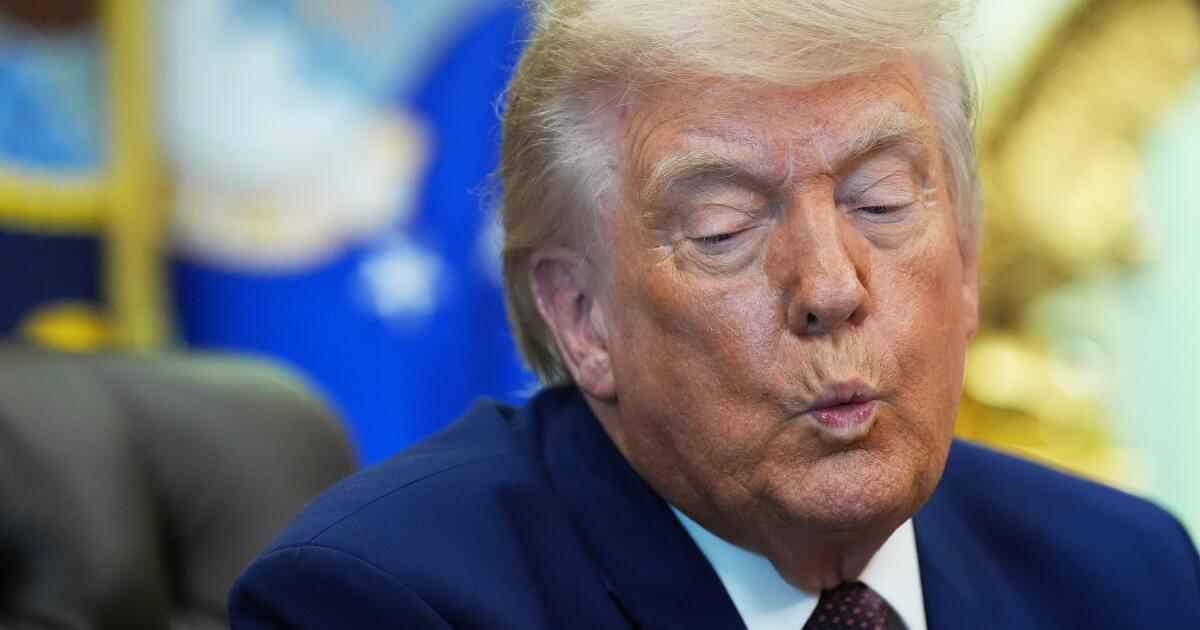
court pick

Voter rolls are a scam. Just not the scam you think

Thank you, Steve Hilton, for calling out President Trump for the liar he is.

Hilton on Tuesday addressed the president’s unfounded but vociferous claims that Democrats have massively cheated in our recent election.

“We’ve got teams standing by, we’ve got lawyers standing by, very focused on that,” Hilton told reporters, including my colleague Seema Mehta, outside the L.A. elections headquarters. “We don’t want to let anyone down, we don’t want to let anything slip away, and we’ve seen nothing.”

We’ve. Seen. Nothing.

How refreshing to have a MAGA insider repudiate the lies.

If only more RITOs (Republicans in Trump Only) would follow suit. But, alas, the conspiracies rage on, aided and abetted by L.A.’s own First Assistant U.S. Atty. Bill Essayli, who recently told right-wing commentator Glenn Beck (among others) that he expected his office to charge people in voter fraud cases in coming months.

“But we need a wide-scale audit of the California voter roll,” Essayli told Beck.

Voter rolls are a huge refrain in conspiracy theories and the subject of numerous (mostly unsucessful) lawsuits by Trump‘s Department of Justice. Trump is demanding that the federal government “audit” the voter rolls to ensure ballots go only to legal voters, which is one of those scary and ill-conceived ideas that sounds reasonable on the surface.

Trump’s lawyers, some of whom made careers out of civil lawsuits around voter conspiracy allegations before being appointed to office, claim untold thousands of ballots are sent out erroneously, then somehow, via Democrats, land in the hands of undocumented immigrants and others who use them to vote illegally.

It is nonsense, but also now government-backed nonsense.

“It certainly is a new level of danger that the people who spent unlimited amounts of time and money trying to prove that the 2020 election was stolen are now leading and staffing the Department of Justice,” Eileen O’Connor told me. She’s a senior counsel at the Brennan Center’s Voting Rights and Elections Program, a nonpartisan effort to protect democracy.

“There have just been people who have spent every waking moment of their lives, practically for decades now, searching for all of this voter fraud that they claim is happening and not finding it,” O’Connor said. “And they’re still failing to find it.”

So what’s the deal with voter rolls? Are they really the dark heart of a Democratic scam to rig elections? Or is the scam that Trump and MAGA are attempting to use the boring and bureaucratic nature of voting rolls to do the very thing they claim to be fighting — undermine of free and fair elections?

What the heck is a voter roll?

Voter rolls are the lists of eligible voters kept by each state.

States run elections, because, well, the Constitution. But that structure is also a good idea because states keep closer track of who is a legal resident and where they are than the federal government.

Those like O’Connor who care about democracy and fair elections point out federal meddling with an “audit” of these lists is vastly overstepping federal power — and likely will knock of numerous voters who have a right to cast a ballot.

Part of that is because voter rolls are “loose,” according to Chris Fowler, a professor of geography and demographics at Penn State who specializes in voting rights. Most states have laws that strive to be inclusive and are slow to remove people from the lists, precisely because we want as many people to vote as we can get.

Some people in California are added when they get a driver’s license. Some people move and ask the postal service to update their voter registration. Some people register once, move dozens of times and never think to tell their secretary of state.

Some people die. Some people get married and change their name. Some people don’t vote for 10 years, then do. You get the idea. Life happens, and updating voter registration is rarely our first thought.

And yes, there are cases of folks illegally getting onto voter rolls, such as one Essayli recently pointed to in which a signature gatherer was paying folks on Skid Row to register to vote. The key there being register, not actually vote.

One-off cases like this should be and are prosecuted, but the inclusive nature of the rolls is by design, not a flaw.

“They’re imperfect,” Fowler said.

Why not audit?

Fowler added, though, if someone wants to make a big stink about fraud without any actual evidence, that inaccuracy is the perfect sleight of hand. To the average person, it sounds bad that we can’t keep a clean list of eligible voters.

But here’s what the conspiracy folks leave out: Being on the voter roll doesn’t automatically mean a vote will be counted or even that a ballot will be sent. It’s just the starting point of everyone who might be invited to the party.

There are numerous safeguards, such as signature verification, that cast ballots go through before the vote is considered legitimate. When there is doubt, the vote is “cured,” which is an unnecessarily convoluted way of saying local election officials may go as far as tracking down the actual voter and making sure they are legit. Yes, if there is a question, actual people contact an actual voter. If they can’t get in contact, the vote is usually set aside.

The MAGA demand to audit voter rolls ignores all this reality and is instead based on the false idea that voter rolls translate directly into counted votes.

The game MAGA is running with voter roll audits is that it was never about election integrity. It’s about suppressing the vote of Black people, brown people, young people and others who tend to vote Democratic and also tend to have more unsettled lives that would lead them to have inaccurate information, such as conflicting addresses, on the voter rolls.

Federal audits would, instead of protecting elections, allow a conspiracy theory to be weaponized into a way to keep legal voters from casting their ballot. Call it the new Jim Crow — a disingenuous way to suppress certain votes all gussied up as safety.

But the effort creates a win-win for Trump. If his Department of Justice is successful in getting state voter rolls — which it has been in more than a dozen states that have voluntarily turned them over — they can demand as many names as they want be removed.

The federal government has not said what criteria it will use to “clean” these rolls, who will be in charge, how the information will be used or kept, or how people will even know they’ve been knocked off until they try to vote. There is even concern the information gathered from audits will be used for other purposes, such as immigration enforcement or surveillance activities.

And for the many states such as California who are fighting the demand in courts — the DOJ lost its California case and has appealed to the 9th U.S. Circuit Court of Appeals — MAGA is simply screaming that the mere fact of protecting these lists from federal interference is proof that we’re covering up this vast conspiracy.

“It is part of laying the groundwork to just be able to say either we have all these voter rolls and we’ve analyzed them and they’re full of errors, or to be able to say, ‘Oh, you didn’t hand over the voter rolls. What are you hiding?’ O’Connor said.

None of that is actually good for elections, or democracy. That’s the real scam with voter roll audits.

They are a Trumped-up attempt to make us doubt a system that is working just as designed, imperfectly and inclusively, protecting democracy while encouraging legal voters to participate.

What else you should be reading

The must-read: Trump Previews Fall Strategy With Baseless Claims of California Vote Fraud
The deep dive: Spencer Pratt could have been a real contender. His greatest enemy was himself
The L.A. Times Special: Why the L.A. mayoral runoff is about to be a ‘knife fight’

Stay Golden,
Anita Chabria

Was this newsletter forwarded to you? Sign up here to get it in your inbox.
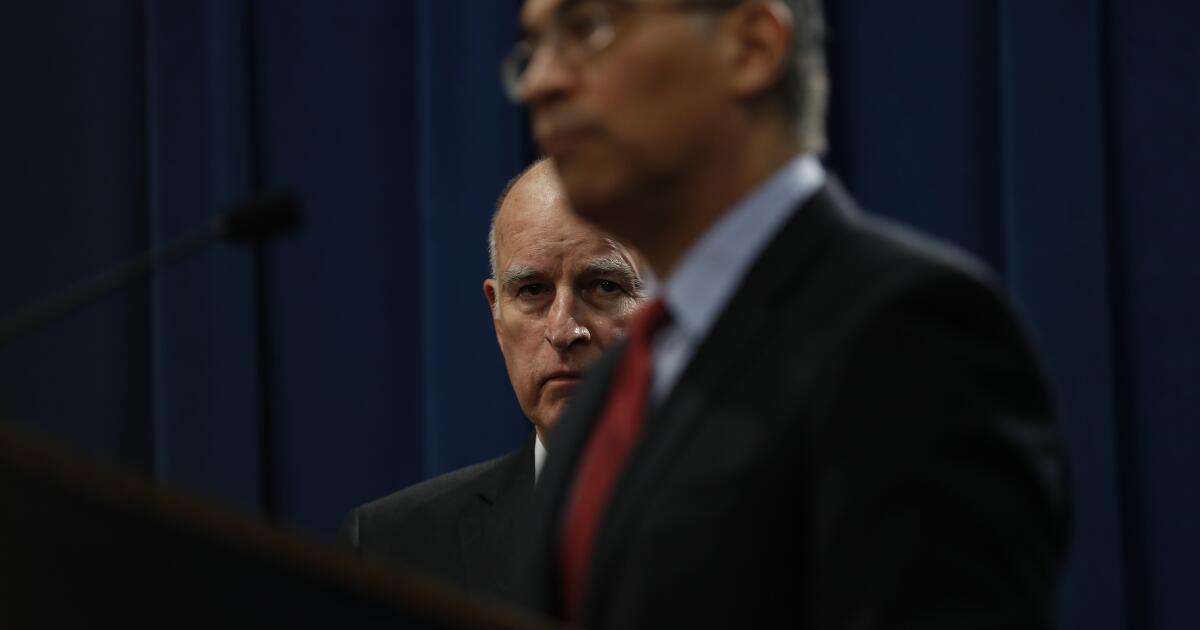
Source link

Column: The secret to Xavier Becerra’s success

Winning elections — or achieving any success — often is about being in the right spot at the right moment. Getting lucky and capitalizing. Xavier Becerra is a textbook example.

Becerra’s moribund campaign for California governor was flatlining in early April when he got a shocking break. Five women publicly accused the Democratic front-runner, Rep. Eric Swalwell, of sexual misconduct, including rape. He denied the allegations but quickly quit the race and Congress.

And Becerra surged, leaping from his political deathbed to Democratic front-runner in the contest to replace Gov. Gavin Newsom, ultimately earning one of two gubernatorial slots on the November ballot.

That’s assuming the agonizingly slow vote count in last week’s primary election holds up, and it’s virtually inconceivable that it won’t.

But Becerra didn’t suddenly just get lucky with Swalwell’s demise. He has capitalized on life-altering sudden good fortune much of his life.

There was a fortuitous incident in high school that substantially upgraded Becerra’s higher education and undoubtedly his career.

You’re reading the L.A. Times Politics newsletter

George Skelton and Michael Wilner cover the insights, legislation, players and politics you need to know. In your inbox Monday and Thursday mornings.

Becerra, the son of Mexican immigrants whose construction worker father didn’t go past the sixth grade, was pulling down good grades at McClatchy High in Sacramento when he was invited to a summer program at UC Davis for promising students of color.

One day he saw a classmate toss some wadded paper into a waste basket.

“What’s that?” Becerra asked.

“I was going to apply to this college, but now I’m not,” the kid replied. He had screwed up on a final exam.

“Give it to me,” Becerra said.

It was an application form for Stanford University. Becerra filled it out and “got it in the mail at the last moment,” he recalled to me years later.

He was accepted. His working-class family was able to send him to the pricey, private university thanks to scholarships, federal aid and after-school work.

“I didn’t know where Stanford was until I rode there with my mom,” Becerra told me.

Becerra got a B.A. in economics at Stanford, then earned a law degree there. That ultimately landed him a job as a deputy state attorney general.

He eventually was elected to Congress, filling a vacant central Los Angeles seat when longtime Rep. Edward Roybal retired. He served 12 terms, rising to the No. 4 Democratic leadership position as party caucus chairman.

A big career break came just before the 2016 election. Becerra was back in Sacramento campaigning for two congressional candidates and was invited to a nonpolitical reception. Also attending by chance was Gov. Jerry Brown’s top aide, Nancy McFadden.

McFadden was impressed. They wound up having a long private talk in a corner. Atty. Gen. Kamala Harris was about to win a U.S. Senate seat and Brown would be appointing her replacement as AG.

“What about Xavier?” McFadden thought to herself, she later told me.

McFadden suggested Becerra to Brown, who didn’t really know the guy. But Becerra’s resume stood out and Brown phoned him. There was an instant liking.

“It wasn’t a hard decision,” McFadden recalled. “It just made sense.”

So, Becerra became California’s so-called top cop, a post he really hadn’t been seeking.

But it was the perfect job for Becerra because goofy Donald Trump became president at the same time. Becerra — often with other Democratic state attorneys general — filed 123 lawsuits against the Trump administration and won the vast majority.

The suits ran the gamut of issues, and one was particularly highlighted: Trump’s efforts to kill the Affordable Care Act, or Obamacare.

Fast-forward to Joe Biden’s ouster of Trump in 2020 and the newly elected president’s search for Cabinet members.

Biden needed a health secretary and was drawn to Becerra partly because he had helped jockey Obamacare through the U.S. House as a congressional leader and had staunchly defended it in court as California attorney general.

Without being appointed AG, Becerra might be running for House reelection in November instead of now seemingly having an easy shot at becoming California’s first elected Latino governor.

Becerra got a huge break in the gubernatorial race when two potential heavyweight contenders concluded the job wasn’t worth running for. Either person would have been heavily favored to win.

Former Vice President Harris decided to retain the option of seeking the presidency for a third time in 2028.

Sen. Alex Padilla opted to keep his comfy job, which opens lots of doors to national cable news sets and doesn’t require running vast, nerdy state bureaucracies.

But “if it hadn’t been for Swalwell’s demise, Becerra never would have made the top two” list of vote-getters in the primary, veteran Democratic strategist Garry South says.

Why did Swalwell’s collapse benefit the mild-mannered, low-key Becerra much more than any other Democrat?

“People are looking for something stable,” he told me several weeks ago. “Everybody likes pizzazz and glitter. Then all of a sudden their hero falls from grace. And they look for who they can trust.”

That trust is built on an impressive resume and likability.

Billionaire hedge fund founder Tom Steyer, who has never held public office, spent tens of millions of dollars attacking rival Becerra in TV ads. But it apparently didn’t work because he lacked credibility. Steyer came across to many voters, I suspect, as a wild-eyed meanie.

He would have been better off spending his negative ad money on positive spots promoting himself and becoming more likable.

Likability is a candidate’s No. 1 asset. We learn that as grammar schoolers in class president elections. It beats a billion dollars every time — at least in California.

Now Becerra is on the verge of another break — facing Republican former Fox news commentator Steve Hilton in a lopsided fall contest. Californians haven’t elected a Republican to statewide office in 20 years.

Becerra merely needs to remind voters that Hilton is endorsed by Trump — a nice break gifted by the president.

What else you should be reading

The must-read: Becerra advances to November, moves closer to becoming California’s first elected Latino governor
This just in: 2026 live primary election results
The L.A. Times Special: How a simple mix-up fueled false conspiracies about L.A. vote count

Until next week,
George Skelton


Was this newsletter forwarded to you? Sign up here to get it in your inbox.
Source link

A competitive governor’s race? Not only in California

As Californians cast their ballots in the state’s closely watched gubernatorial primary Tuesday, a very different race was playing out in Iowa — one that holds clues about the mood of Republican voters heading into November.

President Trump’s endorsed candidate in Iowa’s high-stakes governor’s race, Republican U.S. Rep. Randy Feenstra, lost his bid for the party’s nomination, a rare defeat for a Trump-backed candidate.

The outcome exposed fractures among Republican voters, though their choice of Zach Lahn, who ran on an “Iowa First” and Make America Healthy Again platform, didn’t amount to a rebuke of Trump’s politics, said Jimmy Centers, a Republican strategist in Iowa.

The primary race was “emblematic of the seismic plates that make up the Republican Party in Iowa,” Centers said — the successful MAGA-style message, from Lahn; a more traditional conservative platform, from Feenstra; and a conservative Christian approach, from candidate Adam Steen.

“It’s a bit of a look-ahead in terms of how the Republican Party is going to be shaped in what will be a post-Trump era,” Centers said. “Those plates are moving, and last night in Iowa, we had an earthquake.”

Results from Iowa, California and other late-stage primaries portend contentious fall campaigns, with control of the House and Senate hanging in the balance.

“You’re seeing Republican primary voters rebel against politicians, whether it’s Dusty Johnson in South Dakota or Chip Roy in Texas,” said Matt Gorman, a longtime Republican strategist and chief communications officer at Targeted Victory. “There’s clearly a backlash against sitting politicians, and Republican primary voters are looking for outsiders.”

That pro-outsider outlook has been promoted by Trump himself in some races, as he has used his endorsement to boost primary challengers to victory over Republican incumbents — notably in Texas, Louisiana and Kentucky. In Tuesday’s primaries, however — held in six states — none of the races involved Republican veterans whom Trump wanted to see ousted.

Outside of such races, Trump — who last week said, “I don’t care about the midterms” — has taken a more laissez-faire approach. In Iowa, he did not endorse Feenstra until Friday, a last-minute boost that didn’t help the congressman over the finish line.

Lahn, in a victory speech Tuesday night, acknowledged the upset he had pulled off.

“Nobody thought this could be done,” Lahn said. “We were outspent, opposed by the establishment, told to wait our turn.”

Lahn will face Iowa state auditor Rob Sand, who ran uncontested for the Democratic nomination. The seat is being vacated by Gov. Kim Reynolds, a Republican who is not seeking reelection.

Iowa Republicans will now ramp up efforts to retain both the governor’s office and the U.S. Senate seat being vacated by Sen. Joni Ernst, as Democrats target both offices for flipping.

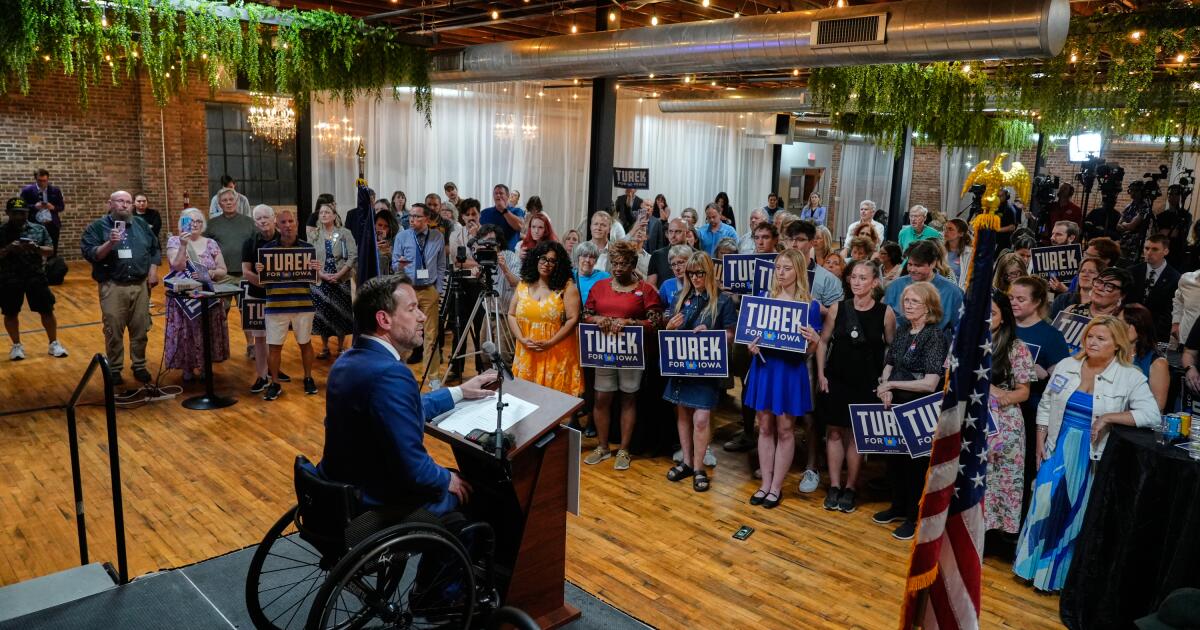
The race to replace Ernst is now on between Republican Rep. Ashley Hinson, who has been in Congress since 2021 and has Trump’s support, and Democratic state Rep. Josh Turek, a former Paralympian who was backed by a leadership PAC aligned with Senate Minority Leader Chuck Schumer.

Economic issues, particularly in the agricultural sector, where farmers have been squeezed by Trump’s tariffs and war in Iran, could dominate the races. Centers said both parties are acutely aware of the economic factors — and aware that Democrats’ chances in Iowa could be slightly better than “a hope and a prayer,” though the state’s voter-registration edge remains solidly red.

“I don’t think many Republicans in Iowa are bashful about acknowledging the environment we’ll face in November,” Centers said. “It’s going to be a hard-fought race.”

You’re reading the L.A. Times Politics newsletter

George Skelton and Michael Wilner cover the insights, legislation, players and politics you need to know. In your inbox Monday and Thursday mornings.

Other Tuesday takeaways

Elsewhere on Tuesday, voters chose candidates in races for U.S. Senate, House and governor’s seats, setting up some lively November match-ups.

In New Jersey, the state’s 7th Congressional District will be a closely watched contest — largely because of the recent absence of Republican Rep. Tom Kean, who has not been publicly seen for months as he deals with an undisclosed medical issue.

His absence has provided an opening to Democrats, who have ramped up attention on the seat as they attempt to flip as many House seats as possible. Rebecca Bennett, a former Navy helicopter pilot, won the Democratic nomination Tuesday.

Kean, who has support from Trump, ran unopposed. In a statement Tuesday evening, he laid out plans to reveal his medical condition when he returns to in-person work, which he said would be “within a matter of weeks.”

The race could become key to Democrats’ attempt to win control of the House in November.

“We’re ready for this fight. Bring it on,” Bennett wrote Wednesday on X.

In Montana, the race for the state’s open U.S. Senate seat, being vacated by Republican Sen. Steve Daines, was also set to get interesting.

Trump-backed Republican Kurt Alme, a former U.S. attorney, and Democrat Alani Bankhead, an Air Force veteran, won primaries Tuesday — but former University of Montana president Seth Bodnar has launched an independent bid for the seat. Bodnar said Tuesday that he had delivered enough petition signatures to the secretary of state to get on the November ballot.

And in New Mexico, former Interior Secretary Deb Haaland secured the Democratic nomination for governor, advancing in her bid to make history as the first Native American governor in the United States. She will face Republican Gregg Hull, a former local mayor, in November.

What’s next

Next week brings Maine’s Senate primaries, following a Democratic race that has taken several twists and turns. Democrats have held hopes of unseating Sen. Susan Collins, the veteran Republican lawmaker, as part of their long-shot attempt to flip the Senate along with the House.

But leading Democratic candidate Graham Platner has been dogged by controversies. The primary vote will be held just more than a week after a New York Times report that he had sent sexual messages to several women outside his marriage. This week, Gov. Janet Mills, who had opposed Platner but suspended her campaign at the end of April, said, “I am still on the ballot.”

Also to watch: Next week’s outcomes in South Carolina’s crowded gubernatorial field; the June 16 Georgia Senate runoff to determine which Republican will face Democratic Sen. Jon Osoff; and the June 16 Democratic primary for Senate in Oklahoma.

Times staff writer Michael Wilner,in Los Angeles contributed to this report.

What else you should be reading

The must-read: The U.S. is investigating two more Mexican governors for connections to cartels
The deep dive:Can we speed up California’s vote count already?
The L.A. Times Special:More middle-class Californians cancel health coverage after losing federal aid

More to come,
Justine McDaniel and Michael Wilner

Was this newsletter forwarded to you? Sign up here to get it in your inbox.
Source link

Column: Easygoing, safe-bet governor may be what California voters want

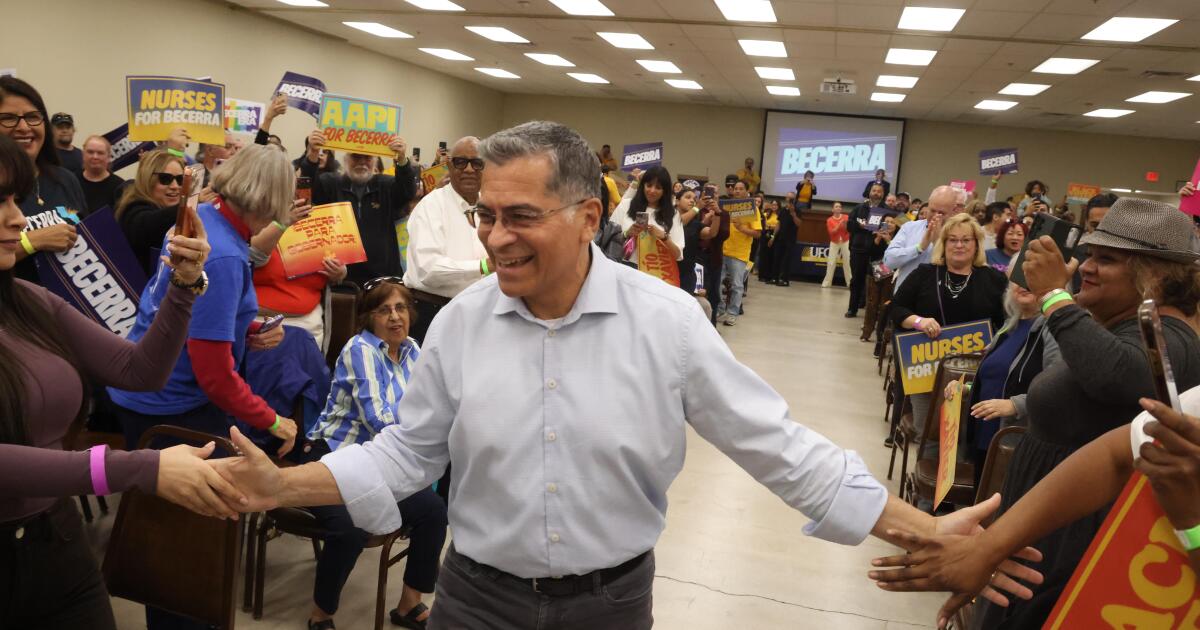
Regardless of the final vote count, Xavier Becerra’s pre-primary sprint to the front in the race for governor was remarkable and historic.

Here’s a low-key 68-year-old candidate who excited no one. And that apparently was a major strength. He was easygoing, non-threatening and a safe bet.

He also had an impressive resume — former U.S. health secretary, California attorney general, longtime congressman and state assemblyman. This seemed to attract voters.

People perpetually badmouth politicians. That’s in the American DNA. And in California, there’s always loud anti-Sacramento jabber. But voters tend to prefer politicians with Sacramento experience when electing governors — unless a celebrity entertainer is available.

You’re reading the L.A. Times Politics newsletter

George Skelton and Michael Wilner cover the insights, legislation, players and politics you need to know. In your inbox Monday and Thursday mornings.

Politics is cyclical, however. In the past six decades, Californians have gone from electing fascinating Govs. Ronald Reagan and Jerry Brown to selecting uninspiring George Deukmejian, Pete Wilson and Gray Davis — then returning to headliners like Arnold Schwarzenegger, Brown again and Gavin Newsom.

Now we’re ready for boring Becerra?

The last pre-primary poll by UC Berkeley’s Institute of Governmental Studies found Democrat Becerra leading the pack. But he was closely trailed by Republican former Fox News commentator Steve Hilton and Democrat billionaire Tom Steyer, a hedge fund founder turned climate activist.

The large field of candidates wound up with those three leading — Becerra drawing 25% support, Hilton at 21% and Steyer with 19%.

A later Emerson College poll also found Becerra in front but Steyer and Hilton in a statistical dead heat: Becerra 28%, Steyer 22%, Hilton 21%.

The top two vote getters will qualify for the November general election.

In contrast to earlier hot speculation about two Republicans — Hilton and Riverside County Sheriff Chad Bianco — finishing in the top two and locking out any Democrat from the November ballot, the final IGS and Emerson polls showed that an opposite scenario was possible. Two Democrats could conceivably advance to the November voting.

As campaigning neared an end, Becerra apparently tried to help Hilton attract more MAGA support to prevent Steyer from edging out the Republican. Becerra would be a shoo-in over any GOP opponent in November, but could face a tough fight facing Steyer with his bottomless checkbook.

The games-playing involved Becerra running a statewide digital ad subtly reminding Republican voters that Hilton was President Trump’s “favorite” candidate for governor. The spot asserted that Becerra is “Trump’s worst nightmare.”

Steyer would be Becerra’s worst nightmare in a general election brawl.

Another major poll completed a few days earlier by the Public Policy Institute of California found the same basic rankings as the IGS survey, but with Steyer a bit further back.

Becerra was leading with 23%, followed by Hilton at 20% and Steyer at 15%.

Every independent poll found Becerra surging from irrelevancy in March to leader of the pack by late May.

It’s “one of the most unusual gubernatorial election campaigns in modern California history,” IGS poll director Mark DiCamillo says.

Particularly unusual was the April frontrunner, then-Rep. Eric Swalwell (D-Dublin), abruptly withdrawing after multiple accusations of sexual misconduct and assault, which he denies.

Most of Swalwell’s voter support soon went to Becerra, which helped him attract campaign donors and endorsements by interest groups.

Becerra, who had been moseying along the race track, suddenly got a second wind. And voters sensed a breath of fresh air.

“Voters are exhausted by Trump. He makes it hard to sleep at night. ‘Cool and calm’ win,” says Chapman University political science professor Fred Smoller. “People want a candidate like a no-drama Becerra.

“The fact he has a charisma deficit may in fact be his political asset.”

But Becerra also has other assets, notes UC San Diego political science professor Thad Kousser — ”legislative and executive experience…. He was safe and predictable.

“And he’s second only to Gavin Newsom in opposing Donald Trump.”

Yes, a calm temperament appeals to voters fatigued by political fire and brimstone. But California Democrats also want someone who will fight back against Trump’s policies.

Becerra repeatedly points out that as state attorney general, he sued the first Trump administration more than 120 times and won the vast majority of cases.

“Becerra has caught the attention of Democratic voters who overwhelmingly disapprove of Trump,” says PPIC Poll Director Mark Baldassare.

How overwhelmingly? Ninety-five percent disapproval by Democrats in the latest PPIC survey, 70% among all likely voters.

Becerra “stood out from the rest of the candidates because of his background as attorney general,” Baldassare adds.

“And look at the other candidates. You can’t name one who has had experience in Sacramento.”

Longshot former Los Angeles Mayor Antonio Villaraigosa was once state Assembly speaker, but that was nearly three decades ago.

Among the last nine California governors, only Schwarzenegger and Reagan have been elected without serving prior Sacramento stints.

Becerra also has another asset: He’d be the first elected Latino governor in California history. He finished the primary campaign with a comfortable lead among Latino voters, as well as Asian American.

As Becerra’s political stock rose, Democratic rivals — especially Steyer — tried to portray him as incompetent, touched by scandal and a Chevron tool. But the mud didn’t seem to stick.

A natural Becerra strength is likability.

DiCamillo recalls what his mentor, the late legendary pollster Mervin Field, used to say about how voters choose between candidates for governor or president.

“It’s a highly personal choice,” DiCamillo says, quoting Field. “People put more mental energy into choosing a top-of-the-ticket candidate than any other.

“It’s like trying on a new suit. If it doesn’t fit well, you don’t buy it. You’ve got to be comfortable in the feel.”

Many California voters apparently feel that way about Becerra — nothing flashy, just plain but comfortable.

What else you should be reading

The must-read: Becerra leads governor’s race, with Hilton and Steyer in tight contest for second spot, poll finds
Money honey: Record-setting outside money pouring into California governor’s race
The L.A. Times Special: Voter guide to the 2026 California primary election

Until next week,
George Skelton


Was this newsletter forwarded to you? Sign up here to get it in your inbox.

Source link