Recently revealed evidence from government investigators and court filings renewed questions about Southern California Edison’s claim that it operated its electrical grid safely before last year’s deadly Eaton fire.
Most records surrounding the fire’s cause have been sealed at the request of Edison and plaintiff attorneys. Yet new details revealed in court show that critical fire prevention equipment needed repair before the blaze and that vegetation under the tower where it ignited hadn’t been trimmed for years.
Los Angeles County and state fire investigators cited eight violations, including three of California’s criminal code, in their report released on Aug. 4. The details were blacked out as the district attorney continues an investigation into the devastating fire.
“We don’t believe there is a basis for criminal liability and we will cooperate with any review,” said Kathleen Dunleavy, an Edison spokeswoman.
The investigators said in the report that the Jan. 7, 2025 inferno, which killed 19 people and destroyed more than 9,000 homes and other structures, was caused by electrical arcing on an out-of-service transmission line in Eaton Canyon, which caused hot metal fragments to fall into the dried vegetation below.
Here are key takeaways from the investigative report and recent court filings by lawyers representing fire victims:
Edison didn’t turn off power on its Eaton Canyon transmission lines, despite emergency conditions.
Before the fire, the National Weather Service predicted a “life-threatening” windstorm, investigators wrote in their report released Aug. 4. Santa Ana wind gusts were forecast to reach speeds of 60 to 80 miles per hour, with peak gusts of 90 miles per hour in the mountains.
Earlier that day, Gov. Gavin Newsom declared a state of emergency because of an out-of-control fire that was burning homes in Pacific Palisades.
Despite those conditions, Edison kept power flowing through its high-voltage transmission lines built in the mountains above Altadena. Investigators noted that wind gusts at a weather station about a half-mile from the Edison tower where the fire started recorded gusts up to 68 miles per hour just before the first flames at 6:11 p.m. By 7, gusts were up to 85 miles per hour.
Dunleavy said the conditions did not meet the company’s internal standards for shutting off the lines.
“SCE was actively monitoring the transmission lines in Eaton Canyon on Jan. 7 and none of these lines met our de-energization criteria,” Dunleavy said.
Safety equipment on the out-of-service line was damaged before the fire but not fixed.
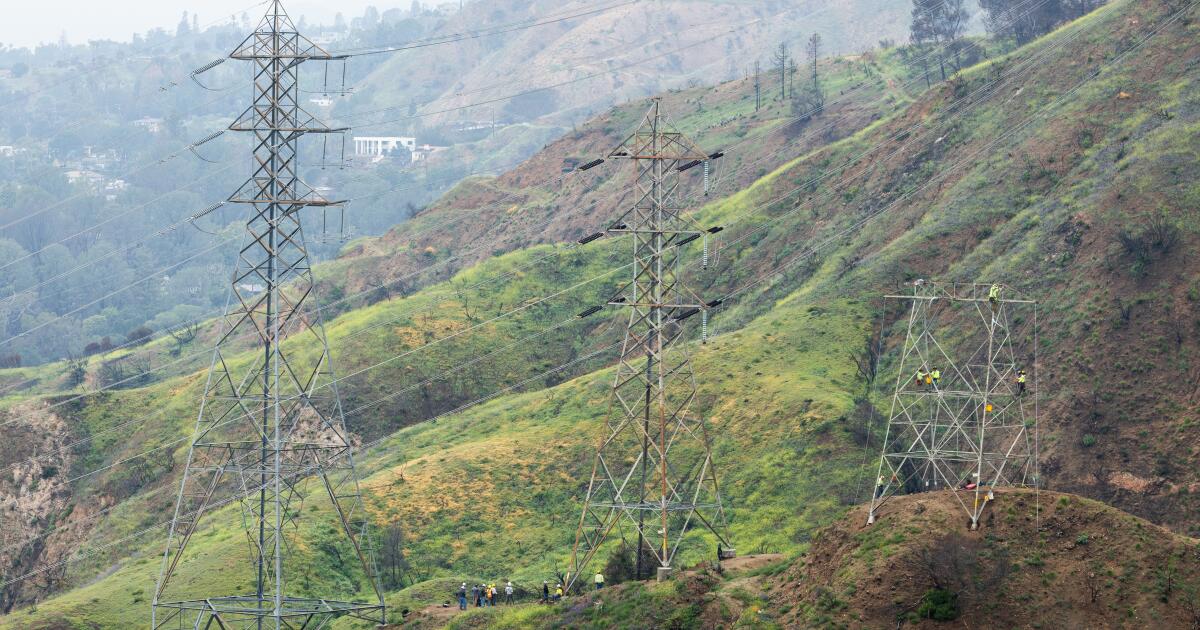
Edison had installed safety equipment at both ends of the out-of-service, unconnected transmission line in Eaton Canyon, including at the pylon known as Tower 208 where the fire ignited. But on the night of the fire, the equipment was broken, according to a June court filing.
The equipment was designed to send any unexpected power on the out-of-service line safely into the earth. The grounding equipment was necessary because the idle Mesa-Sylmar line ran parallel to 12 energized high-voltage lines, creating the danger of induction.
Induction happens when electromagnetic fields cause power on energized lines to jump to nearby idle equipment.
At Tower 208, a component known as a compression paddle was not securely bonded to the pylon, allowing debris to form and creating a dangerous air pocket, the filing said. The paddle was meant to be secured with four bolts, but only one bolt was used.
Government fire investigators also found broken equipment at one of the Mesa-Sylmar towers during a tour of the site with Edison after the fire. According to their report, investigators observed “the center conductor dangling free from the bridge section of the tower; it appeared that the remaining two conductors were not bored down to the tower bridge.”
The investigators said they discussed the equipment “abnormalities” with an Edison lineman and lawyer on the tour. “The Lineman said that they were not new and were like this last year; he was also unsure why they were not corrected when it was inspected,” the investigators wrote.
Asked why the equipment was not fixed, Dunleavy said, “We’re looking into that.”
She said the company strives to have a strong maintenance and inspection program and still was performing post-fire examinations and testing.
Edison kept the century-old, out-of-service Mesa-Sylmar line in place for decades, despite knowing idle lines could reenergize and spark fires.
Utilities have known for decades that unused lines can become energized from nearby electrified equipment through the induction process.
To teach employees about the danger, Edison created a training video featuring a 2007 incident in which a line known as the Kramer-Coolwater circuit was de-energized to allow work by a crew. The line became reenergerized while laying on the ground and started several fires, according to a retelling of the video in a July court filing by lawyers representing victims. Later that day, the crew’s foreman was injured when he touched the line.
Eleven years later, the Kramer-Coolwater circuit was unconnected from the grid, similar to the line in Eaton Canyon. Yet the line was electrified by induction from adjacent lines again in 2018, electrocuting a lineman who touched the conductor, the court filing said.
The company has said it kept the line in place even though it hadn’t carried power since 1971 because executives believed it could be used in the future.
Dunleavy said the induction event in the training video was different from what appears to have happened on Jan. 7 with the Eaton Canyon transmission lines.
“We had never seen an idle, de-energized transmission line cause an ignition,” she said.
Edison failed to clear vegetation below the tower where the fire ignited.
The investigators’ report said the fire ignited when electrical arcing on the idle line caused hot metal particles to fall into “the receptive fuel beds consisting of dry vegetation” below the tower.
The June court filing includes details from Google Earth images showing that the vegetation under Tower 208 had not been trimmed since at least 2021. Leaving the brush to grow violated Edison’s safety standard for “structure brushing,” the filing said.
Edison explained structure brushing in an article last year, describing how it cleared all vegetation around certain equipment, creating a 10-foot barrier to reduce the fire risk.
Asked why Edison let brush grow below the idle line, Dunleavy said, “We inspect and maintain all our equipment according to existing regulations and laws.”
Edison has sued L.A. County and other public entities, saying that their failures, including not clearing brush and delayed evacuation warnings, increased the fire’s destruction.
A fight over accountability
The first jury trial looking at whether Edison acted negligently in igniting the fire is scheduled to begin Jan. 25.
Later, state regulators will evaluate whether the company acted “prudently” in its actions related to the fire’s start.
Under a 2019 law brought by Newsom to protect utilities from bankruptcy, the companies automatically are deemed to have acted prudently if regulators sign off on their wildfire prevention plan.
Newsom’s safety regulators approved Edison’s plan just before the Eaton fire. That means Edison will be fully reimbursed for the billions of dollars in Eaton fire damages by a state fund that Newsom’s legislation created unless outside parties can prove Edison acted imprudently, negligently or worse.
“We continue to believe we will make a good faith showing of prudency,” Dunleavy said.
Newsom is working behind closed doors on legislation to further protect Edison and the state’s two other big for-profit electric utilities from the cost of wildfires caused by their equipment, the Times reported this year.
The three companies’ equipment ignited at least seven of the state’s 20 most destructive wildfires, according to CalFire. The Eaton fire was the state’s second-most destructive fire after the 2018 Camp fire, which killed 85 people and destroyed most of the town of Paradise. That fire, according to investigators, was ignited by an old transmission line owned by Pacific Gas & Electric.
The survivors of Eaton and other fires are fighting Newsom’s plan, saying it would leave California more vulnerable to utility-sparked fires.
“The real danger is what will happen to Californians if we further strip away these corporations’ financial incentives to prevent catastrophic fires,” Joy Chen, executive director of Every Fire Survivor’s Network, wrote in an analysis sent to state lawmakers this week.
“These are not innocent companies overtaken by climate change, nor is this an abstract problem of ‘wildfire liability,’” she wrote. “It is a continuing pattern of catastrophic corporate failure.”