course

As ‘The Pitt’ suffers a digital meltdown, a human saves the day

This article contains spoilers for Season 2, Episode 9 of “The Pitt.”

Midway through Season 2, “The Pitt” has taken on the perils of the digital age and given me a reason to love the show as much as everyone else does.

Don’t get me wrong — I understand perfectly why so many people, including recent Emmy and Golden Globe voters, have lost their minds over the HBO Max medical drama: The propulsive day-in-the-life of a Pittsburgh ER conceit, the dazzling ensemble cast, the writers’ heroic attempts to showcase our perilously broken healthcare system, the healing power of empathy and, of course, the Noah Wyle-ness of it all. His brilliant and gentle-voiced Dr. Michael “Robby” Robinavitch is as aspirational a character on television as we’ve ever seen.

But having recently spent almost six hours passing out and vomiting from pain in the waiting room of my local ER (which was empty except for one other man), while being told there was nothing anyone could do until the next shift arrived, I confess I have watched “The Pitt” with a jaundiced eye. The regular crowd shots of the waiting room too often reduce the afflicted into a zombie-like horde bent on making life more difficult for our beloved medical staff.

Sure it’s tough to work in an ER when you are worried about your mother’s expectations, grieving your dead mentor, struggling with addiction or worrying about your sister, but no doubt many of those in the waiting room are experiencing similar issues while also in terrifying and hideous pain.

I’m just saying.

In this second season, however, “The Pitt” gave me reason to cheer. It chronicles the day before Robby is set to leave on a three-month sabbatical, and in the early hours, we meet his temporary replacement, Dr. Baran Al-Hashimi (Sepideh Moafi). Having already attempted to force those suffering in waiting rooms to create their own “patient portals,” Dr. Al-Hashimi goes on to advocate for an AI-supported system to aid the doctors with pesky paper work.

Robby, of course, does not think any of this is a good idea and since he is always right (and no television writer is going to openly promote AI), her plan backfires almost immediately. First, with a medical notes transcription that gets Very Important words wrong and then after a complete digital blackout.

After a nearby hospital is hacked and ransomed, the higher-ups decide to defend its system by shutting it down, which means business must be conducted in the old-fashioned, paper-and-clipboards way.

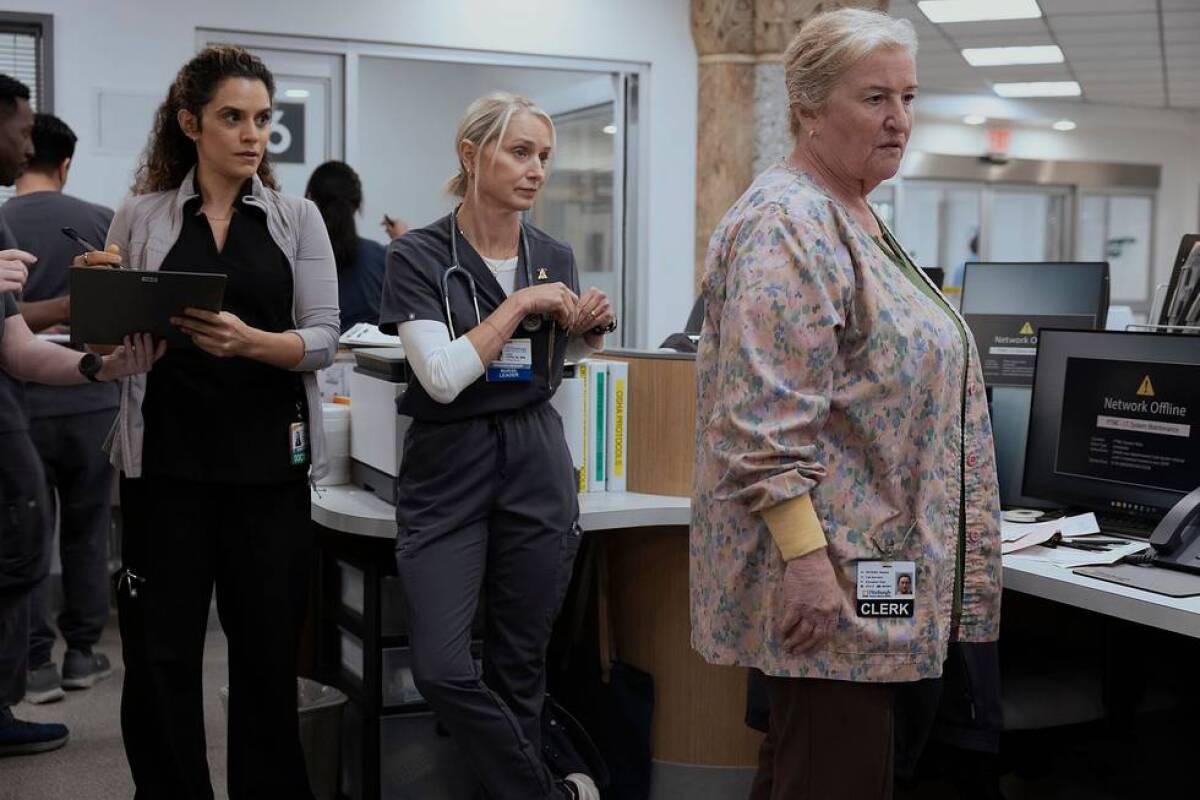
The result is chaos, and a few too many jokes about young people not knowing how to work a fax machine or manage paper. Some of the more seasoned staff, including and especially the indefatigable charge nurse Dana Evans (Katherine LaNasa), remember the days before everyone carried an iPad well enough to keep things moving. Even so, Dana wisely calls upon the services of “retired” clerk Monica Peters (Rusty Schwimmer).

Three women stand near a counter with computer screens.

When the computer system at the Pitt is shut down, Dana (Katherine LaNasa), center, calls in Monica (Rusty Schwimmer), far right, who arrives to help.

(Warrick Page / HBO Max)

“Laid off by the digital revolution, not retired,” Monica corrects her. “And how’s all this digital s— working out for you now?”

This is where I cheered. I love the digital world as much as the next person currently typing on a computer to file a story that I have discussed with my editors on Slack and that I will not see in hard copy until it appears in the physical paper. But like pretty much everyone, I have suffered all manner of digital breakdowns and mix-ups, not to mention the inevitably increased workload that comes with the perception that I can do the work of previous multitudes with a few additional strokes of a keypad.

Except, of course, that’s a lie — a keypad is capable of nothing on its own. Neither are fingers, for that matter. They must be manipulated by someone whose brain has to figure out and execute whatever needs to be done. This requires an ability to navigate the ever-changing tech systems that store and distribute information (often in ways that are not at all intuitive) while also understanding the essentials of the actual work being done.

In “The Pitt,” that is the emergency medical treatment of human beings, which requires all manner of physical tasks. As this storyline makes clear, many of the medical staff do not quite understand how to order or handle these tasks without a screen to guide them.

Hence the need for Monica, representative of a large number of support workers who do understand because it was once their job to keep everything moving, to answer all manner of questions, prioritize what needs to be fast-tracked and make sure nothing falls through the cracks while also engaging with all and sundry on a human level.

The shutdown is obviously an attempt to underline the limits of AI but it also serves as a fine and necessary reminder of how readily we have surrendered people like Monica, with their knowledge and experience, to keyboards and touch pads (which, of course, don’t require salaries, benefits or lunch breaks).

But — and this is important — computers are tools not workers. Alas, that has not kept companies in virtually every industry from drastically cutting back on trained and experienced employees and handing large portions of their work (mental if not physical) to people, in this case doctors and nurses, who already have demanding jobs of their own.

But hey, you get a company iPad!

A woman in blue scrubs stands in front of a white board looking at a woman in a mauve jacket holding a clipboard.

Nurse Dana (Katherine LaNasa), left, and Dr. Baran Al-Hashimi (Sepideh Moafi) have to resort to paper, clipboards and white boards to keep track of patients after the hospital’s systems are shut down.

(Warrick Page / HBO Max)

Often, including with those patient portals, what was once paid labor lands in the lap of the consumers, who in “The Pitt” are people sitting in an emergency room and likely not at the top of their game when it comes to filling out forms about their medical history or coming up with a unique password.

ER dramas, like the “The Pitt,” are inevitably fueled by the tension between the demands for speed and the need for humane care, something that is increasingly true, if not as intrinsically necessary, in all facets of our culture.

With computers in our pockets, we now expect everything to be available instantly. But when something in our online experience goes wrong, we need an actual human to help us fix it. Unfortunately, as the overwhelmed staff of the Pitt discover, those people are increasingly difficult to find because they have been laid off — even nurse Dana can’t do everything!

Dr. Al-Hashimi, like many, believes that patient portals and AI-assisted medical notes will save time, allowing the doctors and nurses to spend more of that precious commodity with their patients. But, as Dr. Robby and Dana repeatedly argue, what they really need is more staff.

There’s no point in saving a few minutes at the admittance window, or on an app, if you are then going to have to spend hours waiting for or trying to find someone who can actually help you when you need it.

That is certainly true in the medical sector, where digital technology has done little to eradicate long wait times for medical appointments or in emergency rooms. Being treated in a hospital hallway by people who can barely stop to talk to you is not an uncommon occurrence for many Americans. The U.S. is facing a critical shortage in hospital staff, with the ranks of registered nurses and other medical personnel having plummeted post-pandemic, often due to burn out.

The amount of time the staff of “The Pitt” spend with each patient, while dramatically satisfying, is almost as aspirational as the wisdom and goodness of Dr. Robby.

None of these problems is going to be solved by AI or any other “time-saving” device. We have not, as far as I know, figured out a way to extend an hour beyond 60 minutes or modified the human body so that it does not require seven to nine hours of sleep each night.

Medical institutions aside, I can’t think of any place I have visited lately that wouldn’t have benefited from more paid and experienced workers, especially those who know how to do things when computers glitch or fail.

The minute Monica sits down and starts barking orders in the ER, everyone feels much better. Here is someone who understands what needs to be done, why, and how to make it happen. Moreover, she has eyes, ears, hands and human experience enough to know that, in the end, people are less interested in saving time than getting the care they need.

In the ER and everywhere else.

Source link

L.A. Marathon and the Oscars: What roads will be closed?

Over the next two weekends, Los Angeles will be flooded by long-distance runners and the film industry’s biggest stars — much to the delight of fans and the dismay of drivers trying to make their way through the city.

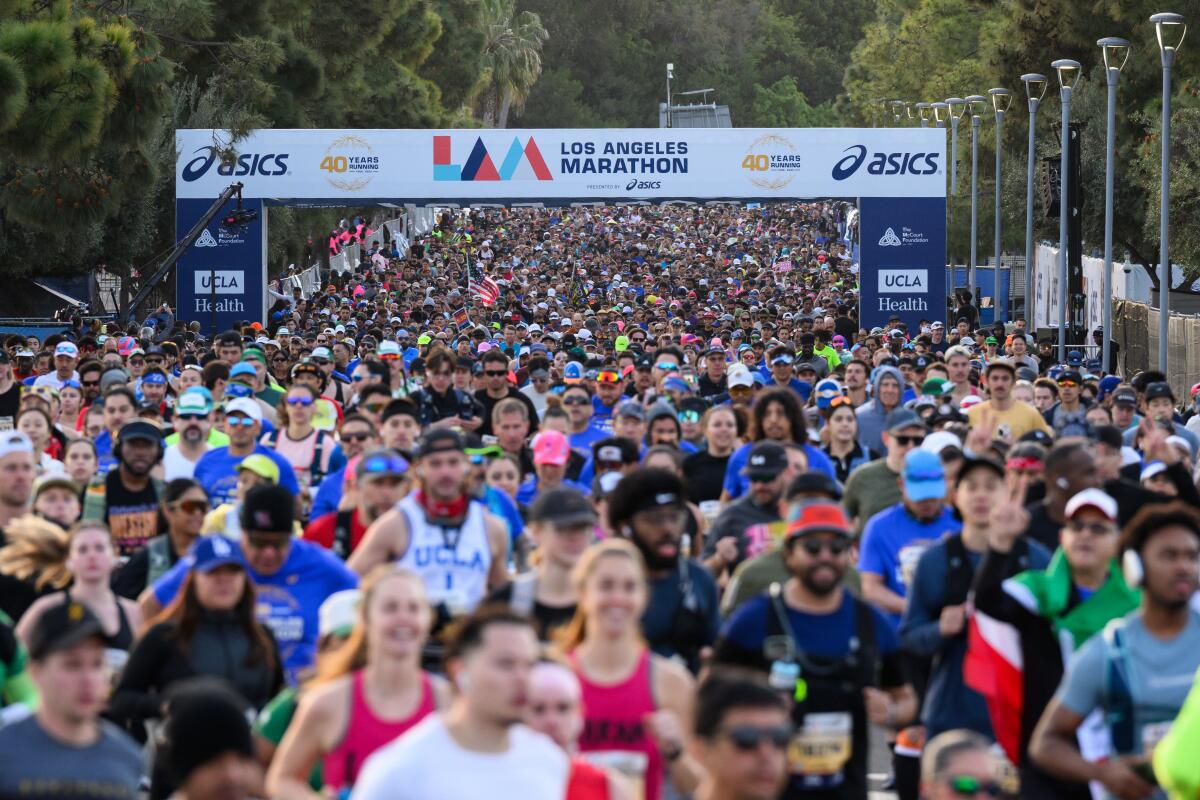
The L.A. Marathon and half-marathon will take place Sunday, with both courses starting at Dodger Stadium and ending at Avenue of the Stars and Santa Monica Boulevard.

The 98th Academy Awards are the following Sunday at the Dolby Theatre in Hollywood.

Here’s what road closures to expect and when:

Marathon closures on Sunday

Runners start the 2025 Los Angeles Marathon.

Runners start the 2025 Los Angeles Marathon.

(William Liang / For The Times)

The L.A. Marathon begins at 7 a.m. at Dodger Stadium. The McCourt Foundation, which organizes the race, said road closures will begin along the route as early at 3 a.m. and will reopen on a rolling basis after runners pass. Some stretches are expected to remain closed until around 6 p.m.

Oscars closures beginning March 15

Julianne Hough on the red carpet near the Dolby Theater at the 97th Academy Awards.

Julianne Hough on the red carpet near the Dolby Theater at the 97th Academy Awards.

(Robert Gauthier/Los Angeles Times)

A few blocks around the Dolby Theatre — including on Hollywood Boulevard, Orange Drive and Johnny Grant Way — closed for the Oscars earlier this month. But larger sections of Hollywood will be affected starting early on March 15.

Maps of the closures, according to event organizers, can be viewed here.

These roads and sidewalks will be closed from 12:01 a.m. March 15 through 6 a.m. March 16:

  • Hawthorn Alley from Orange Drive to Highland Avenue
  • Orange Drive from Hollywood Boulevard to Lanewood Avenue
  • North sidewalk of Hollywood Boulevard from Highland Avenue to 300 feet east of Highland Avenue (no pedestrian access)
  • South sidewalk of Hollywood Boulevard from Highland Avenue to 300 feet east of Highland Avenue (8-foot pedestrian access)
  • South sidewalk of Hollywood Boulevard directly in front of the north-south Hawthorn Alley (no pedestrian access to cross alley)
  • East sidewalk and curb lane of Highland Avenue from Yucca Street to Sunset Boulevard (8-foot pedestrian access, 300 feet south of Hollywood Boulevard only)
  • West sidewalk of Highland Avenue from Hollywood Boulevard to Sunset Boulevard
  • West curb of Highland Avenue from Johnny Grant Way to Hollywood Boulevard

These roads and sidewalks will be closed from 4 a.m. March 15 through 4 a.m. March 16:

  • North and south crosswalks on Hollywood Boulevard at the Highland Avenue intersection
  • Highland Avenue from Sunset Boulevard to Franklin Avenue
  • Hollywood Boulevard from La Brea Avenue to Orange Drive
  • Hollywood Boulevard from Highland Avenue to Cahuenga Boulevard

These roads and sidewalks will be limited to local residents, businesses needs and emergency vehicles from 12:01 a.m. March 15 through 6 a.m. March 16:

  • Hawthorn Avenue between Orange Drive and La Brea Avenue
  • Hawthorn Avenue between Highland Avenue and McCadden Place
  • McCadden Place between Yucca Street and Hollywood Boulevard
  • Yucca Street between Highland Avenue and Wilcox Avenue
  • Wilcox Avenue between Sunset Boulevard and Cahuenga Boulevard
  • South sidewalk of Franklin Avenue from Orchid Avenue to Highland Avenue
  • Hillcrest Road south of Franklin Avenue to the dead end

Source link

Disney California Adventure turns 25. Will it ever not feel like a work in progress?

Disney California Adventure this month turns 25. Though Disneyland Park’s littler and much younger sibling, the park has grown into a respectable offering, one that ranks among my favorite Disney parks in North America. No small feat, considering its checkered, less-than-ambitious launch.

California Adventure is today emblematic of some of the best that Disney has to offer. And yet it remains a work in progress. The subject of constant tinkering, another reimagining is on the horizon.

With more Marvel, more “Avatar” and more Pixar due to be injected into the park, California Adventure stands at a crossroads. But also one with risks: Will it soon feel like a collection of brand deposits? This, of course, has appeared to be the vision of the company’s theme parks in the recent past. This doesn’t always have to be a negative. Consider it more a word of caution.

Guests on a boat in a Día de Muertos-inspired world.

A “Coco” boat ride is destined for Disney California Adventure. The ride is under construction.

(Pixar / Disneyland Resort)

Few Disney properties, for instance, seem more ripe for exploration in a California-focused theme park than “Coco.” Under construction where Paradise Gardens and Pixar Pier meet, a “Coco”-inspired boat ride will give the park at long last a permanent home to recognize our state’s Latin culture and heritage. While fans may long for the days of original attractions such as Pirates of the Caribbean and the Haunted Mansion, those based on intellectual property — IP in industry speak — aren’t evil, especially when used to heighten the overall themes of the park. California Adventure’s own Cars Land is a key example.

When it starts to feel like retail, however, parks can become exhausting. Looking at you, Avengers Campus, a half-finished land with a bombastic orchestral score and familiar, urban design that wouldn’t be out of place in downtown L.A. In its current state, the land works best as a backdrop for live entertainment as it lacks the welcoming feel of Disney’s top creations.

California Adventure, at its most idealized, stood for more than an assortment of film properties. Its pitch was to show the Golden State as a romanticized destination, one that in the post-Gold Rush era has often given America permission to dream. It would capture our people, our nature, our food and our glamour through a lighthearted, optimistic lens. When completed, the park had a mini Golden Gate Bridge and giant letters that spelled out the name of our state (which were removed about a decade later).

By the time California Adventure opened in February 2001, it had already been the subject of much revision. The Walt Disney Co. wanted it to be a West Coast answer to Walt Disney World’s Epcot. Its plans at the time were well-documented, with the Walt Disney Co. initially giving Westcot, as it was to be called, a spherical answer to the Florida park’s Spaceship Earth. In time, and in attempts to quell neighborhood concerns, the globe’s design would shift to become a large, futuristic needle.

A pink dinosaur in sunglasses in a theme park, with a Route 66-themed shop in the background.

California Adventure in 2001 was meant to depict a romanticized vision of California.

(Mark Boster / Los Angeles Times)

None of it was to be. Financial headaches, caused in part by the early-year struggles of Disneyland Paris, inspired Disney to change course. Disney California Adventure would open with few attractions that rose to the Disneyland level, and yet The Times was kind in its opening coverage, praising the park’s change of pace from its neighbor and admiring how its architecture blurred fiction and reality.

The hang-gliding simulation Soarin’ Over California was an instant hit, and Eureka! A California Parade was Disney theatricality at its weirdest, with floats that depicted Old Town San Diego, Watts and more. But California Adventure’s prevalence of dressed-up county fair-like rides failed to command crowds. Disney’s own documentary “The Imagineering Story” took a tough-love approach, comparing some of its initial designs to those of a local mall.

The grand opening of Disney's California Adventure

The grand opening of California Adventure in February 2001.

(Mark Boster / Los Angeles Times)

And yet today it’s home to one of the Walt Disney Co.’s most fully-realized areas in Cars Land, which opened in 2012. Flanked by sun-scarred, reddish rocks that look lifted from Arizona, Cars Land is a marvel, and on par with the best of Walt Disney Imagineering’s designs (see New Orleans Square, Star Wars: Galaxy’s Edge and Pandora — the World of Avatar). Nodding to our Route 66 history, the land is a neon-lit, ‘50s rock leaning hub of activity, complete with the showstopping Radiator Springs Racers.

Cars Land led a major makeover of the park that also included the nostalgic Buena Vista Street, a nod to the Los Feliz era of the 1920s. And by the mid-2010s, many of California Adventure’s most insufferable traits, such as its ghastly puns (San Andreas Shakes was bad, but the Philip A. Couch Casting Agency was cringe-inducing) as well as the short-lived disaster of a ride that was Superstar Limo, had begun to disappear.

Theme park rock work designed to look like the Southwest with two racing cars in the foreground.

Cars Land, added to California Adventure in 2012, is one of Walt Disney Imagineering’s grandest achievements.

(Mark Boster / Los Angeles Times)

With the nighttime show World of Color, and a bevy of in-park entertainment, California Adventure pre-pandemic began to feel like something akin to a full-day park. It wasn’t perfect, of course — no park is.

The Little Mermaid — Ariel’s Undersea Adventure, though lightly charming, suffers from being a hodgepodge of familiar scenes from the film rather than a narrative tableau that can stand on its own. Too many empty buildings clutter its Hollywood Land area, the makeover of Paradise Pier into Pixar Pier did little but add garish film-referencing art to the land and the crowd-pleasing transformation of the Twilight Zone Tower of Terror into Guardians of the Galaxy — Mission: Breakout! was completed at the expense of the park’s prime Southern California theming.

Paradise Pier at California Adventure in 2002.

Paradise Pier at California Adventure in 2002. The land has since been remade into Pixar Pier.

(Don Kelsen / Los Angeles Times)

But there is much about California Adventure to adore. It shines during holidays, whether that’s Lunar New Year at the top of the year or the back-to-back combo of Halloween and Christmas seasons near its end. Here is when California Adventure’s entertainment comes to the fore, bringing the park alive with cultural tales that at last reflect the diversity of the modern theme park audience.

How grand it would be, however, if California Adventure were blessed with this level of entertainment year-round. The Hyperion Theater, a 2,000-seat venue at the end of Hollywood Land, and once home to shows inspired by “Frozen,” “Aladdin” and “Captain America,” today sits empty. If the Walt Disney Co. can’t justify funding the theater, jettison it with the park’s upcoming makeover, as it stands as a reminder of how fickle the corporation can be when it comes to live performance (also gone, the great newsboy-inspired street show).

A Disney cast member polishing a giant letter.

Staff at California Adventure put the final bit of polish on the letters that spell out “California” ahead of the park’s 2001 opening. The letters once stood at the entrance of the park.

(Mark Boster / Los Angeles Times)

Looking ahead, I expect Disney to deliver a powerful “Avatar” ride, and early concept art has shown a thrilling boat attraction that appears to use a similar ride system to Shanghai’s Pirates of the Caribbean: Battle for the Sunken Treasure, which is hailed by many as one of the company’s strongest modern additions. Worthy of debate, however, is how the pure fantasy landscape of “Avatar” fits in a park that still nominally tries to reflect California and our diversity.

And does it matter?

The company would likely argue that if the ride wows guests and extends the “Avatar” brand into another generation, that it does not. But Disneyland next door isn’t timeless because it has “Peter Pan” and “Star Wars.” It has endured for 70 years because its attractions, by and large, reflect cultural myths. And it’s a park we want to spend days in, thanks to its gorgeous landscaping, calming Rivers of America, and human tales of avarice, unity and romance spread throughout its attractions.

For theme parks, after all, can jump the shark, so to speak. Spend some time, for instance, sitting in California Adventure’s San Fransokyo Square. It’s a needless, post-pandemic makeover. What was once a simple food court has been transformed into a loud nook stuffed with a “Big Hero 6” meet-and-greet and gift shop. You’ll be transported, but to a place more akin to a marketing event.

So happy 25, California Adventure. We love you, and you’re a park worth celebrating, but like most post-collegiate kids, there’s still some room to learn.

Source link

Six features of Olympic skiing that you should know

p]:text-cms-story-body-color-text clearfix”>

There are two varieties of fencing: A-net and B-net.

A-net is more rigid, often permanent, and used to prevent racers from flying off the course and into dangerous areas, off cliffs, into rocks and the like.

B-net is temporary and closer to webbing that’s aimed at absorbing the kinetic energy of a falling skier. Frequently, there are multiple layers of B-net with space in between that combined to act as a catcher’s mitt.

“They put nets where you have really big fall zones and high-speed sections, places where you need that extra level of protection,” Morse said.

It isn’t like tumbling into a pit of foam blocks, though.

“The A-net is much more like hitting a trampoline,” Morse said. “The B-net is designed to come out of the ground and wrap you like a blanket. … When you go into the nets, your boot buckles, your bindings, your skis, they all get tangled in the webbing.”

So what does it feel like when you’re going 70-80 mph?

“Terrible,” he said. “It’s like you’re in a washing machine getting hit with sticks.”

Source link

Did torn ACL cause Lindsey Vonn’s crash? Ski experts say no

Lindsey Vonn’s downhill run lasted 13 seconds. The question of whether she should have been racing at all with a ruptured anterior cruciate ligament will be debated for years.

What was going on in the mind of the legendary 41-year-old ski racer, whose violent crash resulted in her being airlifted off the course and in surgery hours later Sunday with, at minimum, a fractured left leg?

Was it a calculated risk or stubborn foolishness?

“She’s so tough mentally that as long as physically she was OK, she was going to do it,” said Stacey Cook, a retired racer and Vonn’s former teammate on the U.S. Ski Team. “I think the harder part is wrapping your mind around putting yourself at risk again. And that’s never been an issue for her. She’s always been willing to, like, put it on the line… She was always the, like, extra fearless one.”

American Lindsey Vonn looks focused ahead of an alpine ski downhill training session in Cortina d'Ampezzo, Italy.

American Lindsey Vonn completed an alpine ski downhill training session in Cortina d’Ampezzo, Italy, without incident on Friday, two days before she crashed.

(Marco Trovati / Associated Press)

What’s more, Cook said, consider what was at stake.

“It isn’t common in everyday life to go another week with an ACL injury, putting yourself at risk,” Cook said. “It’s always common to take care of it right away. But there’s more on the line for the Olympics than that.”

Dr. Neal ElAttrache, who lives in Los Angeles and is a preeminent sports surgeon, doesn’t count Vonn among his current patients but he has scoped her knee twice to remove scar tissue. He’s also in contact with members of her medical team, as he trained Dr. Tom Hackett, a renowned orthopedic surgeon at the Steadman Clinic in Vail, Colo., who works with Vonn to manage her knee health.

“These aren’t amateur people who were helping her make this decision,” said ElAttrache, who specializes in sports medicine at Kerlan-Jobe Orthopaedic Clinic and is renowned for his treatment and research of knee, shoulder and elbow injuries.

ElAttrache said the typical risk-reward calculation was not in play.

“Everybody knew going into it that there was only one way that this was going to come out good, and that’s if she not only made it through the race, but performed well,” he said. “If she didn’t ski a Lindsey Vonn race and was at least competitive at the top of the leaderboard, it would be considered a failure. There wasn’t a lot of upside, except for Lindsey.”

This combination of images shows American Lindsey Vonn crashing during an alpine ski women's downhill race.

This combination of images shows American Lindsey Vonn crashing during an alpine ski women’s downhill race at the Winter Olympics in Cortina d’Ampezzo, Italy, on Sunday.

(Jacquelyn Martin / Associated Press)

Vonn’s crash came near the top of the Olimpia delle Tofane course where she had won 12 World Cup races during her storied career, six in downhill and six in super-G. She was on the podium there a total of 20 times before these Olympics.

Cook said the first turn on the course, which Vonn was traversing when she got into trouble, is actually much steeper falling away from the skier than it looks on TV.

“It’s like dipping into a double-black-diamond and trying to come back out of it for a second,” Cook said. “What the racer sees in that section is way different than how it looks on TV. The way it feels is a lot different.”

The racer is traversing the hill perpendicular to the fall line, almost moving in an upward direction.

“It’s a very tough turn,” Cook said. “And the next gate, you can’t see it until you’re pretty much on top of it. You might as well put on a blindfold because you can’t see anything in front of you.”

She said you have to be there to truly understand the difficulty of negotiating the turn.

American Lindsey Vonn crashes during the alpine downhill during the Winter Olympics in Cortina d'Ampezzo, Italy.

American Lindsey Vonn crashes during the alpine downhill during the Winter Olympics in Cortina d’Ampezzo, Italy, on Sunday.

(Handout / Getty Images)

“To the average fan, you would stand on top of it and just go, ‘Um, no. Not doing that.’ ”

ElAttrache has studied video of the crash and said there’s no obvious indication the knee in question caused Vonn to fall.

“It’s unclear that her fall was due to an instability event in her knee … and when you look at it, you don’t see that she was weight-bearing on that knee and that she had an instability event that led to the fall,” he said.

An executive from the International Ski and Snowboard Federation told reporters Monday that Vonn was simply “incredibly unlucky” in the crash.

“It was a one in a 1,000,” said Johan Eliasch, FIS president. “She got too close to the gate, and she got stuck when she was in the air in the gate and started rotating. No one can recover from that, unless you do a 360. … This is something which is part of ski racing. It’s a dangerous sport.”

Vonn had a chance to compete on one of her favorite courses and cap her career with a meaningful Olympic moment.

“This was not about proving anything to anyone,” said Dr. Armando Gonzalez, Vonn’s mental coach, in an interview with the Los Angeles Times two days before the fateful race. “It was more about defying the odds that were placed against her and being a competitor that always found a way, no matter what, no matter if it was pain, no matter if it was noise from the outside, she’d always find a way.”

ElAttrache made a comparison between Vonn and star NFL receiver Odell Beckham Jr., who was playing on a compromised ACL when the Rams won the Super Bowl in the 2021 season. Beckham understood the risks, but was somewhat at an advantage as a receiver because he knew the routes he would be running, as opposed to being a defensive back who has to react abruptly to what the player he’s covering is doing.

In the first half of the Super Bowl against Cincinnati, Beckham suffered a complete ACL tear and was incapacitated.

Often, ElAttrache said, an ultra-elite athlete will apply a different calculus when deciding whether to play with an injury such as a compromised ACL.

He said Vonn, having endured multiple injuries and surgeries to both knees, understood the risks to her own body the way few athletes do. And whereas most skiers would be hamstrung by a fear of injury that could endanger their career, Vonn is an established icon willing to accept risks others might not. In short, it might not make sense to many, but it made sense to the battle-tested Vonn, who has “earned the right” to make those types of decisions.

What’s more, she had performed well on the same course the day before.

“If you have somebody like her, who’s earned the right to try it, if that’s what she really wants to do, she was going into that race as one of the best skiers on the U.S. team,” ElAttrache said. “She was driving that ship.”

Source link