Supporters of a half-cent sales tax proposed to help fund health services in Los Angeles County declared victory Tuesday after days of steadily gaining ground as more ballots were counted.
The latest results show the “yes” camp ahead by a slim margin, with just more than 50% of the vote. The measure needs a simple majority to win.
“Today, Angelenos sent a clear message: we take care of each other,” said Jim Mangia, chief executive of St. John’s Community Health and a spokesperson for the campaign, in a statement. “For months, we watched Washington make decisions that stripped healthcare away from hundreds of thousands of our neighbors — and today, Los Angeles County answered.”
The campaign said it would be organizing a news conference Wednesday to celebrate the “historic win.”
The proposal, on the ballot as Measure ER, had gained traction since election night, when results showed the tax had failed to gain a majority of support among early voters. Voters have not rejected a sales tax hike in L.A. County since 2012, when a transportation measure fell just short of a needed two-thirds majority with 66.1% support.
Approval of Measure ER would impose a new sales tax of half a penny of every dollar spent in the county, with the proceeds going to local hospitals and clinics that say they’re bleeding funding after federal cuts. Officials anticipate it will bring in $1 billion annually to patch the holes in the health services network.
The tax, which was championed by a coalition of healthcare advocates, takes effect Oct. 1 and will last for five years.
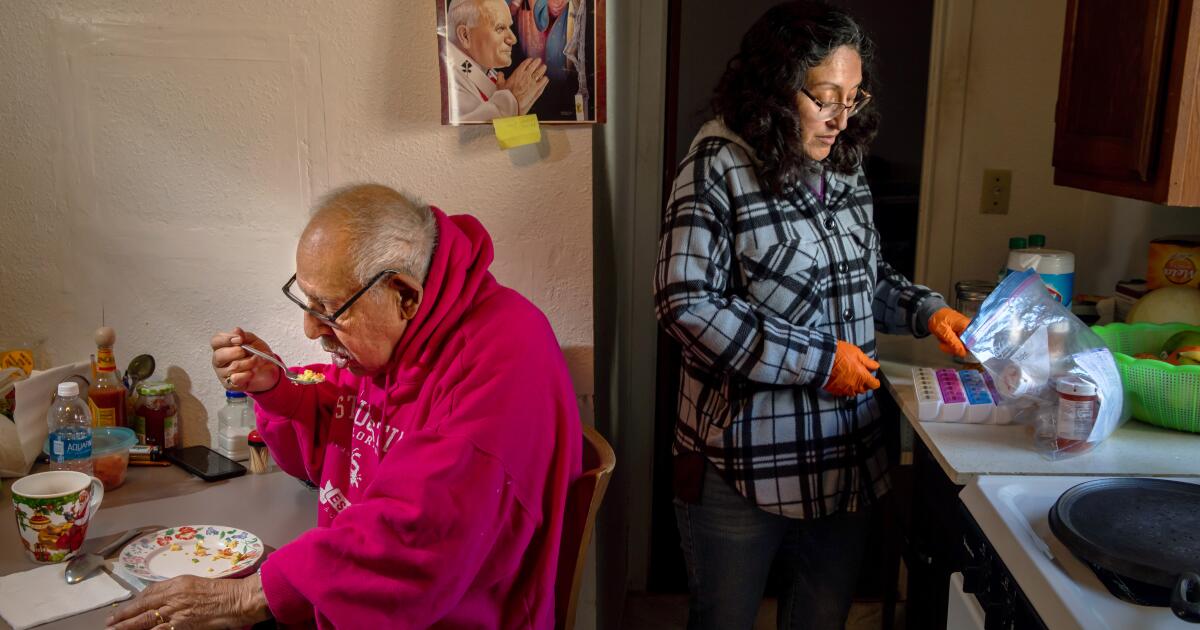
SACRAMENTO — Disability rights advocates on Monday gathered outside the state Capitol to push back on Gov. Gavin Newsom’s proposed cuts to in-home supportive services.
“These aren’t just numbers in a budget; these are real people,” said Assemblymember Jeff Gonzalez (R-Indio). “These are children, seniors, veterans and individuals with disabilities whose independence and quality of life depend on these services every single day.”
The In-Home Supportive Services program helps disabled and elderly people remain in their houses by providing in-home care. It pays assistants to help with tasks such as showering, cooking or attending doctor appointments. Newsom’s revised budget proposal, which was unveiled last month, would cut $367.7 million from the program and shift some of that financial burden onto counties.
Gonzalez explained that the issue hits close to home for his family. He said his son has cerebral palsy and a seizure disorder, and relies on assistance to live with dignity.
“Families should not have to wonder every budget season whether the support they rely on will be taken away,” Gonzalez said. “These services should not be treated as bargaining chips in budget negotiations.”
Assemblymember Laurie Davies (R-Laguna Niguel) questioned why a successful state like California would need to enact such cuts.
“It’s hard to go a day without hearing the governor or the administration brag about how we are the fourth-largest economy in the world and yet we can’t fully fund [this program for] the most vulnerable?” Davies said.
The governor has previously explained that difficult decisions must be made as the state could soon face an economic downturn. The budget proposal relies on a tax windfall, largely attributed to the stock market success of artificial intelligence companies, to erase California’s deficit — but some analysts have warned that the AI bubble could burst.
H.D. Palmer, deputy director for external affairs for the California Department of Finance, on Monday said some of the proposed cuts are a byproduct of the federal government’s changes in funding and eligibility for health and human services programs.
The so-called “Big, Beautiful Bill” signed by President Trump last year shifted federal funding away from safety-net programs, he said.
Palmer stressed that state budget negotiations are ongoing.
“Until we land on an agreement, speculation regarding the resolution of any specific differences between the Governor’s budget plan or the Legislature’s respective budget proposals would be premature,” he stated by email.
Monday’s event drew some bipartisan support. Brody Fernandez, communications director for Assemblymember Esmeralda Z. Soria (D-Fresno), said the legislator had been fighting for In-Home Supportive Services funding since she was elected.
Fernandez said his daughter has special needs and her mother had to give up her career to become a full-time caregiver. “This is personal for us and for many of the incredible individuals standing behind me,” he said.
Graham Knaus, chief executive of the California State Assn. of Counties, told The Times that he appreciated efforts to raise awareness about the burden these changes would place on counties.
“We applaud the Senate and Assembly for recognizing counties’ concerns and rejecting this proposal,” he said. “We ask them to hold the line in final negotiations.”
Elizabette Guecamburu, a bookkeeper who has a rare neuromuscular disorder, spoke at Monday’s rally and implored the governor to remember the teachings of their shared alma mater Santa Clara University, a Jesuit-led private school.
“I want him to remember where he came from,” she said, adding that students were taught to value compassion and community. “Don’t forget your Jesuit roots.”
STAYCATIONS are on the rise, according to the experts – and there is a county that is booming in demand.
In its latest Summer Travel Report, Airbnb revealed that not only are staycations up 11 per cent year on year, but an unlikely trending rural destination is Herefordshire where searches have increased by 76 per cent.
Sign up for the Travel newsletter
Thank you!
Herefordshire is rising in popularity when it comes to staycationsCredit: AlamyEardisley is one of Herefordshire’s ‘black and white’ villagesCredit: Alamy
The county bordered by Gloucestershire, Shropshire and Worcestershire is known for its cider and pretty villages that look similar to those found in the nearby Cotswolds.
Earlier this year, Herefordshire was called the ‘quiet corner of England’ by The Independent – but hoped it would be thrust into the spotlight after the release of Hamnet.
Some of the county’s small villages were used for filming and doubled as Shakespeare’s Stratford.
One of the villages is Weobley which is nicknamed a ‘black and white’ village thanks to its half-timbered houses.
Alongside its pubs, fans of Hamnet should head into The Wobbly Badger Cafe which took centre stage for the exterior of Shakespeare’s family home in the film.
It’s not just Weobley – there are lots of other villages like this one and some are part of that are part of Herefordshire’s ‘black and white villages’ trail which is a 40-minute driving route.
Other villages include Pembridge, or Eardisland, which sits on the banks of the River Arrow (and looks similar to Bourton-on-the-Water).
Even smaller villages include Eardisley, Dilswyn, Leominster and Kingsland.
Hereford Cathedral is in the middle of the cityCredit: Alamy
Herefordshire gets around six million visitors each year compared to the Cotswolds’ 25million – so for visitors it will make for a much quieter staycation.
For fans of cider, Herefordshire has around 15,000 orchards growing apples and pears, some of which is used to produce the drink.
Stops on the South Circuit include Little Pomona Cider & Perry, Gregg’s Pit Cider & Perry, Oliver’s Cider & Perry, Ross on Wye Cider & Perry.
Another famous spot that TV fans will recognise in Herefordshire is Symonds Yat.
The spot on the River Wye is known for its enormous limestone gorge.
It even appeared in the Netflix series of Sex Education – one of the most recognisable places is the red and white chalet that sits high above the valley, which was the exterior of Jean and Otis’ house.
There are a number of cider farms and dedicated routes to visit themCredit: Visit Herefordshire
The River Wye within the valley is the fifth longest river in the country.
It’s surrounded by walking paths and tourists are also welcome to take to the water on a kayak, canoe or paddleboard.
Of course, Herefordshire’s centre is the city of Hereford which is home to a large cathedral.
This houses a famous treasure calledMappa Mundi which is a medieval map of the world from 1300.
It also has the unusual 17th century Chained Library – a collection of over 1,500 rare books and manuscripts that are secured to their shelves by iron chains, rods, and locks.
Entry into Hereford Cathedral is free, but to see Mappa Mundi, Chained Library or a Tower Tour there are additional fees.
Eastnor Castle is a popular spot for a weekend with the familyCredit: Alamy
Another popular spot is the Eastnor Castle which while it looks like one isn’t a medieval fortress, instead, it’s a 19th-century mock castle.
Found in Ledbury, the castle was once home to the Hervey-Bathurst Family who lived at there for over 200 years.
It’s open throughout the year holding events like family fun days, bird of prey and supercar displays,
The grounds are popular for hiking and to entertain the kids, there’s a playground, tree top walkway, maze and mini zip wire.
To apply the existing cannabis business tax to unlicensed cannabis businesses.
Los Angeles Measure TC
To apply the transient occupancy tax to online and other travel companies.
Los Angeles Measure TT
To increase the transient occupancy tax to fund general city services.
Bell Measure BB
To establish a sales tax to fund city services such as emergency services, prevent crime, maintain streets and after-school and anti-gang programs.
Bell Gardens Measure BG
To raise sales tax to fund city services such as police and emergency response, street repairs, park maintainence and youth and senior programs.
Beverly Hills City Treasurer
Beverly Hills City Council
Carson Measure FW
To allow the sale of “safe and sane” fireworks from up to 12 permitted temporary stands within the city around Fourth of July.
Commerce Measure PC
To enact a sales tax to fund police services, 911, youth and senior programs, library services, parks, streets and infrastructure.
Compton City Council, District 2
Compton City Council, District 3
Covina City Council, District 1
Covina City Council, District 3
Covina City Council, District 5
Covina Measure CC
To enact a sales tax to fund emergency services, clean up encampments, address homelessness, improve parks, repair streets and provide senior and youth programs.
Gardena Measure GG
To enact a sales tax to fund city services such as emergency response, hiring police officers, keeping parks clean, repairing streets and maintaining after-school and senior services.
Inglewood Measure I
To repeal the city’s ban on the public’s use of “safe and sane” fireworks, permit their sale under a regulated framework and establish rules and penalties for violations.
La Cañada Flintridge City Council
La Puente Measure LP
To raise the sales tax to fund public safety, street and sidewalk maintenance, park maintenance, youth and senior programs and other services.
Lakewood City Council, District 2
Lomita Measure LW
To enact a sales tax to fund services such as emergency response, property crime prevention, maintain parks, repair streets and sewers, maintain gang prevention efforts and address homelessness.
Long Beach City Council, District 1
Long Beach City Council, District 3
Long Beach City Council, District 5
Long Beach City Council, District 7
Long Beach City Council, District 9
Monterey Park Measure NDC
To prohibit data centers in the city.
Palos Verdes Estates Measure PF
To extend the parcel tax for 10 years to fund emergency services and prepare for wildfires.
Pasadena City Council, District 3
Pasadena City Council, District 5
Pasadena City Council, District 7
Pasadena Glen Community Services District Measure B
To enact an special parcel tax to maintain and improve roads and culverts within the district.
Pomona City Council, District 2
Pomona City Council, District 3
Pomona City Council, District 5
Pomona Measure Z
To restructure funding for the Pomona Children and Youth Fund using city sales tax rather than the general fund.
San Fernando City Council
San Marino Measure S
To enact a transaction and use tax to fund street and infrastructure repairs, improve public safety, provide youth and senior programs and library and parks maintenance.
Sierra Madre Measure GL
To increase the city’s spending limit to fund general governmental services for four years.
The Times’ results pages reveal how Californians voted for governor, U.S. House seats and in local city, school board and ballot measure races.
Every registered voter in the state receives a ballot by mail. Polls close at 8 p.m. on June 2, and mailed ballots need to be postmarked on or before that day. Winners may not be known on election night due to the high volume of mail-in ballots arriving after election day.
The vote counts on these pages update periodically as results are reported by the Associated Press and the L.A. County registrar. On election day, those results include in-person voting as well as any mail-in ballots already received. In the days and weeks following, votes will be reported approximately once a day, as they are processed by county registrars. Voters can track their own cast ballot here.
The Associated Press surveys the numbers posted by local election officials. The AP projects the winner for all statewide and federal races using vote returns and other data. A race may be called before all expected votes are in. Results can change as more ballots are counted.
These pages will update until the secretary of state certifies results on July 10.
Los Angeles County Sheriff Robert Luna jumped out to an early lead over former sheriff Alex Villanueva, his predecessor and leading opponent in the race for the county’s top law enforcement job.
If Luna ultimately receives more than half of the vote, he wins the contest outright and will serve a second term at the helm of the largest sheriff’s department in the U.S.
If Luna falls below the 50% mark, it’s likely that he and Villanueva will head to a runoff once again, reprising their 2022 face-off, when the former Long Beach Police chief unseated Villanueva by a 61% to 39% margin.
This time around, the sheriff’s race was relatively muted. Luna mostly avoided major controversies during his term — unlike Villanueva, who clashed with elected officials and journalists, and was involved in multiple lawsuits. There were no public debates that included the leading candidates and no public polling was done.
Ahead of primary day, Luna touted his leadership and a list of accomplishments. He took credit for reducing the rate of violent crimes and homicides, and said he repaired the relationship with county leaders and others that had been fractured under his predecessor.
Villanueva criticized the sheriff for plunging the department into “chaos and dysfunction,” blaming Luna for the department’s struggles to retain deputies. Luna described both claims as unfounded.
Retired sheriff’s Lt. Eric Strong was in third place as of 8:30 p.m. Tuesday, the same position as when he ran four years ago. He was followed by Sgt. Karla Carranza, who has worked for the department for more than two decades.
Oscar Martinez, who joined the sheriff’s department after fighting in Iraq and Afghanistan, was in fifth, followed by Capt. Mike Bornman, who has decades of experience at the sheriff’s department.
Andre White, a detective with about a dozen years at the department, was in seventh, while Brendan Corbett, a former assistant sheriff for custody operations, was in last place.
Los Angeles County’s half-cent sales tax to fund healthcare services was trailing Tuesday, with early returns showing a majority of voters rejecting the measure.
The tax — a half-penny of every dollar spent in the county — is meant to prop up local hospitals and clinics that are hemorrhaging funding after recent federal cuts.
The sales tax, which needs a simple majority to pass, would take effect Oct. 1 and last five years. Officials say it would pull in $1 billion annually to help plug the budget holes hitting local hospitals and clinics.
L.A. County health officials anticipate the One Big Beautiful Bill Act, signed into law by President Trump last summer, will slash more than $2 billion from the county’s health services budget within the next three years. Due to eligibility changes, the county will no longer be able to get reimbursements for many Californians who have lost Medi-Cal.
The measure was championed by a coalition of healthcare advocates called Restore Healthcare for Angelenos who warned that mass layoffs and emergency room closures could be imminent if new funding didn’t come fast. The Department of Public Health recently closed seven clinics — a grim sign, supporters said, of service cuts to come.
Voters haven’t rejected a sales tax hike since 2012, when a transportation measure fell just short with 66.1% support. It needed 66.7% to pass.
A majority of county supervisors had supported the new tax proposal, voting 4 to 1 this February to put it on the ballot. But the measure faced significant opposition from local cities, with opponents arguing the sales tax hike would unfairly burden the poorest county residents and encourage people to spend their dollars across the county line.
Supervisor Kathryn Barger, the board’s lone opponent of the tax, said she was concerned it was a “general” tax, meaning the money wouldn’t be earmarked for healthcare costs. Instead, she argued, politicians would have final say over how the money gets spent.
The supervisors have created a plan for spending the tax money, with the largest chunk of the money meant to cover the costs for patients without insurance. The measure also asked voters to sign off on a nine-member oversight committee.
The county currently has a base sales tax rate of 9.75%, and cities impose local taxes on top of that.
DENVER — Tina Peters, the former clerk convicted of participating in a scheme to chase election conspiracy theories promulgated by President Trump, was released from prison Monday after the president successfully pressured Colorado’s Democratic governor into commuting her sentence.
Peters’ release was confirmed by the Colorado Department of Corrections. The state agency said it would have no more information about the 70-year-old inmate. Her sentence was shortened by Gov. Jared Polis last month after Trump waged a lengthy pressure campaign against the governor and his state.
Peters served less than a quarter of her nine-year sentence.
Peters was the first local election official to be charged with breaching security after the 2020 election. She snuck in an outside computer expert affiliated with My Pillow Chief Executive Mike Lindell — who himself denied that Trump lost the White House in 2020 — and the person copied the county’s Dominion Voting Systems computer server as it was updated in 2021.
Peters then joined Lindell onstage at a “cybersymposium” that promised to reveal proof that the election was rigged. Video and photos of the computer system upgrade, including passwords, were posted online. The move stoked false claims that voting machines were manipulated to steal the election from Trump.
Peters was convicted in 2024 of attempting to influence a public servant, conspiracy to commit criminal impersonation, violation of duty and other crimes by jurors in Mesa County, a Republican stronghold that supported Trump. An appeals court upheld her conviction in April, but ordered Peters to be resentenced because it said the judge who sent her to prison wrongly punished her for speaking out about election fraud.
Trump had championed Peters’ case, but because she was convicted under state law, he did not have the power to pardon her. Instead, the president pressured Polis to do so, lambasting him on social media and disinviting him to a White House meeting with other governors. The Trump administration also announced plans to dismantle the National Center for Atmospheric Research in Colorado and relocated the U.S. Space Command to Alabama.
Polis commuted Peters’ sentence on May 15. In a letter, he wrote that although Peters was convicted of serious crimes and deserved to spend time in prison, the sentence was “extremely unusual and lengthy” for a first-time non-violent offender.
Colorado Secretary of State Jena Griswold, a Democrat, called the move a “dark day for democracy” and said it amounted to ”selling out our state’s justice system for Trump.”
A pair of nesting bald eagles has been spotted in Los Angeles County, according to a recent Instagram post from the L.A. County Department of Parks and Recreation.
In the video posted Friday, the two eagles are perched on a high tree branch in an undisclosed location. Native nesting birds, like bald eagles, are protected under federal law, and disturbing active nests can “disrupt breeding and impact their success,” the department said in the post.
The department did not immediately respond to a request Sunday for comment about where the eagles took up refuge.
Southern California residents should give nesting birds plenty of space and avoid lingering near nest sites, the post said.
If possible, residents should hold off on tree trimming or vegetation clearing during nesting season. Dogs should also remain leashed and under control around trees and shrubs where birds may be nesting, and residents also should not fly drones near wildlife.
If a nestling is in distress, the department said to contact the San Dimas Raptor Rescue Center for advice at (626) 559-5732.
EVERYBODY seems to flock to the same touristy towns for their seaside holiday, but the county I grew up in is an underrated gem.
You don’t have to brave crowded Cornwall or busy Blackpool for a trip to the seaside this summer.
Sign up for the Travel newsletter
Thank you!
I grew up in North West Norfolk and believe it’s the best UK county for a seaside holidayCredit: Jenna stevensThe walk down to remote Thornham Beach is full of pretty marsh flowers and fresh samphireCredit: Getty
Born and raised in North-West Norfolk, I’ve gotten to know some of the best hidden beaches and prettiest towns and villages to visit – and it’s time to lift the lid on the county’s best-kept secrets.
Norfolk is full of golden sand beaches, spectacular pink and orange sunsets, and far less crowds.
It’s a more affordable choice too, with the average cost of a night’s accommodation sitting at £27.45 and an alcoholic drink costing £5.10 according to North Norfolk News.
While there is a lot of fun to be had in Great Yarmouth, if you’re over the crowds and – let’s face it – tacky atmosphere, you should head further west along the coast.
Coastal villages like Blakeney and Brancaster are underrated spots where you can watch seals play in the water and fishermen haul in fresh mussels to be served in local restaurants the very same day.
Brancaster and neighbouring village Brancaster Staithe are the perfect mix of buzz and relaxation.
For a peaceful day out, spend the day walking the scenic Norfolk coast path, or even trying your hand at sailing or a round of beachside golf at the renowned Royal West Norfolk Golf Club.
The village is also home to Brancaster Boards, where you can rent a stand up paddleboard and float on down the flower-filled saltmarshes.
One of my favourite ways to spend a day here is with Wild YogaNorfolk, where sessions combine activities like wild swimming, beachside yoga and sauna pod sessions into one blissful day.
When you fancy something more lively, head to The White Horse hotel and restaurant.
The vibe of the Marshside bar and restaurant here is unbeatable: house music blasting, the catch of the day served with a local Lucky Lobster beer, plus ice-cold drinks enjoyed in a buzzy atmosphere.
You can get three fresh oysters for £13, or snack on some delicious crispy squid with garlic mayo for £8.50 – not a bad price given the high-quality food and stunning sea views.
The Marshside bar and restaurant at the White Horse in Brancaster is a favourite spot of mineCredit: Jenna stevensGo paddle boarding in Brancaster Staithe for gorgeous views – particularly at sunsetCredit: Jenna stevens
Plus they put on loads of events throughout the summer, like a Lobster & Fizz Fest, Oyster Festival and End of Summer BBQ.
For a less boujee and more family-friendly feel, check out The Jolly Sailors pub.
They do great stonebaked pizzas and tasty rum cocktails, plus there’s a massive beer garden with family fun days and an ice cream shack serving flavours from bubblegum to ‘Unicorn’.
Further along the country roads you’ll find more pretty villages like Thornham, Holme-next-the-Sea and Titchwell.
Titchwell Marsh Nature Reserve has amazing wildlife, where you can spot birds of prey dip down into freshwater lagoons – if you can, bring a pair of binoculars and a good camera!
Thornham Beach is one of my favourites, and is often called the most remote beach in North Norfolk.
It’s a quieter option as it takes a 1.5 mile walk to get there, but the views are absolutely worth it – and it will never be as packed as beaches like Sheringham or Cromer.
After a scenic stroll you’ll reach a vast stretch of soft golden sands backed by rolling dunes and shady pine forest.
The beach is dog-friendly and the surrounding marshes are a great spot to pick some fresh samphire if you’re visiting in season (from June – September).
Holme-next-the-Sea is the new place to be, with a gorgeous stretch of beach and a trendy pub and bakery doing the rounds on Instagram.
The White Horse at Holme is a Grade II-listed pub recently done-up with a fabulous beer garden with its own cosy fire pit, plus a charming rustic bakery serving up freshly-baked pastries and delicious coffee.
Inside the pub itself you can order everything from hearty, homemade pies to moules mariniere with homemade crusty ciabatta.
Plus it’s only a short walk from here to Holme Beach, which is much more peaceful than the flashy arcade lights and promenade of overpopulated Hunstanton.
Norfolk has some of the most spectacular sunsets with bright pink and orange skiesCredit: Jenna stevensGo wildlife watching at Blakeney Point to spot adorable common sealsCredit: Alamy
If you’re visiting with kids, head to Holkham Estate where there’s an action-packed high ropes course plus activities like silent discos and outdoor theatre.
Another great spot is Snettisham, where you can go on a deer safari at Snettisham Park, which costs £13.50 per adult, £11.50 per child with under 3’s going free.
Plus I recommend popping into family-friendly pub The Rose and Crown, where there’s a walled beer garden with a kids play area.
Like many North Norfolk pubs, it’s dog-friendly and even has pet-friendly rooms – so feel free to bring your furry friend along on your trip to Norfolk this summer.
You can hand feed the local deer on a deer safari at Snettisham ParkCredit: Jenna stevens
People don’t come to White Point/Royal Palms Beach for a lazy day of sunbathing, they come here to explore. At low tide, the rocky shoreline is a maze of crater-like formations and tide pools where visitors crouch over searching for life. During my visit, two men poking around with fishing rods excitedly showed me a small octopus they had spotted in one of the crevices. It’s no wonder: White Point offers some of the most diverse tide pools in Southern California.
If you park in the upper parking and playground area, the experience starts to feel special before even reaching the water. Brass plaques placed throughout the bluff describe the area’s rich history, while dramatic, panoramic views of the rugged cliffs and stony coastline unfold below. From there, it’s about a 10-minute walk downhill to the beach itself. The rocky shore is not ideal for swimming, but scuba divers come to experience the underwater hot springs.
During a recent visit, construction equipment occupied one end of the beach due to work on a sewage line, though the lifeguard on duty assured me that treated wastewater is released about three miles offshore, where deep ocean currents disperse it before it can affect water quality at the coast.
Best for: dramatic views, tide-pooling, scuba diving, fishing
Bathrooms: Yes (additional portable toilets also available at bottom of hill)
Parking: Lot immediately after entrance (10 minutes downhill walk to beach) is free weekdays, $8 on weekends; there’s another lot right by the beach, which is $6 after 9 a.m. on weekdays, $8 on weekends
Dog-friendly: Leashed dogs are permitted on the paved trails beyond the rocks
ADA-accessible: ADA parking, but no wheelchair available due to the rocks
What’s nearby: The nearby White Point Nature Preserve offers 102 acres of coastal habitat and hiking trails. There isn’t much in terms of food or drink in this area, so bring sustenance and make use of the picnic tables on the beach’s upper bluff portion.
On a recent spring morning, Championship Soccer Stadium, which sits in a corner of the Orange County Great Park in Irvine, was quiet and empty save for the dozen sprinklers quenching a newly laid grass carpet.
Normally the well-used stadium is a buzz of activity. But its main tenant, the Orange County Soccer Club, which plays in the second-division USL Championship, has been temporarily evicted, left to train in the nearby park and play its final home game before the World Cup at Eddie West Field in Santa Ana, 12 miles away. (Not that it was necessarily a bad thing since the club drew a home-record crowd of 7,651 to its 3-2 win over Oakland on Saturday, which allowed it to hold onto second place in the Western Conference table.)
During the next month, the nine-year-old venue will have just one occupant, the U.S. national soccer team, which has chosen the stadium as its main training base for the World Cup. The temporary change in ownership is heralded by a giant orange orb the size of a hot-air balloon, adorned with the U.S. Soccer logo and tethered to a rise just outside the stadium.
Why and how the federation wound up in Irvine is unknown; U.S. Soccer declined to respond to multiple requests for comment. But it’s safe to say location was a factor since the Orange County Great Park is the closest World Cup training base to SoFi Stadium, where the U.S. will play two of its three group-stage games.
Crews work to prepare the training area for the U.S. soccer team at Championship Soccer Stadium in Irvine.
(Allen J. Schaben/Los Angeles Times)
The U.S. team’s first training session there, on June 8, will be the only practice open to the public. Four days later, the team will open its World Cup schedule against Paraguay in Inglewood, a 45-mile bus ride away. The Americans are one of seven World Cup teams to choose base camps in California. Australia and Paraguay will train in the Bay Area; Switzerland and New Zealand will be in San Diego; and Austria and Qatar will stay in Santa Barbara.
For the Orange County Soccer Club, which has just a humble spot on the U.S. soccer landscape, even a temporary association with the World Cup and the national team is worth celebrating.
“How can you not be excited about the host nation training in your facility when you are a club who prides itself on developing young talent,” said Dan Rutstein, the team’s president of business operations. “Sharing a stadium with the U.S. national team is a great opportunity.”
One that comes with great perks. FIFA, which vetted the location for World Cup teams a couple of years ago, has replaced the stadium’s grass field with one the Orange County team could never have paid for itself and will install security fencing in the next week or so, as it will at all 48 tournament training fields. U.S. Soccer is also expanding and improving the team’s tiny locker room and adding a media work room.
Alvaro Leon, Brian Biniasz, and Joesph Frausto install rubber flooring in the U.S. Soccer World Cup locker room.
(Allen J. Schaben/Los Angeles Times)
The Orange County Soccer Club is paying for those perks with a little inconvenience, however. The players will have to dress at home for practice, which will be held in the adjoining park. And the club’s next six games will all be on the road. The team also had to take down any signs or placards that mentioned the Orange County Soccer Club; they were replaced with USMNT signage.
“It’s their stadium now,” Rutstein said.
“If you look at what the club is trying to achieve and where we are as an organization, any short-term pain is more than offset by the medium- and long-term benefits of being associated with the World Cup and the U.S. national team,” he added.
The team is trying to sell naming rights to the stadium, for example, and its association with the national team and the World Cup could be a big help in that.
When FIFA first released potential World Cup training sites two years ago, Championship Soccer Stadium was on the list and Rutstein said about a dozen national teams sent representatives to have a look. How many bid on the site is unknown but FIFA rules say if two or more teams make a claim on the same venue, the team with the lowest FIFA world ranking gets first dibs.
The U.S. is ranked 16th, which clearly gave it an edge.
An aerial view of crews preparing the training area for the U.S. soccer team at Championship Soccer Stadium in Irvine.
(Allen J. Schaben/Los Angeles Times)
Besides, Orange County is no stranger to world-class soccer. The only other time the World Cup was hosted in the U.S., in 1994, the American team trained in Mission Viejo. And when European champion Paris Saint-Germain came to Southern California for last summer’s Club World Cup, it trained at UC Irvine.
“Being away from the glare of a big city is appealing,” Rutstein said.
“The World Cup is going to do wonders for soccer in this country, as it did over 30 years ago,” he continued. “And we’re excited to make the most of that growth.”
Jones’ performance wrote another chapter in his Wembley story, which started when he helped Coventry win the EFL Trophy in 2017 and being on their books when they won the League Two play-offs in 2018.
His previous visit for Notts involved him scoring a penalty in the National League promotion final shootout against Chesterfield in 2023.
“I’d like to think there’s another chapter at Wembley coming for me,” said Jones. “I haven’t lost with a club. I’d like to think Wembley is a good place for me.”
County’s promotion was their 14th in EFL history, one short of the all-time record held by Grimsby Town, and Jones says there is no reason why they cannot be optimistic about the future.
“My godfather said to me when I went to Notts, ‘I really believe you can do something similar to what you did at Coventry and go up the leagues. Notts seem like the sort of club who would do something like that, they are a massive club’,” said Jones.
“It wasn’t that long ago that I was a Coventry City player and we got promoted against Notts in the play-offs. I hope they have forgiven me for that.
“Who knows where we can go. We are a fantastic club and I’m sure we’ll attract a lot of talent who will want to come and join us.”
As for it being a third major success among his significant clubs, Jones said he spoke about Arsenal, Coventry and Notts County having fruitful campaigns in a family group chat at the start of the season, saying it “would be amazing”.
I’VE lived on Kent’s trendy coastline for more than five years, so I think I can legitimately call myself a local now.
After ditching London in my late twenties, I’ve lived in both Margate and Folkestone, while spending my weekends exploring the other seaside towns.
The pretty harbour in the seaside town of Folkestone, where Deputy Travel Editor Kara Godfrey has been living for the past couple of yearsCredit: AlamyA view of Whitstable sea front, looking towards the much-loved Old Neptune pubCredit: Alamy
In the last 15 years, Kent’s seaside towns have arguably seen the biggest transformations of the whole British coast.
That’s due to a combination of new investment, an influx of ‘down from Londoners’ moving in and a reignited love of the traditional seaside break among Millennials.
But which town you should visit depends on what type of trip you’re looking for.
So here are my top tips for seven of the best Kent beach towns and villages, from what to do and where to eat, to the best hotel and things to do under a fiver.
Whitstable
One of the more established Kent seaside towns, Whitstable is famous for its annual Oyster festival and has been a popular tourist destination for the last few decades – long before towns like Margate saw a resurgence.
Eat and drinkin Whitstable
Blueprint Coffee and Books is the kind of place where you’ll go in for a cappuccino but come out with magazines and a candle.
The pastel pink Wheelers Oyster Bar is where everyone goes for their seafood (and for good reason) but if you fancy something other than fish, Harbour Street Tapas is the place for Spanish sharing plates.
In the summer months, the Old Neptune pub is a must, where the pub garden is right on the beach. Or try Porto Wine Bar, tucked a bit further down for staff who really know their wines.
Don’t forget an ice-cream – Bear’s Ice Cream Imaginarium has everything from classics to more unusual flavours like celeriac and wasabi. Yes, really.
The pastel pink Wheelers Oyster Bar where everyone goes for their seafood (and for good reason)Credit: GettyThe Old Neptune pub on the beach in Whitstable is the perfect spot to enjoy a pint in the sunCredit: Alamy
Best things to do in Whitstable
Harbour Street is home to some fantastic vintage shops to explore. I picked up a jumper worth £69 for a fiver, so it has some treasures if you look hard enough.
There’s also Whitstable Harbour, still a working harbour, to explore as well as the free-to-visit Whitstable Castle with beautiful gardens and a kids’ play area.
Really fancy a dip? Brave the water with the other cold water swimmers but make sure to warm up in the Sea Scrub Sauna, one of many around Kent.
I’ve tried it all from beach saunas (pictured) to rooftop barsCredit: Darren Fletcher
Where to stayin Whitstable
The Marine Hotel is a classic coastal B&B, with big chunky king size beds and windows thick enough to keep out the sea breeze.
The restaurant is where you will join the locals on a Friday night with a classic but hearty menu making you grateful for the proximity of your room.
Head to the end of the harbour and pick up a crabbing net from one of the stalls which are usually under a fiver and see what you can catch.
Margate
A view of Margate Harbour Arm, which is now home to several trendy bars and restaurantsCredit: AlamyRelax al fresco in among the bars and restaurants in Margate Old townCredit: Alamy
Nicknamed Shoreditch-on-Sea, Margate is known for being one of the trendiest beach towns in the country.
As well as having one of Kent’s rare sandy beaches (most are shingle) this has also seen a huge increase in cool wine bars and restaurants.
Eat and drink in Margate
Start your day at Big Shot Diner for a cup of tea while looking out over the beach, or the Bus Cafe for a great full English breakfast.
When it comes to fish, the best chippies in town are Peter’s Fish Factory and Beach Buoys, so expect queues out the door, or for a fancier sit down affair, head to Angela’s.
Pizza by the slice is best at Palm’s Pizzeria, best chased by a pickleback shot (whisky and pickle juice).
There are some great wine bars too but my favourite place to go are the pubs in Margate.
Try Rose in June for fun food and drink pop ups or the 18th century George & Heart House, which also has rooms above if you fancy staying the night.
Best things to doin Margate
The beach itself is beautiful but for more adrenaline-fuelled fun, head to the free-to-visit Dreamland.
You can pay for rides, or just take in the retro-style attraction – come in the summer for the fantastic live music line up ranging from Lovebox to Bastille.
Or did you know Margate is home to Europe’s only Crab Museum? It’s certainly quirky but one to visit as its free, although they rely on donations.
And of course there is the free Turner Contemporary art gallery as well, which is reopening on May 23 with a new exhibit.
Where to stay in Margate
Lots of boutique hotels have opened in Margate in recent years, and one of the best is Guesthouse No.42.
One of just four in the UK, it even has the town’s only rooftop bar, which overlooks the beach.
The bizarre Shell Grotto remains a mystery as to why or how it was built – but its a beauty to see.
Concession tickets start from £5, kids tickets are £2.
Folkestone
Folkestone seen a huge rise in popularity in recent yearsCredit: AlamyThe quirky Old High Street is home to Folkestone’s Creative QuarterCredit: Alamy
Named one of the best places to live in the UK last year, Folkestone has seen a huge rise in popularity in recent years, partly because of its speedy, 52-minute train from London.
There are some new openings to be excited about too, including the Lower Leas Cliff funicular.
Eat and drinkin Folkestone
After it’s success in Margate, Pomus opened their second small plate restaurant in Folkestone. It’s one of the smarter places in town, but service is just as friendly with a rotating menu of locally caught produce.
Award-winning Rocksalt is the place for fish lovers, overlooking the harbour (and the oysters are a must).
Or for something more low-key, there is the local-loved Morley’s which has a small but classic menu – think burgers and pastas.
If there is one thing Folkestone isn’t short of, it’s pubs – try the Harbour Inn or The Pullman for friendly staff and local ciders.
And splash out for the evening by heading to the end of the harbour for a glass of fizz at The Lighthouse Champagne Bar, or a cocktail at Gaia Studios.
People enjoying refreshment at the Lighthouse Champagne bar the on the popular Harbour ArmCredit: AlamyAward-winning Rocksalt is the place for fish lovers, overlooking the harbourCredit: Alamy
Best things to doin Folkestone
The Harbour Arm celebrated 10 years this year, and you can easily spend a day in the shipping container yard.
Along with food and drink stalls, there are independent shops selling everything from locally-made wine to clothing and dog treats. It also has lots of live music throughout the year and live screenings of films and sports.
Also nearby is The Boardroom for darts and shuffleboard (currently closed for a renovation), while the new Sea Scrub Sauna is the largest of its kind in the UK. Otherwise go for a wander along to the Lower Leas Coastal Park, which is getting a huge new playground too.
Where to stayin Folkestone
The London & Paris Hotel is one of the few boutique hotels in town, where every room overlooks the harbour.
Each room is coastal chic – think blue striped walls and vintage bathtubs – and they come with little touches such as complimentary binoculars and breakfasts delivered by hamper.
Grab an ice cream from Herbert’s Gelato with a rotating menu of interesting flavours such as hot cross bun or malted milk. From £3.90.
Ramsgate
Wellington Crescent Cliff Lift, an Edwardian grade II listed working elevator above Ramsgate main sandsCredit: AlamyThe Victorian Pavilion is the UK’s largest Wetherspoon’sCredit: Alamy
From welcoming Queen Victoria in the 1800s to having the UK’s only Royal Harbour, Ramsgate has a rather regal history.
Now, it is a popular seaside town still slightly overlooked by its trendier neighbours Margate and traditional Broadstairs, but it is a great weekend break.
Eat and drink in Ramsgate
Get your morning coffee at Staple (along with an irresistible cruffin to go) with cafes also open in Westgate and Broadstairs.
But for the best places to eat, there are two top choices. First up is Marc-Pierre’s Kitchen restaurant where you will find some of the best seafood in town (with enough awards to show for it).
It’s tucked down a tiny hidden side street but with big restaurants under his belt, including London’s famous Cinnamon Club, you’re in good hands (make sure to save room for the chocolate samosas).
End your evening at Noa Rooftop, which opened last year, for a crisp glass of wine to watch the sunset.
Best things to doin Ramsgate
Ramsgate has the UK’s only Royal Harbour, so it is the best place to spot the boats coming in and out for the day.
But its wartime history is best learned about at the Ramsgate Tunnels.
There are daily tours of the underground system that is also the largest UK network of wartime tunnels.
Search the knick-knacks of Petticoat Emporium, one of Kent’s biggest indoor markets with 200 traders and where you can pick up everything from vintage spoons to huge wicker chairs.
Aerial Views Of Ramsgate HarbourCredit: Alamy
Where to stay in Ramsgate
Ramsgate is more B&Bs than boutique hotels, but one of the best in town is the The House at Ramsgate which dates back to 1780. With just 14 rooms which are cosy but modern, choose the Queen Victoria Room where she spent three months in 1835. Make sure to stay for the roast dinners too…
With strong connections to Charles Dickens, Broadstairs is your more traditional seaside townCredit: Alamy
With strong connections to Charles Dickens (who raved about the place while holidaying there), Broadstairs is your more traditional seaside town.
It has seven sandy beaches to choose from, so you’re spoilt for choice.
Eat and drinkin Broadstairs
If you love a good coffee, you’re in luck – there’s Giant Coffee, who do unique hot drinks like cloud matchas (and are also in Ramsgate and Margate) to Forts who are known for their great coffees across Kent.
Fish and chips are a must at the beach and everyone heads to The Mermaid who do very large portions.
Chase it with an ice cream at Morelli’s Gelato which dates back to 1907, they sell huge towering sundae with all the trimmings.
But for dinner, you can’t go wrong with the award-winning Bar Ingo, a tiny restaurant with just a few tables but serving small plates inspired by basque dishes.
I’m still dreaming of the miso mushrooms after my last visit.
Morelli’s ice cream parlour at the English seaside resort of BroadstairsCredit: Alamy
Best things to do in Broadstairs
Broadstairs has the beautiful curved Viking Bay sandy beach, so hanging out there is a must. Grab a paddleboard or rent a deckchair; you can do what you like to while away the day.
There are also the retro arcades at the top of the hill, which are a surefire hit with the kids.
Or you can explore some of the independent shops selling trinkets and gifts on the high street (my favourites are Home by SP and Arrowsmiths).
Broadstairs beach on a sunny dayCredit: Alamy
Where to stay in Broadstairs
One of the newest hotels in Broadstairs is Smith’s Townhouse, with just six bedrooms in the Georgian building. Stylish east London interiors are across the downstairs cafe and the rooms – Room Five even has Elton John’s former wardrobe.
They have some of the best coffee in town – perfect for a breakfast pick me up – but stay for a vibe in the evening where you can get cocktails and nibbles too.
Broadstairs was once raved about by Charles Dickens, so a visit to the Dickens House Museum is a must.
Inside is the inspiration for Betsey Trotwood’s home from the novel David Copperfield.
Tickets cost £5 for adults of £2.50 for kids.
Deal
Deal is smaller than Whitstable or Folkestone, which makes it far more walkableCredit: Alamy
The town of Deal is quickly becoming a foodie hub, with some critically-rated restaurants popping up.
It also has a great art scene, with numerous galleries and frequent exhibitions from local artists.
It’s on the smaller side than Whitstable or Folkestone, but also makes it far more walkable.
Eat and drinkin Deal
Popup Cafe is, despite it’s name, not a pop-up but a fantastic coffee shop where you’ll be hanging with young families and coworkers on their laptops.
Mostly known only to locals, the local Jenkins & Son Fishmongers opens at certain days to offer street food dishes; I regularly make a trip for the Monkfish Tacos.
For pubs, try the Caribbean style roast at The Port Arms, which shares an outdoor seating area with the nearby Kings Head pub – also worth a drink in.
The recently revamped Le Pinardier wine bar will transport you to a French bistro (without the snobby staff when you ask for a Pinot Grigio, however).
Deal high street is full of art galleries and independent sellersCredit: Alamy
Best things to do in Deal
The high street is full of art galleries and independent sellers, my favourites being The Hoxton Store, Mileage and 123 High Street for gifts.
Explore the brutalist Deal Pier, restored twice in its history and now one of the last remaining of its kind, where you can weave between the fishermen for some of the best views in town.
Kids will love Deal Castle where they can explore the hidden tunnels and even play pretend with wooden muskets.
Otherwise try and visit on a Saturday morning to catch the local market that dates back to 1699 – and fill your pockets with antiques and cinnamon buns.
3A view of Deal pier from Deal beachCredit: Alamy
Where to stayin Deal
The Rose Hotel is one of the UK’s best boutique hotels, with just nine cosy rooms. Make sure to try the restaurant too, its one of the finest in town with a previous menu highlight being the chicken shnitzel.
Grab a bottle of beer at the stunning Deal Pier Kitchen to get beautiful ocean views, while being protected from the sea winds.
Hythe
Aerial views of Marine Parade in HytheCredit: Alamy
The military history of Hythe shapes it, being one of the UK Cinque Ports.
Now, its a sleepy seaside town, less crowded due to it being off the beaten track and having no major train station.
Eat and drink in Hythe
Arrive early and get a coffee from the tiny, locally-run Mit Milche Coffee although expect queues out the door by mid-morning.
Gorge on some moules mariniere at The Waterfront with a table outside by the promenade, where you can expect a range of live jazz and DJ music on certain days.
If you’re in the mood for something fancier, just on the outskirts is Hide & Fox which gained a second Michelin star last year.
Just come hungry if you opt for the eight-course menu.
If the sea air is a little brisk, warm up in the Kings Head pub, one of the oldest and cosiest in town dating back to 1583.
Hythe is one of Kent’s sleepier seaside towns, due to it being off the beaten track and having no major train station.Credit: Alamy
Best things to do in Hythe
The Royal Military Canal is prime for low-key strolling, running for 28 miles and made as an anti-invasion defence again Napoleon in 1803 (although it was never used.)
There are also the Hythe Sound Mirrors which were huge structures build to “listen” for enemy planes and have now been left abandoned – but worth a visit to see the sheer scale of them.
Want to get your shopping kicks? Head to Malthouse Arcade on Fridays and Saturdays with trinkets galore across two floors.
A boat on the Royal Military Canal at HytheCredit: Alamy
Where to stay in Hythe
You don’t get much grander than the Hythe Imperial Hotel, overlooking the English Channel. Inside an 18th manor house, there are 92 rooms to choose from. Save time for a cuppa in the Snug or a trip to its Moet & Chandon Bar.
Why not have a free game of tennis, with five courts open to the public at South Road Sports Facility (although save a few quid to buy some more tennis balls for any rogue hits).
Talk to the passionate team behind KidSTREAM, a new children’s museum in Ventura County, and they’ll tell you about the many lofty goals they have for the 21,000-square-foot space which opened to the public Thursday.
They’ll describe how the museum is the first of its kind in Ventura County and how they hope to make it accessible to as many local children as possible through outreach, discounts and free programming.
They’ll explain how the immersive exhibits highlight the county’s unique industry and geography, including an agriculture area where young visitors can pick pretend fruits and sell them at a farmers market and an ocean exhibit where miniature replicas of the Channel Islands emerge from the bouncy blue “Pacific Ocean.”
A drone view of the museum’s Pacific Ocean and Channel Islands-themed play area.
Avery Hanchar, right, and her brothers Oliver and Carter, test their climbing and balancing skills.
They’ll share that the STREAM in KidSTREAM is an acronym for Science, Technology, Reading, Engineering, Arts and Math, and talk about the activity carts and art projects that will enhance and support learning for young visitors.
But they are also well aware that for some families, the still-evolving space will serve a less highfalutin, if just as important, goal.
“Parents are looking for a good nap on the way home,” said KidSTREAM founder Kristie Akl. “And we can give them that too.”
Akl, along with KidSTREAM board chairman Bryan Yee and guest experience director Dani Hildreth, were giddy with excitement as they took me on a tour of the museum in the days before it opened.
This moment had been a long time coming, they said.
A high-energy former high school biology teacher with a make-it-happen spirit, Akl first began dreaming about a children’s museum in Ventura County in 2013 after taking her three daughters to KidSpace, a children’s museum in Pasadena founded by members of the Caltech community in 1979.
Akl loved Kidspace, but it was a full hour from the family’s house in Camarillo and she longed for something similar closer to home. For two years, she tried convincing others to create a children’s museum in Ventura County. When that failed, she formed a fledgling board in 2015 and incorporated as a 501(c)(3) nonprofit in 2017.
A young guest chases a cloth blown out of the tubes at the museum’s Amazing Airways exhibit.
“I was always optimistic,” she said. “You have to be to do something like this.”
The original plan was to open the museum in 2020, but fundraising efforts were hampered by the 2017 Thomas fire, which destroyed hundreds of homes in the area. A few years later came COVID shutdowns. The delays were discouraging, but Akl and a growing community of motivated believers used the time to build out their proof of concept by bringing science projects to local schools, neighborhoods and community events, creating online workshops and giving farm workers free science kits to help their kids get exploring.
“It was a herculean task and a huge community effort,” Akl said. “Everyone leaned in.”
Today she estimates that the KidSTREAM Children’s Museum touched the lives of 70,000 children in the Ventura area before ever opening its doors.
Luke Delossantos, right, and his son Grayson play pretend.
“They prototyped a lot of ideas,” said Yee, a father of three who took over from Akl as chairman of the board of KidSTREAM in 2022. “That showed us what works and what doesn’t work and what we should do next.”
In 2022, the city of Camarillo donated the building that housed the former public library to the museum and in 2024, the team raised enough money to bring children’s museum specialist Hildreth on board. Construction began in 2025.
In addition to the agriculture and Pacific Ocean areas outside, visitors will find a camping exhibit with an obstacle course, gratitude tree and a series of different shaped tents where kids can play. There’s also a sand pit where children can dig up replicas of pygmy mammoth bones. (The pygmy mammoth is a dwarf species of mammoth that was native to the Channel Islands.) A nature area includes a sensory path designed with the unique needs of neurologically divergent children in mind.
“There are 200,000 kids in Ventura County from a huge range of backgrounds including a lot of farm worker families,” Hildreth said. “The space is designed for all of them, newborn to 10 years old.”
In addition to the outdoor play areas, visitors will find an indoor “makerspace” with a white Lego wall where children can create vertical designs, four tables for art projects and a super-sized Lite-Brite.
Visitors walk through a greenhouse at the museum’s agriculture area.
“When you are 3 feet tall, it’s your whole field of vision,” Hildreth said.
Admission to KidSTREAM is $16 for adults and children over the age of 1, $13 for seniors and military, and $3 for families with EBT, SNAP or WIC cards. Membership options are also available.
Yee said market research suggests the new museum will reach as many as 150,000 people, and there is still room for expansion.
“We’re 21,000 square feet now with room for growth,” he said. “We’re not stopping, but we’re so excited to open our doors.”
As plenty of Californians remain undecided about the gubernatorial primary’s unsettled Democratic field, some are waiting to cast their ballots, creating the potential for a slower vote count or a longer wait to find out the winners.
Though the landscape could change quickly if Democrats coalesce around a single candidate within the next several days — signs of which were emerging this week — for now, many Democratic-leaning voters appear to be waiting for new developments before making their final decisions, political analysts say.
“This has been a roller coaster of a race, and I think voters are waiting to see when the ride is going to end and cast a vote at that time,” said Steve Maviglio, a Democratic strategist.
A larger-than-usual number of people casting mail ballots on or close to election day could extend the ballot-counting process, said Kim Alexander, president of the nonpartisan California Voter Foundation. County election officials said they were prepared for that possibility. Early returns so far haven’t made it clear whether most voters will wait longer than usual to cast ballots.
Mike Sanchez, a spokesperson for the Los Angeles County registrar, said the county was “fully prepared” for the possibility of receiving “a significant number” of ballots returned close to or on election day, June 2.
“It is not uncommon in primary elections, particularly those with a large number of contests and candidates, for some voters to take additional time to review their ballots and hold onto them longer before returning them,” he said.
Californians who want to vote on or close to election day can vote in person or use a mail-ballot return option that doesn’t rely on the U.S. Postal Service to help speed the process and avoid the risk of a mail ballot arriving late, election officials said.
Hesitation by Democratic-leaning voters reflects the toll of a historically uncertain primary race for governor. The contest has been marked by the unusual lack of a clear Democratic front-runner and the party’s failure to line up behind a single candidate after former U.S. Rep. Eric Swalwell dropped out in April.
Early concerns within the party that a split Democratic electorate could put two Republicans on the November ballot under the state’s top-two primary system also heightened the sense of stakes among left-leaning voters.
Those factors, combined with a large slate of candidates, voter confusion about how candidates’ platforms differ and a desire to choose the person “most likely to win” have made Democratic-leaning voters uncertain, said Christian Grose, director of the USC Democracy and Fair Elections Lab.
“There’s a little bit of, whoever’s in the lead some Democrats are choosing to vote for … but people don’t know who that person is,” Grose said, noting that “some of that [could start] to go away” as the race tightens.
An indication that Democrats are starting to consolidate around Xavier Becerra, the former U.S. Health and Human Services secretary, came Tuesday in a new survey released by the California Democratic Party. It showed Becerra with support from 21% of respondents, followed by billionaire Tom Steyer with 15%.
Republican-leaning voters appear to favor Steve Hilton, who had support from 22% of survey respondents. Republican Chad Bianco, the Riverside County sheriff, had 10%. Under California’s primary system, the top two vote-getters advance to the general election, regardless of party.
Tallies from a handful of counties showed varying early turnout so far.
In San Francisco, a relatively small number of ballots have been returned, indicating that voters may be waiting, Michelle Parker, president of the city’s elections commission, said Tuesday. If people vote by mail close to election day — rather than voting in person or using a drop box — it could affect the speed of vote-counting, a possibility the city’s election staff is prepared for, she said.
“We’ll see how quickly they come in, but knowing what the news has been like and watching what the dynamic has been like across the state, I’m not surprised people are waiting,” Parker said, referring to the governor’s race.
In San Bernardino County, 5.6% of mail ballots had been returned as of Tuesday, a rate comparable with previous elections, Registrar of Voters Joani Finwall said. Election officials “strongly encourage” voters to cast ballots early using drop boxes or early voting locations, Finwall said.
In Orange County, by contrast, data so far indicate that voters are not waiting, the Registrar of Voters office said. More than 129,000 vote-by-mail ballots had been returned by the end of the day Monday, more than had been returned by the same time in the 2024 and 2022 primaries. Of those, a slightly higher percentage of Republicans than Democrats had voted.
If a large number of voters were to wait until June 2 to cast a mail ballot, the county would be able to efficiently process them, said Registrar of Voters Bob Page, noting that 90% of the county’s early vote-by-mail ballots were included in election night results in the 2024 presidential primary.
Voters should be prepared for the possibility that the gubernatorial results aren’t determined on election night, Grose said. One candidate could appear to be in the lead on election night and another could overtake them once all ballots are counted.
State election officials warned this month that some social media posts urging Democrats to vote “late” could be misinformation. Secretary of State Shirley Weber’s office said it would look into such posts, one of which falsely attributed the message to historian Heather Cox Richardson.
Mail ballots must be postmarked on or before election day and arrive within seven days after the election; otherwise, they are considered late and not counted.
Rusty Hicks, chair of the California Democratic Party, acknowledged chatter around people holding onto their ballots but said the survey released Tuesday indicated voters are “beginning to move towards specific candidates.”
Even as Becerra and, to a lesser extent, Steyer rose in popularity, other Democrats saw support in the single digits in the poll, including former U.S. Rep. Katie Porter, San José Mayor Matt Mahan and former Los Angeles Mayor Antonio Villaraigosa.
“This race isn’t over; we’ve certainly seen a lot of twists and turns to this point, but you do see some clear consolidation taking place for both Democrats and Republicans,” Hicks said on a call with reporters. “I’m not concerned about California Democrats having their voices heard.”
“There is some uncertainty among Democrats about, ‘Is there one more shoe to drop for someone?” Grose said. “That’s one reason people are holding onto their ballots.”
Voters who want to cast ballots later than May 26 should return their mail ballots at a voting site, county election office or drop box, rather than via the Postal Service, by 8 p.m. on June 2 or should vote in person, recommended Alexander, of the California Voter Foundation.
Because mail ballots require election officials to conduct signature verification, they take longer to count than in-person ballots. In addition, recent changes at the U.S. Postal Service have slowed mail service, creating a higher potential for mailed ballots to arrive late.
Alexander also urged voters to take advantage of Saturday in-person voting, available at county election offices statewide the weekend before election day, and other early voting options.
“I am very sympathetic with voters who want to take their time to make their decision in this very fluid election,” she said. “The important thing is to have a plan.”
MINNEAPOLIS — A Minnesota prosecutor on Monday announced charges against an Immigration and Customs Enforcement officer in the nonfatal shooting of a Venezuelan man during the Trump administration’s crackdown in the state.
The officer, Christian Castro, is charged with four counts of second-degree assault and one count of falsely reporting a crime in the Jan. 14 shooting of Julio Cesar Sosa-Celis, Hennepin County Atty. Mary Moriarty said at a news conference. A warrant was issued for his arrest.
“Mr. Castro is an ICE agent, but his federal badge does not make him immune from state charges for his criminal conduct in Minnesota,” Moriarty said, adding that Sosa-Celis never posed a threat. “There is no such thing as absolute immunity for federal officers who commit crimes in this state or any other.”
A federal officer shot Sosa-Celis in the thigh after he and another officer chased a different man to the apartment duplex where the man and Sosa-Celis lived. Moriarty said both Sosa-Celis and the other man were legally in the U.S.
Federal authorities initially accused Sosa-Celis and Alfredo Alejandro Aljorna of beating an officer with a broom handle and a snow shovel during the incident. But a federal judge later dismissed the charges, and federal officials opened an investigation into whether two immigration officers lied under oath about what happened.
Minneapolis last month released video of the incident captured from a distance by a city-owned security camera.
Department of Homeland Security and Justice Department officials didn’t immediately respond to emails seeking comment. Homeland Security previously said that lying under oath is a “serious federal offense” and that making false statements could result in an officer being fired or prosecuted.
The administration sent thousands of officers to the Minneapolis and St. Paul area as part of President Trump’s national deportation campaign. Homeland Security, which oversees ICE, called Operation Metro Surge its largest immigration enforcement operation ever and deemed it a success.
But tensions mounted during the weekslong campaign, and the shooting deaths of U.S. citizens Renee Good and Alex Pretti by federal officers provoked mass unrest and questions about officers’ conduct.
Hennepin County, which includes Minneapolis, has been conducting investigations into multiple incidents and filed charges last month against an ICE agent for alleged actions while on duty.
Minnesota leaders and the Trump administration have since clashed over which has the authority to investigate and prosecute officers for conduct while on duty. The Trump administration has suggested that Minnesota officials don’t have jurisdiction.
State officials have said they don’t trust the federal government to investigate itself or hold officers accountable.
“There’s no modern precedent for what happened to the people here in Minnesota,” Moriarty said Monday. “So it requires a lot of us to dig in and look at ways to hold people accountable that we probably never thought we would be looking at in our careers.”
Hennepin County continues to investigate Good’s and Pretti’s killings and sued the administration in March over access to evidence in the two cases, as well as in the case involving Sosa-Celis. Although Moriarty hasn’t charged anyone in either killing, she has said she’s confident her office’s investigations will bring transparency, even if not criminal prosecution.
Fingerhut and Sullivan write for the Associated Press. Fingerhut reported from Des Moines, Iowa.
Notwithstanding the California Republican party’s well-intentioned anointment of Sen. Pete Wilson as its gubernatorial nominee, it is no secret that he continues to have an uncomfortable relationship with the conservative wing that dominates it.
As we move closer toward the general election, conservatives across the state, and particularly in vote-rich Orange County, are now asking the question, “What would a Gov. Wilson offer to conservatives?” Some have already answered that question, and for them, the answer is: not much.
This could spell disaster in November, especially if the slickly packaged former mayor of San Francisco, Dianne Feinstein, wins the Democratic Party nomination over liberal Establishment candidate Atty. Gen. John K. Van de Kamp.
Last March, the California Republican Assembly, the largest volunteer, grass-roots Republican organization in the state, adopted a vote of no-confidence in the senator. Pro-life and pro-family organizations–an integral part of winning Republican coalitions–are openly hostile to his candidacy. The conservative Young Americans for Freedom has already gone on record against him. In a futile but symbolic gesture, YAF even put up one of its own, Jeff Greene, to challenge the senator in the June primary.
So far, these are but chinks in the formidable Wilson campaign armor. Though most state conservative leaders are publicly backing Wilson, many are clearly wondering what happened to the Reagan Revolution in California. How is it that the one-time, anti-Reagan moderate mayor from San Diego might now become head of the party in the very state that produced “The Gipper”? (This frustration explains, in part, the enthusiasm among conservatives for the “renegade” primary campaign of “charter” Reaganite Bay Buchanan for state treasurer against the incumbent, Tom Hayes, who was appointed by Gov. George Deukmejian.)
Conservative Republicans have always been suspicious of the “progressive” mayor of San Diego. To begin with, they have never quite forgiven then-Mayor Wilson for campaigning for President Ford against favorite son Ronald Reagan in the 1976 New Hampshire presidential primary. These suspicions contributed to Wilson coming in a poor fourth in the Republican primary for governor two years later. By 1982 he learned a lesson. He then campaigned in the U.S. Senate Republican primary against several Ronald Reagan conservatives, including Rep. Barry Goldwater Jr. and Robert K. Dornan. While Goldwater was preoccupied with trading off his father’s name and latecomer Dornan was in search of campaign funds, Wilson preemptively blitzed the airwaves with commercials tightly wrapping himself around support for President Reagan. Fellow candidate and “first daughter” Maureen Reagan was particularly galled. So were others. But it worked, and Wilson won what was clearly the make-or-break election of his statewide political future.
Once in the Senate, Pete Wilson went on to very smartly, and sincerely, carry the banner of many issues important to conservatives. From his berth on the Senate Armed Services Committee he defended the Reagan military buildup, railed against the Soviet threat and became an ardent spokesman for the Strategic Defense Initiative. He helped protect California’s defense industry, the Long Beach Naval Shipyard and even got Mayor Feinstein to support home-porting the nuclear-powered battleship Missouri in liberal San Francisco. Wilson strongly backed the freedom fighters in Nicaragua and Afghanistan and was up front in his defense of Oliver L. North.
Occasionally, but never reliably, Wilson has voted with conservatives on key social and family-oriented issues. For these things and more, Wilson avoided a primary challenge from the right and deservedly received virtually unqualified conservative support for his 1988 reelection.
The problem now facing gubernatorial candidate Pete Wilson is that those defense and foreign policy issues so essential to his overall appeal to conservatives are no longer available to balance out his generally moderate-to-liberal campaign positions on many social, domestic and environmental issues. Unfortunately, the messages from his campaign and the press seem only to highlight the pro-abortion, pro-homosexual, anti-prayer in school, anti-growth, higher transportation taxes, costly mass transit, and other big-government elements of his platform (including the creation of another costly government Cabinet department to deal with the environment).
As a result, his yeoman efforts on behalf of the speedy-trial initiative seem pale. To many conservatives, the Pete Wilson of 1990 sounds a lot like the Pete Wilson of 1978.
Unlike Sen. Wilson’s 1982 race against Jerry Brown or his 1988 reelection against Leo T. McCarthy, this year every conservative vote will matter–a lot. So, too, will the crossover votes of conservative Democrats who today keep many Republicans in office. We cannot afford to have any one of them sit at home or cast a protest vote for a third-party candidate.
What is of added danger to Wilson is that conservative Democrats are being told that Feinstein is a candidate they can finally support. Who’s kidding whom? A conservative Democrat mayor from San Francisco is about as believable as Dana Rohrabacher being appointed head of the National Endowment for the Arts. Yet the liberal Southern California media persist in mislabeling the Lady from Babylon by the Bay largely because of her “traitorous” support for the death penalty. Look for a finely tuned “come home” message from the Feinstein campaign to conservative Democrats in November.
When the media are not calling her a conservative, they frequently remark that on substantive issues there is little difference between Feinstein and Wilson. Strike another blow to a proven Republican campaign axiom: Fail to differentiate yourself from your Democrat opponent and you lose.
Wilson’s recent campaign commercials do not help. He emphasizes his environmental record, support for mass transit and the need to control those nasty developers. At best it seems an ill-timed ad for the primary season. At worst it emphasizes management, not leadership, and is not conservative on either count. Better he should first shore up his traditional Republican credentials.
The senator should probably not count on the evils of a Democratic-controlled reapportionment process to give him an added loyalty boost, either. Voters have shown either an inability to understand the issue or often view it in partisan terms. But if a state commission on reapportionment is created by the voters on June 5, the argument that a Republican governor is needed to keep the Democrat Legislature honest will be moot.
Finally, the precedent exists for an electorally significant percentage of the conservative vote to be cast in protest for a third-party candidate. That occurred in the Zschau-Cranston race. Despite a strong Republican Party sales effort aimed at ensuring conservative backing for the former moderate Rep. Ed Zschau, including four trips to California by President Reagan (two in Orange County alone), the word went out to the fall-on-your-sword conservatives to cast a protest vote for the pro-life American Independent Party candidate Ed Vallen. Vallen received nearly double the normal statewide and Orange County AIP vote that year (1.5%). Zschau lost to Alan Cranston by only 1.4%. While there are important differences between the seasoned Wilson with proven statewide electability and newcomer Zschau, the point is that a small electoral shift could prove fatal to him in a close race.
Despite what some political pollsters and self-appointed media opinion makers would have us believe, the successful Reagan electoral coalition has not dispersed. Nor have their beliefs in traditional family values, small government, low taxes, free enterprise and equal opportunity for that chance at the American dream taken a back seat to child care, global warming and acid rain.
Pete Wilson, known for waging smart, well-financed campaigns, has some reassuring to do on the right. To win in November, he has to count on every conservative vote in Orange County–and it is not clear yet that he is going to get them.
DENVER — Colorado Gov. Jared Polis on Friday commuted the sentence of election conspiracy theorist Tina Peters following pressure from President Trump, the latest instance of the president using his influence to reward those who echoed his baseless claims of mass fraud as the cause of his 2020 election loss.
Trump has championed the case of Peters, a 70-year-old former county clerk who was sentenced to nine years behind bars after being convicted in a scheme to make a copy of her county’s election computer system. She will be released June 1.
In April, a Colorado appeals court upheld her conviction but ordered Peters to be resentenced because it said the judge who sent her to prison wrongly punished her for speaking out about election fraud, a decision that Polis praised.
In a letter to Peters, Polis wrote that she was convicted of serious crimes and deserved to spend time in prison. “However, this is an extremely unusual and lengthy sentence for a first time offender who committed nonviolent crimes,” the governor wrote.
He added that Peters’ application “demonstrates taking responsibility for your crimes, and a commitment to follow the law going forward.”
Trump posted around the time of the announcement on his social media platform: “FREE TINA!”
Jeany Rush, 76, wears a We the People pin along with numerous Free Tina Peters stickers during the Colorado Republican State Assembly on April 11 at Massari Arena on the Colorado State University Pueblo campus in Pueblo, Colo.
(Timothy Hurst/MediaNews Group/The Denver Post via Getty Images)
‘Affront to the rule of law’
Colorado Secretary of State Jena Griswold criticized the decision by the governor — a fellow Democrat — saying that “it was a dark day for democracy” and that ”selling out our state’s justice system for Trump is an affront to the rule of law.”
“A clear message is being sent to those willing to break the law and attack democracy for the president — they will likely not face consequences for their actions,” Griswold said at a news conference.
Peters has been serving her sentence at a prison in Pueblo after being convicted in 2024 by jurors in Mesa County, a Republican stronghold that supported Trump.
Peters sneaked in an outside computer expert, an associate of MyPillow Chief Executive Mike Lindell — a fellow election denier — to make a copy of her county’s Dominion Voting Systems election computer server as state officials updated it in 2021. Peters joined Lindell onstage at a “cybersymposium” that promised to reveal proof of election rigging, after which video and photos of the update, including passwords, were posted online.
After the commutation announcement, Peters issued a statement through her attorney thanking Polis and apologizing.
“Five years ago I misled the Secretary of State when allowing a person to gain access to county voting equipment. That was wrong,” Peters said. “I have learned and grown during my time in prison and going forward I will make sure that my actions always follow the law, and I will avoid the mistakes of the past.”
She also condemned threats and violence against voters, county clerks and election workers.
Gubernatorial candidates weigh in
Polis is ineligible to seek reelection due to term limits, and the candidates running to succeed him weighed in on his decision.
Sen. Michael Bennet, a Democrat in the race, said that he vehemently disagreed with the commutation and that Peters knowingly broke the law, undermined elections and was convicted by a jury.
“Lawlessness only breeds more lawlessness,” Bennet said. “With President Trump continuing to attack Colorado, we must do everything we can to stand strong for our institutions and the rule of law.”
A Republican candidate, state Sen. Barbara Kirkmeyer, said she would have preferred that the trial judge revisit Peters’ sentence as ordered by the appeals court before the governor considered any commutation.
“A commutation or pardon by a governor should be reserved for truly extraordinary circumstances,” Kirkmeyer wrote in a statement. “The governor has a responsibility to apply justice fairly, consistently, and without bias.”
Trump’s influence
Peters was convicted of state, not federal, crimes, which put her beyond the reach of Trump’s pardon power, which he used to free those convicted of crimes for the Jan. 6, 2021, attack on the U.S. Capitol. So the president championed her cause through the media.
Trump has lambasted both Polis, calling him a “Scumbag Governor,” and the Republican district attorney who prosecuted her, Daniel Rubinstein, for keeping Peters in prison. He has referred to Peters as “elderly” and “sick.” Earlier this year, Trump uninvited Polis from a White House meeting with governors over the case.
The president had said Colorado was “suffering a big price” for refusing to release her. His administration has been choking off funds, ending federal programs and denying disaster aid. It also announced the dismantling of the National Center for Atmospheric Research in Colorado and relocated the U.S. Space Command from the state to Alabama.
Matt Crane, executive director of the Colorado County Clerks Assn., said the commutation “signals that it is open season on our election and election officials.”
“Gov. Polis is bending the knee to the same political voices and conspiracy theories that are undermining belief in our democratic institutions,” Crane said. “This is now Gov. Polis’ legacy. He will not be able to run from it.”
Peters’ health
Peters’ lawyers have said her health has declined in prison. Peters, who had part of her right lung removed in 2017, started coughing frequently after the prison’s heating system was turned on for the winter and has had trouble sleeping due to chronic pain from fibromyalgia, her lawyers said.
In January, Peters was involved in a scuffle with another inmate but was found not guilty of assault following a prison disciplinary hearing, Colorado Department of Corrections spokesperson Alondra Gonzalez-Garcia said. Peters was found guilty of being in a location without authorization.
The federal Bureau of Prisons tried but failed to get Peters moved to a federal prison. In January, Polis said he was considering granting clemency for Peters, calling her sentence “unusual and harsh“ for a first-time, nonviolent offender. In March he repeated those arguments in a lengthy post on the social media platform X.
Polis defended his decision Friday in a social media post.
“I’ll always stand for free speech and to make sure that we live in a country that no matter what your viewpoints are, you are not incarcerated longer because of them,” Polis said.
In contrast to some other Democratic governors, Polis, who portrays himself as a political iconoclast, has at times taken an accommodating stance toward Trump. Though he criticized the president’s tariff and immigration policies, the governor praised earlier moves by Trump such as creating the Department of Government Efficiency, which was run by billionaire Elon Musk, and the choice of vaccine critic Robert F. Kennedy Jr. to run the Department of Health and Human Services.
Slevin and Riccardi write for the Associated Press. AP writers Ali Swenson in New York, Jacques Billeaud in Phoenix and Audrey McAvoy in Honolulu contributed to this report.