council member

By running for mayor, Nithya Raman will learn how progressive L.A. really isn’t

On the last day of January, hundreds of people filled the pews of Immanuel Presbyterian Church in Koreatown to hear not the word of God but the gospel of the Democratic Socialists of America.

It was the local chapter’s bimonthly meeting and also a kickoff event for a year during which they planned to build on an already impressive foothold in L.A. politics. Four of their own are council members and the two up for reelection — Eunisses Hernandez and Hugo Soto-Martínez — received standing ovations after their impassioned speeches. They implored the faithful to believe that anything is politically possible in a year when President Trump is waging war on Los Angeles and one of their own, Zohran Mamdani, is the mayor of New York.

Among the true believers was someone who arrived late that day: L.A.’s original democratic socialist insurgent, Nithya Raman.

She shocked the city’s political class in 2020 by beating Councilmember David Ryu — the first time in 17 years that an incumbent lost their seat. Her upset blazed the way for Hernandez and Soto-Martínez in 2022 and fellow DSAer Ysabel Jurado in 2024. They’ve created a progressive bloc that has helped Mayor Karen Bass implement her agenda, offering Her Honor cover from critics on the left while also pushing for democratic socialist principles such as less police spending and more intervention programs.

Raman kept a low profile at the DSA-LA event, according to attendees. The 44-year-old listened to her colleagues’ speeches and those of other hopefuls, made small talk with fellow members and then left.

There was no hint that afternoon of the political earthquake she uncorked this Saturday, when Raman announced a mayoral run against longtime ally Bass. The council member described the mayor to The Times as an “icon” who nevertheless needs to be replaced because “Los Angeles is at a breaking point.”

I can only imagine Bass — whom Raman publicly endorsed just a month ago — was surprised.

The mayor seems vulnerable, for sure. From her handling of the Palisades fire to crumbling infrastructure to the economy and so much more, critics maintain Bass spent all of last year living up to the old Johnny Mathis and Deniece Williams duet: She did things too much, too little and too late. This was all before sources told The Times last week that Bass ordered an after-action report on the Palisades fire be — no pun intended — watered down to limit legal liability against the city.

Her supporters point to a drop in homelessness and homicides over the last four years as reason enough for Bass to return — but their hosannas haven’t gotten as much traction as an incumbent should be seeing at this point in a reelection campaign. That’s why the proverbial smart money had someone on the right side of L.A.’s Democratic spectrum mounting a strong challenge this year — Councilmembers Monica Rodriguez or Traci Park, L.A. County Supervisor Lindsey Horvath or even 2022 challenger Rick Caruso.

While Mamdani’s fall win got local progressives dreaming about one day doing the same in Los Angeles, the prospect of a strong challenger from the left in this mayoral cycle was considered so unlikely that DSA-LA didn’t have candidate Rae Huang — a dues-paying member and Presbyterian minister — speak at the Immanuel gathering since she couldn’t gather enough signatures to make her case for an endorsement in the fall.

Raman has proved effective enough as a council member to win her reelection outright two years ago during the primaries despite a well-funded effort to paint her as a limousine leftist. I admire her brio to take on Bass and respect her place in L.A. political history. I’m glad someone is going to make the mayor work hard to get reelected because no incumbent should ever have an automatic reelection.

But Nithya Raman?

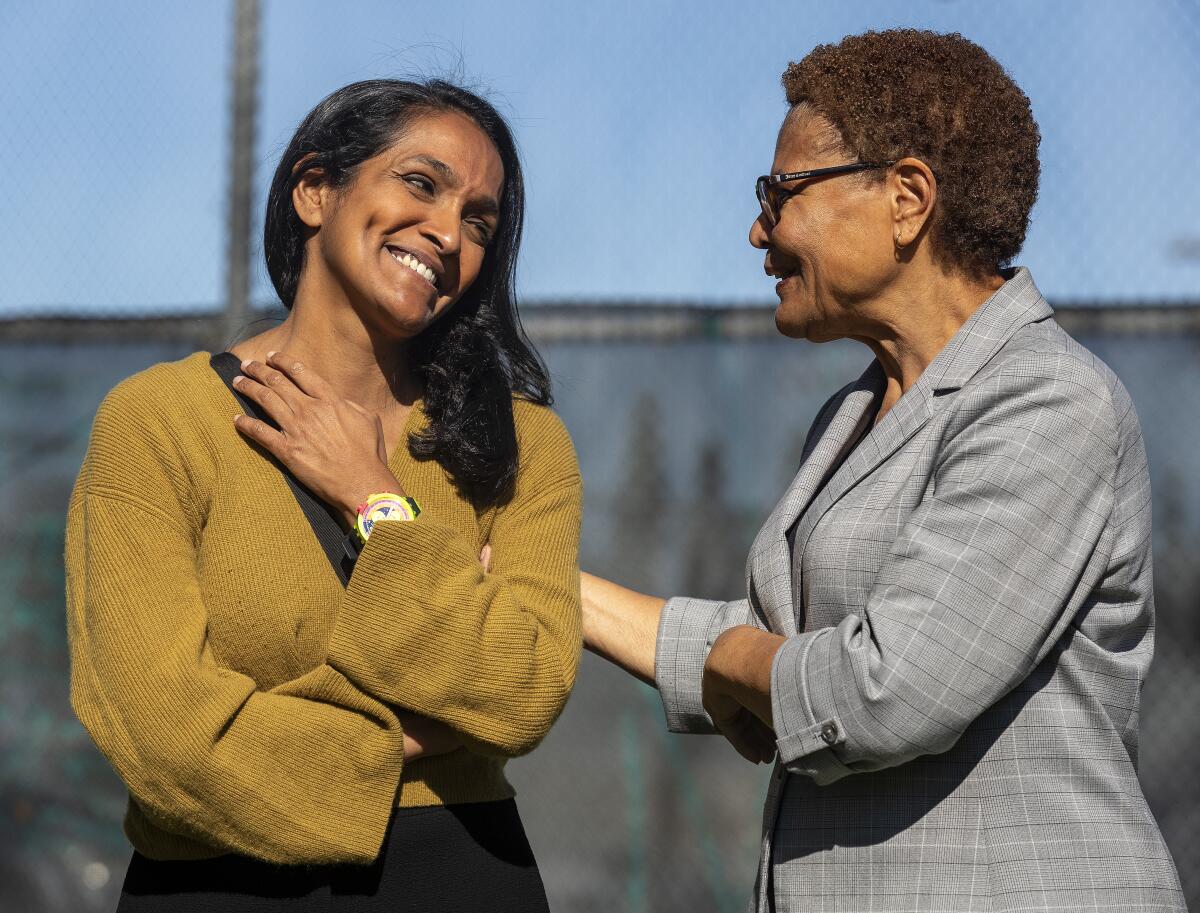
Los Angeles City Councilmember Nithya Raman, left, talks with Mayor Karen Bass

Los Angeles City Councilmember Nithya Raman, left, talks with Mayor Karen Bass at Hazeltine Park in Sherman Oaks during a 2024 rally for Raman’s ultimately successful reelection bid. She’s now challenging Bass in the 2026 mayoral election.

(Mel Melcon/Los Angeles Times)

Presbyterians, such as those who pray at the Koreatown church, have historically believed in predestination, the idea that God has determined everyone’s fate and we can’t do a thing about it. Raman doesn’t belong to the denomination, but perhaps its tenets moved her at Immanuel into believing that another unlikely political revival is in her stars. Because that’s the only way to make sense of Raman’s turn and belief that she can pull off the victory.

Raman’s 4th District is one of the wealthier in the city, a mishmash of Encino rich, Silver Lake hipster and the San Fernando Valley lower middle class — relatively sheltered from the day-to-day struggles of many working class and working poor Angelenos living in L.A. While Soto-Martínez and Hernandez draw their perspective and base from the union and activist left, Raman’s loudest supporters have struck me as folks who might have the passion and money to win over her district but don’t have the street-level knowledge and experience to sell their candidate to all corners of the city.

Raman has walked the progressive walk during her two council terms by getting arrested at sit-ins, showing up to protests and through her City Hall work. But the coalition she needs to topple Bass seems exceedingly hard to build.

She’d have to run under the assumption that enough people on the left think the current mayor is a sellout — or at minimum, just not progressive enough. That conservative and centrist voters so loathe Bass that they’ll hold their nose and vote for a democratic socialist. She’d have to win over Latino voters, who went with Caruso four years ago but who represent only 19% of Raman’s district in a city that’s nearly majority Latino.

Raman would have to peel off labor from Bass, who has counted on and rewarded their support from Sacramento to Washington to City Hall for over two decades. Needs to paint Bass as soft on Trump’s deportation deluge despite her consistently calling him out. Appeal to homeowners who won’t like Raman’s ties to YIMBY-minded folks seeking to shove multistory units anywhere and everywhere. Convince Black voters — who already must reckon with the likely reality that the city will not have three Black council members for the first time since 1963 because the leading candidates to replace outgoing Curren Price are Latinos — that dethroning the city’s first Black female mayor is somehow good for the community’s political future.

And then there’s Raman’s fellow DSA members. The rank-and-file are currently furious at her for recently, unsuccessfully trying to tweak L.A.’s so-called mansion tax. Raman can’t run in the primary with DSA’s endorsement because that process ended last fall. Supporters can petition for a vote on the matter, but that opens her anew to critics who engineered a censure of her during her 2024 reelection campaign for accepting an endorsement by a pro-Israel group while the country was bombing Gaza.

Raman — who can keep her council seat if she doesn’t beat Bass — is about to find out that L.A. isn’t as progressive as people make it out to be.

Nithya Raman

Los Angeles Councilmember Nithya Raman speaks to a crowd as she hosts an election night event in Edendale in March 2024 in Los Angeles.

(Myung Chun/Los Angeles Times)

She might have visions of a populist movement a la what happened in New York ushering her into City Hall — but she’s no Mamdani and Bass is no Eric Adams. Even fans of Raman I talked to over the weekend are upset that the progressive march that DSA-LA has successfully launched in city and county politics this decade now must deal with a curveball from within. It threatens to distract from efforts for other campaigns in a year when the left needs to concentrate on defeating true opponents — not a fellow traveler like Bass.

Raman must figure this disruption is worth the risk for her legacy and will further strengthen L.A.’s left. Let’s see what voters decide.

Source link

Law firm’s contract hiked to nearly $7.5 million in L.A. homelessness case

The Los Angeles City Council has again increased what it will pay Gibson Dunn to represent it in a contentious homelessness case, bringing the law firm’s contract to nearly $7.5 million.

In mid-May, the council approved a three-year contract capped at $900,000. The law firm then billed the city $1.8 million for two weeks of legal work, with 15 of its attorneys charging nearly $1,300 per hour.

In a closed-door meeting Wednesday, the council voted 9-4 to approve an increase of about $1.8 million from the current $5.7 million, with Councilmembers John Lee, Tim McOsker, Imelda Padilla and Monica Rodriguez opposed. It was not clear why the additional money was needed.

Rodriguez said that spending resources on outside lawyers instead of complying with the settlement terms in the case is “simply a waste of public funds.”

“In the face of a mounting homelessness crisis, it’s misguided for the City to continue pouring our scarce resources into outside counsel instead of housing the most vulnerable Angelenos,” Rodriguez said in a statement.

The contract “has expanded significantly beyond its original scope,” Lee said in a statement, later adding, “I believe the Council has a duty to demand transparency and closely scrutinize costs.”

The L.A. city attorney’s office did not respond to a request for comment.

The city reached a settlement with the nonprofit LA Alliance in 2022, agreeing to create 12,915 homeless shelter beds or other housing opportunities, while also clearing thousands of encampments.

Since then, the LA Alliance has repeatedly accused the city of failing to comply with the terms of the settlement agreement.

Gibson Dunn was retained by the city a week before a federal judge called a seven-day hearing to determine whether he should take authority over the city’s homelessness programs from Mayor Karen Bass and the City Council. Alliance lawyers said during those proceedings that they wanted Bass and two council members to testify.

The judge later declined to put Los Angeles’ homelessness programs into receivership, even as he concluded that the city failed to adhere to the settlement.

Theane Evangelis, a Gibson Dunn attorney who led the firm’s LA Alliance team, did not immediately respond to a request for comment.

City Atty. Hydee Feldstein Soto has praised Gibson Dunn’s work in the LA Alliance case, saying the firm helped the city retain control over its homelessness programs while also keeping Bass and the two council members off the stand.

She commended the firm — which secured a landmark Supreme Court ruling that upheld laws prohibiting homeless people from camping in public spaces — for getting up to speed on the settlement, mastering a complex set of policy matters within a week.

Faced with lingering criticism from council members, Feldstein Soto agreed to help with the cost of the Gibson Dunn contract, committing $1 million from her office’s budget. The council has also tapped $4 million from the city’s “unappropriated balance,” an account for funds that have not yet been allocated.

On Thursday, Matthew D. Umhofer, an attorney who represents LA Alliance, called the Gibson Dunn contract increase “predictable.”

“It’s a taxpayer-funded debacle designed to help city officials avoid being held accountable for their failures on homelessness,” Umhofer said in a statement. “The amount will keep going up as long as the City is more interested in ending oversight than ending homelessness.”

Source link