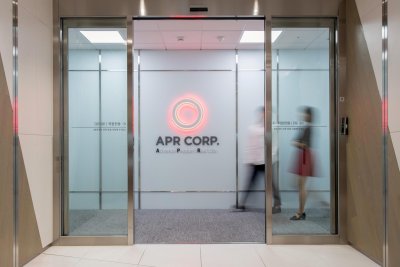
The head office of APR in Seoul. The South Korean beauty company has emerged as a new powerhouse in the country’s cosmetics industry. Photo by APR
May 28 (UPI) — South Korea overtook the United States in 2025 to become the world’s second-largest exporter of cosmetics, according to the Ministry of Food and Drug Safety (MFDS) earlier this month.
The ministry noted that the East Asian country’s cosmetics exports amounted to $11.4 billion in 2025, up 11.8% from a year before, trailing only runaway leader France with $24.3 billion.
The United States ranked third with $10.8 billion, followed by Germany with $9.9 billion, Spain with $9.2 billion, Italy with $9 billion, China with $7.3 billion, and Japan with $3.9 billion.
Meanwhile, South Korea’s 2025 cosmetics imports declined 2.3% year-on-year to $1.29 billion, resulting in a trade surplus of $10.1 billion. It marked the first time Asia’s fourth-largest economy topped $10 billion in the annual cosmetics trade surplus.
By destination, the United States has emerged as the largest overseas market for Korean cosmetics last year as exports jumped 15% year-over-year to $2.2 billion. In contrast, shipments to China plunged 19% to $2 billion.
Demand for Korean cosmetics, widely known as K-beauty products, also increased sharply in Europe and the Middle East. Exports to Poland, in particular, more than doubled from a year earlier to $282 million.
To further beef up the competitiveness of the K-beauty industry, the MFDS pledged to pursue a range of policy initiatives, including expanded regulatory support programs.
“As countries such as the United States and China have recently introduced cosmetic safety assessment systems, we are preparing to implement our own safety evaluation framework in phases,” the MFDS said in a statement.
“To help domestic companies comply smoothly with the new system, the government plans to establish guidelines, provide consulting services, and train professional evaluators,” it added.
New players fueling K-beauty boom
In the past, South Korea’s cosmetics giants relied heavily on China as their primary offshore market. Traditional behemoths, including AmorePacific and LG Household and Health Care, resorted to such a business model for years.
However, a new wave of entrepreneurs has come to the fore with a different approach, reducing dependence on China while tapping aggressively into the United States, Europe, and Southeast Asia.
Leading the shift is APR, which was founded in 2014 and built its growth around online sales channels and beauty devices aimed at international customers.
Last year, APR almost tripled its operating profit to $240 million, which is almost equivalent to that of AmorePacific and well above $113 million of LG Household & Health Care.
APR continued its strong momentum this year as its first-quarter operating profit stood at $101 million, up 173.7% from a year ago, based on robust performance in such major markets as the United States and Japan.
According to U.S. business tracker Navigo Marketing, APR came in third place in Amazon’s beauty category last year with a 7.1% market share. The firm doubled it to 14.1% in the first quarter to claim the top position.
APR has also strengthened its offline presence by entering more than 1,500 Target stores across the United States last month. It plans to expand further into about 3,000 Walmart stores in June.
Meanwhile, first-quarter operating incomes of AmorePacific and LG Household and Health Care fell short of APR with $84 million and $72 million, respectively.
The strong earnings have prompted investors to pile into APR shares on the Seoul bourse.
As a result, APR’s market capitalization jumped 73.59% this year to reach $10 billion as of Thursday. Those of AmorePacific and LG Household & Health Care were $4.49 billion and $2.52 billion, respectively.
“Considering the expansion of offline channels in the United States and accelerating sales growth in Europe, APR’s stock is likely to maintain a medium- to long-term upward trajectory,” Yuanta Securities Korea analyst Lee Seung-eun said in a report.
HMC Investment Securities analyst Ha Hee-ji shared a similar view.
“APR’s growing brand recognition in the United States appears to be spreading across global markets, thus creating a virtuous cycle,” Ha said. “Business-to-business sales in Europe, Latin America, and the Middle East are also showing steep growth trends.”