Maria Corina’s Pitch for Elections in Venezuela, Explained
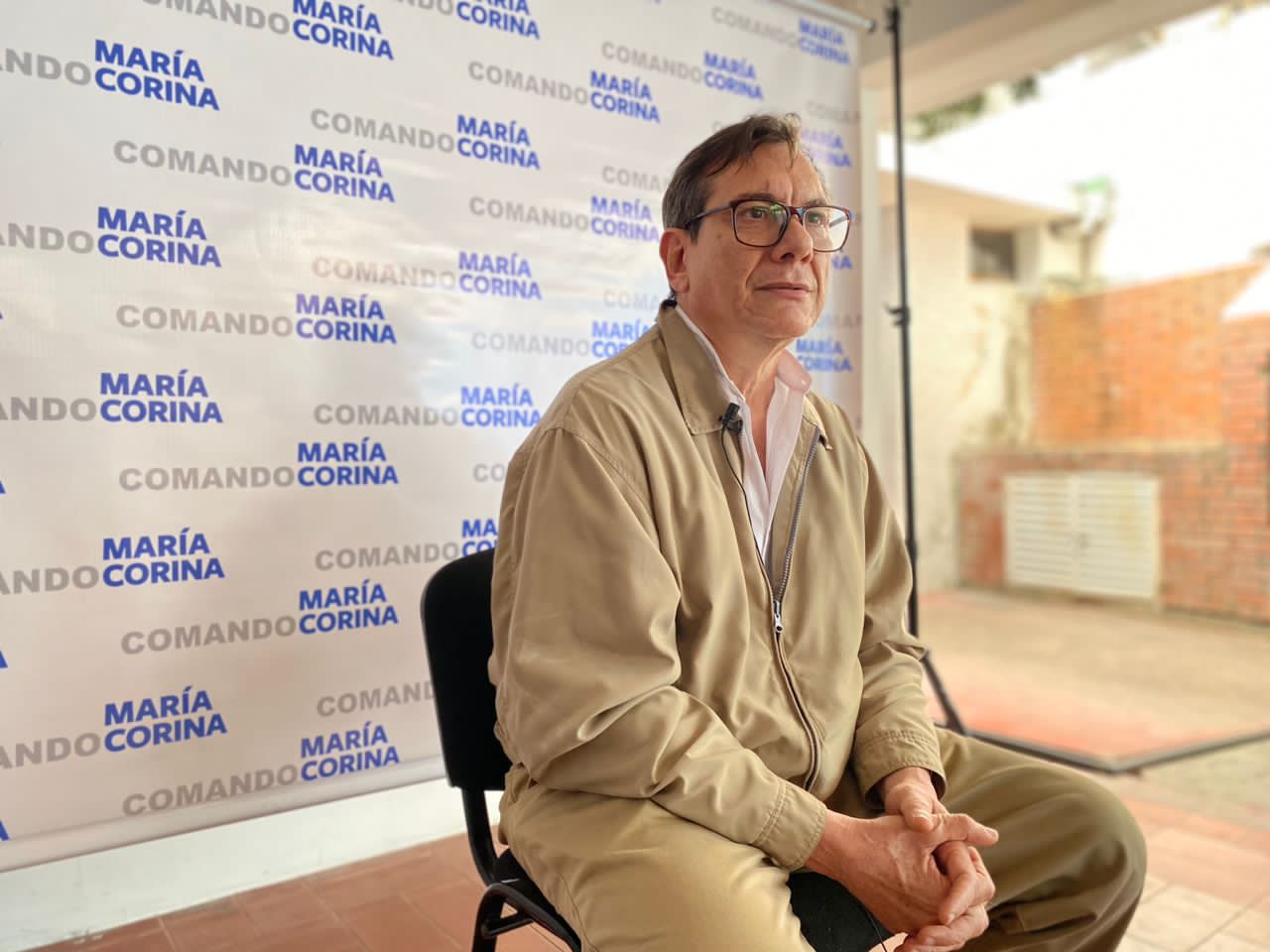
Photo: Humberto Villalobos in February 2023, months before the last opposition primaries
While Washington’s focus seems to be shifting toward security and armed groups, Machado’s team keeps its priorities clear, looking beyond the immediate circumstances. The Nobel Peace Prize laureate keeps saying that an election will be the vehicle to channel a transition to democracy—an event where the anti-chavista movement sees itself as the clear winner. Following the 2023 and especially the 2024 elections (where the coalition successfully defended a clear victory for Edmundo González by collecting and publishing 85% of the official tally sheets), it is not far-fetched to say that this is where the Venezuelan opposition’s greatest strengths lie, even under adverse conditions.
At Caracas Chronicles, we sat down with Humberto Villalobos—Vente Venezuela’s electoral chief, who coordinated Machado’s famous defense machinery—to discuss the current gap between ideal electoral conditions and reality, now that the publication of the Panama Manifesto has opened the opposition to negotiating elections with chavismo, naming Machado as the leader (or conductora) of the process.
Machado’s team is proposing changes that, to a large extent, aim to “demolish” the electoral system as we know it. Among other measures, this involves migrating to a hybrid system that would get rid of the ExCle voting machines, (paper ballots would be counted by hand), establishing a CNE in a novel fashion, improving the Venezuelan Electoral Registry so it accurately reflects how the population is scattered both inside and abroad, and implementing a mechanism to legalize political party competition in practice.
Once a new CNE is formed and the electoral calendar is published, Villalobos says this study could contribute to the renewal of the Electoral Registry. Under the proposal, the Registry would be renewed in three months.
This is a baseline proposal that could change in a scenario where Villalobos views the US as the guarantor of an agreement: “Delcy will make proposals, we will too, and in the end, all those things will be considered to yield something reasonable.” He envisions an election that is “simpler to produce,” stripping away the obvious strategic advantages that chavismo has historically claimed for itself during elections. “Under other conditions,” Villalobos says, “none of this would even be on the table. But here they proved to us that they can pass an energy reform in 15 days. You could do something similar to make elections happen, something just as important as pumping oil.”
First: an independent citizen register
Villalobos began by describing the need to produce a rigorous study of the local and migrant populations to understand the country’s actual electoral reality. The opposition would gather information directly from the people to understand who still lives where the Electoral Registry says they do, who left the country, and how many voters would require a change in their polling station. Villalobos calls this empadronamiento: the creation of a citizen residency register. The objective, he notes, is for the majority of voters to update their addresses through a digital platform featuring biometric facial recognition (ABIS) identification mechanisms, or at registration points operated by a network of enumerators or empadronadores
Once a new CNE is established and the electoral calendar is released, this study could assist in overhauling the Electoral Registry, the current state of which Villalobos calls “disastrous.”
“While citizens are changing their voting addresses, they could also support a political party. From that, you would yield parties with validated groups of voters.”
The digital platform and the network already exist. Vente has started the process with its own members, and all current enumerators hold positions within the party: “We originally thought of it just for Vente, and as we grew, we envisioned it as a solution for all Venezuelans.” They would only need the people’s consent to use their data. Villalobos admits that managing a database of this scale carries an enormous burden of responsibility, but the alternative would mean negotiating while relying exclusively on data managed by the chavista state, which “treats it as its own asset.”
“At the end of the day, we are the only ones ready to do it. The systems being employed are the ones we already used in the 2024 presidential election. We simply added an extra feature that allows for enrollment of this type,” Villalobos asserts. “That feature handled half of the tally sheets we transcribed. And that gives you the certainty that you can handle millions. Furthermore, the guarantee is being provided by María Corina Machado.”
Second: ad hoc CNE, Electoral Registry, and political parties
The proposal rests on the premise that the CNE’s current structure is too flawed to fix simply by appointing a new board of rectors (or “electoral commission,” as Marco Rubio has called it). They propose a new, temporary electoral authority termed ad hoc CNE, an entity created specifically to manage an electoral transition. From that point on, it would only require a new specialized company to carry out the formal overhaul of the Electoral Registry
“More than one company is already preparing its bid under the terms we are working with,” Villalobos says. “That bidding process would have to be run by the new CNE, a natural process that nobody else can handle.”
Data from the independent, citizen register “would serve as a foundation” for the state provider to shorten the process. Villalobos assures that, in this manner, the new Registry could be ready in three months. Meanwhile, political parties that have been suspended or intervened since the last decade would be legalized through groups of voters that endorse these political organizations. “While citizens are changing their voting addresses, they could also support a political party. From that, you would yield parties with validated groups of voters. That would save us a lot of time.” The concept of groups of voters (grupos de electores) exists in Venezuelan legislation, though not necessarily for these purposes. A new statute for the ad hoc CNE, Villalobos suggests, could change that.
The electoral expert noted that one additional provider would be needed to manage the calendar and the elections. Identity verification made possible by the technology first implemented in the independent citizen register would thus help the ad hoc CNE assign party representatives and witnesses.
Third: goodbye to the machines
The most ambitious part of the proposal is to discard the electronic voting system that has been in place in Venezuela throughout this century and move to a mixed system featuring manual counting and automatic transmission.
According to Villalobos, paper ballots would be counted by hand by polling station members in the presence of party representatives. Afterward, a photo and a scan of the voting tally sheet would be taken. The data of all votes would then be transmitted from the polling station to the CNE, the political parties, international institutions linked to the electoral process, universities, and media outlets.
“It works almost like a blockchain, because you will have multiple repositories of the original document, which prevents it from being altered. It isn’t a galactic development like a voting machine that does absolutely everything,” Villalobos says. “It would be a matter of scanning something, transcribing it, and sending it. That fits on a smartphone.”
Villalobos noted they will push to ensure there are no polling stations where it is impossible to deploy a witness.
He maintains that the current system operates like a “black box” where voters are forced to accept the results transmitted by the machines, which he claims can be manipulated by those managing the CNE. But didn’t the physical tally sheets printed by these machines on July 28, 2024—which proved Edmundo González won the election by a 2-to-1 margin—serve to show that the count itself wasn’t manipulated, but rather that the CNE simply fabricated results declaring Maduro the winner? Villalobos insists that the current technology failed because, regardless, opposition witnesses were unable to obtain 15% of the tally sheets. He asserts that without representatives at a polling center, “there are ways they can change your result.”
“The extraordinary concept of having a machine that does everything is not dominant worldwide. In Colombia [referring to the first round of presidential elections where Abelardo de la Espriella secured the majority of votes], where the process was not the fastest, we already had the results of all tally sheets within an hour and a half. All of them, not a single one was missing.”
Finally, Villalobos was emphatic that voting must end strictly at a specific hour (in Venezuela, polling stations commonly close at 6 pm, but voting can be extended if there are still voters in line). He also stressed that the opposition will push to ensure there are no polling stations where it is impossible to deploy a witness. In the 2024 presidential election and previous ones, voting centers were set up inside Misiones Vivienda (state housing complexes), communal council headquarters controlled by the ruling party, and military bases—places where the likelihood of a clean process and of collecting the printed tally sheet is usually much lower.
“Voting systems were created to resolve conflicts. The first step is for all of us to believe we won’t be cheated, because otherwise, we go right back to the same thing,” he concludes. “In any election, they can change the result of a polling center if you don’t have anyone there. That’s why we are going to motivate people to stay at the centers, to have the fiesta right there. So that you walk away from that center knowing it is impossible for them to change the results.”