Los Angeles police Officer Daniel Flores may have broken the law when he secretly recorded his colleagues making ugly, unacceptable comments that were variously racist, homophobic, misogynistic or otherwise gross and unprofessional at best.
So L.A. County Dist. Atty. Nathan Hochman is right to take this, or any, violation of the law by a badge-wearing member of our police force seriously, no matter what Flores’ intent was.
But Monday, Flores was arraigned on 16 felony counts that could lock him up in state prison for 13 years (he pleaded not guilty).
That court hearing was preceded by an unusual and disturbing summary of the case filed with the court by Hochman. It seemed like an inappropriate attempt to smear Flores as a money-grubber with a convoluted plan to sue taxpayers into a sweet retirement (as opposed to intending to expose misconduct), while simultaneously giving an aw-shucks, it-was-all-in-good-fun defense of the ugly commentary of the recorded officers.
Regardless of what Hochman’s intent is in throwing the book at Flores, the result is one that will haunt this city for years to come: a police force in which the officers are clear that if you rat out the cops for misconduct, you get what you get.
“The message to everyone in the police department is keep your mouth shut,” said David A. Harris, a law professor at University of Pittsburgh and an expert on police misconduct. “You cannot stand up for principle or even for the policy of the police department, except at the risk of your own career and your own well-being, and perhaps your freedom.”
Hochman spoke with me for nearly an hour about his reasons for what many, myself included, see as his prosecutorial overreach in this case. Before I tell you the reasons why I think Hochman has it wrong — dangerously wrong — in the decision to charge Flores’ so harshly, I’ll tell you where we agree.
Cops, we concur, should not call women “bitches.” They also should not call women “rapeable,” even if, as Hochman’s filing assures us, “the use of the phrase ‘rape’ was not in a sexual context.”
I am not sure what the nonsexual context of rape is, but OK.
Cops should not make fun of, in no particular order, people with disabilities; candidates applying for jobs; co-workers; Asian people; Hispanic people; or people who may be overweight — as the officers in this case allegedly did.
“These comments are deplorable. They’re despicable. They’re racist. They’re homophobic. They’re sexist,” Hochman told me. “There’s no place in our society for them, and they should be punished.”
So Hochman and I agree that Flores may have broken the law, and that the comments of his fellow officers are unacceptable.
And now the roads diverge.
Because faced with those competing truths, Hochman could have used prosecutorial discretion — the art of tempering the law with the mores and ethics of the community.
He could have used that discretion to cut Flores a break, charge him at a lower misdemeanor level or not at all, and put the focus where it belongs — on the officers who disgraced their badge with their behavior, and what is seemingly a culture of disrespect and degradation within the unit charged with choosing the next generation of officers.
These are the officers charged with recruiting the officers of the future, so the stakes here are high. This is misconduct that the people of L.A. need to know about, because if these officers are so casual in their hateful comments, can we trust their judgment on hiring?
“On one hand, being a whistleblower doesn’t give a person the right to violate the law,” said Erwin Chemerinsky, the dean of UC Berkeley’s law school, who did an investigation on police culture in the LAPD in 2000 in the wake of the Rampart scandal. “On the other hand, I would hope that the district attorney would take context into account. And 16 felony charges seems really excessive.”
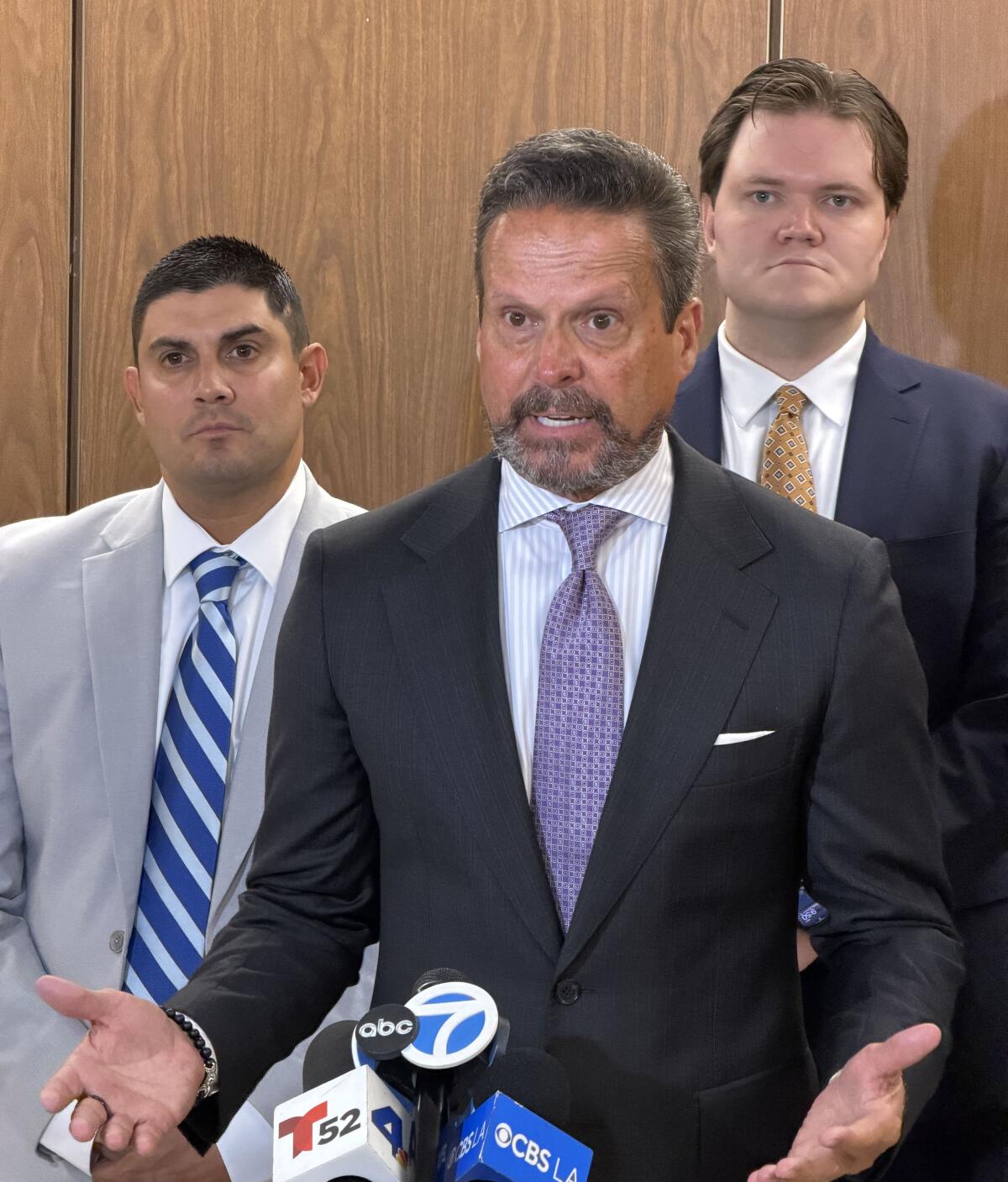
LAPD Officer Daniel Flores, left, listens as his attorney Alan Jackson speaks to reporters Monday.
(Libor Jany / Los Angeles Times)
But Hochman argues that a “message has to be sent” because it’s a police officer who broke the law.
“If you don’t hold police officers accountable, it’s very hard to hold anybody accountable,” Hochman said. “I believe that no, we’re not going to let the ends justify the means, even if the ends may be laudable, like exposing bigotry, because it leads us down a very slippery slope.”
Hochman said Flores simply could have taken notes on the inappropriate comments and turned them in to superiors or the independent inspector general, which strikes me as either sweetly naive or disingenuous.
“The officer would be shunned; his career would be over, and he would probably find himself on the receiving end of some kind of retaliation,” Harris, the law professor, said of the likely outcome of that plan.
Chemerinsky said retaliation against whistleblowers has long been a part of the culture of the department. Make a complaint, his report in 2000 found, and an officer might get “freeway therapy,” transferred to someplace far from where they lived to send a message, or even find themselves without backup in a dangerous situation.
This decision to treat Flores so harshly, Chemerinsky said, comes off as “part of that long history of LAPD trying to very much crack down on whistleblowing.”
Hochman told me that he wants to make it “crystal clear” that “nothing in this prosecution should be read that we are in any way trying to chill whistleblowers.”
He added that he did use discretion.
“I hope you note in your article that the district attorney could have brought 122 felony charges, or 122 misdemeanors, or some combination of felonies and misdemeanors up to 122,” Hochman said.
Flores made 122 total recordings of 16 people. Hochman charged on the number of people recorded, not the number of recordings, he pointed out.
So sure, we can count that as discretion, I guess?
This is where Hochman has his messages dangerously backward. Sure, hold Flores reasonably accountable for taking matters into his own hands, if he broke the law in doing so. Certainly, Flores knew there would be consequences to his actions.
But that Hochman is trying to frame this as a fair and reasonable prosecution, while protecting the officers who made the comments by giving us their weak-sauce excuses about having no ill intent, does not provide this city the justice it expects and deserves.
Hochman, you may recall, replaced George Gascón, a prosecutor who was accused of forcing his own values on the city.
Now, Hochman seems to be doing the same with his heavy-handed approach to Flores.
Hammering on Flores does not reflect the values of the majority of the Los Angeles community that wants a police force in which integrity and respect are fundamental, impunity is the outcast, and whistleblowers aren’t attacked, even if it turns out their motives aren’t pure.
Personally, I don’t care what Flores’ intent was in making the recordings. I don’t care if the officers caught on tape didn’t intend to offend, and I don’t care what Hochman intends the message to be with his vast over-charging of Flores.
I care about the result: a city in which misogyny and racism are just locker room talk, but breaking the blue wall of silence is a serious crime.
Karen Thomas, a detective constable investigating the murder of Joanna Yeates, has shared that she never thought Christopher Jefferies had a motive after he was wrongfully arrested, revealing the moment she knew the killer was Vincent Tabak instead.
Christopher Jefferies was wrongfully arrested for Joanna Yeates’ death
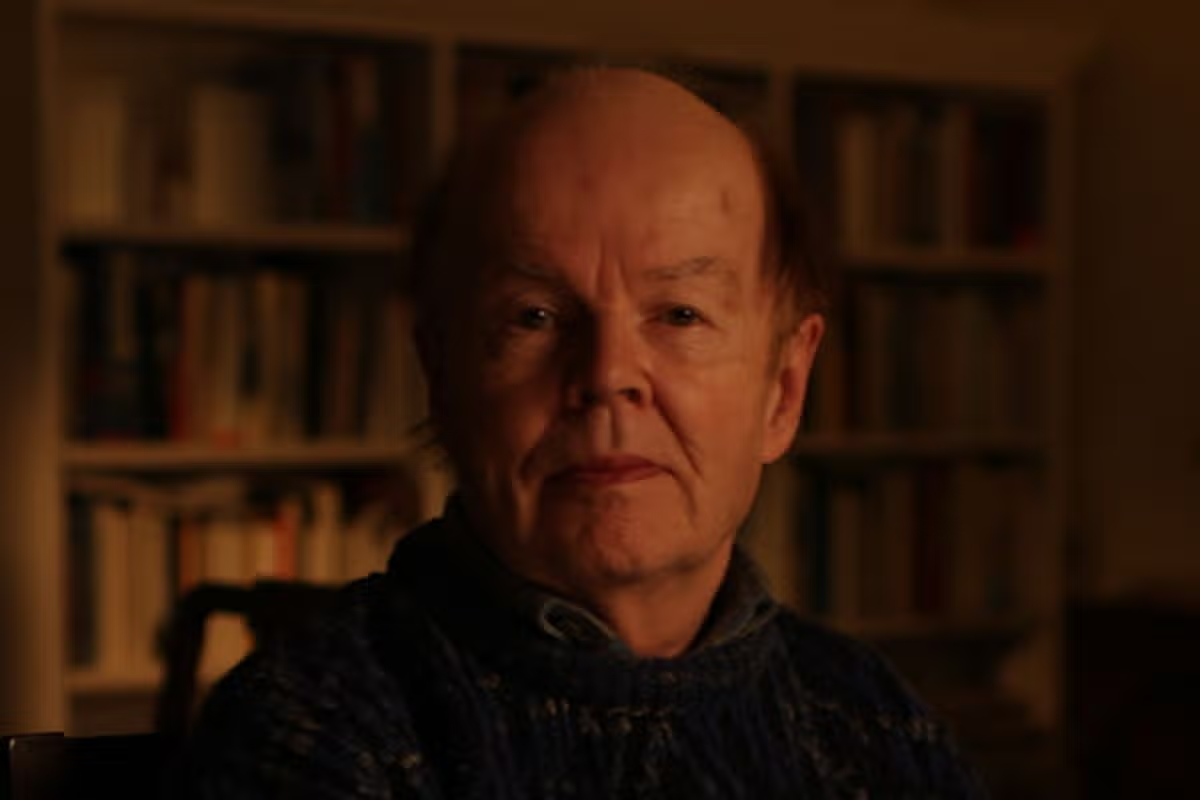
One of the police officers investigating the murder of Joanna Yeates has said that she “never thought there was a motive” for Christopher Jefferies, who was wrongfully arrested for her death. Jefferies, who was then 65, was arrested on suspicion of murdering Yeates, 25, on December 30, 2010.
Over 15 years later, Karen Thomas, a detective constable involved in the investigation, has recalled what she thought at the time – of Jefferies, the real killer Tabak, and of how her bosses reacted when she brought her suspicions to them.
Speaking in Disney’s new docuseries, Britain’s Most Notorious Crime Investigations, Thomas shared that she didn’t think Jefferies had a reason to kill Yeates, but could see why her colleagues were insistent that he had.
“I never thought there was a motive for Christopher Jefferies to kill Jo,” she said. “Having said that, we’ve sat with many people in custody who we thought maybe were the wrong people and were the right people, so as long as there was a reason to keep him in custody, it was justified.”
Jefferies was arrested just five days after Yeates’ body was discovered in Failand, Somerset, and 13 after she was first reported missing. The primary evidence against him was a speck of blood on one of his trainers, which police later discovered did not match Yeates’ DNA.
While he was in custody, Thomas was sent to Holland to take the witness statement of Vincent Tabak, Yeates’ neighbour, who claimed Jefferies had moved his car around the time that she went missing.
Thomas explained that Tabak’s statement troubled her. He claimed he had driven to an Asda in Bedminster for crisps and beer, even though there was a Tesco “down the road”. He asked questions about DNA and said he had knocked on Yeates’ door, despite having never offered that information before.
The detective said it seemed like Tabak was trying to “stitch up” the man they had in custody. “Inside, my heart was going ten to the dozen. I was sitting there thinking this could be our guy, this could be our killer.”
After flying back to the UK, Thomas took the statement straight to her bosses. She said: “In fairness, there was a lot coming from a lot of different angles and he’s trying to keep everything going, so I said ‘Boss, if you do nothing else, please prioritise his DNA’.”
But she later implied that she did think there was an issue with the investigation: “We took longer than we should have to catch Vincent Tabak. I think there’s always a danger that an officer can become fixated on a suspect and want the evidence to fit that.”
Tabak’s DNA was a match for the samples found on Yeates’ body. Jefferies was released two days after his arrest, and Tabak was taken into custody on 20 January.
He eventually pleaded guilty to manslaughter, saying he strangled Yeates whilst trying to silence her when she screamed after he tried to kiss her. He was found guilty of her murder and sentenced to life imprisonment.
20/20: Britain’s Most Notorious Crime Investigations is available on Disney+ now.
A police drama that has gripped viewers is returning for a new series on the BBC
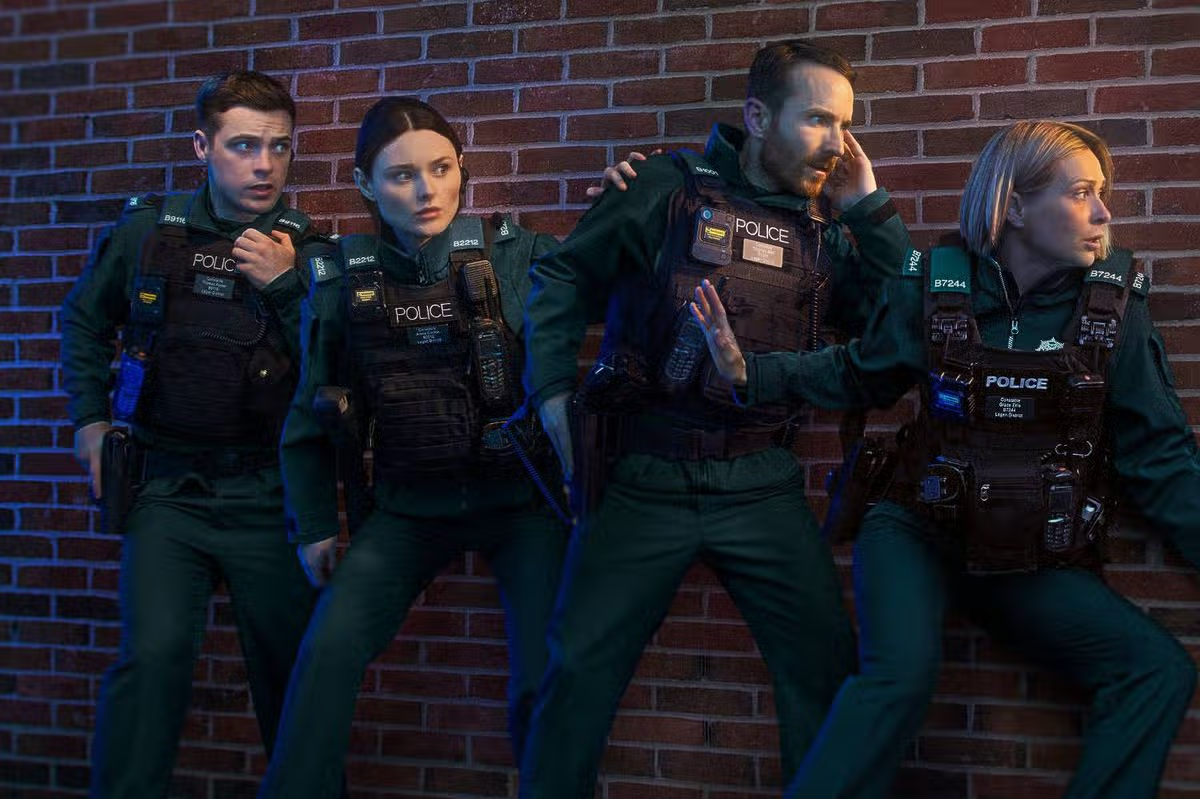
The BBC has shared an update on Blue Lights(Image: CREDIT LINE:BBC/Two Cities Television/Matthias Clamer)
The BBC has shared a first look at the new series of a police drama fans have called “the best cop show”.
Belfast-set Blue Lights has become a huge success since it started in 2023, with viewers gripped by its first three series.
It is now set to return for a fourth run, and the broadcaster has given fans a peek at what’s to come in images showing Siân Brooke, Martin McCann, Katherine Devlin and Nathan Braniff back in uniform.
The series, which follows officers at the fictional Blackthorn police station in Belfast, will also see the return of Game of Thrones’ Richard Dormer.
He played Gerry Cliff in series one, and will be back alongside Hannah McClean as solicitor Jen Robinson and Jonathan Harden as disgraced former Inspector, Jonty, in an episode “that will answer important questions from the past”.
The new images come weeks after the BBC shared an exclusive clip from the new season.
The brief look at series four showed Constable Shane Bradley (Frank Blake) pulling over elderly driver David (Trevor Gill) and his passenger, Imelda (Rosamund Monteith), to quiz him about whether he had been drinking.
Fans are eagerly awaiting the new episodes, after declaring the first three series of Blue Lights were “excellent” and “outstanding”.
One posted a comment on IMDb.com saying the show was “entertainment at its best”, while another remarked: “As an ex-cop, I’m so sick of US made cookie cutter police shows. Blue Lights in my opinion is bang on what it’s like to be cop.”
“Brilliant acting, directing, production – award winning drama all round,” said someone else. “Absolutely outstanding British drama. It’s poignant, emotional, engaging. The cast are brilliant. Best show I’ve watched in a long time.”
“If you haven’t watched Blue Lights yet, you’re missing out on one of the best shows in years,” one fan wrote on Reddit. “This is a must watch show, one of the best of the 2020s and will one day be a classic,” they continued.
“Watched this whole thing in like a week, it is fantastic,” said someone else, as another wrote on Reddit that it was “a masterpiece of a show”.
“This is probably the best cop show since Southland and Bosch,” another viewer commented.
Blue Lights will be available on BBC iPlayer and BBC One this autumn.