DALLAS — A federal jury Friday convicted nine people — eight on terrorism charges — over a shooting at a Texas immigration facility that federal prosecutors tied to antifa, the decentralized far-left movement that has become a target of the Trump administration.
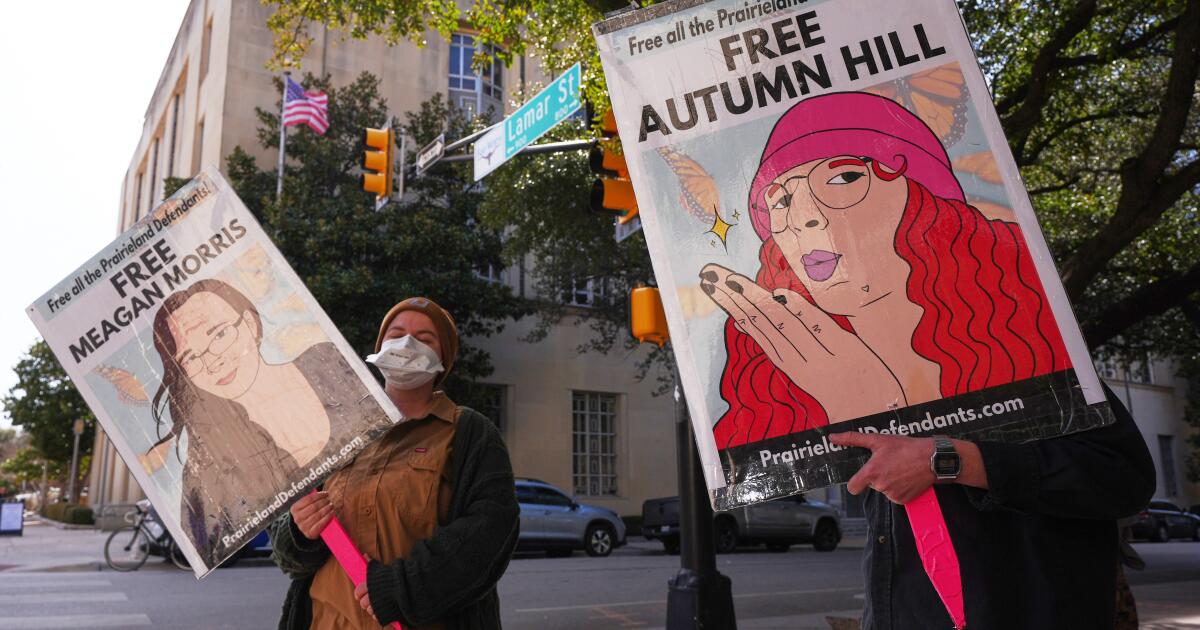
One person was also found guilty of attempted murder after prosecutors say he opened fire last summer outside the Prairieland Detention Center outside Fort Worth, wounding a police officer. The Justice Department called the violence an attack plotted by antifa operatives, but attorneys for the accused denied that characterization, saying there were no antifa associations and that there was merely a demonstration with fireworks before gunshots broke out.
U.S. District Judge Mark Pittman, an appointee of President Trump, presided over the nearly three-week trial in Fort Worth. It was closely followed by legal experts and critics who called the proceedings a test of the lengths the government can go to punish protesters.
FBI Director Kash Patel had said the case was the first time charges of providing material support to terrorists had targeted people accused of being antifa members.
“Today’s verdict on terrorism charges will not be the last as the Trump administration systematically dismantles Antifa and finally halts their violence on America’s streets,” U.S. Atty. Gen. Pam Bondi said in a statement.
Short for “anti-fascists,” antifa is not an organization but rather an umbrella term for far-left militant groups that confront or resist neo-Nazis and white supremacists at demonstrations.
Protesters denied having antifa ties
Defense attorneys told jurors that there was no plan for violence on July 4 outside the facility in Alvarado.
Of the nine defendants on trial, eight faced the charge of providing material support to terrorists, among other charges. The ninth defendant, Daniel Sanchez Estrada, was charged with corruptly concealing a document and conspiracy to conceal documents. He was found guilty of both.
Sanchez Estrada’s attorney, Christopher Weinbel, said he can’t believe jurors “came to this conclusion.” Weinbel said his client had deployed as a member of the U.S. Army several times and he’d hoped what he sacrificed for the country “meant something.”
“But I feel like it turned its back on justice with this. … The U.S. lost today with this verdict,” Weinbel said.
Prosecutor Shawn Smith told jurors during closing arguments that the group’s actions — including bringing firearms and first aid kits and wearing body armor — were all signs of nefarious intent. He said they practiced “antifa tactics” and were “obsessed with operational security.”
Attorneys for the defendants have said that there was no planned ambush and that protesters who brought firearms did so for their own protection — in a state with very lenient gun laws.
A test of 1st Amendment rights
The terrorism charges followed Trump’s order last fall to designate antifa as a domestic terrorist organization. Those charges did not require a tie to any organization, and there is no domestic equivalent to the State Department’s list of foreign terrorist organizations. That’s in part because organizations operating within the United States are protected by broad 1st Amendment rights.
Critics of the Justice Department’s case have said the outcome could have wide-reaching effects on protests.
“That opposition is something that the government wants to squash, so a case like this helps the government kind of see how far they can go in criminalizing constitutionally protected protests and also helps them kind of intimidate, increase the fear, hoping that folks in other cities then will think twice over protesting,” said Suzanne Adely, interim president of the National Lawyers Guild, a progressive legal group.
Trial focused on shots fired
Attorneys for the defendants have said most protesters began leaving when two guards from the center came outside. That was before any shots were fired.
Prosecutors said Benjamin Song, a former Marine Corps reservist, yelled, “Get to the rifles,” and opened fire, striking one police officer who had just pulled up to the center.
Though it was Song who opened fire, prosecutors charged several other protesters with attempted murder of an officer and discharging a firearm, but they were found not guilty. The prosecution had argued that from the group’s planning, it was foreseeable to those others that a shooting could happen.
The officer who was shot, Alvarado Police Lt. Thomas Gross, testified that when responding to the scene he saw a person clad in all-black with their face covered and carrying a rifle. He told jurors he was shot with a round that went into his shoulder and out of his neck.
Song’s attorney, Phillip Hayes, told jurors during closing arguments that there wasn’t a call to arms before Gross arrived on the scene and “aggressively” pulled out his firearm. Hayes suggested that Song’s shots were “suppressive fire” and that a ricochet bullet hit the officer.
Leading up to the trial, several people pleaded guilty to providing material support to terrorists after being accused of supporting antifa. They face up to 15 years in prison at sentencing.
Some of them testified for the prosecution, including Seth Sikes, who said he went to the detention center because he wanted to bring some joy to those held inside.
“I felt like I was doing the right thing,” he said.
Stengle writes for the Associated Press. AP writer Jim Vertuno in Austin, Texas, contributed to this report.