After US Intervention, Crime Still Controls Venezuelan Mines (Part I)
This is an abridged version of the original story in Spanish, the second part of award-winning investigative journalism project Dorada Opacidad. We will publish the second (and last) part of this investigation tomorrow.
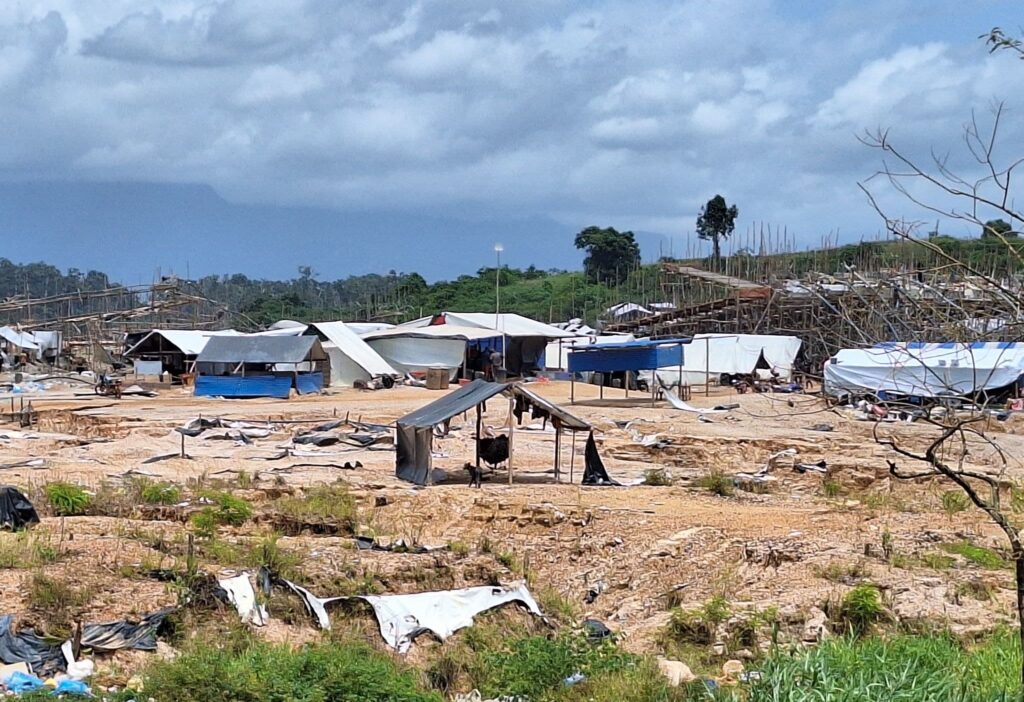
When they pass through the streets of the Las Claritas–Kilómetro 88 mining corridor in Bolívar state, southern Venezuela, a thick, yellowish cloud of dust blankets them like a veil. The sound is unmistakable: a convoy of 15, 20, or 25 motorcycles riding together. Aboard are soldiers from the Orinoco Mining Arc Protection Group (GPAMO)—a unit conceived and activated in 2022 under the command of the Strategic Operational Command of the Bolivarian National Armed Forces (CEOFANB) to safeguard the deposits. They had never been there before June 9, 2026, when three rockets, shot by a US aircraft, shook the area’s flimsy houses. Now, GPAMO is the law.
Although some cover their faces, Rafael knows them well. He owns one of the gold mills operating at the El Mecatico mine—one of many in an area that holds the world’s fourth-largest gold deposit, according to a 2018 certification by Canadian mining company Gold Reserve. Standing beneath the tin roof that shelters his business, he explained that he would soon have to pay the GPAMO 20 grams of gold (roughly 2,000 US dollars) in exchange for a registration form that in theory is free. He is also required to make monthly payments to remain on the site.
For Rafael and the residents of Las Claritas, everything changed on the morning of June 9, when they woke up to find the area occupied by the military. In the early hours, dozens of vehicles transported hundreds of troops from various branches of the Bolivarian National Armed Forces (FANB)—such as the Special Affairs Directorate (DAE) of the General Directorate of Military Counterintelligence (DGCIM)—who patrolled the streets alongside unidentified men dressed in black and carrying long guns. Meanwhile, a pair of military aviation Cougar helicopters flew just above the rooftops of the houses.
The objective of that mobilization was to dismantle “The System.” That was the name given to the criminal alliance between Juan Gabriel Rivas Núñez—known as “Negro Juancho”—and Yohan José Romero (nicknamed “Johan Petrica” or “El Viejo”), one of the leaders of the “mega-gang” born in the Tocorón prison: the Tren de Aragua. For over a decade, this criminal alliance had dominated the territory containing one of the world’s largest gold mining complexes—Las Brisas-Las Cristinas—and had subjugated the local population through torture, mutilation, and murder.
All signs pointed to a “change of government”—a term used in the Venezuelan criminal underworld to describe one criminal group replacing another in a territory.
The residents were so terrified that they remained locked themselves in their homes for days. Rafael did not hear the explosions that rang out mid-morning in Brisas de Cuyuní, near the Kilómetro 88 mining area, because he had gone to his ore mill in the early hours of the morning without noticing the military deployment. Hours later, the military arrived in El Mecatico to destroy the warehouses and properties belonging to The System. This operation was repeated at other mines, as well as at hotels, homes, and businesses in the town.
To determine who truly holds power along the Las Claritas-Kilómetro 88 corridor and in the southern mining towns extending as far as Guasipati, a team of reporters from the Alianza Rebelde Investiga (ARI) and Convoca toured the region as part of the investigative series Dorada Opacidad (Golden Opacity). Interviews with more than twenty sources—ranging from merchants, mill operators, police officers, and local residents to religious figures and local government officials—made it possible to map out the new criminal landscape of the Orinoco Mining Arc.
For days, information about the events was available only through social media or details gathered by journalists working remotely. The first official explanation did not come from any Venezuelan authority, but from Donald Trump. Three days after the bombings, the president stated that his country’s Southern Command had launched a “kinetic attack” to “take out” AKA Niño Guerrero—the nickname of Héctor Rusthenford Guerrero Flores, the most prominent leader of the Tren de Aragua—with the collaboration of the Delcy Rodríguez government.
A new criminal governance
From then on, a military-imposed order took hold in Las Claritas. Rafael recounted that shortly after the town was seized, all mine workers were summoned to a meeting where a FANB captain urged them to keep working without pause, as they had to “produce as Commander Delcy Rodríguez ordered.”
All signs pointed to a “change of government”—a term used in the Venezuelan criminal underworld to describe one criminal group replacing another in a territory, without necessarily putting an end to criminal activities.
That call for productivity came with no guarantees. The mill operator, his shoulders slumped in despair, recalled the sense of security The System had once provided: he could leave his tools outside and stay at his mill until midnight. After the military incursion, however, he had to finish his work and leave before 6:00 pm for fear of being robbed, as happened to others in the mine.
The military has displaced the armed group in the Las Claritas-Kilómetro 88 area, but shares control with criminal mafias in El Dorado and Guasipati.
Since the military took control to oust The System, extortion of merchants, gold buyers, and even random passersby had become commonplace, according to several sources on the ground consulted for this investigation. Soldiers seized sacks of gold-bearing sand left behind by members of The System in order to process them and extract the gold, recounted Óscar, speaking from a shop on the town’s main road. “A captain who extracts gold every day exchanges 5,000 or 6,000 dollars in cash, and asks a friend to convert it to USDT [a cryptocurrency] and send it to Puerto Ordaz,” he said.

According to witnesses, soldiers confiscated motorcycles and vehicles belonging to people with no ties to The System and spread fear across all the mining towns in southern Bolívar, about whether FANB would bomb all territories within the Mining Arc where armed groups operate, or the joint operation with the Americans would end in another massacre of workers by military forces.
However, local residents confirmed that the intervention was limited to Las Claritas-Kilómetro 88. Meanwhile, in towns like El Dorado, Tumeremo, and El Callao, criminal gangs continue to reign, albeit more discreetly and without the brazen displays of the past.
Former Bolívar lawmaker Américo De Grazia claimed on social media that The System’s ringleaders had returned to their old territory, though locals dispute this. Yet De Grazia’s account is not far-fetched: locals told the ARI and Convoca team that some of The System’s bosses—including the men known as Juancho and Johan Petrica—had left Las Claritas a few days before the military incursion. Apparently, they had been tipped off and fled. They were spotted trying to lay low near the Brazilian border.
What does seem clear is that in the Las Claritas-Kilómetro 88, the military displaced the armed group, but in El Dorado and Guasipati, they share control with criminal mafias—albeit maintaining a lower profile to preserve appearances before the Venezuelan government’s new partners: American businesspeople.
The American footprint
Five days after Maduro was taken away, Delcy Rodríguez announced a package of legislative amendments designed to appease Washington—such as a reformed mining law, whose latest version offers low taxes and numerous concessions to foreign capital that was previously unwelcome.
The new legislation, enacted in April, repealed the decree that had reserved the exploration and exploitation of gold and other strategic minerals for the State, paving the way for private and international companies to engage in these activities through concessions lasting up to 50 years.
Furthermore, it established special payments (up to 1% of gross production under the concession contract for the National Mining Fund and a royalty of up to 13% for the State), a tax of up to 6% regulated by the government, and incentives such as exemptions from the Large Assets Tax, as well as special contributions mandated by four other laws—including the Law on the Protection of Social Security Pensions—all aimed at benefiting the new companies operating in Venezuela’s mining sector.
Alongside the law’s approval, the United States also took action: in March, it issued licenses allowing American companies to purchase, transport, and resell Venezuelan gold. On September 2, the Treasury Department’s Office of Foreign Assets Control (OFAC) expanded the scope of these licenses, authorizing US companies to participate in the export, sale, purchase, storage, transport, processing, and refining of minerals of Venezuelan origin, including gold. It also permitted the supply of specific goods and services for mineral operations, as well as the negotiation and execution of contracts within the mining sector.
This entire framework has enabled Rodríguez to consolidate her economic team within the government through the appointment of key officials—both civilian and military—to positions within the Mining Arc. Their key figures are positioned not only within the executive branch but also across the State-owned enterprises involved in the business, and among military personnel capable of guaranteeing gasoline supplies and mine operations.
The interviewees’ identities have been changed for their safety. This report was supported by the Pulitzer Center.
Text and photos: Lorena Meléndez | Coordination and editing: Ronna Rísquez | General direction: Milagros Salazar | Design and infographics: ET