Dodgers continue to find ways to beat the Toronto Blue Jays
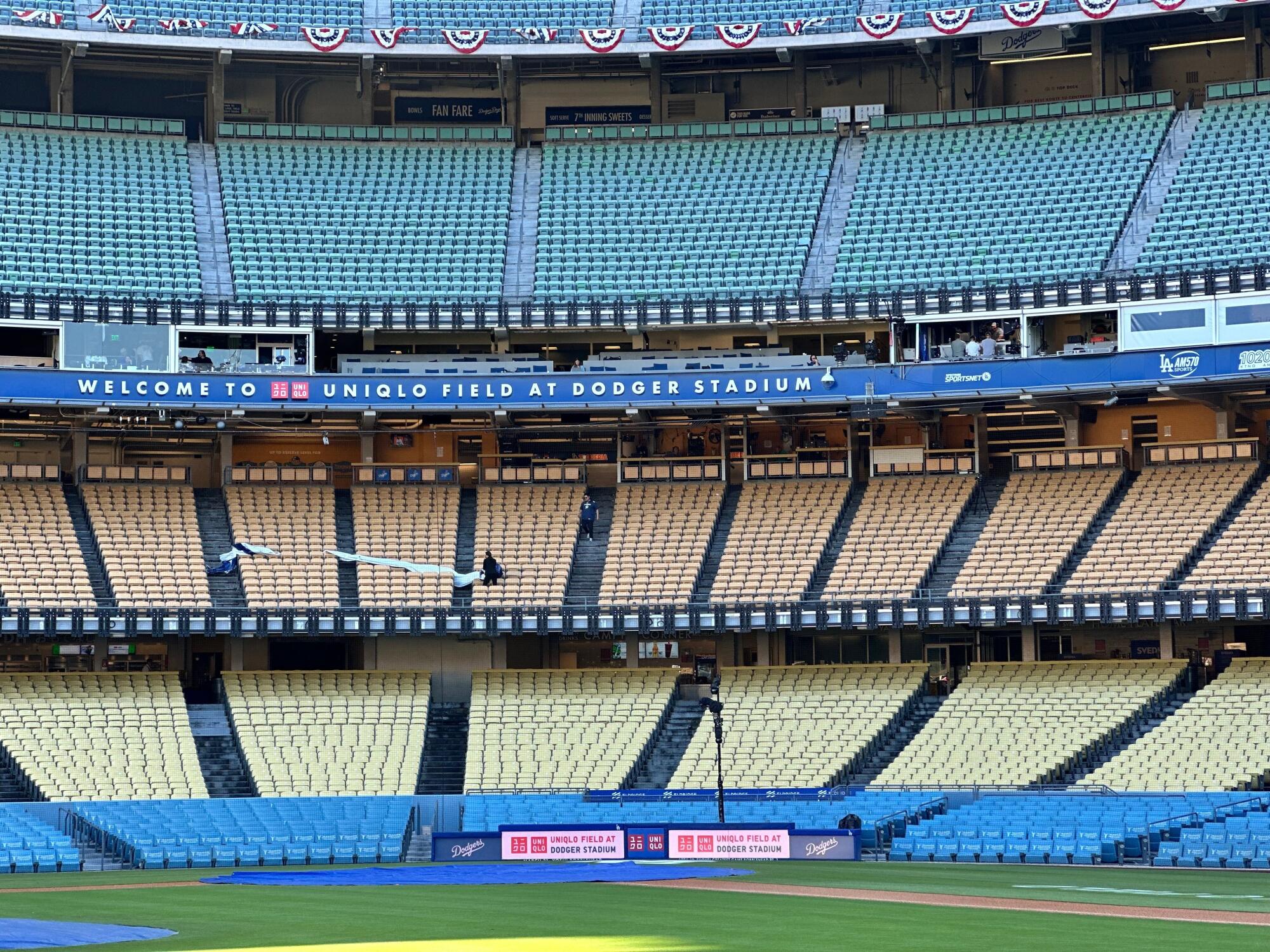
From Maddie Lee: As Dodgers right-hander Yoshinobu Yamamoto came set on the Rogers Centre mound Tuesday, he didn’t let his mind drift to the last time he gazed from that exact spot.
He didn’t think of the snap of Alejandro Kirk’s bat as it splintered, or the fluidity of Mookie Betts’s movement as he started the double play, or the joy on Freddie Freeman’s face as his arms flew in the air.
He didn’t think of the relief as a back-and-forth World Series Game 7 finally ended, or the mayhem that ensued around him as he tilted his head back and smiled.
Yamamoto insisted he didn’t think about the final pitch of last year’s World Series during his start Tuesday. And in the Dodgers’ 4-1 win against the Blue Jays, his focus showed.
“No matter how important, how big the game is, I just treat every game as the same,” Yamamoto said through an interpreter the day before. “And in just normal games, I just pretend that that’s the biggest game.”
Tuesday was, by all measures, just a normal game. And Yamamoto held the Blue Jays to one run through six-plus innings.
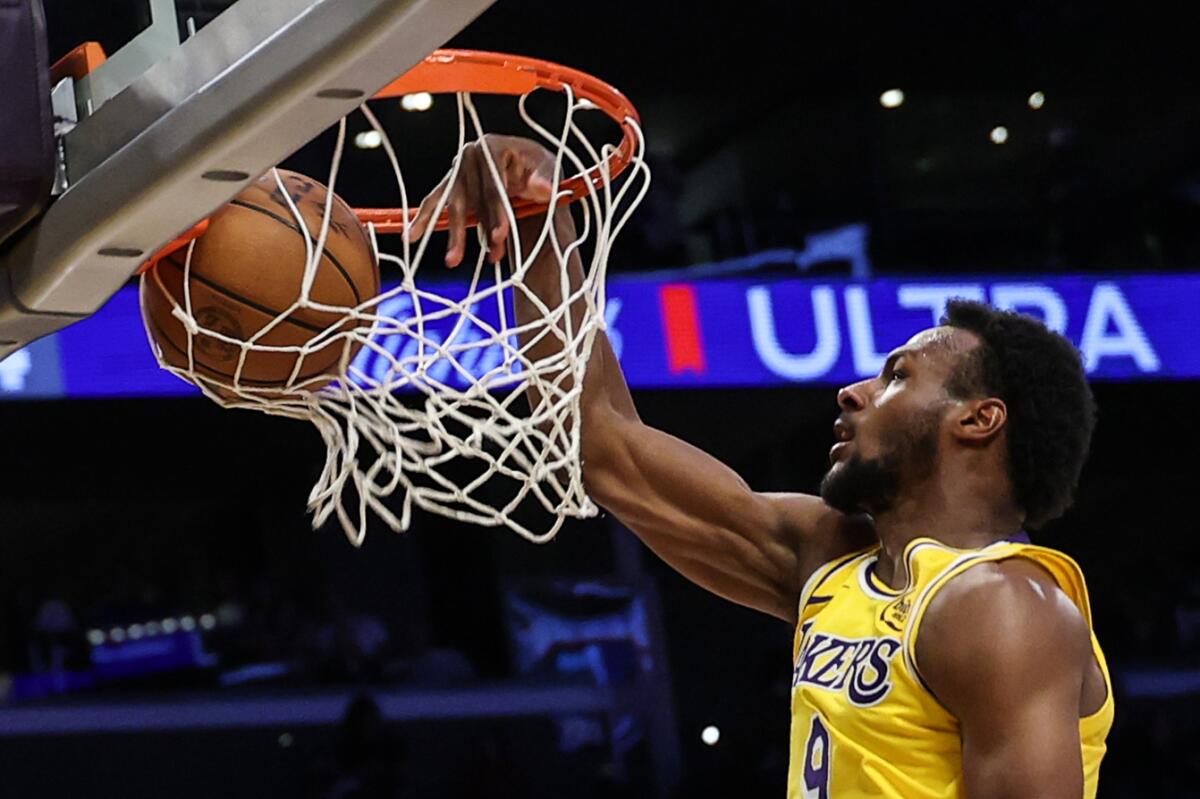
With Big 3 out, Lakers lose to Thunder

Lakers guard Bronny James dunks during a loss to the Oklahoma City Thunder on Tuesday night.
(Robert Gauthier / Los Angeles Times)
From Thuc Nhi Nguyen: No Big Three. No surprise.
Without 80% of their starting lineup, the Lakers, predictably, got crushed by the Oklahoma City Thunder on Tuesday, losing 123-87 to drop their third consecutive game and fall one game out of third place in the Western Conference.
Already without Luka Doncic (hamstring) and Austin Reaves (oblique) for the rest of the regular season, the Lakers had to dig deep in their bench when LeBron James (left foot injury management) and Jaxson Hayes (left foot soreness) were ruled out.
With Marcus Smart (ankle) sidelined for his eighth consecutive game, the Lakers were without five of their top nine players. Even some veterans left from the rotation didn’t inspire confidence early.
Jorge Soler, Reynaldo López get into benches-clearing fight

Angels batter Jorge Soler, left, fights Atlanta Braves pitcher Reynaldo López as the benches clear in the fifth inning at Angel Stadium on Tuesday night.
(Ethan Swope / Associated Press)
From the Associated Press: Ozzie Albies hit his third home run of the season, starter Reynaldo López struck out seven in 4⅔ innings before being ejected after a bench-clearing brawl, and the Atlanta Braves beat the Angels 7-2 on Tuesday night.
Angels designated hitter Jorge Soler went after López following a high-and-tight wild pitch in the fifth. There was a lengthy staredown before Soler took steps toward the mound and López held out his arms before the two exchanged punches. López was holding the baseball when he landed a punch on Soler’s batting helmet.
Soler homered in the first — the fifth of his career in 23 at-bats against López — and was hit by a pitch in the third.
Atlanta snapped a three-game skid and ended the Angels’ three-game winning streak.
Aday Mara winning a national title exposes Mick Cronin’s failure

Michigan center Aday Mara celebrates during the Wolverines’ NCAA men’s basketball championship win over Connecticut on Monday night.
(Abbie Parr / Associated Press)
From Bill Plaschke: Was that really Aday Mara?
It was the most maddening part of March.
It was a Cinderella story that smelled like rotting pumpkin.
It was a big dance over the sensibilities of everything that is UCLA.
Seriously, was that really Aday Mara?
The biggest player on the giant national champion Michigan basketball team Monday night looked familiar, yet strange.
Familiar, because he once played for the Bruins.
Strange, because he wasn’t buried on the bench.
Meet Mick Cronin’s nightmare, a 7-foot-3 indictment of his embattled program, a monumental mistake that has spent three weeks eating at the heart of even the most dedicated Bruin loyalists.
Kawhi Leonard leads Clippers past Mavericks

Clippers star Kawhi Leonard, right, passes the ball in front of Dallas Mavericks forward Dwight Powell during the first half of the Clippers’ 116-103 win Tuesday at Intuit Dome.
(Gina Ferazzi / Los Angeles Times)
From the Associated Press: Kawhi Leonard scored 34 points, hitting six three-pointers, and the Clippers recovered after blowing a 23-point lead to beat rookie Cooper Flagg and the Dallas Mavericks 116-103 on Tuesday night.
It was Leonard’s 55th straight game with 20 or more points in the Clippers’ first win in three tries against the Mavericks this season.
Leonard played in his 62nd game, and he’ll have to appear in the final three games of the regular season to reach 65 and be eligible for postseason awards such as league MVP and All-NBA honors.
Ducks shut out by Predators

Nashville goaltender Justus Annunen makes a save on a shot by Ducks forward Ryan Poehling in the first period of the Ducks’ 5-0 loss at Honda Center on Tuesday.
(Scott Strazzante / Associated Press)
From the Associated Press: Justus Annunen stopped 43 shots — one shy of his career high — for his third career shutout, and the Nashville Predators sent the Ducks to their sixth consecutive loss, 5-0 on Tuesday night.
Erick Haula, Filip Forsberg and Brady Skjei scored second-period goals, and Zachary L’Heureux and Fedor Svechkov scored in the third for the Predators. Joakim Kemmell and Ryan O’Reilly each had two assists.
The win pushed Nashville (84 points) one point ahead of the Kings for the eighth and final playoff spot in the Western Conference. The Predators have four regular-season games left.
Who UCLA could pursue in transfer portal

Iowa State center Audi Crooks, a prolific scorer, is in the transfer portal and is among the players UCLA could pursue.
(Jessica Hill / Associated Press)
From Marisa Ingemi: Women’s college basketball’s version of free agency is here. Less than six hours after UCLA won its first NCAA national title, the transfer portal opened, allowing teams to talk to players seeking new schools. And, like the past few seasons, it is already filled with star power.
UCLA coach Cori Close has to replace six seniors and graduate students who exhausted their eligibility after scoring every point in the national title game.
Close enters the derby with considerable momentum.
“The transfer portal just got easier,” she said with a smile with a championship net draped around her neck Sunday.
Rory McIlroy learns something about winning

Rory McIlroy watches his tee shot on the 17th hole during a practice round ahead of the Masters on Tuesday.
(Eric Gay / Associated Press)
From Sam Farmer: Rory McIlroy, defending Masters champion, finally belongs.
That’s how he feels in the Augusta National clubhouse, at least, even though this week marks his 18th start in the historic golf tournament.
“I always felt like I knew the week of the tournament that the clubhouse is for participants and their families,” he said, “but I still felt like I had to earn the right to be there a little more often.”
A year ago, McIlroy beat Justin Rose in a sudden-death playoff to become the sixth man to complete a career grand slam, winning all four major championships.
This day in sports history
1935 — Gene Sarazen gets a double eagle on the 15th hole to erase Craig Wood’s three-stroke lead, then goes on to win the Masters.
1941 — In his 4th title defense in 9 weeks Joe Louis beats Tony Musto by TKO in the 9th round.
1943 — The Detroit Red Wings beat the Boston Bruins 2-0 to win the Stanley Cup with a four-game sweep.
1956 — Jack Burke, Jr. comes back from eight strokes behind to beat Ken Venturi by one and win the Masters.
1966 — American Football League votes in 36 year old Al Davis as commissioner after Joe Foss resigns. Appointment lasts 3 months when AFL merges with NFL.
1968 — Major League Baseball decides to postpone Opening Day because of the assassination of civil rights leader Martin Luther King Jr.
1969 — MLB expansion teams Royals, Expos, Padres & Pilots win their 1st games
1971 — The first legal off-track betting (OTB) system in the United States opens in New York City.
1974 — In the home opener in Atlanta, Hank Aaron breaks Babe Ruth’s career record by hitting his 715th home run, connecting off Al Downing of Los Angeles in the fourth inning.
1975 — Frank Robinson, the first black manager in the majors, debuts as player-manager for the Cleveland Indians. Robinson hits a home run in his first at-bat — as a designated hitter — to help beat the New York Yankees 5-3.
1989 — Alex English scores 26 points to become the first player in NBA history to score 2,000 points in eight straight seasons, and the Denver Nuggets beat the Utah Jazz 110-106.
1989 — One-handed pitcher Jim Abbott makes MLB debut.
1990 — Nick Faldo becomes the second player to win consecutive Masters, beating Ray Floyd on the second hole of a sudden-death playoff. Faldo joins Jack Nicklaus as the only repeat winner.
1991 — Major league umpires & baseball reach a 4-year agreement after strike.
1995 — Oliver McCall beats Larry Holmes in 12 for heavyweight boxing title.
2001 — Tiger Woods claims the greatest feat in modern golf by winning the Masters, giving him a clean sweep of the four professional majors in a span of 294 days. Woods, with his winning score of 16-under 272, sweeps the majors with a combined score of 65-under.
2003 — 22nd NCAA Women’s Basketball Championship: Connecticut beats Tennessee, 73-68.
2007 — Zach Johnson hits three clutch birdies on the back nine of Augusta National, to close with a 69 for a two-shot victory over Tiger Woods at the Masters.
2008 — Candace Parker, playing with an injured left shoulder, scores 17 points and grabs nine rebounds to help Tennessee capture its eighth women’s NCAA championship with a 64-48 victory over Stanford.
2012 — 76th US Masters Tournament, Augusta National GC: Bubba Watson wins on the second hole of a sudden-death playoff.
2013 — Luke Hancock makes all five of his 3-pointers and leads Louisville to its first NCAA men’s basketball championship since 1986 with a 82-76 victory over Michigan. Coach Rick Pitino adds this title to the one he won at Kentucky in 1996 and became the first coach to win a championship at two schools.
2014 — 33rd NCAA Women’s Basketball Championship: Connecticut beats Notre Dame, 79-58.
2017 — Damian Lillard scores a franchise-record 59 points and matches his career high with nine 3-pointers to help the Portland Trail Blazers beat the Utah Jazz 101-86.
2018 — 82nd US Masters Tournament, Augusta National GC: Patrick Reed wins his first major title.
2019 — 81st NCAA Men’s Basketball Championship: Virginia beats Texas Tech, 85-77 OT.
Compiled by the Associated Press.
Until next time…
That concludes today’s newsletter. If you have any feedback, ideas for improvement or things you’d like to see, email me at houston.mitchell@latimes.com. To get this newsletter in your inbox, click here.