Containerized

Rheinmetall Launches New Containerized Loitering Munition From Moving Truck

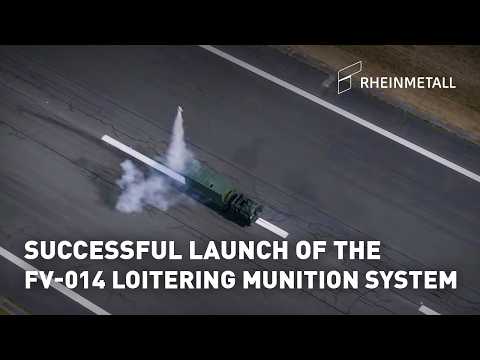
German defense giant Rheinmetall has demonstrated its new FV-014 loitering munition being launched from a containerized launcher mounted on a truck, including while the vehicle was moving. The test marks the first time the FV-014 has been fired from its Containerized Missile Launcher, a modular system intended to carry significant numbers of missiles or loitering munitions.

The demonstration took place in July at the National Test Center for Unmanned Aerial Systems at the German Aerospace Center in Cochstedt, Saxony-Anhalt. The customer demonstration included both stationary and mobile launches from an HX-series truck, followed by simulated operational profiles and attack flights.

Rheinmetall demonstrates FV-014 launch from Containerized Missile Launcher thumbnail

Rheinmetall demonstrates FV-014 launch from Containerized Missile Launcher


The FV-014 is a relatively long-range, truck-launched loitering munition that can perform its own reconnaissance and then conduct a precision attack. Rheinmetall says the weapon has a range of up to 100 kilometers (62 miles) and can remain airborne for as long as 70 minutes.

Like many loitering munitions, this endurance gives the operator considerably more time to search for targets and decide whether to conduct an attack than would be available with a conventional fire-and-forget missile. Rheinmetall describes the system as combining “reconnaissance, target identification and precision strike capabilities within a single system.”

The FV-014 is designed to remain under permanent human control. An operator using the associated ground station can identify and track targets and authorize an attack, while also having the ability to abort an engagement if circumstances change.

An FV-014 in its launch tube. Rheinmetall screencap

As we have discussed in the past, human-in-the-loop architecture is useful when operating against targets that may be moving or difficult to identify in advance.

However, the concept also has significant drawbacks compared to increasingly autonomous loitering-munition concepts in which the system itself can perform much more of the target-detection and engagement process. Human-in-the-loop comes with latency and communications dependencies, as well as operator workload, but it may also be the result of a particular customer demand, whether operational or legal. At the same time, for all its promise, autonomous technology is still in its infancy.

The FV-014 has a launch weight of around 50 pounds, including a payload of approximately 13 pounds. Its HEDP, or high-explosive dual-purpose, warhead is claimed to be capable of penetrating around 24 inches of solid armor steel.

That would give the weapon a substantial anti-armor capability for its size, although Rheinmetall also says the warhead can be used against unarmored targets and infrastructure.

After being ejected from its launch tube using a booster, the FV-014 unfolds its wings and transitions into aerodynamic flight. An electrically driven propeller provides propulsion during the cruise phase. Rheinmetall also says the weapon has been designed with reduced radar and infrared signatures in mind.

A rendering of an FV-014 loitering munition in flight. Rheinmetall

The company is pitching the FV-014 for both individual attacks and coordinated swarm operations. In the latter case, multiple weapons could be used simultaneously against a number of targets or to overwhelm an adversary’s defenses and create outsized, rapid effects on the battlefield.

‘Swarm’ has become something of a catch-all term in the loitering-munition market, however, and Rheinmetall has not provided detailed information about the level of autonomy or coordination available between FV-014s. The company does say that the weapon has network connectivity and a “high degree of autonomy” intended to help it operate in environments where satellite navigation is being disrupted.

This capability is particularly important on the modern battlefield, where electronic warfare systems are routinely used to interfere with satellite-navigation signals. Rheinmetall says the FV-014 is resilient to global navigation satellite system (GNSS) interference, although specific details about its navigation architecture have not been disclosed.

The weapon’s launch system, Rheinmetall’s Containerized Missile Launcher, is built around a standardized ISO container that can be installed on a fixed site, carried by a truck, or potentially integrated onto a ship. In its 20-foot configuration, the company says the launcher can accommodate up to 18 FV-014s.

That is considerably fewer weapons than some other containerized drone-launcher concepts Rheinmetall has previously promoted. In 2024, for example, the company showed a containerized system intended to carry as many as 126 Hero-series loitering munitions from Israeli manufacturer UVision.

An earlier rendering of a containerized launch system for Hero-family loitering munitions from the Rheinmetall brochure. Rheinmetall

Rather than simply acting as a large rack of launch tubes, the new launch system has its own integrated power supply and can connect to command, control, communications, computers and intelligence networks. It can also be operated locally, through a radio link, or via satellite communications.

The launcher is intended to make extensive use of commercial off-the-shelf components, which should reduce lifecycle costs. It also incorporates what the company calls a “sleeper” capability, allowing the launcher to remain inactive and be remotely activated when required.

The ability to move the entire system on a standard military truck is potentially significant. Rheinmetall has demonstrated the launch of FV-014s from a moving truck, as well as a stationary one. Shooting on the move could be beneficial when defending convoys, engaging targets of opportunity, or offering rapid fire support to units within range. Beyond that, interceptor drones would allow for engagements against drone threats while on the move.

Detonation of an FV-014 loitering munition. Rheinmetall screencap

Using a standardized container makes it possible to rapidly relocate a large number of long-range loitering munitions without relying on a dedicated launcher vehicle, and also opens up potential maritime applications. Rheinmetall says future versions are planned for other mobile land platforms and seagoing ones, while the container itself is compatible with existing transportation and logistics infrastructure.

This general concept is already seeing considerable uptake. Containerized launchers provide a relatively discreet way of deploying large numbers of missiles or drones and can potentially turn trucks, ships, or other platforms capable of carrying ISO containers into weapons carriers. TWZ has previously examined the broader appeal of this approach, including Rheinmetall’s earlier Hero-family launcher concept.

In the past, we have also highlighted the immense potential battlefield impact of this type of capability, which other countries, especially China, are also actively pursuing.

The video below shows a test of a Chinese truck-mounted launcher design capable of being loaded with up to 48 kamikaze drones. 

中国电科陆空协同固定翼无人机“蜂群”系统 thumbnail

中国电科陆空协同固定翼无人机“蜂群”系统


In general, containerized launchers offer an unusual degree of concealability: a weapons system housed in a standard shipping container can potentially be moved through conventional logistics networks and deployed without the distinctive appearance of a dedicated missile battery. Rheinmetall has explicitly pitched the standardized container format as supporting “covert operations,” and this immediately calls to mind Ukraine’s audacious Operation Spiderweb that saw several Russian bombers and other aircraft destroyed or damaged by (much shorter-range) drones launched from trucks.

Rheinmetall has not disclosed details about the customer involved in the July demonstration, nor of the targets used, the engagement distances, the number of FV-014s launched, or the extent of autonomy involved in reported swarm operations.

However, with the FV-014 now proven, Rheinmetall can offer a complete system in which a truck can arrive with a sizeable magazine of relatively long-range weapons, launch them individually or in groups, and provide operators with the ability to search for targets before deciding whether to attack. The German company’s mobile containerized launcher and a 100-kilometer-class loitering munition are eye-catching, but the system also enters an increasingly competitive market.

Contact the author: thomas@thewarzone.com
Thomas Newdick is a staff writer at TWZ, where he covers military aviation, defense technology, weapons systems, and international security. Based in Berlin, Germany, he reports on conflicts, military modernization efforts, and emerging aerospace technologies around the world, with a particular interest in airpower and its role in contemporary warfare. His reporting is informed by deep expertise in modern and historical airpower, particularly in Europe, with a focus on military aviation, air campaigns, and aerospace developments across the continent and beyond.


Source link

Containerized Variant Of Navy’s Drone-Swatting HELIOS Laser Being Pushed By Congress

Members of Congress are moving to push the U.S. Navy to develop a containerized version of its High-Energy Laser with Integrated Optical Dazzler and Surveillance (HELIOS) system. Containerized designs could help accelerate the service’s fielding of laser directed energy weapons on a wider array of ships, providing added layers of close-in defense. The Navy has already been experimenting with palletized designs as part of its larger laser development efforts, which have faced continued hurdles in recent years.

An early draft of the annual defense policy bill, or National Defense Authorization Act (NDAA), for the 2027 Fiscal Year, would authorize the addition of $5 million to the Navy’s budget for work on a containerized HELIOS. It would also add $2.5 million for a “Containerized Maritime High Energy Laser Weapon System,” which does not otherwise appear to be mentioned, at least by that name, in the service’s proposed budget for the 2027 Fiscal Year. The House Armed Services Committee released this draft NDAA earlier this week.

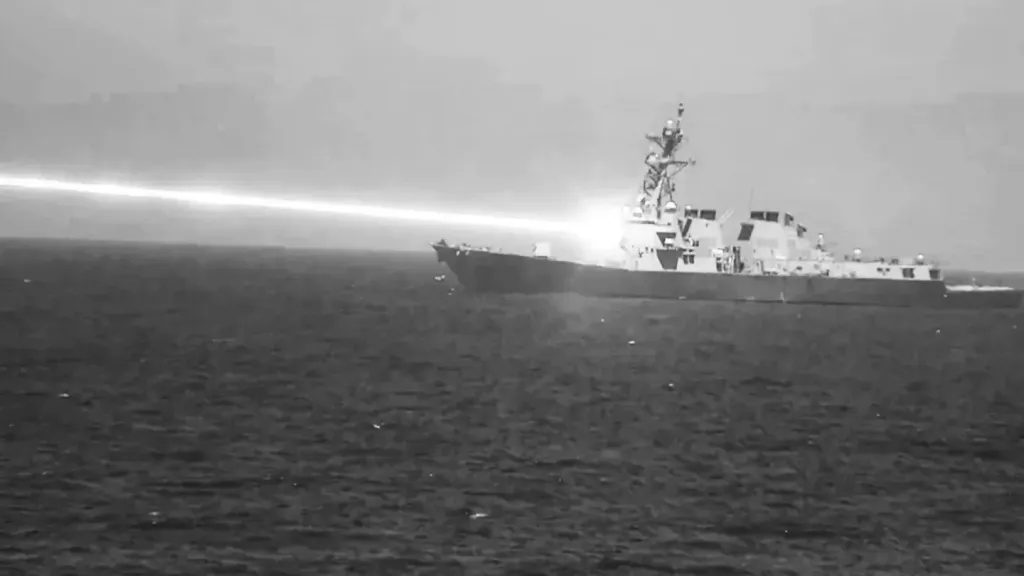
The one HELIOS laser directed energy weapon in Navy service currently, which is integrated onto the Arleigh Burke class destroyer USS Preble, seen being tested. USN USN

The Navy’s proposed budget for the next fiscal cycle does already include a request for $75.6 million for a separate Joint Laser Weapon System (JLWS) effort. The development of a containerized 150-kilowatt-class laser directed energy weapon, along with work toward 300 and 500-kilowatt-class designs, are part of the stated plans for JLWS. It’s unclear whether the Maritime High Energy Laser Weapon System mentioned in the draft NDAA is related to JLWS.

HELIOS, which the Navy has also designated Mk 5 Mod 0, is a 60-kilowatt-class laser directed energy weapon. At that power level, it is able to destroy or at least damage certain targets, such as drones or small boats, a capability that has now been demonstrated in multiple tests. There has been talk in the past about scaling HELIOS’s power rating up to 150 kilowatts.

Currently, the Navy only has one HELIOS laser, installed on the Arleigh Burke class destroyer USS Preble. Despite integration on an operational warship, the service describes this system as a “Non-Program of Record (POR) Research & Development (R&D) asset” in its most recent budget request.

A graphic depicting an Arleigh Burke class destroyer firing a HELIOS laser. Note that the beam would not be visible to the naked eye during a real engagement. Lockheed Martin

As an aside, another laser system, the Optical Dazzling Interdictor, Navy (ODIN), is currently found on seven other Arleigh Burke class destroyers. An eighth example was integrated on the USS Kidd, but has been temporarily removed while that ship is completing a two-year maintenance availability. That ODIN system is currently being used for land-based training at the Naval Surface Warfare Center, Port Hueneme Division, in California. Designed as a “dazzler,” ODIN is lower-powered than HELIOS, and is intended to blind or confuse electro-optical and/or imaging infrared systems, including seekers on incoming munitions, sending them off course rather than shooting them down.

An ODIN system seen undergoing testing on land. USN

As noted, HELIOS offers demonstrated capability now, and a containerized version is something the Navy might be able to field more widely in the near-term. This, in turn, could help provide a bridge to future developments under JLWS. Containerized systems, as well as palletized ones, inherently offer valuable flexibility, especially in a maritime context. Integration can be more readily achieved on a broad array of ships – including carriers, amphibious warfare ships, sea base-type vessels, and sealift ships, as well as certain surface combatants – as long as there is sufficient deck space and available power.

In April, the Navy disclosed a test of a palletized version of AeroVironment LOCUST laser counter-drone system on the Nimitz class aircraft carrier USS George H.W. Bush, underscoring exactly this kind of flexibility. For that test, AeroVironment leveraged a palletized configuration of LOCUST it had already developed for the U.S. Army. However, various changes were made to adapt it to shipboard use, including “hardened electronics for salt fog, humidity, vibration, and long deployments” and the addition of “stabilization hardware to manage ship motion,” according to a company press release.

The palletized LOCUST system seen on the deck of the USS George H.W. Bush. USN

Counter-drone defense has emerged as a critical priority for the Navy, both at sea and on land. This has only been underscored by experience gained during the latest conflict with Iran, as well as operations in and around the Red Sea in recent years. The service has already been adding counter-drone systems that use physical interceptors as their effectors to an ever larger number of ships, something TWZ has been closely tracking.

When it comes to a containerized version of HELIOS, which could also be used to bolster defenses ashore, would benefit from having been developed for maritime use from the start. It might still be less hardened against environmental conditions, as well as battle damage, than its more deeply integrated counterpart on the USS Preble. There are also questions about how the system might be integrated onto the host ship and its combat system, if it has one at all.

In general, as long as there is sufficient power and cooling capacity, laser directed energy weapons like HELIOS offer essentially unlimited magazine depth. This offers cost benefits, especially when compared to employing traditional surface-to-air interceptors. As one comparative example, the latest versions of the RIM-116 Rolling Airframe Missile (RAM), which many Navy ships are armed for point defense, have unit costs in the $1 million range. All of this could also help in addressing long-standing concerns about the sufficiency of stockpiles of critical anti-air interceptors (as well as other munitions), and the ability to readily replenish those inventories, which have only been reinforced by the latest conflict with Iran.

USS Porter Conducts SeaRAM Test Fire thumbnail

USS Porter Conducts SeaRAM Test Fire


Laser directed energy weapons do also have limitations, especially when employed in the maritime domain, as TWZ has highlighted in the past:

“A single laser can only engage one target at once. As the beam gets further away from the source, its power also drops, just as a result of it having to propagate through the atmosphere. This can be further compounded by the weather and other environmental factors like smoke and dust. More power is then needed to produce suitable effects at appreciable distances. Adaptive optics are used to help overcome atmospheric distortion to a degree. Altogether, laser directed energy weapons generally remain relatively short-range systems.”

“In addition, laser directed energy weapons, especially sensitive optics, present inherent reliability challenges for use in real-world military operations. Shipboard use adds rough sea states and saltwater exposure to the equation. There is also the matter of needing to keep everything properly cooled, which creates additional power generation and other demands.”

Overall, the Navy’s current top leadership is already very supportive of containerized systems and directed energy weapons, including both lasers and high-power microwave types. In March, Chief of Naval Operations (CNO) Adm. Daryl Caudle, the service’s top officer, unveiled a formal Containerized Capability Campaign.

Chief of Naval Operations Adm. Daryl Caudle, left, speaks at a separate budget-related hearing before members of the House Appropriations Committee on May 12, 2026. USN

“From towed-array-systems, to drone swarms, to electronic attack systems, to high-powered lasers … I want to containerize everything,” Caudle said at the annual McAleese Defense Programs Conference in March. “Tailored capabilities give our combatant commanders something they value above all else: options.”

Containerized systems are particularly central to the Navy’s current vision for future fleets of USVs, as well as its new FF(X) frigates.

Laser directed energy weapons are also central to the current plan for the Navy’s future Trump class battleships, but they are expected to be deeply integrated into that design rather than containerized. Adm. Caudle has been outspoken more broadly in his view that laser-directed energy weapons are key to bolstering close-in defenses on his service’s warships going forward, including against the growing threat posed by drones.

A rendering of a Trump class battleship firing various weapons, including laser directed energy weapons. USN

“My thesis research at [the] Naval Post Graduate School was on directed energy and nuclear weapons,” the CNO told TWZ and other outlets at a roundtable at the Surface Navy Association’s (SNA) annual symposium in January. “This is my goal, if it’s in line of sight of a ship, that the first solution that we’re using is directed energy.”

In particular, “point defense needs to shift to directed energy,” Caudle added at that time. “It has an infinite magazine.”

Even before assuming his current role as CNO, Caudle has been a vocal supporter of Navy directed energy weapon developments. At the same time, as mentioned, the service has faced continued stumbling blocks to more widespread fielding of these capabilities. This is, in many ways, reflected just in HELIOS, which remains a largely experimental effort despite years of testing and previous talk about expanding it into a broader operational capability. The Navy has integrated other one-off lasers onto other ships in the past. This includes the Laser Weapon System Demonstrator Mk 2 Mod 0 installed for a time on the San Antonio class amphibous warfare ship USS Portland, which is seen being tested in this video below.

USS Portland (LPD 27) tests LWSD laser system thumbnail

USS Portland (LPD 27) tests LWSD laser system


Several U.S. Air Force and Army laser directed energy programs have also been realigned, curtailed, or outright cancelled in recent years due to technical hurdles and other factors.

Despite it adding funding for containerized system development, the draft NDAA that the House Armed Services Committee also proposes to cut $5 million from the Navy’s Directed Energy and Electric Weapon Systems line item due to what it simply describes as “unjustified growth.” The bill is also very likely to change in substantial ways in the coming weeks and months before it is ever put to a full vote, let alone sent to President Trump’s desk.

Whether or not the extra funding for a containerized version of HELIOS, or the Maritime High Energy Laser Weapon System, comes across in the end, the Navy is already heavily committed to new developments in this arena despite the continued challenges.

Contact the author: joe@twz.com

Joseph has been a member of The War Zone team since early 2017. Prior to that, he was an Associate Editor at War Is Boring, and his byline has appeared in other publications, including Small Arms Review, Small Arms Defense Journal, Reuters, We Are the Mighty, and Task & Purpose.


Source link