The Tudares Case and the Regime’s New Constraints
The release of Rafael Tudares, son-in-law of president-elect Edmundo González Urrutia, should not be read as an act of goodwill or as evidence of political normalization. It tells us something else. It tells us that the Venezuelan regime is operating under constraints it does not fully control anymore.
Political prisoners were never hidden, and they were never quiet. Everyone knew they existed, and everyone knew what they were for. For years, they generated exactly what the regime wanted, instilled fear, and discouraged people from testing the limits. That logic held, especially after the astronomical repression that followed July 28, when the government made a point of showing that even the smallest act of dissent, printing T-shirts, organizing vigils, speaking too loudly, would be punished.
What has changed is not the visibility of repression, but its effectiveness. For much of the last decade, political imprisonment functioned as a kind of currency. Detainees were bargaining chips, reminders that the state answered to no one, signals that consequences were final. That system depended on a relatively closed circuit of authority. Decisions were made internally, enforced vertically, and rarely explained. As long as that circuit held, repression worked not because it was subtle, but because it was definitive. Detention meant disappearance, uncertainty stretched over months or years. Tudares’ year-long disappearance is a good example. It produced exactly the reaction the regime expected, a broad recalculation of risk, fewer protests, more caution.
After Maduro’s removal, that circuit did not disappear, but became weaker. The regime did not stop repressing. It still , still intimidates, still punishes, more than 700 political prisoners remain unjustly detained. But it no longer does so from a position of uncontested control. It no longer acts as if it answers only to itself. Increasingly, it has to answer outwardly, and upward.
This is where Donald Trump enters the picture. Whatever one thinks of the arrangement taking shape, Caracas no longer governs in isolation. Trump’s own allies, many of them already uneasy about leaving figures like Delcy Rodríguez and Diosdado Cabello in positions of power, have grown increasingly uncomfortable with a slow, opaque process in which hundreds of political prisoners remain behind bars. In that context, prolonged detention no longer signals strength. It starts to look like defiance without cover. The White House at some point will wonder when do Venezuela’s political prisoners begin to look like Trump’s political prisoners?
That shift matters at home as well. Fear hasn’t disappeared, but it no longer dominates everything. Students are back in the streets, political figures are reemerging from hiding. Even the so-called colaboracionistas seem to be reassessing how much silence is worth. The question is no longer whether repression is real, but whether it’s still decisive.
Tudares’ release wasn’t the regime executing a plan. It was a reaction, in a context where the regime seems to have lost some control over political timing. More revealing still, it was a reaction through intermediaries, not institutions.
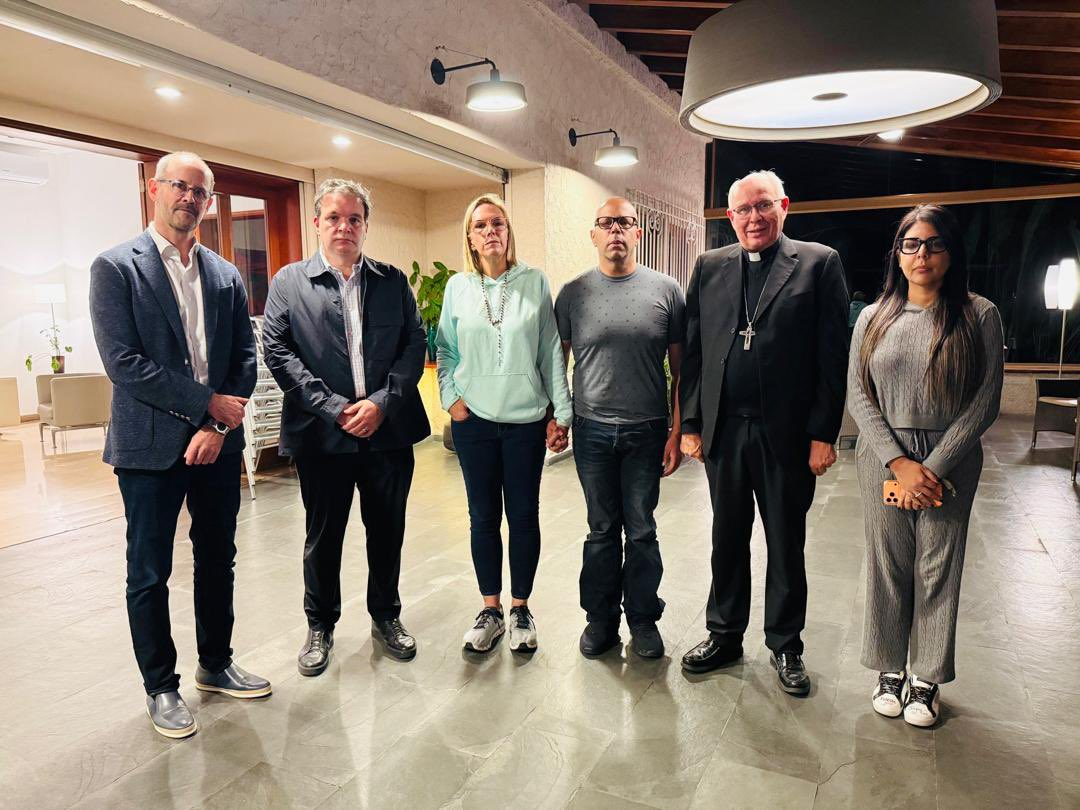
The speed and manner of Tudares release make this hard to miss. What followed the surge of public scrutiny around figures like former Fedecámaras president Ricardo Cusanno and Caracas Archbishop Raúl Biord was not a drawn-out negotiation or a carefully managed announcement. It was fast, happened within hours, in the middle of the night, and outside of formal institutions, and perhaps, more strikingly, it came with no explanation. That sequence matters. It suggests the system did not need time to think. It needed a release valve. That reaction was triggered when Mariana González de Tudares published an explosive statement pointing to several actors allegedly involved in the release of political detainees after the 2024 post-electoral crackdown.
Midnight decisions, diplomatic handoffs, releases carried out quietly and offstage are rarely signs of confidence. They are about containment. This was not the regime executing a plan. It was a reaction, in a context where the regime seems to have lost some control over political timing. More revealing still, it was a reaction through intermediaries, not institutions. Tudares was not released publicly from a detention center. No senior official stood next to him. No one wanted to own the decision.
That does not mean the regime suddenly became fragmented, as it was always dispersed. Different security bodies and political actors have long controlled different sets of prisoners. That dispersion is one reason releases have historically been slow and uneven, with individual detainees effectively tied to specific figures. What makes this episode different is that someone gave in quickly, and did so without wanting to be seen doing it.
This was not an assertion of authority, the decision was fast, and the execution was evasive. It reads more like damage control. A concession made quietly, designed to minimize visibility and avoid setting a precedent in daylight. The release of Rafael Tudares looks less like sovereignty and more like containment, a move taken not because it fits a strategy, but because delay had become riskier than action.
The regime’s weakest points are not at its core, but at its edges, among the intermediaries who must explain, manage, and deflect on its behalf.
What this reveals is not confusion about who holds power, but clarity about where pressure works. The regime did not need agreement on principle. It needed someone to absorb the cost, quickly, and without fanfare. That is the behavior of a system that understands its own exposure and is governing less through displays of strength and more through tactical retreats.
For the opposition, this matters. It shows that the regime is more exposed to public pressure than it has been in years, not because it has lost the capacity to repress, but because it has lost its monopoly over timing, narrative, and accountability. As explored in “María Corina vs. the Realpolitik of Trump and Delcy,” Machado is operating in a narrower, more brittle political landscape. The Tudares episode suggests that this landscape does not absorb pressure well. When scrutiny becomes public, targeted, and reputational, outcomes can be forced quickly and awkwardly.
Political prisoners have become a liability not because they are invisible, but because they are contested. They no longer function as a one-way threat. They sit at the intersection of domestic mobilization, international pressure, and reputational risk. The regime still represses. What it no longer fully controls are the consequences.
This does not mean collapse is imminent, but signals something more practical. The regime’s weakest points are not at its core, but at its edges, among the intermediaries who must explain, manage, and deflect on its behalf. When those actors are exposed, when delay becomes more costly than action, results can come fast. The release of Rafael Tudares should not be mistaken for closure. It shows that the fear-based equilibrium that sustained the system for years is wearing down, and that public pressure, when aimed correctly, now moves faster than authority. That is not a victory, but it is useful knowledge.