congressional

Virginia voting on new congressional map drawn by Democrats

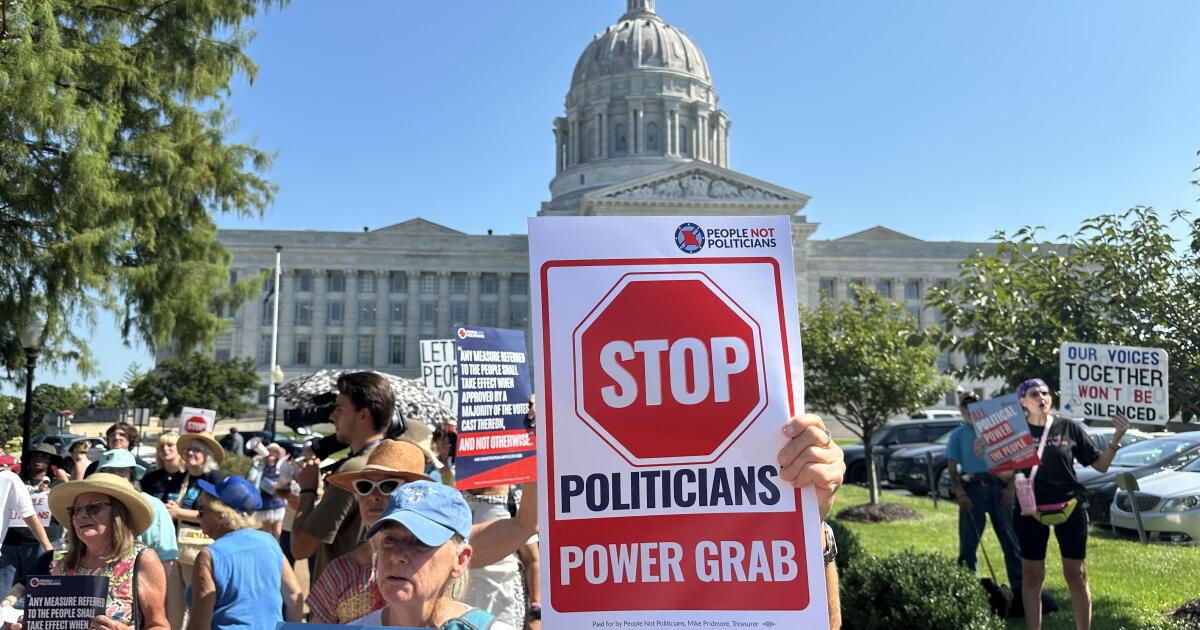
April 21 (UPI) — Voters are heading to the polls in Virginia on Tuesday to vote on a new congressional map drawn by state lawmakers.

Polls are open until 7 p.m. EST., with nearly 1.4 million early ballots already cast on a constitutional amendment to change the congressional map. The result of Tuesday’s vote could have significant implications for the midterm elections in November.

If the map, drawn by Democratic lawmakers, is approved by voters, Democrats would be favored to win 10 of the state’s 11 congressional districts. Democrats currently hold six of the state’s 11 congressional seats and Republicans hold five.

Virginia is just the latest state to weigh redrawing its congressional map mid-decade after Texas approved a map that will favor Republicans last year. Four Republican-led states have approved new congressional maps.

Democrats and Republicans outside of the state have lent their voices to campaigns for and against Virginia’s redistricting plan. President Donald Trump and House Speaker Mike Johnson, R-La., voiced their opposition to the plan, with Trump calling it “unfair.”

House Minority Leader Hakeem Jeffries, D-N.Y., has joined Virginia lawmakers Sen. Mark Warner and Sen. Tim Kaine at rallies to support redistricting. Former President Barack Obama has also been involved, appearing in ad campaigns calling on voters to vote “yes.”

“We’re giving Virginians a chance to vote — which Republican states have not done — about whether they want to have a congressional delegation that will stand up against Donald Trump’s tyranny if he tries to interfere with our elections,” Kaine said in an appearance on Fox News on Sunday.

The Virginia Supreme Court allowed Tuesday’s election to move forward but may still weigh in on whether the new congressional map is legal or not.

Secretary of Health and Human Services Robert F. Kennedy, Jr. speaks during a House Appropriations Subcommittee on Labor, Health and Human Services, Education, and Related Agencies hearing on the budget for the Department of Health and Human Services in the Rayburn House Office Building near the U.S. Capitol on Thursday. Photo by Bonnie Cash/UPI | License Photo

Source link

RFK Jr. defends decisions at HHS in congressional testimony

Secretary of Health and Human Services Robert F. Kennedy, Jr. speaks during a House Appropriations Subcommittee on Labor, Health and Human Services, Education and Related Agencies, one of seven congressional committees he testified before Thursday. Photo by Bonnie Cash/UPI | License Photo

April 16 (UPI) — Health and Human Services Secretary Robert F. Kennedy, Jr. on Thursday testified before seven congressional committees, often clashing with Democrats about decisions he has made about vaccines and department priorities.

The testimony is Kennedy’s first trip to the Capitol this year and the first time that he has appeared before Congress in more than seven months, The Washington Post reported.

In addition to unilaterally remaking the Center for Disease Control and Prevention’s vaccine advisory committee and the agency’s recommended childhood vaccine schedule — which were blocked by a federal judge in March — he has changed the Food and Drug Administration‘s recommendations on diet and shepherded medications through federal approval processes while allegedly ignoring data on them.

Kennedy also was asked by members of Congress about the Trump administration’s 12.5% budget request decrease, which amounts to about $16 billion that it sought for its fiscal year 2027 budget proposal, NPR reported.

“Our children are the sickest generation in modern history — decades of failed policy, captured agencies and profit-driven systems have caused it,” Kennedy said during a hearing before the House Ways and Means Committee.

“Parents across this country demanded change — and we are delivering it,” he said.

Kennedy said that the measles vaccine “certainly” could have saved the life of a child who died in Texas last year during an outbreak in the state.

More than 1,700 measles cases have been reported through the first 3 1/2 months of 2026, compared to more than 2,200 reported in all of 2025.

He also was asked by Rep. Linda Sanchez, D-Calif., about ending an influenza vaccine public awareness campaign while investing money in marketing efforts for his remade food pyramid.

“You suspended this pro-vaccine messaging campaign, but somehow you’re spending taxpayer dollars to drink milk, shirtless in a hot tub with Kid Rock?” Sanchez asked.

Kennedy also was accused of “diminishing science” by Rep. Bradley Scott, D-Ill., with his support for $5.7 billion in cuts to the National Institutes of Health meant for drug development.

“Nobody wants to make the cuts,” Kennedy said in response to several questions about reducing the HHS budget, but said the nation needs “to tighten our belt” because of the national debt, which he blamed on Congress.

First lady Melania Trump speaks during a House Ways and Means Committee roundtable discussion on protecting children in America’s foster care system in the Longworth House Office Building near the U.S. Capitol on Wednesday. The bipartisan group of lawmakers are looking to address challenges children in foster care face, including barriers to education and educational advocacy, housing, employment opportunities, financial independence, and technology. Photo by Bonnie Cash/UPI | License Photo

Source link

A vaccine standoff and other key moments from RFK Jr.’s first congressional hearing in months

Health Secretary Robert F. Kennedy Jr. on Thursday faced federal lawmakers for the first time since September as he sought to defend a more than 12% proposed cut to his department’s budget and dodge arrows from angry Democrats along the way.

In his testimony before the House Ways and Means Committee, kicking off an expected sprint of seven budget hearings he’ll attend across congressional committees and subcommittees over the next week, Kennedy emphasized the administration’s work to reform dietary guidelines and crack down on waste, fraud and abuse.

Republicans on the committee praised Kennedy as a “breath of fresh air” and asked him to promote his department’s recent actions. Democrats, who have been furious over Kennedy’s sweeping overhaul of the U.S. Department of Health and Human Services, largely had a different agenda.

They needled Kennedy on what they viewed as the Trump administration’s hypocrisy on fraud, demanded to know why he was cutting budgets for various programs and slammed his efforts to pull back vaccine recommendations and messaging, which they said have caused unnecessary deaths.

Kennedy fired back, often raising his voice as he accused the Democrats of misrepresenting his work and past statements.

Here are three standout moments from Thursday’s hearing:

A standoff over measles

One heated exchange early in the hearing came between Kennedy and Rep. Linda Sanchez. The California Democrat decried recent measles outbreaks across the U.S. and asked Kennedy to answer for the fact that under his leadership, the Centers for Disease Control and Prevention pulled back public health messaging supporting vaccination.

“As a mother, this horrifies me,” Sanchez said. “Did President Trump approve your decision to end CDC’s pro-vaccine public messaging campaign?”

Kennedy repeatedly refused to answer, saying first he wanted to respond to the “misstatements that you’ve made” and later praising the Trump administration’s record on preventing measles, although protections against the disease have eroded in some parts of the country as vaccination rates have dropped.

“That’s not answering my question,” Sanchez said as the two talked over each other.

But Sanchez also got Kennedy, a longtime anti-vaccine activist before he entered politics, to acknowledge that a 6-year-old who died of measles last year in West Texas could have potentially been saved with vaccination.

“Do you agree with the majority of doctors that the measles vaccine could have saved that child’s life in Texas?” she asked.

“It’s possible, certainly,” Kennedy said.

RFK Jr. denies talking about Black children being ‘re-parented’

A fight erupted between Kennedy and Rep. Terri Sewell, a Democrat from Alabama, when Kennedy vehemently denied making remarks he’d said in 2024.

The comments dated back to when Kennedy was a presidential candidate. On the “High Level Conversations” podcast last July, he said, “Psychiatric drugs — which every Black kid is now just standard put on Adderall, SSRIs, benzos, which are known to induce violence, and those kids are going to have a chance to go somewhere and get re-parented to live in a community where there’ll be no cellphones, no screens, you’ll actually have to talk to people.”

“Have you ever re-parented, or parented, I should say, a Black child?” Sewell asked, as her staff held up a poster featuring an abbreviated version of the quote.

“I don’t even know what that phrase means,” Kennedy said. “I’m not going to answer something I didn’t say.”

“You’re making stuff up,” he later claimed.

A recording of the podcast shows he made the comments during a conversation about free rehabilitation facilities he was proposing opening at the time in rural areas around the country.

Health and Human Services spokesperson Emily Hilliard said Kennedy before joining the administration was referring to spaces where young people facing alienation, mental health challenges and despair could get re-parented, which she said was a psychotherapy term for “developing the emotional regulation, discipline, boundaries, and self-worth that may not have been established in childhood.”

For Kennedy and his former party, civility is the exception

Kennedy spent most of his life as a Democrat, the scion of one of the nation’s most famous political families. Both Republicans and Democrats during the hearing began their remarks by expressing their admiration of Kennedy’s relatives, among them former President John F. Kennedy.

But again and again throughout Thursday’s hearing, the fraying of bonds between Kennedy and his former party was on full display as spiteful comments were passed back and forth.

The Health secretary grew defensive and visibly agitated. He repeatedly criticized Democratic lawmakers for not giving him a word in edgewise.

“They’ve all shut me up,” Kennedy said at one point. “They give a little speech that they can go and market, you know, for fundraising, and they don’t allow me to answer the question.”

On a few rare occasions, the exchanges were civil. One representative, Gwen Moore of Wisconsin, used humor to make that happen.

“I promise to give you easy, comfortable questions if you don’t yell at me and hurt my feelings,” she told Kennedy. He promised he wouldn’t.

Swenson writes for the Associated Press.

Source link

Jackie Speier would like her former congressional colleagues to zip up and shape up

It seems like a simple ask that male politicians don’t sexually harass or even rape women, but also, it seems like an open secret in Congress that sexual misconduct is too common.

Take Eric Swalwell, whose epic political immolation has captivated this week’s national political news, including a TMZ-obtained video of the then-congressman bleary-eyed in a bathrobe on a yacht that was literally the least-worst revelation.

For years “there were swirling rumors about Eric,” former Rep. Jackie Speier told me. Speier in 2018 thought she’d put in place tough new rules to stop sexual misconduct among her former colleagues, and the type of backroom shrugs that allowed men to prowl unchecked.

But despite her efforts, Speier, who represented a part of the Bay Area near Swalwell’s district until 2023, said the problem remains Congress itself, and the “crippling” power that elected officials have over their staffs. Don’t get her started on how that power imbalance is even worse for young lobbyists.

“I’ve always said that Congress is Hollywood for ugly people,” she said. “It’s a whole environment that becomes, I think, toxic.”

But also one that, she added, isn’t inevitable.

The 2018 change

In 2017, the #MeToo movement had swept into the public consciousness and ignited calls for change.

Armed with that outrage and the roiling fire of public opinion, Speier set out to change archaic rules that governed how sexual misconduct was handled in Congress.

“I’ll just run through what it was like,” she told me. “If you wanted to file a complaint, you had to be prepared to go through some period of counseling; to have a cooling off period; to participate in mandatory mediation; and sign an NDA, and then the taxpayers picked up the tab if there was a settlement. It was kind of jaw dropping to think that that was the policy.”

It wasn’t just policy, it was culture. Speier herself had been the victim of an assault when she was a young staffer — a senior staffer pushing her against a wall and forcibly kissing her. And like so many women, she put the episode aside and went on with her career because speaking out would have likely brought her more grief than justice.

But by 2017, she realized the public was at a “tipping point,” and, as she said then, “Congress has been a breeding ground for a hostile work environment for far too long.”

With Rep. Bradley Byrne, a Republican from Alabama, they passed the Congressional Accountability Act of 1995 Reform Act.

It did away with the weird and coercive requirement for counseling and a cooling off period and most significantly, forced sexual harassers to pay for their own settlements instead of pinning the cost on taxpayers.

But even with the new rules, some colleagues didn’t seem to get it. Speier recalled one man who, informed of possibility he would have to pay sexual harassment settlements out of his own pocket, asked if he could purchase insurance to cover those costs.

“How about you keep your zipper up?” Speier wondered.

The bigger problem

Still, Speier said she thought the law made a difference not just in how claims of misconduct were handled, but in the culture of Capitol Hill.

But, “over time it just was relaxed,” she said.

When Speier left office in 2023, Rep. George Santos (R-N.Y.) was under investigation for sexual harassment — a claim Congress deemed unfounded, but bounced Santos from its ranks for a bunch of other misconduct.

Let’s be real — Congress has never been without scandal.

But Speier said that doesn’t mean sexual abuse can’t be stopped. She just thinks the rules she put in place need to be even tougher: A zero-tolerance approach similar to what corporate America often enforces.

“I’m thinking now that the way to fix this may be something more direct and straightforward and simple, much like they do in the private sector,” she said.

“When the CEO is having an affair with a subordinate and it becomes known, he’s history. He’s relieved of his duties, and if we made it clear that if you sexually harass a staff member, or you have an affair with a staff member, you will be expelled, or you will be subject to expulsion of Congress, that will change their behavior.”

I love her enthusiasm and I support tossing out miscreant members, but I’m not sure even that will keep the zippers up. But there is always hope.

And something has to be done.

“These cases underscore the fact that these women do not feel comfortable coming forward,” she pointed out. “So we’ve got to figure out why and close that hole.

“Is it because they’re fearful that they’ll be retaliated against or that they’ll be ostracized or blackballed? I don’t know the answer, but I’m really urging my colleagues on both sides of the aisle to fix this, and part of fixing it is talking to these women who were, in fact, sexually harassed and assaulted and find out why they didn’t feel comfortable coming forward.”

That’s the real issue, and the real demand we should be making. From the Oval Office to district offices, too many elected leaders have proven they’ll use their power to obtain sex — by coercion or even force.

And too many women remain afraid to speak out because they still suffer both career and social consequences — a realistic fear that coming forward could end their own ambitions, or at least leave them battling to not be defined by the abuse.

Yes, Swalwell and others have been shamed into resigning.

But it’s past time to make sexual abuse a one-strike-you’re-out offense — for the perpetrator, not the survivor.

You’re reading the L.A. Times Politics newsletter

George Skelton and Michael Wilner cover the insights, legislation, players and politics you need to know. In your inbox Monday and Thursday mornings.

What else you should be reading

The must-read: Swalwell supporters scramble after he drops out of governor’s race. Who will benefit?
The deep dive:Rebuilding After Fires, L.A. Neighbors Join Forces and Innovate
The L.A. Times Special: In L.A. County, many homeless people enter shelters, only to end up back on the streets

Stay Golden,
Anita Chabria

Was this newsletter forwarded to you? Sign up here to get it in your inbox.

Source link

Ex-Trump adviser Olivia Troye launches congressional campaign as Democrat

Olivia Troye, a former Trump administration national security official, speaks at the 2024 Democratic National Convention at the United Center in Chicago. Troye has launched a campaign for Congress in Virginia. File Photo by Tannen Maury/UPI | License Photo

April 14 (UPI) — Saying, “Trump doesn’t scare me,” Olivia Troye, a former counterterrorism and homeland security adviser in the first administration of President Donald Trump, launched a campaign for Congress as a Virginia Democrat on Tuesday.

“I took [Trump] on when it mattered the most, and I’m ready to do it again,” she said in a campaign video posted on YouTube. “It’s time to send some real courage to Congress.”

The former Republican, who was also a member of the White House’s coronavirus task force, resigned before the presidential election in2020. She became a vocal critic of Trump’s attitude toward the coronavirus pandemic and appeared in an ad for Republican Voters Against Trump to share those criticisms.

In her launch video, Troye said “the evil I saw in that White House was staggering.”

“Too many families are struggling to get by while Washington looks the other way,” she said. “I won’t because I’ve lived it. Virginia deserves someone who’s been through the fire, who isn’t afraid to fight for our freedom, for our values, for our future.”

Troye, the daughter of a Mexican immigrant, worked in the Pentagon during the George W. Bush administration, as an intelligence officer in the Department of Homeland Security and as an adviser for then-Vice President Mike Pence.

Details of Troye’s run depend in part on a vote planned April 21 in Virginia, Politico reported. If voters approve a redistricting measure in that vote, she’ll run in the state’s 7th Congressional District, while Rep. Eugene Vindman, D-Va., will run in the 1st Congressional District.

Source link

Georgia congressional election pits Trump-backed Clay Fuller against Shawn Harris

Republican Clay Fuller will try to close the deal with Georgia voters on Tuesday to succeed Marjorie Taylor Greene in Congress, while Democrat Shawn Harris seeks an upset.

Harris led a first round of voting on March 10 with 37% in the district that stretches across 10 counties from suburban Atlanta to Tennessee. While Fuller came in second in the 17-candidate all-party special election with 35%, the Republican candidates combined won nearly 60% of the vote. The 14th District is rated as the most Republican-leaning district in Georgia by the Cook Political Report.

President Trump in February endorsed Fuller, a district attorney who prosecuted crimes in four counties, to succeed Greene in Georgia’s 14th Congressional District. Greene, once among Trump’s most ardent supporters, resigned in January after falling out with the president.

Fuller has backed Trump to the hilt, finding no issue on which he disagreed with the president when asked in a March 23 debate.

“We need an America First fighter to stand strong for northwest Georgia,” Fuller said March 23. He was a White House fellow in the first Trump administration and is a lieutenant colonel in the Georgia Air National Guard.

Trump reiterated his support for Fuller on Monday night.

“I am asking all Republicans, America First Patriots, and MAGA Warriors, to please GET OUT AND VOTE for a fantastic Candidate, Clay Fuller, who has my Complete and Total Endorsement!” the president wrote on social media.

Harris, a cattle farmer and retired general who lost to Greene in 2024, has contrasted himself with Greene’s bomb-throwing style. He said he’s a “dirt-road Democrat” with common sense, and practical-minded Republicans should vote for him because he will focus on the district’s interest.

“He has sold his soul to Donald Trump,” Harris said of Fuller on March 23. “The reality of it is he cannot fight for you because he cannot go against the president.”

The winner will serve out the remaining months of Greene’s term. A Republican win would bolster the party’s slim majority in the House, where Republicans control 217 seats to Democrats’ 214, with one independent.

But if the winner wants to remain in Congress beyond January, he will have to run again. Republicans seeking a full two-year term are set for a May 19 party primary, and possibly a June 16 party runoff, before advancing to the general election in November. Harris is the only Democrat running, meaning he faces no primary election.

Greene was one of the most well-known members of Congress until she left in January. She remained loyal to Trump after he lost to Democrat Joe Biden in 2020, promoting Trump’s falsehoods about a stolen election. When Trump ran again in 2024, she toured the country with him and spoke at his rallies while wearing a red “Make America Great Again” hat.

But Greene began clashing with Trump last year after he and other Republicans pushed back against her running for U.S. Senate or governor. Greene criticized Trump’s foreign policy and his reluctance to release documents involving the Jeffrey Epstein case. The president eventually had enough, saying he would support a primary challenge against her. Greene announced a week later that she would resign.

Amy writes for the Associated Press.

Source link

Illinois primary Tuesday looks to fill six open congressional seats

March 16 (UPI) — Illinois will have busy primary elections Tuesday as voters select a candidate to replace retiring U.S. Sen. Dick Durbin and fill five U.S. House seats without incumbents.

Three House seats are open due to retirements, and two others have incumbents running for Senate. All seats are expected to be filled with Democrats.

There will also be primaries for governor of the state, but there are no Democrats running against incumbent Democrat JB Pritzker.

Illinois voters “have an opportunity for generational turnover — where a boomer senator is stepping down, and you’ve got three Gen-Xers, who’ve been around on the scene for quite some time, trying to get the seat,” Northwestern University political science professor and Democratic strategist Alvin Tillery told ABC News. Tillery is not involved in any Illinois races.

“It could be another 20 or 30 years before we have a Senate race this competitive in Illinois,” he added.

Key Republicans running for Senate are attorney Jeannie Evans and former Illinois GOP chair Don Tracy.

There are 11 Democrats vying for the seat, but the top three are Rep. Raja Krishnamoorthi, Lt. Gov. Juliana Stratton and Rep. Robin Kelly.

Krishnamoorthi has raised the most money — more than $30 million — while Stratton has the benefit of Pritzker’s endorsement.

All three have run on fighting President Donald Trump and opposing Immigrations and Customs Enforcement, which operated heavily in Chicago during Operation Midway Blitz.

“Fighting ICE has become synonymous with opposing and fighting back against Trump,” Brandon Davis, a Democratic consultant who worked on Chicago Mayor Brandon Johnson’s 2023 campaign, told NBC News.

“I’m the only one with the background of standing up to bullies and bad actors, and successfully doing so, and now I have to stand up to Donald Trump,” Krishnamoorthi told ABC News in an interview. He would be the second Indian-American to hold a seat in the Senate.

Stratton is the first Black lieutenant governor in Illinois and told ABC News: “I have the best path in the nation to elect another Black woman to the United States Senate.”

Kelly has the endorsement of longtime Congressional Black Caucus member Rep. Jim Clyburn, D-S.C. He campaigned with Kelly on Tuesday, telling WLS-TV she is “our go-to person on healthcare issues.”

But all three have focused their ads against ICE.

Stratton has said she wants to “abolish” the agency because, “I don’t believe that this agency can be reformed. I want ICE and CBP out of our American cities.”

Krishnamoorthi said he wants to “abolish Trump’s ICE.” He explained he’s pushing for reforms to stop them from wearing masks and stop “roving gangs of ICE and CBP agents stirring up trouble in our cities.”

Kelly has called to dismantle ICE and the whole of the Department of Homeland Security, saying it’s “too big, too unwieldy and they’re not accountable.”

Source link