congressional black caucus

Congressional Black Caucus presses companies in the US to oppose Republican redistricting push

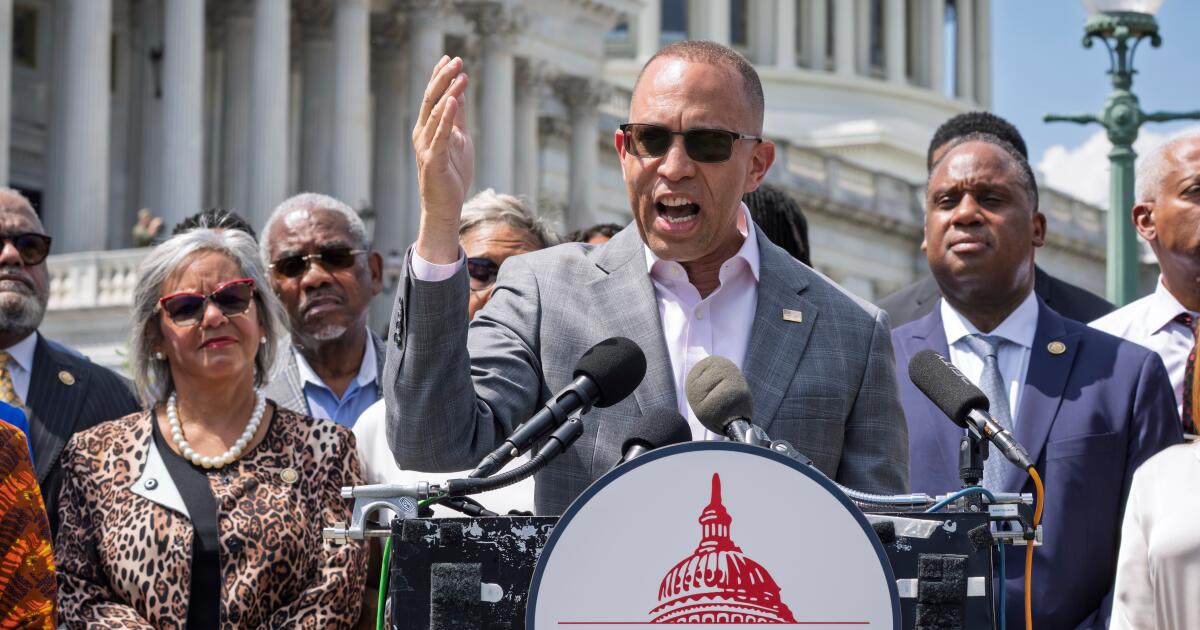
The Congressional Black Caucus on Tuesday called on major corporations across the U.S., including those that previously expressed support for voting rights and racial justice, to oppose redistricting efforts by Republican-led states that seek to eliminate majority-Black U.S. House districts.

In a letter sent to more than 250 companies, members of the Black Caucus urge them to condemn the redistricting efforts, which the lawmakers describe as “coordinated efforts to silence Black voices at the ballot box.” Some of the companies had co-signed their own message to Congress five years ago urging lawmakers to pass the John Lewis Voting Rights Act, a Democratic proposal to restore and update the Voting Rights Act.

That 2021 coalition, Business for Voting Rights, was backed by many of the country’s most valuable and influential companies, including Apple, Amazon, Google, Meta, Microsoft, Tesla, Salesforce, Target, PayPal, Intel and Starbucks.

Tuesday’s letter is the latest effort by the Congressional Black Caucus and its allies to gather support for preventing more Republican-led states from redrawing their legislative maps in ways that would dilute Black political representation. Several states have moved to eliminate congressional districts represented by Black Democratic lawmakers after a U.S. Supreme Court ruling last month that severely weakened a key provision of the Voting Rights Act.

“Corporations that have profited from Black consumers, relied on Black workers, and amassed wealth in part from Black communities cannot look away while Black political power is dismantled in plain sight,” Rep. Yvette Clarke, chair of the Black Caucus, said in an interview.

Clarke described the letter as “putting corporate America on notice,” but she said the caucus was not seeking an adversarial relationship with corporations. Among those receiving Tuesday’s letter were companies based overseas that have a significant presence in the U.S.

The caucus last week called for Black athletes to boycott public universities in states that are gerrymandering their congressional maps to eliminate districts held by Black lawmakers. The 59-member Congressional Black Caucus consists entirely of Democrats, including more than a third from Southern states.

Some lawmakers have said mass protests and federal legislation might be necessary to undo the efforts underway in Republican-led states. Any new federal voting rights law would almost certainly require Democrats to secure majorities in both chambers of Congress and win the presidency.

It is unclear how companies will respond to the demands. The Associated Press was making efforts to contact them.

“Many companies that previously issued statements after the murder of George Floyd, pledged billions toward racial equity initiatives, and spoke forcefully in defense of democracy following January 6 now face a defining test of whether those commitments were rooted in principle or convenience,” the caucus’ letter states.

It also represents the latest instance of the caucus expressing frustrations with corporate America. A 2024 Black Caucus report noted that lawmakers were “troubled that some corporations that made pledges in 2020 have taken several steps in the opposite direction,” such as rolling back or failing to follow through on pledges to diversify their workforces.

“We understand who the occupant in the White House is and the reality of Republicans being in charge,” Democratic Rep. Steven Horsford of Nevada said of the caucus’ message. “But what corporate America also understands is that there will be a shift at some point.”

The letter calls on companies to publicly condemn the redistricting plans, meet with Black Caucus members to discuss corporate America’s role in protecting voting rights and disclose their political donations to Republican politicians in states that are redistricting their congressional maps.

President Trump last year kicked off the unusual mid-decade round of congressional redistricting when he pushed Texas lawmakers to redraw their maps in a way that would add Republican seats. Democratic-led California responded, but it has been mostly Republican states redrawing their lines since as the party tries to maintain its majority in the U.S. House during this year’s midterm elections.

The effort was supercharged by the Supreme Court decision, which allowed even more Republican states to redraw congressional maps that previously had protected minority communities.

Horsford, who chaired the Black Caucus during President Biden’s Democratic administration, said the caucus is demanding that companies “stand on the side of democracy, fairness and equal representation.”

“This is about power, who holds it and what it’s used for,” he said. “And when you’re diluting Black economic and political power, we need to know where these companies stand in this moment, and what side of history they’re on.”

Brown writes for the Associated Press.

Source link

NAACP calls for boycott of Southern college sports programs over voting rights

The NAACP is calling on Black athletes and fans to boycott the athletic programs of public universities in states that are taking steps that the nation’s oldest civil rights group says are restricting Black voting rights.

Launched on Tuesday, the “Out of Bounds” campaign urges prospective Black athletes, their families, alumni and fans to “withhold athletic and financial support” from major public universities in states that “have moved to limit, weaken or erase Black voting representation.”

If Black athletes participate in the boycott, it could deplete rosters for powerhouse football and basketball programs across the Southeastern Conference and Atlantic Coast Conference.

The NAACP is among groups responding to a wave of gerrymandering in the aftermath of a Supreme Court ruling that winnowed a key provision of the Voting Rights Act of 1965.

The boycott comes as civil rights activists have mobilized across the South to protest redistricting plans by Republican state legislatures that eliminate majority-Black congressional districts after the high court’s ruling. Activists have looked for pressure points to dissuade GOP-led states from redistricting maps, including calls for mass protests and economic boycotts.

“Across the South, Black athletes have helped build some of the most profitable college athletic programs in America,” said NAACP President Derrick Johnson. Johnson noted that the programs “generate hundreds of millions of dollars in annual revenue, national television value, alumni donations, merchandising sales, ticket sales, and brand equity — much of it powered by Black football and basketball talent.”

The NAACP’s campaign calls out Alabama, Florida, Georgia, Louisiana, Mississippi, Texas and South Carolina as states to boycott, arguing that the athletic programs of those states’ flagship universities are especially reliant on Black athletic talent and should protect Black political interests.

“Black athletes should not be asked to generate wealth, prestige, and power for state institutions while those same states strip political power from Black communities,” said Johnson.

Black lawmakers themselves are also putting pressure on athletic leagues to take action against Republican-led states that may redistrict longtime Black members of Congress.

The Congressional Black Caucus on Monday sent a letter to the commissioners of the SEC and ACC athletic conferences, as well as NCAA President Charlie Baker, that its members will oppose the SCORE Act, a bill to standardize athletes’ contracting rights across the country, unless conference leaders oppose GOP-led redistricting efforts in states that include major conference members.

“The Congressional Black Caucus believes institutions that profit from Black talent and Black communities have a responsibility to stand with those communities when their fundamental rights are under attack,” the CBC said in a Monday statement. “Silence in the face of injustice is not neutrality — it is complicity.”

Brown writes for the Associated Press.

Source link

The Black Caucus is the ‘conscience of Congress.’ Supreme Court ruling has it bracing for a big hit

Black members of Congress are bracing for a crippling shake-up of their ranks after a Supreme Court ruling gutted a key section of the Voting Rights Act that had protected minority communities in political redistricting and helped boost their representation.

Wednesday’s decision clears the way for Republican-led states to redraw U.S. House districts without regard to race, potentially creating many more GOP-friendly seats.

Rep. Yvette Clarke, chair of the Congressional Black Caucus, told reporters that its members and Democrats would fight the effects of the ruling.

“The Supreme Court has opened the door to a coordinated attack on Black voters across the country,” Clarke said. “This is an outright power grab.”

Under Section 2 of the Voting Rights Act, voters could challenge electoral maps that appeared to dilute the ability of minority communities to elect representatives of their choosing. The expected wave of congressional redistricting by Republican-controlled states after Wednesday’s ruling, especially for the 2028 election and beyond, is likely to result in a much smaller Black Caucus.

Changes are coming, but how quickly is unknown

Clarke was joined by over a dozen of the 60 Black Caucus members, including Democratic House Minority Leader Hakeem Jeffries. Their responses to the court’s decision ranged from outrage to defiance to mourning.

It’s not clear how many seats will ultimately be affected by the ruling, but redistricting experts predict that more than a dozen now held by minorities could be swept away.

Rep. Troy Carter, one of two Black Democrats from Louisiana, the state at the center of the case, called the ruling “a devastating blow to our democracy, plain and simple.”

Republican leaders in several Southern states already have been discussing how to apply the ruling and create new GOP-friendly congressional maps. In Florida, Republicans wasted no time approving a new U.S. House map, part of which redrew one district created to elect a Black representative.

“I would be surprised if we do not see former slave-holding states moving at lightning speed to target districts that provide Black voters and other voters of color an equal opportunity to elect candidates,” said Kristen Clarke, general counsel for the NAACP and the first Black woman to be assistant attorney general in the U.S. Department of Justice’s civil rights division.

It’s not clear whether state-level voting laws or constitutional prohibitions against racial discrimination will provide any protection, she added.

Republican officials and Black conservatives praised the decision as a victory against race-based mandates. Linda Lee Tarver, of the Project 21 Black Leadership Network, said in a statement civil rights laws were not intended “to institutionalize racial line-drawing as a default feature of our political system.”

Voting Rights Act expanded Black representation

The Congressional Black Caucus was formed in 1971 as court-ordered redistricting under the Voting Rights Act, passed just six years earlier, sent more minorities to Congress.

The number of Black representatives in Congress jumped from nine to 13. Shirley Chisholm, the first Black woman elected to Congress, decided to expand the Democracy Select Committee created in the 1960s by Democratic Rep. Charles Diggs into the more formal Congressional Black Caucus.

The CBC raised its profile in its first year when it boycotted President Nixon’s State of the Union address after he refused to meet with the group. Nixon eventually acquiesced. The group created a list of over 60 recommendations to help the Black community, including counteracting racism and building adequate housing. It earned the nickname the “conscience of the Congress.”

“That caucus has had such an important voice in American politics — the things that we’ve been able to achieve together, the creation of equity and access,” Democratic Sen. Raphael Warnock of Georgia said during a separate news conference Wednesday. “And I’m afraid that with this ruling, we could see that caucus shrink in a hugely significant way.”

What can Black constituents do

The ruling upset Thomas Johnson when he heard about it while visiting Louisiana’s Capitol in Baton Rouge. Johnson, who is Black, is from New Orleans and represented by Carter. He fears Republicans could redraw the state’s congressional map in a way that dismantles predominately Black districts.

“I feel like this is an embarrassing attack upon the minorities, particularly the Black community,” Johnson said. “We have very little [voice] in Congress.”

Antjuan Seawright, a Democratic strategist who advises the Black Caucus, said he expects the group will be involved in multiple legal fights for members whose districts will be targeted after the Supreme Court ruling. He also said the ruling makes voter turnout efforts even more important “if we want to change course on some of the things that are likely to happen because of this decision.”

Democratic Rep. Terri Sewell of Alabama, whose state was at the center of a major Voting Rights Act case decided in favor of Black representation nearly three years ago, agreed that the party now needs to focus on getting voters motivated ahead of this year’s midterm elections.

“Now more than ever, we need communities across this nation to mobilize — in state legislatures, in the courts and at the ballot box,” Sewell said. “We need to vote like we’ve never voted before.”

Tang writes for the Associated Press. AP writers Leah Askarinam, Matt Brown and Ali Swenson in Washington and Sara Cline in Baton Rouge, La., contributed to this report.

Source link