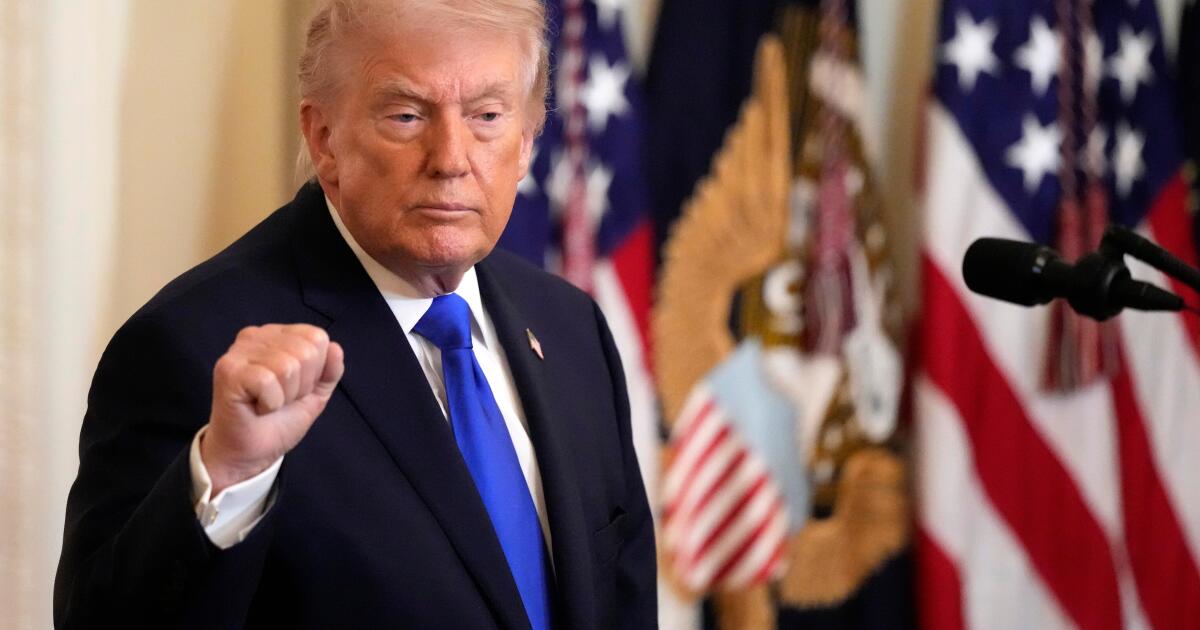
An embattled Trump is set to address a divided Congress
WASHINGTON — President Trump will deliver his annual State of the Union address Tuesday night at a moment of unusual upheaval, confronting a cascade of crises that have left Washington unsettled and his own political standing diminished early in his second term.
When lawmakers gather to hear the president’s agenda for the year ahead, the scene is expected to reflect an undeterred president under increasing political strain.
The president is facing a partial government shutdown triggered by his administration’s aggressive deportation campaign, rising tensions over the United States’ involvement in foreign conflicts and growing domestic dissent that is fracturing the president’s political alliances and aggravating his rivals.
Adding to the turbulent atmosphere is the economic unease in an election year. The president, who a year ago promised to bring down prices for consumers, insisted Monday that America has “the greatest economy we’ve ever had” even though public polling shows economic pressures are worrying a majority of Americans.
Trump said he plans to talk about the country’s economic successes in his speech, saying “it is going to be a long speech because we have so much to talk about.”
Republicans have recently pushed Trump to focus on the push to lower costs, a message they see as crucial to help them keep control of Congress. What remains to be seen is how much of Trump’s economic message will be colored by a Supreme Court decision last week that struck down his use of tariffs, a key portion of his economic agenda. In recent days, the president has remained defiant on the issue, lashing out at the justices for delivering a legal setback on his tariffs, and looking to impose new global tariffs in a different way.
Trump said Monday he does not need to seek congressional approval to impose new levies, even though the nation’s highest court ruled his tariffs cannot stand without the approval of Congress.
“As president, I do not have to go back to Congress to get approval of Tariffs,” Trump wrote on Truth Social. “It has already been gotten, in many forms, a long time ago!”
Trump’s rebuke underscores the president’s increasingly combative posture toward both the judiciary and Congress, at a time when he is heavily relying on his executive authority to advance sweeping policies on immigration, trade and national security.
His willingness to wield executive authority has been seen in the last year as the president led U.S. forces to capture former Venezuelan President Nicolás Maduro, threatened to seize Greenland, considered an attack on Iran and eyed an armed conflict with drug cartels in Mexico.
At home, Trump has said he thinks the federal government should assert control over state elections as he continues to push false claims of a stolen 2020 election.
Whether that will happen remains to be seen as Republican leaders, and other conservative lawmakers, voice opposition to some of the president’s legislative pitches.
In recent months, Congress has tried to reassert its authority over the executive branch — in some cases led by small Republican defections by lawmakers who have grown concerned about the president’s involvement in foreign wars and his economic policies.
One of the most notable rebukes to Trump’s authority occurred late last year, when a bipartisan group of lawmakers secured legislation that forced the Trump administration to release investigative files related to convicted sex offender Jeffrey Epstein.
While Trump maintains the release of those files cleared him of wrongdoing, the findings have so far ensnared key figures in Trump’s political orbit and reinforced a sense of scandal that continues to loom over his administration. Anger over the administration’s handling of the Epstein case has led to bipartisan backlash, even prompting some conservatives to call for U.S. Atty. Gen. Pam Bondi to resign.
Another sign of the polarized moment Trump will face Tuesday night will be led by Democrats.
About a dozen Democrats in the Senate and House of Representatives plan to boycott the president’s speech and participate in what they have dubbed the “People’s State of the Union.”
“I will not be attending the State of the Union,” U.S. Sen. Adam Schiff (D-Calif.) said in a social media video over the weekend. “We cannot treat this as normal. This is not business as usual. I will not give him the audience he craves for the lies that he tells.”
In recent years, lawmakers who wished to disavow the president’s address would typically stand and shout in protest, disrupt the remarks or coordinate outfits to signal their opposition.
In 2020, for example, former House Speaker Nancy Pelosi (D-San Francisco) stood behind Trump at the podium as he delivered his remarks and then shredded a copy of his script. She later called it a “manifesto of mistruths.”
This year, even the president’s allies appear to be on notice.
While it is a long-standing custom for the Supreme Court justices to attend the president’s annual address, Trump told reporters on Friday that the six justices who voted against his tariffs policy were “barely” invited to the event.
“Three of them are invited,” he said.
Trump’s State of the Union remarks will be dissected to see how he intends to advance his agenda and to deal with a divided Congress that remains at a standstill over how to fund the Department of Homeland Security.
The partial government shutdown was triggered by partisan tensions over Trump’s aggressive immigration crackdown in Minneapolis, where two U.S. citizens were shot and killed by federal agents.
At a White House event Monday, Trump lamented that public polling shows waning support for federal immigration agents.
“It just amazes me that there is not more support out there,” Trump said. “We actually have a silent support, I think it is silent.”