UCLA gymnastics focuses on staying calm, confident at NCAA regionals
The UCLA women’s gymnastics team enters the NCAA regionals on Friday in Corvallis, Ore., focused on three principles — calm, confidence and commitment to one another. The Bruins started leaning on the mantra to help them stay dialed in as they took home the Big Ten tournament title, Mika Webster-Longin said.
Now, they will use it as they to push to reach the NCAA championship.
“The Big Ten win really feels good and helps our confidence going [into NCAA regionals],” she said. “It felt great to put everything together because I feel like we really built off of one another and showed what we can do to not only the Big Ten competition, but to everyone.”
“It gives us just the right amount of confidence going into regionals and then seeing where it takes us,” Tiana Sumanasekera said.

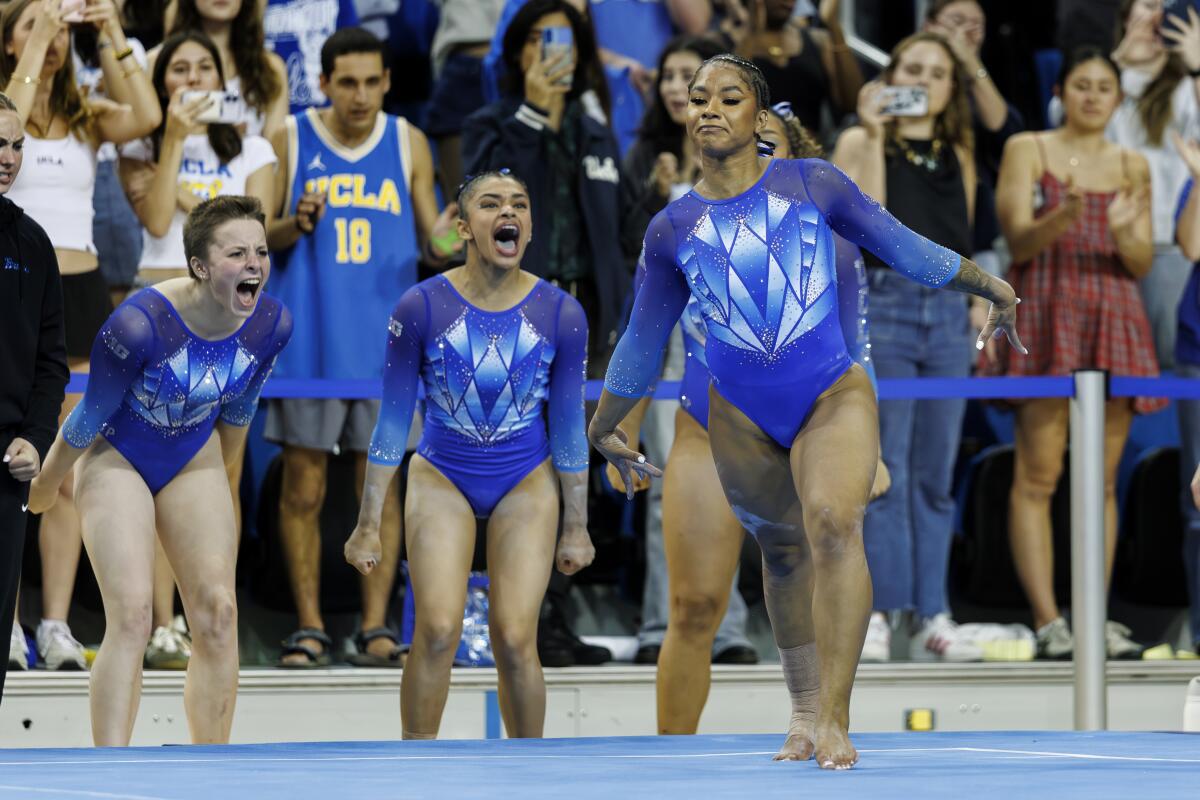
UCLA gymnasts Nola Matthews, left, and Tiana Sumanasekera, right, cheer as Jordan Chiles lands a jump during her floor exercise routine at Pauley Pavilion on Jan. 17.
(Gina Ferazzi / Los Angeles Times)
During the NCAA Corvallis Regional, San José State and Washington will face off for spots in the main pool. No. 4 seed UCLA then competes in one of two sessions on Friday at 7 p.m. against No. 13 seed Minnesota, Iowa and the winner of the Spartans versus Huskies early matchup.
If the Bruins place in the top two, they advance to the regional final on Sunday to face the top two teams in the other regional pool that includes No. 5 seed Alabama, No. 12 seed Utah, Denver and host Oregon State.
The top two teams in the regional final along with the top individual all-around performer and top event finishers not on a qualifying team advance to the NCAA championship.
Last year, UCLA finished in first place during its opening regional matchup and second during the finals, advancing to the championship meet.
The Bruins’ biggest takeaway from last season’s competition has been to be intentional, attack their gymnastics and be aggressive with their routines, UCLA coach Janelle McDonald said.
“The best teams that have the most success at these competitions are the ones that really leave no doubt out there,” she said.
At this point in the season, performing a familiar routine isn’t hard for UCLA. The Bruins’ main focus is on nailing details and to be present during every moment of their routines to score every possible point. With a two-day competition waiting for them in Corvallis, the Bruins also need to make sure they commit to recovery treatment so that they’re as sharp as possible for the second day of competition, McDonald said.
“That’s really been our mentality, be really efficient, very confident, very present and intentional about what we’re doing,” she said.
The stakes are higher, but the conference champions say they will treat this as business as usual. The Bruins want to lock in and highlight the areas that have helped them demonstrate competitive greatness throughout the season.
“Each and every weekend we’re building that mentality,” McDonald said. “We have so many experiences under our belt that we’ve learned from.”
Sumanasekera said hard work all season has helped prepare the team for the test it faces this weekend.
“We’re really excited, we have incredible depth on this team, so I think that really helped us in the long run,” she said.

UCLA teammates cheer as gymnast Jordan Chiles completes her floor routine during the Big Four competition at Pauley Pavilion on Feb. 27.
(Etienne Laurent / For The Times)
Webster-Longin experienced the postseason last year as a freshman. This year, she had a late start due to an illness that kept her out for three meets.
Since returning on Feb. 27, she has competed in all-around events during the last three meets and has improved her scores each week.
That was the moment Webster-Longin remembered just how competitively great she is, McDonald said.
“I’ve seen the details become more consistent, and I’ve just seen her just be excited to go out and help the team in any way they need,” McDonald said, “And boy, has she done just that.”
Webster-Longin was asked to fill in as an emergency injury replacement during her first meet of the season and has figured out how to be successful whenever she’s placed in the lineup.
“At least for me, trusting the work I put in this year and even the experience I’ve had last year helped me be able to step up for those pressure situations and important moments,” she said.
Alipio has turned the page

UCLA gymnast Ciena Alipio celebrates after competing on the uneven bars during the Big Four meet at Pauley Pavilion on Feb. 27.
(Katharine Lotze / Getty Images)
During the Big Ten championship, Ciena Alipio fell during her balance beam routine. It was a moment when she was looking forward to doing her best, McDonald said, but Alipio didn’t have the result she wanted. Instead, it was a great lesson for her to learn — mistakes happen.
“She’s just really been able to turn the page and get back into training,” she added. “She’s had a great week of training. She looked phenomenal and just really dialed in and it kind of put those kinds of mistakes behind you.”