



condition

Supreme Court will hear Trump’s bid to end legal protection for up to 1.3 million immigrants

The Supreme Court will hear arguments this week over whether the Trump administration may revoke temporary protected status for about 350,000 Haitian and 6,100 Syrian immigrants.

TPS allows people who are already in the United States to legally reside and work here if they are unable to safely return to their home country because of a sudden emergency such as war or a natural disaster. The humanitarian program, enacted by Congress in 1990, has since been used by Republican and Democratic administrations alike.

Since President Trump returned to office last year, his administration has terminated such protections for immigrants from 13 countries. Court challenges on behalf of Haitians and Syrians have been consolidated into a single case, Mullin vs. Doe, which the justices will hear Wednesday.

The high court’s ruling could eventually have sweeping repercussions for all 1.3 million immigrants from the 17 countries that were designated for TPS at the start of this administration. That’s because the federal government is arguing that decisions regarding the program are almost entirely immune from review by courts.

“Temporary means temporary and the final word will not be from activist judges legislating from the bench,” a Department of Homeland Security spokesperson, who did not provide their name, wrote in response to a request for comment.

Lower courts have repeatedly deemed the administration’s actions improper.

“We’re seeing clear gamesmanship from government to insulate all TPS decision-making from any oversight,” said Emi MacLean, a senior staff attorney at the American Civil Liberties Union of Northern California, who is counsel in the case for Syrians and in other cases challenging five of the terminations. “They’ve created a farce of a process to justify the ends that they sought, which was to strip humanitarian protections from over a million people.”

In the Trump administration’s appeal, Solicitor Gen. D. John Sauer argued that Congress gave the Homeland Security secretary the power to grant or end the temporary protected status for troubled countries and barred judges from intervening.

He pointed to a provision that says: “There is no judicial review of any determination of the [secretary] with respect to the designation, or termination or extension of a designation, of a foreign state.”

Citing this hands-off provision, Trump’s lawyers won brief emergency orders last year that allowed the administration to strip legal protections from about 600,000 Venezuelans. In that case, then-Homeland Security Secretary Kristi Noem had quickly reversed an extension granted by the Biden administration three days before Trump was sworn in.

The circumstances surrounding the Syria and Haiti cases are different. Advocates for the immigrants argue that the administration failed to conduct the required process to properly evaluate each country’s conditions.

They point to emails in July from a Homeland Security official to a State Department official. The Homeland Security official listed TPS designations coming up for review — Syria, South Sudan, Myanmar and Ethiopia. In response, the State Department official wrote: “I confirm that State has no foreign policy concerns with ending these TPS designations.”

State Department travel advisories for both countries warn people against traveling to either because of the risk of terrorism, kidnapping and widespread violence. U.S. citizens are advised to prepare a will.

For Syria, the advisory cites active armed conflict since 2011. For Haiti, it says the country has been under a national state of emergency since March 2024.

But Federal Register notices announcing the terminations said country conditions had sufficiently improved. The notice for Syria, for example, says “the Secretary has determined that, while some sporadic and episodic violence occurs in Syria, the situation no longer meets the criteria for an ongoing armed conflict that poses a serious threat to the personal safety of returning Syrian nationals.”

If the government loses, Homeland Security officials would have to reevaluate the TPS decisions in consultation with the State Department and make a decision based entirely on the country conditions themselves.

The government could start over, in that case, and still find that TPS is no longer warranted — if the process bears that out.

In a friend-of-the-court brief led by immigration law scholars at Georgetown and Temple universities, they explained that before TPS existed, similar forms of humanitarian relief were determined by the executive branch “without reference to any statutory criteria or constraints, and with little if any explanation for why nationals of certain countries received protection while others did not.”

With TPS in 1990, Congress sought to end that “unfettered discretion,” they wrote. Instead, the statute requires the Homeland Security secretary to terminate TPS if the review finds that conditions justifying the designation no longer exist. Otherwise, the law states, it “is extended.”

“The point of the TPS statute was to depoliticize humanitarian decisions,” said MacLean, the ACLU attorney. “Secretary Noem in all of her TPS decisions has completely undermined that fundamental goal.”

Ahilan Arulanantham, who is arguing for the Syria case on Wednesday, added that if the government wins, “it also means they could probably grant TPS to countries that don’t deserve it.” Arulanantham, co-director of the Center for Immigration Law and Policy at UCLA, has represented the National TPS Alliance in separate litigation during this administration and Trump’s first.

Top Homeland Security and State Department officials from the George W. Bush, Obama, Trump and Biden administrations filed a brief arguing that the Trump administration’s terminations of TPS for Syria and Haiti were “not based on evidence and sharply departed from past inter-agency practices.”

Haiti was originally designated for TPS in 2010 after a massive earthquake devastated the country and redesignated because of subsequent natural disasters and gang violence. In November, Noem announced that she would terminate TPS for Haiti, effective Feb. 3. She wrote in the Federal Register that “there are no extraordinary and temporary conditions in Haiti” that prevent Haitians from safely returning.

But even if there were, she continued, “termination of Temporary Protected Status of Haiti is still required because it is contrary to the national interest of the United States.”

The Homeland Security spokesperson said TPS for Haiti “was never intended to be a de facto amnesty program, yet that’s how previous administrations have used it for decades.”

Syria, meanwhile, “has been a hotbed of terrorism and extremism for nearly two decades,” the spokesperson wrote, “and it is contrary to our national interest to allow Syrians to remain in our country.”

In the Federal Register notice for Syria, Noem added that maintaining its TPS designation would “complicate the administration’s broader diplomatic engagement with Syria’s transitional government” by undermining peace-building efforts.

The Supreme Court will take up the question of whether the Homeland Security secretary can use national interest as a reason to revoke TPS. Attorneys for the TPS holders believe any decision to revoke TPS must come down to the country conditions alone.

Syria and Haiti are among the countries for which the Trump administration has also paused processing all immigration benefits. If their TPS protections expire, those immigrants would become vulnerable to detention and deportation even if they are eligible for other forms of relief.

U.S. Solicitor Gen. D. John Sauer attends a press briefing at the White House.

U.S. Solicitor Gen. D. John Sauer argued that Congress gave the Homeland Security secretary the power to grant or end the temporary protected status for troubled countries and barred judges from intervening.

(Aaron Schwartz / Getty Images)

Attorneys for the TPS holders say the terminations were also driven by racial animus. They point to various statements by Trump over the years, including his false claim that Haitians were eating the pets of people in Springfield, Ohio, that they “probably have AIDS” and that Haiti is among the “shithole countries” from which he would permanently pause migration.

Among those affected is a 35-year-old Haitian woman who has lived in the U.S. since 2000 and is raising her four U.S. citizen children in a Southern state. The woman requested to be identified by her middle and last initials, B.B., out of concern for her immigration case.

After graduating high school, B.B. got into nursing school but couldn’t attend because she didn’t qualify for financial aid. She said later getting TPS allowed her to become a certified nursing assistant, and she now works as a medical coordinator while owning a nail salon and three real estate properties.

Though B.B.’s TPS remains active because of the court proceedings, her driver’s license expired Feb. 3 and she has since had to rely on friends and rideshares to get around while repeatedly requesting a renewal.

She said she worries most about her children. If she were deported back to Haiti, she said, she would leave them in the U.S. for their own safety.

“It’s like planning your death,” she said. “I’m 35 and I already have a will — not because I’m going to die but because of the situation.”

On a call with reporters, attorneys and advocates, a Syrian man said he earned his master’s degree in the U.S. and now works in the healthcare industry. The man, who was identified by a pseudonym, said he and his wife are afraid of what their future will look like.

“TPS gave us something we had not had in years: a place to settle and a moment to grieve,” he said, later adding that “telling Syrians to go back right now is not a policy — it’s abandonment.”

Among the public, there is broad support for TPS and other humanitarian programs. According to a poll conducted last month by the firm Equis Research, 68% of Latino and 65% of non-Latino voters support fighting to give back legal protection to those who have lost their temporary protected status or asylum protections as a result of the current administration’s actions.

Earlier this month, the House voted in favor of a bill that would require new Homeland Security Secretary Markwayne Mullin to redesignate Haiti for TPS. Among those who crossed the political aisle to support it were 10 Republicans and Rep. Kevin Kiley, an independent from Rocklin, Calif., who caucuses with Republicans. The measure faces an uphill battle in the Senate.

In an interview with The Times, Kiley said his vote was about common sense and being humane.

“It’s particularly dangerous for people that would be returning where the gangs that are ravaging the country are just lying in wait outside the airport in Port-au-Prince,” he said, referring to the Haitian capital.

And because most won’t return willingly, Kiley added, “really all you’d be doing is removing work authorization from 350,000-some people who are going to mostly remain in the country, who will not be able to work anymore and may end up being more reliant on public assistance in states where they’re eligible.”

At the same time, Kiley said, the TPS system hasn’t worked as intended because most so-called temporary designations drag on.

“The system needs to be reformed,” he said. “But that’s all separate and apart from what we do with the folks who were already given this designation.”

Times staff writer David G. Savage in Washington contributed to this report.

Source link

First Dates star’s ‘isolating’ condition that left her in and out of hospital

First Dates returns to Channel 4 tonight with more hopeful singles looking for love

First Dates: Girl discusses her cystic fibrosis condition

One First Dates star opened up on her incurable condition that left her living in fear of illness.

A First Dates star was informed she wouldn’t survive beyond the age of 16 following a diagnosis with an “isolating condition”.

The BAFTA-winning dating programme is scheduled to return for a brand new series tonight (Friday, 10th April), tracking singletons searching for romance as they embark on their first date at an upmarket restaurant in Bath.

Making its comeback to Channel 4 with its opening episode tonight at 10pm, the optimistic singles remain unaware of who their prospective match might be as they meet for the first time at the restaurant, overseen by French maître d’ Fred Sirieix and his team.

Featuring awkward encounters and flourishing romantic connections, the programme has become enormously popular with audiences since it initially premiered in 2013.

This evening’s episode will feature a yoga teacher meeting a mindfulness coach, alongside a former Lioness turned firefighter, reports OK!.

A synopsis states: “First Dates returns with a brand new series as Fred and the team match hopeful singles looking for love. From a yoga Instructor and a mindfulness coach navigating an age gap to a returning dater hoping for a better chance, sparks are flying.”

It continues: “A former lioness meets a cat lover, and a doctor faces her nerves with a self confessed geek searching for the one.”

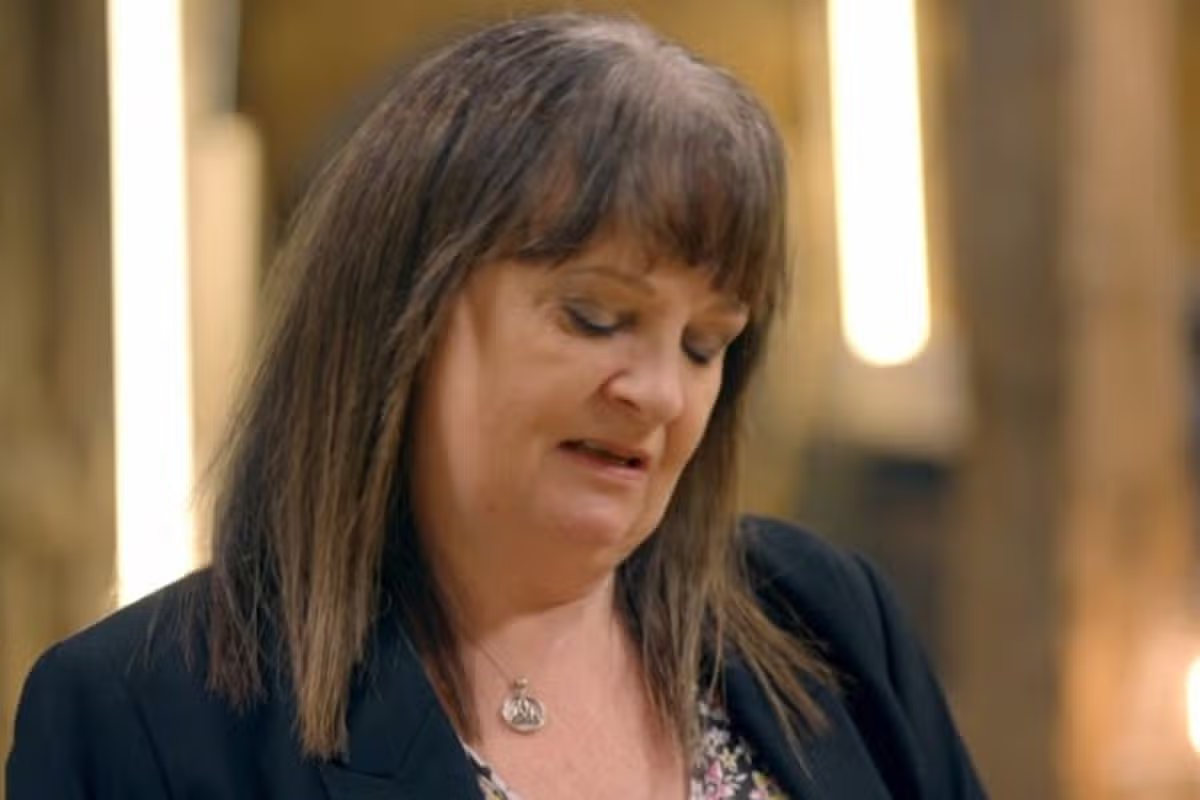
During the episode, one First Dates star revealed details about a degenerative condition which led her parents to be told she wouldn’t survive past 16. Briefly pausing her date, 27 year old Nicole from East Sussex informed 24 year old Matthew she needed to take some medication before revealing: “I actually have cystic fibrosis. It’s a life long condition, you’re born with it, there’s no cure.”

Nicole continued to explain she had been a healthy child until the age of seven before experiencing a chest infection that persisted for three years, while being admitted to hospital every three months.

Characterising it as an “isolating condition”, the 27 year old said she would consume 30 tablets daily, living with the anxiety of contracting an illness.

Speaking to producers, the First Dates star revealed: “My parents were told that I would only live until I was 16. I think I have mentally blocked it out as a way of coping.”

Nevertheless, in encouraging news, Nicole shared with her date: “In 2020 this brand new modulator therapy came about and it was a big turning point to me, touch wood I have been pretty well ever since. Last year I started paying into a pension.”

Meanwhile, one Lioness-turned-firefighter became emotional during her date. Abbie, 32, from Manchester, was matched with 27 year old dental nurse Charlotte as they quickly began discussing their professions.

Abbie disclosed she had been a firefighter for one year, but previously had been a footballer for Manchester City, Manchester United and Leicester – even representing England.

However, she became tearful as she revealed that a tragic accident, which resulted in her breaking her leg, marked the end of her football career. She confided to producers: “It ended my career, which was heartbreaking. I’m going to get upset now… sorry.”

First Dates returns to Channel 4 tonight at 10pm.

Source link

Young immigrants face concerning conditions at Texas site, lawyers say

Nearly 600 immigrant children were held in a Texas family detention center in recent months without enough food, medical care or mental health services, as their time inside stretched beyond court-mandated limits, according to court documents.

Children and families held at the detention facility in Dilley, where 5-year-old Liam Conejo Ramos and his father were sent this year, also faced virus outbreaks and lasting lockdowns in December and January, although the total number of children held there has fallen in recent weeks, according to the attorney reports and site visits.

The case of Liam, a preschooler who was wearing a blue bunny hat and Spider-Man backpack when he was picked up in Minnesota by U.S. Immigration and Customs Enforcement agents, stoked protests over the Trump administration’s immigration crackdown, including among detainees who gathered and held up signs in the yard behind the Dilley facility’s chain-link fences.

Last week about 85 children remained detained at the Dilley facility, but concerning conditions continued, said Mishan Wroe, directing attorney at the National Center for Youth Law, who visited in mid-March. In early February, a legal advocate for the children observed about 280 children.

The filings Friday cited numerous poignant cases, including that of a 13-year-old girl held at Dilley who tried to take her own life after staff withheld prescribed antidepressants and denied her request to join her mother, as reported by the Associated Press. The government reported there had been “no placements on suicide watch,” according to the filing. The AP obtained Dilley facility discharge documents that described a “suicide attempt by cutting of wrist” and “self-harm.”

The filings were submitted in a lawsuit launched in 1985 that led to the creation in 1997 of court-ordered supervision of standards and eventually established a 20-day limit in custody. The Trump administration seeks to end the Flores settlement, as it is known.

“For years, the Flores consent decree has been a tool of the left that is antithetical to the law and wastes valuable U.S. taxpayer funded resources,” the Department of Homeland Security said in a statement. “Being in detention is a choice.”

Attorneys for detainees highlighted the government’s data showing longer custody times for immigrant children, and also cited worms in food and poor access to medical care or sufficient legal counsel as reported by families and monitors at federal facilities.

“Dilley remains a hellhole,” said Leecia Welch, the chief legal director at Children’s Rights, who visits the center regularly to ensure compliance. “Although the number of children has decreased, the suffering remains the same.”

The Homeland Security spokesperson said the Dilley facility is retrofitted for families, who receive basic necessities including adequate food and water while in detention, and the Trump administration is working to quickly deport detainees.

A report from U.S. Immigration and Customs Enforcement showed that about 595 immigrant children were held in custody for more than the 20-day limit in December and January, with some stretching into months, per the court filings.

“Approximately 265 of these children were detained for more than 50 days and a shocking 55 children were detained more than 100 days,” the filings state.

That is up from a previous government disclosure late last year that showed that from August to September, 400 children had been held at the Dilley facility beyond the 20-day limit. Homeland Security did not respond to questions seeking comment on the data.

Chief U.S. District Judge Dolly Gee of the Central District of California is scheduled to hold a hearing on the case later this month.

Burke writes for the Associated Press.

Source link

Nicholas Brendon, star in ‘Buffy the Vampire Slayer,’ dies at 54

Nicholas Brendon, best known for portraying the loyal, wisecracking Xander Harris in “Buffy the Vampire Slayer,” died Friday from natural causes after dealing with a congenital heart defect and other health issues in recent years. He was 54.

His family shared news of his passing in a statement posted on the actor’s social media accounts. While it’s “no secret Nicholas had struggles in the past,” they said, he was on medication to manage his diagnosis and “optimistic about the future” at the time of his death.

His siblings and parents asked for privacy as they grieve the loss of “a man who lived with intensity, imagination, and heart.”

“He was passionate, sensitive, and endlessly driven to create,” the family stated. “Those who truly knew him understood that his art was one of the purest reflections of who he was.”

Brendon was born in Los Angeles in 1971 and began his acting career in the mid-’90s. He got his big break in 1997 when he was cast as Harris in “Buffy.” Over the show’s seven-season run, Brendon became a central figure, portraying the witty, insecure but dependable “everyman” in the gang’s battles against the forces of darkness.

He starred in his first feature film, “Psycho Beach Party,” in 2000, playing the love interest Starcat in the indie flick that’s now regarded as a cult classic.

After “Buffy” ended in 2003, Brendon continued working in television, making appearances on series such as “Without a Trace,” “Private Practice,” and “Kitchen Confidential.” He also played a recurring role as FBI technical analyst Kevin Lynch on “Criminal Minds.”

In 2022, his family shared that he had been rushed to the hospital because of tachycardia, a condition that makes the heart beat abnormally fast, and had been diagnosed with a congenital heart defect that is common in twins. Brendon has an identical twin brother named Kelly Donovan, who appeared as his stand-in and double in episodes of “Buffy.”

The “Criminal Minds” star also underwent multiple spinal surgeries to manage cauda equina syndrome, a rare condition in which nerve bundles in the lumbar or sacral spine are compressed or not functioning properly. His serious spinal injury was triggered by a fall in 2021, which required emergency surgery to prevent paralysis, his manager Theresa Fortier said in a statement at the time.

In recent years, he developed a love for painting and the arts and enjoyed sharing his emerging talent with family and friends, his family said.

Former Times staff writer Nardine Saad contributed to this report.

Source link

Sheriff asks federal agency to review L.A. jails after inmate deaths

Sheriff Robert Luna has asked the National Institute of Corrections to examine conditions and practices at Los Angeles County jails, a request made after 10 inmates died in jail custody in less than three months.

The request comes amid growing concern over conditions inside county lockups. In September, California Atty. Gen. Rob Bonta sued the Sheriff’s Department over what he called “unsafe and unconstitutional conditions at county jails.”

Luna has also faced questions from the Sheriff Civilian Oversight Commission over health conditions, health access, drug use, and other factors that have led to in-custody deaths.

Now, the Sheriff’s Department is asking the National Institute of Corrections to conduct a comprehensive review of county jails in an effort to reduce the number of deaths, Luna told The Times.

“I want someone to come in and review from top to bottom,” Luna said.

Specifics on when the review would begin, and what it would entail, have not yet been set, but Luna said the aim is to get an outside, “unbiased view.”

Officials with the National Institute of Corrections referred questions to the federal Bureau of Prisons, its parent agency, which did not respond to a request for comment.

The National Institute of Corrections provides state, local and federal resources and guidance.

The agency, according to its site, provides “on site technical assistance” to jail administrators, and also helps to identify “gaps in policy and practice.”

The review, Luna said, would entail “everything we’re doing from policy, procedure, facilities, to make sure we’re not missing anything,” Luna said.

Inmate deaths have raised concerns among top sheriff officials and agencies charged with overseeing sheriff operations. The department saw 46 in-custody deaths in 2025, a steep increase from the 32 reported in 2024.

In-custody deaths are reviewed by the Office of Inspector General and the U.S. Department of Justice.

Bonta’s lawsuit against the Sheriff’s Department, filed in September 2025, alleged inmates were being “forced to live in filthy cells with broken and overflowing toilets, infestations of rats and roaches, and no clean water for drinking or bathing.”

In a statement, Bonta’s office alleged that a lack of access to healthcare in the jails, and conditions inside, contributed to a “shocking rate of preventable in-custody deaths, such as suicides.”

In a previous interview, Luna referred to the spate of death at the start of the year as a “kick in the groin.”

Efforts to reduce deaths are challenging partly because the inmate population inside the jails has been increasingly older, and ill, Luna said, with many of them suffering from drug addiction or long-term conditions.

About 82% of those in custody disclosed at least one medical or mental health issue when booked, officials said.

According to department data, half of the 46 inmate deaths recorded in 2025 were listed as natural. Autopsy results to determine the causes of death are still pending in this year’s cases.

Luna has pointed to changes that have already been made as efforts to improve conditions, including deploying body-worn cameras at the Inmate Reception Center, Men’s Central Jail and Twin Towers Correctional Facility.

The department has also opened a remodeled mental health assessment area at the Inmate Reception Center, the primary intake and release point for county inmates near Men’s Central Jail.

Source link