Condemnation

MLB’s Pride Night cap condemnation is not an anti-Christian crackdown

Amid the first days of grief after Alex Vesia and his wife lost their newborn daughter last fall, Vesia noticed something as he watched the World Series on television. He paused the broadcast, then checked the video, then texted another player to make sure.

51.

Dodgers teammates wore his number on their caps. So did players from the Toronto Blue Jays.

“It was awesome,” Vesia said. “It was a very heartwarming moment.”

Moving.

Touching.

And, under baseball’s rules, illegal.

Who knew, really, until this week? Three pitchers from the San Francisco Giants wrote the name of a Bible verse on their Pride Night caps and, amid an uproar, Major League Baseball said it had warned the players that “writing of any kind, with any message” on any playing apparel is not permitted. The issue, the league said in a statement, was not what they wrote on their caps but simply that they wrote on them at all.

Said MLB in the statement: “We have given the same warning numerous times in the past to players for messages such as ‘Dad’, ‘Happy Mother’s Day, I Love Mom’ and names of family members.”

To its credit, the league did not enforce the rule when Vesia’s number started appearing on caps in the World Series. But, if you’re going to draw a line on enforcement, where should you draw it?

In San Francisco, the actions of the Giants’ pitchers were widely condemned.

“They were in for a rude awakening with the response, and it wasn’t just from the gay community,” Giants broadcaster and former pitcher Mike Krukow told KNBR, the team’s flagship radio station. “It was from the Northern California community that supports the gay community.”

In response to media inquiries, and as first reported by Outsports, MLB confirmed it had warned the three players. I asked the league whether warnings had been issued in two other instances in which players had written on their caps, including Clayton Kershaw last year writing the same Bible verse on his Pride Night cap that the Giants’ pitchers wrote this year. MLB declined to comment.

“I got chastised by the league when I put Charlie [Kirk]’s name on my hat last year, because a man was murdered in cold blood,” Dodgers pitcher Blake Treinen told me, “and now these gentlemen who are relievers in San Francisco are getting chastised by the league for putting a Bible verse on their hat. It’s crazy to me.”

Treinen said league officials had told him the rule is strictly enforced.

“I straight up asked Clayton last year, ‘Did they call you when you put that on your hat?’” Treinen said. “He said, ‘No.’”

The Pride caps feature team logos decorated in the colors of the rainbow, a symbol long associated with the gay community. In the Bible verse cited by the pitchers (Genesis 9:12-16), the rainbow represents “the everlasting covenant between God and all living creatures.”

That the league would warn players against writing a Bible verse on their caps ignited a wave of conservative outrage, from Vice President JD Vance to Texas Gov. Greg Abbott.

Missouri Sen. Josh Hawley fired off a letter to MLB commissioner Rob Manfred, alleging apparent discrimination “against baseball players who profess their Christian faith” and threatening the league’s antitrust exemption. Assistant U.S. Atty. Gen. Harmeet Dhillon said on national television that players might be able to file a claim for employment discrimination.

That is complete nonsense. This is what you want: When employees raise an issue to their employer, the employer listens and addresses their concerns.

In 2023, the year after five Tampa Bay Rays players declined to wear rainbow logos for Pride Night, Manfred said the league would no longer compel players to do so.

“We have told teams, in terms of actual uniforms, hats, bases that we don’t think putting logos on them is a good idea just because of the desire to protect players: not putting them in a position of doing something that may make them uncomfortable because of their personal views,” Manfred said then.

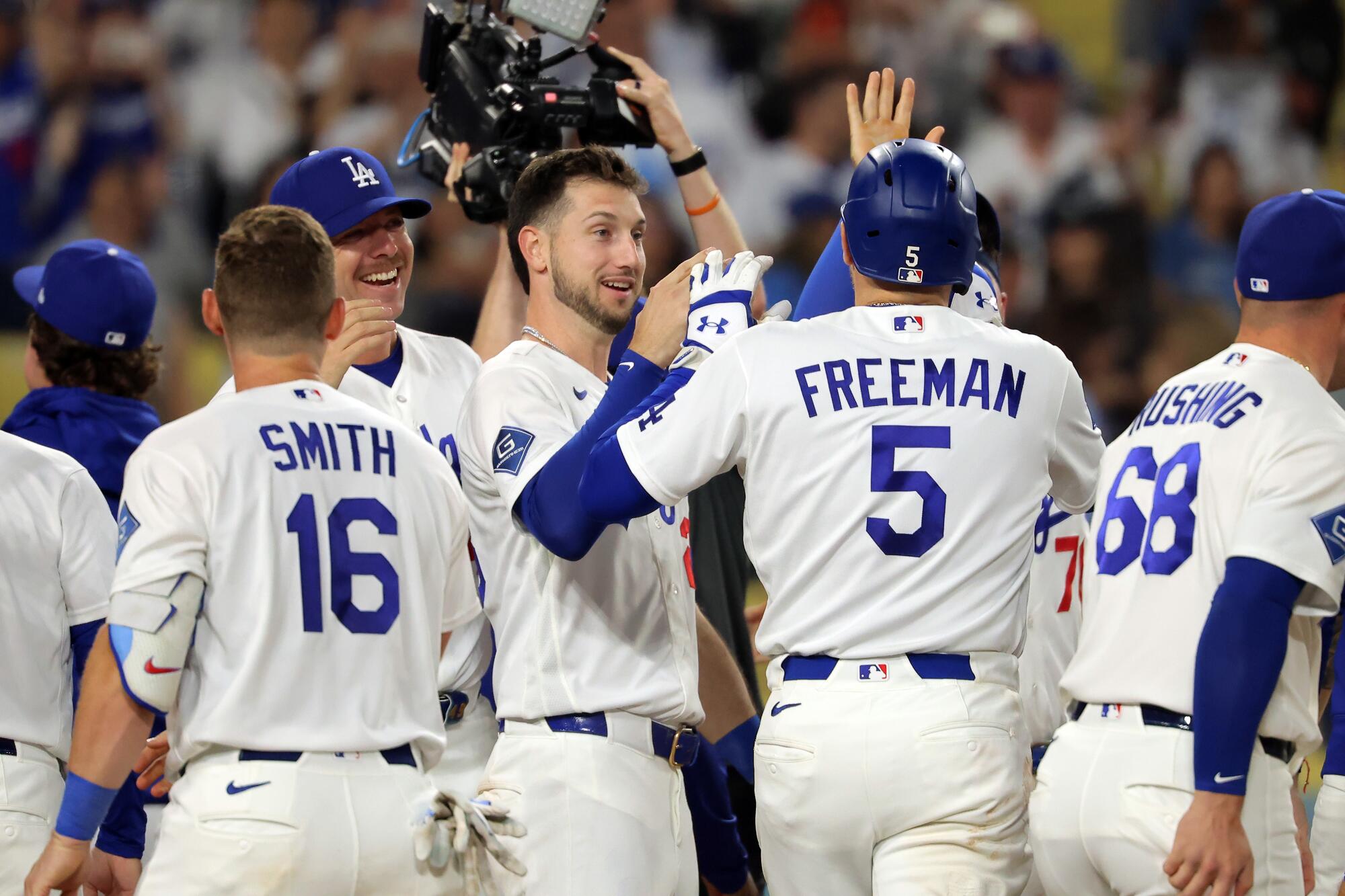
Dodgers teammates congratulate Freddie Freeman after his walk-off home run.

Teammates congratulate Freddie Freeman after his walk-off home run gave the Dodgers a 1-0 win on June 5, when the Dodgers held their annual Pride Night. Blake Treinen, the winning pitcher that night, elected to wear his regular Dodgers cap instead of the Pride version.

(Katelyn Mulcahy / Getty Images)

Manfred said the Pride Night celebrations could go on, however a team wished to stage them — or not, in the case of the Texas Rangers, the only one of the 30 MLB teams that declines to hold a Pride Night. And the league still sells Pride gear on its website for all teams, including the Rangers.

In the cases of the Giants and Dodgers, MLB grandfathered each team’s long-running use of a rainbow logo on the cap, with this accommodation to players: If you don’t feel comfortable wearing the Pride cap, just wear your regular cap.

That is what Treinen and outfielder Alex Call did when the Dodgers celebrated Pride Night. That is also what a fourth Giants pitcher did.

“My job is to abide by the rules,” Treinen said. “Ultimately, the only rule we have is to wear our team-issued uniform. So that’s what I chose to do.”

To Treinen, the decision over whether to wear a Pride cap is not about passing judgment on anyone else but about what he sees as the push “to force something on people that you know that is controversial to their faith — and, in fact, straight up against their faith.”

He expressed his support for the Giants pitchers.

“Kudos to those men over there who are standing strong in their faith,” he said. “It’s a sad thing to corner someone and try to make them feel bad about their convictions.”

I respect Treinen for explaining his viewpoint. To me, wearing a Pride cap for one night does not diminish your faith at all. It might sharpen your convictions. More important, it signals a welcome to everyone in the community that buys the tickets and broadcast subscriptions that help pay your salary.

“I think a few people made it about themselves and not about the community,” San Francisco Mayor Daniel Lurie told the Bay Area Reporter.

We always proclaim the life lessons of sports. One of them: Sometimes you have to put the team’s interests ahead of your own.

Source link

‘Badge of honour’: Israeli settlers shrug off global condemnation | Occupied West Bank News

When the European Union issued its latest tranche of sanctions against Israeli settler groups and their leaders, Regavim, founded in part by the country’s Finance Minister Bezalel Smotrich, these groups welcomed the measures as a “badge of honour.”

Another sanctioned figure, Daniella Weiss, whose movement, Nachala, has held conferences on the Gaza border to discuss plans for settlement expansion into the occupied Palestinian territory, likewise dismissed the European penalties as “ridiculous” and “banal”.

Recommended Stories

list of 4 itemsend of list

In total, the EU sanctioned four entities and three individuals associated with the settler movement, which includes high-profile characters such as Weiss, Regavim and its director, Meir Deutsch, and the Amana cooperative association, which offers logistical and financial support to settlements in the occupied West Bank.

Even government figures have been targeted in recent Western actions. Finance Minister Bezalel Smotrich, a son of the settler movement, was sanctioned by the United Kingdom, Canada and several other countries for his alleged role in supporting or enabling violence in the West Bank, highlighting how the settlement project has the support of the highest echelons of the Israeli state.

Overall, the nonchalant response from the targeted figures and entities suggests that none of the EU measures will do anything to stop settlement expansion or make individuals accountable for the growing wave of violence against Palestinians.

Ironically, the largely toothless measures might instead become a source of domestic prestige for their leaders, analysts say, as few would expect these hardline settler figures to spend their summers in Paris or London and thus be affected by the sanctions. Instead, a wave of terror in the occupied West Bank will likely continue, with the tacit support of the government.


Endemic violence

In the eyes of many activists and observers who spoke to Al Jazeera, the EU’s focus on group and individual “violations” falls far short of articulating the scale of the highly coordinated settler attacks or the extent to which the state and society support them.

Following the Hamas-led attack of October 2023, United Nations and human rights monitors have documented systemic lethal settler attacks in places such as the South Hebron Hills, where residents of villages like Susiya and Umm al-Khair have been killed or seriously injured in collective incursions.

In the northern West Bank, Palestinian residents of villages around Nablus and Ramallah have seen their homes, vehicles and olive groves torched during nighttime settler raids. Entire Bedouin herding communities in the Jordan Valley have also been forcibly displaced following sustained campaigns of intimidation and violence.

All of this underscores the depth and breadth of settler activity, which, according to people on the ground, has the direct support of the Israeli government.

“It’s gotten much worse since October 2023. They now have the courage to attack into the heart of densely populated Palestinian villages. I see them, they came into the heart of my village outside Ramallah, they feel safe to do so,” Tahseen Alayan, deputy director of Al-Haq, told Al Jazeera.

“If you buy a sheep, they will steal it. If you build a house, they will destroy it. If you buy a car, they will burn it.”

BE'ERI, ISRAEL - OCTOBER 21: Daniella Weiss, founder of the Nachalot Association, attends the Jewish religious holiday of Sukkot (Feast of Tabernacles) activities, where activist Jewish people set up numerous gazebos in the area as a tradition in Be'eri, Israel on October 21, 2024. Israelis and far-right politicians are demonstrating demanding the expulsion of Palestinians from the Gaza Strip and the reopening of settlements there, while others dream of invading many countries in the region in pursuit of “Greater Israel”. ( Enes Canlı - Anadolu Agency )
Daniella Weiss, founder of the Nachalot Association, described the EU sanctions as “ridiculous” and “banal” [Enes Canli/Anadolu Agency]

Examples of Israeli government complicity in these settler raids are not hard to find, and the statistics indicate collective efforts to entrench Israeli control over the West Bank, which has been occupied since 1967.

Israeli forces and settlers are accused of killing an estimated 1,168 people in the occupied West Bank since October 2023 and injuring a further 12,666 Palestinians. Another 33,000 people have been displaced, while Israel has also detained nearly 23,000 Palestinians in the West Bank during this period, many without charge.

“The violence does not happen in a vacuum,” Alayan continued. “This is an extension of the Israeli government; settlement is at the core of their identity. They are protected by the government and by the occupying services, and they freely admit it.”

A tragic incident that comes to mind is settler Yinon Levi, who allegedly shot dead Palestinian activist Awdah Hathaleen in Masafer Yatta last year. Despite the murder being captured on video, Levi nevertheless remains at large.

“Even if they are ever prosecuted, the sentences rarely reflect the severity of the crime,” Alayan said. “These people return to their homes and are seen as heroes.”

‘Entitlement and superiority’

This sense of impunity that settlers appear to be imbued with cannot be detached from the appointment to ministerial positions of leading figures or sympathisers of the settler movement – notably Ben-Gvir and Smotrich, the latter born in an illegal settlement in the occupied Golan Heights.

In a sign of state-settler cooperation to achieve direct control of the West Bank, in contravention of the Oslo Accords, Israel last year announced plans for the establishment of the E1 settlement that would link occupied East Jerusalem with its growing Maale Adumim bloc.

According to plans outlined by Smotrich, when established, this settlement would kill any hopes of the creation of a Palestinian state in the West Bank and Gaza and fulfil a biblical prophecy that many in the movement have been working towards.

Israeli far-right Finance Minister Bezalel Smotrich holds a map of an area near the settlement of Maale Adumim, a land corridor known as E1, outside Jerusalem in the occupied West Bank, on August 14, 2025, after a press conference at the site. [Menahem Kahana/AFP]
Israeli far-right Finance Minister Bezalel Smotrich holds a map of an area near the settlement of Maale Adumim, a land corridor known as E1, outside Jerusalem in the occupied West Bank, on August 14, 2025, after a news conference at the site [Menahem Kahana/AFP]

Daniel Bar-Tal, a professor of social-political psychology from the Department of Education at Tel Aviv University, interpreted the thinking behind the settlers leading this violence across the West Bank.

“It is divine order to settle West Bank. With divine order you do not argue but achieve it in the way Yehoshua carried it 3,000 years ago when he entered the promised land,” he explained. “He achieved it with sword, so we need to do the same.”

Shai Parnes of the Israeli human rights group B’Tselem told Al Jazeera that the absence of international pressure has bolstered the alliance between the state and settler movement.

“The Israeli regime is an apartheid regime based on Jewish supremacy and institutionalised discrimination against Palestinians,” Parnes told Al Jazeera.

“Any Israeli, civilian or soldier, who harms a Palestinian receives full immunity and support from the Israeli systems, and Israel itself receives this from the international community. These facts explain the Israelis’ sense of entitlement and superiority.”

Palestinian Nazem Saleh Shoman stands inside a pen at a sheep farm that was set on fire the previous night by Israeli settlers in the Palestinian village of Abu Falah in the central occupied West Bank on June 2, 2026.
Palestinian Nazem Saleh Shoman stands inside a pen at a sheep farm that was set on fire the previous night by Israeli settlers in the Palestinian village of Khirbet Abu Falah in the central occupied West Bank [AFP]

Yehouda Shenhav-Shahrabani, one of Israel’s leading sociologists, described the channelling of “Jewish supremacy” from the individual to the group, to the state, and back again, as a “closed loop”.

This, he said, fosters a sense of superiority among individuals, and when combined with a militarised society, makes violence against the native Palestinian population, who are in the way of realising this supposed biblical prophecy, almost inevitable.

“Some believe they’re in the West Bank because God said it was theirs. Others are there because they’re too poor to be anywhere else, and have been told they’re superior anyway,” he said.

“Two-thirds of the time, these same people are soldiers. They carry guns all the time. Looking on while they carry out this violence against Palestinians are other soldiers who believe almost exactly the same thing, and behind them politicians. Like I said, it’s a closed loop.”

Source link

Condemnation and protests against Israel’s raid of Gaza aid flotilla | Gaza

NewsFeed

Israel has provoked international condemnation for its interception of Gaza-bound aid boats in international waters and detention of hundreds onboard, including Al Jazeera journalists. World leaders, rights groups and media advocates are demanding Israel release the Global Sumud Flotilla detainees.

Source link