concessions

Rodríguez, Trump Energy Chief Hail Oil Deal as Venezuela Signs New Concessions

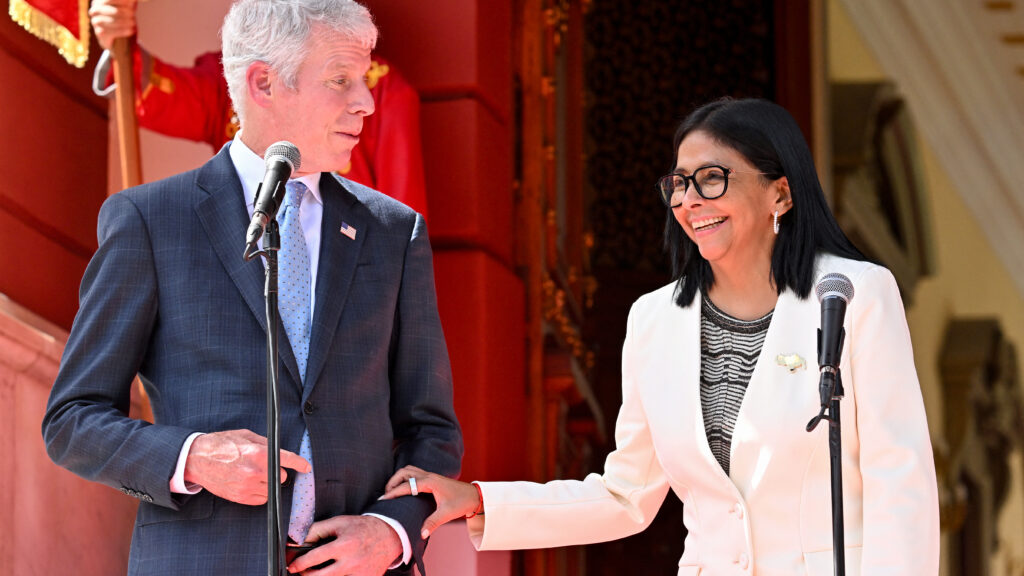
Wright visited Caracas for a second time since the January 3 US strikes and Maduro kidnapping. (AFP)

Caracas, September 3, 2026 (venezuelanalysis.com) – Venezuelan Acting President Delcy Rodríguez and US Energy Secretary Chris Wright celebrated an oil agreement between the two countries and North American Blue Energy Partners (NABEP) and a flurry of additional energy deals signed on Wednesday.

“This is a historic day in the transformation of Venezuela,” Wright said in a joint press conference at Miraflores Palace. “President [Donald] Trump has a clear mission in Venezuela: to bring peace, freedom, and prosperity to everyone.”

The US official went on to praise the “enormous deal” announced last Friday that will see NABEP, a company owned by Venezuelan businessman Alejandro Betancourt, receive long-term concessions for 17 prime oilfields in the Caribbean nation that hold 65 billion barrels of reserves.

According to the White House, the US Department of War’s Office of Strategic Capital (OSC) will acquire a 35 percent stake in NABEP through penny warrants. The US State Department will be able to purchase 20 percent of NABEP’s production at cost and hold a right of first refusal for the remaining 80 percent. 

Washington will likewise control the company’s board of directors. Wright stated that the NABEP deal is “ambitious” and predicted that Venezuelan oil production would surpass 2 million barrels per day (bpd) by the end of the decade, nearly doubling the current output of 1.1 million bpd.

For her part, Rodríguez urged Wright to convey her gratitude to Trump, the US State Department, and the Department of Energy for helping secure “a mutually beneficial, win-win agreement.”

“I trust that the binational agreement will also prove beneficial for the people of the United States,” the acting president told reporters. “Venezuela is ready to welcome these investments that will boost the country’s development.”

Rodríguez had previously stated that Venezuela is estimating US $19 of revenue per barrel extracted in the project, significantly below the government take under the 2001 Hydrocarbon Law enacted by former President Hugo Chávez. The law was overhauled with US support in January to expand benefits for foreign corporations.

Both Rodríguez and Wright faced questions about Betancourt, who has faced embezzlement and money laundering investigations in Spain and Switzerland stemming from alleged corruption in dealings with state oil company PDVSA.

NABEP has operated in the country since 2024 and was awarded the project without a prior bidding process. It is currently Venezuela’s second-largest crude producer after Chevron. Wright said the US government had negotiated the agreement carefully and would exercise strict control over the flow of funds associated with the NABEP deal.

Rodríguez, for her part, said that Betancourt is not facing any judicial proceedings in Venezuela, with a 2022 arrest warrant for corruption having been dropped one year later. Similarly, Secretary of State Marco Rubio argued in an interview that the Venezuelan mogul is not the subject of any investigation in the US.

Before the afternoon press conference, Wright attended a ceremony at the presidential palace that saw the Venezuelan government sign a number of agreements with foreign corporations.

Chevron, the largest foreign corporation operating in Venezuela, saw its joint venture with PDVSA awarded two additional extra-heavy crude fields, Carabobo-1 and Carabobo-2 South, in the Orinoco Oil Belt.

The Texas-based company announced plans to invest $7 billion in its Venezuela projects over the next five years with the goal of more than doubling the current 250,000 bpd output. Chevron CEO Mike Wirth affirmed in an interview that the “strong legal protections” and “improved terms” under the reformed Hydrocarbon Law granted the company “attractive low-cost oil growth” prospects. 

Italian company Eni also signed a contract to develop the Junín-5 block, one of the largest in the Orinoco Oil Belt. The project will migrate from a joint venture with PDVSA majority to a concession-type deal, called a Productive Participation Contract, which offers increased benefits for the private operator.

Eni CEO Claudio Descalzi was likewise present in Miraflores Palace and thanked US and Venezuelan authorities for backing foreign investments in the South American country.

Wednesday’s ceremony also saw Primavera secure a concession to exploit the medium- and heavy-crude Budare-Elotes block in eastern Venezuela. Primavera is an energy-investment vehicle created by billionaire Fred Ehrsam, a Trump supporter and co-founder of Coinbase, to enter the Venezuelan oil industry.

Additionally, Colorado-based wildcatter Aspect Energy received rights to study potential new oilfields in eastern Venezuela.

Finally, PDVSA and state electricity company CORPOELEC signed “strategic alliance” agreements with GE Vernova, an offshoot of General Electric, to upgrade and repair electrical infrastructure supporting Venezuela’s oil industry.

Following the pro-business overhaul of its energy sector, Caracas has signed new or updated agreements with multiple Western multinational corporations, including BP, Shell, and Repsol. 

Since the January 3 military strikes and kidnapping of President Nicolás Maduro, the Trump administration has wielded significant control over the Venezuelan oil and gas industry. The Caribbean nation’s export revenues are currently deposited in a US Treasury account before the White House decides the disbursement timings and amounts.

Washington has also kept wide-reaching sanctions in place while issuing licenses for select corporations and banning dealings with companies from Russia, China, and Iran. With NABEP set to take over five oilfields previously operated by joint ventures with Chinese firms, Beijing demanded that its “rights and interests” in Venezuela be respected.

Edited by Ricardo Vaz in Caracas.
Source link

Long list of U.S. concessions to Iran raises specter of a ‘lost war’

The White House pushed back Thursday against growing bipartisan criticism of a negotiated settlement to the war with Iran, arguing its concessions to the Islamic Republic were contingent on its conduct and essential to securing peace.

The administration’s defensive posture came as details of the framework agreement, known as a memorandum of understanding, were finally shared with the public, revealing a raft of compromises with Tehran long opposed by Republicans.

Vice President JD Vance, who helped negotiate the deal, told reporters Thursday that the deal was structured to reward Iran for good behavior. But the text of the agreement suggests otherwise.

The Trump administration agreed to release billions of dollars in Iranian assets that were frozen and restricted by the United States “upon the implementation” of the memorandum — before any further actions are taken or additional negotiations begin. The president will issue sanctions waivers on Iranian oil, allowing Tehran to resume trading its most valuable export and breaking with decades of policy. And to facilitate that trade, boosting Tehran’s revenues, Trump agreed to immediately end a U.S. naval blockade of Iranian ports.

Still more concessions were offered to the Iranians, including a commitment by the U.S. administration to establish a fund of “at least $300 billion for the reconstruction and economic development of the Islamic Republic” — in effect providing reparations for the war Trump started.

“All required licenses, waivers and permissions needed for the relevant financial transactions will be granted by the United States of America,” the memorandum reads.

Taken together, the document reads as a stunning reversal of U.S. policy toward Iran after decades of concern across administrations in Washington — including throughout Trump’s two terms — that the Islamic Republic represents the nation’s greatest security threats as the world’s largest state sponsor of terrorism.

Criticism from Republican senators, in particular, has been sharp and swift.

Sen. Roger Wicker (R-Miss.), chairman of the Senate Armed Services Committee, said the $300-billion fund “would make Iran’s payoff under President Obama’s 2015 deal look like a pittance by comparison.” And Sen. Ted Cruz (R-Texas) accused the Trump administration of giving Iran money it would use to kill Americans.

“History demonstrates that giving billions of dollars to theocratic lunatics who want to murder us is an exceptionally bad idea, and I think, unfortunately, the president is receiving some really bad advice on this deal,” Cruz said. “I don’t want to see us send a penny to the ayatollah. And I hope that we don’t.”

The Obama-era deal, known as the Joint Comprehensive Plan of Action, included structured sanctions relief for Iran in exchange for concrete and verifiable steps by Tehran to dismantle much of its nuclear program — a framework that Republicans broadly criticized at the time.

By contrast, Trump’s agreement commits the United States to pursuing economic relief for Iran while providing no clarity about the future of Iran’s nuclear program — the very issue Trump cited as the rationale for launching the war.

The memorandum includes a pledge by Iran to never purchase or construct nuclear weapons — a vow the Islamic Republic has made multiple times before, including by signing the Nuclear Non-Proliferation Treaty, in a religious edict issued by the late supreme leader and in the Obama-era nuclear accord.

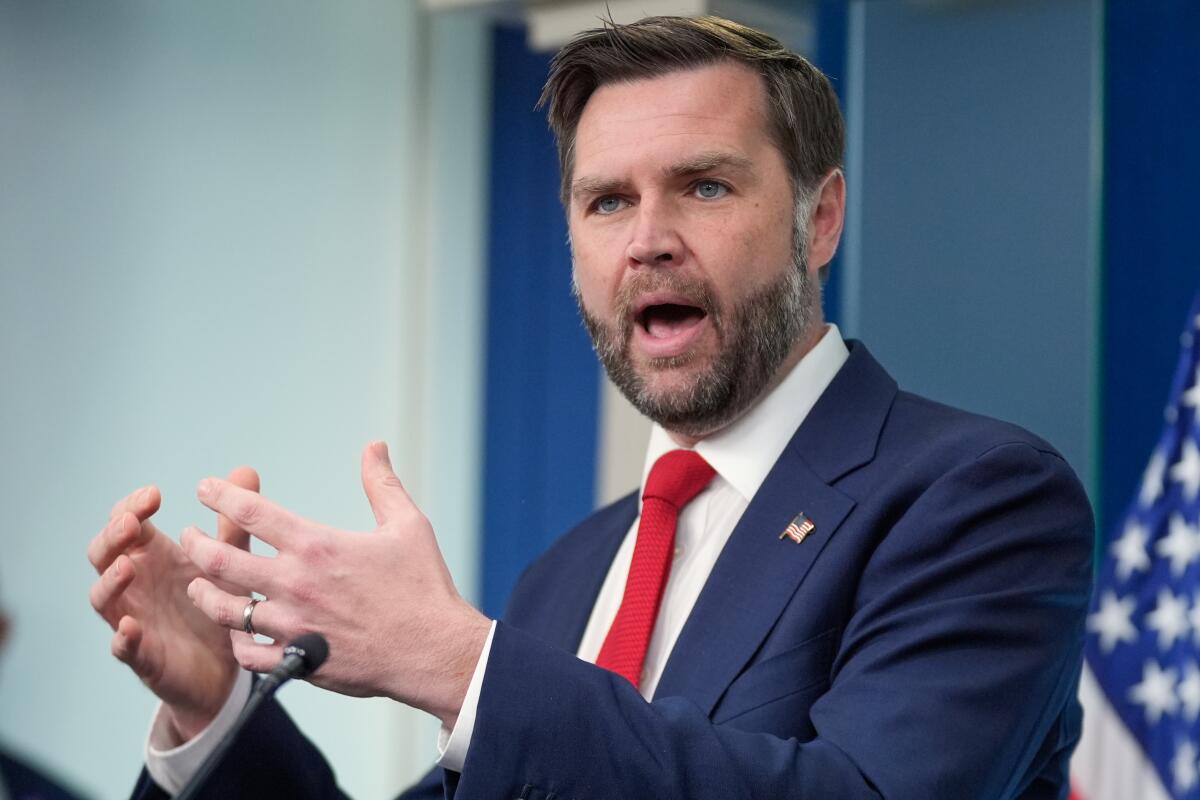
A man with dark hair and beard, in a dark blue suit and red tie, gestures with his hands while speaking

Vice President JD Vance speaks to reporters at the White House on June 18, 2026.

(Manuel Balce Ceneta / Associated Press)

Detailed negotiations over Iran’s nuclear program — including whether Tehran could continue domestic uranium enrichment, at what level, and under what monitoring regime — were left for another day.

For more than a decade, the U.S. intelligence community has assessed that Iran sought a threshold nuclear capability, securing the strategic advantages of a nuclear power without incurring the costs of openly pursuing a bomb.

The agreement does include a commitment by Iran to do its “best” to bring commercial shipping traffic through the Strait of Hormuz, a vital international waterway, back to prewar levels. But critics of the president said he had to make deep, historic concessions just to secure a status quo ante upended by the war he started. And in the document, Tehran agreed to refrain from imposing a toll on ships transiting the strait for only a 60-day period.

“Unless you were homeschooled by a day drinker, no one’s confident that Iran is going to do anything,” Sen. John Kennedy, a Republican from Louisiana, told reporters this week.

Sen. Bill Cassidy, Kennedy’s Republican counterpart from Louisiana, called the deal “the worst foreign policy blunder in decades” that would have President Reagan “rolling over in his grave.”

“Iran’s nuclear ambitions were not curbed, and they have learned that threatening the Strait of Hormuz works and will undoubtedly leverage it in the future. Now, Iran gets to build brand-new infrastructure under this deal,” Cassidy said.

“Before the war, the strait was open, Iran was being crushed by sanctions, and 13 service members were still alive,” he added. “Now, 13 Americans are dead, families have paid billions at the pump, sanctions will be lifted, and the bombing has stopped.”

Despite mounting criticism, Trump put his signature to the memorandum on Wednesday night while attending a dinner with the French president in Versailles, a palace infamous for hosting a treaty signing that disgraced Germany at the end of the First World War.

He defended the agreement while in Europe and suggested further concessions might be forthcoming, including recognition of Iran’s claimed right to enrich uranium and a new willingness to tolerate its continued ballistic missile development — another program that Trump had vowed to eliminate as a central war aim.

“He took America to war — killing 13 soldiers, thousands of Iranian civilians and costing taxpayers $60 billion — to get rid of Iran’s missile program. And now that he’s lost the war, he pretends like it’s no big deal,” said Sen. Chris Murphy, a Democrat from Connecticut.

“Just unforgivable,” he added. “What a charlatan.”

Source link

Trump Administration Extracts Renewed Venezuela Oil Concessions as Rodríguez Touts New Deals

SLB, formerly Schlumberger, is the latest major corporation to sign a renewed agreement with the Venezuelan government. (Archive)

Caracas, June 11, 2026 (venezuelanalysis.com) – The Trump administration continues to dictate conditions on Venezuela’s energy industry for the benefit of US and Western corporations.

At an event organized by Politico, National Energy Dominance Council Director Jarrod Agen stated that he is in contact with Venezuelan Acting President Delcy Rodríguez and her team “multiple times a day” to discuss the legal framework for foreign conglomerates.

“I raised issues [on oil contracts] when I went down [to Venezuela] and she said ‘we’ll work with you to get through it,’”the Trump official added. 

Agen stated that the administration is currently working to turn “memoranda of understanding (MoU) into binding contracts” and insisted that Venezuela has “made a lot of progress” in overhauling the country’s hydrocarbon and mining laws. 

The legislation approved by the National Assembly slashes royalties and fiscal responsibilities for private companies, while also granting them expanded control over operations and sales. After the laws were approved, authorities were tasked with drafting regulations for their implementation and new contract templates.

Agen went on to announce that a Trump administration delegation will travel to Caracas in the coming days to further discuss conditions for multinational firms in petroleum and gas projects.

Venezuelan oil authorities have reportedly begun circulating drafts of regulations and contract models with industry partners, though the texts have not been made public. The final versions are required to be published in the country’s National Gazette. 

According to Bloomberg, Caracas has revised the proposals under pressure from investors, including the removal of a clause that would have allowed the Venezuelan government to terminate contracts, with compensation, for reasons of “public interest.” Venezuelan leaders have openly acknowledged incorporating private sector input into the recent oil and mining reforms.

Since launching military strikes and kidnapping Venezuelan President Nicolás Maduro on January 3, the Trump administration has seized control of the South American country’s energy and mineral exports.

While keeping wide-reaching sanctions in place, the US Treasury Department has issued multiple sanctions waivers allowing select Western corporations to undertake oil and gas operations in Venezuela while barring participation from Chinese, Russian, and Iranian competitors. The general licenses mandate that all Venezuela-owed payments, including royalties and taxes, be deposited in a Treasury-run account.

On Wednesday, the Trump administration updated multiple licenses concerning energy, petrochemical, and mining activities, stipulating that contract disputes can now also be settled in the United Kingdom, France, and Singapore, rather than just the US. However, the licenses still demand that contract terms be “construed and interpreted” in accordance with US laws and jurisdiction.

The revised waivers likewise establish that contracts may recognize that “certain aspects” of the activity are subject to Venezuelan laws and regulations.

For its part, the acting Rodríguez administration has aggressively courted foreign investment in the oil and gas sectors.

On Wednesday, Venezuelan state oil company PDVSA signed a memorandum of understanding with SLB, formerly Schlumberger, one of the world’s largest oil services providers with a presence in the Caribbean nation since the 1920s. The Houston-based multinational stated that the agreement intends to “strengthen operational execution and promote sustainable development” of the Venezuelan energy sector.

During a televised ceremony, Rodríguez said she was “very pleased” with the deal and expressed confidence that SLB’s cutting-edge technology would have a “major impact on oil exploration and production.”

The acting leader has inked agreements with multiple Western energy giants in recent weeks, including Chevron, Shell, BP, and Repsol. Rodríguez has announced that more companies are set to arrive in the coming weeks. Business executives have made repeated trips to Venezuela to evaluate opportunities and meet with government officials.

Rodríguez recently visited India and touted oil project opportunities in meetings with Reliance Industries and Indian public sector energy firms.

Other government officials, including Economy Vice President Calixto Ortega and Oil Minister Paula Henao, have also held closed-door meetings with investors to promote recent reforms and incentives for foreign firms. At a Houston conference in May, Henao trumpeted the new oil law’s international arbitration clauses for offering more “legal certainty” to investors.

Venezuela’s oil output has continued its recent upward trend, with OPEC’s secondary sources registering a production of 1.072 million barrels per day (bpd) in May, up from 1.036 million in April.

For its part, PDVSA registered a 1.179 million bpd output last month, up from 1.136 million in April. Direct and secondary measurements have historically differed over disagreements on the inclusion of condensates and natural gas liquids.

According to Reuters, Venezuelan oil and byproduct exports rose for a third consecutive month, registering 1.25 million bpd, thanks to increased volumes shipped to the US and India.

Edited by Lucas Koerner in Caracas.

Source link