Taylor Swift has yet another new thing to celebrate.
Now in her newlywed era, the pop superstar’s concert film, “The Eras Tour: The Final Show,” earned five Emmy nominations Wednesday. This includes nods for variety special (pre-recorded), sound mixing for a variety series or special, directing for a variety special, picture editing for variety programming, and technical direction and camerawork for a special.
The nomination for variety special (pre-recorded) means Swift herself is a nominee as the performer and a producer of the concert film, which showcased the final performance of her record-breaking tour. This marks the “The Life of a Showgirl” singer-songwriter’s second career Emmy nomination. She previously won in 2015 in the category of creative achievement in interactive media — original interactive program, as the executive producer of the mobile app AMEX Unstaged: Taylor Swift Experience.
The accolades come just five days after Swift married beau Travis Kelce in an extravagant — yet secretive — Manhattan affair at Madison Square Garden. The Kansas City Chiefs tight end has spoken about his failed attempt to slide Swift his phone number (via friendship bracelet) when he attended an Eras tour concert in 2023.
The Emmy nominations follow her latest legal win. On Monday, a federal judge in Florida dismissed with prejudice a copyright lawsuit that accused Swift of plagiarizing a self-published poet.
In February 2025, Kimberly Marasco, representing herself, filed a lawsuit that alleged Swift copied “unique expressions” such as short phrases and specific words from her poetry in numerous songs, including “The Man,” “Down Bad,” “I Can Do It With a Broken Heart,” “Hoax,” “Guilty as Sin?” and “It’s Time to Go.” A similar lawsuit Marasco filed against Swift and other named defendants was dismissed by the same judge last September.
Swift’s lawyers called the lawsuit “absurd and legally baseless” in their filings. “For instance, the concept of betrayal or the words ‘fire’ or ‘love’ cannot be owned by one person, as basic themes or words are not protectable by copyright law,” reads the motion to dismiss submitted by attorneys James Douglas Baldridge and Katherine Wright Morrone, who also represented co-defendants Republic Records and Universal Music Group.
In her order granting Swift and her record label’s motion, U.S. District Judge Aileen Cannon agreed, reiterating that “the allegedly infringed material — basic ideas, themes, metaphors, isolated words, and short phrases — is not protected expression and cannot be infringed.”
Cannon mentioned these allegedly plagiarized words and phrases included “tears,” “running,” “fire,” “rain,” “sky,” “love,” “invisible,” “caged me,” “flesh and blood” and “it’s time to go.”
Even if they were protected expressions, “the works are not even substantially similar — a point Plaintiff effectively concedes by characterizing the alleged copying as ‘paraphrase[s],’ ‘rephrase[s],’ and copying with ‘minor word substitutions,’” Cannon wrote.
But it appears Swift has not completely shaken off Marasco’s copyright lawsuit. The Florida poet has already filed an appeal.
Brooke McCree, a 22-year-old recent UCLA graduate, is the first to admit she’s been going to the movies a lot less.
Back when Regency operated the local Village and Bruin theaters in Westwood Village, she would often take advantage of the student discount and see as many movies as possible. But in the two years since the theaters closed, she said moviegoing for many UCLA students has become inaccessible.
“At UCLA, it’s been rough because I’ll have to walk really far or take the bus [to the movies]. There’s nothing really nearby,” said McCree, who recalled fond memories of seeing movies like “Madame Web” and a “Hunger Games” prequel in a dense crowd of excited college students. “I was pretty devastated when it initially closed.”
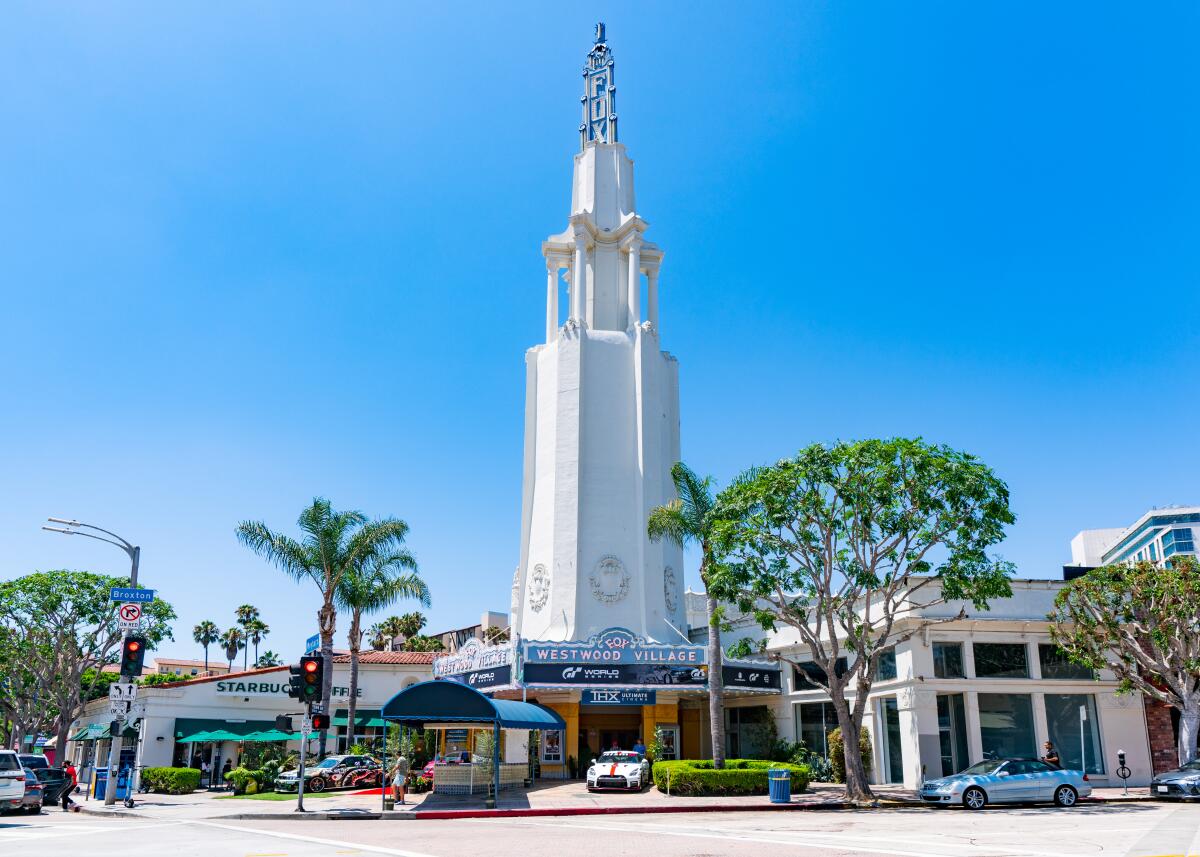
There is still hope for the Village Theatre, which recently received a breath of new life thanks to some of Hollywood’s biggest names.
The event was reportedly the first of a limited number of premieres and screenings planned for this summer to support a 12-month renovation set to begin this fall.
A representative for Reitman declined to comment on the plans.
Nissan GT-R NISMO sports cars are seen outside the Fox Westwood Village Theatre, promoting the “Gran Turismo” movie in 2023.
(AaronP / Bauer-Griffin / GC Images )
The $25-million restoration, which organizers previously told The Times would be completed next year, includes plans for a restaurant, bar, gallery and a multipurpose space in the lobby for filmmakers and hosting premiere-related events.
Last year, the coalition of directors announced that American Cinematheque would operate the theater, hosting special screenings of new releases and repertory titles and conversations with filmmakers. The film non-profit already runs Santa Monica’s Aero Theatre and co-programs both the Egyptian Theatre in Hollywood and the Los Feliz 3.
Historically, the neighborhood has been a tricky market for businesses, said Jonathan Kuntz, a former lecturer at the UCLA School of Theater, Film and Television. He worked in the area for nearly 40 years and saw much turnover among local businesses due to high rents and inadequate parking.
“We’ve had some great things, like bookstores and eateries that have flourished sometimes for a decade or two, but it faded out,” Kuntz said. “[The theater] will certainly help Westwood if it is a success.”
For that to happen, Kuntz said, 1400-seat theater will need to screen a regular supply of films to a diverse customer base, including nearby students that have long been among its most frequent customers.
Many current UCLA students are already eagerly anticipating the theater’s reopening, said Ingrid Fan, a senior at the university majoring in public affairs.
“It’s been a bummer to have it closed for so long,” said Fan. “My friends and I always talk about how we just wish it opened sooner.”
While the theater’s renovation timeline won’t be complete before she graduates, she’s certain that other students will make good use of it when it reopens.
“Westwood is a college town, and we are always looking for a new source of community. It’s a space a lot of students would definitely flock to,” Fan said.
Broxton Avenue in Westwood Village during one of UCLA’s First Thursdays community events.
(Myung J. Chun / Los Angeles Times)
A historic movie hub
The university and its surrounding village, including the theater, were developed simultaneously throughout the 1920s and 1930s. Designed by Percy P. Lewis, the Westwood Village Theatre originally opened as a part of the Fox Theatres chain in 1931.
Despite launching during the Great Depression, the Westwood Village Theatre had a prime location working in its favor.
Westwood was imagined as a satellite town in West L.A. that would eventually support the growing UCLA campus. The neighborhood became known as the third major movie theater hub, behind downtown and Hollywood. In the 1920s, when the Chinese and the Egyptian theaters opened on Hollywood Boulevard, Westwood was next in line as a booming premiere destination.
“It was much more convenient to those folks than going to downtown Los Angeles, or even to Hollywood,” Kuntz said.
This was an era of moviegoing when premieres were essential to a movie’s box office success, drawing substantial marketing opportunities. The volume of films being produced at the time made it necessary to have multiple premiere-ready theaters around L.A., Kuntz said.
A “Terminator” poster is unveiled at the world premiere of “Terminator 3: Rise of the Machines” in 2003.
(Robert Mora / Getty Images)
Over its 95-year history, the venue has been remodeled a handful of times, including in the 1950s when television became a mainstream medium. Soon, multiplexes emerged, which put the Westwood Village location at a disadvantage. To this day, the theater can only show one film at a time.
In the 1970s, the venue joined the Mann Theatres chain, and in 1988, it was designated a historic cultural monument.
The ticket booth at the Regency Bruin theater in Westwood Village all boarded up, as seen on the afternoon of Nov. 3, 2020.
(Carolina A. Miranda / Los Angeles Times)
Regency continued to operate the two locations until its lease ended in 2024. Although the group of Hollywood directors was quick to bid on the Village (the Bruin was not included in the deal), the theater has remained closed since then, with the exception of the recent Billie Eilish premiere.
“A lot of people in Hollywood want to preserve at least some of what made classic Hollywood successful, like the big screen experience,” Kuntz said. “These folks are the ones who could afford to buy a movie house or two, program it and keep that tradition alive.”
L.A. Times staff writers Josh Rottenberg and Meg James contributed to this report.