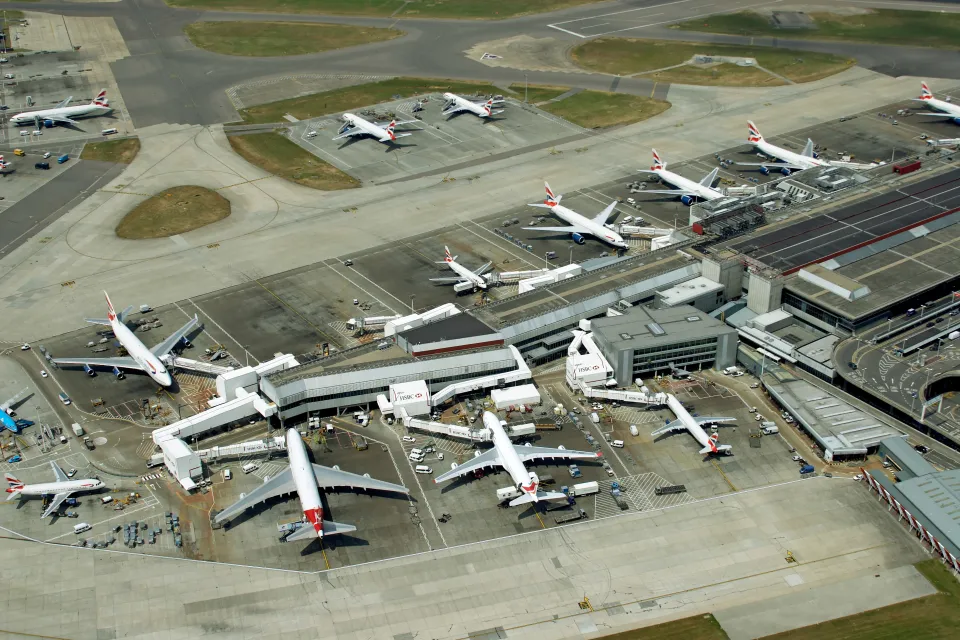
TWO major tech outage have caused hundreds of flight cancellations and delays across the UK this month – yet Brits will struggle to get any compensation, according to experts.
Earlier this month a major Air Traffic Control failure in the UK resulted in thousands of flights cancelled across the globe.
Thousands of flights have been disrupted by two Air Traffic Control failures in the UK this monthCredit: Reuters
And another failure yesterday caused more than 200 flight cancellations and widespread delays.
With the two incidents less than two weeks apart, many travellers have been left out of pocket.
Unfortunately, it’s bad news – the NATS issue was classed as an “extraordinary circumstance” which means travellers are not entitled to cash compensation.
The maximum compensation you can get is for long-haul flights which are delayed four hours or more, which would be £520.
This is only for when the problems are caused by the airline, directly, however.
Lisa Minot, Head of Travel previously said: “Airlines are only required to give you compensation if the delay or cancellation is the airline’s fault, as in a technical failure on a plane or issues with crew.
The two incidents took place less than two weeks apartCredit: Getty
“In this situation, where ATC is the reason for the chaos, there is unfortunately no compensation due.”
But one thing you should note is that airlines have a duty of care.
This means that when you flight is delayed, they must provide you with food, drink and accommodation.
Sometimes the airline might provide you with a voucher, but if this isn’t provided you can keep your receipts to claim back any expenses.
Often airlines will automatically book you accommodation, but you may also be asked to book accommodation yourself through its website or a dedicated app.
Travellers are advised to always check with airport staff though before booking any hotel yourself.
And passengers are unlikely to get compensationCredit: GettyThough airlines do have a duty of careCredit: PA
And make sure to keep your receipts for your hotel as well, to claim back your costs.
Don’t book anything lavish though – airlines will usually only cover a hotel at a reasonable price.
Airlines will usually have a dedicated expenses claims page for you to fill out on its website.
The CAA also recommends asking for an itemised receipt to show what you purchased and how much was spent on each thing.
Lisa added: “Check your insurance policy to see if you have any redress if you have incurred additional costs like missing a concert or unable to pick up car hire. You may be able to claim for that.
“Generally for delays, if an airline looks after you or provides you with food and drink or hotels, you cannot claim for the same costs against your travel insurance.”
TRAVEL chaos caused by a major tech outage across all UK airports earlier this week has left thousands stranded – with many left out of pocket when booking back up flights and hotels.
An Air Traffic Control failure in the UK on Tuesday saw thousands of flights cancelled, resulting in travel chaos across the globe.
An Air Traffic Control issue in the UK left thousands of travellers stranded this weekCredit: EPA
Many have since been asking if they can claim compensation back, with flights both delayed and cancelled for days.
However, as the NATS issue was classed as an “extraordinary circumstance” travellers are not entitled to cash compensation.
Sign up for the Travel newsletter
Thank you!
The maximum compensation you can get is for long-haul flights which are delayed four hours or more, which would be £520.
This is only for when the problems are the caused by the airline, directly, however.
Lisa Minot, Head of Travel said: “Airlines are only required to give you compensation if the delay or cancellation is the airline’s fault, as in a technical failure on a plane or issues with crew.
“In this situation, where ATC is the reason for the chaos, there is unfortunately no compensation due.”
Yet, airlines do have a duty of care, so you can recoup some of your costs.
When affected by flight delays, airlines must provide travellers with food and drink as well as accommodation.
‘Care’ you should receive includes food and drink, two phone calls, accommodation and transport between the airport and where you are staying.
Usually, an airline will provide you with a voucher to get food or drink, however if a voucher isn’t provided, make sure you keep your receipts to claim back expenses incurred.
As the issue was outside of airlines’ control, it is class as an “extraordinary circumstance” meaning passengers cannot claim cash compensationCredit: EPA
While an airline might automatically book your accommodation when your flight is delayed or cancelled, sometimes you might be asked to book it yourself via its website or a dedicated app.
Although, it is advised to always ask airport staff before booking a hotel yourself.
If you pay for your own hotel, you must make sure to keep all your receipts so you can claim back your costs.
Airlines will cover a hotel with a reasonable price though, so don’t go booking a five-star stay.
Then head to your airline’s website and find their expenses claims page and fill out the form with the relevant details.
The CAA also recommends asking for an itemised receipt to show what you purchased and how much was spent on each thing.
Lisa added: “Check your insurance policy to see if you have any redress if you have incurred additional costs like missing a concert or unable to pick up car hire. You may be able to claim for that.
“Generally for delays, if an airline looks after you or provides you with food and drink or hotels, you cannot claim for the same costs against your travel insurance.”
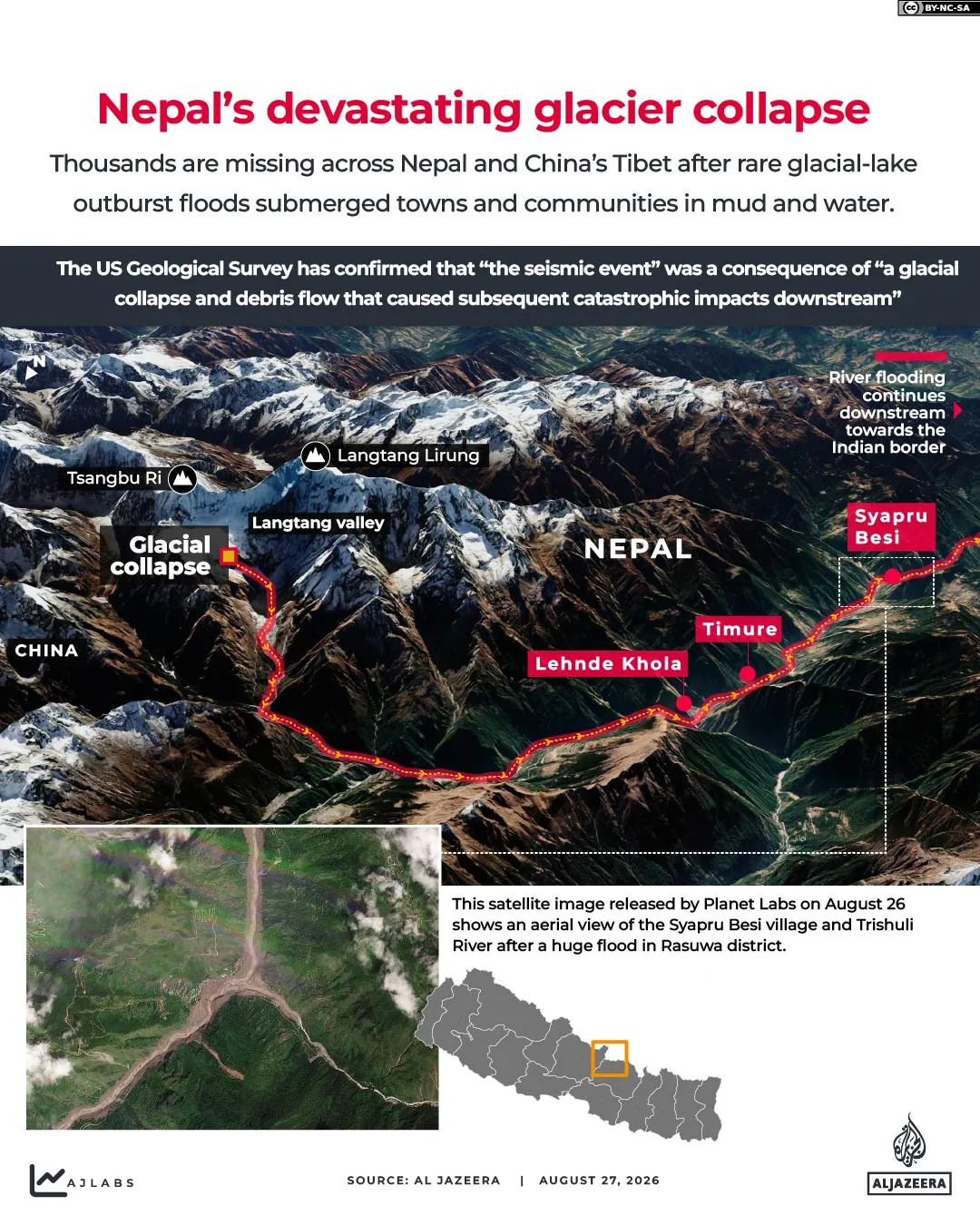
Nepal is demanding “climate justice” and $20m in compensation after the recent devastating floods in the country and China’s Tibet region, which led to the deaths and disappearances of thousands of people.
The catastrophe, which scientists say was caused by the effects of climate change, was triggered when part of a mountain glacier collapsed and a torrent of water and mud flooded down into Nepal’s Rasuwa and Nuwakot regions, as well as into China’s Tibet region on August 26. More than 1,300 people have been confirmed dead and more than 5,000 remain missing.
Recommended Stories
list of 3 itemsend of list
“We are paying the ultimate price for a global crisis we did not create,” Nepal’s Foreign Minister Shisir Khanal said last week.
“Support for Nepal should not be seen from an angle of aid or charity, but should be seen from the perspective of climate justice,” he told the AFP news agency.
On Monday, the country’s President Ramchandra Paudel made a similar demand during an address to the nation.
“I make a heartfelt appeal to the international community not only to listen to the voices of ecologically vulnerable countries, including Nepal, but also to take concrete and effective steps to ensure climate justice for them,” he said.
Nepal’s Ministry of Finance and Ministry of Environment have written a joint letter to the United Nations, which set up a fund to respond to loss and damage caused by climate change in 2022 in line with the 2015 Paris Agreement on climate, with a request for $20m in damages.
The UN’s Loss and Damage Fund is, however, facing a $2.8bn funding gap as it prepares to approve its first climate recovery projects.
‘Collective frustration’
Nepal’s leaders may have a point.
Nepal contributes less than 0.1 percent of global greenhouse gas emissions and generates most of its electricity from renewable sources of energy. Yet its geographical location in the Himalayas makes it particularly vulnerable to severe climate and weather events.
Last month’s catastrophic flooding in the country comes against a backdrop of rapid global warming and glacial loss across the Himalayas.
Glaciers across the Hindu Kush Himalaya mountain range – which spans Afghanistan, Bangladesh, Bhutan, China, India, Myanmar, Nepal and Pakistan – lost ice 65 percent faster between 2011 and 2020 than during the previous decade.
Nepal’s glaciers, which are sandwiched between two major carbon emitters – India and China – have lost close to one-third of their ice volume in roughly three decades due to global warming, the United Nations said in 2023.
Tanuja Pandey, a Nepal-based climate activist and lawyer, said there is collective frustration behind Nepal’s demand for climate justice.
“People here feel the world often pays attention to Nepal only when a climate disaster becomes impossible to ignore. It is deeply painful to people here that global attention intensifies when headlines report thousands of people dead or missing and in the end, their suffering does not generate any urgency to fight climate change,” she told Al Jazeera.
Shreya KC, a 28-year-old Nepali climate activist, said there is profound anger and sadness among people in Nepal who say that they must no longer continue to suffer the impact of climate change, which, as they see it, other countries are responsible for.
“My hometown is in Solukhumbu in eastern Nepal,” the activist told Al Jazeera. “It is a district of mountains and is also home to the world’s highest mountain, Mount Everest, and my home is also downstream. After the glacial collapse happened two weeks ago, people in my region have realised that this can now happen anywhere in Nepal since the Himalayas are warming and glaciers are melting faster.”
While Nepal has been actively fighting climate change, Shreya KC said she herself has been involved in projects in the country that focus on clean hydropower generation, forestry and other such climate advocacy programmes.
“Because of other countries,” she said, “today Nepalis are the ones most impacted by climate change. So people want justice.”
[Planet Labs PBC]
Is there such a thing as ‘climate justice’?
According to preliminary estimates from Nepal’s National Disaster Risk Reduction and Management Authority, the country’s property, housing and infrastructure losses in the floods amount to some $2.56bn.
But claiming compensation under a notion of “climate justice” won’t be straightforward, according to Joyeeta Gupta, a professor of Environment and Development in the Global South at the University of Amsterdam.
According to the United Nations, “‘climate justice’ is the moral and ethical principle that seeks to address the disproportionate impact of climate change on vulnerable communities and future generations”.
“I define it as a system of justice where others’ perspectives are taken into account, and no harm is caused to others,” Gupta told Al Jazeera.
Nepal is a country that has very low emissions, she said, but is facing the brunt of climate issues which it never created. “That is reason enough for Nepal to claim climate justice,” she noted.
But, practically speaking, can it? In the pre-1990 period, there was a lot of discussion among nations about the need for large emitters to compensate those that would be harmed, Gupta noted. But soon after that, the term “compensation” disappeared from the agenda of international climate treaties, which turned more to discussions about providing assistance to developing countries that need to tackle climate change instead.
In a July 2025 advisory opinion on climate change, the International Court of Justice (ICJ) declared that “all nations have binding legal duties under international law to prevent significant climate harm”.
The ICJ’s advisory opinion on climate change also says that states breaching their international climate obligations can be required to make full reparations, including financial compensation to “injured states” or countries impacted by climate change caused by the actions of other countries.
While the ICJ’s opinion is not legally binding, Gupta said, it is a statement in international law that could support Nepal’s government’s international appeal for climate justice and compensation.
‘No climate justice without internal justice’
Nepal’s rapper-turned-prime minister, Balendra Shah, is scheduled to travel to New York on September 22 to address the 81st session of the United Nations General Assembly (UNGA) on September 24. His country’s appeal for climate justice is expected to be a key part of his address.
For climate activist Shreya KC, while UN meetings and international conferences on climate change may hold some weight when it comes to discussing climate disasters, right now, what Nepal needs is money.
“So much of our money allotted for healthcare, education and to transition into a more developed nation is now being spent on fighting climate change. So countries who are causing emissions, especially from the global north, need to commit more money to the UN’s Loss and Damage Fund,” she said, adding that money from that fund should be disbursed to vulnerable communities in need, not as a loan but as compensation for bearing the brunt of climate change.
Pandey noted that this is not the first time a climate disaster has occurred in Nepal and said that the new government, which came into power in March this year on the back of Nepal’s Gen Z protests last year, has also failed to make climate a priority in its budget.
While it is a good sign that Nepali politicians are appealing for international climate justice, she said, they also need to address the country’s internal development model to fight climate change in the first place.
“There is no climate justice without internal justice within the country itself,” she said.
“I hope that even in our development, partners and investors stop treating climate resilience as an optional addition to development in Nepal just because we are economically vulnerable.
“Investing in Nepal without investing in sustainability is simply a bad investment.”
On Monday, Nepal declared a national day of mourning to remember the more than 1,300 people who are known to have died in last month’s catastrophic floods. Thousands more are still missing.
The country’s President Paudel used the opportunity to call on people to unite.
“This is not a time for division. Nor is it a time to blame one another or become entangled in political disputes and confrontation,” he said.
“This is a time to demonstrate national unity and solidarity. It is also a time for reconstruction, rehabilitation and economic recovery.”
But Gupta says Nepal’s biggest challenge right now is establishing a precedent for compensation for climate change-related disasters.
“It was recently a glacial collapse in the country, but soon, it will become a bigger issue as time goes on because the monsoon patterns will change, the sea level will rise,” she said.
As many other developing countries – notably island states that face being submerged altogether – are also likely facing similar climate change challenges, the damage could become huge.
“That is going to be a very big reason why many rich countries will probably be unwilling to pay compensation, because that would set a precedent for future issues,” Gupta said.
“But the issues countries like Nepal are facing are a very strong argument to try and convince the whole world to accelerate action to phase out fossil fuels and fight climate change.”
UK airports are experiencing delays after a tech outageCredit: Alamy
What is happening right now at UK airports?
Airports across the UK are experiencing huge delays and cancellations with passengers reporting being stuck parked at gates due to Air Traffic Control outages.
It comes after NATS experienced a technical issue just after 1pm today according to multiple sources, halting departures at UK airports.
Sign up for the Travel newsletter
Thank you!
NATS stated: “We have identified that the issue was in our flight processing system.
“Our engineers are on site and working urgently to resume normal operations as quickly as possible.
“We recognise the ongoing disruption to travel, for which we sincerely apologise.
“Flights are still departing and airspace is open, but recovery will take some time. We will provide further updates as soon as possible.
“Passengers should check the status of their flight with their airline. We will provide further updates as soon as we have confirmed information, at http://www.nats.aero and on X at @NATS.”
Are flights being affected?
Flights are being impacted across UK airports London Heathrow, London Gatwick and Manchester.
More than 20 flights have been cancelled at London Heathrow AirportCredit: Alamy
More than 50 flights departing London Heathrow have already been cancelled.
Manchester Airport has advised passengers to “check the latest status of their flight with their airline” amid the turmoil caused by the air traffic control failure.
The airport said it would “Continue to monitor the situation and share further updates as more information becomes available.”
At Luton Airport a Ryanair flight to Dublin scheduled to leave at 4.10PM is now estimated to leave at 7PM.
And a Jet2 flight to Alicante scheduled to leave at 4.25PM, is now estimated to leave at 6PM.
What are my rights if my flight is delayed or cancelled?
Airlines have a duty of care they must offer passengers affected by delays or cancellations.
The Civil Aviation Authority states: “If your flight is delayed, and UK261 applies to it, your airline must look after you while you are delayed.
“This includes providing you with food and drink based on how long your delay is, and accommodation if you are delayed overnight.”
If your airline doesn’t provide these and you end up paying for food, a hotel or transport yourself, keep all receipts so you can claim back reasonable expenses later.
If your flight is cancelled, they must also offer a refund or an alternative flight, even with another airline.
If you accept a refund, they no longer need to offer you any additional forms of care, such as hotels or food vouchers.
Can I claim compensation?
Airlines are not required to offer any compensation if the situation is deemed “extraordinary circumstances”.
This can mean anything out of the airline’s control like extreme weather – or air traffic control failures.
As a result, the current NATS technical outage is classed as an “extraordinary circumstance”.
In the last major NATS outage in 2023, travellers did not receive compensation.
The Civil Aviation Authority revealed that around 700,000 passengers were impacted by the last outage.
This included 300,000 people by cancellations, 95,000 by delays of over three hours and a further 300,000 by shorter delays.
Flight compensation rules
A look at your rights if a flight is delayed or cancelled, when your entitled to compensation and if your travel insurance can cover the costs.
What are my rights if my flight is cancelled or delayed?
Under UK law, airlines have to provide compensation if your flight arrives at its destination more than three hours late.
If you’re flying to or from the UK, your airline must let you choose a refund or an alternative flight.
You will be able to get your money back for the part of your ticket that you haven’t used yet.
So if you booked a return flight and the outbound leg is cancelled, you can get the full cost of the return ticket refunded.
But if travelling is essential, then your airline has to find you an alternative flight. This could even be with another airline.
When am I not entitled to compensation?
The airline doesn’t have to give you a refund if the flight was cancelled due to reasons beyond their control, such as extreme weather.
Disruptions caused by things like extreme weather, airport or air traffic control employee strikes or other ‘extraordinary circumstances’ are not eligible for compensation.
Some airlines may stretch the definition of “extraordinary circumstances” but you can challenge them through the aviation regulator the Civil Aviation Authority (CAA).
Will my insurance cover me if my flight is cancelled?
If you can’t claim compensation directly through the airline, your travel insurance may refund you.
Policies vary so you should check the small print, but a delay of eight to 12 hours will normally mean you qualify for some money from your insurer.
Remember to get written confirmation of your delay from the airport as your insurer will need proof.
If your flight is cancelled entirely, you’re unlikely to be covered by your insurance.
Moscow challenges Norway’s seizure of vessel, the Professor Molchanov, calling it an act of piracy.
Published On 3 Sep 20263 Sep 2026
Norway has seized a Russian ship in the Arctic to enforce a compensation claim by Ukrainian energy firm Naftogaz, linked to Russian asset seizures in Crimea.
Norway seized the ship on Wednesday, after Moscow failed to pay Naftogaz $4.22bn plus interest and legal costs to compensate for assets it seized in Crimea after a tribunal ruling at The Hague in 2023.
Recommended Stories
list of 3 itemsend of list
In a post on X, Naftogaz said the seizure made up “part of global efforts to enforce the arbitral award obtained by Naftogaz against the Russian Federation in connection with the unlawful expropriation of their assets in Crimea, which Russia illegally annexed in 2014”.
The vessel, the Professor Molchanov, was taken off the Norwegian Arctic archipelago of Svalbard after a 24-hour standoff with the Norwegian Coast Guard, according to Covington, the US law firm representing Naftogaz.
Russian state news agency TASS quoted a Ministry of Foreign Affairs spokesperson as calling the Norwegian action “piracy”.
Alexei Chekunkov, Russia’s minister for the development of the Russian Far East and Arctic, said Moscow would challenge the ruling.
Chekunkov called Norway’s seizure of the Professor Molchanov “another example of Western countries’ legal nihilism and lawlessness,” according to the Interfax news agency.
Naftogaz has been pursuing legal action against Russia since 2016 to seek compensation for the expropriation of its property in Crimea.
“Russia cannot evade responsibility simply by refusing to comply with an international arbitral award,” said Naftogaz Acting CEO Sergii Fedorenko.
“We will continue to pursue Russian assets around the world until the compensation awarded to Naftogaz and other Naftogaz Group companies is paid,” the Ukrainian company said.
Covington, the law firm, said it had been tracking the Professor Molchanov, a Russian-owned vessel that is used for commercial cruises, for months.
The ship was being used for commercial expedition cruises, including to Svalbard, according to the company.
Naftogaz said the passengers on board are being handled by Norwegian authorities.