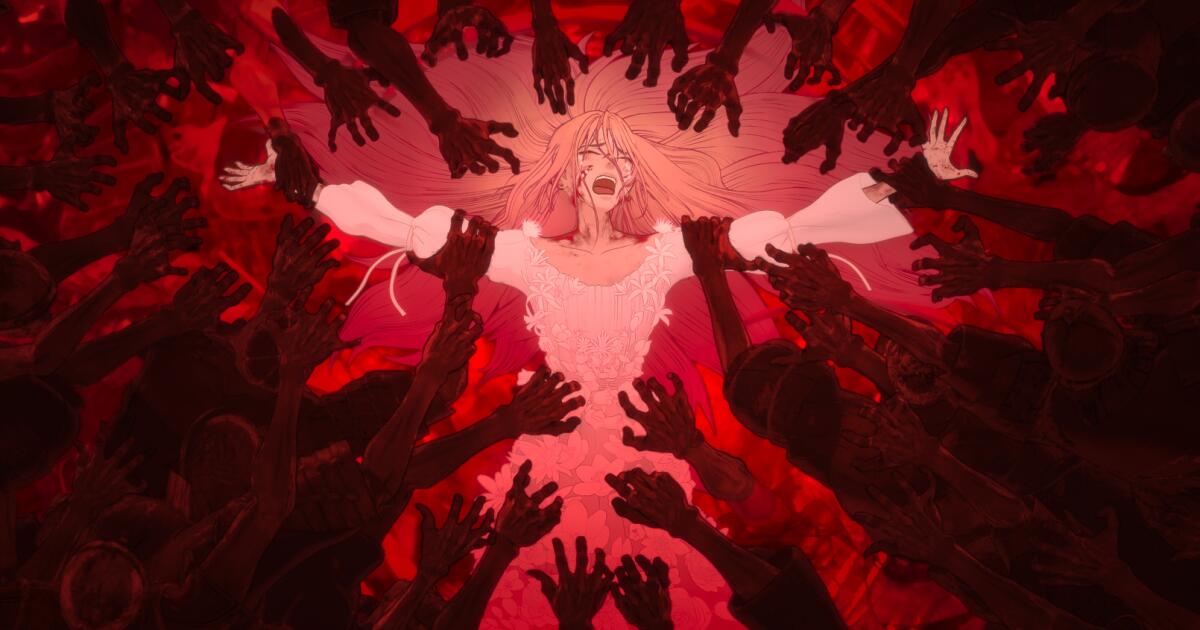
‘Scarlet’ review: Animation from Japan’s Mamoru Hosoda is his most mature
Currently nominated for multiple Oscars, Chloé Zhao’s “Hamnet” traces how the immeasurable sorrow of losing a child fueled William Shakespeare to write “Hamlet” as a literary effigy to loss. That revered text, which has inspired countless adaptations (“The Lion King” among them), takes on a new form in the hands of Japanese animation master Mamoru Hosoda for his latest fantastical epic, “Scarlet.”
In a career of animated features with thematic heft and deep emotional impact, “Scarlet” may be the director’s most sobering and intense effort to date, not only given the severity of the violence on display, but because it advocates for the sometimes-impossible task of forgiving one’s foes, even when they show no remorse. Here, what’s at stake is one’s very soul. What remains is Hosoda’s investment in parent-child relationships, a recurring subject for him, always explored with compassion for both parties: the child in need of guidance and the parent struggling to be a beacon.
Gender-swapping the play, Hosoda once again centers a heroine (he seems to prefer female protagonists). The 16th century eponymous Danish princess (voiced by Mana Ashida) loses her father, King Amleth (Masachika Ichimura), to a gruesome betrayal. Her unscrupulous, power-hungry uncle Claudius (Kôji Yakusho) murders his own brother to become king. But in his final moments, as Scarlet watches, Amleth pleads a request she cannot hear. Avenging her fallen father — and finding out what he asked for before dying — becomes the young woman’s sole purpose going forward. Rage consumes her.
Hosoda’s body of work consists almost exclusively of movies that take place on two distinct planes, whether those be reality and a digital world (“Summer Wars,” “Belle”) or reality and a magical realm (“Mirai,” “The Boy and the Beast”). “Scarlet” is no different in that regard.
This time, however, he explores an afterlife with its own set of rules. Sensing Scarlet’s resolve to destroy him, Claudius poisons her. Scarlet wakes up in the Otherworld, an endless, arid landscape with an ocean for sky where a dragon roams. The deceased from the past and the present convene here. That’s how Scarlet and Hijiri (Masaki Okada), a paramedic from our present who refuses to believe he’s died, can exist in the same timeline. This purgatory essentially mirrors life: There’s conflict and suffering and if you die again here, you vanish into darkness forever. The goal is to ascend to the Infinite Land, a stand-in for heaven. But Scarlet cares not for eternal peace. She learns that Claudius is here and embarks on a trek to find him and kill him for good.
Hosoda doesn’t dwell on the differences between Scarlet and Hijiri’s realities back in the land of living. Instead, he zeroes in on their clashing worldviews. While Scarlet doesn’t think twice about slaughtering anyone who gets in her way, Hijiri protects life at all costs, so much that one can understand Scarlet’s frustration with him. After a brutal fight, for example, Hijiri bandages her enemies’ wounds with as much care as he does hers.
Multiple battles with Claudius’ henchmen pepper Scarlet and Hijiri’s journey, as does an encounter with the United Nations of this place: a group of wandering nomads from around the world who’ve come together for companionship. Even after death, Hosoda suggests, all people truly hope for is a shoulder to cry on and someone to share their burdens with.
For “Scarlet,” Hosoda ventures into uncharted aesthetic territory. When the narrative is in the Otherworld, fans will immediately notice the look differs from his previous creations. And that’s because Hosoda has opted for photorealistic, computer-generated animation in those sections. The early scenes in Scarlet’s time period are conceived using the more traditional hand-drawn technique.
Still, the characters in the Otherworld, created in CGI, retain qualities of hand-drawn animation, making one hyperaware of the relationship between the figure’s movement and the environment. The mix of visual approaches shocks the eye at first, though it comes to seem fitting.
If probed too closely, Hosoda’s high-concept interpretation of life after death may raise more questions than it can answer (have all of history’s villains been killed in the Otherworld?). But despite any narrative quibbles, the movie deserves praise for its genuine call for compassion. Scarlet’s final encounter with Claudius radiates with the complicated poignancy expected of real, difficult catharsis.
Admittedly, the film’s resolution feels naïve. Scarlet’s good intentions to end wars by way of sheer determination to do what’s right might prove insubstantial in practice. In that regard, “Scarlet” is the prayer of a director who fervently wants to believe in kindness (even for those who don’t deserve it) as the one true road to healing. That’s a tall order these days, especially in this country, but it’s hard to fault Hosoda for the sincere reminder of what could be.
‘Scarlet’
In Japanese, with subtitles
Rated: PG-13, for strong violence/bloody images
Running time: 1 hour, 51 minutes
Playing: Opens Friday, Feb. 6 in limited release