com arena

Joshua Van beats Alexandre Pantoja, defends his title at UFC 331

Alexandre Pantoja did not tap Joshua Van’s glove before the fight began. Nine months after an injury ended his reign as flyweight champion in just 26 seconds, the Brazilian returned to the Octagon to try to reclaim the belt that slipped away.

This time, no injury clouded the result. Pantoja came out determined to impose his style from the opening seconds, but Van found a way to keep him at a distance, counter with his boxing and survive the former champion’s take-down attempts.

After five rounds, the judges awarded the fight to the Van by unanimous decision, with scores of 49-46, 49-47 and 50-45.

Van retained the 125-pound title in the main event of UFC 331, held Saturday at Crypto.com Arena in front of a sold-out crowd of 19,357 fans. UFC CEO Dana White said the event generated $8.3 million in box office revenue, the highest in the arena’s history.

The result also vindicated Van’s claim to the championship.

In December 2025, Pantoja threw a high kick that Van caught. The Brazilian lost his balance and braced his left arm on the canvas to break his fall, but his elbow dislocated. The fight ended after 26 seconds and Van was awarded the belt.

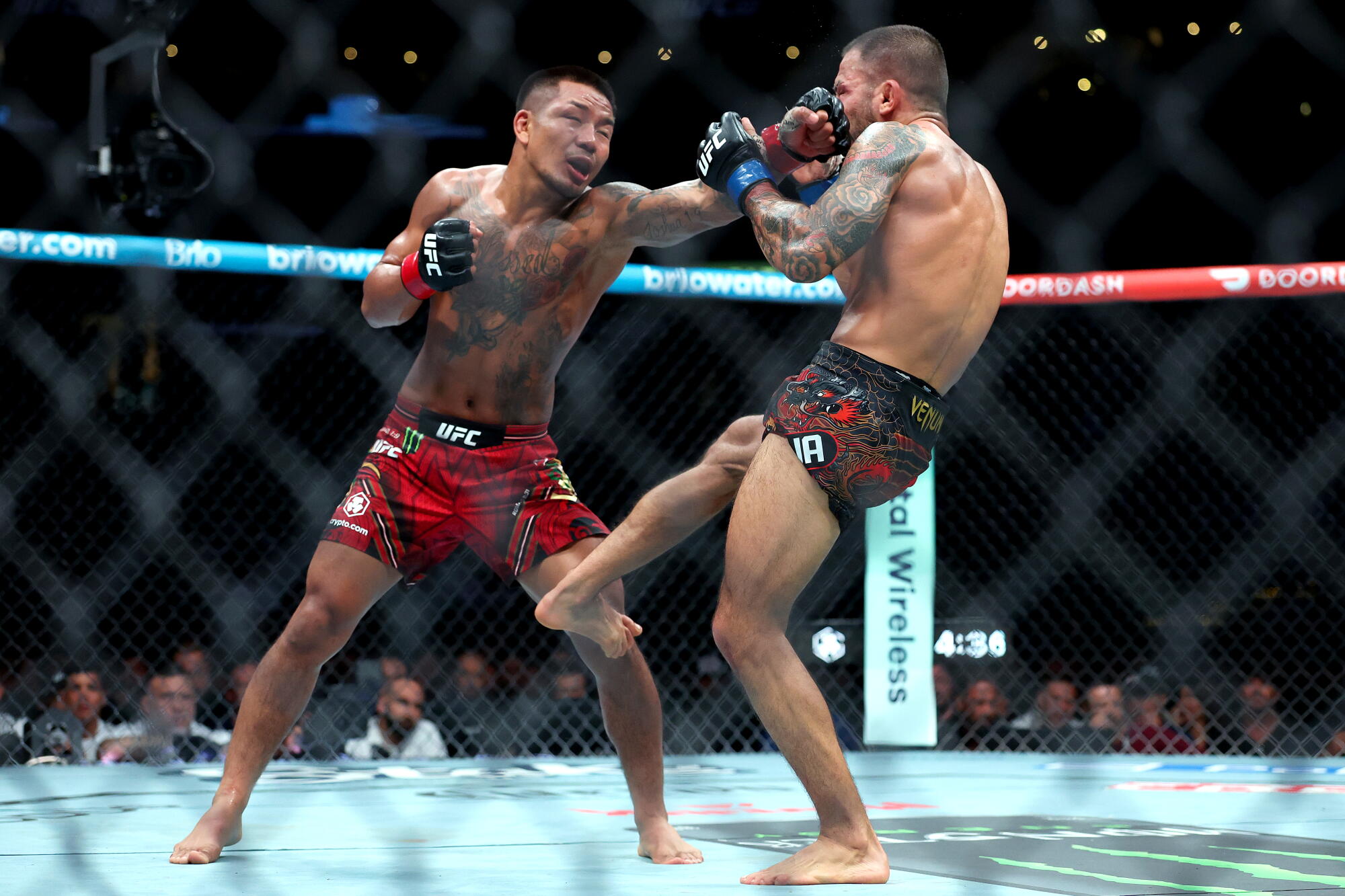
Joshua Van punches Alexandre Pantoja during their UFC 331 flyweight championship bout at Crypto.com Arena on Saturday.

Joshua Van punches Alexandre Pantoja during their UFC 331 flyweight championship bout at Crypto.com Arena on Saturday.

(Luke Hales / Getty Images)

Both fighters had much to gain during their return to the Octagon.

The animosity that had built up was evident from the start. As the fight began, Pantoja went straight for Van. The Brazilian scored an early takedown and sought to keep the champion on the mat, attempting to turn the fight into a grappling and ground-and-pound battle.

Van resisted and managed to get back to his feet. The lack of action during some early stretches prompted the first boos from the crowd.

But the pace changed.

Van began to find openings with his hands and Pantoja had to absorb strikes while continuing to seek takedowns. The champion also showed better defense against the Brazilian’s advances as the rounds progressed.

In the second round, the fight had to be briefly stopped after Pantoja claimed a headbutt. The strike was reviewed and determined to have been accidental, so the fight continued.

“I don’t even know why he was getting worked up. He came at me throwing punches, and I was just trying to counter, and he simply hit me in the head,” Van said. “I guess … I have a tougher head. So then he started complaining and all that. He was saying, ‘You headbutted me, you’re cheating.’ And I told him, ‘You hit me!’ So… um … that was it.”

Van began to take greater control of the fight during the second and third rounds. His boxing allowed him to keep Pantoja at a distance and respond when the Brazilian tried to close in to take him down. Pantoja kept pressing, but he could no longer control the fight on the ground for extended periods.

The fourth round allowed the former champion to regain some of the control he’d lost. Pantoja managed to take Van down to the canvas again and worked from the top for much of the round, showing that he could still trouble the champion when he managed to impose his style.

Van, however, ended the fight on a high note.

“I knew I hurt him — you know, I knew I hurt him,” Van said. “He’s a mental giant, you know. He just didn’t want to go down. He doesn’t want to show that he’s hurt, but I know deep down he was hurt. But like I said, man, that’s why I respect him so much.”

In the fifth round, the champion landed a powerful right-hand punch that knocked Pantoja down. The Brazilian managed to recover and continue until the end, but the blow ultimately tipped the fight in Van’s favor.

Alexandre Pantoja tries to pin Joshua Van on the ground during their UFC 331 flyweight championship bout.

Alexandre Pantoja tries to pin Joshua Van on the ground during their UFC 331 flyweight championship bout at Crypto.com Arena on Saturday.

(Luke Hales / Getty Images)

Ahead of the bout, Van defended his title in May against Tatsuro Taira, winning by technical knockout in the fifth round. Pantoja, on the other hand, hadn’t competed since his elbow injury against Van.

“There’s nothing to prove, man,” Van said. “Like I said, I knew I was going to win the first fight, too. So it’s like: ‘OK, do you guys want to see me win again?’”

Before the fight, tensions between the two had escalated. Van had insisted that his first victory wasn’t solely due to Pantoja’s injury, while the Brazilian argued that the December result didn’t show who was truly the better fighter.

The answer, this time, came after 25 minutes.

Tsarukyan knocks out Ruffy

Arman Tsarukyan celebrates after earning a knockout win over Mauricio Ruffy during his UFC 331 lightweight bout.

Arman Tsarukyan celebrates after earning a knockout win over Mauricio Ruffy during his UFC 331 lightweight bout at Crypto.com Arena on Saturday.

(Luke Hales / Getty Images)

The co-main event of the night also ended sooner than expected.

Arman Tsarukyan and Mauricio Ruffy arrived at Crypto.com Arena with a five-round bout scheduled and key positions in the lightweight division on the line. Ruffy accepted the fight with just four weeks of preparation after Charles Oliveira was pulled from the card.

Ruffy came out ready to trade blows and showed speed in the opening minutes. Tsarukyan, as he had done for much of his career, sought to use his wrestling skills to change the pace of the fight.

Tsarukyan managed to drive Ruffy against the cage and began landing elbows. At the 4:56 mark of the first round, Tsarukyan landed two elbows that knocked Ruffy out and forced the referee to stop the fight.

“I came to Los Angeles to enjoy the city,” Tsarukyan said. “But I also came to win. I owe those elbows to one of my coaches who taught me how to use them.”
Source link

Journey’s biggest hits, ranked from worst to best

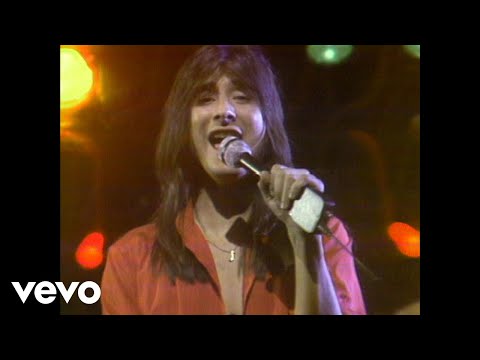
Turn on a radio between 1978 and 1987 and you were sure to hear Journey — any of the more than two dozen sumptuous yet muscular rock hits that shaped young America’s ideas about love, inspiration and wanting it the way you need it. Four decades later, the band’s music is still everywhere, including television, social media and streaming platforms like Spotify, where Journey has more monthly listeners than Bruce Springsteen, U2 or Bob Dylan. Yet Saturday night the group will bring what it’s calling its farewell tour to Crypto.com Arena — a capstone (at least if the band is to be believed) to a long career full of twists and turns.

Indeed, domination was hardly a given when guitarist Neal Schon and keyboardist Gregg Rolie — both of whom had played with Carlos Santana — formed Journey as a kind of jazzy proto-jam band in San Francisco in 1973. But with the addition a few years later of singer Steve Perry, the group found its gloriously dramatic sound and began racking up hits one after the next (though critics were rarely kind). Perry eventually quit, which took the wind out of Journey’s sails until Schon discovered an uncanny soundalike from the Philippines, Arnel Pineda, on YouTube; he’s helped the band get back into arenas and the occasional stadium even as Schon and keyboardist Jonathan Cain, who replaced Rolie in 1980, have battled each other in court over financial matters.

Got all that? To try to make sense of Journey’s path, I’ve ranked all 25 of the band’s hits that have charted on Billboard’s Hot 100, starting with the worst and ending with the best. Hold onto that feeling — it goes on and on and on and on.

25. ‘Walks Like a Lady’ (peaked at No. 32 in July 1980)

Some are born to sing the blues, as Perry once observed — just not Perry himself, who chews his way through this corny come-on like an overserved uncle at the Hard Rock Cafe. Nice showcase for Rolie’s organ work, though, on one of the last Journey singles he played on before leaving the band.

24. ‘Just the Same Way’ (peaked at No. 58 in May 1979)

Rolie and Perry tag-teaming lead vocals is not a form of democracy I’d vote for.

23. ‘After the Fall’ (peaked at No. 23 in August 1983)

Safe? Sterile? Soulless? Look, the haters can’t always be wrong.

22. ‘Too Late’ (peaked at No. 70 in January 1980)

“Before your time has run astray / You’ve got to try to get away.”

21. ‘Anytime’ (peaked at No. 83 in July 1978)

After overseeing Queen’s first few albums, producer Roy Thomas Baker turned his attention to Journey (and to the Cars); this midtempo number from the “Infinity” LP offers a credible approximation of Queen’s trademark stacked vocal harmonies.

20. ‘The Party’s Over (Hopelessly in Love)’ (peaked at No. 34 in April 1981)

Three platinum plaques in less than two years — for “Infinity,” “Evolution” and “Departure” — meant that Journey had no choice but to drop a live record, “Captured,” at the top of 1981. (It went platinum by Christmas.) As extra consumer bait, the double album closed with this new studio cut built around a killer Schon lick (and not much else).

19. ‘Good Morning Girl’/‘Stay Awhile’ (peaked at No. 55 in September 1980)

Phantom of the roller rink.

18. ‘Why Can’t This Night Go On Forever’ (peaked at No. 60 in May 1987)

Propelled by the success of his debut solo album — not to mention his appearance on the smash all-star “We Are the World” — Perry assumed greater control of Journey’s sound for 1986’s synthed-up “Raised on Radio,” which spawned no fewer than five singles, ending with this slightly lugubrious ballad. Yet the takeover came with a cost: By the end of 1987, the band had entered a hiatus that would last nearly a decade.

17. ‘Still They Ride’ (peaked at No. 19 in July 1982)

Listen to how nimbly Perry maneuvers some very tricky intervals.

16. ‘When You Love a Woman’ (peaked at No. 12 in December 1996)

Journey reunited for 1996’s “Trial by Fire,” which brought the band its only Grammy nomination (and which might feature the ghastliest album cover in music history). If the members knew that rock had changed dramatically while they were away, they didn’t show it in the LP’s romantic lead single: “When You Love a Woman” — a chart-topper for three weeks on Billboard’s adult contemporary tally — clearly sought to pick up where “Open Arms” and “Faithfully” had left off.

15. ‘Girl Can’t Help It’ (peaked at No. 17 in November 1986)

Wonder what Perry and Huey Lewis talked about between takes on “We Are the World.”

14. ‘Be Good to Yourself’ (peaked at No. 9 in May 1986)

“Karate Kid”-core.

13. ‘Only the Young’ (peaked at No. 9 in March 1985)

More “Karate Kid”-core, in this case released first as a song by Patty Smyth’s band Scandal; Journey’s version later wound up alongside Madonna’s “Crazy for You” on the soundtrack to “Vision Quest.”

12. ‘Wheel in the Sky’ (peaked at No. 57 in May 1978)

Before Perry came aboard in 1977, Journey spent a few months with Robert Fleischman as lead singer — long enough for Fleischman to co-write the group’s first Hot 100 entry, not so long that he got to sing it on the record.

11. ‘Any Way You Want It’ (peaked at No. 23 in April 1980)

Ooh, baby, hold tight.

10. ‘Suzanne’ (peaked at No. 17 in August 1986)

Easily Perry’s most unhinged vocal performance.

9. ‘Send Her My Love’ (peaked at No. 23 in November 1983)

A luscious and melancholy white-soul song that I’d bet Phil Collins admired back in the day — and that Justin Bieber would probably flip for now.

8. ‘Lovin’, Touchin’, Squeezin’’ (peaked at No. 16 in October 1979)

Inducting Journey into the Rock & Roll Hall of Fame in 2017, Train’s Pat Monahan belted the na-na-na outro of the band’s first Top 40 hit as he made his case for the group’s excellence. “They didn’t even need lyrics — that’s how badass this band is,” he pointed out. Still, let’s not gloss over the appealing perversity of starting a song this horny the way Perry does: “You make me weep and want to die.”

7. ‘Lights’ (peaked at No. 68 in September 1978)

Dodgers fans can delight in the fact that Perry originally wrote this paean to San Francisco — an anthem taken up at one time or another by every Bay Area pro sports team, including the Giants — about the lights going down and the sun shining on … Los Angeles. (Swap out “the bay” for “L.A.”) Maybe that’s why “Lights” has always felt to me like a precursor to the Red Hot Chili Peppers’ “Under the Bridge.”

6. ‘Separate Ways (Worlds Apart)’ (peaked at No. 8 in March 1983)

[Listens to “Eye of the Tiger” once.]

5. ‘I’ll Be Alright Without You’ (peaked at No. 14 in February 1987)

Shout out to future “American Idol” judge Randy Jackson, who joined Journey for “Raised on Radio” and proceeded to lay down the slinkiest, sultriest, funkiest bass line the band had ever known.

4. ‘Don’t Stop Believin’’ (peaked at No. 9 in December 1981)

Believin’ in what, exactly? The genius of Journey’s most-streamed track on Spotify (with more than 2.9 billion plays) is its use of concrete images to advance a pretty mysterious narrative. We’ve all stood under a streetlight; we all know the smell of wine and cheap perfume. Yet everybody’s midnight train is going to a different anywhere.

3. ‘Open Arms’ (peaked at No. 2 in February 1982)

Famously — and fortuitously — rejected by a former bandmate of Cain’s as “sentimental rubbish,” “Open Arms” was perhaps just waiting to be embraced by Perry, who sings it with the wounded gusto of a man well acquainted with regret. In a poetic twist, Journey’s highest-charting hit was blocked from No. 1 by the J. Geils Band’s “Centerfold,” in which the heartbroken narrator goes laughing all the way to his bed.

2. ‘Who’s Crying Now’ (peaked at No. 4 in October 1981)

The first of three Top 10 singles from 1981’s 10-times-platinum “Escape,” this immaculate R&B jam imagines an alternate dimension where Perry and Cain hear Earth, Wind & Fire’s “After the Love Has Gone” and decide to form a new group with David Foster. Except Perry remembers the song as a high point for Schon: “You know the guitar outro from ‘Who’s Crying Now’?” he asked a New York Times reporter in 2003. “I fought for that because I knew no DJ would cut that song off with Neal’s guitar wailing at the end of it. It was too brilliant.”

1. ‘Faithfully’ (peaked at No. 12 in June 1983)

It wasn’t the first rock ballad about life on the road — and it definitely wasn’t the last — but “Faithfully” might be the most emotionally generous: “Loving a music man ain’t always what it’s supposed to be,” Perry tells his lady, grounding the song in the experience of those who leave and those left behind; later, he envisions their reunion with such tenderness — “I’ll get the joy of rediscovering you” — that you know he’s already decided to take off again.

Source link