columbia circuit

Trump asks Supreme Court to let White House resume ballroom construction during appeal

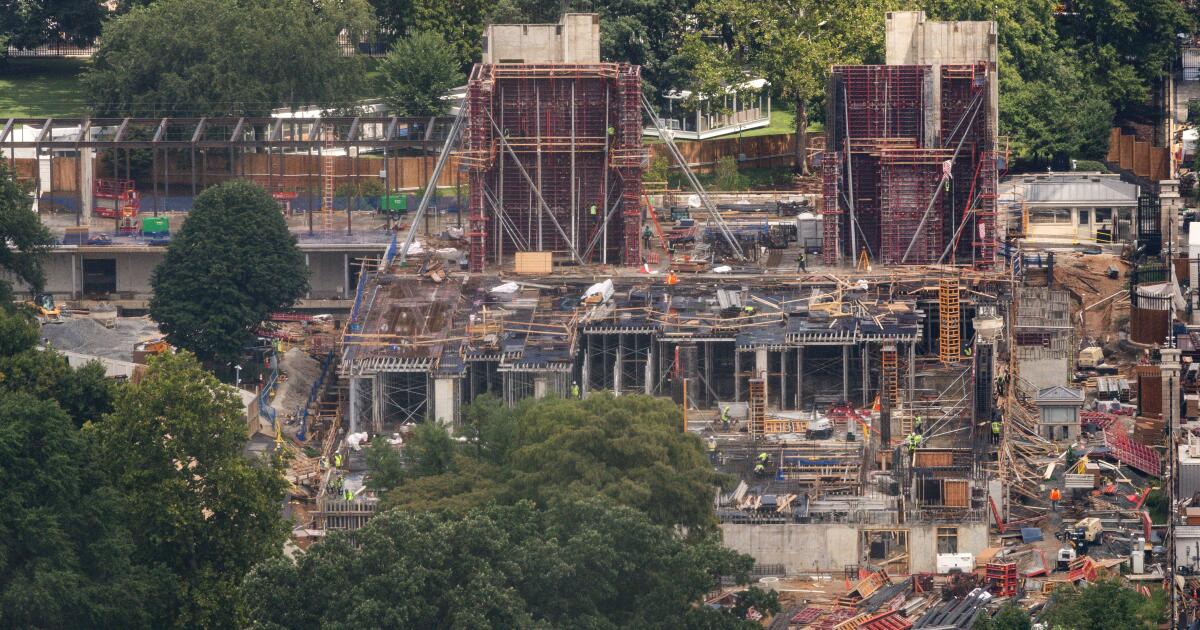
President Trump’s administration has asked the U.S. Supreme Court to allow the White House to resume construction on its $400 million ballroom project while it appeals a lower court’s order to halt the work.

Trump’s solicitor general on Friday petitioned the high court to suspend last week’s decision by a three-judge panel from the U.S. Court of Appeals for the District of Columbia Circuit.

The divided panel ruled last week Trump must stop the White House ballroom’s construction because Congress has not approved the project. The panel’s majority said Trump doesn’t have the unilateral authority to build a 90,000-square-foot ballroom where the White House’s East Wing stood before he ordered its demolition last fall.

The lower court suspended its own ruling for two weeks to give Trump’s Republican administration time to appeal to the Supreme Court. The solicitor general asked the Supreme Court to rule on its stay petition before the appeals court panel’s decision takes effect on Aug. 21.

“This case involves an extraordinary and unlawful injunction that will halt the ongoing construction of the integrated military complex, including a totally secure ballroom space, at the East Wing of the White House, which is vitally required by national security,” the solicitor general wrote.

The lower court’s 2-1 decision sided with historic preservationists who sued to stop construction of the ballroom.

The administration argues that the president, not Congress or the courts, has unimpeded authority to renovate the White House. The current state of the project, essentially an open construction site, makes it harder to protect the White House, the Justice Department contends.

The administration also says the National Trust for Historic Preservation does not have the legal right, or standing, to sue over the ballroom.

During an appeals court hearing in early June, an administration lawyer defended a broad view of presidential control over iconic public facilities.

The government could bulldoze the Statue of Liberty and the White House, Justice Department lawyer Yaakov Roth said in response to a hypothetical question, and the descendants of immigrants who came through Ellis Island and the enslaved people who built the White House would not have standing to sue.

Kunzelman writes for the Associated Press.
Source link

Pentagon policy illegally banned transgender troops from military service, appeals court panel rules

A Trump administration policy illegally banned transgender troops from military service, a divided panel of federal appeal court judges ruled on Monday.

The majority opinion by a three-judge panel from the U.S. Court of Appeals for the District of Columbia circuit largely upholds a March 2025 ruling by U.S. District Judge Ana Reyes in Washington, D.C. Reyes concluded that President Trump’s executive order to exclude transgender troops from military service likely violates their constitutional rights.

The administration appealed after Reyes issued a preliminary injunction requested by attorneys for six transgender people who are active-duty service members and two others seeking to join the military. The appeal court’s majority decided that the injunction should be narrowed to the plaintiffs currently serving in the military but not those seeking to join.

The ruling won’t immediately go into effect, allowing the administration time to ask the full appeals court to hear the case.

The U.S. Supreme Court allowed the transgender military ban to go into effect last year, as litigation continues to play out. Another lawsuit challenging the ban was filed in Washington state and led to a ruling in favor of the plaintiffs challenging the policy in that case.

In January 2025, Trump signed an executive order that claims the sexual identity of transgender service members “conflicts with a soldier’s commitment to an honorable, truthful, and disciplined lifestyle, even in one’s personal life” and is harmful to military readiness.

In response to the order, Defense Secretary Pete Hegseth issued a policy that presumptively disqualifies people with gender dysphoria from military service. Gender dysphoria is the distress that a person feels because their assigned gender and gender identity don’t match. The medical condition has been linked to depression and suicidal thoughts.

The policy “appears to be driven by the bare desire to harm a politically unpopular group: persons who identify as transgender,” Judge Robert Wilkins wrote for the majority. Wilkins was nominated to the court by Democratic President Obama.

In a dissenting opinion, Judge Justin Walker said judges lack the power to second-guess the decision to exclude transgender troops.

“We have neither the expertise nor the authority to decide whether the military can exclude the plaintiffs from its ranks. The Constitution assigns that authority to Congress and the Commander in Chief,” wrote Walker, who was nominated by Trump, a Republican.

Judge Judith Rogers, who was nominated by Democratic President Clinton, joined Wilkins’ opinion but also partially dissented.

Kunzelman and Whitehurst write for the Associated Press.

Source link