college

Prep talk: Former San Fernando Valley tennis players lead Mission College to state title

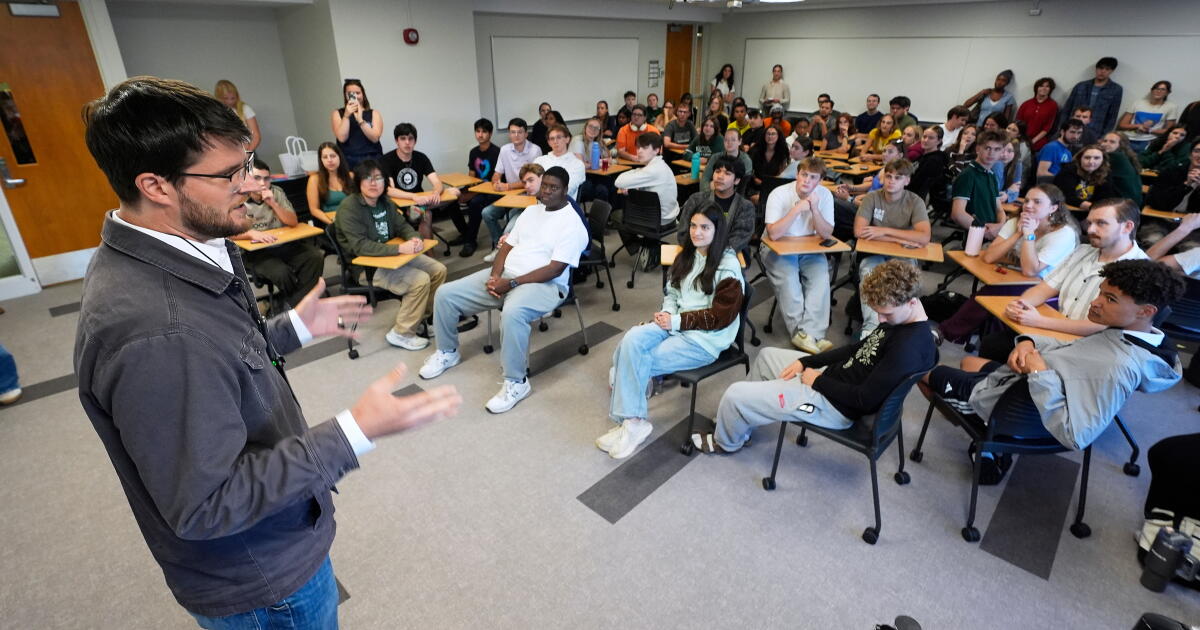
Five years ago, longtime baseball coach Joe Cascione left coaching the sport to start a women’s tennis team at Mission College.

On Wednesday, Mission College won the state women’s tennis championship armed with local players from Kennedy, Granada Hills, Sylmar and Birmingham high schools, among others.

It’s quite an achievement to win it all with local athletes.

Key contributors included Amy Nghiem, Priscilla Grinner and America Fragoso from Granada Hills; Jaelyn Rivera from Birmingham; Josilyn Rivera and Natalia Ponce from Kennedy; Alitzel Ortega Partida from Golden Valley; Genesis Nochez from West Ranch and Kristen Bonzon from Sylmar.

Cascione singled out his players for their passion and commitment.

This is a daily look at the positive happenings in high school sports. To submit any news, please email eric.sondheimer@latimes.com.

Source link

Clinton Vows to Help California : Economy: President is mobbed in campaign-style stops in inner city and Valley College. He says he will pick a ‘compassionate but hard-headed’ INS chief.

Closing a two-day Western trip, President Clinton on Tuesday pledged to Los Angeles audiences his special commitment to help the California economy, while asking state residents to do their part for the economic plan he is pushing through Congress.

Clinton, in mobbed campaign-style stops in South-Central Los Angeles and at Los Angeles Valley College in Van Nuys, asserted that the U.S. economy won’t recover until the nation’s largest state can pull itself out of its slump. “We can’t turn this economy around unless we’re going to lift California up,” Clinton told students at the community college.

The President also signaled his interest in California immigration problems, saying that he will soon pick a “compassionate but hard-headed” person to head the Immigration and Naturalization Service. He said he hopes to get Atty. Gen. Janet Reno’s recommendation for that post as early as this week.

Clinton, who has traveled out of Washington for part of the past two weeks trying to drum up support for his economic plan, visited a black-owned apparel store on South-Central’s Florence Avenue to illustrate his view that the riot-torn area can only be rebuilt through a joint effort of government and business. He used the community college stop to stress his advocacy of continually retraining workers to make them competitive in a world economy.

The Clinton road show has been part economics seminar and part campaign extravaganza, and his visit to Los Angeles was no exception.

At the community college, he sat on a wooden stool under flowering mimosa trees to field questions from students on education, jobs, immigration and other subjects. At the South-Central stop, he and Commerce Secretary Ronald H. Brown toured the store, then stripped off their suit jackets and ties and shot baskets for a few minutes with a group of youngsters.

The crowds were large and warm, but Clinton’s most impassioned defense of his program came when hecklers taunted him at the community college. To their chants “You broke your promise”–referring to his pledge not to raise taxes on the middle class–and “No new taxes,” the President rejoined:

“You know what the ‘no new tax’ crowd did for 12 years? They cut taxes on the rich, raised taxes on the middle class and left the country in a ditch,” he said. “The free lunch crowd has had their chance.”

He cited as proof of his commitment to California the efforts of Commerce Secretary Brown, who has visited the state seven times since January to help coordinate the government’s effort to help the economy. He said he had asked Brown to “map a specific plan to turn this economy around.”

The President told the college students he would like to help the state’s economy through increased aid for laid off defense workers and their communities, additional community policing and financial aid to offset immigration-related costs.

He made again a pitch for the central idea of his economic plan, that the country needs to cut its deficit while increasing spending–”investment”–for other purposes that will strengthen the economy over the long term.

In South-Central Los Angeles, Clinton visited The Playground, a community center and sporting goods store on Florence Avenue just one mile west of where rioting erupted last year. It was founded by a business person, a lawyer, a doctor and ex-gang members from the Crips. A basketball court was established in back so youths could play as well as buy merchandise.

While the store has received no federal aid, Clinton used it to illustrate his Administration’s redevelopment strategy, which also calls for the use of tax-advantaged “empowerment zones” to bring commerce to distressed areas.

After touring the store and meeting its owners, Clinton headed for the basketball court. He shed his coat, removed his shoes and socks and deposited the contents of his pockets in a shoe box.

In front of a phalanx of several dozen photographers, Leonard Baylor, 8, presented Clinton with a gift of size 13 sneakers.

“Thank you, Mr. President, for coming,” Leonard told the President. “Here, take these shoes.” Then, the boy said to the President: “Shoot some hoops with us?”

Baylor broke into tears–because he was overcome with emotion, a store owner later said. The President pulled Baylor close to comfort him.

Clinton pulled off his tie and pulled on athletic socks and the sneakers. Brown did the same. They then joined 18 youths on the court ranging in age from 6 to 17.

The President captained one team and Brown led another while a friendly crowd of about 200 as well as reporters and camera crews looked on.

Clinton, with shirttails flapping from the back of his baggy suit pants, missed his first two shots, then saved face by hitting from 10 feet out. Brown, however, swished from 20 feet away.

Clinton also grabbed five rebounds. “I made some good passes,” he said, but seemed to acknowledge that his commerce secretary stole the show, declaring, “Can Ron Brown shoot a jump shot or what?”

After the game, Clinton told the crowd: “I want everybody in America to know that there are people here in Los Angeles who believe that we can bring business to this area, that we can put people to work, if you have the help you need.”

“I wanted to come here today not just to have a little fun with a basketball, but to say to you and all of America that we’re going to have to rebuild this country from the grass roots up,” Clinton said. “This is an incredible untapped resource for America. If everyone in this country who wanted a job had one, we wouldn’t have half the problems we’ve got.”

Clinton said that he and Brown planned to go back to Washington to try to pass an economic program that will put “you back to work.”

The crowd in South-Central was clearly with him. Dorothy Redmond, a nursery school owner in the neighborhood, said: “I’m very encouraged. I am an entrepreneur of a small business and I think this is a step in the right direction.”

“I’m just speechless,” said Flora Lane, who traveled to South-Central from her home in the Wilshire district. “He is a person who cares about all people. I am for him 100%, plus his wife.”

But all the reviews of Clinton’s program weren’t favorable.

In Washington, Senate Minority Leader Bob Dole (R-Kan.) characterized Clinton’s trip as “heading West while his poll numbers go South.”

“His West Coast public relations blitz is just another political make-over to try to convince people he’s cutting spending when he’s really breaking all world records for tax increases,” Dole said.

In Sacramento, the Wilson Administration released a report contending that Clinton’s five-year plan would cost Californians $11.6 billion more than their “fair share” of spending cuts and tax increases.

The state Department of Finance said it drew its figures from Clinton’s proposals for defense cuts, defense conversion and retraining, tax increases on personal income and energy, and tax credits for investment. The analysis also included estimates of the indirect effect of changes in spending and tax policy and a possible reduction in interest rates.

The study said it was assumed that “California will receive a disproportionate share of benefits included in the Clinton proposals–tax credits, investment spending and defense conversion spending.”

But those benefits, it said, will only partially offset the “dampening effect” of the defense cuts. Although California’s population is about 12% of the nation, the study said it appeared the state would absorb at least 25% of the cuts.

Overall, the report said, the plan would cost Californians $68.7 billion, or 14.6% of the total. Based on the state’s 12% share of the nation’s population, the “fair share” of the deficit-cutting burden would cost the state and its residents $57 billion, the report said.

Times staff writer Daniel M. Weintraub contributed to this story from Sacramento.

* RELATED STORIES: A3, B1

Source link

Trump administration terminates agreements to protect transgender students in several schools

The Education Department said Monday it has terminated agreements that previous administrations reached with five school districts and a college aimed at upholding rights and protections for transgender students.

The decision means the department will no longer play a role in enforcing those agreements, which called for schools to take steps to comply with federal civil rights law. The districts affected are Cape Henlopen School District in Delaware, Fife School District in Washington, Delaware Valley School District in Pennsylvania, and La Mesa-Spring Valley School District, Sacramento City Unified and Taft College in California.

Under the Biden and Obama administrations, the department interpreted Title IX, which prohibits sex discrimination in education, to include protections for transgender and gay students.

The Trump administration has penalized schools that have made efforts to accommodate students based on their gender identity. It has filed lawsuits in California and Minnesota over state policies permitting transgender students to participate in interscholastic sports, and opened civil rights investigations into schools and universities over their policies on transgender students.

But the announcement Monday appeared to involve the first known cases of the administration terminating civil rights settlements that had been negotiated with schools.

Assistant Secretary for Civil Rights Kimberly Richey said the action reflects the administration’s efforts to keep transgender students from participating in girls’ and women’s sports teams and accessing shared locker rooms.

“Today, the Trump Administration is removing the unnecessary and unlawful burdens that prior Administrations imposed on schools in its relentless pursuit of a radical transgender agenda,” she said in a written statement.

Ma writes for the Associated Press.

Source link

Judge blocks Trump administration from gathering for college applicant information

April 4 (UPI) — A federal judge has blocked the Trump administration’s attempt to collect data on students on public universities in their attempt to stop them from considering race as part of the admissions process.

Seventeen states had sued to stop the administration from forcing several universities from submitting seven years of data on applicants and admitted students to prove that they have not factored race into admission decisions, Politico and The Los Angeles Times reported.

U.S. District Court Judge Dennis Saylor on Friday night issued a preliminary injunction that will allow universities in California, Colorado, Connecticut, Delaware, Hawaii, Illinois, Maryland, Massachusetts, Nevada, New Jersey, New York, Oregon, Rhode Island, Vermont, Virginia, Washington and Wisconsin to retain their records until the trial is over.

The injunction said that the administration’s efforts to gather the information are “rushed” and “chaotic,” and moves to shut down the federal Department of Education would not only make collecting and analyzing the data difficult, but it may also become illegal.

“This is not a merely technical issue,” Saylor said in the ruling, explaining that if the department no longer exists, the work “cannot be turned over to States and local communities; they have no authority … to conduct such surveys.”

He added that that only federal agency with that authority is the DOE and its National Center for Education Services, meaning that if the department is shut down, the federal government’s authority to collect and analyze university data “vanishes.”

The Supreme Court in 2023 ruled against using affirmative action — the consideration of race to increase the diversity of university populations — in the admissions process.

The Trump administration has worked to enforce the ruling as part of its antagonistic view of diversity, equity and inclusion (DEI) programs. Gathering and analyzing public university data, as well as lawsuits, are among the ways they are doing so.

The federal DOE was created by Congress under President Jimmy Carter in 1979 with the aim of improving coordination and management of federal education programs, but Trump ordered the department to be dismantled in a March 2025 executive order.

Twenty states have sued the administration to prevent that effort, as well.

President Donald Trump delivers a prime-time address to the nation from the Cross Hall in the White House on Wednesday. President Trump used the address to update the public on the month-long war in Iran. Pool photo by Alex Brandon/UPI | License Photo

Source link

Trump pushing to stabilize college sports and limit transfers

President Trump signed an executive order aimed at fixing college sports Friday that would give federal agencies authority to cut funding at schools that don’t comply with mandates covering transfers, eligibility and pay-for-play in the rapidly changing industry.

The order is a laundry list of proposed fixes, many of which lawmakers and college leaders have been pushing for since the approval of a $2.8 billion settlement changed the face of games that were once played by pure amateurs.

Among the notable parts of the order was a call to establish “clear, consistent and fair eligibility limits, including a five-year participation window” — an element that could fend off the dozens of lawsuits the NCAA has faced of late.

It also calls for “structured transfer rules,” but offered no specifics for a system that allows players to move around freely, sometimes in the middle of the season, which adds uncertainty to roster building that many consider unsustainable.

As much as the changes he directs, Trump’s call for the Education Department, the Federal Trade Commission and the attorney general’s office to evaluate “whether violations of such rules render a university unfit for Federal grants and contracts” stands out as a proactive way to force change.

Several universities across the country have made policy changes related to diversity, equity and inclusion, transgender rights and even the sorts of courses they teach to comply with federal orders and avoid funding-related showdowns with the government.

At a college sports roundtable last month, Trump said he anticipated any order he signed would trigger litigation. Attorney Mit Winter, who follows college sports law, agreed, saying the order “appears to direct the NCAA to create rules that would likely violate” court orders.

NCAA President Charlie Baker, however, did not signal any intent to litigate, saying Trump’s order “reinforces many of our mandatory protections — including guaranteed health care coverage, mental health services and scholarship protections.”

“This action is a significant step forward, and we appreciate the administration’s interest and attention to these issues,” Baker said. “Stabilizing college athletics for student-athletes still requires a permanent, bipartisan federal legislative solution.”

Trump, in the order, also called on Congress to “quickly pass legislation,” the likes of which has stalled multiple times.

The president’s mandate is likely to set up a situation where the NCAA and schools have to decide whether to follow a federal court order or an executive order, Winter said.

“Federal court orders prohibit the NCAA from making athletes sit out a season if they transfer more than once and prohibit the NCAA from enforcing rules that limit collectives from being involved in recruiting,” he said. “The EO appears to direct the NCAA to create rules that would likely violate both of these court orders. Will the NCAA create rules that do that? And if they do, will schools follow them?

“Either way, we’re likely going to see litigation challenging the EO by athletes and third parties.”

Winter added that the order also appears to urge schools to pay new revenue share amounts.

“Most schools are paying 90-95% of their rev-share funds to men’s basketball and football players,” he said. “And those funds are already promised via contracts signed with those athletes. Will the order purport to make schools not adhere to those contracts?”

Long and Pells write for the Associated Press. AP writer Maura Carey contributed.

Source link

Prep talk: Jessie Christensen is the MacGyver of St. John Bosco football

Every football program needs a Jessie Christensen on their staff. She’s the MacGyver of St. John Bosco High‘s program.

Before colleges had general managers or people in charge of operations, St. John Bosco hired Christensen in 2013 to be director of football operations. That means everything and anything is within her purview, from travel arrangements to parental and player communication to finances to dealing with college coaches.

“She was first the first of her kind. Now everybody has one,” coach Jason Negro said.

A former parent in the program, Taliuta Viliamu-Asa, said of Christensen, “She wears so many hats and ensures each year that the whole operations, academics study halls, grade checks, player feeding, banquet, games, media visitors, ball boys, volunteers, tailgate, middle school camps, and etc. are well planned out. She has a hand in it all to make sure every event, trip, fundraiser, football game and practically everything involving the football program results in being ran with careful planning for successful results.”

Always be nice to Christensen, for she has the keys to open any door.

This is a daily look at the positive happenings in high school sports. To submit any news, please email eric.sondheimer@latimes.com.

Source link

‘Atomic Dragons’ opened at Pitzer College, then the U.S. bombed Iran

The anti-nuclear artists collective whose work is on display at Pitzer College in Claremont never predicted a nuclear proliferation crisis would break out in the Middle East during their exhibit, or how grimly topical their work would quickly become as a result.

“Atomic Dragons,” wrapping April 4 with a closing-day symposium of nuclear experts, is the work of SWANS, which stands for Slow War Against the Nuclear State. The group is made up of artists, activists and academics with ties to the nuclear industry, including children and spouses of nuclear industrial complex workers — putting a new spin on the “nuclear family.”

The show examines the environmental and human cost of the atomic era through an artistic lens, tracing present day nuclear risk back to its Cold War roots.

The SWANS’ warning call has always been clear, but ”Atomic Dragons” took on a whole new meaning when the United States and Israel launched a joint assault on Iran over its illicit stockpile of nuclear materials Feb. 28, three weeks after the show opened.

“We’re at the start of what will be an exceedingly dangerous period in terms of the Iranian nuclear program,” nuclear policy expert Scott Sagan, who co-directs Stanford’s Center for International Security and Cooperation, said. “We’re likely to have a major, major conflict over this.”

In a time of acute nuclear anxiety, SWANS is an outlet through which the artists process the fear and gravity of our atomic reality.

A black and white photo of a cherry tree."

Fiona Amundsen, “Yoshino Cherry Tree, Sanyo Buntokuden, Hiroshima (lovingly held),” 2025, from the series, “The Trees are Leaking Light,” 2024-25, 4 x 5 inch negative processed using seaweed, gathered from the ocean current of the Fukushima wastewater release, inkjet washi photograph.

(Chloe Shrager)

“My maybe-naive hope is that the artworks help to provide an avenue into that understanding of the severity of what it means to play with the nuclear,” said Fiona Amundsen, whose arresting film photography of three trees in Hiroshima that survived the 1945 nuclear bomb was developed using contaminated seaweed growing in the Fukushima wastewater release line.

The resulting images are dotted with delicate white flares: trace amounts of radioactive tritium that transferred to the film from the nuclear effluent during the chemical processing, bearing physical witness to the usually invisible effects of radiation.

Amundsen’s work is in keeping with the rest of the show, which fills two halls at the liberal arts school with visual and multimedia works that probe the persistence of radioactive materials. Artifacts from the birth of the nuclear age are also featured, including items recovered from postwar Hiroshima and a letter from the father of the nuclear bomb, Robert J. Oppenheimer.

The artworks are as likely to unsettle as they are to move.

Elin o’Hara slavick labored over an expansive series of photochemical drawings of every above-ground nuclear test — 528 in total, a selection of which are featured in the exhibit— on salvaged darkroom paper from Caltech, the institution that played a role in developing the detonators for the U.S. nuclear bombs dropped on Japan under the top secret Project Camel.

A photo-chemical drawing.

elin o’Hara slavick, selection from “There Have Been 528 Atmospheric Nuclear Tests to Date,” 2022, photo-chemical drawings on outdated and fogged silver gelatin paper.

(Chloe Shrager)

Slavick said she found the abandoned silver-gelatin paper, which was fogged despite being stored in closed boxes, in the basement of the university near a door labeled “Radiation Science,” which led her to believe radiation exposure from Caltech’s Manhattan Project past distorted the photographic paper.

SWANS seems to double as a support group for families impacted by the nuclear industry. Many members believe they’ve lost loved ones to radiation, or were themselves likely impacted by early-life exposure as children of Manhattan Project engineers. The tension between the anti-nuclear artwork and its artists’ familial ties to the production of the very technology they reject is an enticing dance of its own.

A photo of two milk bottles.

Judith Dancoff, “The Milk Pathway (still),” 2023, video, briefcase, antique milk bottles, and tempera.

(Chloe Shrager)

Writer Judith Dancoff links her hyperthyroidism and long-term reproductive issues from a pituitary gland tumor to childhood radiation exposure during a summer spent at the Oak Ridge uranium enrichment site in Tennessee where her father worked as a student of Oppenheimer. Her father died young of cancer, and the story is woven into her featured SWANS work.

One of the largest pieces on display at “Atomic Dragons” is Nancy Buchanan’s interactive full-wall exhibit of documents her father brought home from his government work as a Manhattan Project physicist, alongside material from the FBI file on his mysterious death, on display for viewers to read under looming red letters spelling out “SECURITY.”

An art installation on a white wall.

Nancy Buchanan, “Security,” 1987, installation with file folders, photos, map pins, and documents.

(Chloe Shrager)

The current crisis in Iran has sent memories bubbling to the surface for the collective, and chills down the spines of viewers.

Many have expressed fears of an Orwellian-style forever war, or worse, the use of the atomic weapon invented “to end all wars” in a twisted attempt to do so, poisoning the region as a byproduct. But nuclear policy expert Sagan said the likelihood of the conflict escalating to involve nuclear weapons is “exceedingly low,” even if Iran has the capability to build them.

Iran possesses enough 60% highly-enriched uranium to build about 10 nuclear weapons if further enriched to 90% weapons grade, he said. This could take a matter of weeks to complete depending on the state of Iran’s enrichment centrifuges, which Trump claimed to have “obliterated” during air strikes in June.

Iran could also craft a primitive nuclear device out of minimally enriched materials for an offensive attack (“60% could actually create an explosion, it just wouldn’t be a very efficient one,” according to Sagan), but George Perkovich, senior fellow for the Carnegie Endowment for International Peace’s Nuclear Policy Program and author of “How to Assess Nuclear Threats in the 21st Century,” points out that “you have to build more than one for it to be useful,” especially under the wrath of a nuclear-armed West’s expected response.

What is more likely, and probably more dangerous, experts say, is the now-heightened long-term risk of global proliferation. “This war is going to suggest to some countries that if they want to secure their sovereignty, they need nuclear weapons,” Sagan said.

A photo-chemical drawing.

elin o’Hara slavick, selection from “There Have Been 528 Atmospheric Nuclear Tests to Date,” 2022, photo-chemical drawings on outdated and fogged silver gelatin paper.

(Chloe Shrager)

Since 1968, the world nuclear order has rested on the delicate architecture of the Nuclear Non-Proliferation Treaty, enforcing the international norm that countries without nuclear weapons won’t try to get them, and countries with nuclear weapons won’t help arm their allies. Now, experts say the rulebook has been thrown out.

“What this does is it breaks the old system that was based on the non-proliferation treaty,” said Perkovich, who has worked on nuclear issues for 44 years. “It’s now ‘might makes right,’ everybody’s on their own, friends versus enemies. I think the terms now change, and we’re not bargaining.”

Though the timing of the military operation in Iran with the “Atomic Dragons” exhibit could not be described as kismet as much as brutally ironic, slavick said the “sick and sad thing” is that “it’s always topical when you’re an American.”

“We do this. We wage wars. We are the leading nuclear country,” she said, speaking to the heart of the SWANS message: In a world where nuclear materials exist, it is not a matter of if humans will be harmed, but when.

There is a historic relationship between visual art and nuclear war, said Jim Walsh, a senior research associate at the MIT Security Studies Program on nuclear weapons risk issues in Iran and North Korea, who is also a speaker at the exhibit’s closing symposium. As the world enters a “more disruptive period” after the post-Cold War cooling of nuclear tensions, he expects to soon see “a flowering of artistic projects,” as nuclear risk reaches a local peak. “It’s a super powerful thing involving life and death, the planet, the entire environment, love and hate,” he said.

“Atomic Dragons,” which also features work created decades ago, highlights questions that are as relevant today as they were at the dawn of the nuclear era: Can we make the world safe enough so we can once again dream? Is the strength of a country found in its military rather than its culture? Is fear our gross national product?

Symposium: Art, Science, and the Nuclear Legacy

A talk by nuclear expert panelists Jim Walsh and David Richardson, as well as a viewing of the “Atomic Dragons” art exhibit and a conversation with the artists. Coffee and a light lunch will be served.

When: Saturday, April 4, 11 a.m. – 4 p.m.
Where: George C. S. Benson Auditorium, Pitzer College
Tickets: Free RSVP
Info: Details on event website

Source link

Trump signs order to ban other college games in Army-Navy time slot

March 21 (UPI) — President Donald Trump on Friday signed an executive order forcing networks and the NCAA to avoid scheduling conflicts with the annual Army-Navy game in December.

The order would create an exclusive broadcast window for the college football game, played between the U.S. Military Academy at West Point, N.Y., and the U.S. Naval Academy at Annapolis, Md. The game is usually played on the second Saturday in December, but College Football Playoffs and other post-season games have conflicted with the annual broadcast.

“Such scheduling conflicts weaken the national focus on our Military Service Academies and detract from a morale-building event of vital interest to the Department of War,” a White House press release titled “Preserving America’s Game” said. “Accordingly, it is the policy of the United States that no college football game, specifically college football’s CFP or other postseason games, be broadcast in a manner that directly conflicts with the Army‑Navy Game.”

The order says that the Federal Communications Commission and the Department of Commerce must work with the NCAA, College Football Playoff and broadcasters to prevent scheduling conflicts during the usual time slot for the game.

“Nobody’s going to play football for four hours during that very special time of the year, in December. It’s preserved forever for the Army-Navy game,” Trump said just before signing the order. “Of course, we’ll probably get sued at some point,” he added.

The president was surrounded by Naval Academy midshipment as he signed the order. Navy won the game against Army on Dec. 13, 17-16.

“Thank you for signing that executive order protecting the sanctity of the Army-Navy game,” Navy coach Brian Newberry said. “It’s a game with a soul, and it deserves to be protected.”

Some have suggested the Army-Navy game be played on a different day or to broadcast other games at the same time.

Army head coach Jeff Monken told The Athletic in February that he would rather play the game on Thanksgiving weekend to avoid conflict with the playoffs.

“I think Army-Navy is a huge part of the history of college football, and what it is today, even,” he said. “Give us a four-hour block on Thanksgiving, or on Friday of Thanksgiving, or on Saturday of Thanksgiving, and give us a four-hour block, and just say nobody else plays during this four-hour block. That’s still protecting the game.”

Media law experts say the White House should be careful of intervening in college sports.

Jeffrey Cole, director of the Center for the Digital Future at the University of Southern California’s Annenberg School for Communication and Journalism, wrote in an email to The Washington Post that the White House should have these important conversations.

“But, it should not be a ‘decider.’ If change is needed at the federal level, it should come from legislation.”

The Army vs. Navy game has been played annually since 1930. CBS Sports has the broadcast rights through 2038.

The game has traditionally been played on the last weekend of November or the first weekend of December, The Athletic reported. It moved to the second weekend of December in 2009 to bring more attention and ratings to CBS.

“We are deeply appreciative of President Trump’s executive order preserving a dedicated window for the Army-Navy Game — America’s Game — a tradition that represents far more than football by honoring our service academies and the mission of developing leaders for our nation,” Navy Athletic Director Michael Kelly said in a statement to The Athletic. “Maintaining its exclusivity ensures the country can come together to recognize the sacrifice, commitment and readiness that are essential to our military. We are also encouraged that this step helps create a pathway for Navy Football to participate in the College Football Playoff when earned, allowing us to both preserve tradition and embrace opportunity.”

“We’re grateful for the President’s leadership and for everyone working to protect, preserve, and unite around America’s game and the values it stands for,” Army Athletic Director Tom Theodorakis said in a statement.

Source link

Trump administration sues Harvard, saying it violated civil rights law and seeking to recover funds

The Justice Department filed a new lawsuit Friday against Harvard University, saying its leadership failed to address antisemitism on campus, creating grounds for the government to freeze existing grants and seek repayment for grants already paid.

The lawsuit, filed in federal court in Massachusetts, is another salvo in a protracted battle between the administration of President Trump and the elite university.

“The United States cannot and will not tolerate these failures,” the Justice Department wrote in the lawsuit. It asked the court to compel Harvard to comply with federal civil rights law and to help it “recover billions of dollars of taxpayer subsidies awarded to a discriminatory institution.”

The lawsuit also asks a judge to require that Harvard call police to arrest protesters blocking parts of campus and to appoint an “independent outside monitor,” approved by the government, to ensure it complies with court orders.

Harvard did not immediately respond to a request for comment.

The lawsuit comes after negotiations appear to have bogged down in the months-long battle with the Trump administration that has tested the boundaries of the government’s authority over America’s universities. What began as an investigation into campus antisemitism escalated into an all-out feud as the Trump administration slashed more than $2.6 billion in research funding, ended federal contracts and attempted to block Harvard from hosting international students.

In a pair of lawsuits filed by the university, Harvard has said it’s being unfairly penalized for refusing to adopt the administration’s views. A federal judge agreed in December, reversing the funding cuts and calling the antisemitism argument a “smokescreen.”

Ted Mitchell, president of the American Council on Education, a major association of colleges and universities, accused the administration of launching a “full scale, multi-pronged” attack on Harvard. Friday’s lawsuit, he said, is just the latest attempt to pressure Harvard to agree to changes favored by the administration.

“When bullies pound on the table and don’t get they want, they pound again,” Mitchell said.

The Trump administration began investigating allegations of discrimination against Harvard’s Jewish and Israeli students less than two weeks after the president took office. The allegations focus on Harvard’s actions during and after pro-Palestinian demonstrations during the Israel-Hamas war.

Officials concluded Harvard did not adequately address concerns raised about antisemitism that drove some students to conceal their religious skullcaps and avoid classes. During protests of the war, Trump officials said, Harvard permitted students to demonstrate against Israel’s actions in the school library and allowed a pro-Palestinian encampment to remain on campus for 20 days, “in violation of university policy.”

In its lawsuit Friday, the Justice Department also accused Harvard of failing to discipline staff or students who protested or tacitly endorsed the demonstrations, such as by canceling or dismissing classes that conflicted with protests.

“Harvard University has failed to protect its Jewish students from harassment and has allowed discrimination to wreak havoc on its campus,” White House press secretary Liz Huston said Friday on X. “President Trump is committed to ensuring every student can pursue their academic goals in a safe environment.”

Despite their bitter dispute, Harvard and the Trump administration have held some negotiations, and the two sides have reportedly been close to reaching an agreement on multiple occasions. Last year, the administration and the university were reportedly approaching a deal that would have required Harvard to pay $500 million to regain access to federal funding and to end the investigations. Almost a year later, Trump upped that figure to $1 billion, saying that Harvard has been “behaving very badly.”

At the same time, the administration was taking steps in a civil rights investigation that had the potential to jeopardize all of Harvard’s federal funding.

In June, the Trump administration made a formal finding that Harvard tolerated antisemitism.

In a letter sent to Harvard, a federal task force said its investigation had found the university was a “willful participant” in antisemitic harassment of Jewish students and faculty. The task force threatened to refer the case to the Justice Department to file a civil rights lawsuit “as soon as possible,” unless Harvard came into compliance.

When colleges are found in violation of federal civil rights law, they almost always reach compliance through voluntary agreements. When the government determines a resolution can’t be negotiated, it can try to sever federal funding through an administrative process or, as the Trump administration has done, by referring the case to the Justice Department through litigation.

Such an impasse has been extraordinarily rare in recent decades.

Last summer, Harvard responded that it strongly disagreed with the government’s investigative finding and was committed to fighting bias.

“Antisemitism is a serious problem and no matter the context, it is unacceptable,” the university said in a statement. “Harvard has taken substantive, proactive steps to address the root causes of antisemitism in its community.”

In a letter last spring, Harvard President Alan M. Garber told government officials that the school had formed a task force to combat antisemitism, which released a detailed report of what unfolded on campus after Hamas militants stormed Israel on Oct. 7, 2023, killing around 1,200 people and abducting 251 others. Israel retaliated with an offensive that killed tens of thousands of Palestinians and displaced around 90% of Gaza’s population — prompting pro-Palestinian demonstrations at colleges around the country.

After the demonstrations at Harvard, Garber said the university had hired a new provost and new deans and that it had reformed its discipline policies to make them “more consistent, fair and effective.”

Since he took office, Trump has targeted elite universities he believes are overrun by left-wing ideology and antisemitism. His administration has frozen billions of dollars in research grants, which colleges have come to rely on for scientific and medical research.

Several universities have reached agreements with the White House to restore funding. Some deals have included direct payments to the government, including $200 million from Columbia University. Brown University agreed to pay $50 million toward state workforce development groups.

Balingit and Casey write for the Associated Press.

Source link

College Republicans sue University of Florida’s president over deactivation of its chapter

College Republicans have sued the University of Florida’s president on free speech grounds over the school’s decision to deactivate its chapter after being notified that at least one member engaged in an antisemitic act.

The University of Florida College Republicans filed the lawsuit Monday in federal court against interim president Donald Landry, asking a judge to stop the enforcement of the school’s decision and to restore access to facilities on the Gainesville campus.

“The University of Florida punitively deactivated and shut down the UFCR, in response to alleged viewpoints expressed by a member of UFCR, and in an effort to silence the club and chill its future speech,” the group said in its lawsuit.

UF spokeswoman Cynthia Roldan Hernandez said in an email that the university doesn’t comment on pending litigation.

Officials at the University of Florida said over the weekend that they had been informed by the Florida Federation of College Republicans that the federation had disbanded the Gainesville campus’ chapter after determining that some members had “engaged in a pattern of conduct that violated its rules and values, including a recent antisemitic gesture.”

When the Florida Federation of College Republicans is ready, the university will assist with reactivating the campus chapter under new student leadership, UF officials said in a statement.

The deactivation wasn’t based on any university policy or rule, and it was only based on a member’s expression of a viewpoint “which was alleged to be antisemitic,” the lawsuit said.

The university also didn’t provide the College Republicans with adequate notice and didn’t give the chapter an opportunity to explain its side of the story, according to the lawsuit.

The deactivation effort at the University of Florida campus marks the second time this month that a public university in Florida has taken action against a Republican group accused of being involved in racist or antisemitic behavior.

Earlier this month, Florida International University in Miami launched an investigation into a group chat started by an official with the Miami-Dade chapter of the Republican Party that included violently racist slurs, antisemitic comments and misogynistic language. The chat involved students and several top conservative leaders at Florida International University.

Last fall, New York’s Republican State Committee suspended a Young Republican organization following the release of a group chat that included jokes about rape and flippant commentary on gas chambers.

Schneider writes for the Associated Press.

Source link