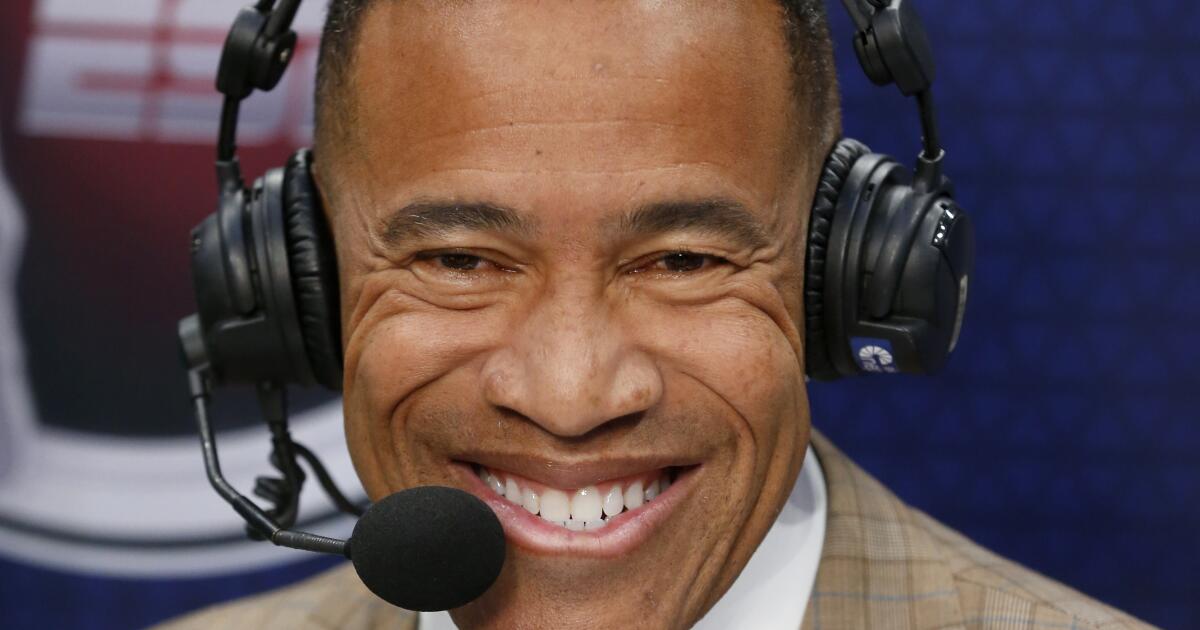
Mark Jones has been an on-air staple on ESPN since the first Bush administration — as in George H.W. Bush, who served from 1989 to 1992.
So, yeah, it’s been a long time.
And now, Jones says, “it’s time to move on.”
Jones’ final ESPN broadcast will be Sunday, when he will serve as the play-by-play announcer for the Orlando Magic at Boston Celtics game on the final day of the NBA’s regular season. It could very well be the last time the phrase “hotter than fish grease” is uttered on the network.
“It’s been a memorable journey these decades with the ABC/ESPN family, but I have decided that it’s time to move on,” Jones wrote in a statement posted Friday on Instagram. “From the day Dennis Swanson hired me in 1990 and working with the best producer in the business, Kim Belton, until today I will forever be grateful for the many friends and colleagues along the way.”
Jones, 64, started at ESPN in 1990. As a play-by-play announcer, he is best known for calling NBA games but he has also covered college football, men’s and women’s college basketball, the WNBA and UFL. On June 2, 2022, Jones, Mark Jackson and Lisa Salters were the first all-Black crew to call an NBA Finals game on TV.
In addition, Jones has hosted the “NBA Today” studio show and been an anchor and reporter on “SportsCenter.”
“Mark has made an enduring impact at ESPN since 1990, serving as a signature voice primarily within our NBA and college football coverage and across nearly all of our platforms,” ESPN said in a statement. “We’re grateful for Mark’s countless contributions and we wish him continued success.”
Separate from his work at ESPN, Jones has also been the primary TV play-by-play announcer for the Sacramento Kings since 2020.
Jones hasn’t indicated what he’ll be doing next, but he ended his announcement with a big prediction for the future — and threw in his signature phrase for good measure.
“As I move on to my next chapter I believe my best work is yet to come,” he wrote. “I’ll be out there cookin’ hotter than fish grease!”
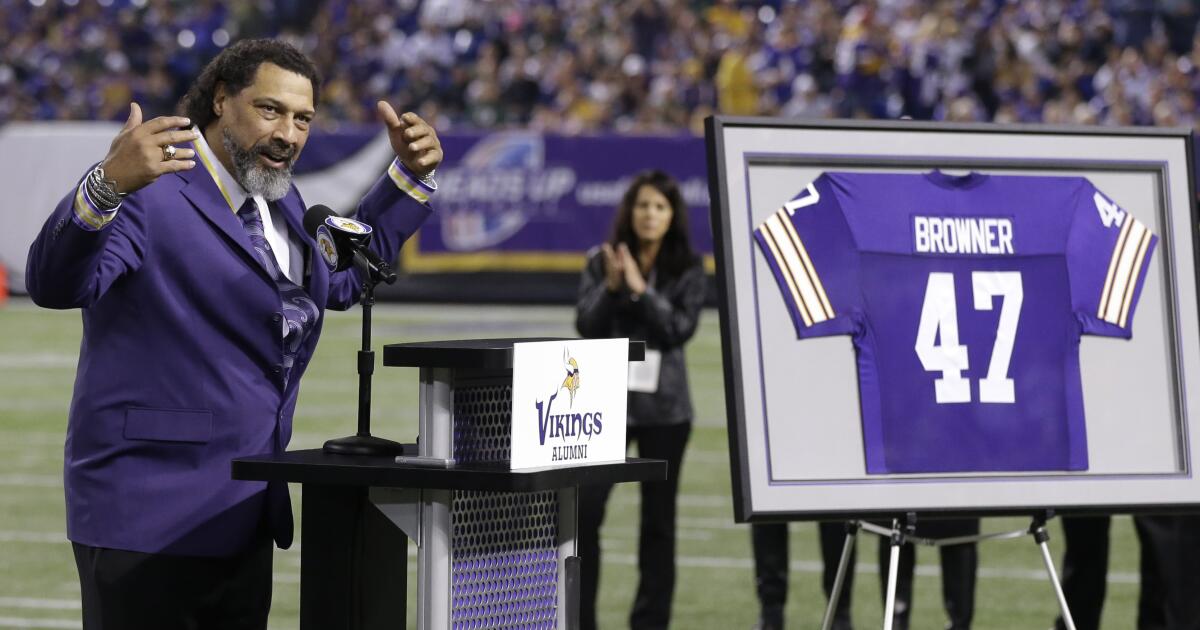
Joey Browner, a star defensive back at USC and a six-time NFL Pro Bowl selection, has died. He was 65.
“The Vikings are mourning the loss of Ring of Honor member Joey Browner,” the team said Sunday in a statement. “Browner will be deeply missed by former coaches and teammates, as well as many others he impacted throughout his life.”
The Vikings added in a separate post: “He helped define what it is to be an NFL safety.”
No cause of death was given. In August, former Minnesota quarterback Tommy Kramer organized a fundraiser for Browner, who Kramer said was “battling through some serious health issues.”
On Sunday, Kramer wrote about Browning on Facebook: “Not only a great player, a great person. Rest in peace my friend.”
Browner was one of six brothers, all of whom played college football and four of whom went on to play in the NFL. Younger brother Keith Browner, who also played at USC and spent five seasons in the NFL, died in November at age 63 after a sudden illness.
Oldest brother Ross Browner, who played 10 NFL seasons for the Cincinnati Bengals and Green Bay Packers, died in 2022. Another older brother, Jim Browner, who played two seasons for the Bengals, died in 2024.
A high school standout in football, basketball and track and field, Browner played at USC from 1979-1982. He was named team MVP his senior year and finished his college career with nine interceptions and 40 pass deflections, as well as one punt return for a touchdown.
In the 1983 draft, Browner became the first defensive back to be selected by the Vikings in the first round (19th overall). He went on to play nine seasons in Minnesota, making the Pro Bowl six times (1985-1990), and spent his final NFL season with the Tampa Bay Buccaneers.
Browner finished his career with 37 interceptions, 17 forced fumbles and 17 fumble recoveries. He was named to the NFL 1980s all-decade team, as selected by the Pro Football Hall of Fame, and inducted into the Vikings’ Ring of Honor in 2013.
Sean Salisbury, a former quarterback whose career intersected with Browner’s in college and the NFL, was one of many in the football community paying their respects to the four-time All-Pro player.
“This is a major gut punch,” Salisbury wrote on X. “I was blessed to be his teammate at USC and with the Vikings! Phenomenal player and loved by so many. One of the best players I’ve ever played with in both college and the NFL. Very grateful to have called him a good friend. God Bless him and his family.”
Former tight end Steve Jordan, who played nine seasons with Browner in Minnesota, recently visited his former teammate in the Twin Cities, according to a Vikings news release.
“We’ve lost a great friend and one of the best Vikings teammates,” Jordan said in a statement released by the team. “God blessed Joey with phenomenal talent and a big heart to love people and be a beacon of positivity. Truly, he will be missed.”
Former quarterback Rich Gannon, who played five seasons with Browner in Minnesota, wrote on X: “Sad to hear about the passing of my former teammate Joey Browner. On the football field he was one bad dude, off he was a kind soul!”
Retired punter Greg Coleman wrote on X that “one of the happiest moments of my time with the Vikings” was learning that Browner was going to be added to the punt team.
“One of the best teammates you could have and a man I called Friend!” Coleman wrote. “Prayers up for his family. RIP JB!”
Current Vikings cornerback Dwight McGlothern wrote on X: “Dang, I had a chance to meet him my rookie year & I was wearing #47 at the time during camp & hearing about his accomplishments, I’m grateful to [have] had the chance to meet him & [represent] the # he wore with the Vikings !! Everytime I walk in the DB room I always see greatness on the wall !!”
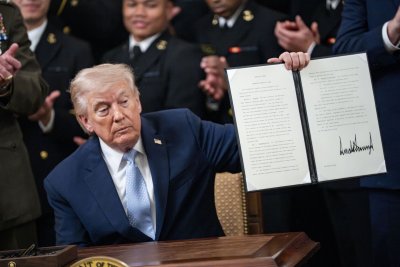
March 21 (UPI) — President Donald Trump on Friday signed an executive order forcing networks and the NCAA to avoid scheduling conflicts with the annual Army-Navy game in December.
The order would create an exclusive broadcast window for the college football game, played between the U.S. Military Academy at West Point, N.Y., and the U.S. Naval Academy at Annapolis, Md. The game is usually played on the second Saturday in December, but College Football Playoffs and other post-season games have conflicted with the annual broadcast.
“Such scheduling conflicts weaken the national focus on our Military Service Academies and detract from a morale-building event of vital interest to the Department of War,” a White House press release titled “Preserving America’s Game” said. “Accordingly, it is the policy of the United States that no college football game, specifically college football’s CFP or other postseason games, be broadcast in a manner that directly conflicts with the Army‑Navy Game.”
The order says that the Federal Communications Commission and the Department of Commerce must work with the NCAA, College Football Playoff and broadcasters to prevent scheduling conflicts during the usual time slot for the game.
“Nobody’s going to play football for four hours during that very special time of the year, in December. It’s preserved forever for the Army-Navy game,” Trump said just before signing the order. “Of course, we’ll probably get sued at some point,” he added.
The president was surrounded by Naval Academy midshipment as he signed the order. Navy won the game against Army on Dec. 13, 17-16.
“Thank you for signing that executive order protecting the sanctity of the Army-Navy game,” Navy coach Brian Newberry said. “It’s a game with a soul, and it deserves to be protected.”
Some have suggested the Army-Navy game be played on a different day or to broadcast other games at the same time.
Army head coach Jeff Monken told The Athletic in February that he would rather play the game on Thanksgiving weekend to avoid conflict with the playoffs.
“I think Army-Navy is a huge part of the history of college football, and what it is today, even,” he said. “Give us a four-hour block on Thanksgiving, or on Friday of Thanksgiving, or on Saturday of Thanksgiving, and give us a four-hour block, and just say nobody else plays during this four-hour block. That’s still protecting the game.”
Media law experts say the White House should be careful of intervening in college sports.
Jeffrey Cole, director of the Center for the Digital Future at the University of Southern California’s Annenberg School for Communication and Journalism, wrote in an email to The Washington Post that the White House should have these important conversations.
“But, it should not be a ‘decider.’ If change is needed at the federal level, it should come from legislation.”
The Army vs. Navy game has been played annually since 1930. CBS Sports has the broadcast rights through 2038.
The game has traditionally been played on the last weekend of November or the first weekend of December, The Athletic reported. It moved to the second weekend of December in 2009 to bring more attention and ratings to CBS.
“We are deeply appreciative of President Trump’s executive order preserving a dedicated window for the Army-Navy Game — America’s Game — a tradition that represents far more than football by honoring our service academies and the mission of developing leaders for our nation,” Navy Athletic Director Michael Kelly said in a statement to The Athletic. “Maintaining its exclusivity ensures the country can come together to recognize the sacrifice, commitment and readiness that are essential to our military. We are also encouraged that this step helps create a pathway for Navy Football to participate in the College Football Playoff when earned, allowing us to both preserve tradition and embrace opportunity.”
“We’re grateful for the President’s leadership and for everyone working to protect, preserve, and unite around America’s game and the values it stands for,” Army Athletic Director Tom Theodorakis said in a statement.
Makai Lemon got another chance Thursday to demonstrate his skills for NFL scouts.
About 50 of them — representatives from each of the 32 teams — gathered at USC to spend a few hours evaluating the school’s latest class of draft prospects. Lemon, who won the Biletnikoff Award last fall as college football’s top receiver, had everyone’s attention.
“Running good routes, catching the ball, running fast,” he said of his objectives for the day. “Whatever I showcase, let them know I can do it at a high level.”
It was a more comfortable setting than Indianapolis. At the scouting combine, Lemon’s performance at the podium drew scrutiny — not for anything he said, but for how he said it. He swayed. He was measured, unhurried, visibly unbothered. Some read it as detached. Others saw something else entirely.
“We don’t want a guy who’s phony and coached up,” said one team executive, speaking on condition of anonymity. “We want a guy to be his authentic self. As long as he’s not a jerk, we love it.”
Rams general manager Les Snead, who attended Thursday’s workout of 17 USC players, put it another way. “At the combine you’re usually getting some version of a personality,” he said. “A lot of times it’s, ‘This is my interview personality,’ and that’s not necessarily who they are 365 days a year.”
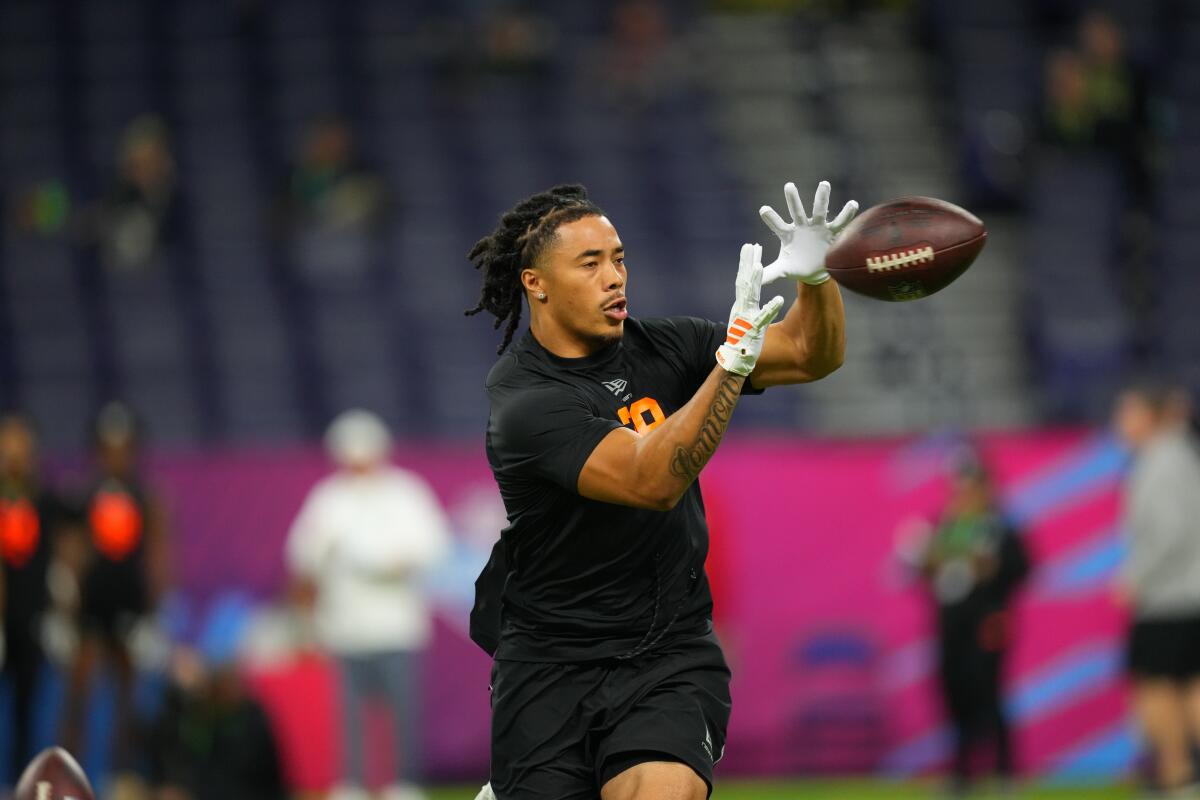
USC receiver Makai Lemon catches pass during a drill at the NFL combine in Indianapolis last month.
(Julio Cortez / Associated Press)
The other USC prospects who participated in Thursday’s workouts were receivers Ja’Kobi Lane, Jaden Richardson and Jay Fair; running back Eli Sanders; tight end Lake McRee; offensive linemen J’Onre Reed and DJ Wingfield; defensive linemen Anthony Lucas and Keeshawn Silver; linebacker Eric Gentry; cornerbacks DJ Harvey and DeCarlos Nicholson; safeties Bishop Fitzgerald and Kamari Ramsey; punter Sam Johnson; and long snapper Hank Pepper.
Former Trojan linebacker Mason Cobb, who was on the team in 2024, also participated.
Lemon’s credentials are not in dispute. He finished last season with 79 catches for 1,156 yards and 11 touchdowns. At 5-foot-11 and 192 pounds he’s not big for the position, and according to a school release ran the 40 in 4.46 seconds, which is fast but not blistering. But those aren’t his main strengths.
“One of the underrated aspects when you’re watching wide receivers is toughness, and he kind of oozes toughness,” said Daniel Jeremiah, lead draft analyst for NFL Network. “He catches everything. He’s super strong physically and super strong to the ball.”
The technical detail that stands out for Jeremiah: Lemon doesn’t leave his feet to catch unless he has to. He stays grounded, keeps himself in position to do something after the ball arrives. Receivers who lunge and cradle in the air have nowhere to go. Receivers who catch with their feet under them turn completions into more yards.
“He’s got a really good feel for the game,” Jeremiah said. “I think he’s going to be a high-volume guy. I think he’ll catch 90-plus balls every year and be the quarterback’s best friend.”
Snead, who has a history of finding productive receivers that others miss — among them Cooper Kupp and Puka Nacua — is skeptical of the 40 as a measuring stick.
“You rarely see a route in football where the receiver runs straight for 40 yards and then makes his break,” he said. “Even on a go route you’re usually trying to get an edge on the defender, so you’re not running straight. The 40 might tell you how many gears you have in your body. But sometimes you need to run a route in third gear and then shift into fourth or fifth, or decelerate.”
Jeremiah ranks Lemon among the two best receivers in this draft, giving a slight edge to Ohio State’s Carnell Tate, who projects as more of a down-the-field, big-play threat. Comparisons to Detroit’s Amon-Ra St. Brown (also a former USC player) and Tampa Bay’s Emeka Egbuka have circulated. Jeremiah sees those, but also reaches back to Jarvis Landry, the former Louisiana State standout who made five Pro Bowl appearances.
“I actually think Lemon is a better player than Jarvis Landry coming out,” Jeremiah said. “When you’re instinctive, you’re tough and you catch everything, that’s a pretty high floor. Absolute worst case, you’re going to have a steady, dependable, reliable player.”
Watching from the sideline Thursday was Marqise Lee, who won the Biletnikoff in 2012 — the only other USC player to do so — and was a second-round pick of the Jacksonville Jaguars in 2014. He has spent much of the past several months as a mentor to Lemon, and when the combine criticism arrived Lee wasn’t surprised by any of it.
“My biggest thing to him was just enjoy it,” Lee said. “I know he got a lot of backlash about the media stuff and things like that, but when you know the guy, he’s not a big talker. He’s calm, he’s all about business.”
Lee believes Lemon has the skills to thrive at the next level, but knows how much context matters once a player gets there.
“The league is different until you actually get there and get the opportunity to practice and go through it,” Lee said. “Some people have a hard time adapting. Once he gets on a team I’ll be texting him: ‘How’s the comfort level? How’s the offense?’ Because that stuff matters. Offensive coordinator, people loving you — all that matters.”
Lemon, for his part, already sounds like someone who has thought about this.
“I want to go in there and be myself,” he said. “Don’t want to try to be anybody else.”